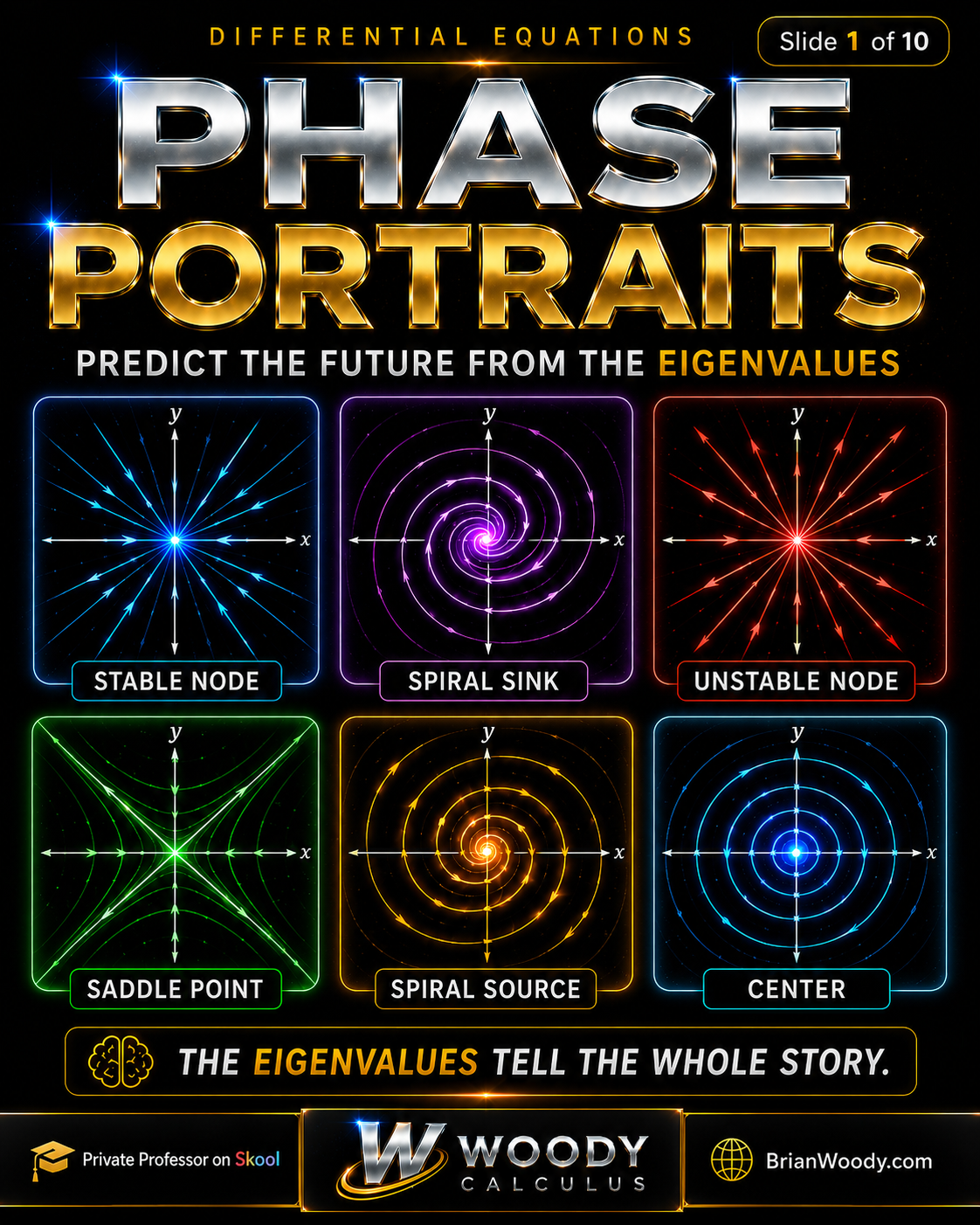

Learn how eigenvalues determine phase portraits in Differential Equations. This Woody Calculus lesson explains stable nodes, unstable nodes, saddle points, spiral sinks, spiral sources, centers, repeated eigenvalues, eigenvectors, and stability.
Learn how eigenvalues determine phase portraits in Differential Equations. This Woody Calculus lesson explains stable nodes, unstable nodes, saddle points, spiral sinks, spiral sources, centers, repeated eigenvalues, eigenvectors, and stability.
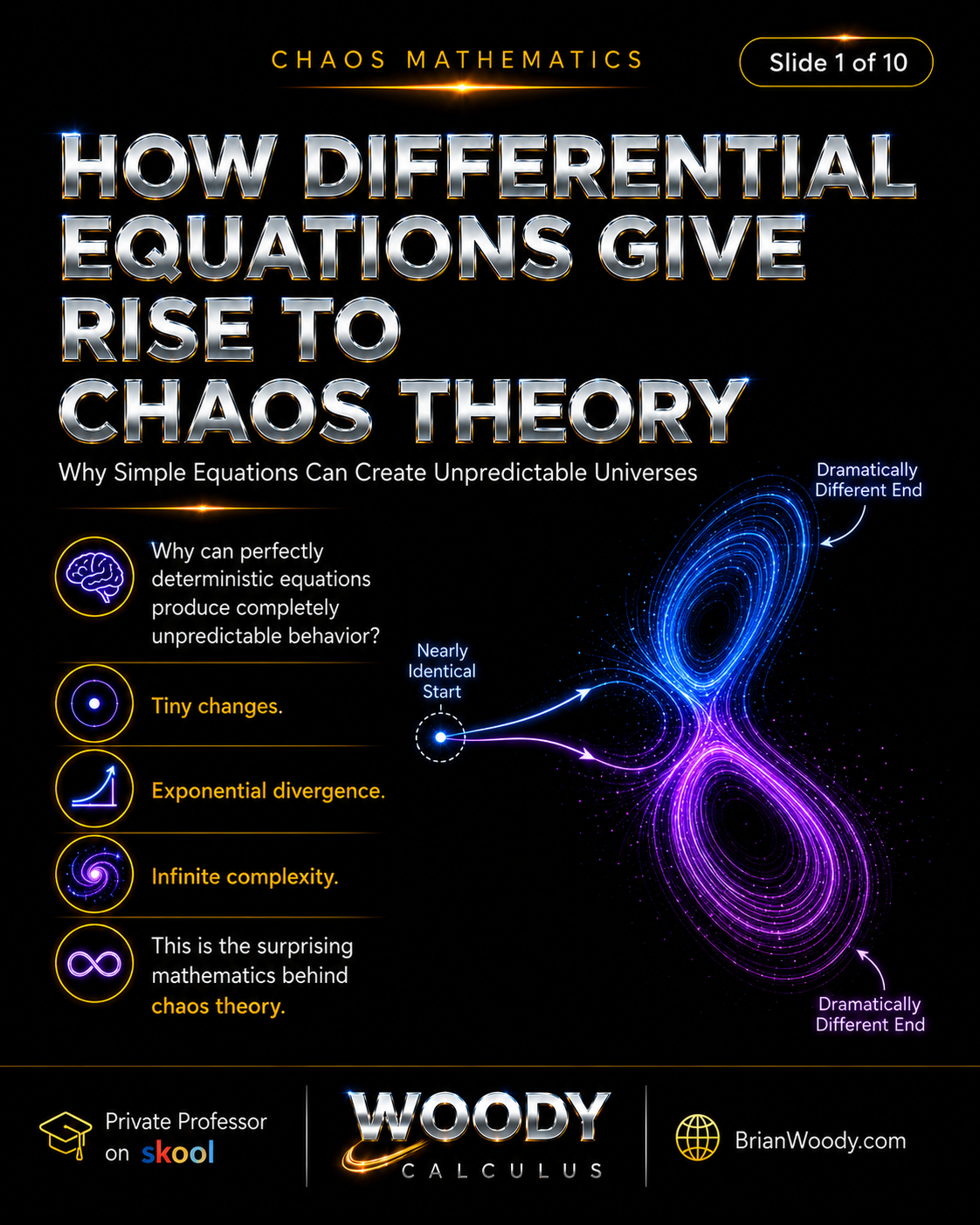
How can deterministic differential equations create unpredictable behavior? This Woody Calculus lesson explains chaos theory through sensitivity to initial conditions, nonlinear systems, phase portraits, Lyapunov exponents, and the Lorenz attractor.
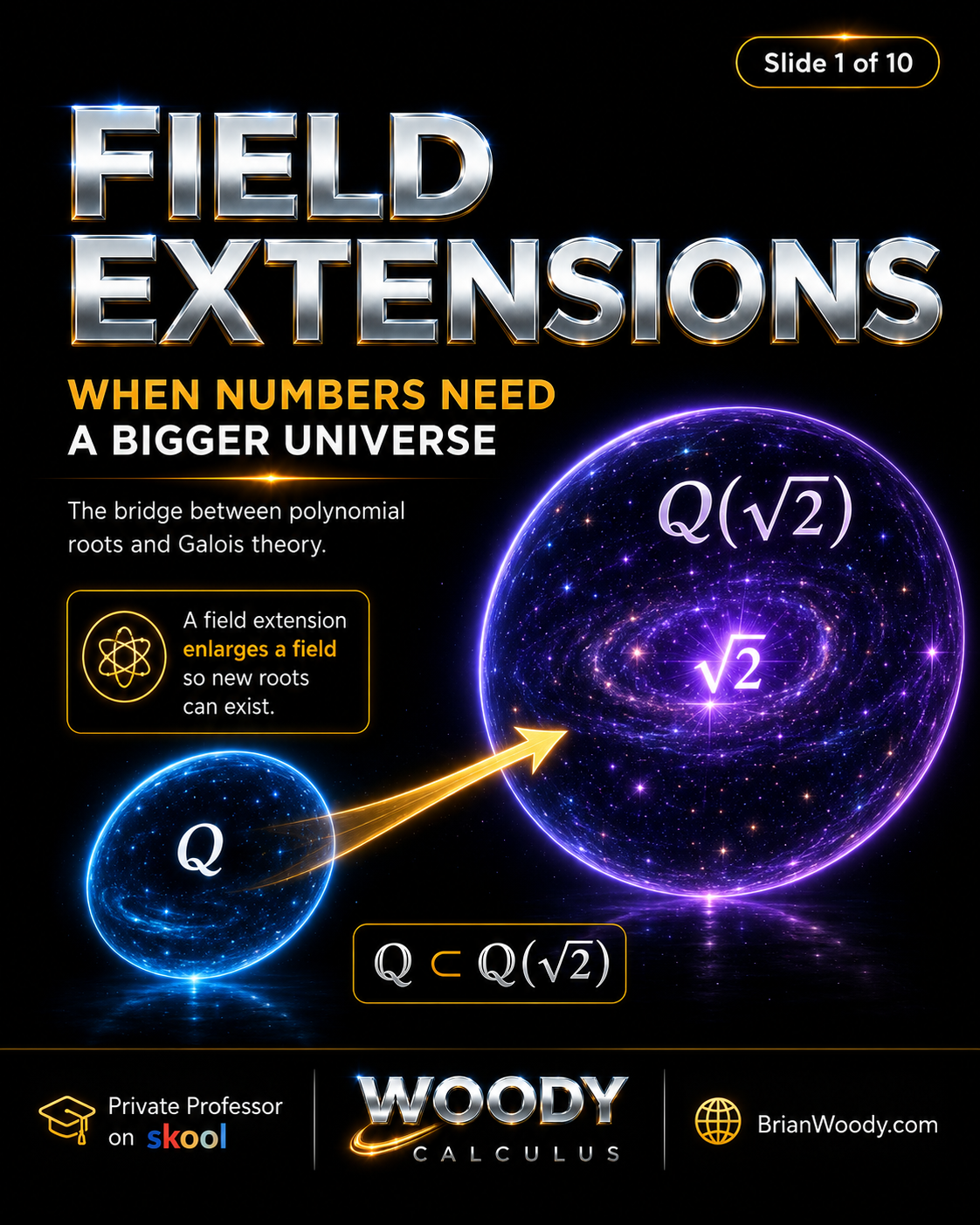
Field extensions are how Abstract Algebra builds a bigger number system when a polynomial has missing roots. In this Woody Calculus visual lesson, learn how Q becomes Q(√2), why x² − 2 has no rational root, how degree and minimal polynomials work, and why field extensions open the door to Galois theory.
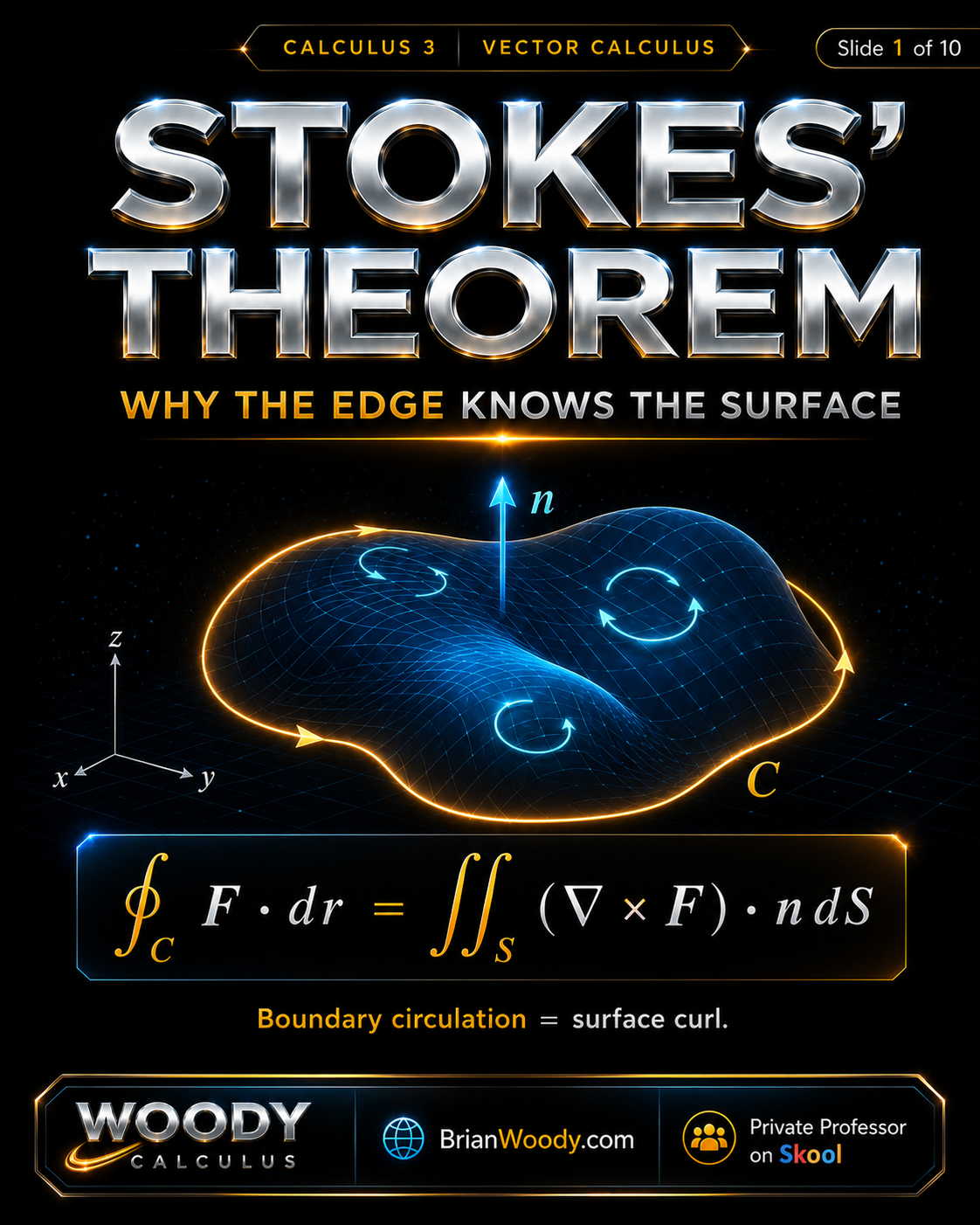
Stokes’ Theorem says that boundary circulation equals the total curl through a surface. In this Woody Calculus visual lesson, learn how Stokes’ Theorem connects line integrals, surface integrals, curl, orientation, the right-hand rule, Green’s Theorem, and vector calculus in Calculus 3.
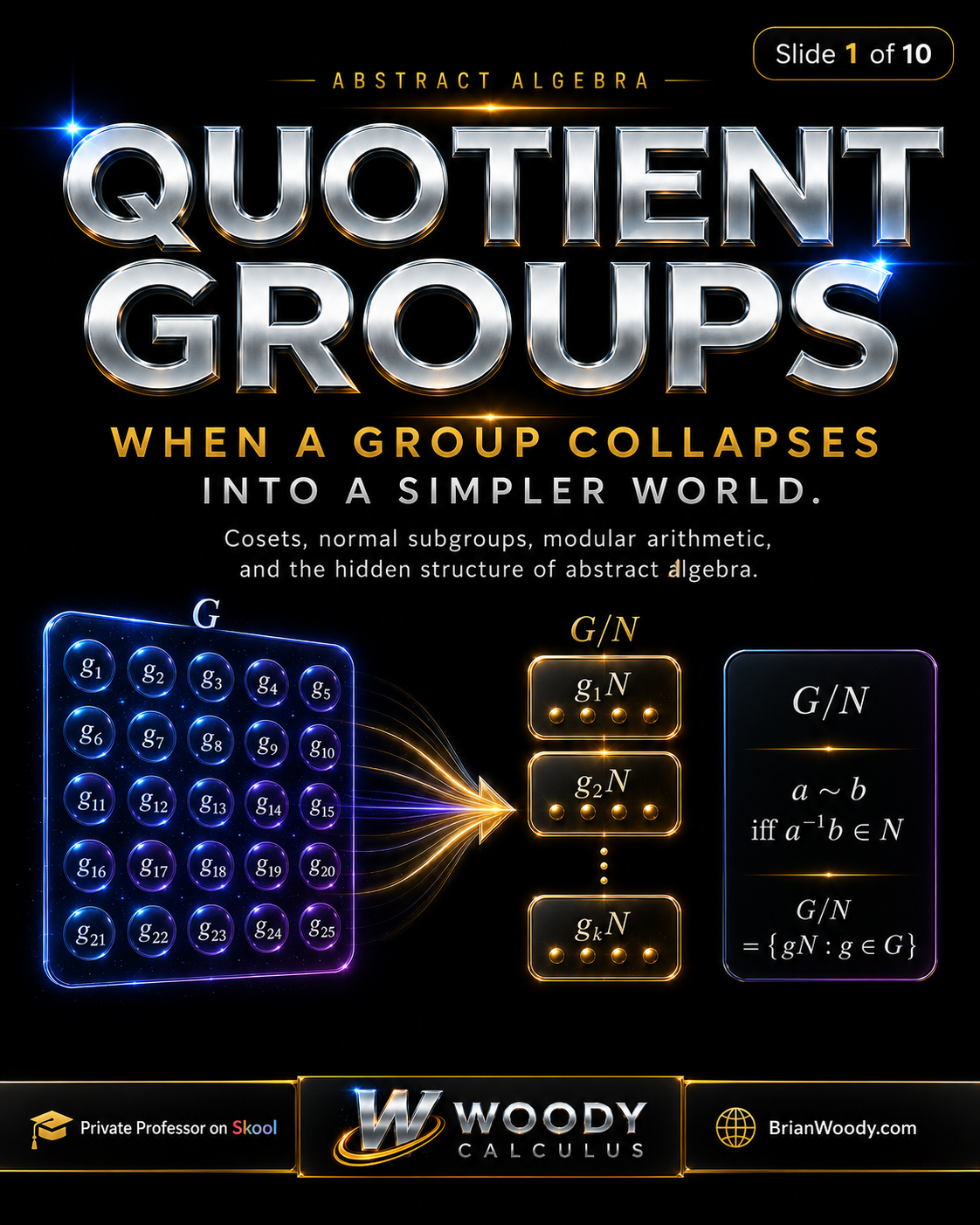
Quotient groups are how Abstract Algebra collapses a group into a simpler structure. In this Woody Calculus visual lesson, learn how cosets become the new elements, why normal subgroups are required, how modular arithmetic is a quotient group, and how kernels lead directly to the First Isomorphism Theorem.
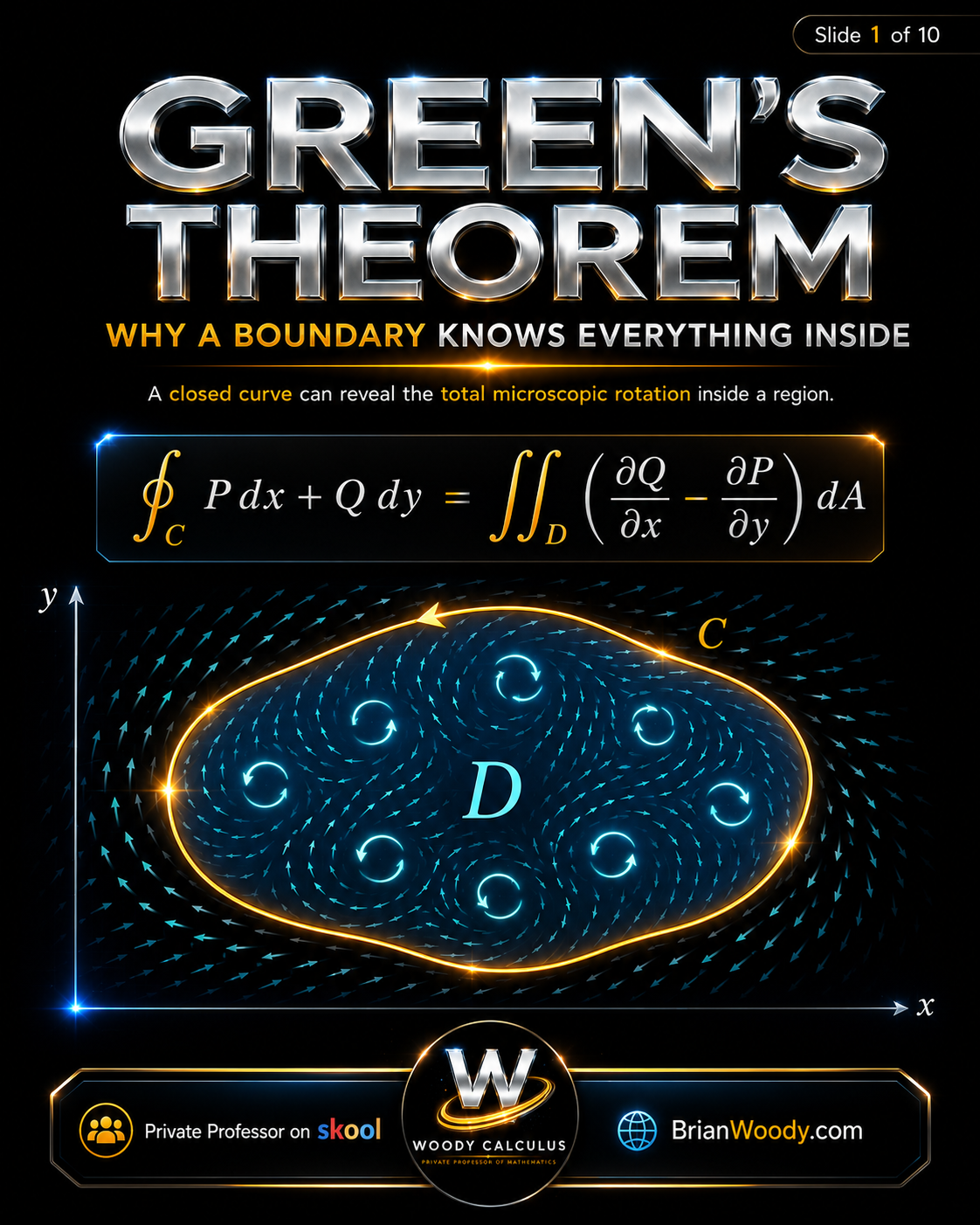
Green’s Theorem turns a boundary line integral into an interior double integral. In this Woody Calculus visual lesson, learn how Green’s Theorem connects circulation, curl, flux, area, line integrals, double integrals, Stokes’ Theorem, and the Divergence Theorem in Calculus 3.
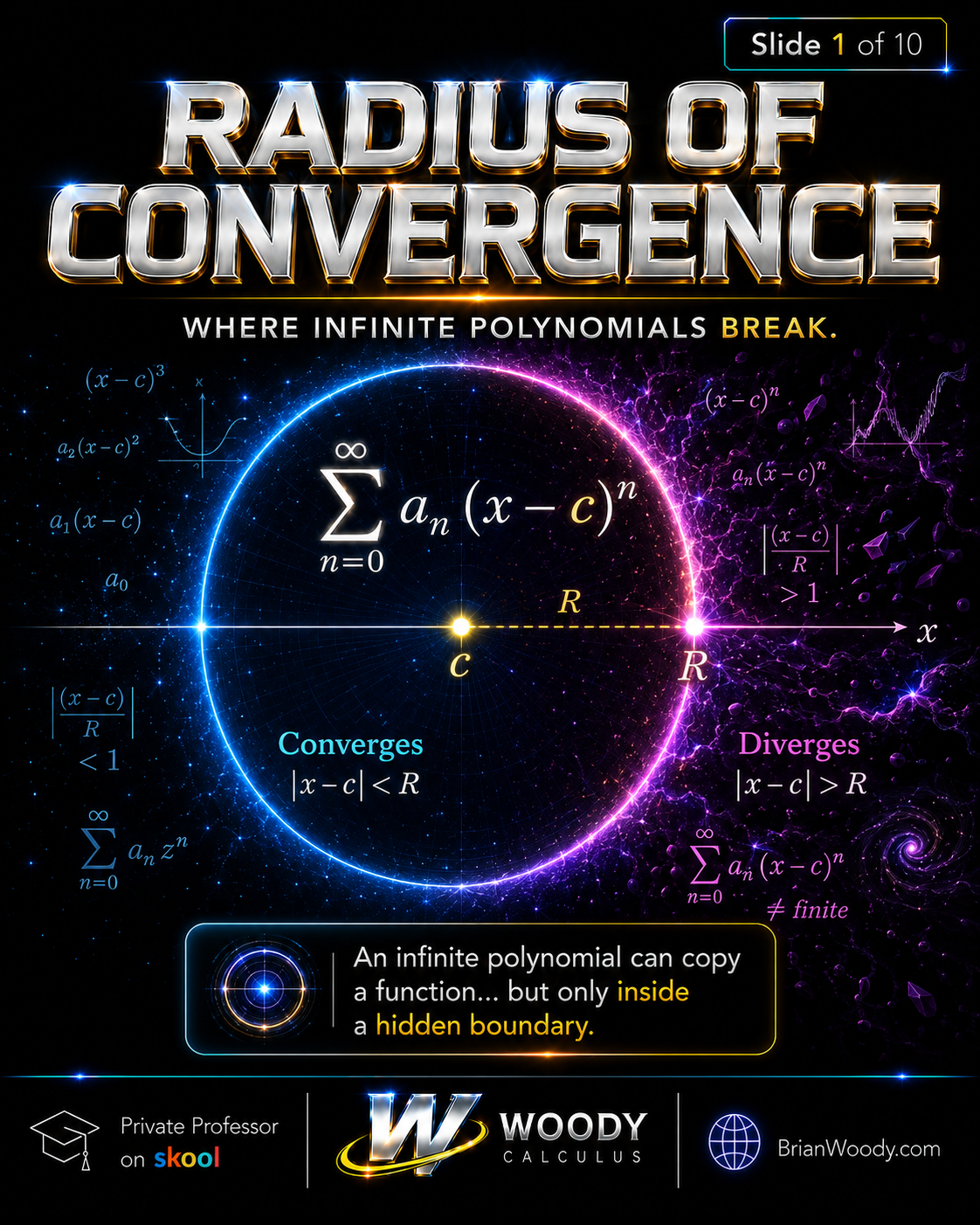
The radius of convergence is the hidden boundary where an infinite polynomial stops behaving like a function. In this Woody Calculus visual lesson, learn how power series are built around a center, how the Ratio Test finds R, why endpoints must be tested separately, and how to find the full interval of convergence.
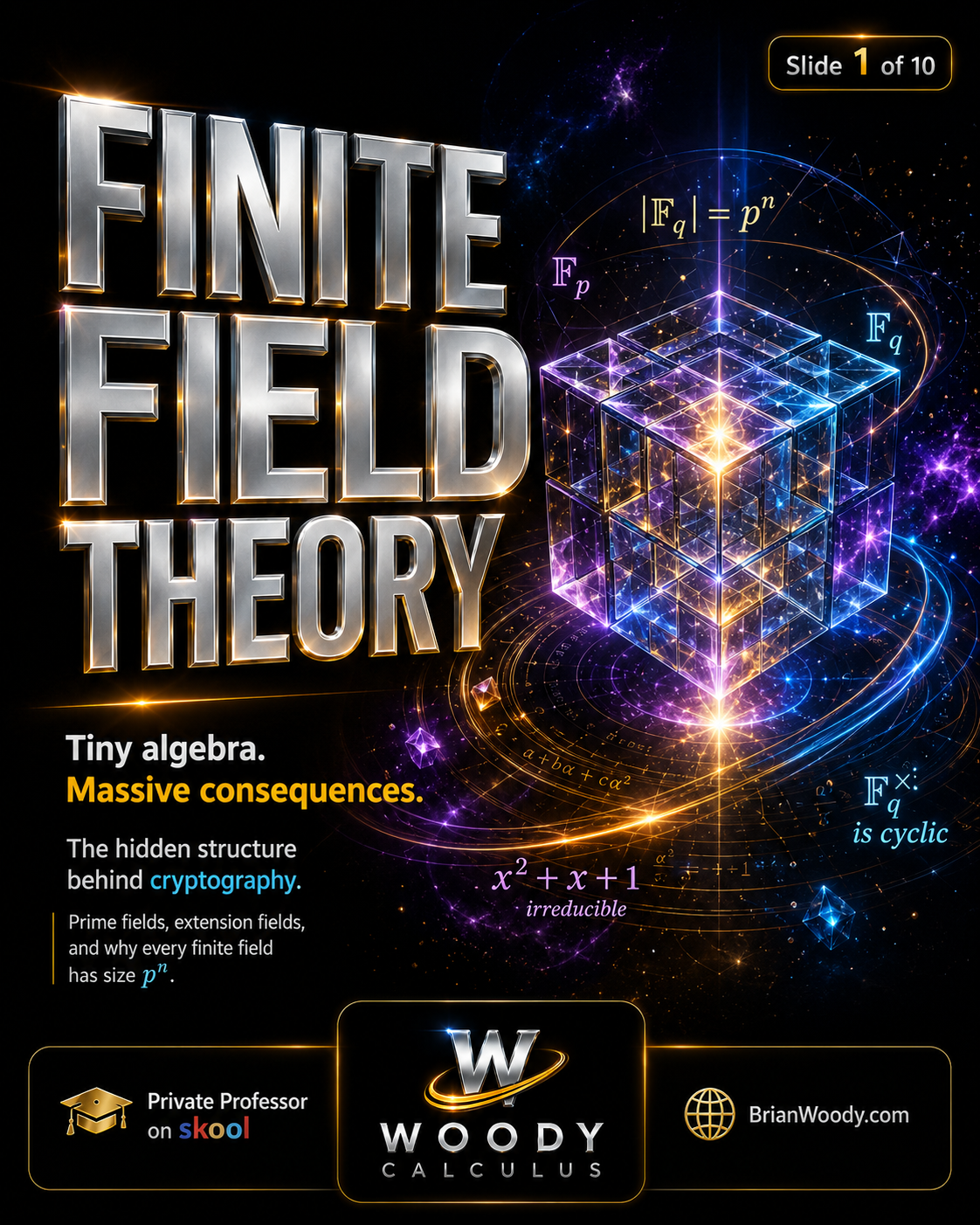
Finite field theory looks abstract until you realize it powers modern cryptography, error correction, QR codes, AES encryption, and elliptic curve cryptography. In this Woody Calculus visual lesson, learn what finite fields are, why prime fields matter, why every finite field has size q = p^n, how extension fields are built from irreducible polynomials, and why finite fields are the hidden algebra behind secure communication.
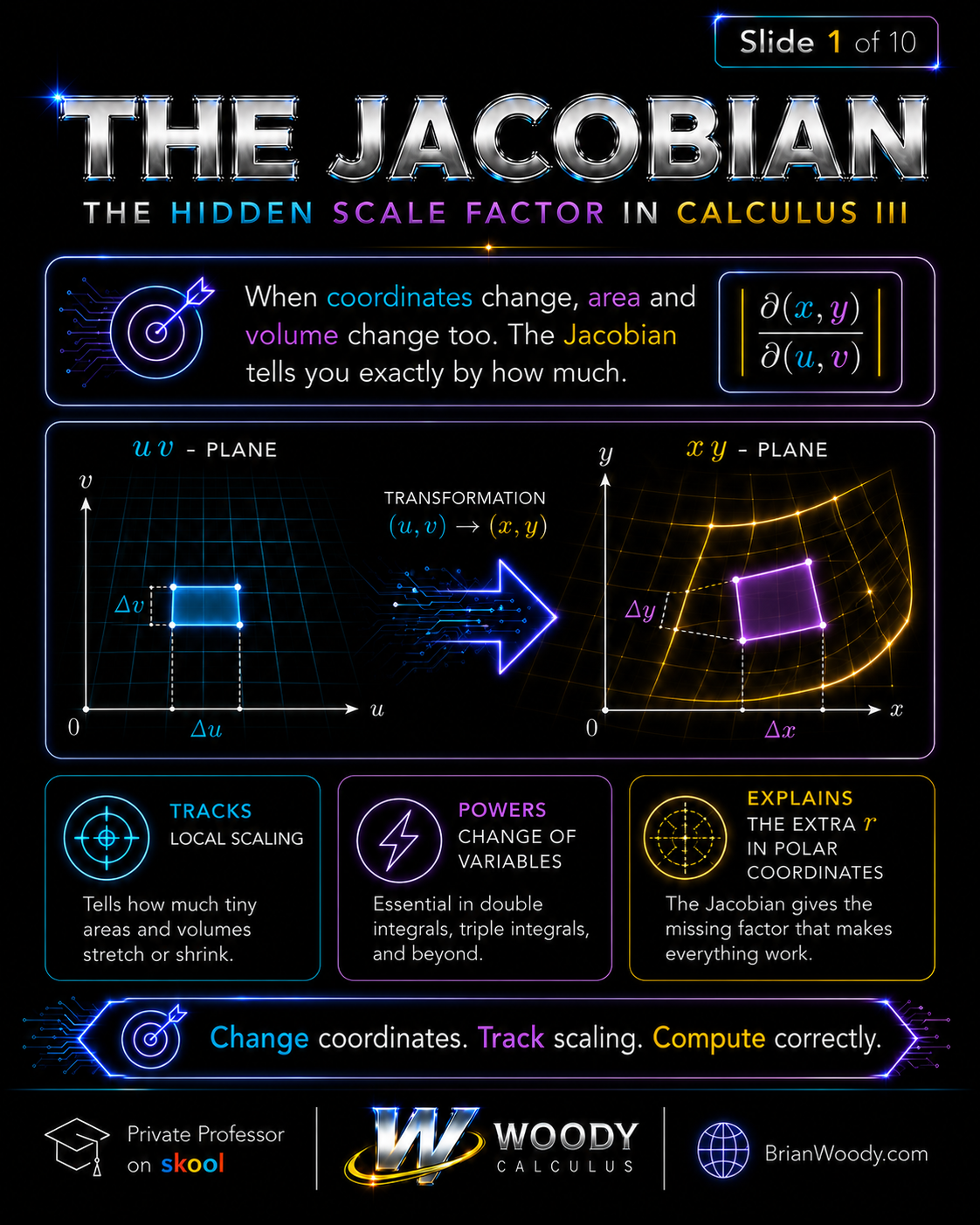
The Jacobian is the hidden scale factor behind every coordinate change in Calculus III. In this Woody Calculus visual lesson, learn how Jacobians explain area and volume scaling, change of variables, polar coordinates, cylindrical coordinates, spherical coordinates, double integrals, triple integrals, and why the mysterious extra factors r and ρ²sinφ appear.
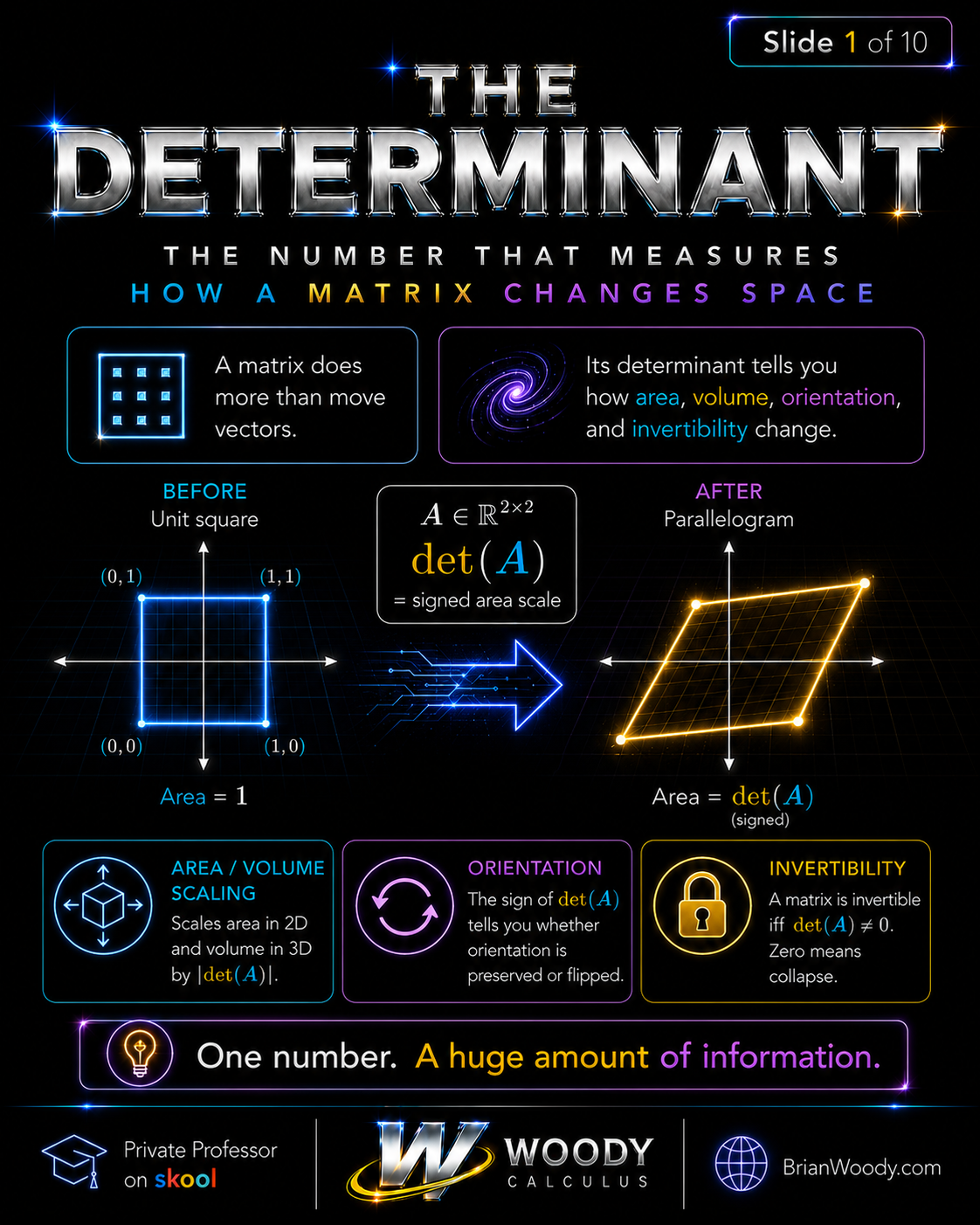
The determinant is the number that measures how a matrix changes space. In this Woody Calculus visual lesson, learn how determinants explain area and volume scaling, orientation, invertibility, matrix collapse, eigenvalues, Wronskians, and why det(A) connects Linear Algebra to Differential Equations.