Field extensions are one of the most important ideas in Abstract Algebra. They explain what mathematicians do when the number system they started with is too small to solve the equations they care about.
Sometimes a polynomial has no root in the field you are working in. Instead of giving up, Abstract Algebra builds a bigger field where the missing root exists.
That is the purpose of a field extension.
For example, the equation
x^2-2=0
\]
has no solution in \(\mathbb{Q}\), because no rational number squares to \(2\). But once we adjoin \(\sqrt{2}\), we get a bigger field:
\mathbb{Q}\subset \mathbb{Q}(\sqrt{2}).
\]
Inside \(\mathbb{Q}(\sqrt{2})\), the missing root exists, and the polynomial \(x^2-2\) factors completely.
This is the bridge between polynomial roots, minimal polynomials, extension degree, automorphisms, and Galois Theory. For a deeper example where a cubic polynomial creates the full triangle symmetry group, read Why Does \(x^3-2\) Create \(S_3\)? Galois Theory Explained.
Estimated read time: 7 minutes.
Quick summary: A field extension \(F\subseteq K\) means a smaller field \(F\) lives inside a bigger field \(K\). Field extensions let us add missing roots of polynomials, such as passing from \(\mathbb{Q}\) to \(\mathbb{Q}(\sqrt{2})\). The degree \([K:F]\) measures the dimension of \(K\) as a vector space over \(F\). Minimal polynomials and automorphisms reveal the hidden structure that leads to Galois theory.
Field Extensions Key Facts
- A field extension has the form \(F\subseteq K\), where \(K\) is a bigger field containing \(F\).
- A field extension keeps all elements and operations of \(F\) inside the larger field \(K\).
- Field extensions are often built by adjoining missing roots of polynomials.
- The field \(\mathbb{Q}(\sqrt{2})\) is formed by adjoining \(\sqrt{2}\) to \(\mathbb{Q}\).
- Every element of \(\mathbb{Q}(\sqrt{2})\) has the form \(a+b\sqrt{2}\), where \(a,b\in\mathbb{Q}\).
- The degree \([\mathbb{Q}(\sqrt{2}):\mathbb{Q}]\) is \(2\).
- The minimal polynomial of \(\sqrt{2}\) over \(\mathbb{Q}\) is \(x^2-2\).
- The extension \(\mathbb{C}=\mathbb{R}(i)\) is another famous degree \(2\) field extension.
- Field extensions reveal symmetries of roots and open the door to Galois theory.
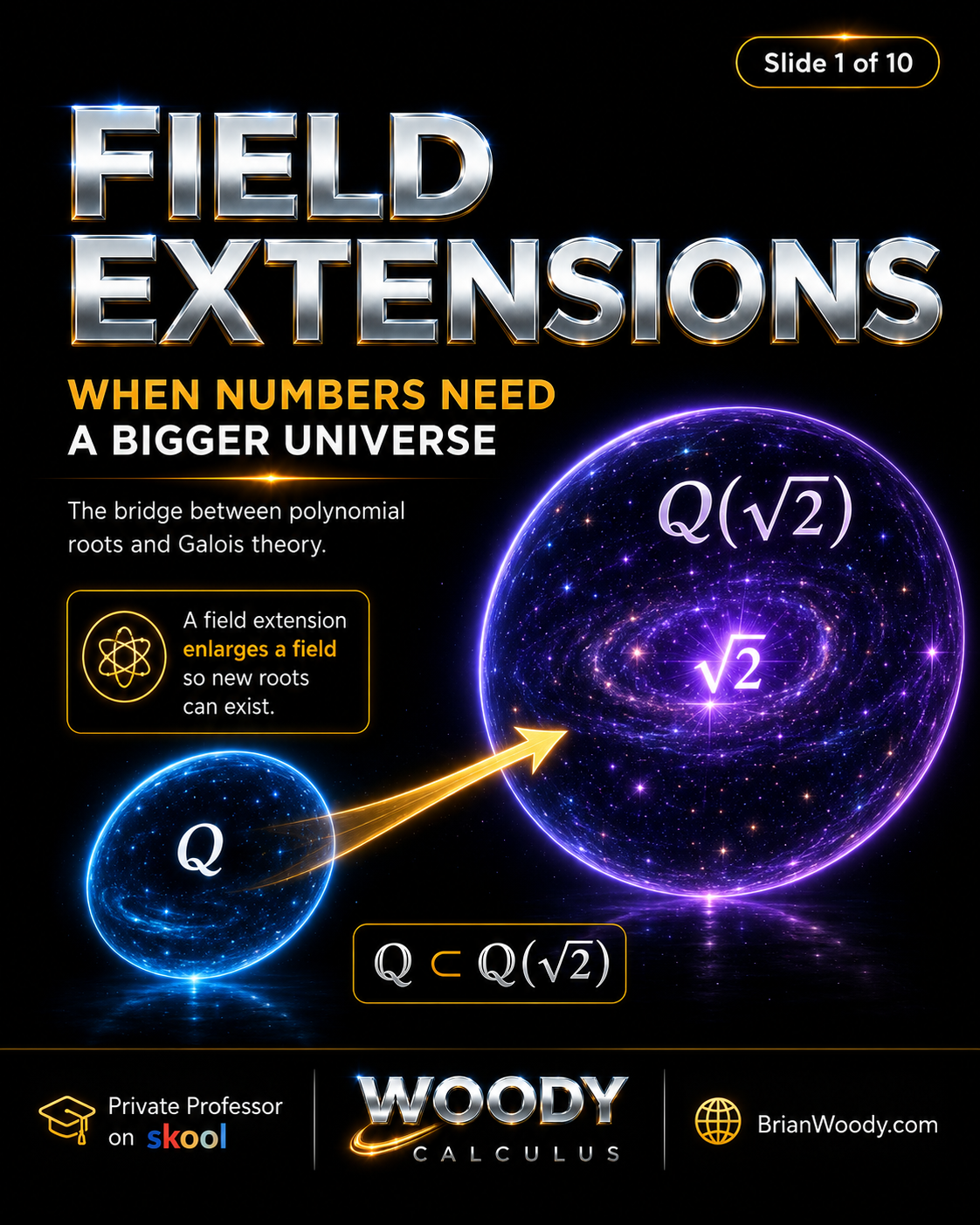
This Woody Calculus lesson explains field extensions in order: what a field extension is, why we extend fields, how \(\mathbb{Q}(\sqrt{2})\) is built, what its elements look like, how extension degree works, how minimal polynomials control the extension, why \(\mathbb{C}=\mathbb{R}(i)\) is another classic example, and how field extensions become the language of Galois theory.
What Is a Field Extension?
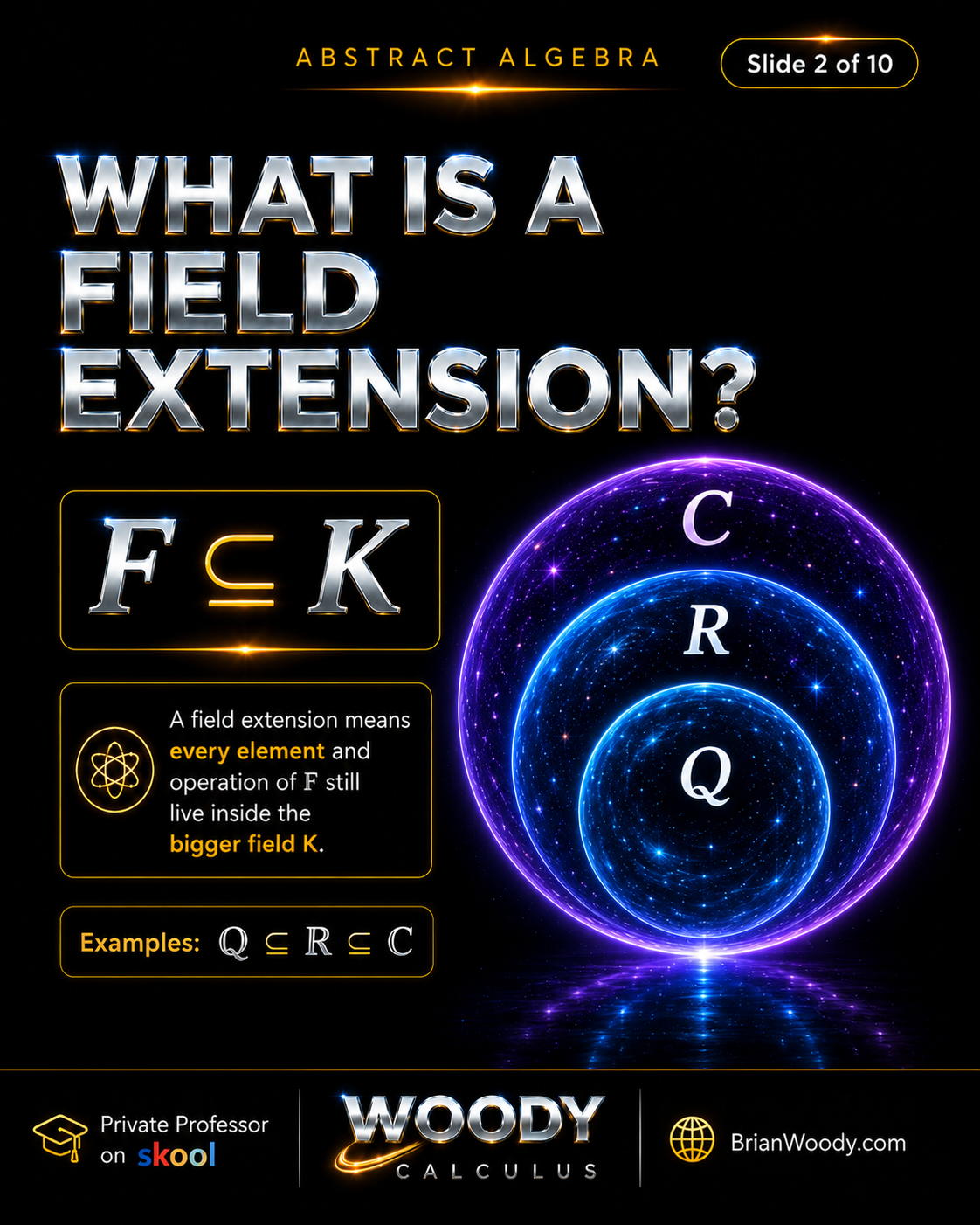
A field extension is a relationship between two fields:
F\subseteq K.
\]
This means \(F\) is a smaller field sitting inside a bigger field \(K\).
The larger field \(K\) contains every element of \(F\), and the operations from \(F\) still behave the same way inside \(K\). Addition, subtraction, multiplication, and division by nonzero elements still work.
Examples include:
\mathbb{Q}\subseteq \mathbb{R}\subseteq \mathbb{C}.
\]
The rational numbers live inside the real numbers, and the real numbers live inside the complex numbers.
The key idea is that a field extension gives us a bigger universe where more algebraic objects can exist.
Why Extend a Field?
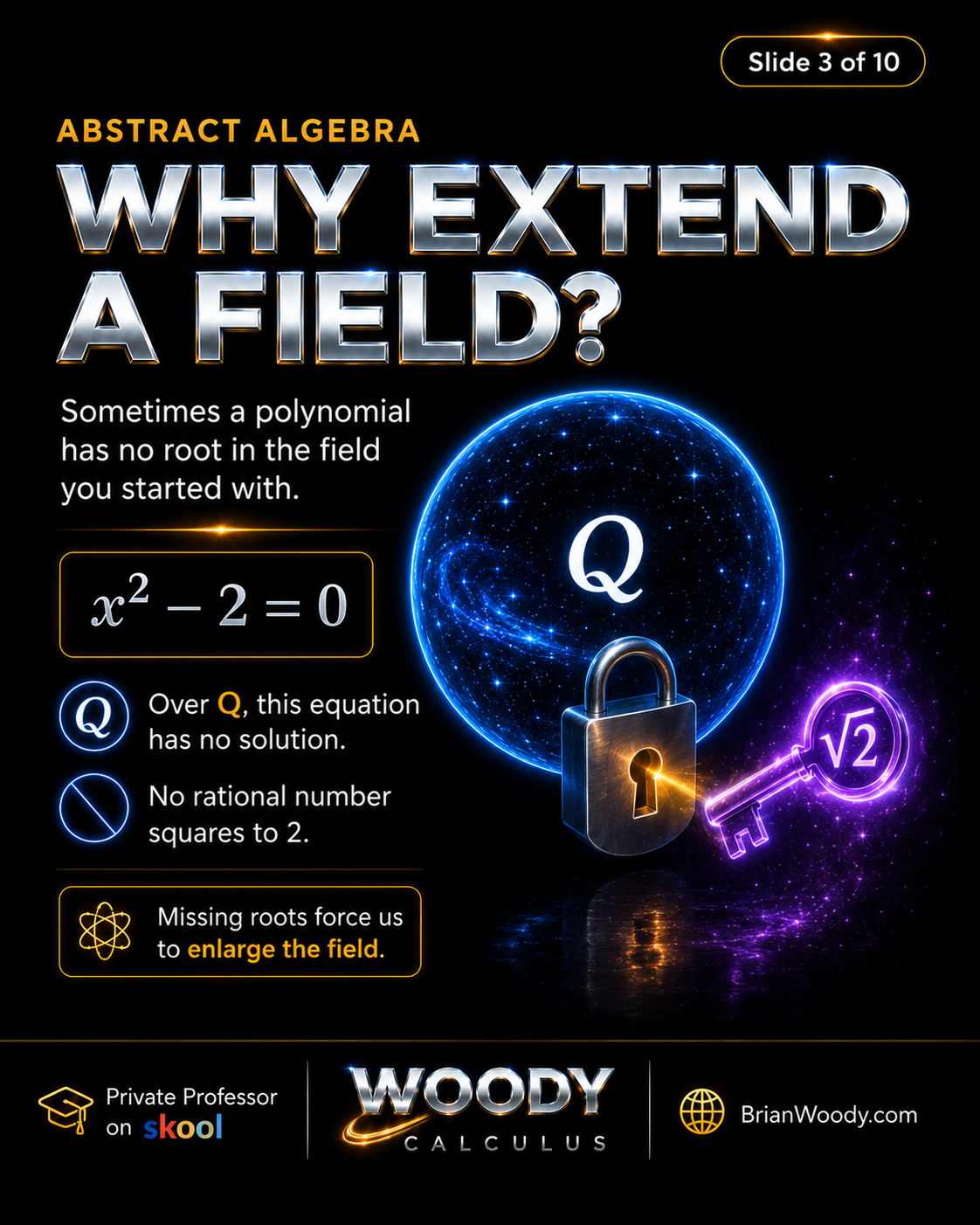
We extend a field because the original field may not contain the roots of the polynomials we want to solve.
For example, consider:
x^2-2=0.
\]
The solutions are:
x=\pm\sqrt{2}.
\]
But \(\sqrt{2}\notin\mathbb{Q}\), and \(-\sqrt{2}\notin\mathbb{Q}\). There is no rational number whose square is \(2\).
So over \(\mathbb{Q}\), the polynomial has no root.
This is the moment field extensions become necessary.
Instead of staying trapped inside \(\mathbb{Q}\), we build a bigger field containing the missing root:
\mathbb{Q}(\sqrt{2}).
\]
This new field contains \(\mathbb{Q}\) and also contains \(\sqrt{2}\).
Add the Missing Root
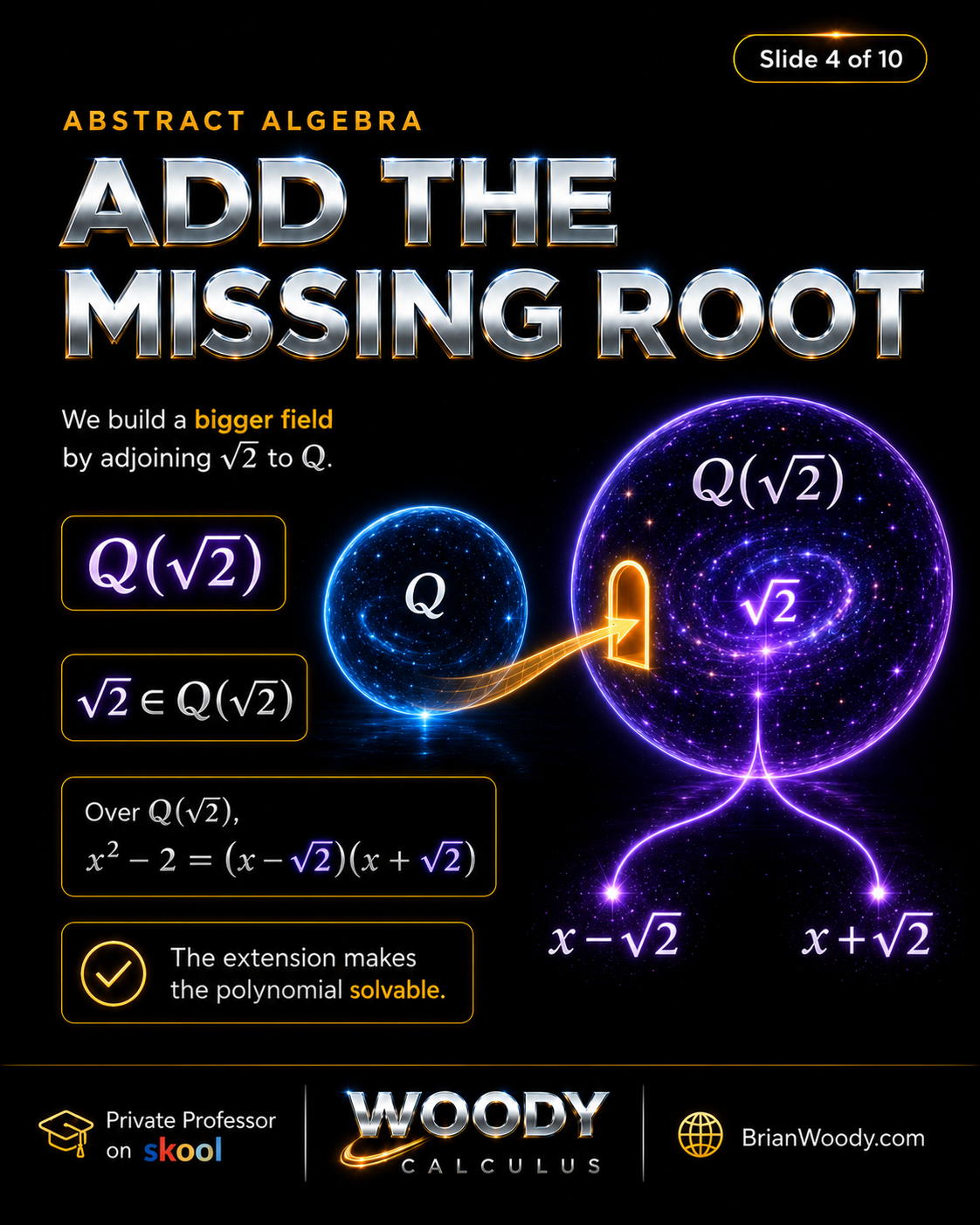
To solve \(x^2-2=0\), we adjoin \(\sqrt{2}\) to \(\mathbb{Q}\).
The notation is:
\mathbb{Q}(\sqrt{2}).
\]
This means the smallest field containing both \(\mathbb{Q}\) and \(\sqrt{2}\).
Once \(\sqrt{2}\) is in the field, \(-\sqrt{2}\) is also in the field because fields are closed under additive inverses.
Now the polynomial factors:
x^2-2=(x-\sqrt{2})(x+\sqrt{2}).
\]
So the extension makes the polynomial solvable.
This is one of the main reasons field extensions matter. They let us enlarge the number system just enough to include the roots we need.
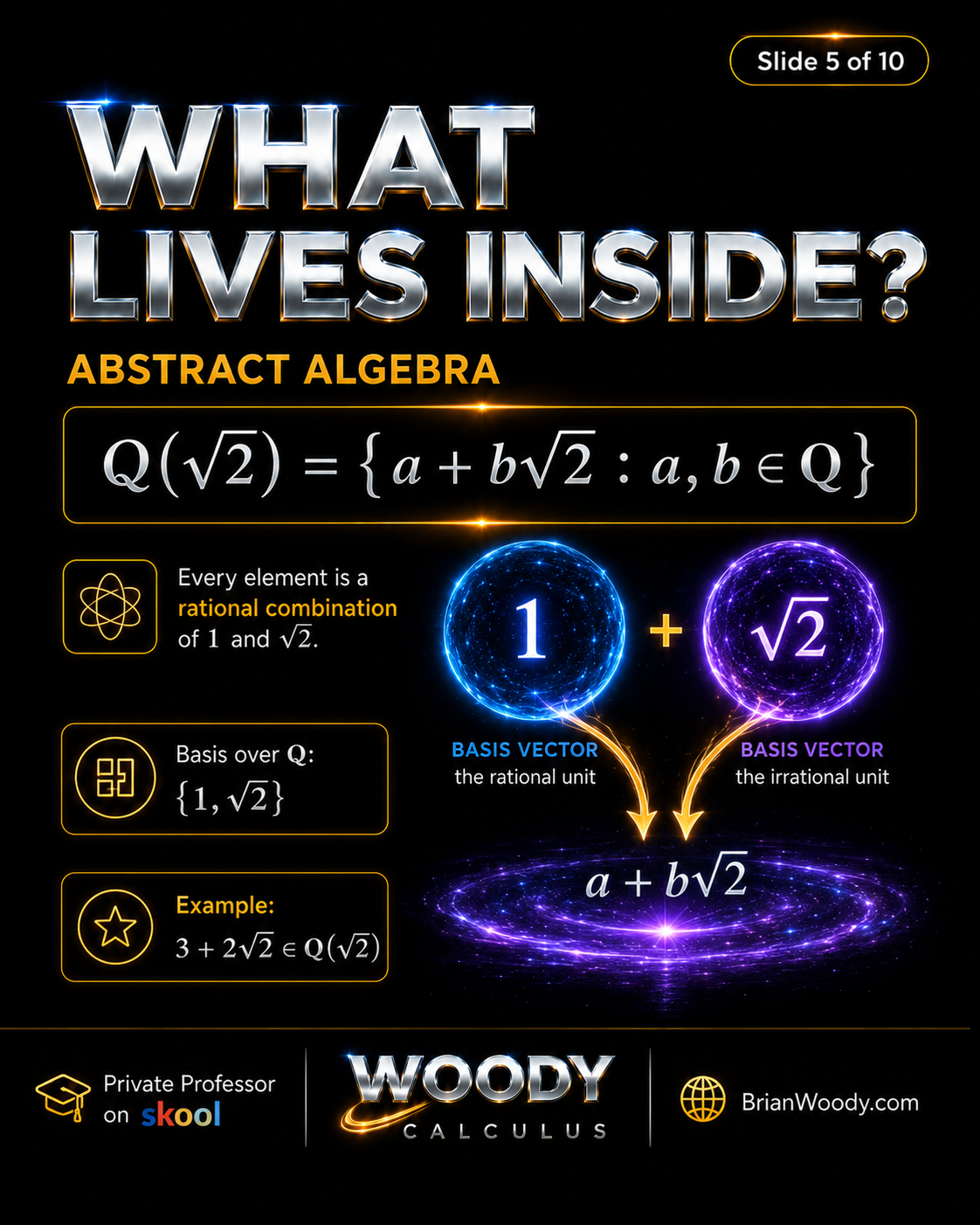
What Lives Inside \(\mathbb{Q}(\sqrt{2})\)?
Structure of \(\mathbb{Q}(\sqrt{2})\)
The field \(\mathbb{Q}(\sqrt{2})\) is not just \(\mathbb{Q}\) plus one extra number.
It contains every number you can build using rational numbers and \(\sqrt{2}\) with field operations.
In fact:
\mathbb{Q}(\sqrt{2})
=
\{a+b\sqrt{2}:a,b\in\mathbb{Q}\}.
\]
Every element is a rational combination of \(1\) and \(\sqrt{2}\).
Examples include:
3+2\sqrt{2},
\qquad
-\frac{1}{5}+\frac{7}{3}\sqrt{2},
\qquad
11-\sqrt{2}.
\]
The basis over \(\mathbb{Q}\) is:
\{1,\sqrt{2}\}.
\]
This means every element of \(\mathbb{Q}(\sqrt{2})\) can be written uniquely as \(a+b\sqrt{2}\) with \(a,b\in\mathbb{Q}\).
Closure Under Field Operations
The field is closed under multiplication:
(a+b\sqrt{2})(c+d\sqrt{2})
=
(ac+2bd)+(ad+bc)\sqrt{2}.
\]
The product is still of the form rational plus rational times \(\sqrt{2}\).
Division in \(\mathbb{Q}(\sqrt{2})\)
The field is also closed under division by nonzero elements. If \(a+b\sqrt{2}\ne 0\), then:
\frac{1}{a+b\sqrt{2}}
=
\frac{a-b\sqrt{2}}{a^2-2b^2}.
\]
The denominator is nonzero for rational \(a,b\) unless \(a=b=0\). If \(a^2-2b^2=0\) with \(a,b\in\mathbb{Q}\) and \(b\ne 0\), then \((a/b)^2=2\), which would make \(\sqrt{2}\) rational. That is impossible.
So \(\mathbb{Q}(\sqrt{2})\) really is a field.
Degree of the Extension
A field extension can be measured by its degree.
The degree of \(K/F\) is written:
[K:F].
\]
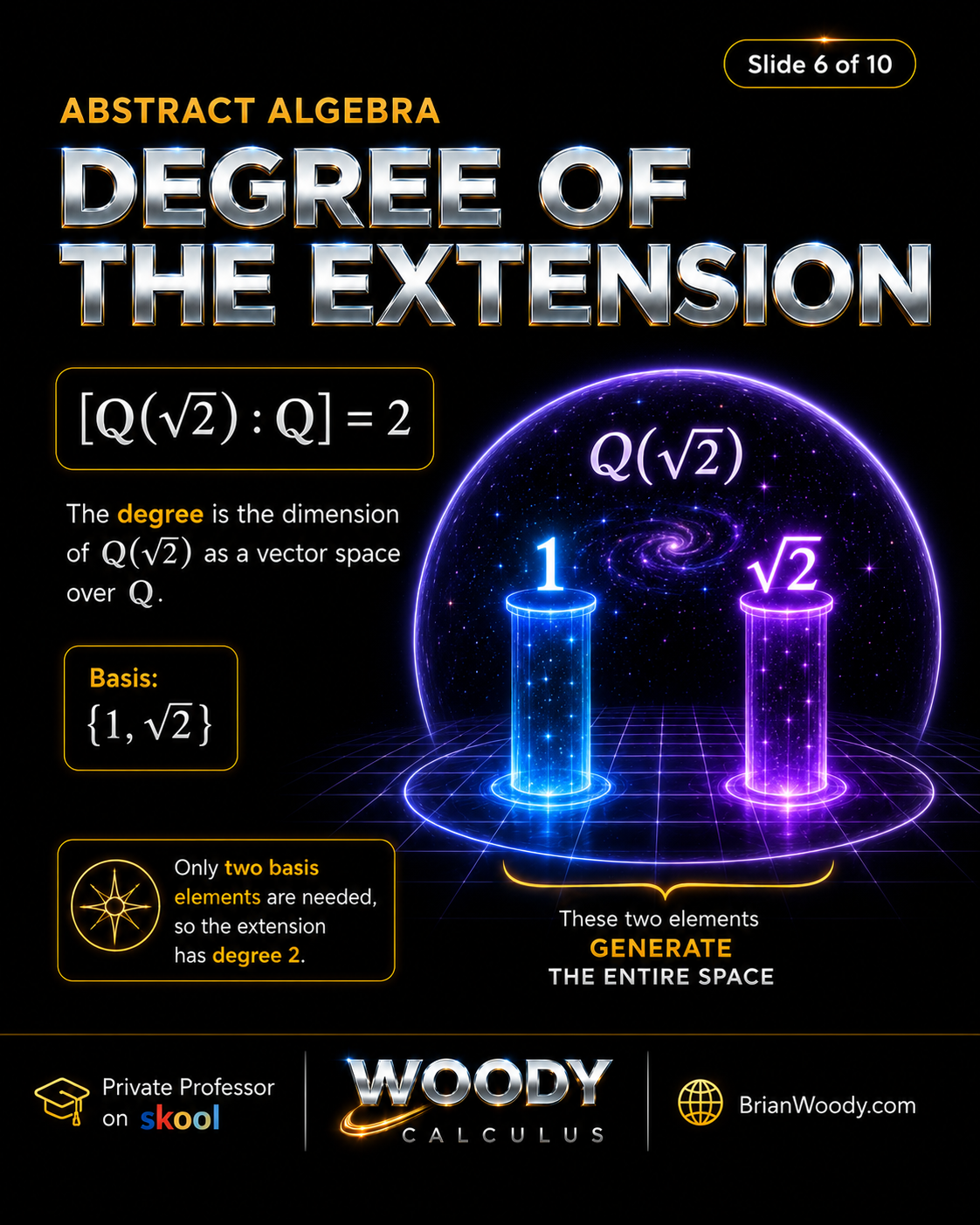
This means the dimension of \(K\) as a vector space over \(F\).
For \(\mathbb{Q}(\sqrt{2})\) over \(\mathbb{Q}\), the basis is:
\{1,\sqrt{2}\}.
\]
Only two basis elements are needed.
Therefore:
[\mathbb{Q}(\sqrt{2}):\mathbb{Q}]=2.
\]
This is why \(\mathbb{Q}(\sqrt{2})\) is called a quadratic extension of \(\mathbb{Q}\).
The word “quadratic” reflects the fact that \(\sqrt{2}\) satisfies a degree \(2\) polynomial over \(\mathbb{Q}\).
Minimal Polynomial
Definition of a Minimal Polynomial
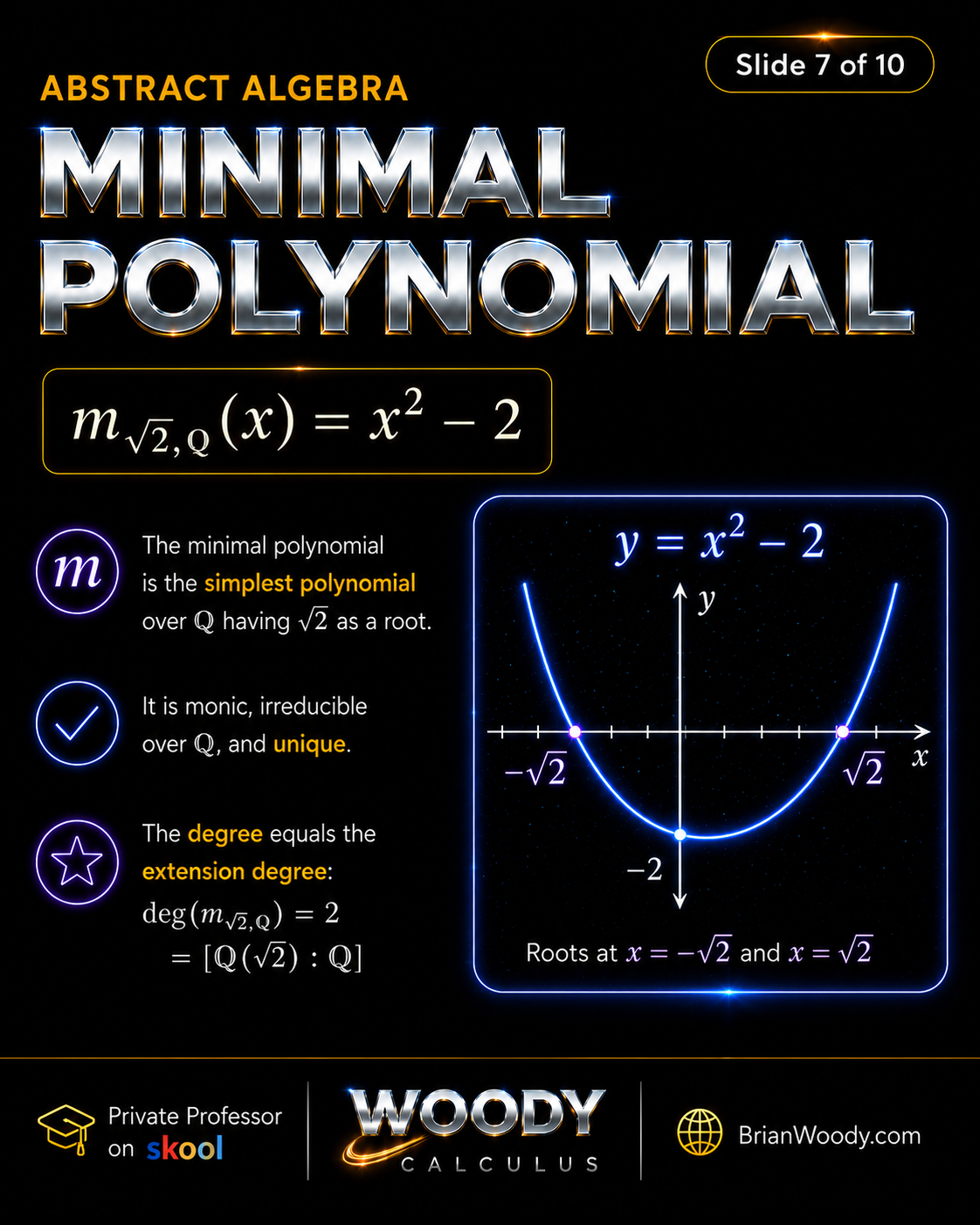
The minimal polynomial of an algebraic element is the simplest polynomial over the base field that has that element as a root.
For \(\sqrt{2}\) over \(\mathbb{Q}\), the minimal polynomial is:
m_{\sqrt{2},\mathbb{Q}}(x)=x^2-2.
\]
Why \(x^2-2\) Is Irreducible Over \(\mathbb{Q}\)
This polynomial is:
- monic, meaning its leading coefficient is \(1\),
- irreducible over \(\mathbb{Q}\),
- unique.
It is irreducible over \(\mathbb{Q}\) because it has no rational root. By the Rational Root Test, the only possible rational roots are \(\pm 1\) and \(\pm 2\), and none of them satisfy \(x^2-2=0\).
Minimal Polynomial and Extension Degree
For a simple algebraic extension \(F(\alpha)\), the degree of the extension equals the degree of the minimal polynomial:
[F(\alpha):F]=\deg(m_{\alpha,F}(x)).
\]
So in this example:
[\mathbb{Q}(\sqrt{2}):\mathbb{Q}]
=
\deg(x^2-2)
=
2.
\]
This is one of the most important connections in field theory.
Another Famous Extension: \(\mathbb{C}=\mathbb{R}(i)\)
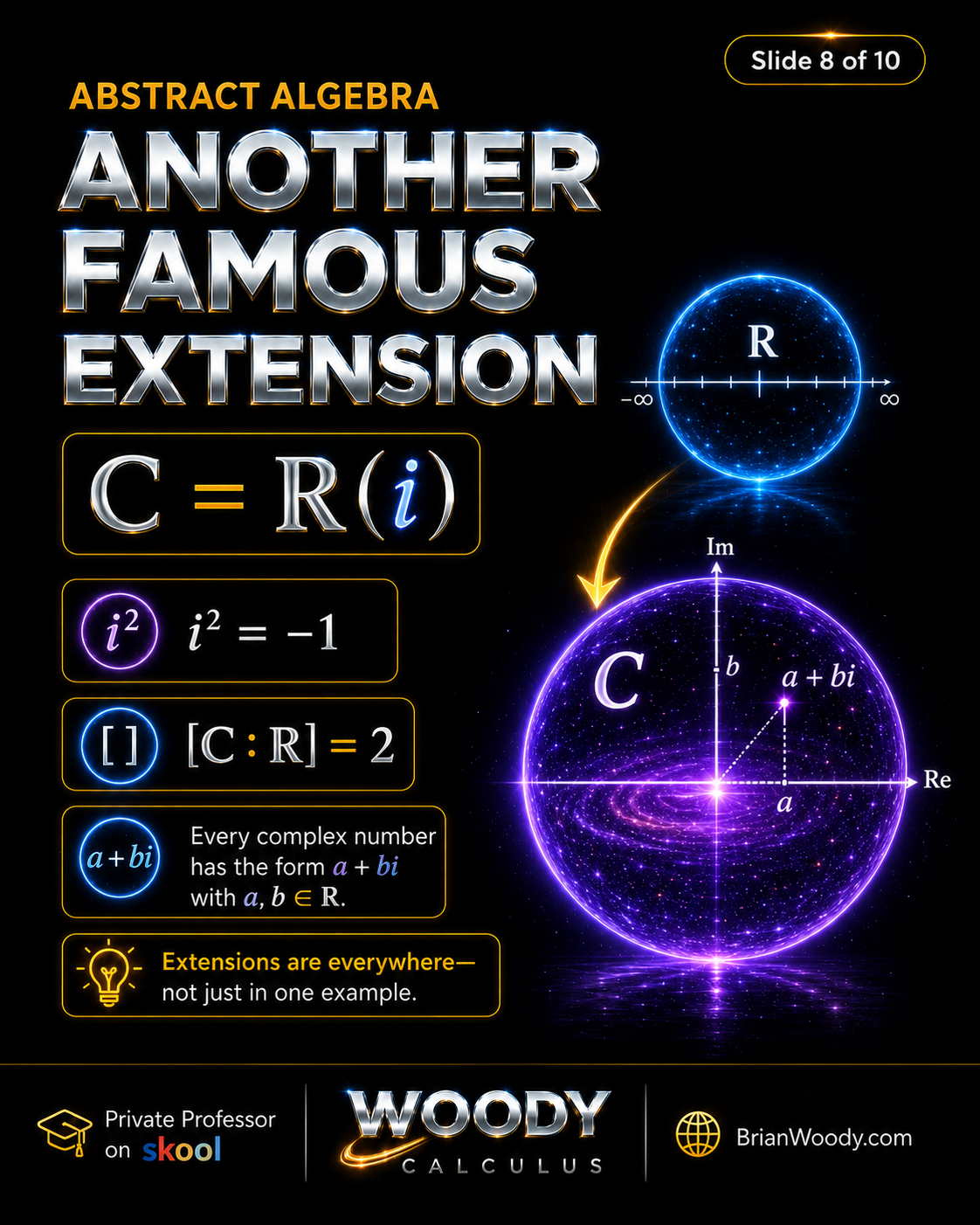
Field extensions are everywhere, not just in the example \(\mathbb{Q}(\sqrt{2})\).
Another famous field extension is:
\mathbb{C}=\mathbb{R}(i).
\]
The real numbers do not contain a solution to:
x^2+1=0.
\]
So we adjoin \(i\), where:
i^2=-1.
\]
Every complex number has the form:
a+bi,
\qquad
a,b\in\mathbb{R}.
\]
So \(\mathbb{C}\) is a vector space over \(\mathbb{R}\) with basis:
\{1,i\}.
\]
Therefore:
[\mathbb{C}:\mathbb{R}]=2.
\]
This is the same structural idea as \(\mathbb{Q}(\sqrt{2})\): we enlarge the field by adding a missing root.
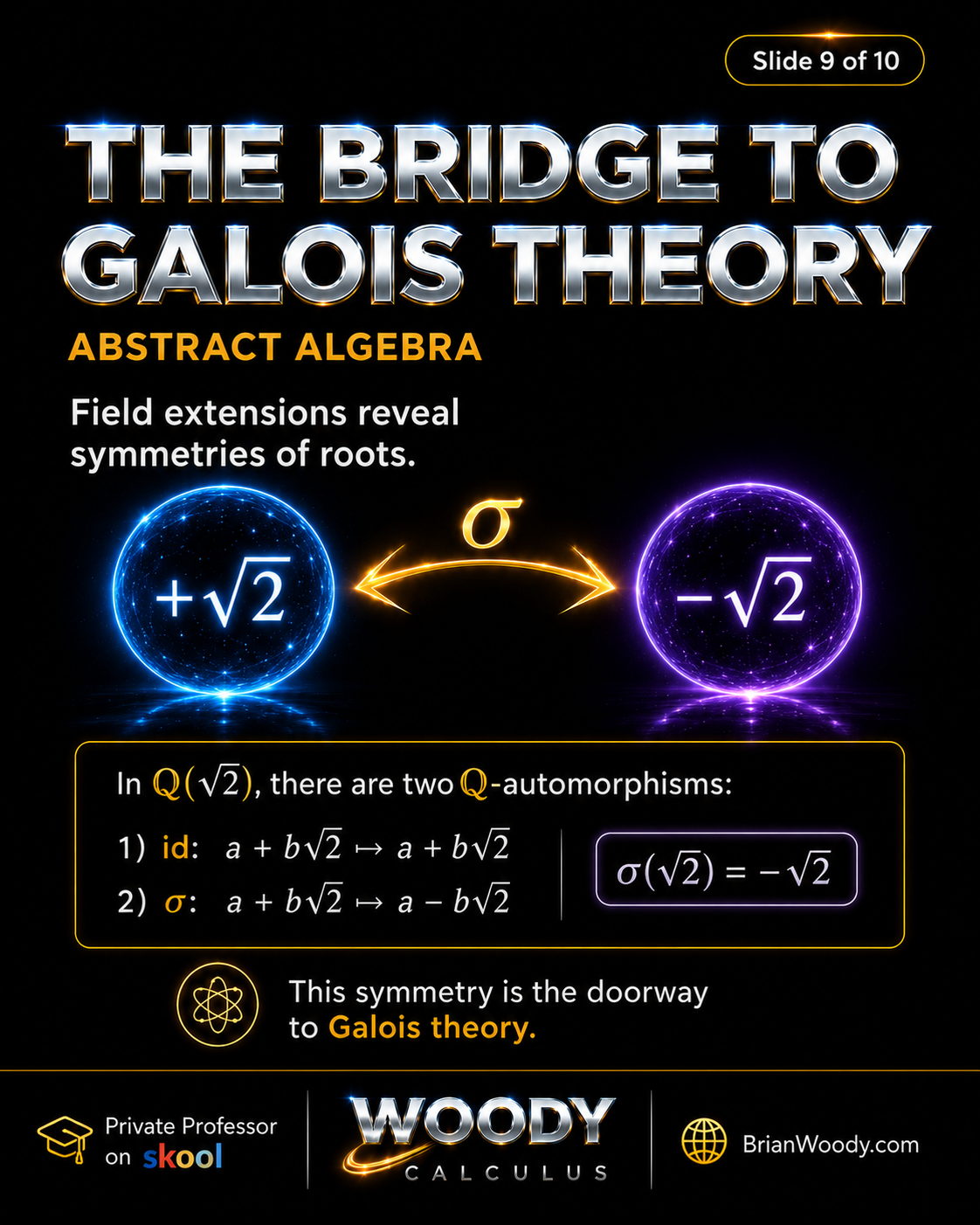
The Bridge to Galois Theory
Field extensions reveal symmetries of roots.
This is the doorway to Galois theory.
Automorphisms of \(\mathbb{Q}(\sqrt{2})\)
In \(\mathbb{Q}(\sqrt{2})\), there are two \(\mathbb{Q}\)-automorphisms:
\operatorname{id}:a+b\sqrt{2}\mapsto a+b\sqrt{2},
\]
and
\sigma:a+b\sqrt{2}\mapsto a-b\sqrt{2}.
\]
The first automorphism does nothing. The second sends:
\sigma(\sqrt{2})=-\sqrt{2}.
\]
Why the Symmetry Exists
This works because \(\sqrt{2}\) and \(-\sqrt{2}\) are both roots of the same minimal polynomial:
x^2-2.
\]
A \(\mathbb{Q}\)-automorphism must fix every rational number, but it may permute roots that have the same algebraic role.
The Galois Group
For this extension:
\operatorname{Gal}(\mathbb{Q}(\sqrt{2})/\mathbb{Q})
=
\{\operatorname{id},\sigma\}.
\]
This group has two elements and is isomorphic to \(C_2\).
That is the core idea of Galois theory: study polynomial roots by studying the symmetries of field extensions.
For a deeper cubic example where the splitting field has six automorphisms and the roots form an equilateral triangle, read Why Does \(x^3-2\) Create \(S_3\)? Galois Theory Explained.
More Field Extension Examples
Example 1: \(\mathbb{Q}(i)\)
The field \(\mathbb{Q}(i)\) is formed by adjoining \(i\) to \(\mathbb{Q}\).
Every element has the form:
a+bi,
\qquad
a,b\in\mathbb{Q}.
\]
The minimal polynomial of \(i\) over \(\mathbb{Q}\) is:
x^2+1.
\]
So:
[\mathbb{Q}(i):\mathbb{Q}]=2.
\]
Example 2: \(\mathbb{Q}(\sqrt[3]{2})\)
The number \(\sqrt[3]{2}\) is a root of:
x^3-2.
\]
This polynomial is irreducible over \(\mathbb{Q}\), so:
[\mathbb{Q}(\sqrt[3]{2}):\mathbb{Q}]=3.
\]
A basis is:
\{1,\sqrt[3]{2},(\sqrt[3]{2})^2\}.
\]
This extension is algebraic, but it does not contain all roots of \(x^3-2\). The other roots are complex, so this extension is not the full splitting field.
To see the full splitting field and the Galois group \(S_3\), read Why Does \(x^3-2\) Create \(S_3\)? Galois Theory Explained.
Example 3: \(\mathbb{Q}(\sqrt{2},\sqrt{3})\)
The field \(\mathbb{Q}(\sqrt{2},\sqrt{3})\) contains both \(\sqrt{2}\) and \(\sqrt{3}\).
A basis over \(\mathbb{Q}\) is:
\{1,\sqrt{2},\sqrt{3},\sqrt{6}\}.
\]
So:
[\mathbb{Q}(\sqrt{2},\sqrt{3}):\mathbb{Q}]=4.
\]
This example shows how adjoining more roots can create a larger extension.
Example 4: Finite fields
Field extensions also appear in finite fields.
For example, \(\mathbb{F}_{p^n}\) is an extension of \(\mathbb{F}_p\), and:
[\mathbb{F}_{p^n}:\mathbb{F}_p]=n.
\]
This connects field extensions to finite field theory, cryptography, coding theory, polynomial classification, and modern technology.
Students who want to see how field extensions lead into original research can explore the Brian M. Woody Research Hub and the student guide to A Complete Classification of a Reciprocal Degree-Five Quadrinomial Family over \(\mathbb{F}_{q^2}\).
Common Mistakes with Field Extensions
Field extensions are conceptually deep, so it is normal for students to struggle at first.
Mistake 1: Thinking \(\mathbb{Q}(\sqrt{2})\) contains only \(\sqrt{2}\)
The field \(\mathbb{Q}(\sqrt{2})\) contains all numbers of the form \(a+b\sqrt{2}\), where \(a,b\in\mathbb{Q}\). It is much bigger than just \(\mathbb{Q}\cup\{\sqrt{2}\}\).
Mistake 2: Forgetting closure under field operations
A field must be closed under addition, subtraction, multiplication, and division by nonzero elements. When we adjoin a root, we must include everything needed to keep a field.
Mistake 3: Confusing the degree of a polynomial with the degree of every extension
The degree of a simple algebraic extension \(F(\alpha)/F\) equals the degree of the minimal polynomial of \(\alpha\) over \(F\). But for extensions built from multiple elements, the degree may require additional work.
Mistake 4: Forgetting the base field
The same element can behave differently over different base fields. For example, \(i\) has minimal polynomial \(x^2+1\) over \(\mathbb{R}\), but if the base field is already \(\mathbb{C}\), then \(i\) is already inside the field.
Mistake 5: Missing the Galois theory connection
Field extensions are not just about adding roots. They reveal which roots can be permuted while preserving the base field. That symmetry is the foundation of Galois theory.
Key Takeaways
- A field extension has the form \(F\subseteq K\).
- Field extensions build a bigger universe where missing roots can exist.
- The field \(\mathbb{Q}(\sqrt{2})\) is formed by adjoining \(\sqrt{2}\) to \(\mathbb{Q}\).
- Every element of \(\mathbb{Q}(\sqrt{2})\) has the form \(a+b\sqrt{2}\), where \(a,b\in\mathbb{Q}\).
- The degree \([K:F]\) is the dimension of \(K\) as a vector space over \(F\).
- The extension \(\mathbb{Q}(\sqrt{2})/\mathbb{Q}\) has degree \(2\).
- The minimal polynomial of \(\sqrt{2}\) over \(\mathbb{Q}\) is \(x^2-2\).
- The complex numbers satisfy \(\mathbb{C}=\mathbb{R}(i)\), a degree \(2\) extension.
- Field extensions reveal symmetries of roots and lead naturally to Galois theory.
- The splitting field of \(x^3-2\) gives a concrete path from field extensions to the Galois group \(S_3\).
Field Extensions FAQ
What is a field extension?
A field extension is a relationship \(F\subseteq K\), where \(K\) is a larger field containing the smaller field \(F\). The operations of \(F\) still work inside \(K\).
Why do we use field extensions?
We use field extensions to build larger fields where missing polynomial roots exist. For example, \(x^2-2=0\) has no rational root, so we extend \(\mathbb{Q}\) to \(\mathbb{Q}(\sqrt{2})\).
What is \(\mathbb{Q}(\sqrt{2})\)?
The field \(\mathbb{Q}(\sqrt{2})\) is the smallest field containing \(\mathbb{Q}\) and \(\sqrt{2}\). Its elements have the form \(a+b\sqrt{2}\), where \(a,b\in\mathbb{Q}\).
What is the degree of a field extension?
The degree \([K:F]\) is the dimension of \(K\) as a vector space over \(F\). For example, \([\mathbb{Q}(\sqrt{2}):\mathbb{Q}]=2\).
What is a minimal polynomial?
The minimal polynomial of an algebraic element \(\alpha\) over a field \(F\) is the unique monic irreducible polynomial over \(F\) that has \(\alpha\) as a root.
What is the minimal polynomial of \(\sqrt{2}\) over \(\mathbb{Q}\)?
The minimal polynomial of \(\sqrt{2}\) over \(\mathbb{Q}\) is \(x^2-2\).
How are field extensions related to Galois theory?
Field extensions reveal symmetries of polynomial roots. Galois theory studies automorphisms of field extensions that fix the base field and permute roots in structure-preserving ways.
How does \(x^3-2\) connect field extensions to \(S_3\)?
The polynomial \(x^3-2\) has splitting field \(\mathbb{Q}(\sqrt[3]{2},\omega)\). Its three roots form an equilateral triangle, and the six automorphisms of the splitting field act like the six symmetries of that triangle, giving the Galois group \(S_3\).
Master Field Extensions in Abstract Algebra
Field extensions are not just a definition. They are the language of missing roots, algebraic structure, minimal polynomials, splitting fields, automorphisms, and Galois theory.
To master field extensions, students need to connect:
- Base fields: the field you start with.
- Larger fields: the universe where new elements live.
- Adjoining roots: building \(F(\alpha)\) from a missing root \(\alpha\).
- Basis and degree: measuring the extension as a vector space.
- Minimal polynomials: the irreducible equations that control algebraic elements.
- Automorphisms: symmetries that fix the base field.
- Galois theory: the study of root symmetries through field extensions.
At Woody Calculus, students build fluency through clean definitions, proof structure, formula memorization, example repetition, rewriting perfect solutions, and saying each step out loud until the method becomes automatic.
A field extension is what happens when algebra builds a bigger universe so the missing roots finally have somewhere to live.
— Brian M. Woody
If you are studying Abstract Algebra, field theory, minimal polynomials, Galois theory, roots of polynomials, finite fields, or advanced mathematics, field extensions are one of the ideas you want to understand deeply.
Join Woody Calculus Mastery Lab on Skool
Related Woody Calculus Mathematical Essays
Explore more Woody Calculus visual lessons and deep-dive mathematical essays connecting Abstract Algebra, Real Analysis, Calculus 2, Calculus 3, Differential Equations, Linear Algebra, Galois Theory, finite field theory, and peak performance study methods.
- How to Learn Calculus and Advanced Mathematics: A Peak Performance Study Guide
- Why Does x³ − 2 Create S₃? Galois Theory Explained
- Frobenius Automorphism Explained: The Most Important Map in Finite Fields
- Galois Theory Explained: Hidden Symmetry Behind Equations
- Quotient Groups Explained: Cosets, Normal Subgroups, and the First Isomorphism Theorem
- Finite Field Theory Explained: Galois Fields, Cryptography, and Abstract Algebra
- Finite Field Permutation Polynomial Research
- Dickson Trace Curves and Reciprocal Quadrinomials over Finite Fields
- The Determinant Explained: The Number That Measures How a Matrix Changes Space
- Eigenvalues and Eigenvectors Explained: The Special Directions That Unlock Linear Algebra
- View All Woody Calculus Blog Posts
Brian M. Woody Research and Finite Field Connections
Field extensions are a foundation for finite field theory, and finite fields are central to Brian M. Woody’s current research. Students who want to see how Abstract Algebra leads into research can explore the Brian M. Woody Research Hub.
- Brian M. Woody Research Hub
- Student Guide to the Degree-Five Finite Field Classification Paper
- Dickson Trace Curves and Reciprocal Quadrinomials over Finite Fields
- Official arXiv Record: arXiv:2607.01267
These research connections show how field extensions, finite fields, roots of unity, polynomial maps, and algebraic structure move from undergraduate Abstract Algebra into modern mathematical research.
Private Instruction
Brian M. Woody also works privately with a limited number of serious students who need one-on-one help in Abstract Algebra, Real Analysis, Calculus II, Calculus III, and Differential Equations.
Private instruction is reserved for serious students, requires weekly sessions, requires enrollment in the Woody Calculus Mastery Lab first, and approval is not guaranteed.
Students interested in private instruction can learn more here: Private Math Tutor and Advanced Mathematics Instruction.
Related University Math Help Pages
Woody Calculus supports students at major universities with structured help in Abstract Algebra, Real Analysis, Calculus II, Calculus III, Differential Equations, Linear Algebra, and advanced mathematics. For the full list of supported schools, visit the University Calculus Tutor Hub.
- University Calculus Tutor Hub
- MIT Calculus Tutor
- Harvard Calculus Tutor
- Stanford Calculus Tutor
- Princeton Calculus Tutor
- Caltech Calculus Tutor
- Purdue University Calculus Tutor
- University of Florida Calculus Tutor
- Colorado State University Calculus Help
- UCF Calculus Tutor
- Georgia Tech Calculus Tutor
- University of Michigan Calculus Tutor
- University of Nevada, Reno Calculus Tutor
- UCLA Calculus Tutor
Trusted by Students Nationwide
The Woody Calculus Mastery Lab gives university students access to structured mathematics support, written solutions, video lessons, exam-focused training, proof-based lessons, and expert guidance from Brian M. Woody.
Students use Woody Calculus for Abstract Algebra, Real Analysis, Calculus II, Calculus III, Differential Equations, Linear Algebra, and other advanced mathematics courses.