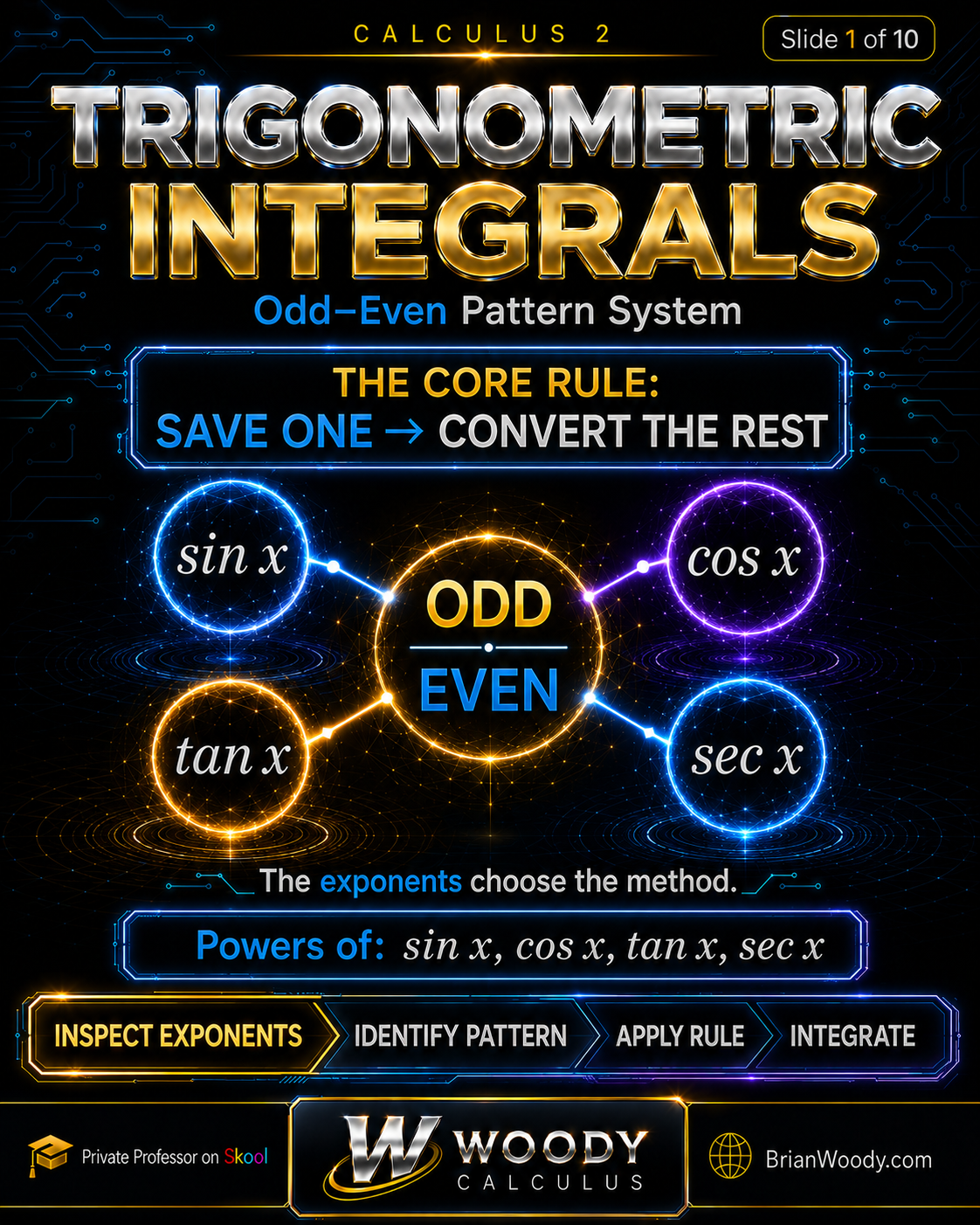
Learn trigonometric integrals through the Woody Calculus odd-even pattern system. This complete Calculus 2 lesson explains when to save one sine, cosine, secant-squared, or secant-tangent factor; when to use power reduction; how cosecant and cotangent mirror the pattern; and how to verify every answer by differentiation.
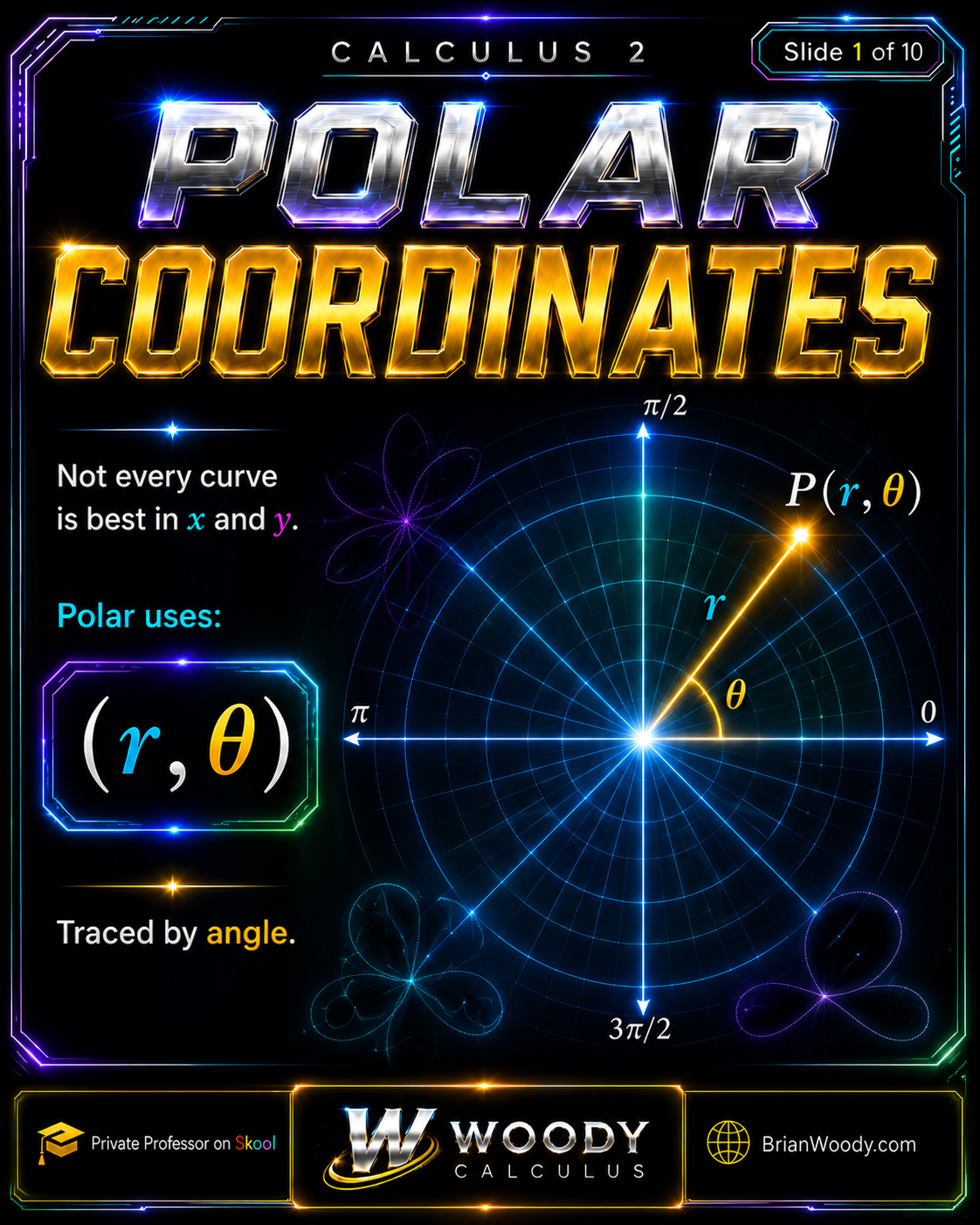
Polar coordinates describe a point using distance and angle instead of x and y. This Woody Calculus lesson explains r and θ, negative radius, graphing, symmetry tests, rose curves, cardioids, limaçons, and the polar area formula.
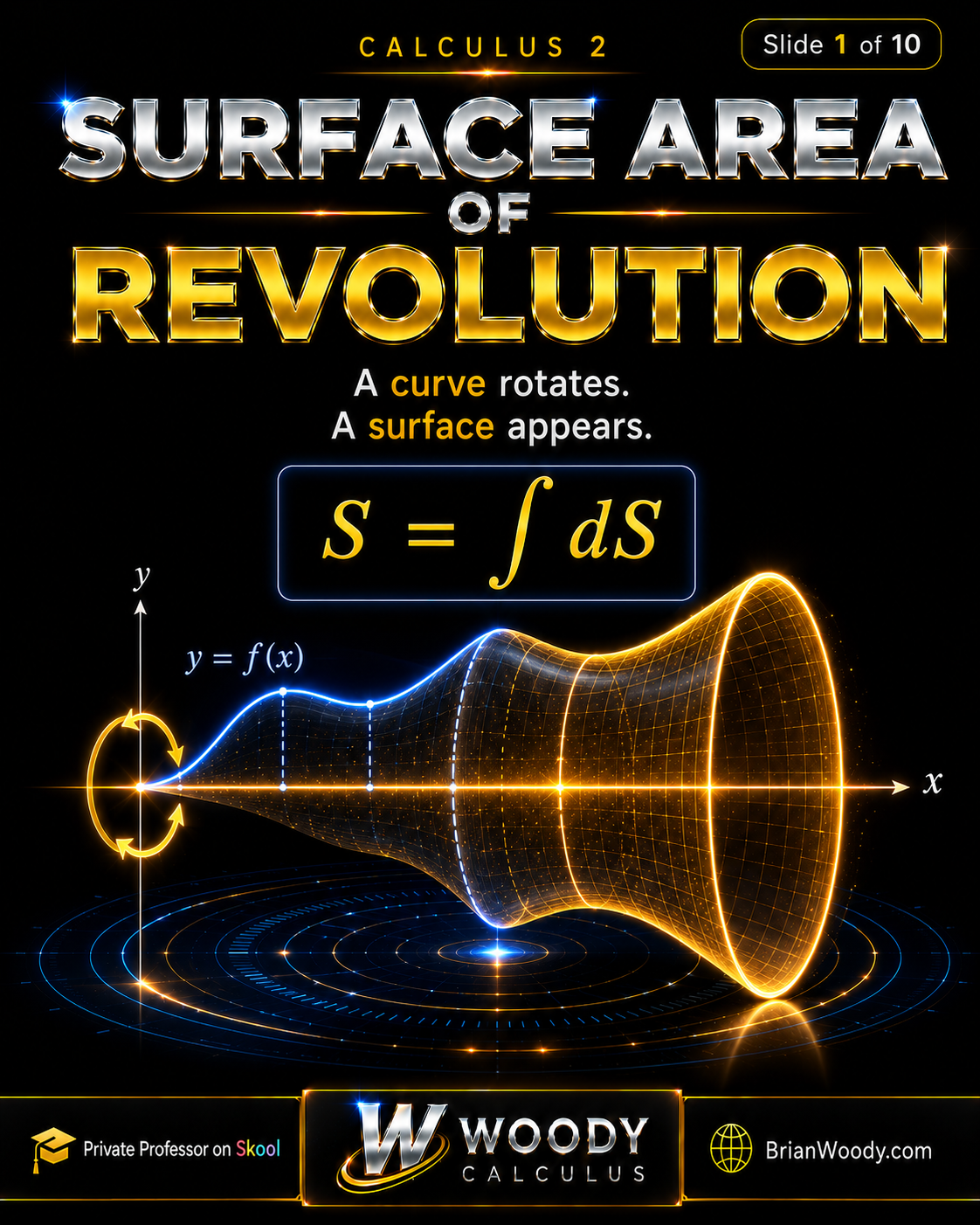
Surface area of revolution measures the curved surface created when a graph rotates around an axis. This Woody Calculus lesson derives dS = 2πr ds, explains the x-axis and y-axis formulas, and solves the complete example y = √x on [0,4].
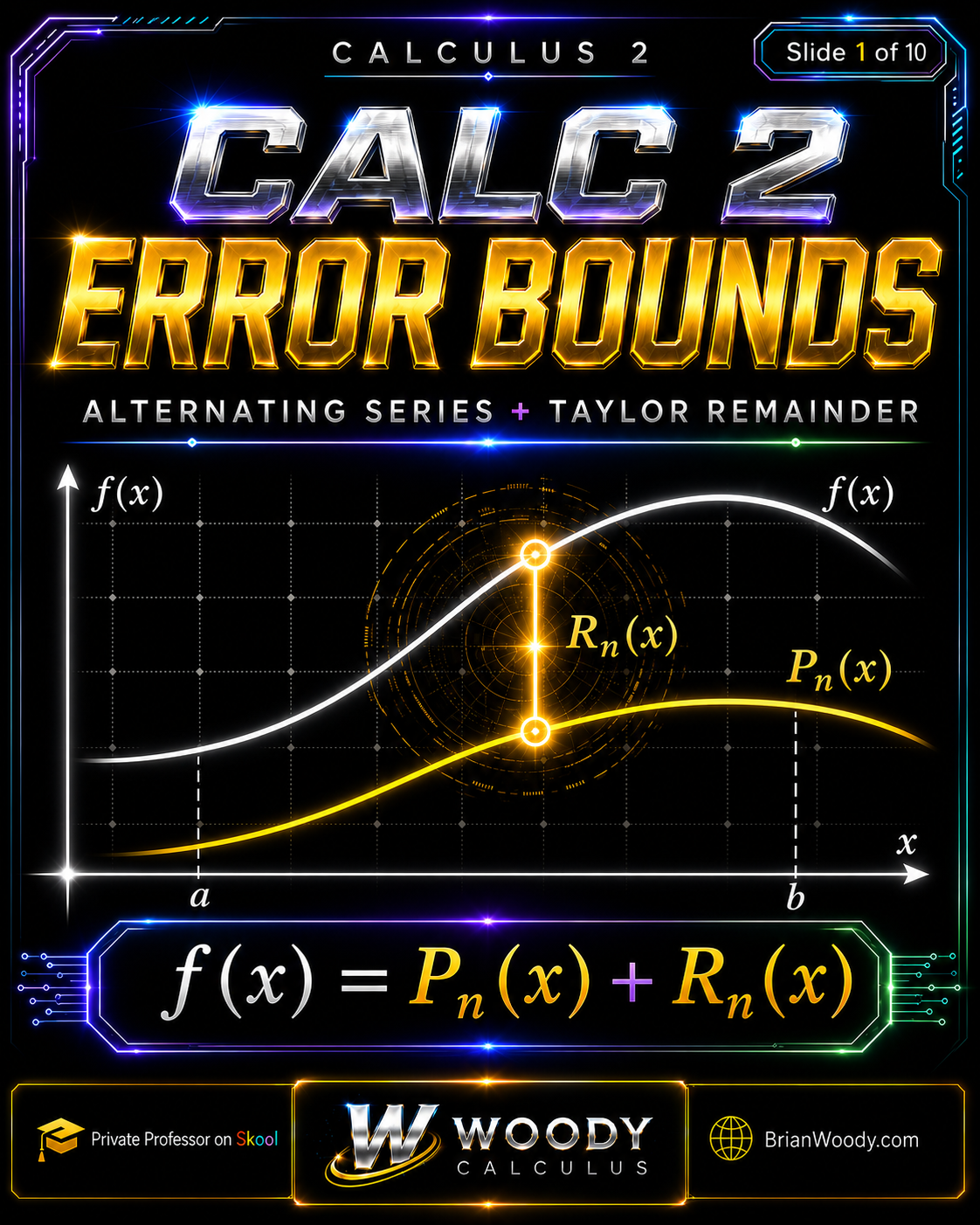
Error bounds tell students how accurate an approximation is. This Woody Calculus lesson compares alternating series error with Taylor remainder, explains the first omitted term rule, and shows how Taylor’s theorem controls polynomial approximation error.
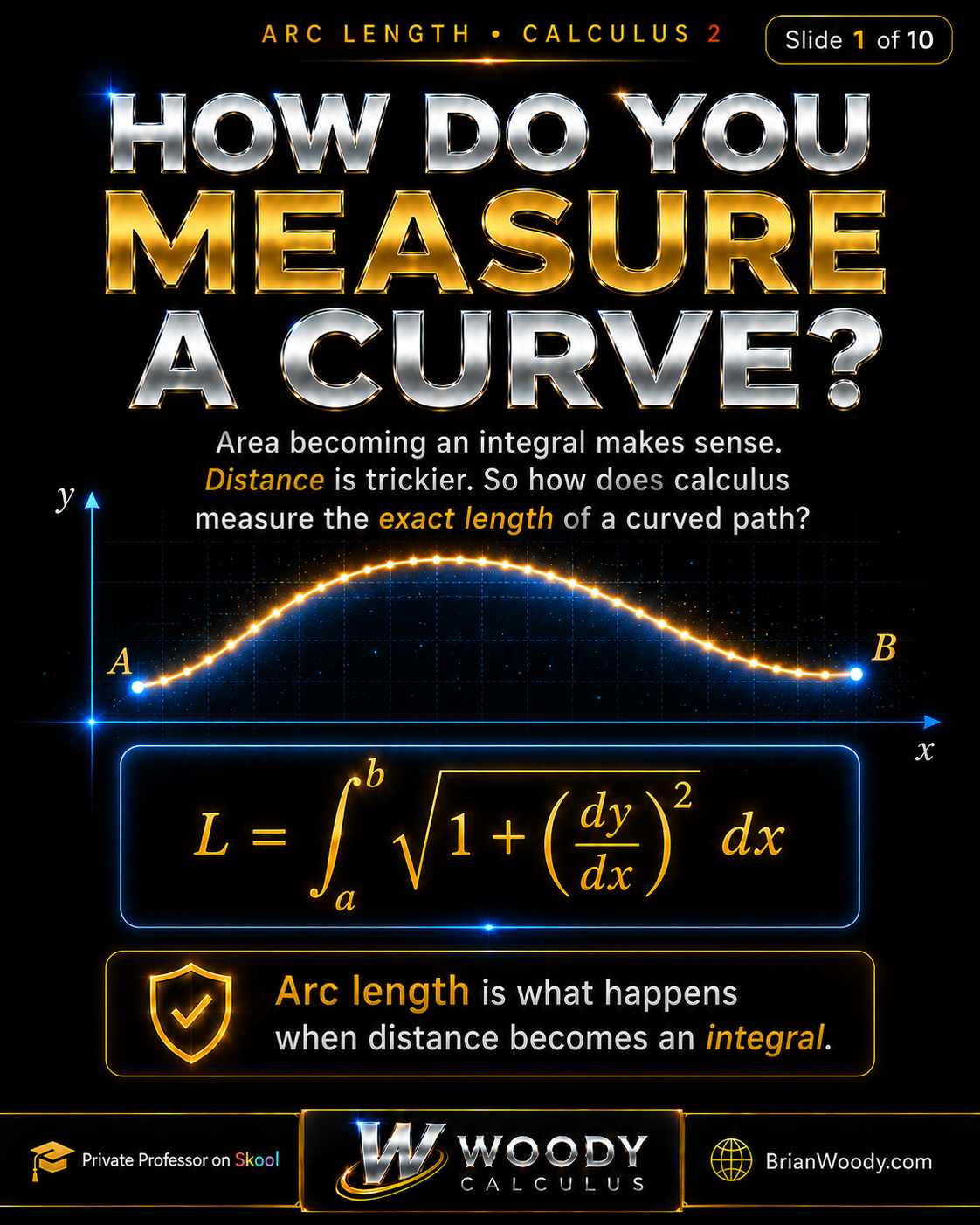
Arc length measures the exact distance along a curve by adding infinitely many tiny straight-line distances. This Woody Calculus lesson derives the formula, explains the ds triangle, and solves the classic hard arc length example step by step.
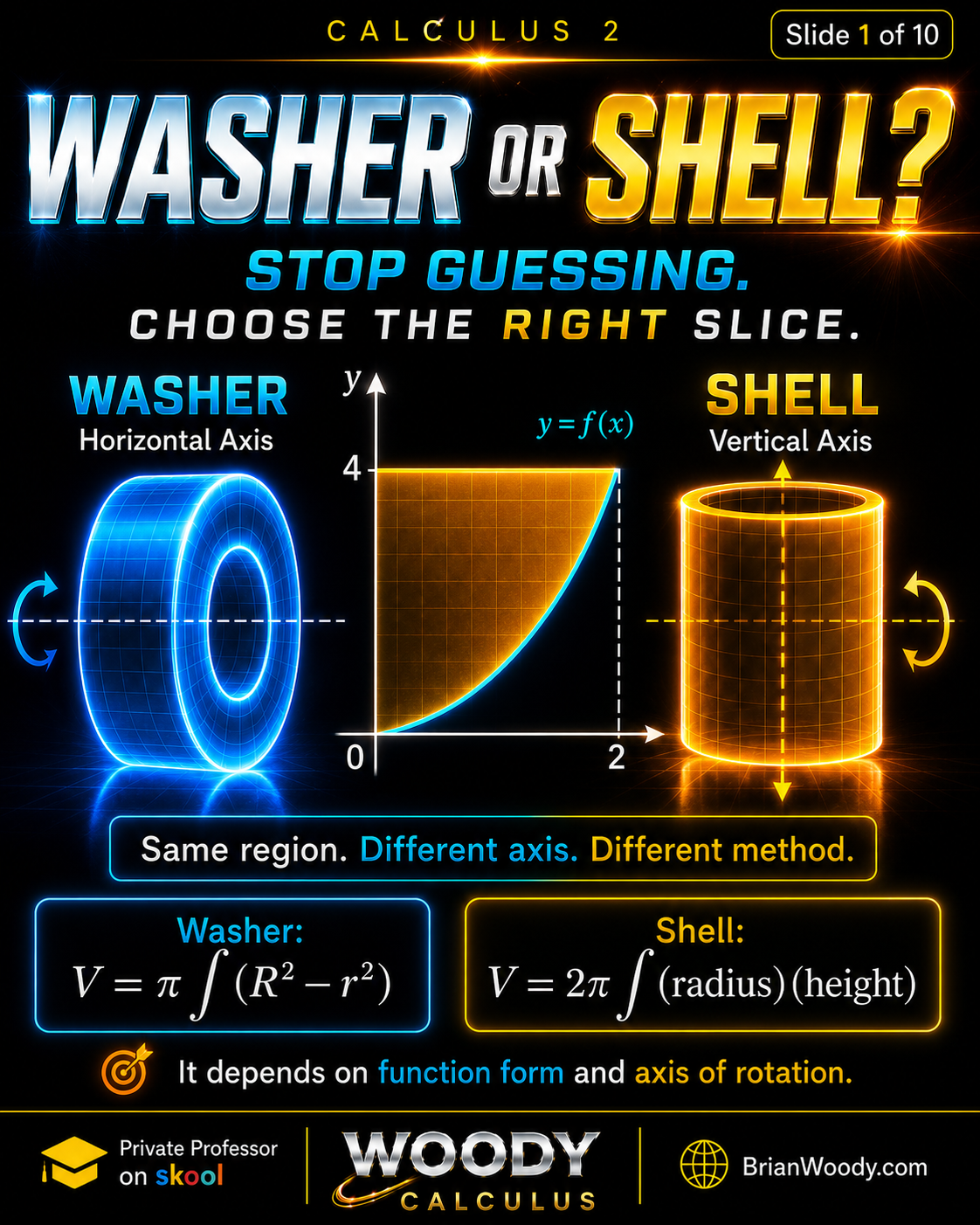
Washer method or shell method? This Woody Calculus lesson teaches the Calculus 2 decision rule for volumes of revolution: identify the function form, check the axis of rotation, choose the right slice, and build the correct volume integral.
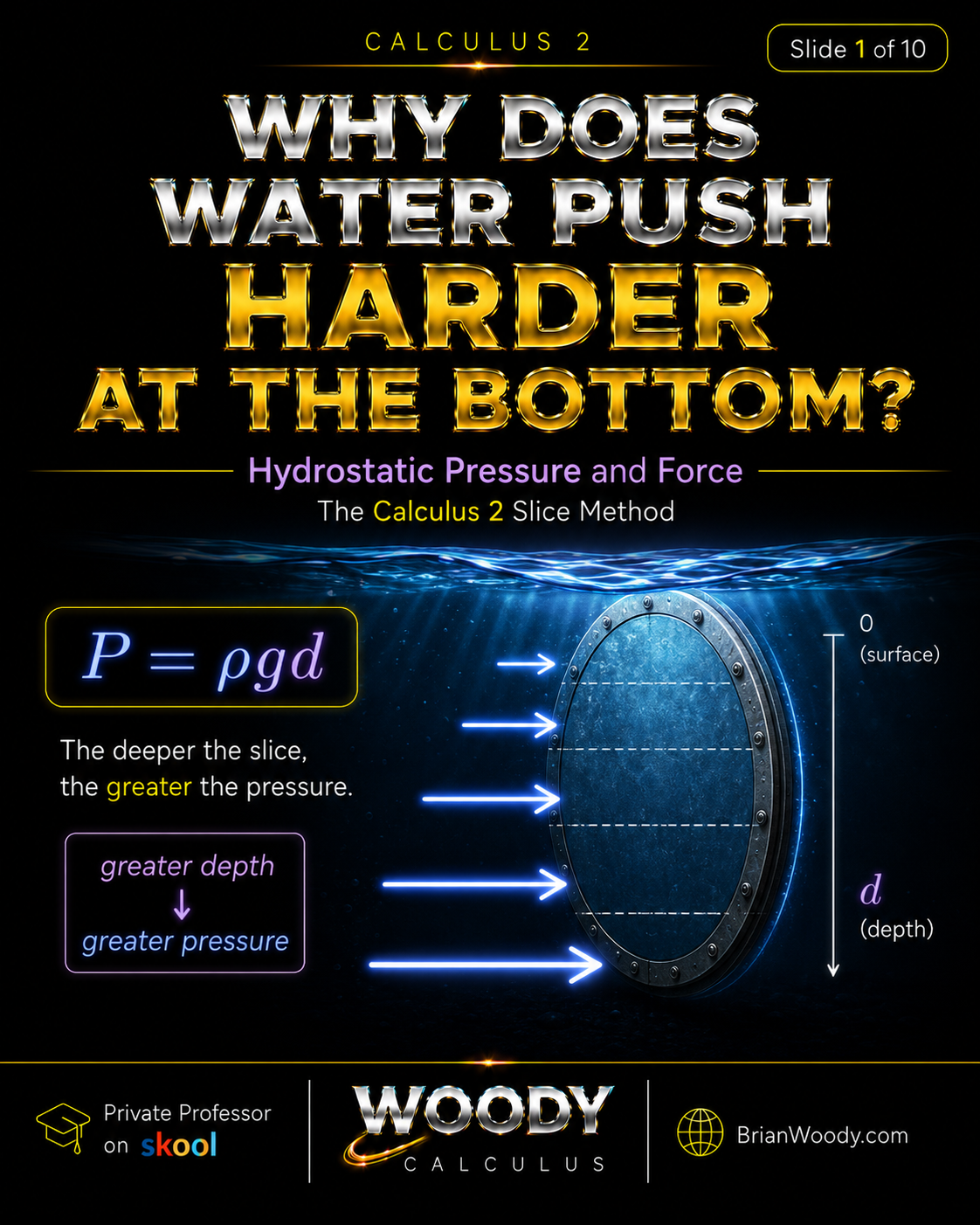
Hydrostatic force problems are Calculus 2 slice-method problems in disguise. This Woody Calculus lesson explains why force equals density times gravity times area times depth, why pressure changes with depth, and how to set up the hydrostatic force integral for a circular plate.
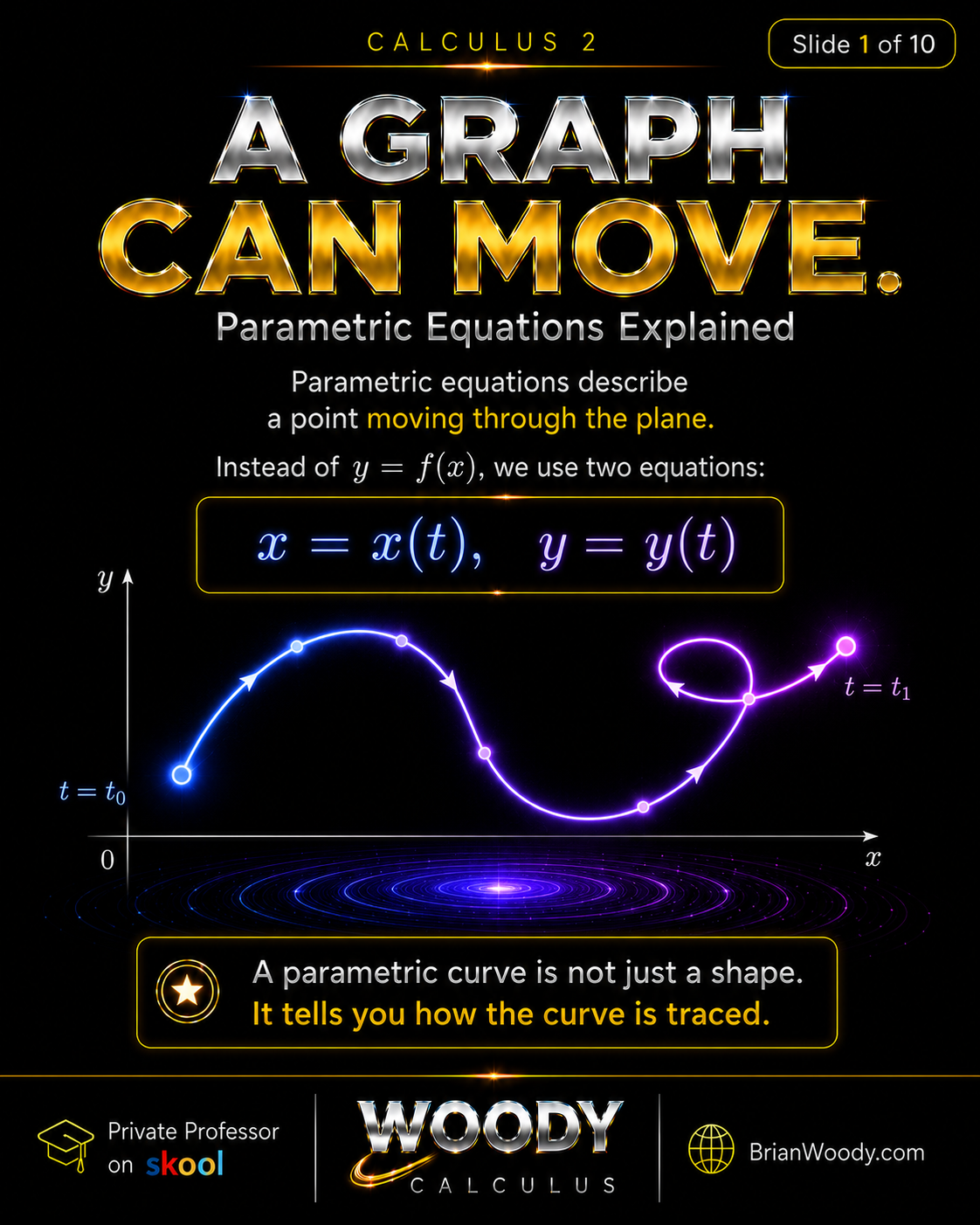
Parametric equations describe a point moving through the plane. This Woody Calculus lesson explains how \(x=x(t)\) and \(y=y(t)\) create a directed curve, how to compute \(\frac{dy}{dx}\), and how to find horizontal and vertical tangent lines.
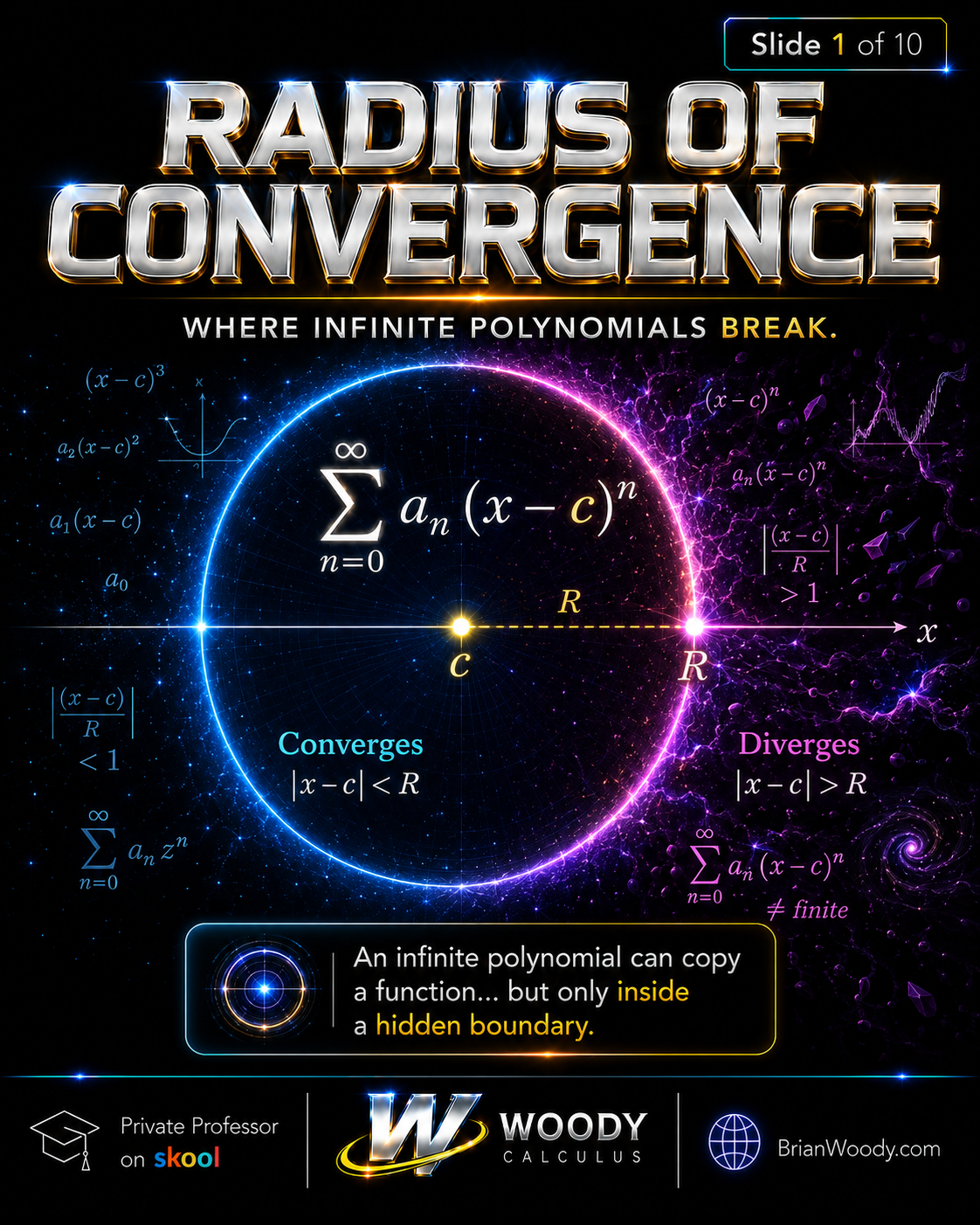
The radius of convergence is the hidden boundary where an infinite polynomial stops behaving like a function. In this Woody Calculus visual lesson, learn how power series are built around a center, how the Ratio Test finds R, why endpoints must be tested separately, and how to find the full interval of convergence.