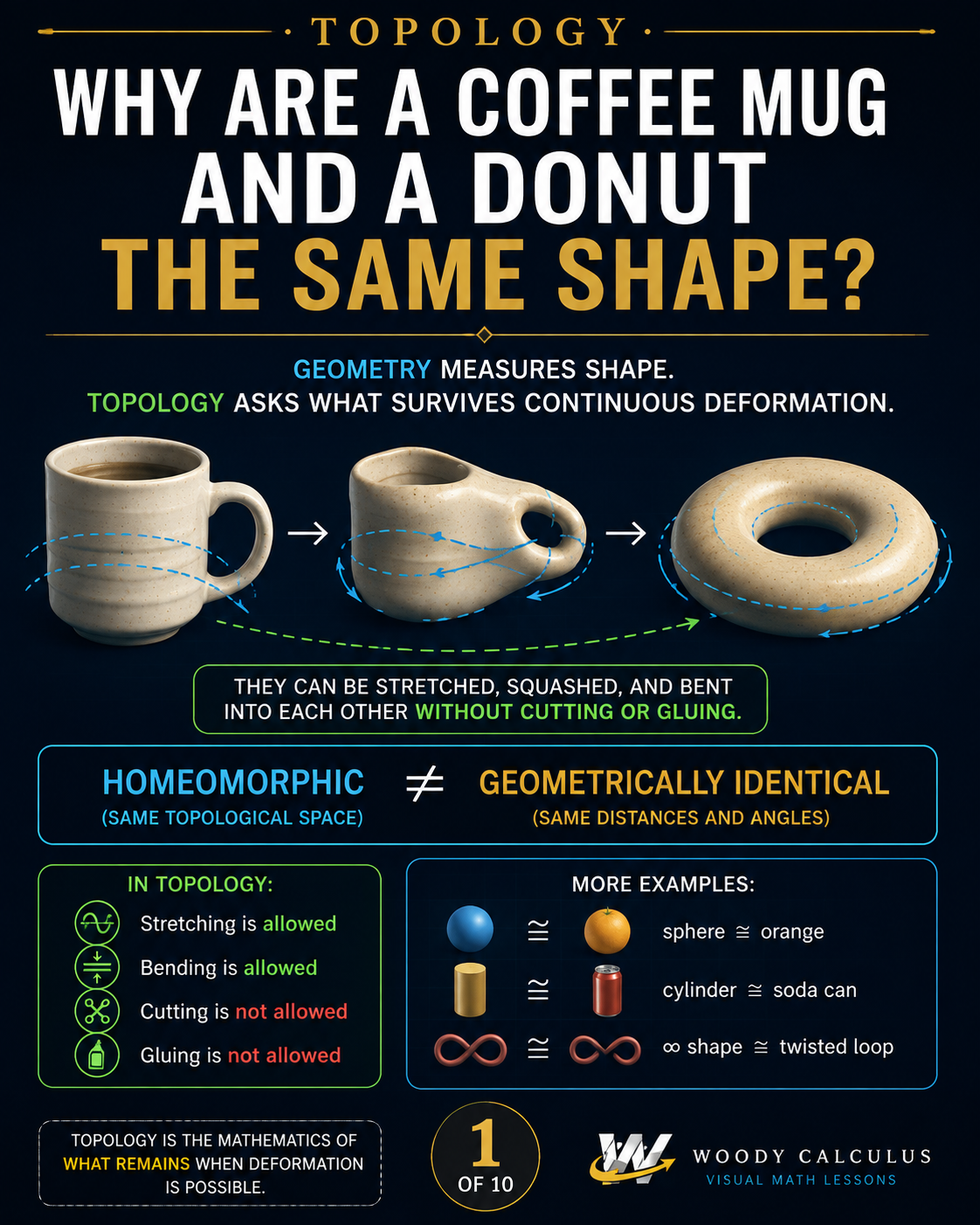

What is topology really about? Start with the famous coffee mug and donut, then learn open sets, continuity, homeomorphisms, connectedness, compactness, Euler characteristic, orientability, and the fundamental group.
What is topology really about? Start with the famous coffee mug and donut, then learn open sets, continuity, homeomorphisms, connectedness, compactness, Euler characteristic, orientability, and the fundamental group.
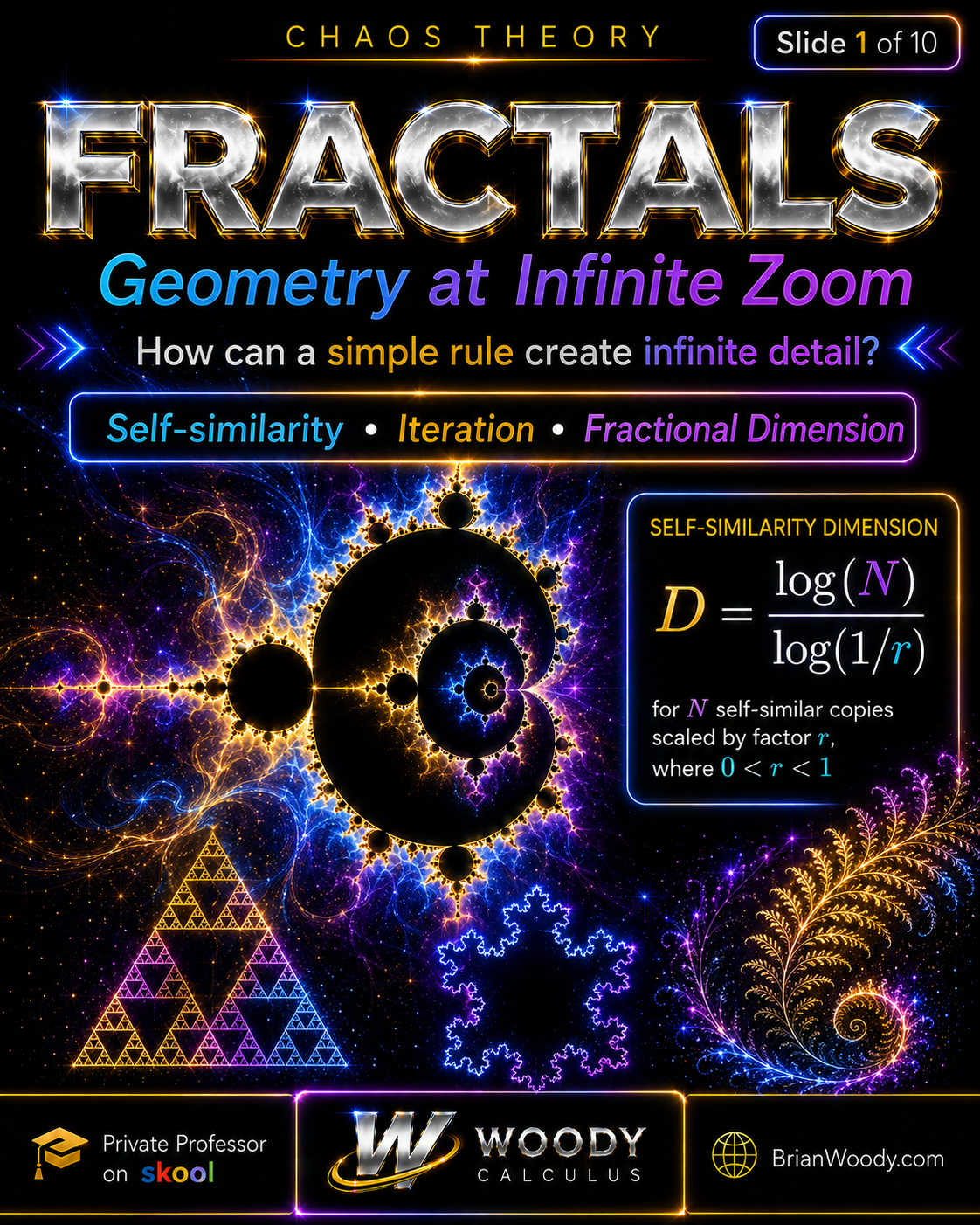
Fractals turn simple repeated rules into geometry with structure at every scale. This rigorous visual lesson explains the Mandelbrot set, escape orbits, Julia sets, fractal dimension, chaos theory, and the truth about fractals in nature.
![Real Analysis compactness overview showing the closed interval [0,1] and three consequences: convergent subsequences, maxima and minima for continuous functions, and uniform continuity.](https://k3p6r8v3.delivery.rocketcdn.me/wp-content/uploads/2026/08/Compactness-Slide-1.png)
What does compactness mean in Real Analysis? Learn open covers, finite subcovers, the Heine–Borel Theorem, sequential compactness, Bolzano–Weierstrass, and why continuous functions become dramatically better behaved on compact sets.
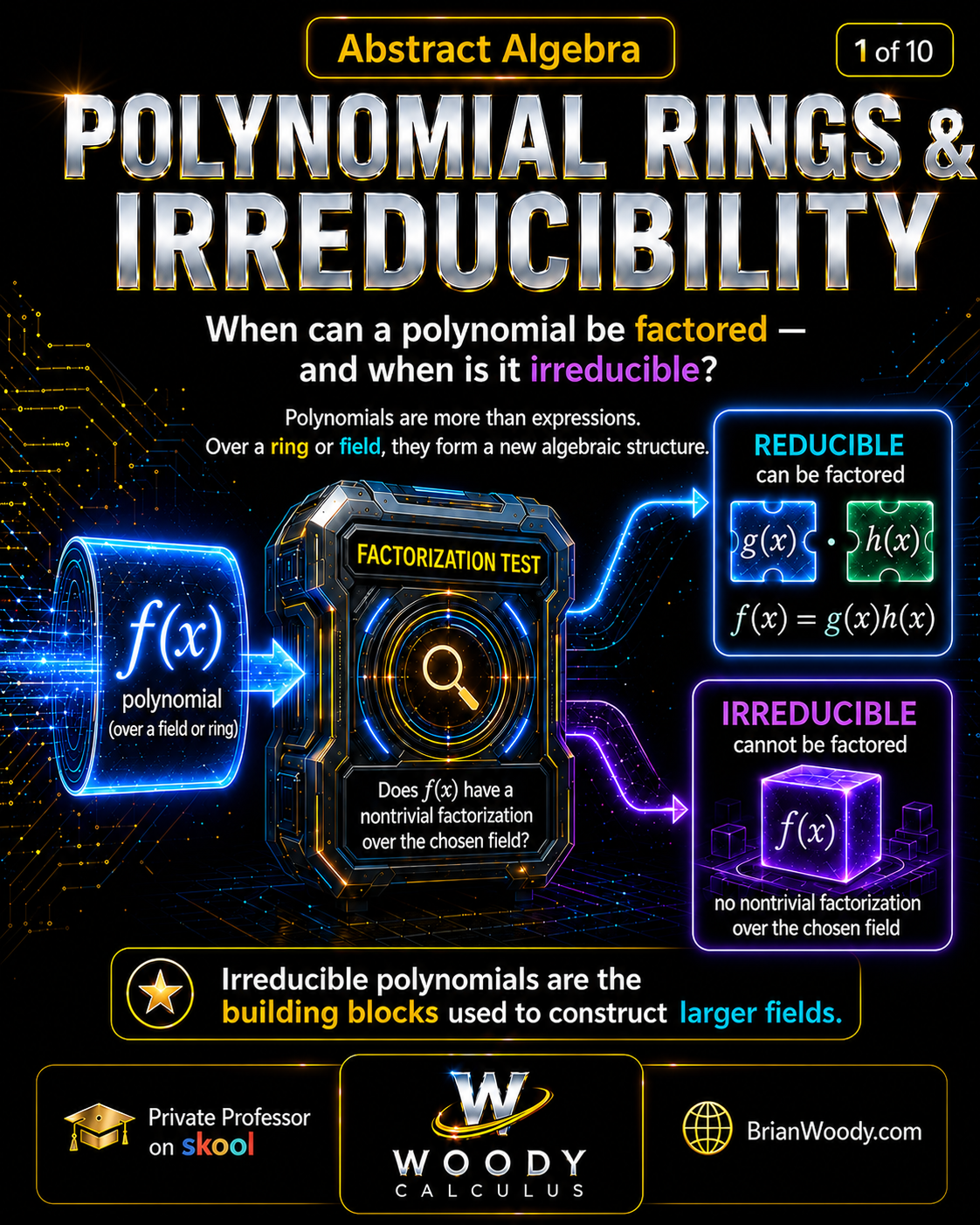
Polynomial irreducibility is never just about the polynomial—it depends on the coefficient ring or field. Learn a complete Abstract Algebra decision system using root tests, the Rational Root Theorem, Gauss’s Lemma, Eisenstein’s Criterion, reduction modulo p, finite-field factor tests, quotient rings, and field extensions.
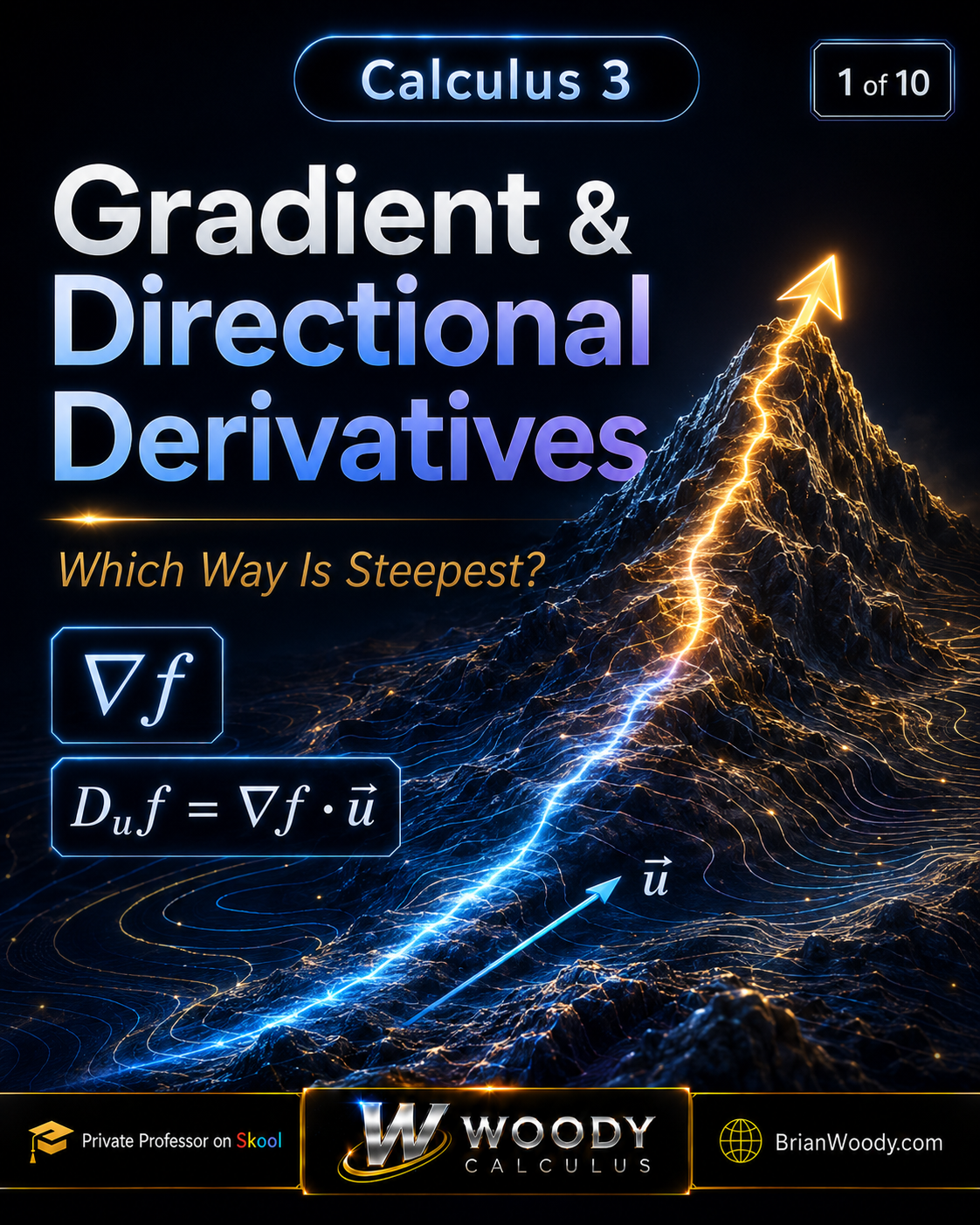
Which direction makes a multivariable function increase fastest? Learn how the gradient packages partial derivatives, how to calculate directional derivatives with unit vectors and dot products, and why gradients cross level curves at right angles.
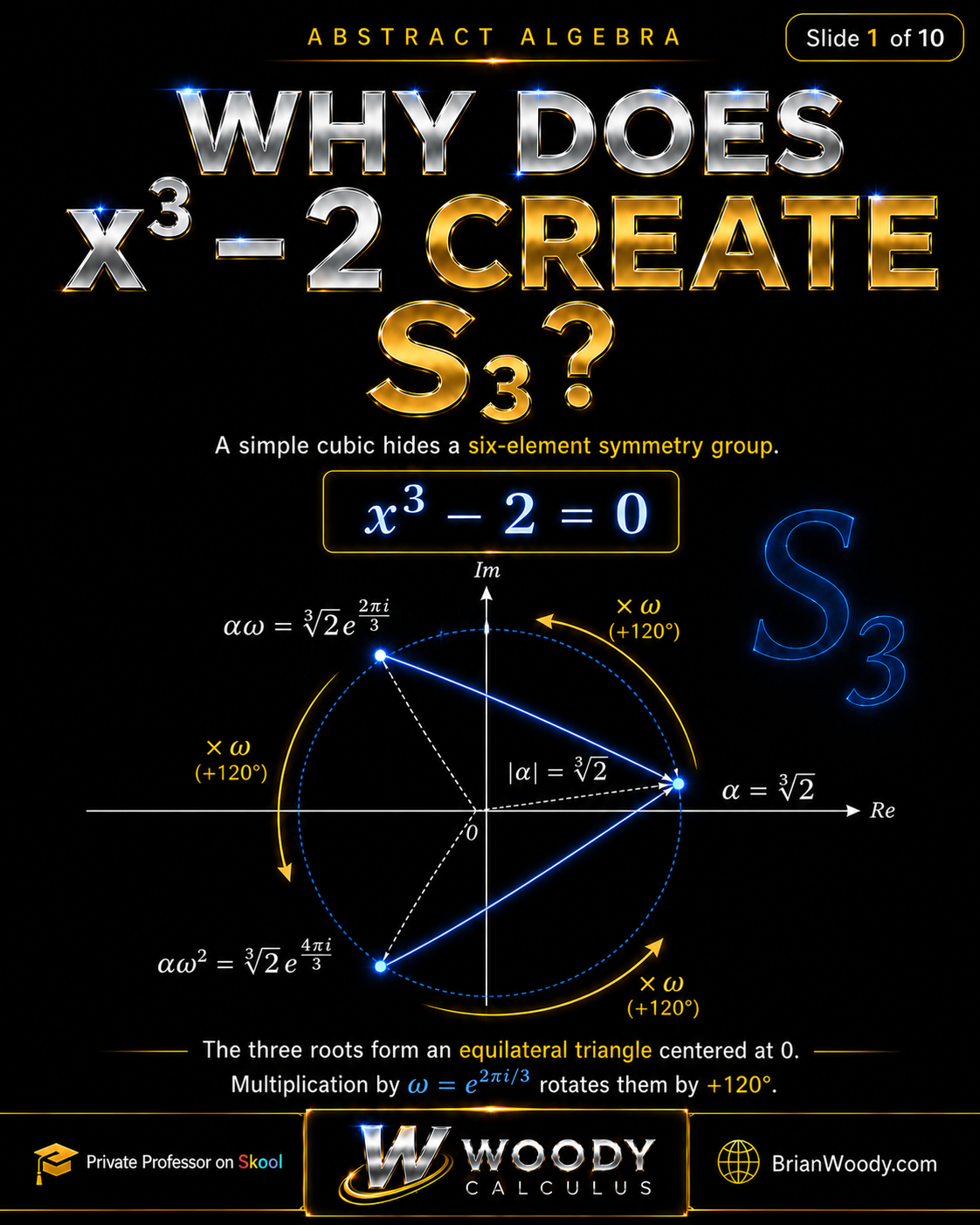
Why does the simple cubic x³ − 2 create the six-element symmetry group S₃? This Woody Calculus Abstract Algebra lesson explains the roots, splitting field, extension degree, automorphisms, triangle symmetries, and quotient group connection behind one of the cleanest examples in Galois theory.
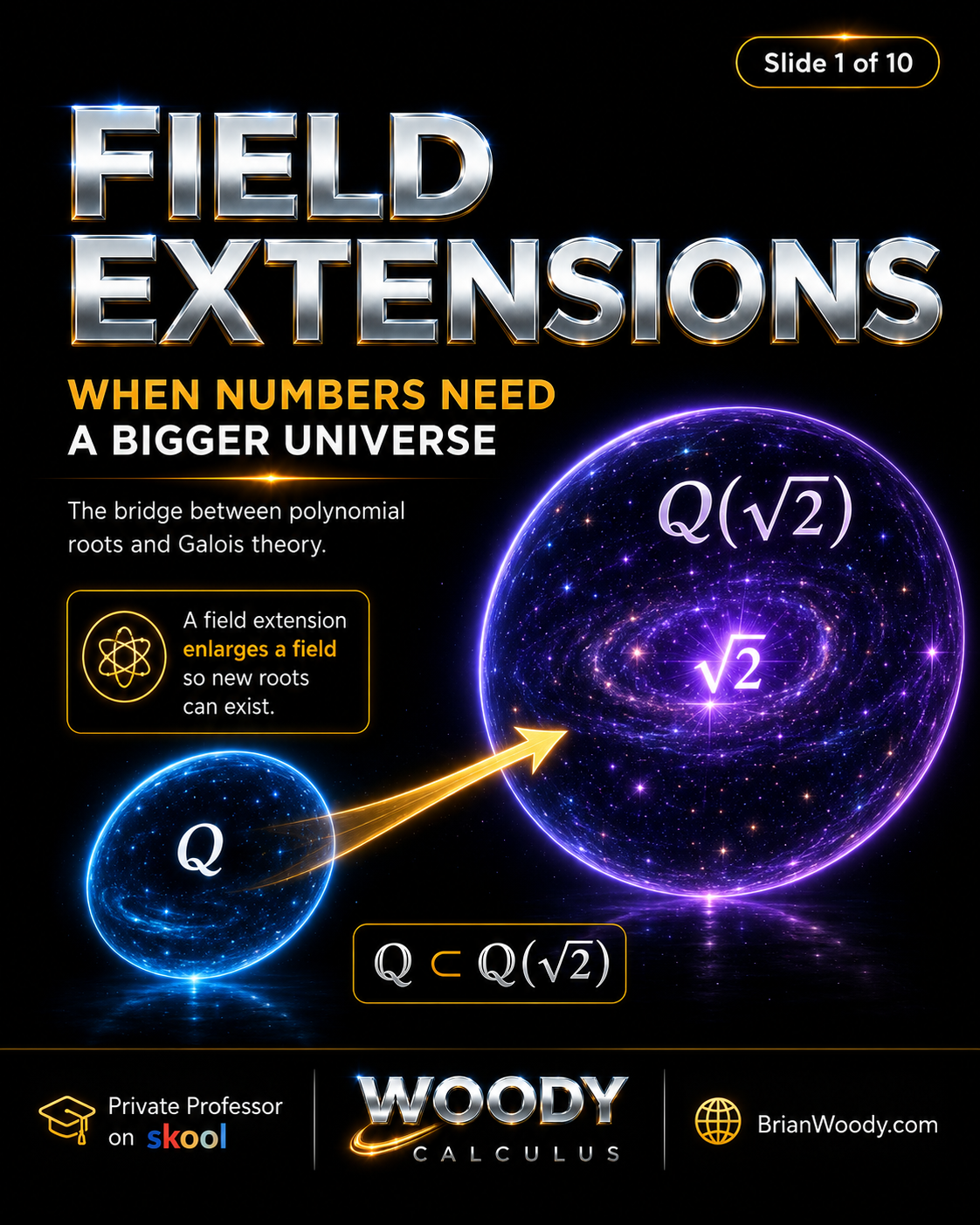
Field extensions are how Abstract Algebra builds a bigger number system when a polynomial has missing roots. In this Woody Calculus visual lesson, learn how Q becomes Q(√2), why x² − 2 has no rational root, how degree and minimal polynomials work, and why field extensions open the door to Galois theory.
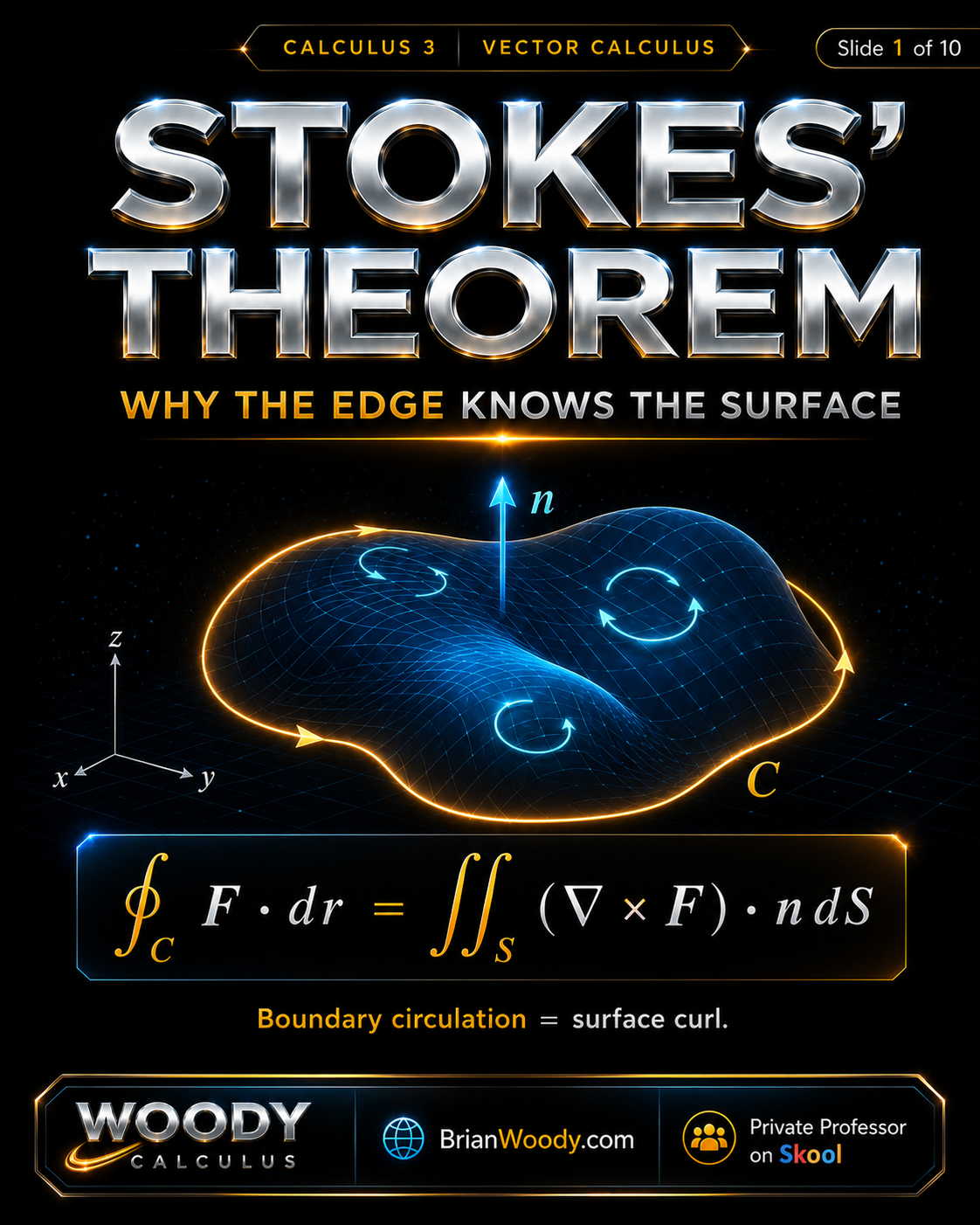
Stokes’ Theorem says that boundary circulation equals the total curl through a surface. In this Woody Calculus visual lesson, learn how Stokes’ Theorem connects line integrals, surface integrals, curl, orientation, the right-hand rule, Green’s Theorem, and vector calculus in Calculus 3.
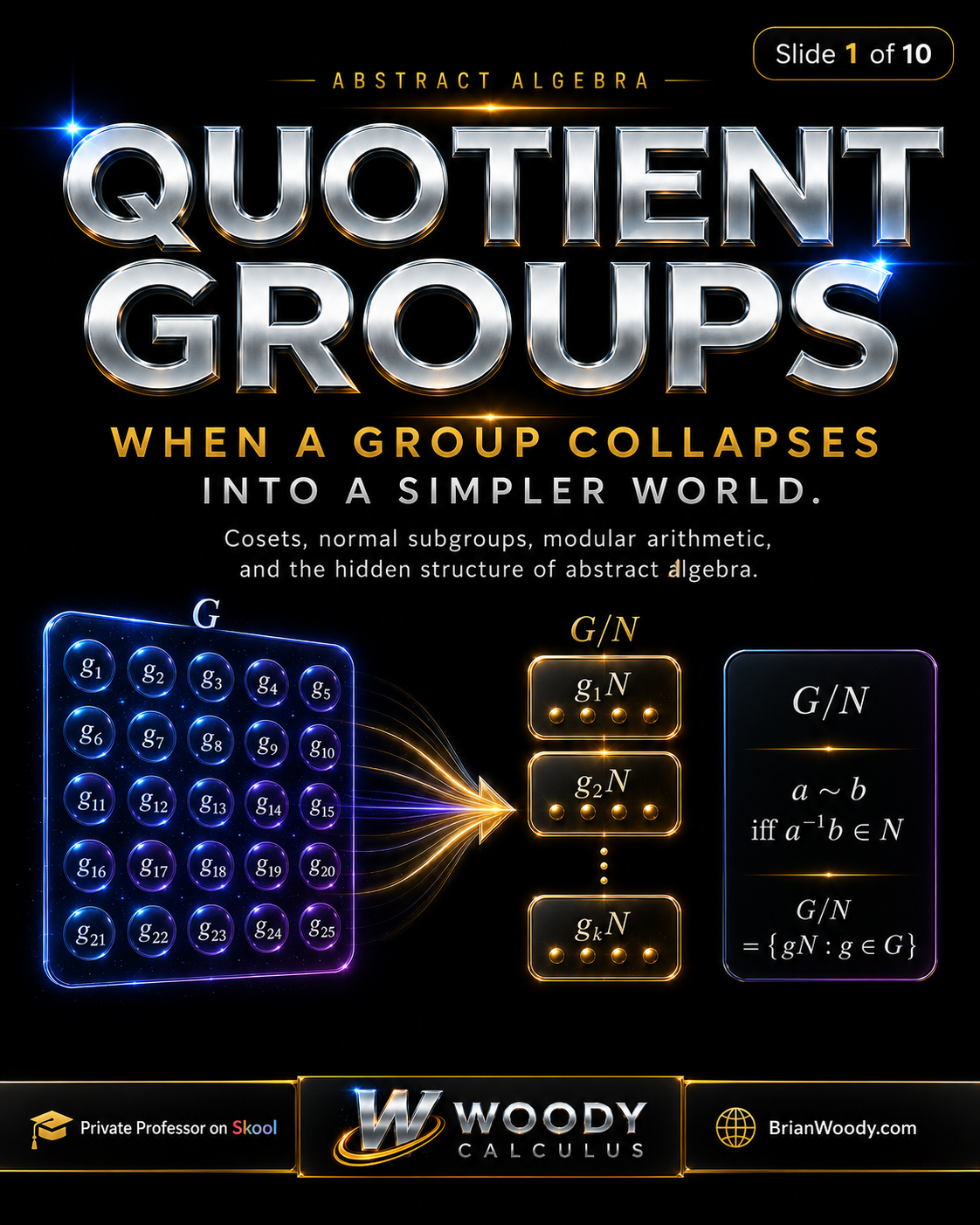
Quotient groups are how Abstract Algebra collapses a group into a simpler structure. In this Woody Calculus visual lesson, learn how cosets become the new elements, why normal subgroups are required, how modular arithmetic is a quotient group, and how kernels lead directly to the First Isomorphism Theorem.
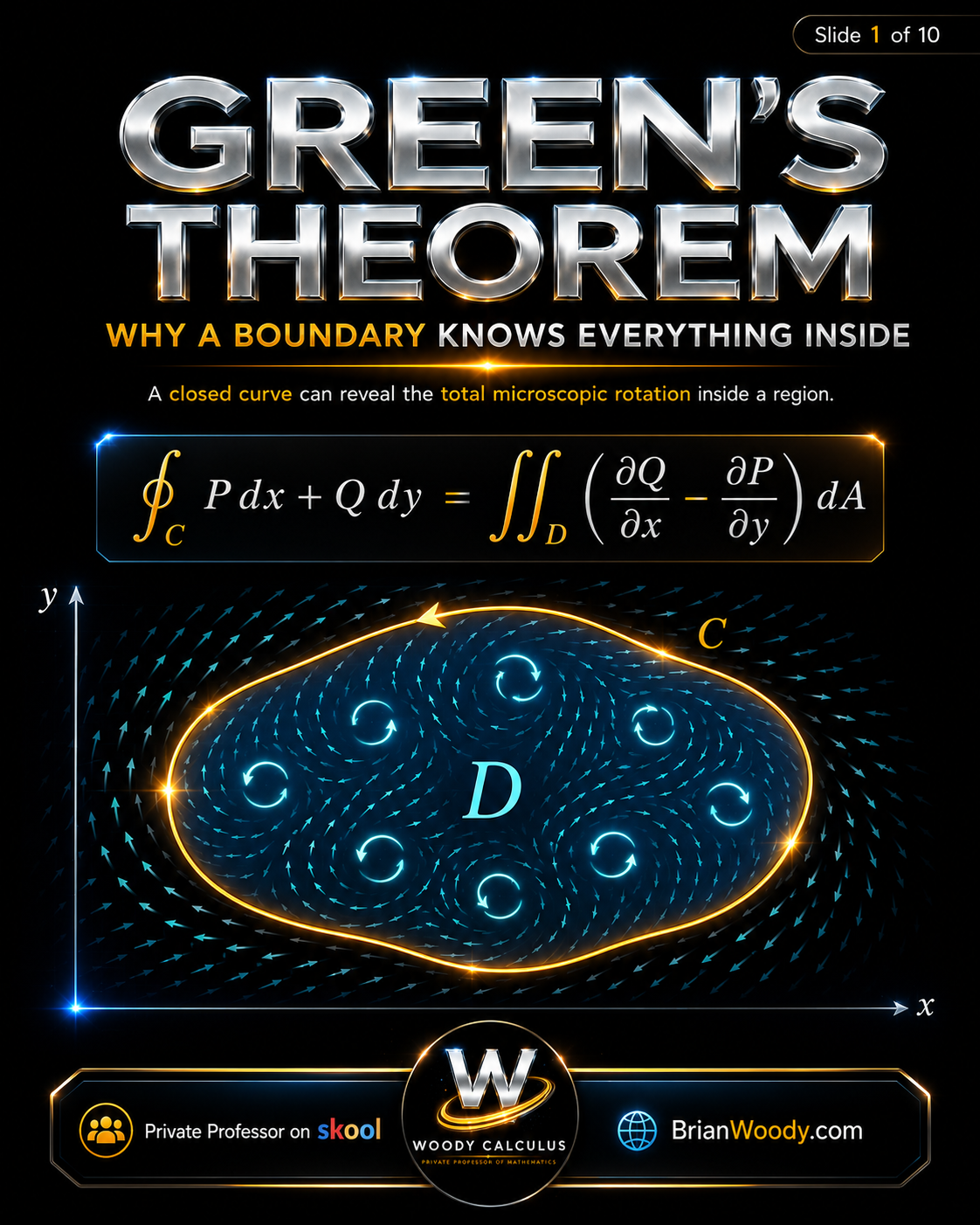
Green’s Theorem turns a boundary line integral into an interior double integral. In this Woody Calculus visual lesson, learn how Green’s Theorem connects circulation, curl, flux, area, line integrals, double integrals, Stokes’ Theorem, and the Divergence Theorem in Calculus 3.