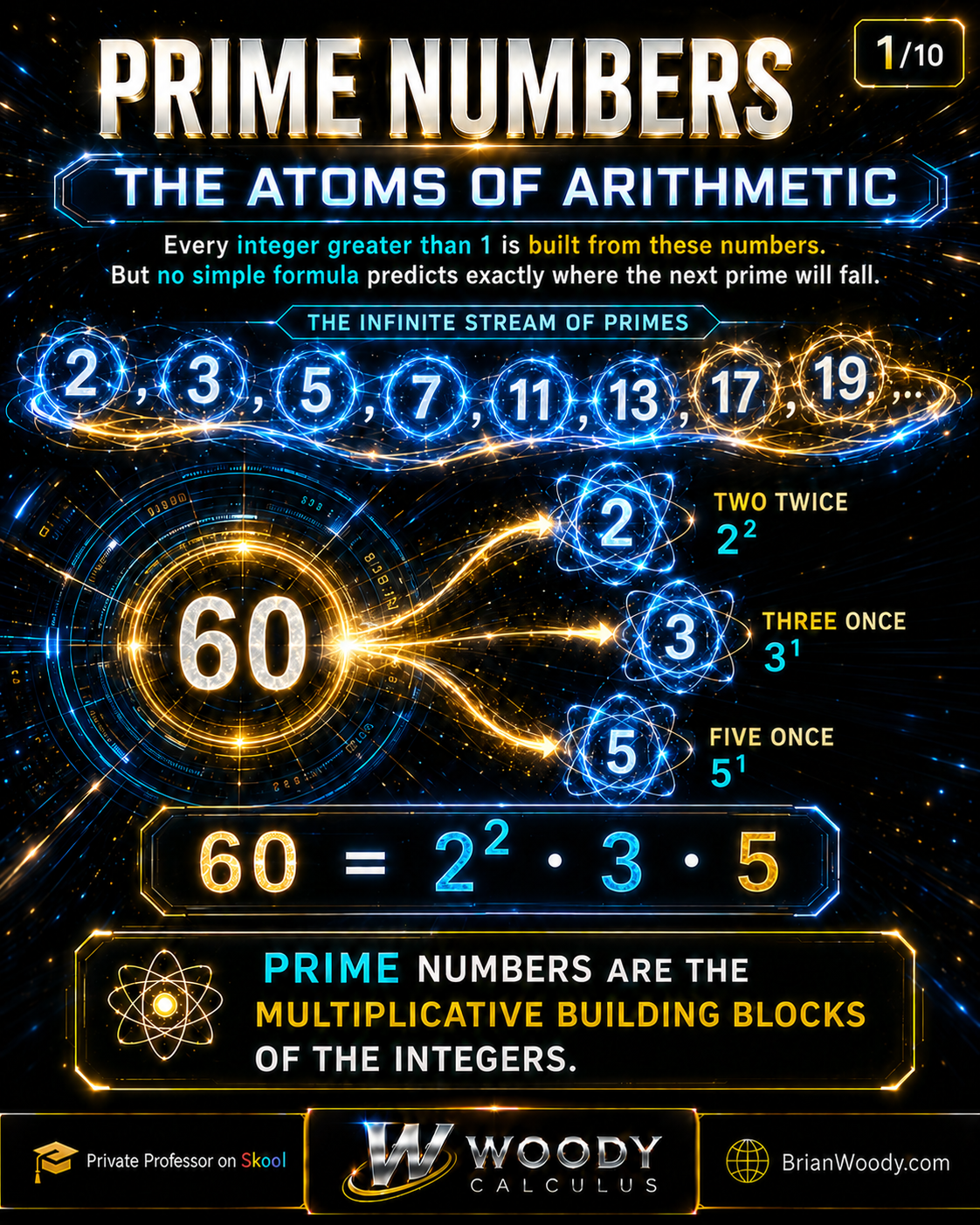
Prime numbers are the multiplicative building blocks of the integers. In this Woody Calculus lesson, learn the formal definition of a prime, why 1 is excluded, the Fundamental Theorem of Arithmetic, Euclid’s proof of infinitely many primes, the Sieve of Eratosthenes, prime patterns modulo 6, the Prime Number Theorem, modern cryptography, and the deep connection between primes and the Riemann Hypothesis.
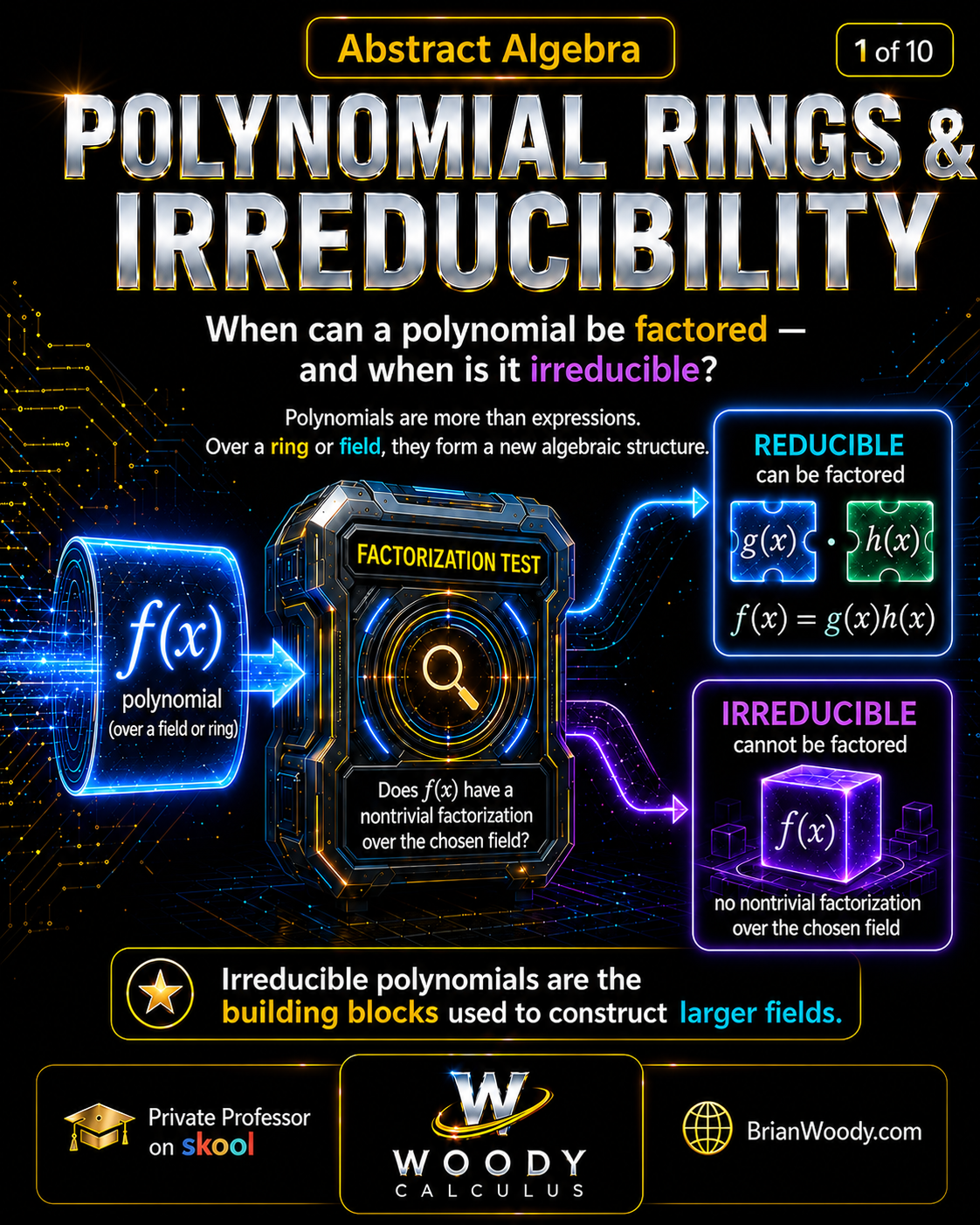
Polynomial irreducibility is never just about the polynomial—it depends on the coefficient ring or field. Learn a complete Abstract Algebra decision system using root tests, the Rational Root Theorem, Gauss’s Lemma, Eisenstein’s Criterion, reduction modulo p, finite-field factor tests, quotient rings, and field extensions.
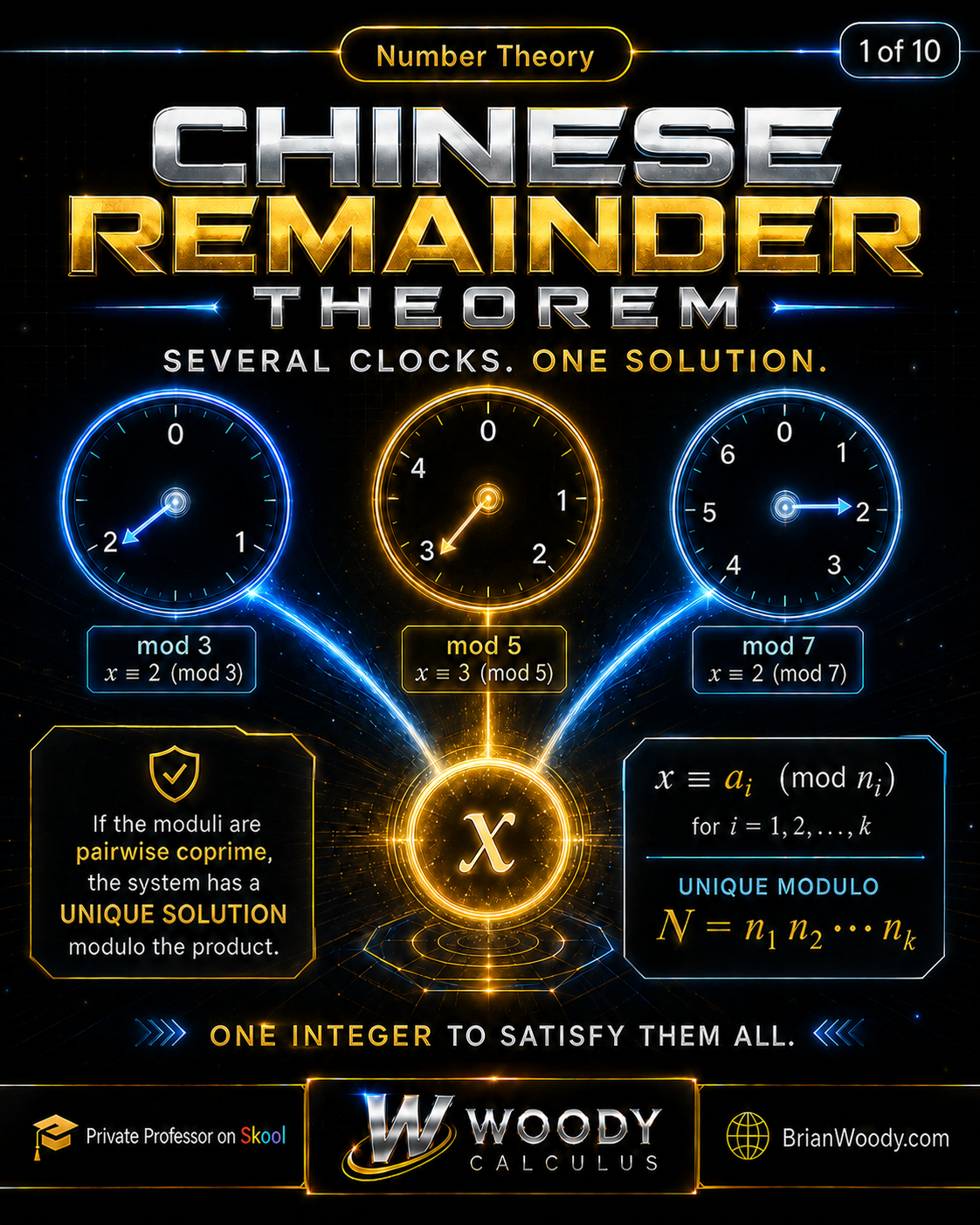
The Chinese Remainder Theorem combines simultaneous congruences into one residue class. Learn the modular-inverse algorithm, two complete examples, proof, verification, noncoprime cases, common mistakes, and exam-ready method selection.
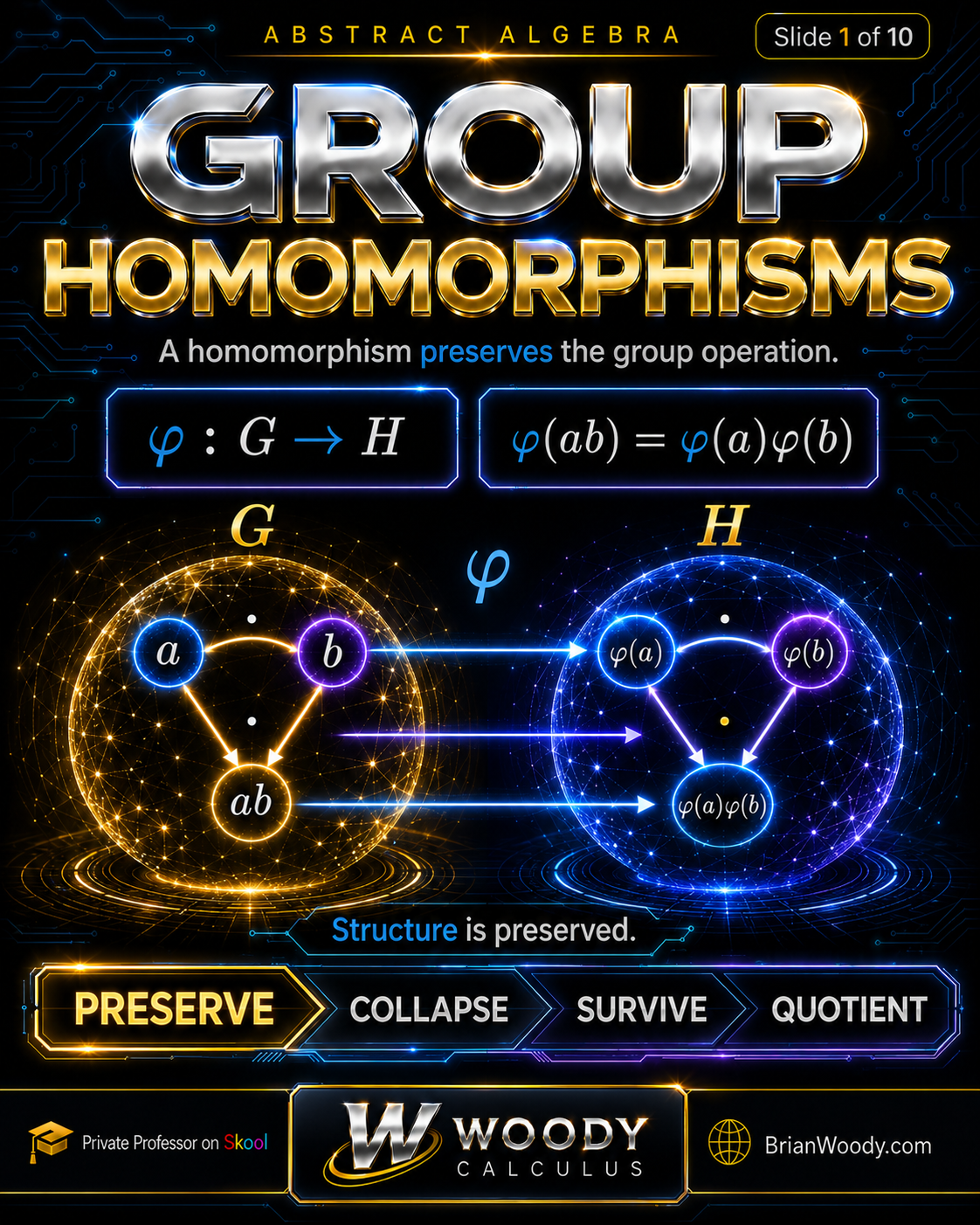
Learn group homomorphisms through visual intuition, exact definitions, complete proofs, and a detailed map from the integers to Z₄. This Woody Calculus lesson explains operation preservation, kernels, images, fibers, quotient groups, injectivity, surjectivity, and the First Isomorphism Theorem.
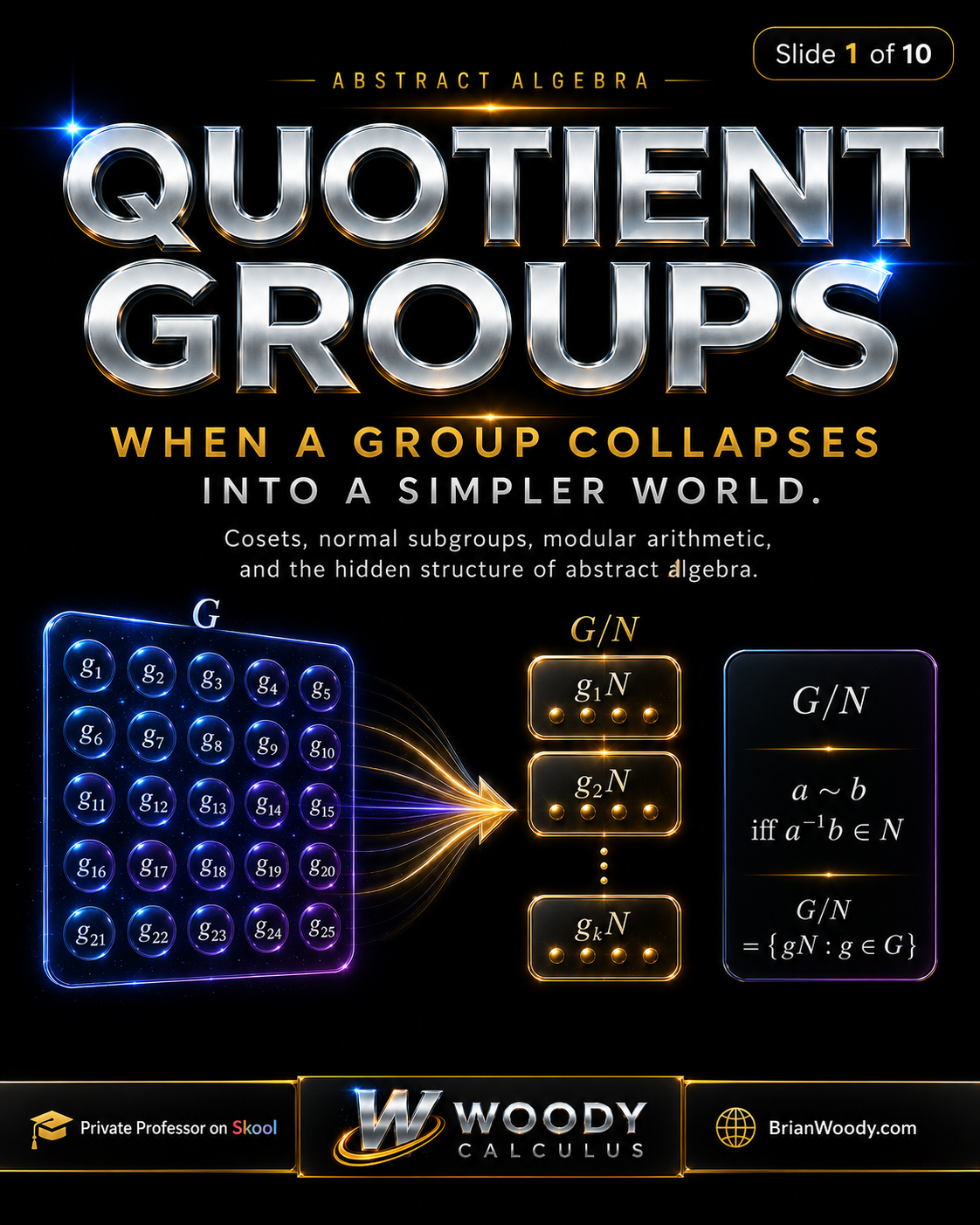
Quotient groups are how Abstract Algebra collapses a group into a simpler structure. In this Woody Calculus visual lesson, learn how cosets become the new elements, why normal subgroups are required, how modular arithmetic is a quotient group, and how kernels lead directly to the First Isomorphism Theorem.
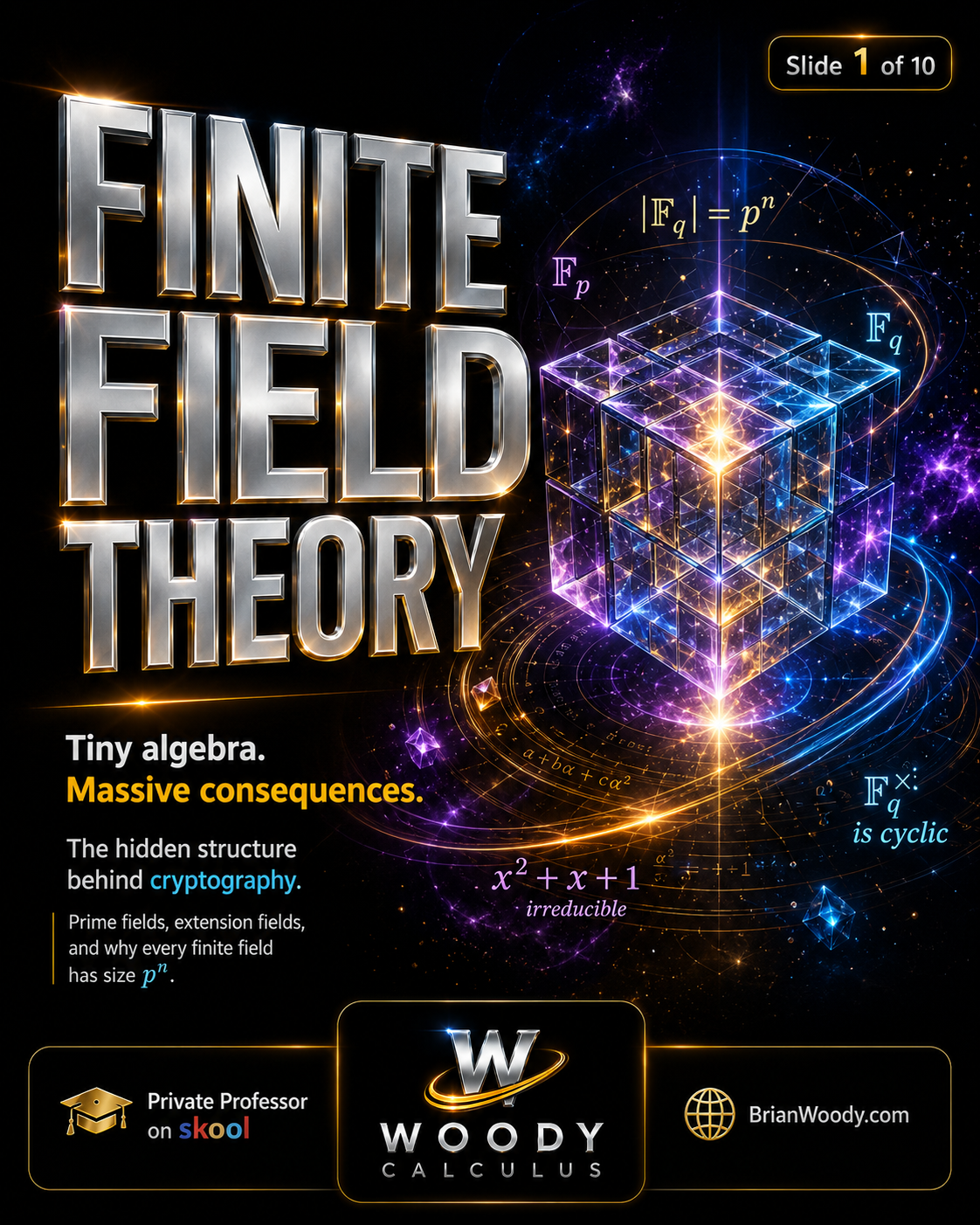
Finite field theory looks abstract until you realize it powers modern cryptography, error correction, QR codes, AES encryption, and elliptic curve cryptography. In this Woody Calculus visual lesson, learn what finite fields are, why prime fields matter, why every finite field has size q = p^n, how extension fields are built from irreducible polynomials, and why finite fields are the hidden algebra behind secure communication.