The Jacobian Explained: The Hidden Scale Factor in Calculus III
The Jacobian is the hidden scale factor behind every coordinate change in Calculus III. Whenever coordinates change, area and volume change too. The Jacobian tells you exactly by how much.
Students usually first meet the Jacobian in double integrals, triple integrals, polar coordinates, cylindrical coordinates, and spherical coordinates. At first, the formulas can feel mysterious:
\[
dA = r\,dr\,d\theta
\]
and
\[
dV = \rho^2\sin\phi\,d\rho\,d\phi\,d\theta.
\]
But those extra factors are not random. They are Jacobians. They come from local scaling.
This Woody Calculus visual lesson explains the Jacobian in order: what it measures, why tiny rectangles become parallelograms, how determinants become Jacobians, why polar coordinates need the extra \(r\), how change of variables works in double integrals, why cylindrical coordinates still use \(r\), and why spherical coordinates require the full factor \(\rho^2\sin\phi\).
What Is the Jacobian?
The Jacobian is a determinant that measures how a coordinate transformation locally stretches or shrinks area or volume.
For a transformation from \((u,v)\)-coordinates to \((x,y)\)-coordinates,
\[
(u,v)\mapsto (x(u,v),y(u,v)),
\]
the Jacobian is
\[
J=\frac{\partial(x,y)}{\partial(u,v)}
=
\det
\begin{bmatrix}
\frac{\partial x}{\partial u} & \frac{\partial x}{\partial v}\\
\frac{\partial y}{\partial u} & \frac{\partial y}{\partial v}
\end{bmatrix}.
\]
The absolute value \(|J|\) tells how much tiny areas scale under the transformation.
That is the key idea:
\[
dA \approx |J|\,du\,dv.
\]
If \(|J|=2\), tiny areas double. If \(|J|=\frac{1}{3}\), tiny areas shrink by a factor of three. If \(J=0\), the transformation collapses area locally.
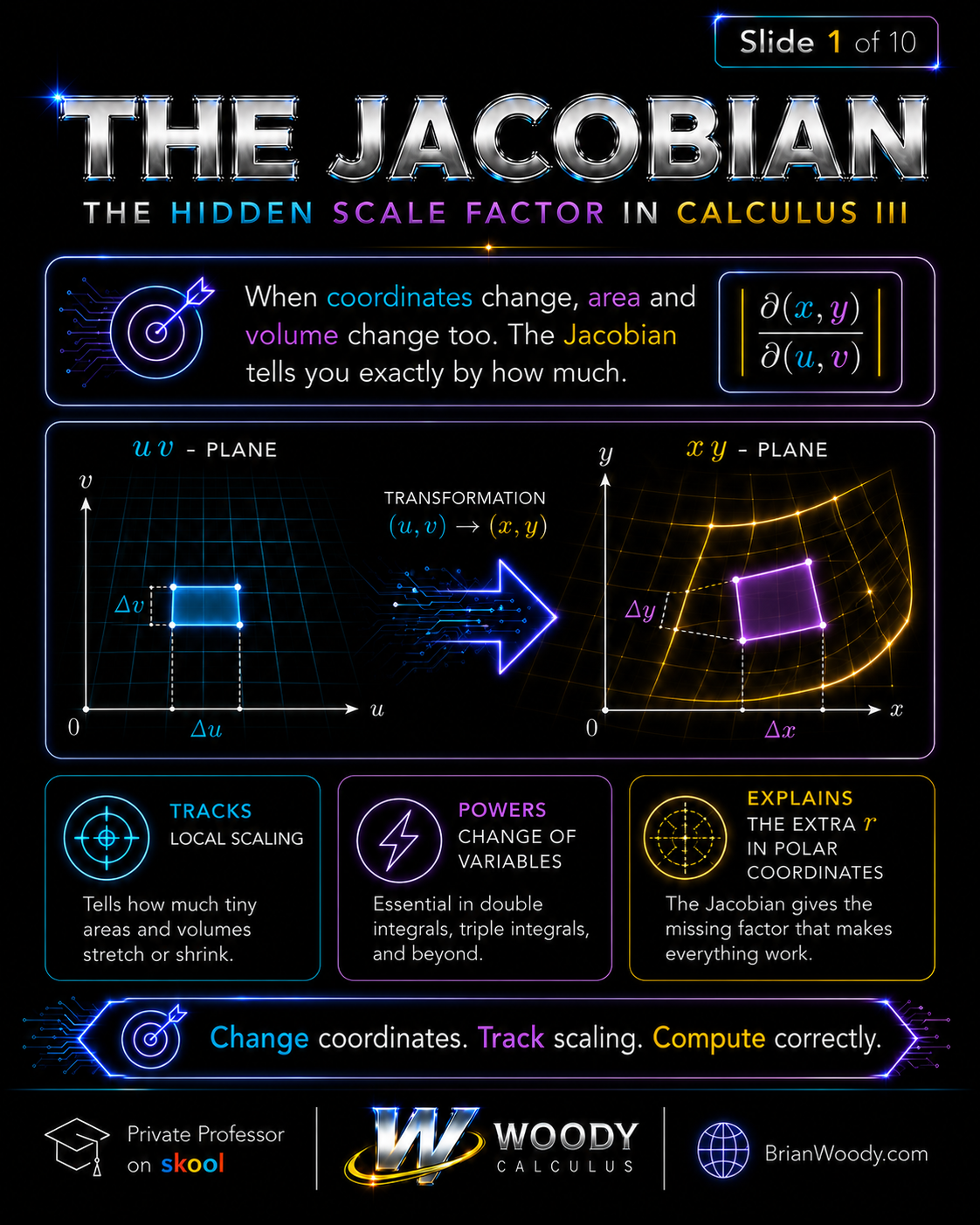
The Big Idea: A Tiny Rectangle Can Change Size
The big idea is simple: a tiny rectangle in one coordinate system may become a different shape in another coordinate system.
In the \(uv\)-plane, a small rectangle has side lengths \(du\) and \(dv\), so its area is approximately
\[
du\,dv.
\]
After the transformation
\[
(x,y)=(x(u,v),y(u,v)),
\]
that tiny rectangle may become a small parallelogram in the \(xy\)-plane. The Jacobian tells us the local area scale factor:
\[
dA \approx |J|\,du\,dv.
\]
This is why the Jacobian is essential in change of variables. It corrects the area or volume when the coordinate grid bends, stretches, compresses, or curves.

From Determinants to Jacobians
The Jacobian is the determinant version of local linear approximation.
A smooth transformation
\[
T(u,v)=(x(u,v),y(u,v))
\]
may curve and bend globally. But near one point, the transformation is approximately linear.
The tangent vectors are
\[
r_u=\left(\frac{\partial x}{\partial u},\frac{\partial y}{\partial u}\right),
\qquad
r_v=\left(\frac{\partial x}{\partial v},\frac{\partial y}{\partial v}\right).
\]
These vectors form the sides of a tiny parallelogram in the image plane. Its area is controlled by the determinant:
\[
\text{Area} \approx \left|\det[r_u\ r_v]\right|\,du\,dv.
\]
That determinant is the Jacobian:
\[
J(u,v)=\det[r_u\ r_v]=\det[DT(u,v)].
\]
So the determinant becomes the Jacobian when the transformation varies from point to point.

Polar Coordinates: Why \(dA=r\,dr\,d\theta\)
Polar coordinates are often the first place students see the Jacobian in Calculus III.
The polar coordinate change is
\[
x=r\cos\theta,
\qquad
y=r\sin\theta.
\]
The Jacobian matrix is
\[
\begin{bmatrix}
\frac{\partial x}{\partial r} & \frac{\partial x}{\partial \theta}\\
\frac{\partial y}{\partial r} & \frac{\partial y}{\partial \theta}
\end{bmatrix}
=
\begin{bmatrix}
\cos\theta & -r\sin\theta\\
\sin\theta & r\cos\theta
\end{bmatrix}.
\]
Now compute the determinant:
\[
J
=
\det
\begin{bmatrix}
\cos\theta & -r\sin\theta\\
\sin\theta & r\cos\theta
\end{bmatrix}.
\]
Expanding gives
\[
J
=
(\cos\theta)(r\cos\theta)-(-r\sin\theta)(\sin\theta).
\]
Therefore,
\[
J=r\cos^2\theta+r\sin^2\theta.
\]
Since \(\cos^2\theta+\sin^2\theta=1\),
\[
J=r.
\]
Thus the polar area element is
\[
dA=|J|\,dr\,d\theta=r\,dr\,d\theta,
\]
where \(r\ge 0\).

Where the Extra \(r\) Comes From
The extra \(r\) in polar coordinates has a simple geometric explanation.
A small polar patch has one radial side length
\[
dr.
\]
The curved side is an arc length. For a small angle \(d\theta\), the arc length is approximately
\[
r\,d\theta.
\]
So the area of the small polar patch is approximately
\[
(dr)(r\,d\theta)=r\,dr\,d\theta.
\]
This is the geometric reason the polar Jacobian is \(r\). The farther you are from the origin, the wider a small angular change becomes.
Arc length contributes the factor \(r\).

Change of Variables in Double Integrals
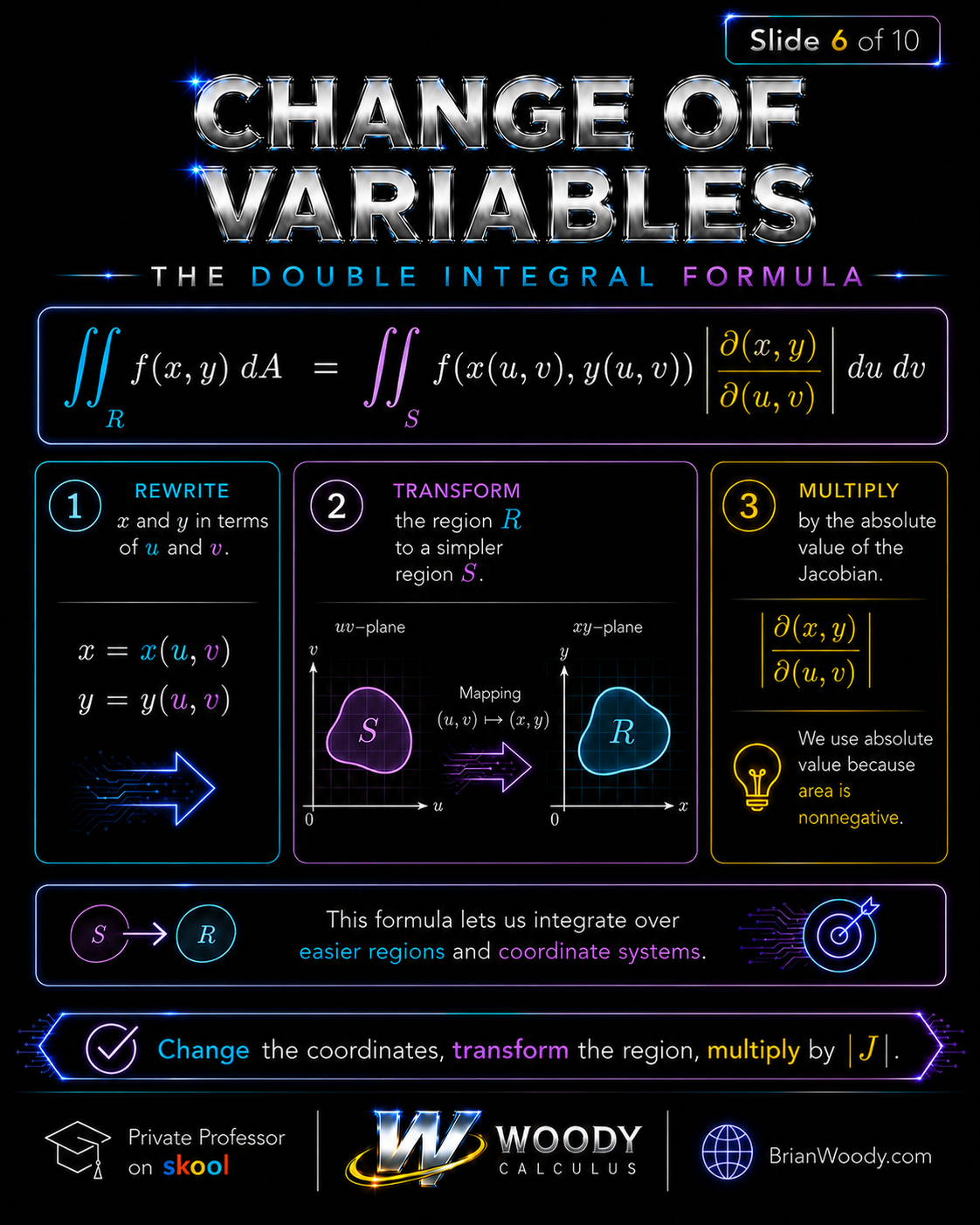
The Jacobian is essential in the change of variables formula for double integrals.
If a transformation sends a simpler region \(S\) in the \(uv\)-plane to a region \(R\) in the \(xy\)-plane, then
\[
\iint_R f(x,y)\,dA
=
\iint_S f(x(u,v),y(u,v))
\left|
\frac{\partial(x,y)}{\partial(u,v)}
\right|
\,du\,dv.
\]
This formula has three steps:
- Rewrite \(x\) and \(y\) in terms of \(u\) and \(v\).
- Re-express the integral over \(R\) as an integral over the simpler region \(S\).
- Multiply by the absolute value of the Jacobian.
We use the absolute value because area is nonnegative.
This formula lets us integrate over easier regions and coordinate systems.
Cylindrical Coordinates: Why \(dV=r\,dr\,d\theta\,dz\)
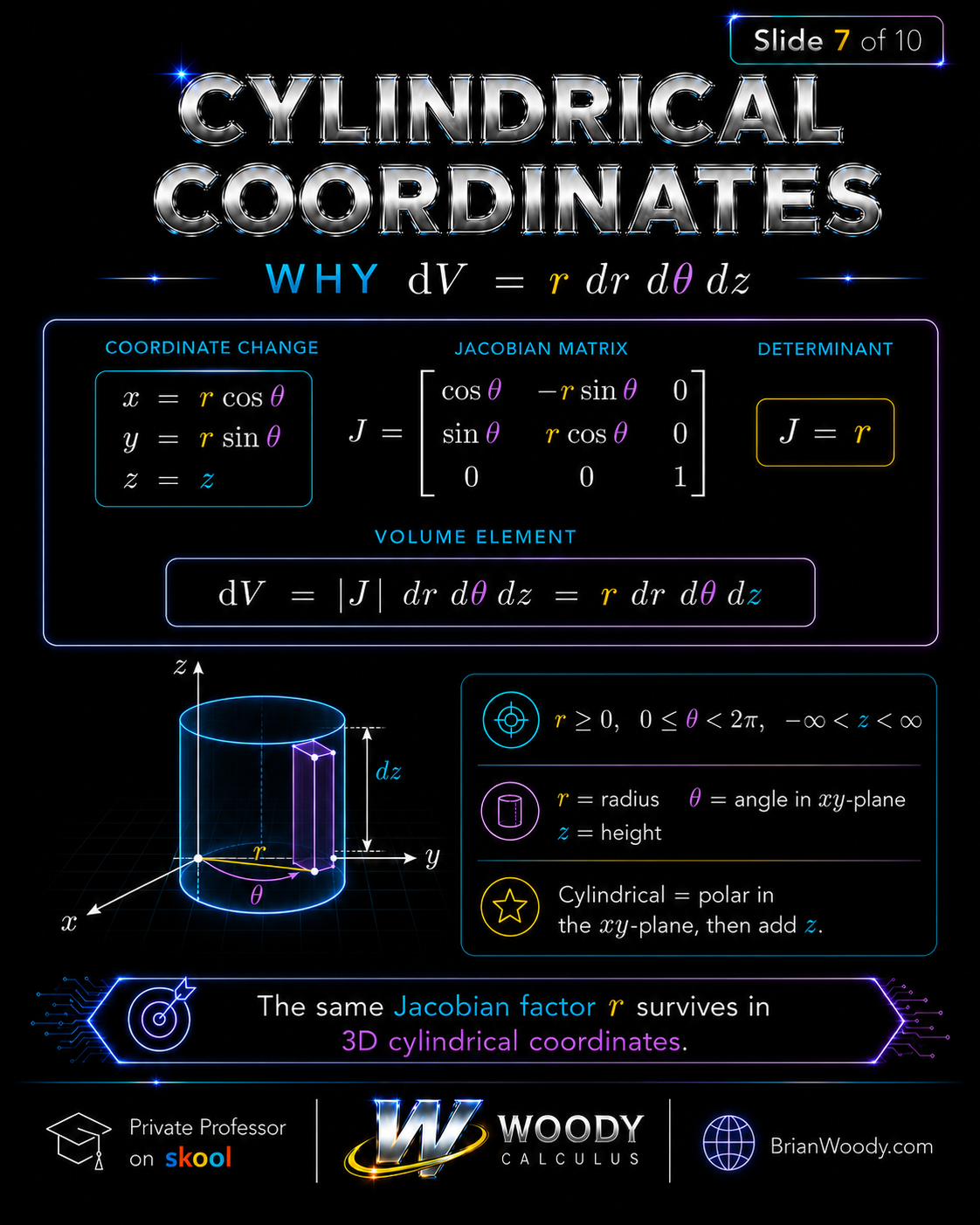
Cylindrical coordinates are polar coordinates in the \(xy\)-plane with height \(z\) added.
The coordinate change is
\[
x=r\cos\theta,
\qquad
y=r\sin\theta,
\qquad
z=z.
\]
The Jacobian matrix is
\[
\begin{bmatrix}
\cos\theta & -r\sin\theta & 0\\
\sin\theta & r\cos\theta & 0\\
0 & 0 & 1
\end{bmatrix}.
\]
Its determinant is
\[
J=r.
\]
Therefore the cylindrical volume element is
\[
dV=|J|\,dr\,d\theta\,dz=r\,dr\,d\theta\,dz.
\]
The same Jacobian factor \(r\) survives in \(3D\) cylindrical coordinates because cylindrical coordinates are just polar coordinates in the \(xy\)-plane with a vertical direction added.
Spherical Coordinates: Why \(dV=\rho^2\sin\phi\,d\rho\,d\phi\,d\theta\)
Spherical coordinates use three variables:
- \(\rho\): distance from the origin, with \(\rho\ge 0\)
- \(\phi\): angle from the positive \(z\)-axis, with \(0\le \phi\le \pi\)
- \(\theta\): azimuthal angle in the \(xy\)-plane, with \(0\le \theta<2\pi\)
The coordinate change is
\[
x=\rho\sin\phi\cos\theta,
\qquad
y=\rho\sin\phi\sin\theta,
\qquad
z=\rho\cos\phi.
\]
The Jacobian determinant for spherical coordinates is
\[
J=\rho^2\sin\phi.
\]
Therefore the spherical volume element is
\[
dV=\rho^2\sin\phi\,d\rho\,d\phi\,d\theta.
\]
The factor \(\rho^2\) accounts for radial spreading. The factor \(\sin\phi\) accounts for shrinking toward the poles.
This is why spherical coordinates need the full Jacobian factor \(\rho^2\sin\phi\).

Where the Jacobian Appears
The Jacobian appears whenever a coordinate change changes area or volume.
Here is the essential Calculus III cheat sheet:
- Rectangular coordinates: \(J=1\)
- Polar coordinates: \(J=r\)
- Cylindrical coordinates: \(J=r\)
- Spherical coordinates: \(J=\rho^2\sin\phi\)
These factors appear in double integrals, triple integrals, mass calculations, charge density calculations, probability density calculations, physics models, engineering models, and coordinate transformations.
The Jacobian is the scale factor behind every coordinate change.

Key Takeaways
- The Jacobian measures local area or volume scaling.
- The Jacobian is a determinant of a derivative matrix.
- For double integrals, \(dA=|J|\,du\,dv\).
- For polar coordinates, \(J=r\), so \(dA=r\,dr\,d\theta\).
- The extra \(r\) in polar coordinates comes from arc length.
- For cylindrical coordinates, \(J=r\), so \(dV=r\,dr\,d\theta\,dz\).
- For spherical coordinates, \(J=\rho^2\sin\phi\), so \(dV=\rho^2\sin\phi\,d\rho\,d\phi\,d\theta\).
- The Jacobian is essential for change of variables in Calculus III.
Jacobian FAQ
What is the Jacobian?
The Jacobian is the determinant of the derivative matrix for a coordinate transformation. It measures how areas or volumes scale locally when variables change.
Why do we use the absolute value of the Jacobian?
We use \(|J|\) because area and volume are nonnegative. The sign of \(J\) can describe orientation, but the size of an area or volume element must be positive.
Why is the polar Jacobian equal to \(r\)?
In polar coordinates, a small patch has radial side length \(dr\) and angular arc length approximately \(r\,d\theta\). Multiplying gives \(dA=r\,dr\,d\theta\), so the Jacobian is \(r\).
Why is the cylindrical Jacobian also \(r\)?
Cylindrical coordinates are polar coordinates in the \(xy\)-plane with height \(z\) added. The polar area scale factor \(r\) remains, so \(dV=r\,dr\,d\theta\,dz\).
Why is the spherical Jacobian \(\rho^2\sin\phi\)?
In spherical coordinates, \(\rho^2\) accounts for radial spreading and \(\sin\phi\) accounts for shrinking near the poles. Together they give the volume scale factor \(\rho^2\sin\phi\).
Master the Jacobian in Calculus III
The Jacobian is not just a formula. It is the bridge between Linear Algebra, determinants, coordinate transformations, and Calculus III.
To master the Jacobian, students need to connect:
- Geometry: tiny rectangles become parallelograms or curved patches.
- Determinants: the Jacobian is a determinant that measures scaling.
- Polar coordinates: \(dA=r\,dr\,d\theta\).
- Cylindrical coordinates: \(dV=r\,dr\,d\theta\,dz\).
- Spherical coordinates: \(dV=\rho^2\sin\phi\,d\rho\,d\phi\,d\theta\).
- Change of variables: the Jacobian makes transformed integrals correct.
At Woody Calculus, students build fluency through clean setup, repeated perfect solutions, formula memorization, pattern recognition, and saying every step out loud until the process becomes automatic.
The Jacobian is the missing scale factor that makes coordinate changes work.
— Brian M. Woody
If you are studying Calculus III, Differential Equations, Linear Algebra, or advanced university mathematics, the Jacobian is one of the ideas you want to master deeply.
Join Woody Calculus Mastery Lab on Skool

Related Woody Calculus Mathematical Essays
Explore more Woody Calculus visual lessons and deep-dive mathematical essays connecting
Calculus 2,
Calculus 3,
Differential Equations,
Linear Algebra,
Abstract Algebra,
Real Analysis,
topology,
Fourier Series,
Chaos Theory,
Galois Theory,
blockchain mathematics,
mathematical psychology and subconscious training,
artificial intelligence,
math anxiety,
and peak performance study methods and advanced problem-solving.
- How to Learn Calculus and Advanced Mathematics: A Peak Performance Study Guide
- The Determinant Explained: The Number That Measures How a Matrix Changes Space
- Eigenvalues and Eigenvectors Explained: The Special Directions That Unlock Linear Algebra
- Laplace Transforms Explained: Turning Differential Equations Into Algebra
- Euler’s Identity Explained: The Most Beautiful Equation in Mathematics
- Taylor Series Explained: Mathematical Time Travel in Calculus 2
- Gabriel’s Horn Explained: Finite Volume, Infinite Surface Area in Calculus 2
- Möbius Strip Explained: Orientation, Vector Calculus, and Stokes’ Theorem
- Fourier Series Explained: Harmonics, Sound, Heat, and Quantum Mechanics
- Line Integrals and Vector Fields: What They Measure in Calculus 3
- Chaos Theory Explained: Butterfly Effect, Lorenz System, and Lyapunov Exponents
- Galois Theory Explained: Hidden Symmetry and the Quintic
- The Baader-Meinhof Phenomenon in Mathematics: Pattern Recognition and Subconscious Training
- Blockchain Mathematics Explained: Hash Functions, Cryptography, AI, and Consensus
- View All Woody Calculus Blog Posts
Related University Math Help Pages
Woody Calculus supports students at major universities with structured help in Calculus III, Differential Equations, Linear Algebra, Calculus II, Abstract Algebra, Real Analysis, and advanced mathematics. For a full list of supported schools, visit the University Calculus Tutor Hub.
- University Calculus Tutor Hub
- MIT Calculus Tutor
- Purdue University Calculus Tutor
- University of Florida Calculus Tutor
- Colorado State University Calculus Help
- UCF Calculus Tutor
- Georgia Tech Calculus Tutor
- University of Michigan Calculus Tutor
- Virginia Tech Calculus Tutor
- University of Nevada, Reno Calculus Tutor
Trusted by Students Nationwide
The Woody Calculus Mastery Lab gives university students access to structured mathematics support, written solutions, video lessons, exam-focused training, and expert guidance from Brian M. Woody.
Students use Woody Calculus for Calculus III, Differential Equations, Linear Algebra, Calculus II, Abstract Algebra, Real Analysis, AP Calculus BC, and other advanced mathematics courses.
- Read Woody Calculus Google Reviews
- Private Math Tutor and Advanced Mathematics Instruction
- Join the Woody Calculus Mastery Lab