Polynomial irreducibility is never just about the polynomial—it depends on the coefficient ring or field. Learn a complete Abstract Algebra decision system using root tests, the Rational Root Theorem, Gauss’s Lemma, Eisenstein’s Criterion, reduction modulo p, finite-field factor tests, quotient rings, and field extensions.
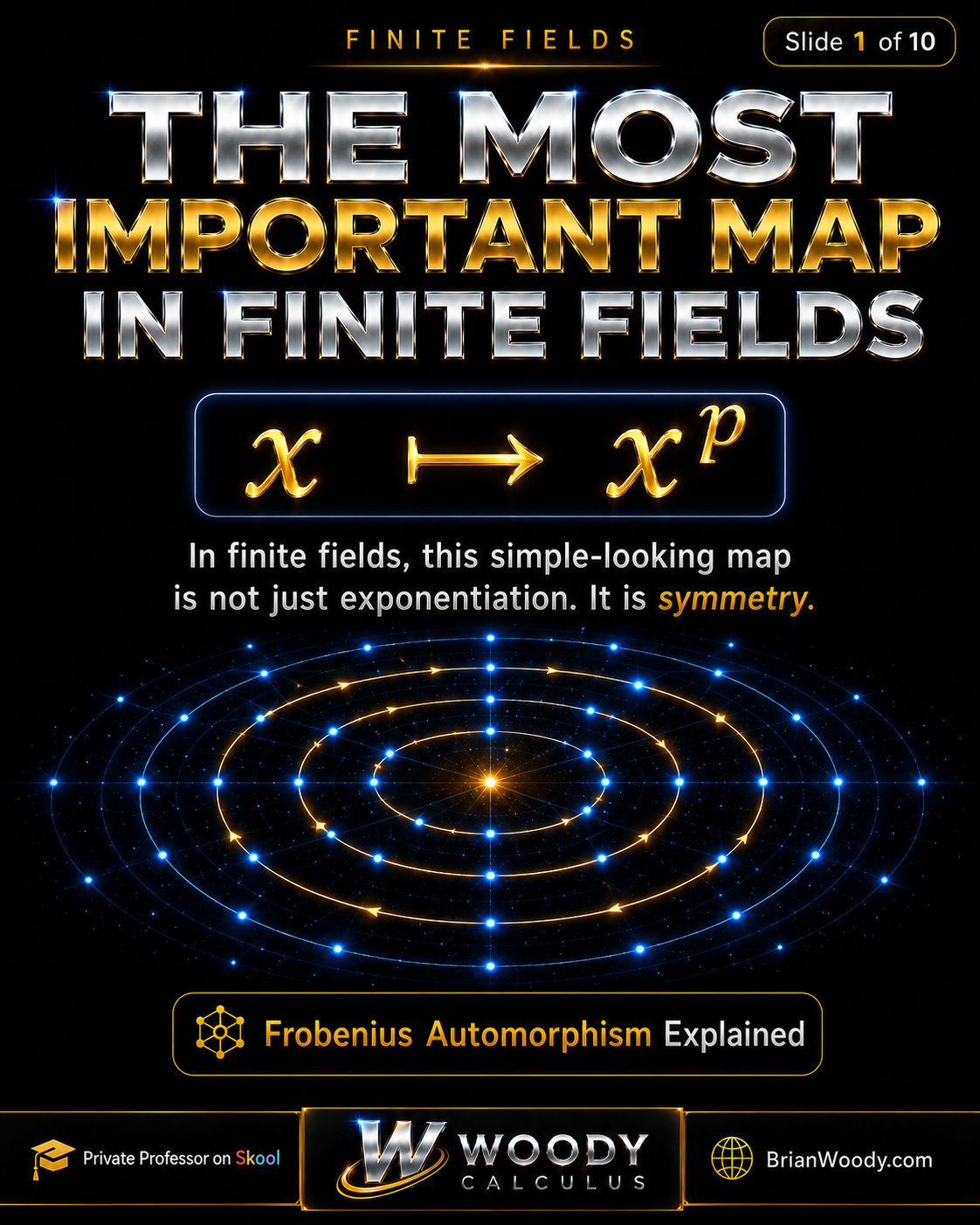
The Frobenius automorphism \(x\mapsto x^p\) is the central symmetry of finite fields. This Woody Calculus Abstract Algebra lesson explains characteristic \(p\), the Freshman’s Dream, cyclic finite-field Galois groups, Frobenius conjugates, trace, norm, unit circles, and how these ideas connect to modern finite-field research.
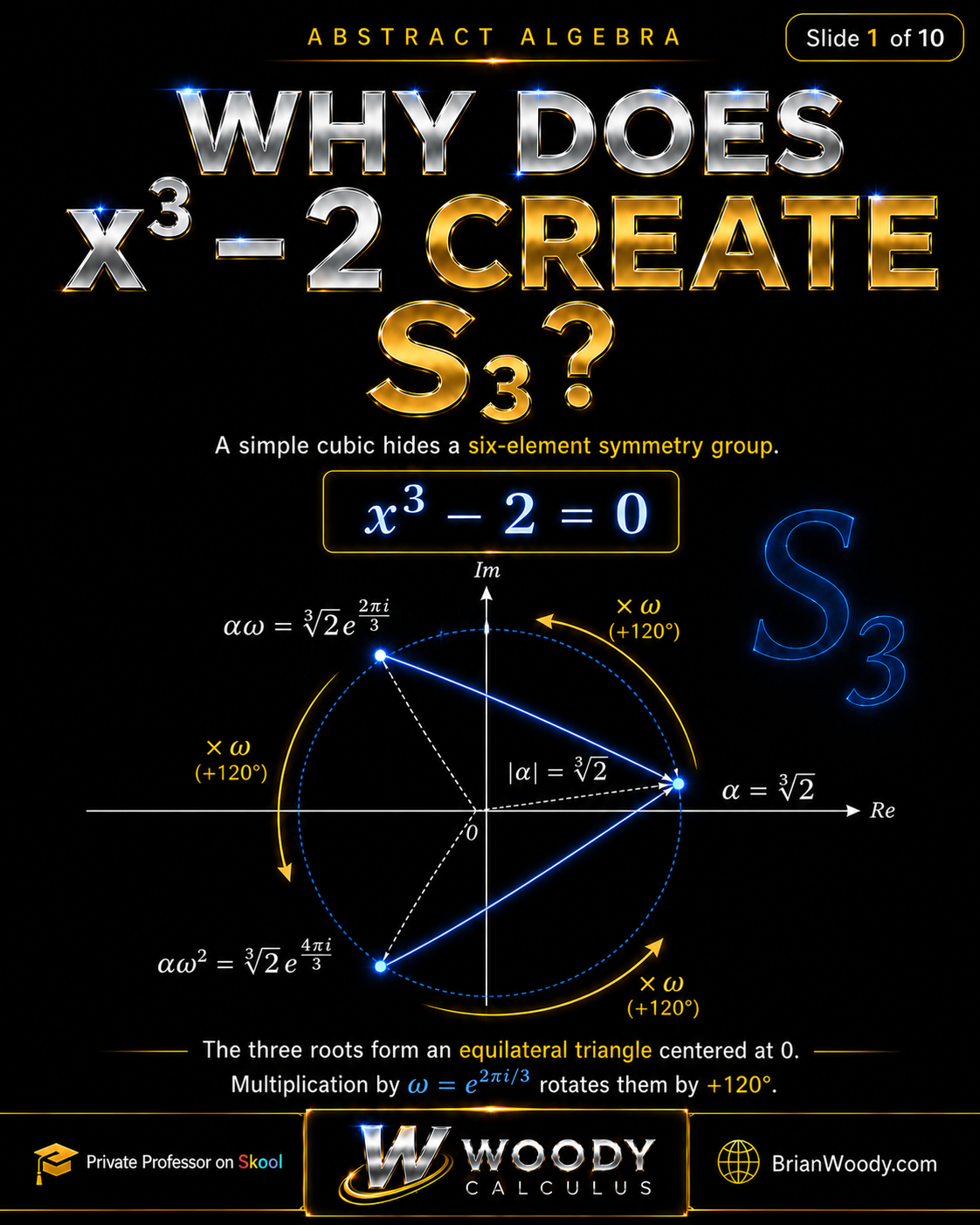
Why does the simple cubic x³ − 2 create the six-element symmetry group S₃? This Woody Calculus Abstract Algebra lesson explains the roots, splitting field, extension degree, automorphisms, triangle symmetries, and quotient group connection behind one of the cleanest examples in Galois theory.
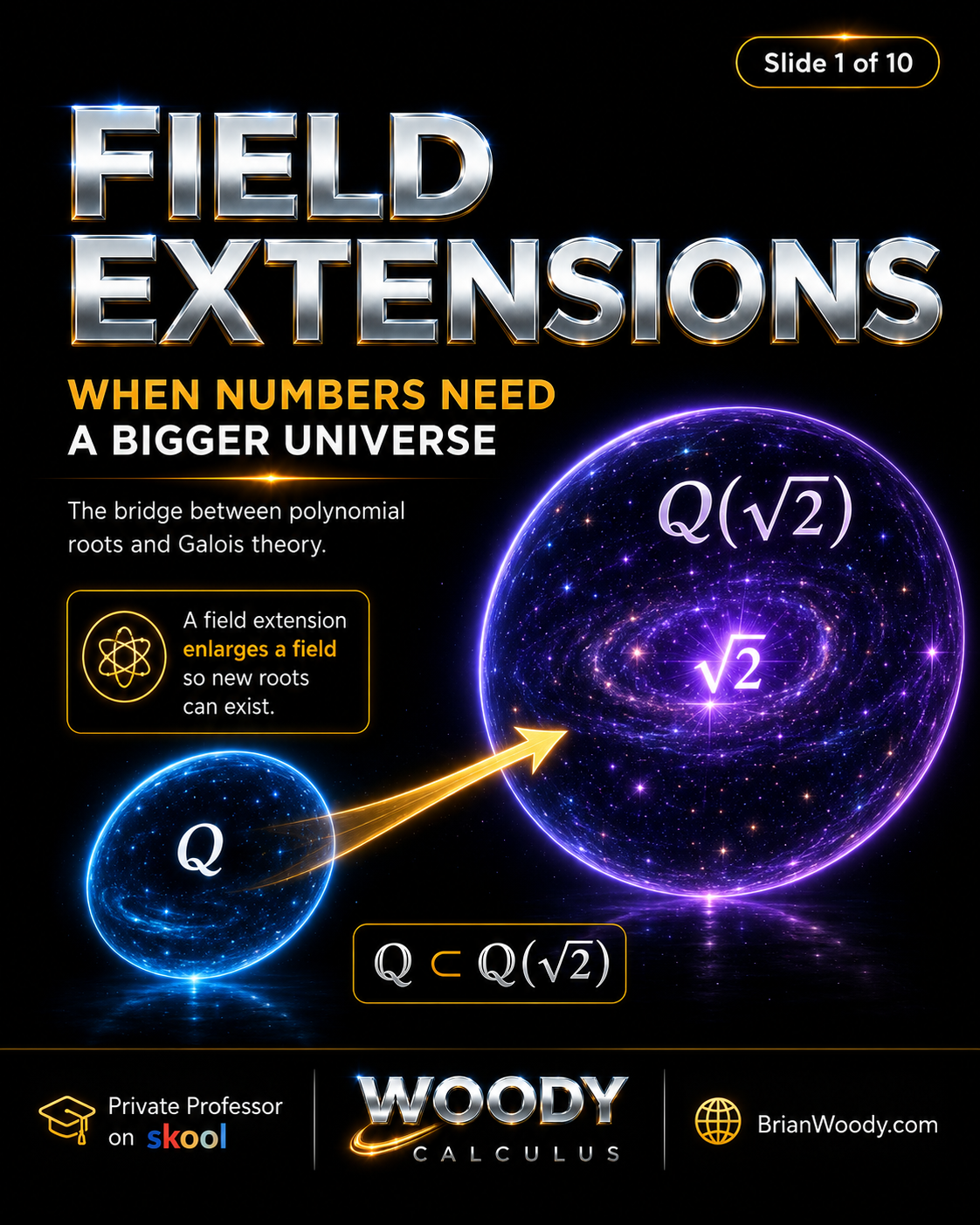
Field extensions are how Abstract Algebra builds a bigger number system when a polynomial has missing roots. In this Woody Calculus visual lesson, learn how Q becomes Q(√2), why x² − 2 has no rational root, how degree and minimal polynomials work, and why field extensions open the door to Galois theory.
Galois theory explains why some equations can be solved by radicals and others cannot. This undergraduate-friendly introduction explores Galois groups, splitting fields, fixed fields, subgroup lattices, normal subgroups, and the deep symmetry behind the quintic equation.