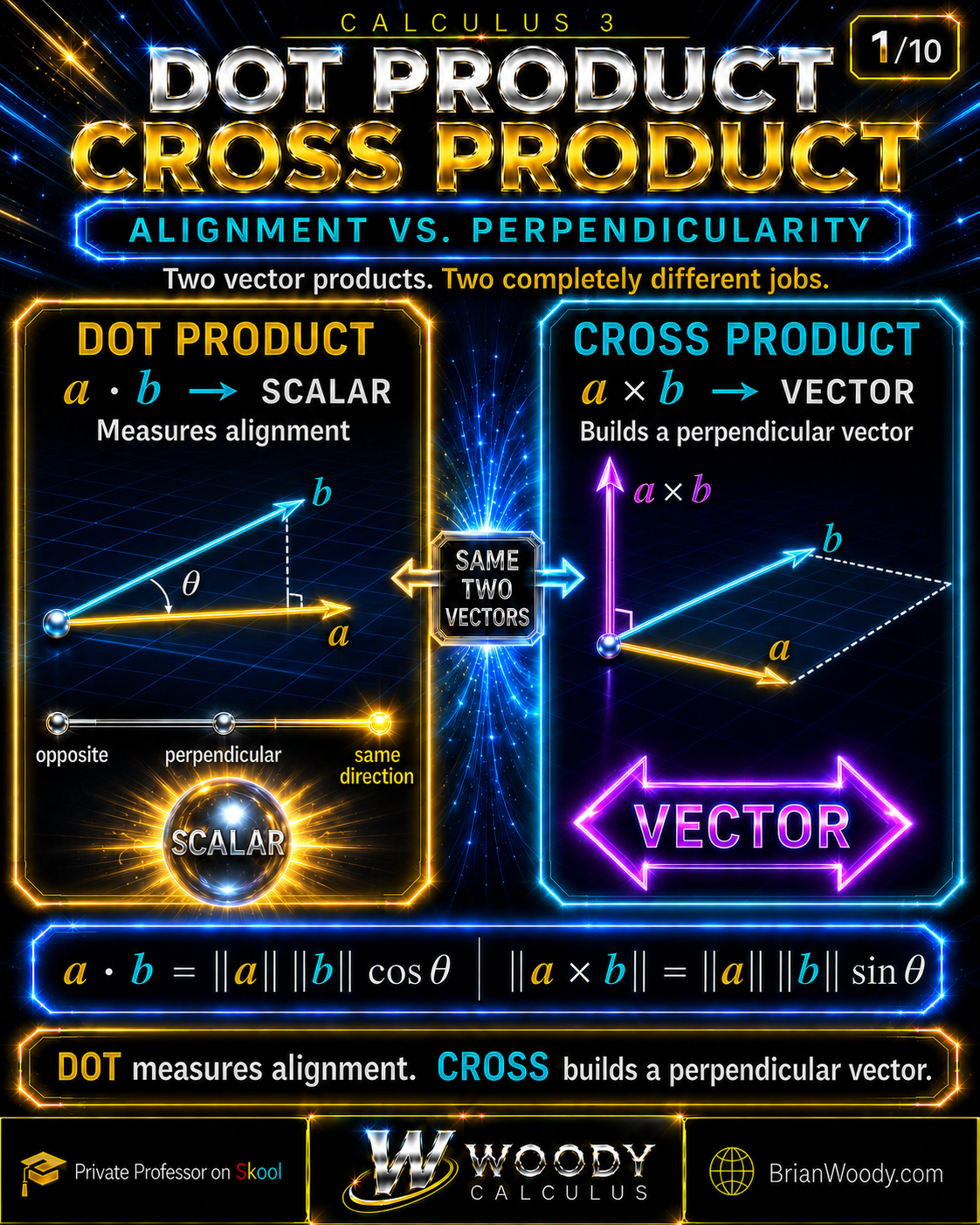
The dot product returns a scalar that measures alignment, while the cross product returns a vector perpendicular to two three-dimensional vectors. Learn the formulas, geometric meaning, right-hand rule, projections, work, area, plane normals, torque, flux, scalar triple products, Lagrange’s identity, and complete worked examples.
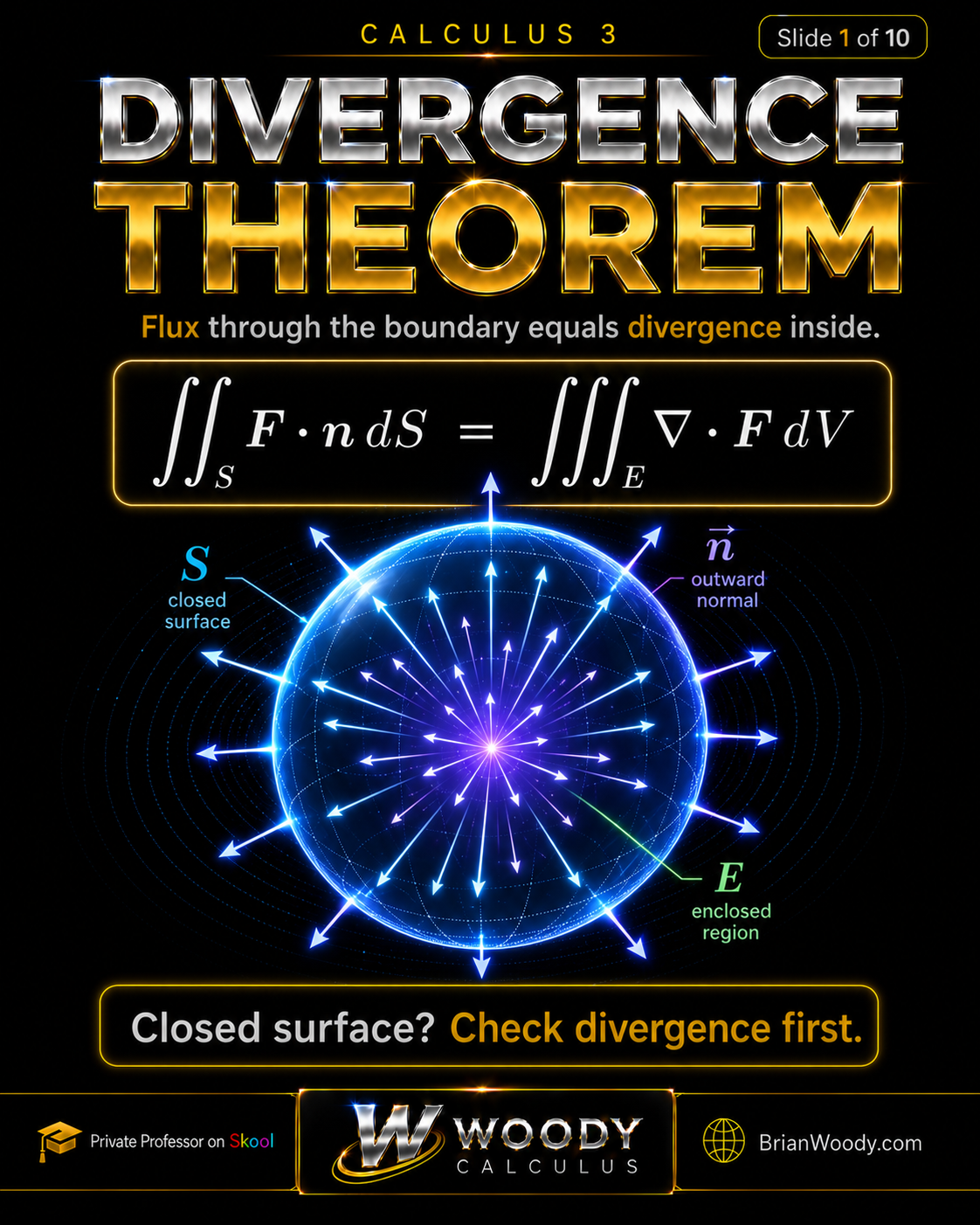
The Divergence Theorem converts outward flux through a closed surface into a triple integral of divergence over the enclosed solid. Learn the theorem’s conditions, flux and divergence meanings, method-selection rules, singularity warnings, and a complete sphere example with exact verification.
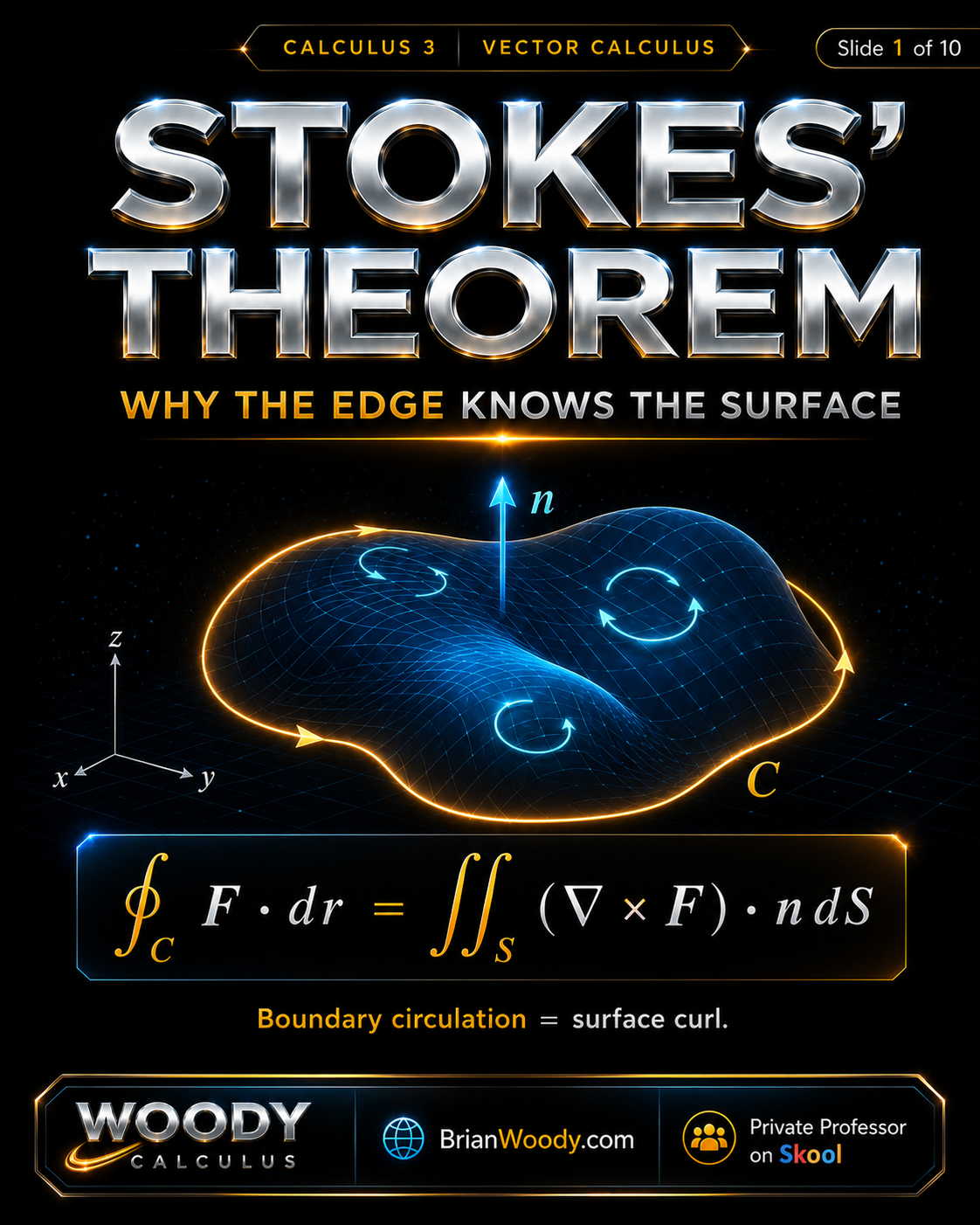
Stokes’ Theorem says that boundary circulation equals the total curl through a surface. In this Woody Calculus visual lesson, learn how Stokes’ Theorem connects line integrals, surface integrals, curl, orientation, the right-hand rule, Green’s Theorem, and vector calculus in Calculus 3.
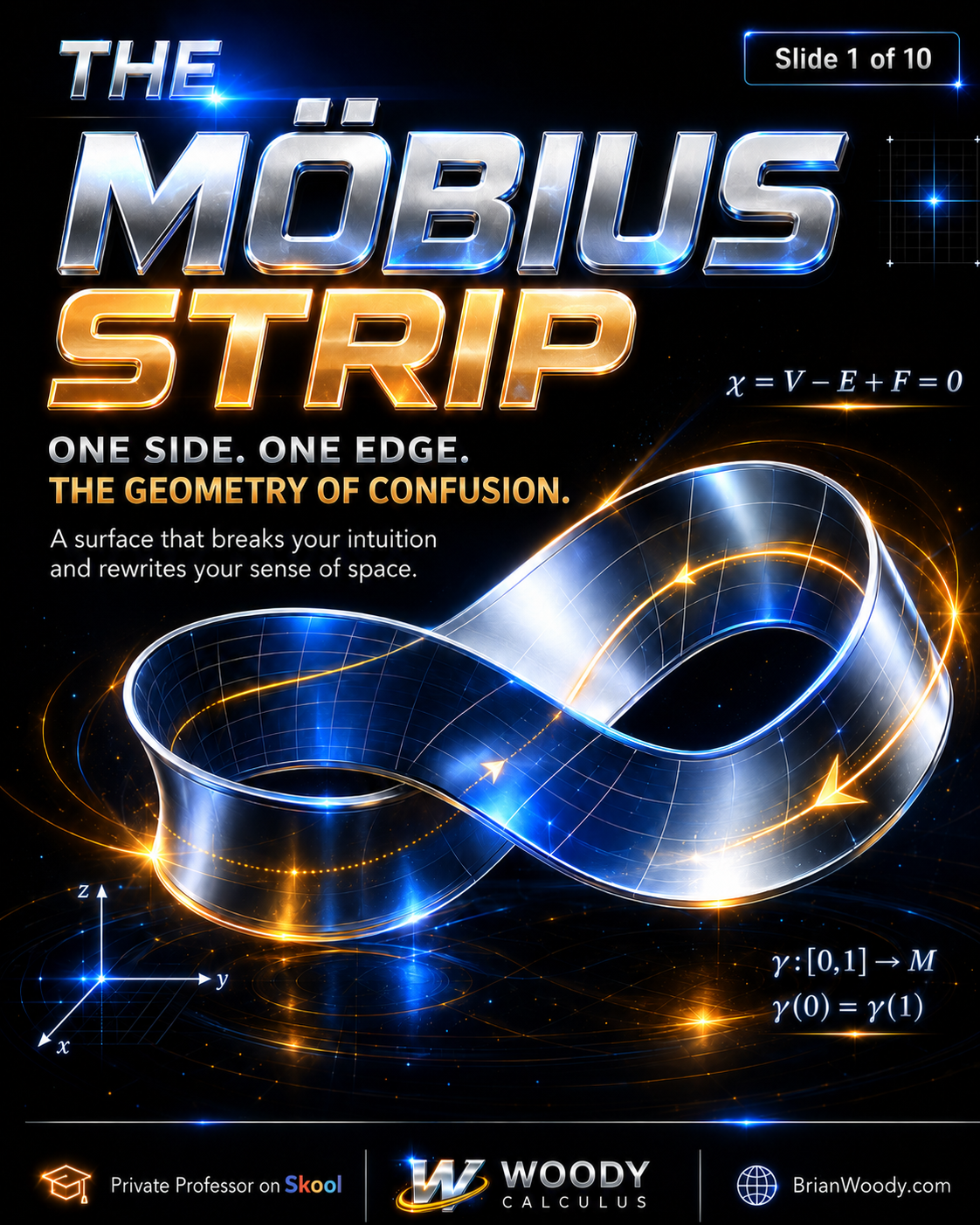
The Möbius strip is one of the clearest examples of why orientation matters in Calculus 3, vector calculus, topology, and surface integrals. Learn how one half-twist creates a one-sided surface with one boundary edge, no global normal vector, and a powerful obstruction to the standard global form of Stokes’ Theorem.