Polynomial irreducibility is never just about the polynomial—it depends on the coefficient ring or field. Learn a complete Abstract Algebra decision system using root tests, the Rational Root Theorem, Gauss’s Lemma, Eisenstein’s Criterion, reduction modulo p, finite-field factor tests, quotient rings, and field extensions.
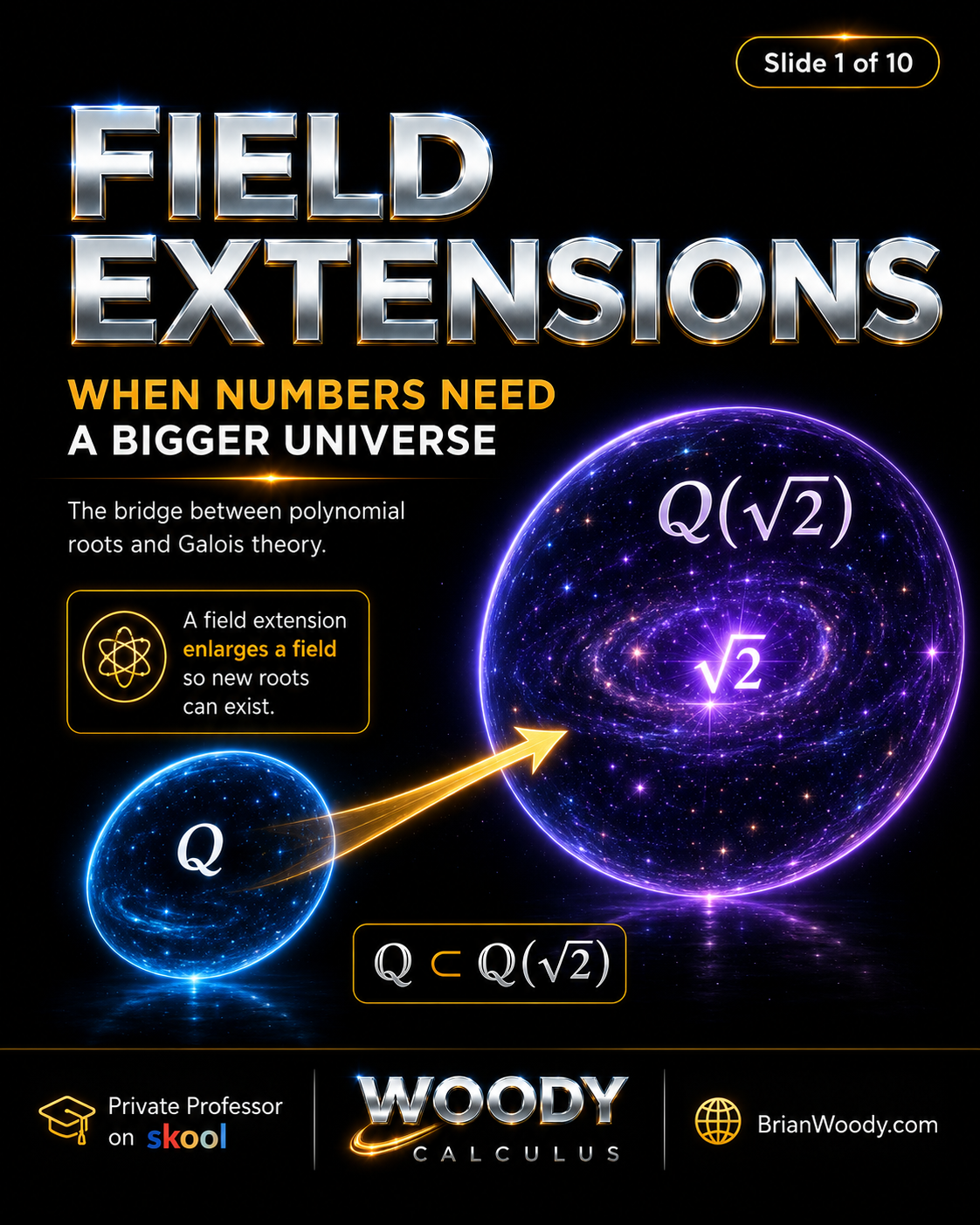
Field extensions are how Abstract Algebra builds a bigger number system when a polynomial has missing roots. In this Woody Calculus visual lesson, learn how Q becomes Q(√2), why x² − 2 has no rational root, how degree and minimal polynomials work, and why field extensions open the door to Galois theory.
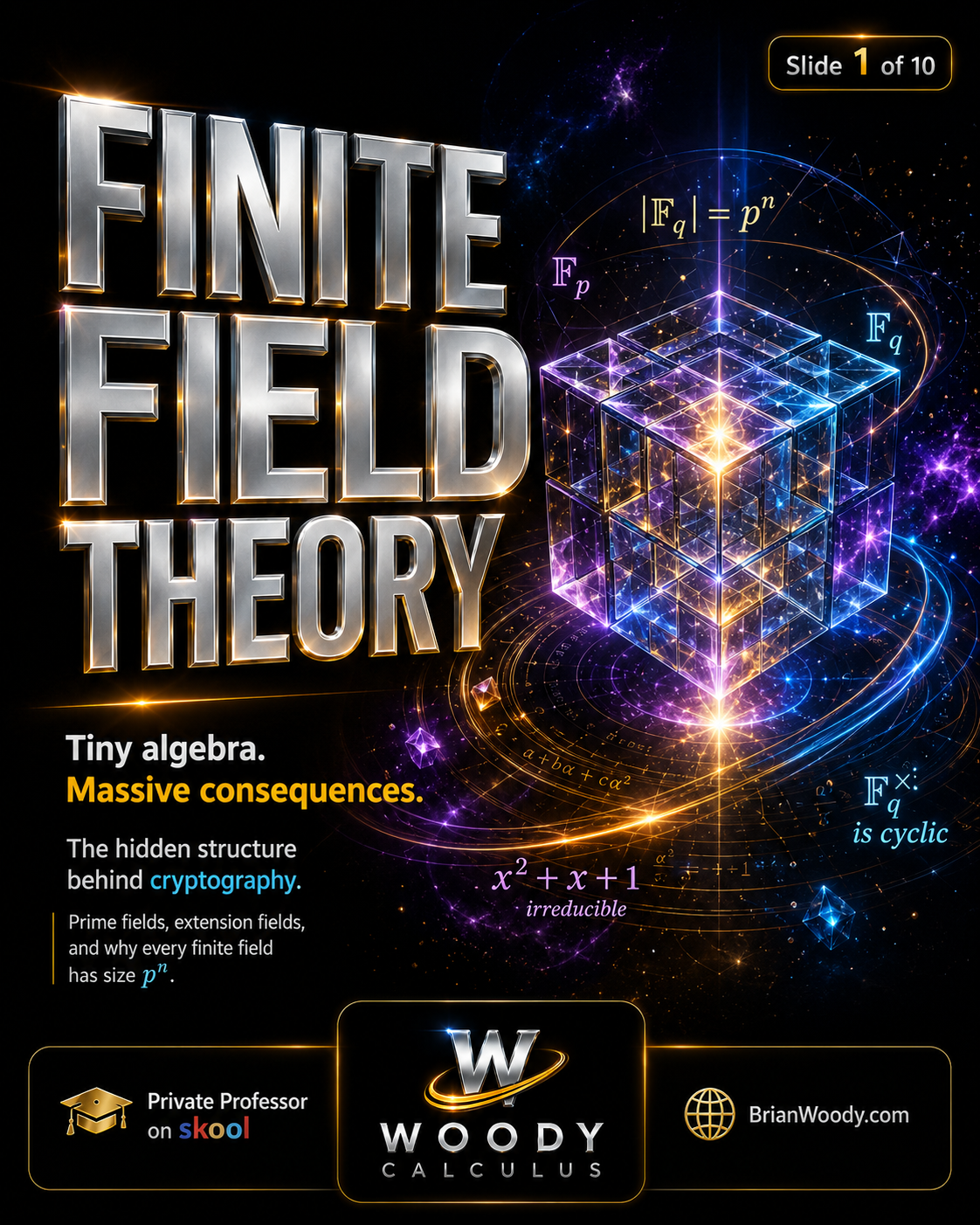
Finite field theory looks abstract until you realize it powers modern cryptography, error correction, QR codes, AES encryption, and elliptic curve cryptography. In this Woody Calculus visual lesson, learn what finite fields are, why prime fields matter, why every finite field has size q = p^n, how extension fields are built from irreducible polynomials, and why finite fields are the hidden algebra behind secure communication.