The Determinant Explained: The Number That Measures How a Matrix Changes Space
The determinant is one of the most important numbers in Linear Algebra. It tells you how a matrix changes space.
At first, the determinant may look like a formula to memorize:
\[
\det(A)=ad-bc.
\]
But the determinant is much more than a computation. It measures area scaling, volume scaling, orientation, invertibility, collapse, eigenvalue structure, and even solution behavior in Differential Equations.
This Woody Calculus visual lesson explains the determinant in order: what a determinant is, what it measures geometrically, what positive and negative determinants mean, why \(\det(A)=0\) is a warning sign, how determinants connect to invertibility, how to compute a \(2\times 2\) determinant, how determinants connect to eigenvalues, and why determinants appear in Wronskians and solution sets.
What Is the Determinant?
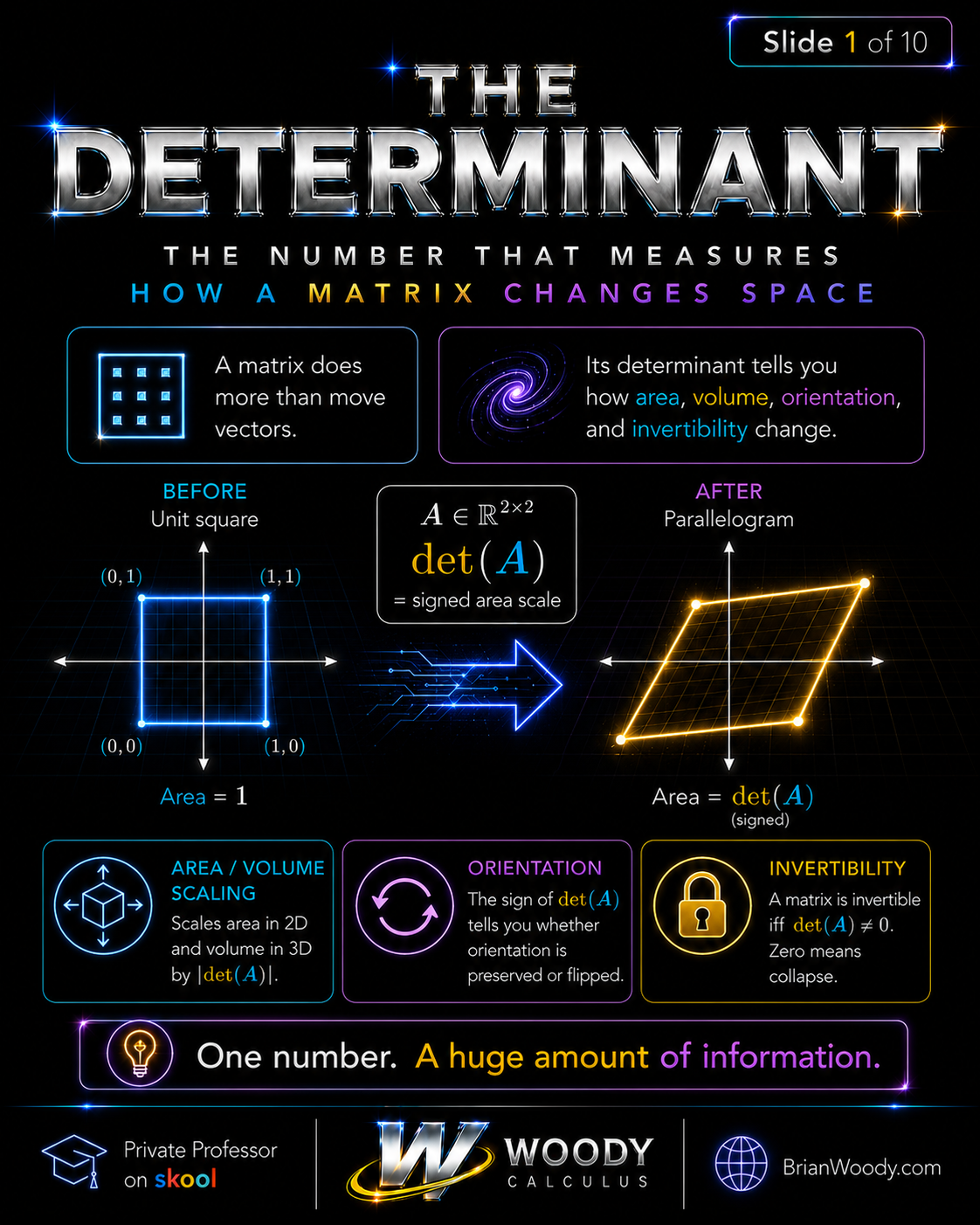
A matrix does more than move vectors. A matrix can transform space. It can stretch, shrink, shear, rotate, reflect, collapse, or reverse orientation.
The determinant summarizes a huge amount of information about that transformation in one number.
For a \(2\times 2\) matrix, the determinant tells you the signed area scale factor. If a matrix sends the unit square to a parallelogram, then the determinant tells you the signed area of that transformed parallelogram.
In two dimensions, the determinant measures signed area scaling. In three dimensions, it measures signed volume scaling. The absolute value \(|\det(A)|\) tells the size change, while the sign of \(\det(A)\) tells whether orientation is preserved or reversed.
The determinant also tells you whether a matrix is invertible:
\[
A \text{ is invertible if and only if } \det(A)\ne 0.
\]
If \(\det(A)=0\), then space collapses. Information is lost. The matrix cannot be undone.
A Single Number Attached to a Square Matrix
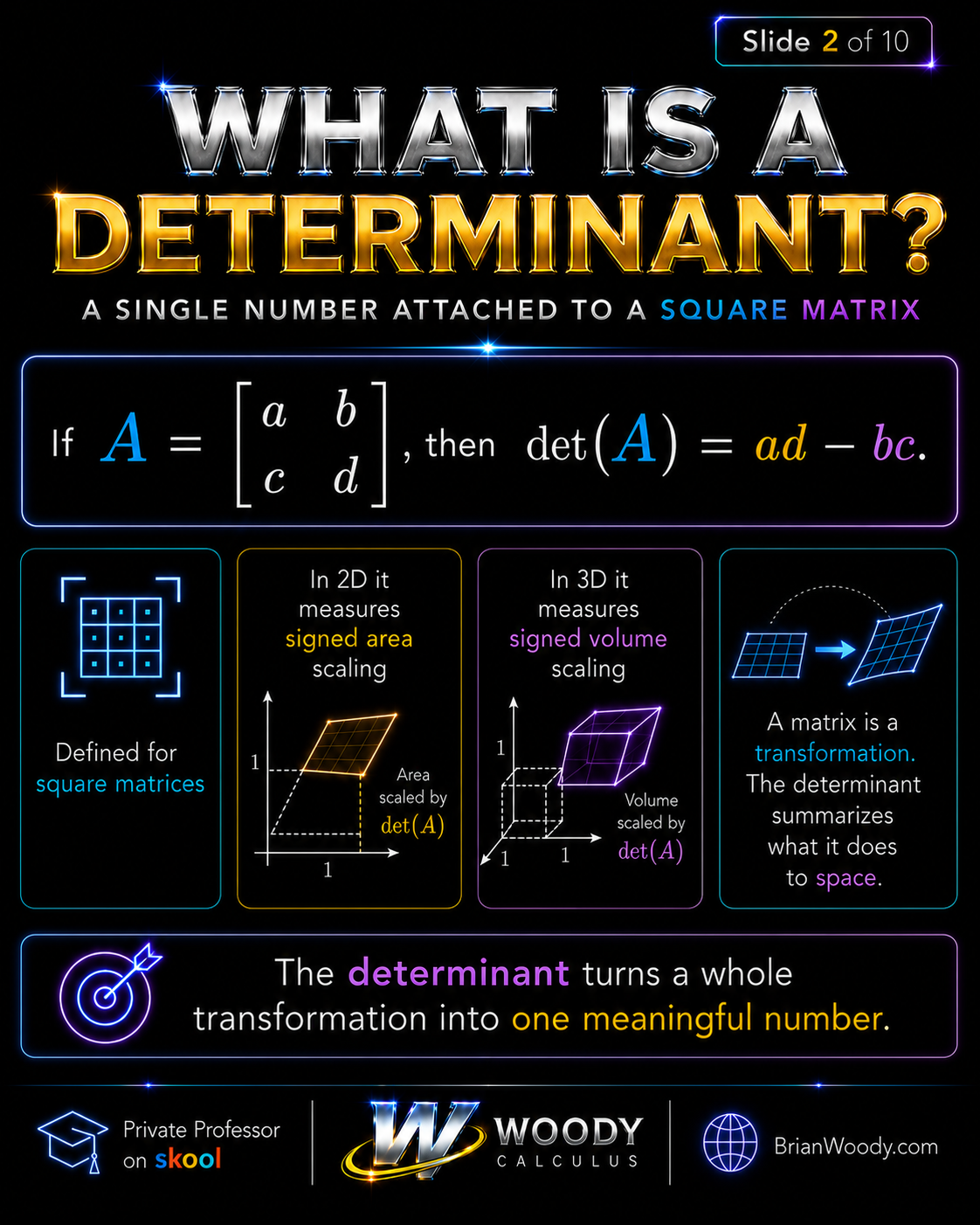
The determinant is defined for square matrices. For a \(2\times 2\) matrix
\[
A=
\begin{bmatrix}
a & b\\
c & d
\end{bmatrix},
\]
the determinant is
\[
\det(A)=ad-bc.
\]
This formula is fast to compute, but the meaning is much deeper than the arithmetic.
In \(2D\), the determinant measures signed area scaling. In \(3D\), it measures signed volume scaling. More generally, the determinant tells how a square matrix scales \(n\)-dimensional volume.
That means the determinant turns a whole matrix transformation into one meaningful number.
Geometric Meaning: Area Scaling
The geometric meaning of the determinant is one of the most important ideas in Linear Algebra.
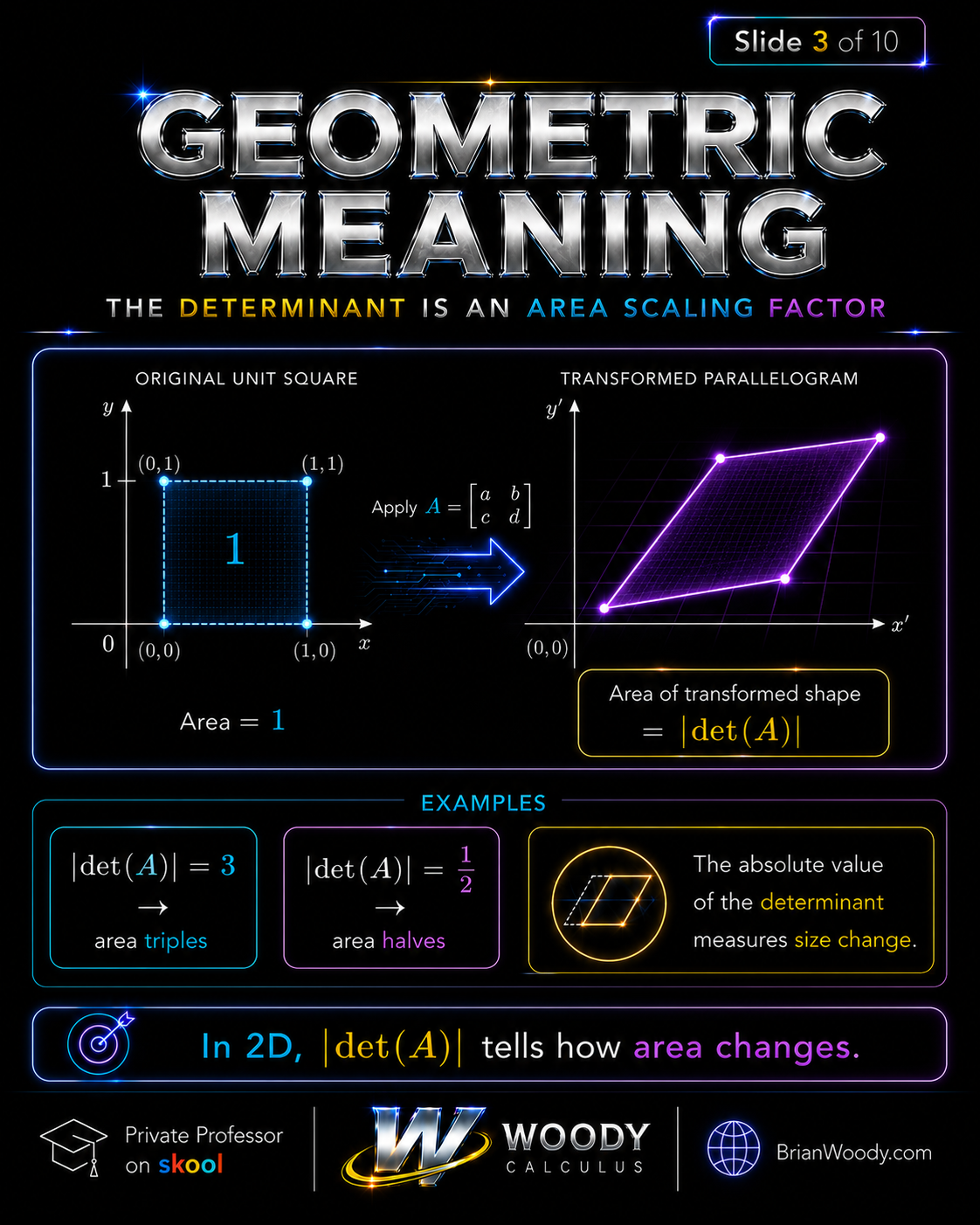
Start with the unit square. Its area is \(1\). When a \(2\times 2\) matrix \(A\) acts on the plane, it transforms that unit square into a parallelogram.
The area of the transformed parallelogram is \(|\det(A)|\).
The absolute value matters because area is always nonnegative. The determinant itself can be positive or negative, but \(|\det(A)|\) measures size change.
For example:
- If \(|\det(A)|=3\), area triples.
- If \(|\det(A)|=\frac{1}{2}\), area is cut in half.
- If \(|\det(A)|=1\), area is preserved.
- If \(|\det(A)|=0\), area collapses to zero.
So in \(2D\), \(|\det(A)|\) tells how area changes.
Sign and Orientation
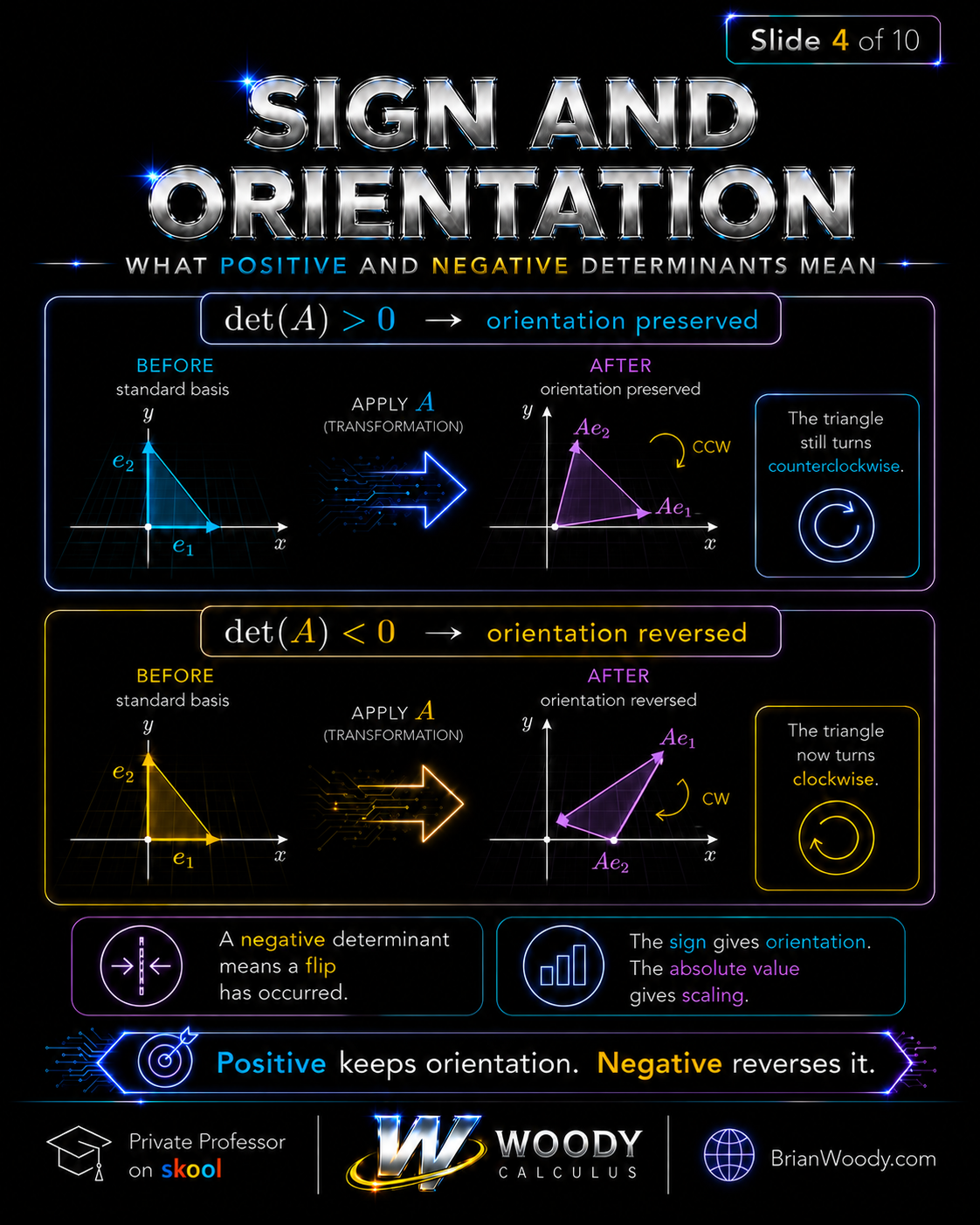
The sign of the determinant tells you whether orientation is preserved or reversed.
If \(\det(A) > 0\), then orientation is preserved. A positively oriented basis stays positively oriented. Visually, a counterclockwise orientation remains counterclockwise after the transformation.
If \(\det(A) < 0\), then orientation is reversed. A flip has occurred. A counterclockwise orientation becomes clockwise.
This gives a clean split:
- Positive determinant: orientation preserved.
- Negative determinant: orientation reversed.
- Absolute value of determinant: scaling factor.
So the determinant contains two kinds of information at once:
\[
\text{sign} \Rightarrow \text{orientation},
\qquad
|\det(A)| \Rightarrow \text{scaling}.
\]
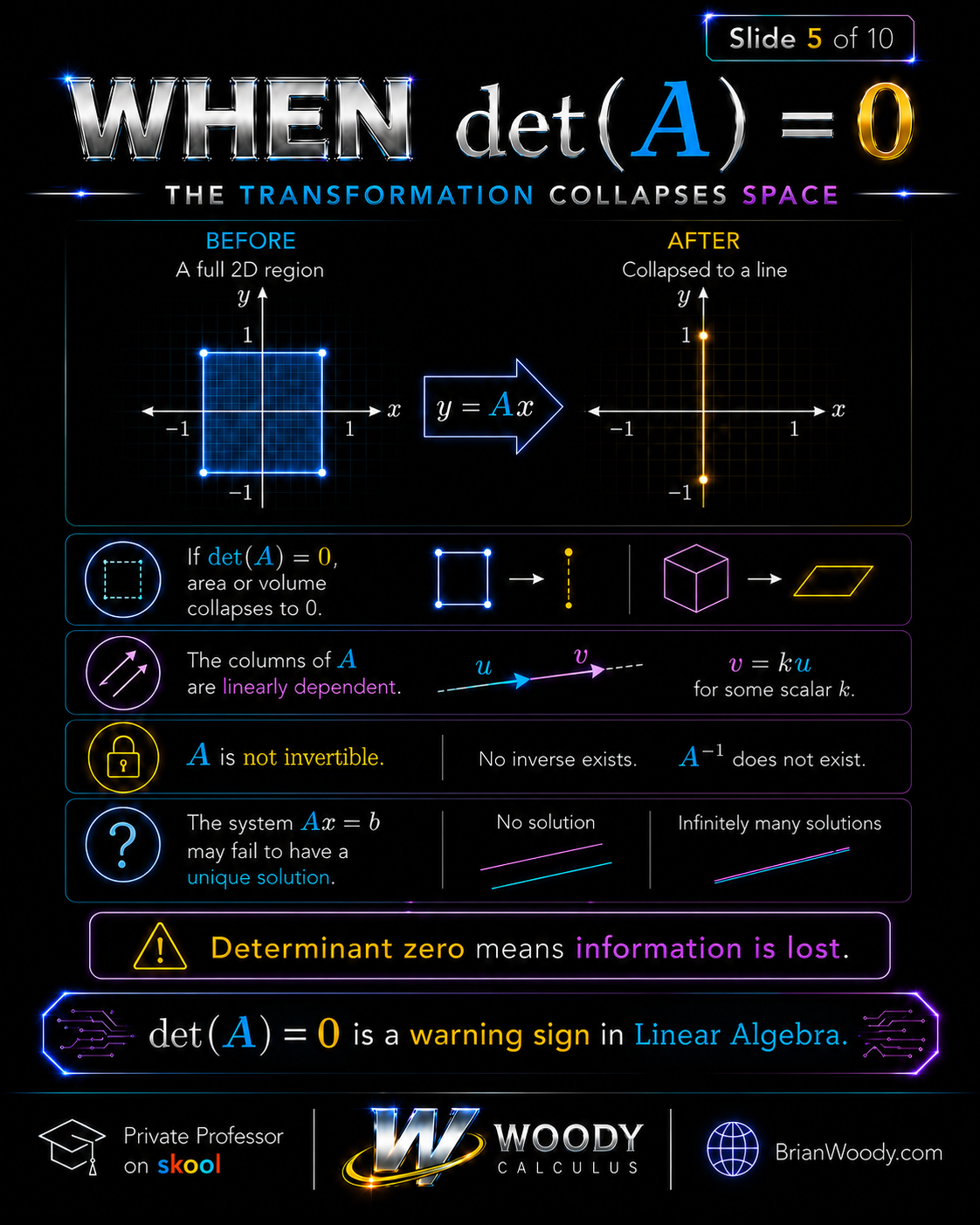
When \(\det(A)=0\): Collapse and Lost Information
The case \(\det(A)=0\) is one of the most important warning signs in Linear Algebra.
If \(\det(A)=0\), then the transformation collapses space. In two dimensions, a full region can collapse to a line. In three dimensions, volume can collapse to a plane or lower-dimensional object.
When this happens:
- Area or volume collapses to \(0\).
- The columns of \(A\) are linearly dependent.
- The matrix \(A\) is not invertible.
- No inverse \(A^{-1}\) exists.
- The system \(Ax=b\) may fail to have a unique solution.
Geometrically, determinant zero means information is lost. The transformation crushes space into a lower-dimensional object, so you cannot recover the original input uniquely.
That is why \(\det(A)=0\) is a major warning sign.
Invertibility and Systems
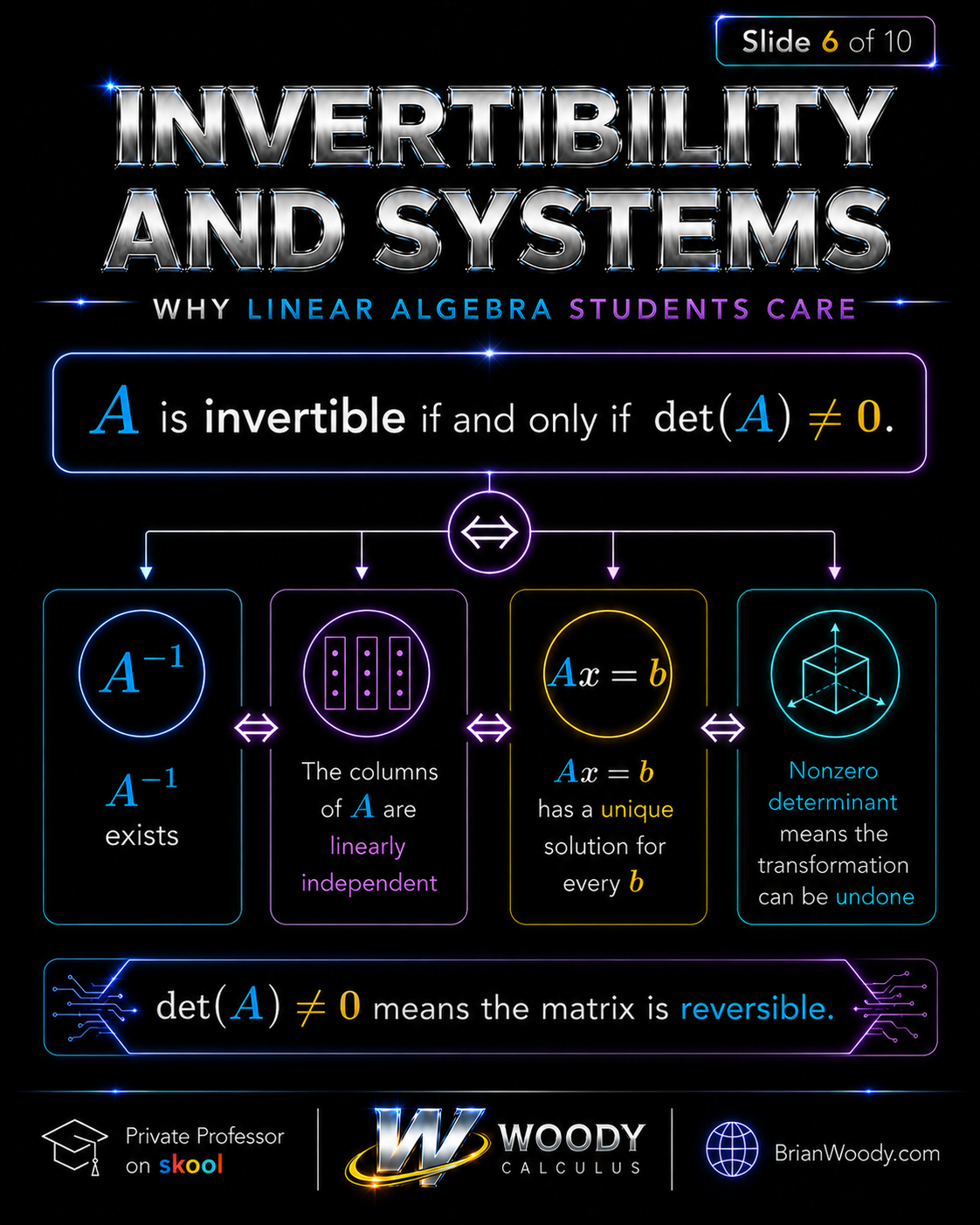
One of the most powerful facts in Linear Algebra is:
\[
A \text{ is invertible if and only if } \det(A)\ne 0.
\]
This statement connects determinants, inverse matrices, linear independence, systems of equations, and geometry.
When \(\det(A)\ne 0\):
- The inverse \(A^{-1}\) exists.
- The columns of \(A\) are linearly independent.
- The system \(Ax=b\) has a unique solution for every \(b\).
- The transformation can be undone.
A nonzero determinant means the matrix transformation is reversible. It may stretch, shrink, shear, rotate, or flip space, but it does not collapse space.
That is the key difference:
\[
\det(A)\ne 0 \Rightarrow \text{reversible},
\qquad
\det(A)=0 \Rightarrow \text{collapsed}.
\]
How to Compute a Determinant
For a \(2\times 2\) matrix, the determinant is quick to compute:
\[
\det
\begin{bmatrix}
a & b\\
c & d
\end{bmatrix}
=
ad-bc.
\]
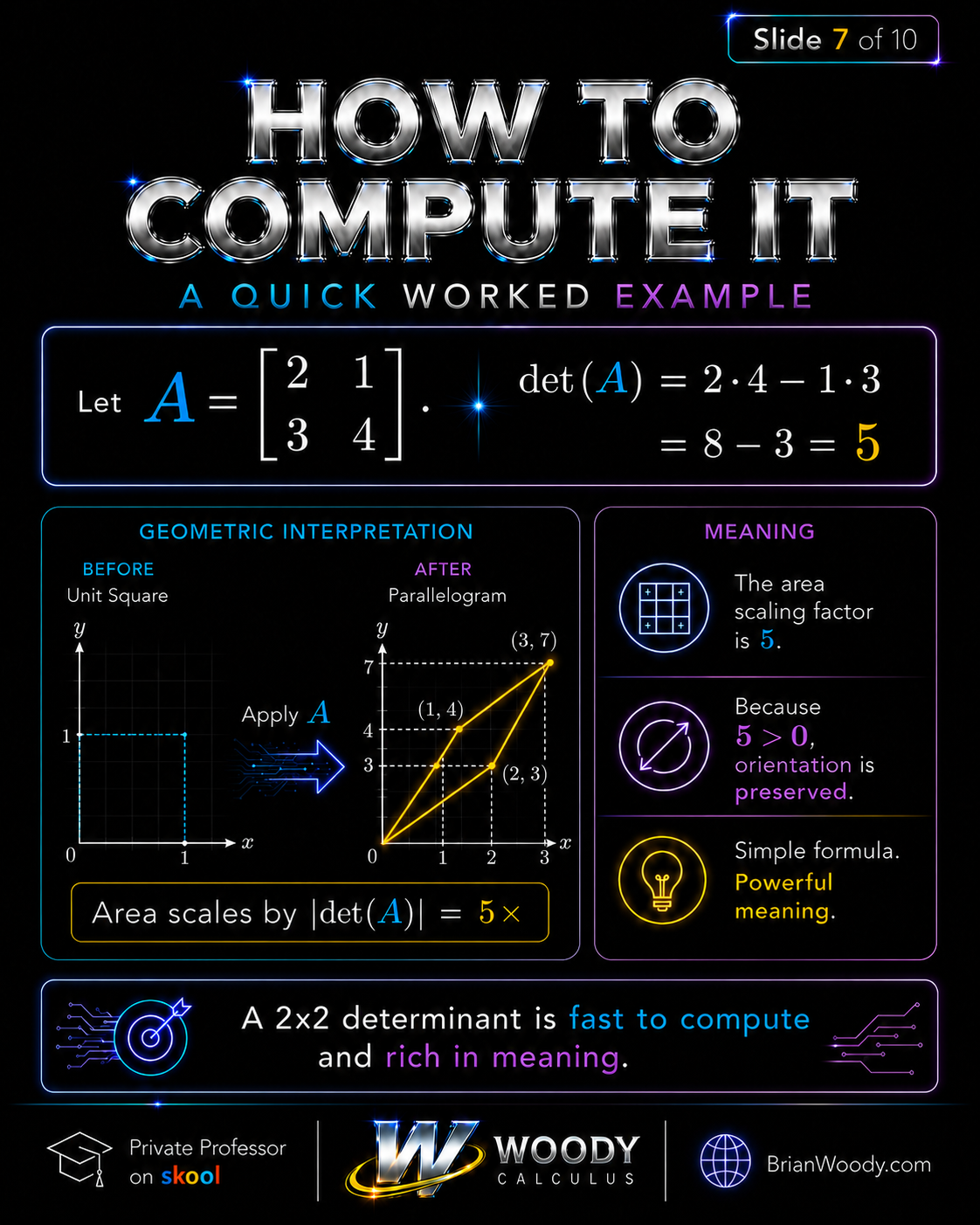
For example, let
\[
A=
\begin{bmatrix}
2 & 1\\
3 & 4
\end{bmatrix}.
\]
Then
\[
\det(A)=2\cdot 4-1\cdot 3.
\]
So
\[
\det(A)=8-3=5.
\]
This tells us several things immediately:
- The area scaling factor is \(|\det(A)|=5\).
- Because \(5 > 0\), orientation is preserved.
- Because \(\det(A)\ne 0\), the matrix is invertible.
A \(2\times 2\) determinant is fast to compute, but rich in meaning.
Eigenvalues and the Determinant
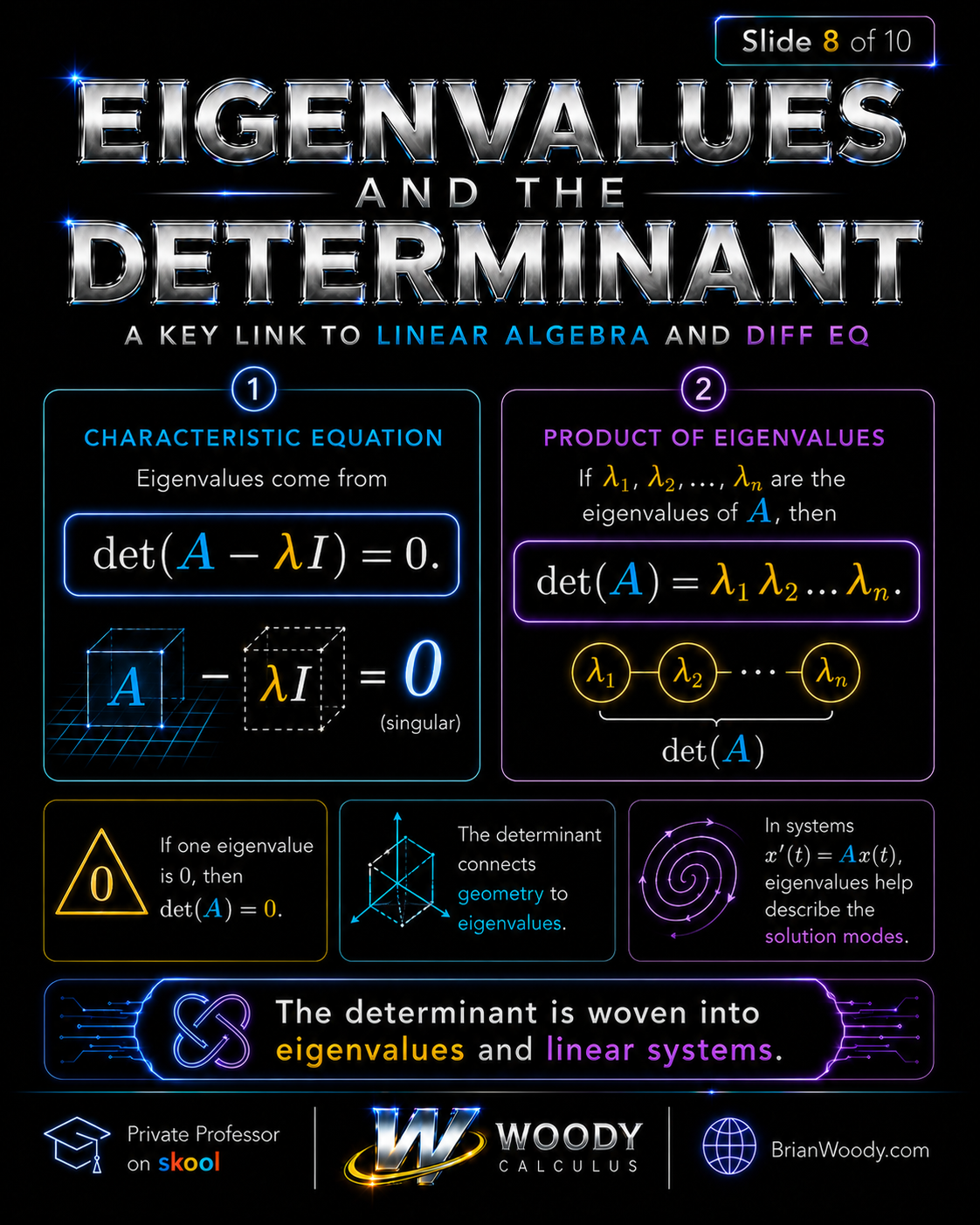
The determinant is deeply connected to eigenvalues.
Eigenvalues come from the characteristic equation
\[
\det(A-\lambda I)=0.
\]
This equation asks when \(A-\lambda I\) becomes singular. In other words, it asks when the transformation has a special direction that gets scaled by \(\lambda\).
If \(\lambda_1,\lambda_2,\ldots,\lambda_n\) are the eigenvalues of \(A\), counted with algebraic multiplicity, then
\[
\det(A)=\lambda_1\lambda_2\cdots\lambda_n.
\]
So the determinant is the product of the eigenvalues.
This explains an important fact: if one eigenvalue is \(0\), then \(\det(A)=0\).
That means the matrix is singular, not invertible, and collapses space in at least one direction.
The determinant connects geometry to eigenvalues. It links area and volume scaling to the hidden scaling factors of the matrix.
Determinants in Differential Equations
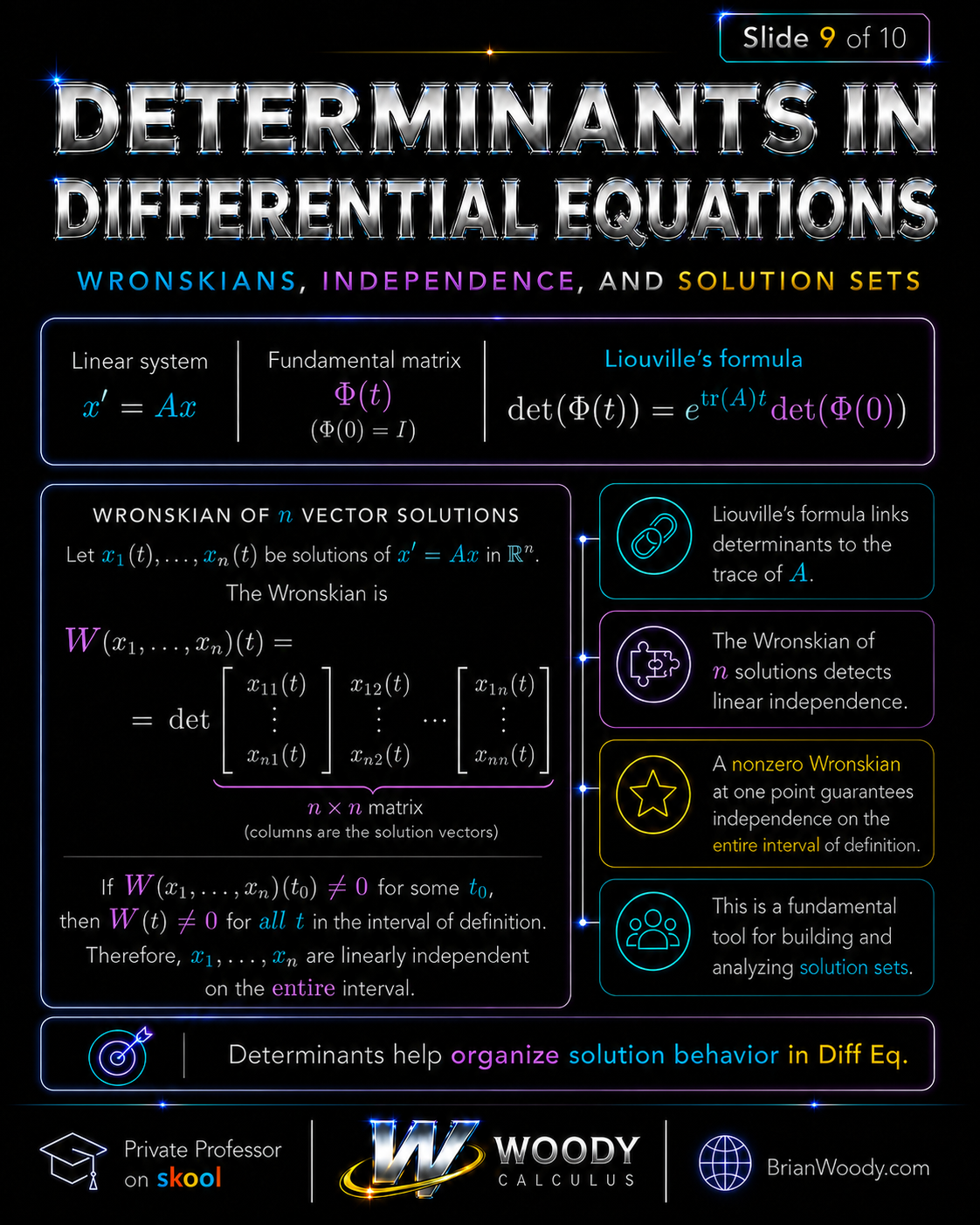
Determinants also appear naturally in Differential Equations, especially through Wronskians, fundamental matrices, and solution sets.
For a linear system
\[
x^{\prime}=Ax,
\]
a fundamental matrix \(\Phi(t)\) organizes independent vector solutions into one matrix. If \(\Phi(0)=I\), then Liouville’s formula for a constant matrix \(A\) gives
\[
\det(\Phi(t))=e^{\operatorname{tr}(A)t}\det(\Phi(0)).
\]
This formula links determinants to the trace of \(A\) and shows how solution volume evolves over time.
Wronskian of Vector Solutions
Suppose \(x_1(t),\ldots,x_n(t)\) are solutions of \(x^{\prime}=Ax\) in \(\mathbb{R}^n\). The Wronskian is the determinant of the matrix whose columns are the solution vectors:
\[
W(x_1,\ldots,x_n)(t)
=
\det
\begin{bmatrix}
x_{11}(t) & x_{12}(t) & \cdots & x_{1n}(t)\\
\vdots & \vdots & \ddots & \vdots\\
x_{n1}(t) & x_{n2}(t) & \cdots & x_{nn}(t)
\end{bmatrix}.
\]
If \(W(x_1,\ldots,x_n)(t_0)\ne 0\) for some \(t_0\), then \(W(t)\ne 0\) for all \(t\) in the interval of definition.
Therefore, \(x_1,\ldots,x_n\) are linearly independent on the entire interval.
This is why determinants help organize solution behavior in Differential Equations. A nonzero Wronskian guarantees that a set of solutions is independent and can be used to build the general solution.
Key Takeaways
- The determinant is a single number attached to a square matrix.
- In \(2D\), \(|\det(A)|\) measures area scaling.
- In \(3D\), \(|\det(A)|\) measures volume scaling.
- The sign of \(\det(A)\) tells whether orientation is preserved or reversed.
- If \(\det(A)=0\), the matrix collapses space and is not invertible.
- If \(\det(A)\ne 0\), the matrix is invertible and the transformation can be undone.
- The determinant equals the product of the eigenvalues.
- Wronskians use determinants to test whether solutions are linearly independent in Differential Equations.
Determinant FAQ
What does the determinant measure?
The determinant measures how a square matrix scales space. In two dimensions, it measures signed area scaling. In three dimensions, it measures signed volume scaling.
What does \(\det(A)=0\) mean?
If \(\det(A)=0\), the matrix collapses space into a lower-dimensional object. The matrix is not invertible, and information is lost.
What does a negative determinant mean?
A negative determinant means the transformation reverses orientation. In two dimensions, a counterclockwise orientation becomes clockwise.
How is the determinant connected to eigenvalues?
The determinant is the product of the eigenvalues of a matrix, counted with algebraic multiplicity. If any eigenvalue is zero, then the determinant is zero.
Why does the determinant matter in Differential Equations?
Determinants appear in Wronskians and fundamental matrices. A nonzero Wronskian shows that a set of solutions is linearly independent, which is essential for building the general solution.
Master Linear Algebra and Differential Equations
The determinant is not just a formula. It is a bridge between geometry, algebra, and Differential Equations.
To truly understand determinants, students need to connect:
- Geometry: determinants measure area and volume scaling.
- Orientation: the sign of the determinant tells whether orientation is preserved or reversed.
- Invertibility: nonzero determinant means the matrix can be undone.
- Eigenvalues: the determinant is the product of the eigenvalues.
- Differential Equations: Wronskians use determinants to test solution independence.
At Woody Calculus, students build fluency through clean setup, step-by-step solutions, concept breakdowns, formula memorization, repeated practice, and saying every step out loud until the method becomes automatic.
The determinant is one number, but it contains the story of how a matrix changes space.
— Brian M. Woody
If you are studying Linear Algebra, Differential Equations, Calculus II, Calculus III, or advanced university mathematics, determinants are one of the foundational ideas you want to master deeply.
Students who want to go deeper can explore the Woody Calculus Mastery Lab, where Brian M. Woody teaches advanced mathematics through clear structure, expert-guided repetition, and exam-focused problem solving.
Join Woody Calculus Private Professor on Skool
You can also explore more lessons, mathematical essays, and advanced mathematics support at BrianWoody.com.
Related Woody Calculus Mathematical Essays
Explore more Woody Calculus visual lessons and deep-dive mathematical essays connecting
Real Analysis,
Calculus 2,
Calculus 3,
Differential Equations,
Linear Algebra,
Abstract Algebra,
topology,
Fourier Series,
Chaos Theory,
Galois Theory,
blockchain mathematics,
mathematical psychology and subconscious training,
artificial intelligence,
math anxiety,
and peak performance study methods and advanced problem-solving.
- Eigenvalues and Eigenvectors Explained: The Special Directions That Unlock Linear Algebra
- Laplace Transforms Explained: Turning Differential Equations Into Algebra
- How to Learn Calculus and Advanced Mathematics: A Peak Performance Study Guide
- Euler’s Identity Explained: The Most Beautiful Equation in Mathematics
- Taylor Series Explained: Mathematical Time Travel in Calculus 2
- Cantor Set Explained: Infinite Points, Zero Length in Real Analysis
- Möbius Strip Explained: Orientation, Vector Calculus, and Stokes’ Theorem
- Fourier Series Explained: Harmonics, Sound, Heat, and Quantum Mechanics
- Gabriel’s Horn Explained: Finite Volume, Infinite Surface Area in Calculus 2
- Line Integrals and Vector Fields: What They Measure in Calculus 3
- Chaos Theory Explained: Butterfly Effect, Lorenz System, and Lyapunov Exponents
- Galois Theory Explained: Hidden Symmetry and the Quintic
- The Baader-Meinhof Phenomenon in Mathematics: Pattern Recognition and Subconscious Training
- Blockchain Mathematics Explained: Hash Functions, Cryptography, AI, and Consensus
- View All Woody Calculus Blog Posts
Related University Math Help Pages
Woody Calculus supports students at major universities with structured help in Calculus, Differential Equations, Linear Algebra, Abstract Algebra, Real Analysis, and advanced mathematics.
- University Calculus Tutor Hub
- MIT Calculus Tutor
- Purdue University Calculus Tutor
- University of Florida Calculus Tutor
- Colorado State University Calculus Help
- UCF Calculus Tutor
- Georgia Tech Calculus Tutor
- University of Michigan Calculus Tutor
- Michigan State Calculus Tutor
- Virginia Tech Calculus Tutor
- University of Nevada, Reno Calculus Tutor
Trusted by Students Nationwide
The Woody Calculus Mastery Lab gives university students access to structured mathematics support, written solutions, video lessons, exam-focused training, and expert guidance from Brian M. Woody.
Students use Woody Calculus for Linear Algebra, Differential Equations, Calculus II, Calculus III, Abstract Algebra, Real Analysis, AP Calculus BC, and other advanced mathematics courses.
- Read Woody Calculus Google Reviews
- Private Math Tutor and Advanced Mathematics Instruction
- Join the Woody Calculus Mastery Lab
Universities Supported by Woody Calculus
Students from universities across the United States use Woody Calculus for help with Calculus, Differential Equations, Linear Algebra, Abstract Algebra, Real Analysis, and advanced mathematics.
- View the full university calculus tutor hub
- Colorado State University Calculus Help
- UCF Calculus Tutor
- Purdue University Calculus Tutor
- University of Florida Calculus Tutor
- Georgia Tech Calculus Tutor
- Texas A&M Calculus Tutor
- Penn State Calculus Tutor
- Arizona State Calculus Tutor
- UCLA Calculus Tutor
- UC San Diego Calculus Tutor
- Michigan State Calculus Tutor
- Virginia Tech Calculus Tutor
- University of Washington Calculus Tutor
- University of Illinois Urbana-Champaign Calculus Tutor
- Rutgers Calculus Tutor
- University of Maryland Calculus Tutor
- Indiana University Calculus Tutor
- UNC Calculus Tutor
- Auburn University Calculus Tutor
- SDSU Calculus Tutor
- University of Nevada, Reno Calculus Tutor