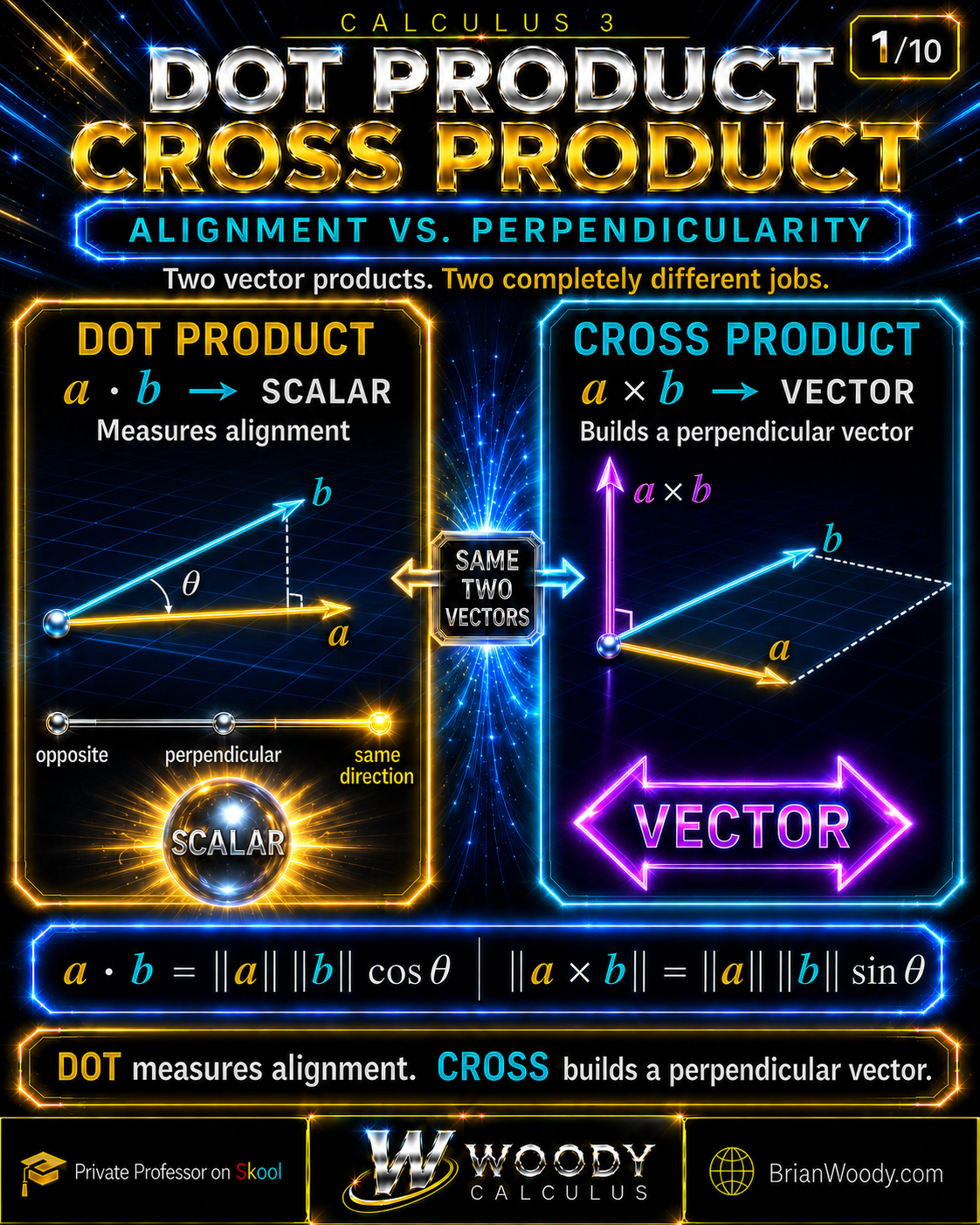
The dot product returns a scalar that measures alignment, while the cross product returns a vector perpendicular to two three-dimensional vectors. Learn the formulas, geometric meaning, right-hand rule, projections, work, area, plane normals, torque, flux, scalar triple products, Lagrange’s identity, and complete worked examples.
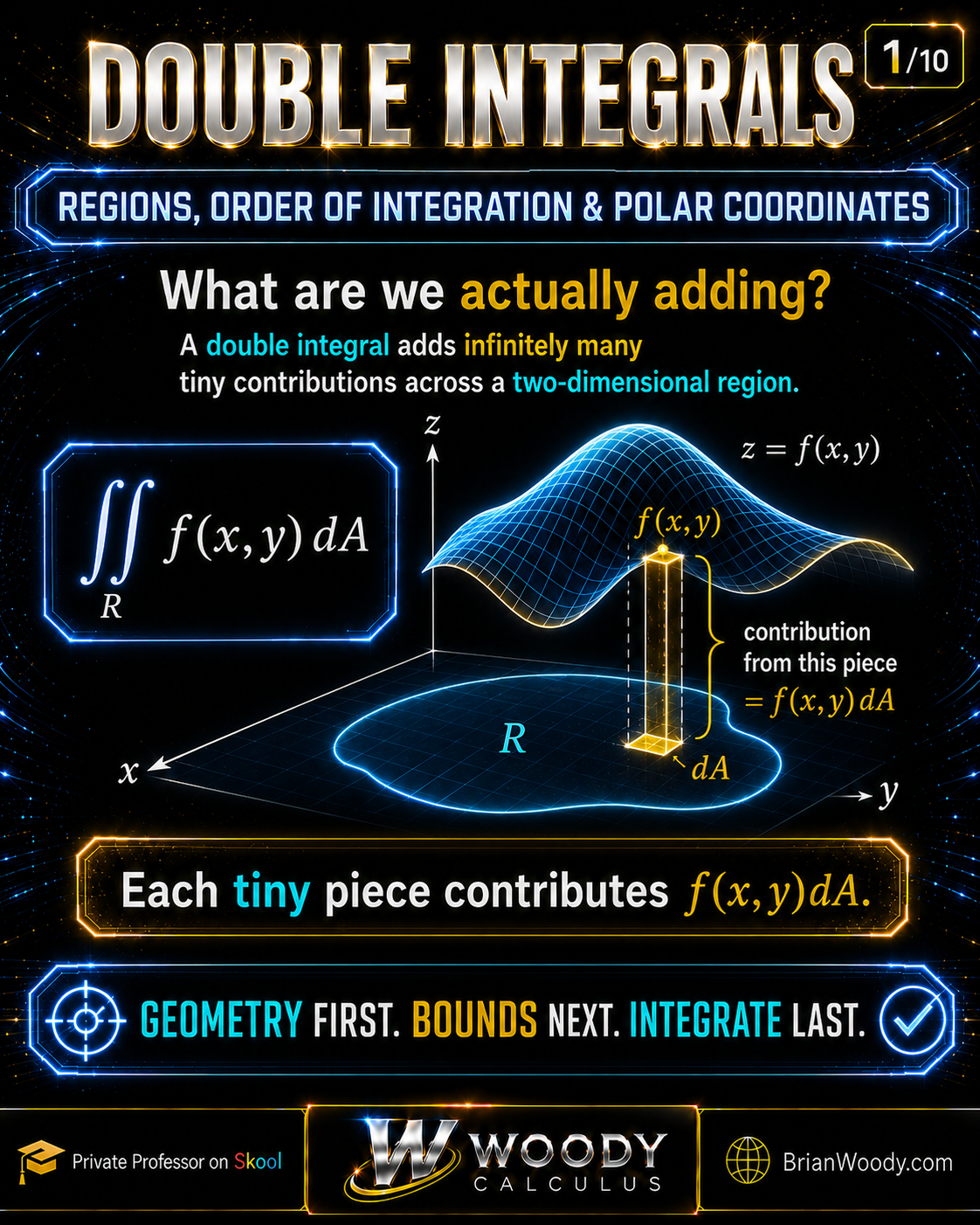
This complete Woody Calculus lesson explains double integrals from the ground up. Learn the geometric meaning of ∬R f(x,y) dA, how Fubini’s Theorem turns double integrals into iterated integrals, how to identify Type I and Type II regions, how to reverse the order of integration, and when polar coordinates make the setup easier.
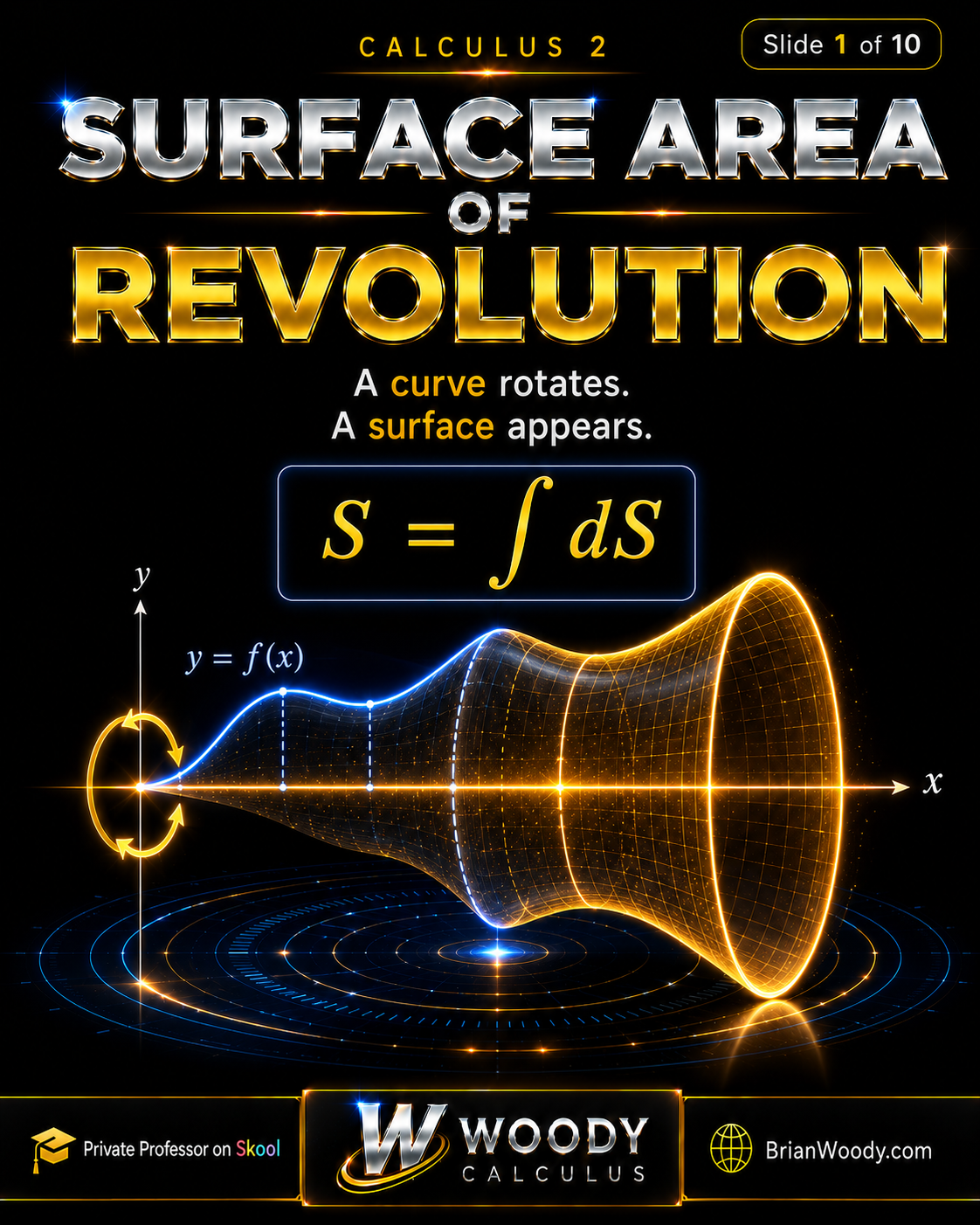
Surface area of revolution measures the curved surface created when a graph rotates around an axis. This Woody Calculus lesson derives dS = 2πr ds, explains the x-axis and y-axis formulas, and solves the complete example y = √x on [0,4].
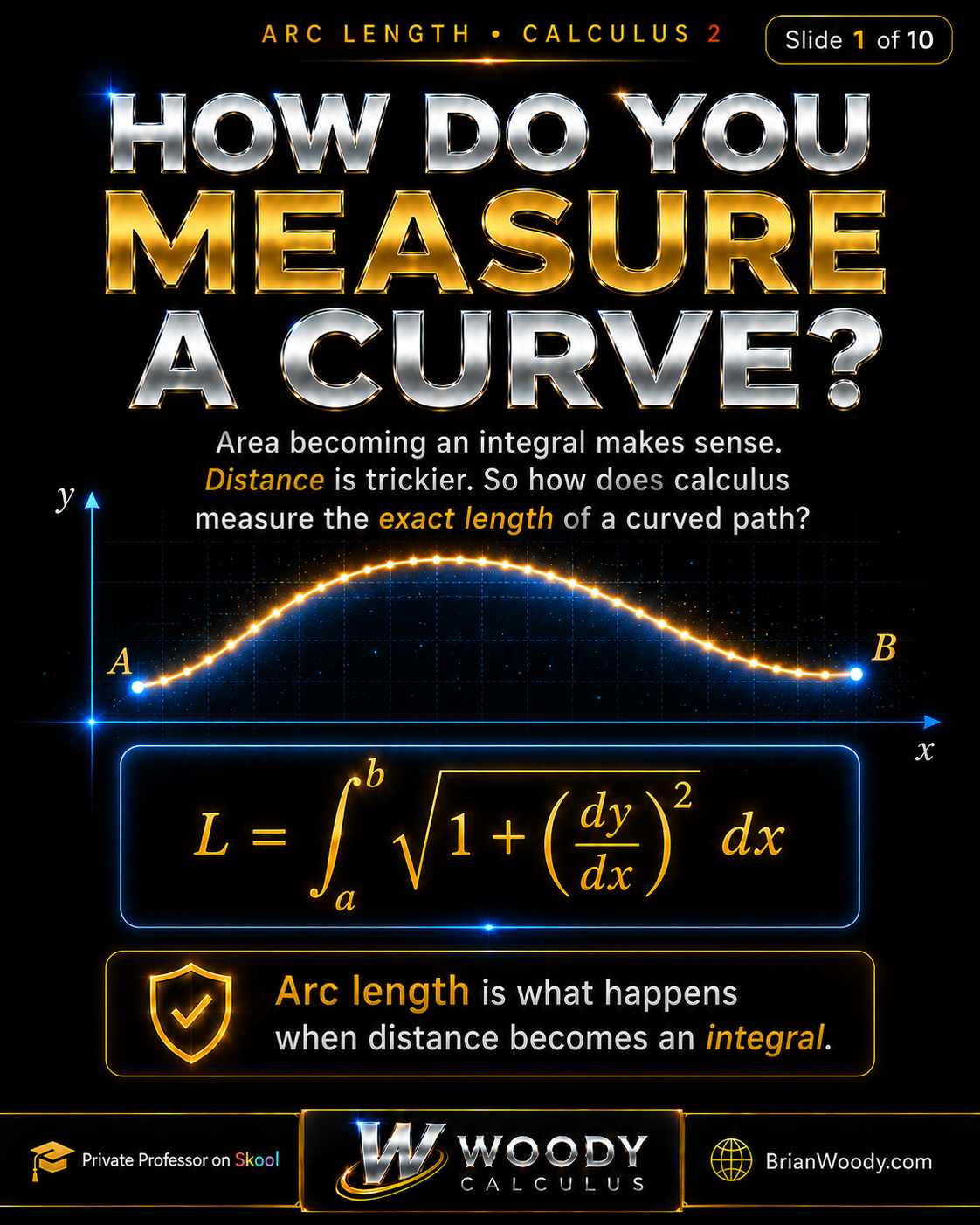
Arc length measures the exact distance along a curve by adding infinitely many tiny straight-line distances. This Woody Calculus lesson derives the formula, explains the ds triangle, and solves the classic hard arc length example step by step.
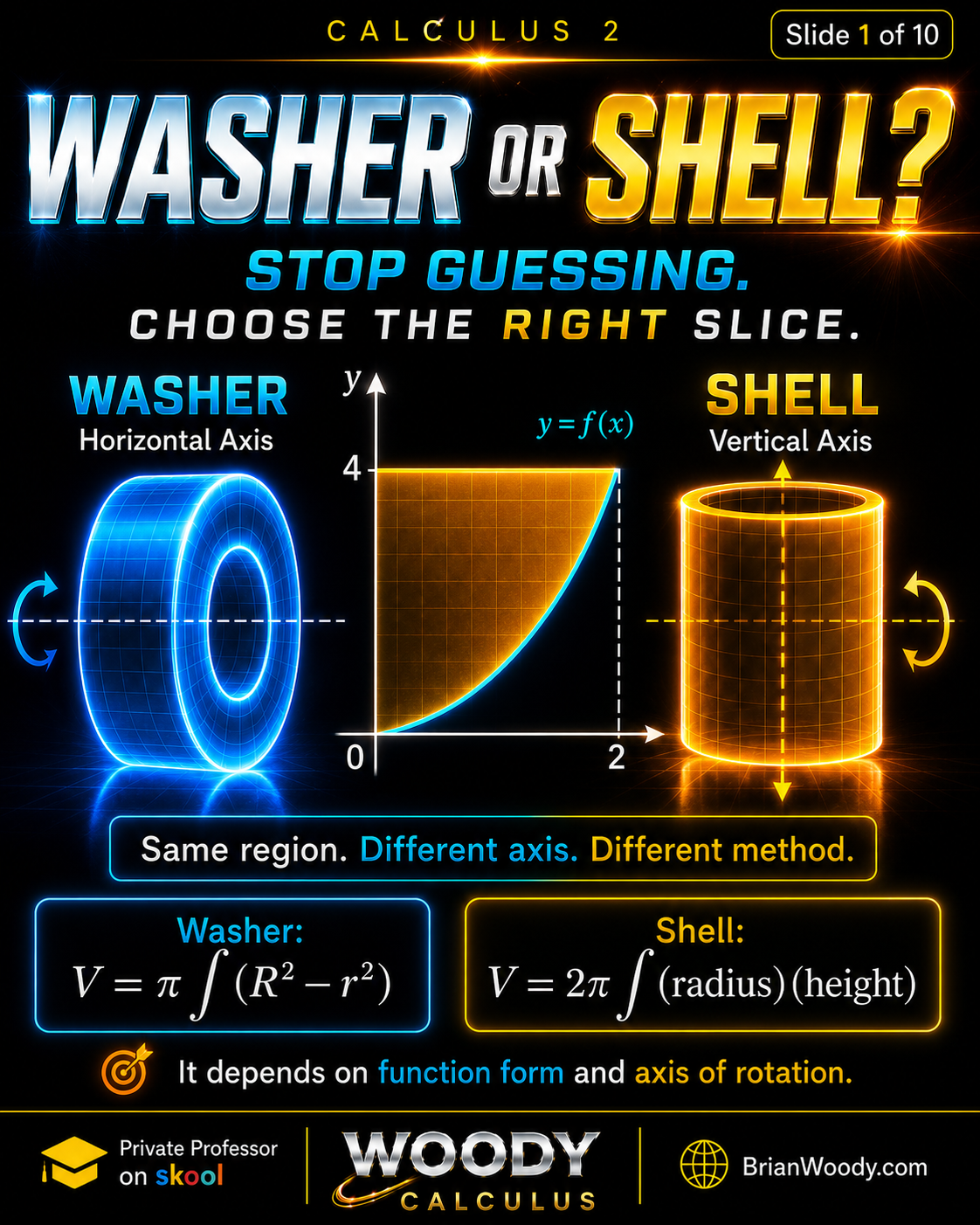
Washer method or shell method? This Woody Calculus lesson teaches the Calculus 2 decision rule for volumes of revolution: identify the function form, check the axis of rotation, choose the right slice, and build the correct volume integral.
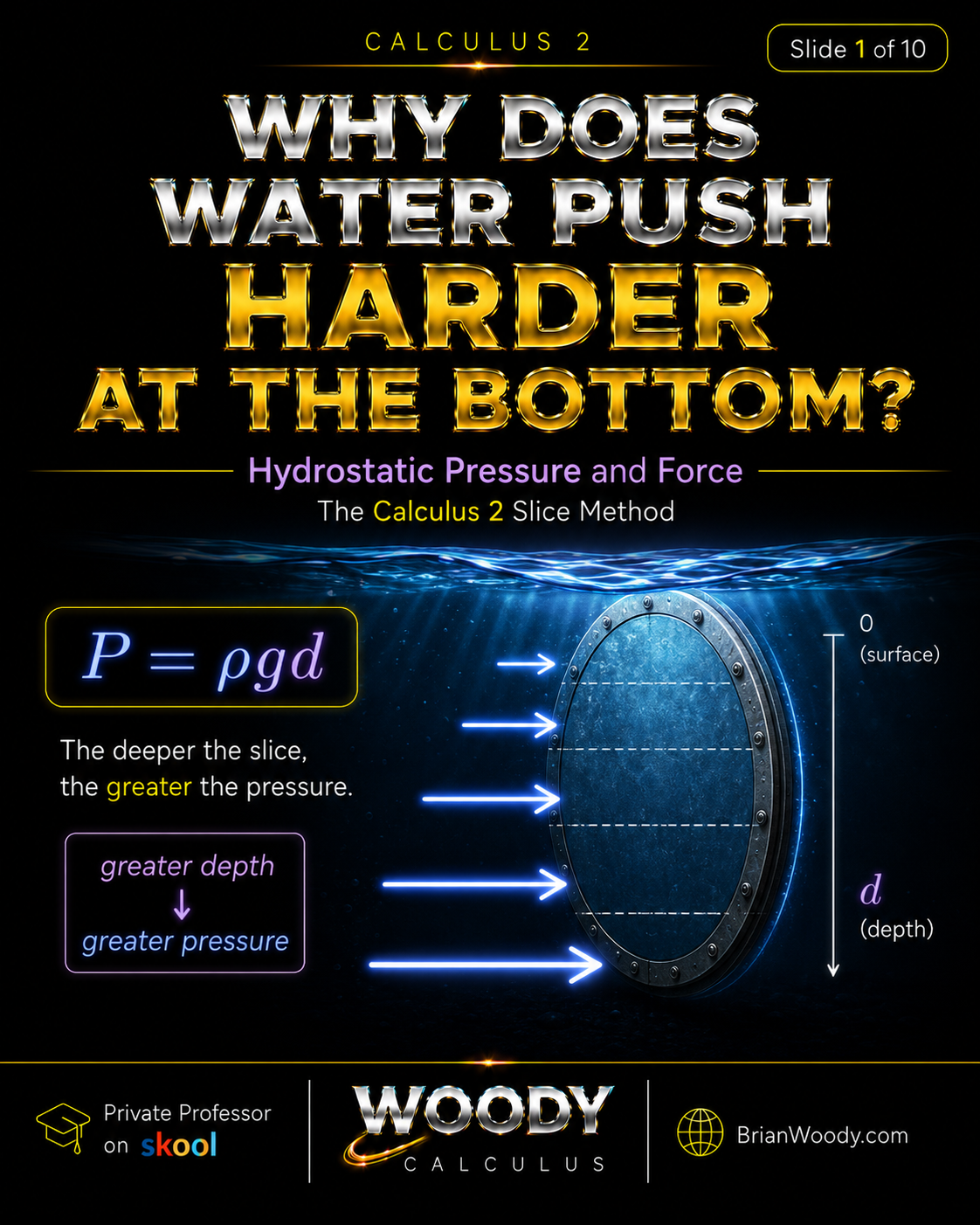
Hydrostatic force problems are Calculus 2 slice-method problems in disguise. This Woody Calculus lesson explains why force equals density times gravity times area times depth, why pressure changes with depth, and how to set up the hydrostatic force integral for a circular plate.
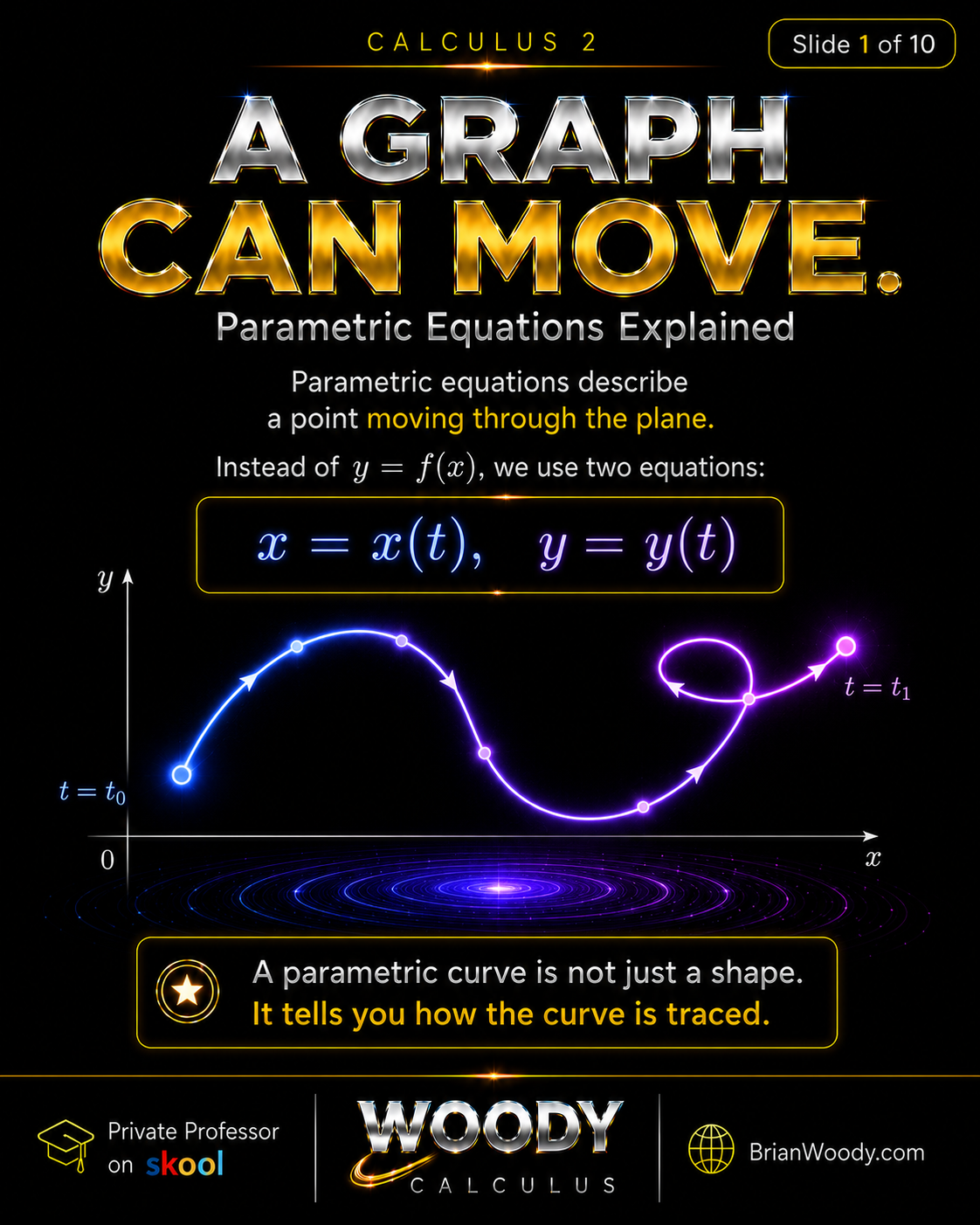
Parametric equations describe a point moving through the plane. This Woody Calculus lesson explains how \(x=x(t)\) and \(y=y(t)\) create a directed curve, how to compute \(\frac{dy}{dx}\), and how to find horizontal and vertical tangent lines.
Improper integrals are Calculus 2 limit problems in disguise. This Woody Calculus lesson teaches how to handle infinite intervals, vertical asymptotes, bad points inside an interval, p-integrals, comparison tests, convergence, and divergence with a clear step-by-step system.
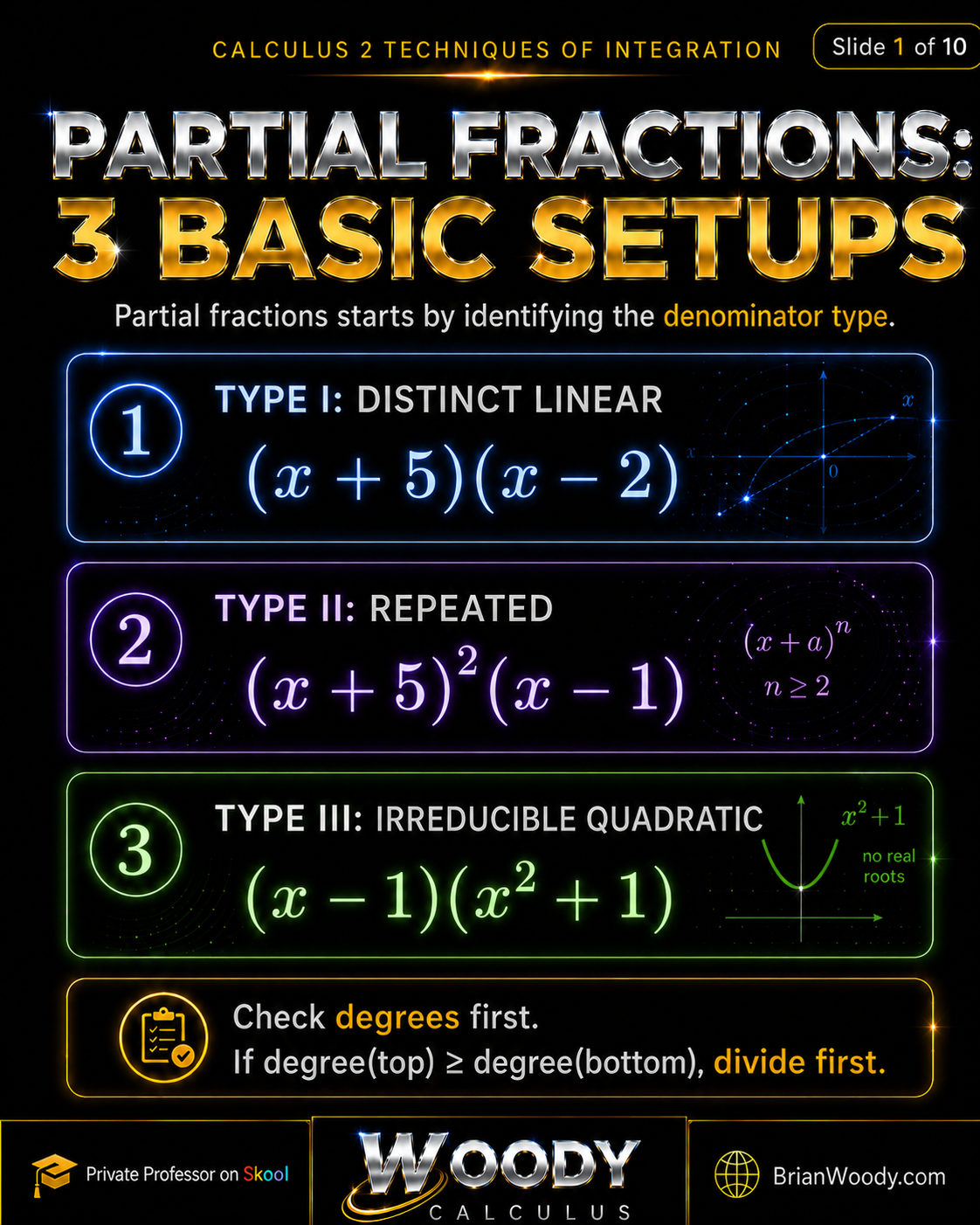
Partial fraction decomposition becomes easier when students stop guessing and identify the denominator type first. This Woody Calculus lesson teaches the complete Calculus 2 system: distinct linear factors, repeated factors, irreducible quadratics, solving for constants, and integrating each piece.
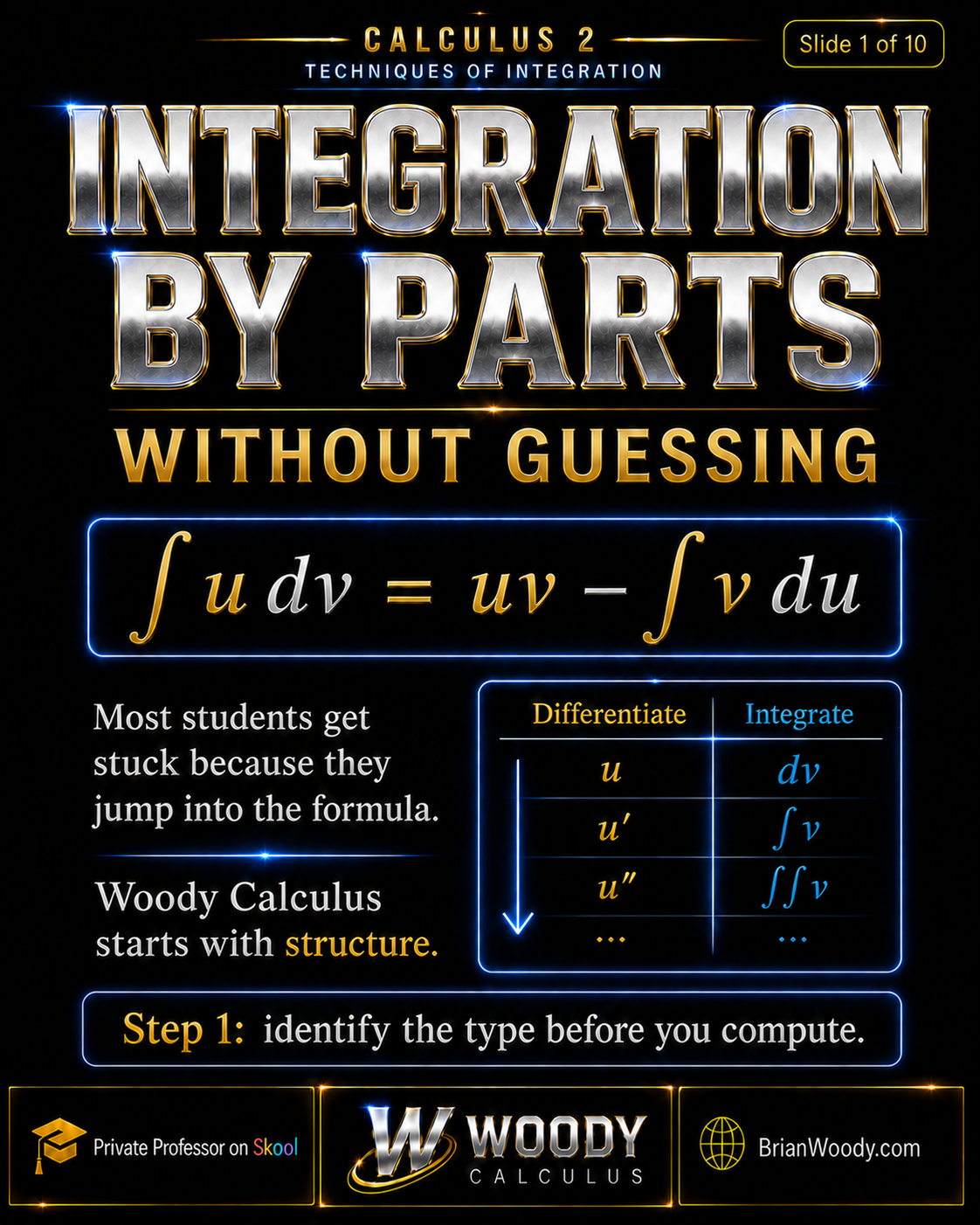
Integration by parts becomes easier when students stop guessing and identify the structure first. This Woody Calculus lesson teaches the complete 3-type IBP system for Calculus 2, including tabular integration by parts, exponential-trig loops, logarithms, inverse trig, and worked examples.