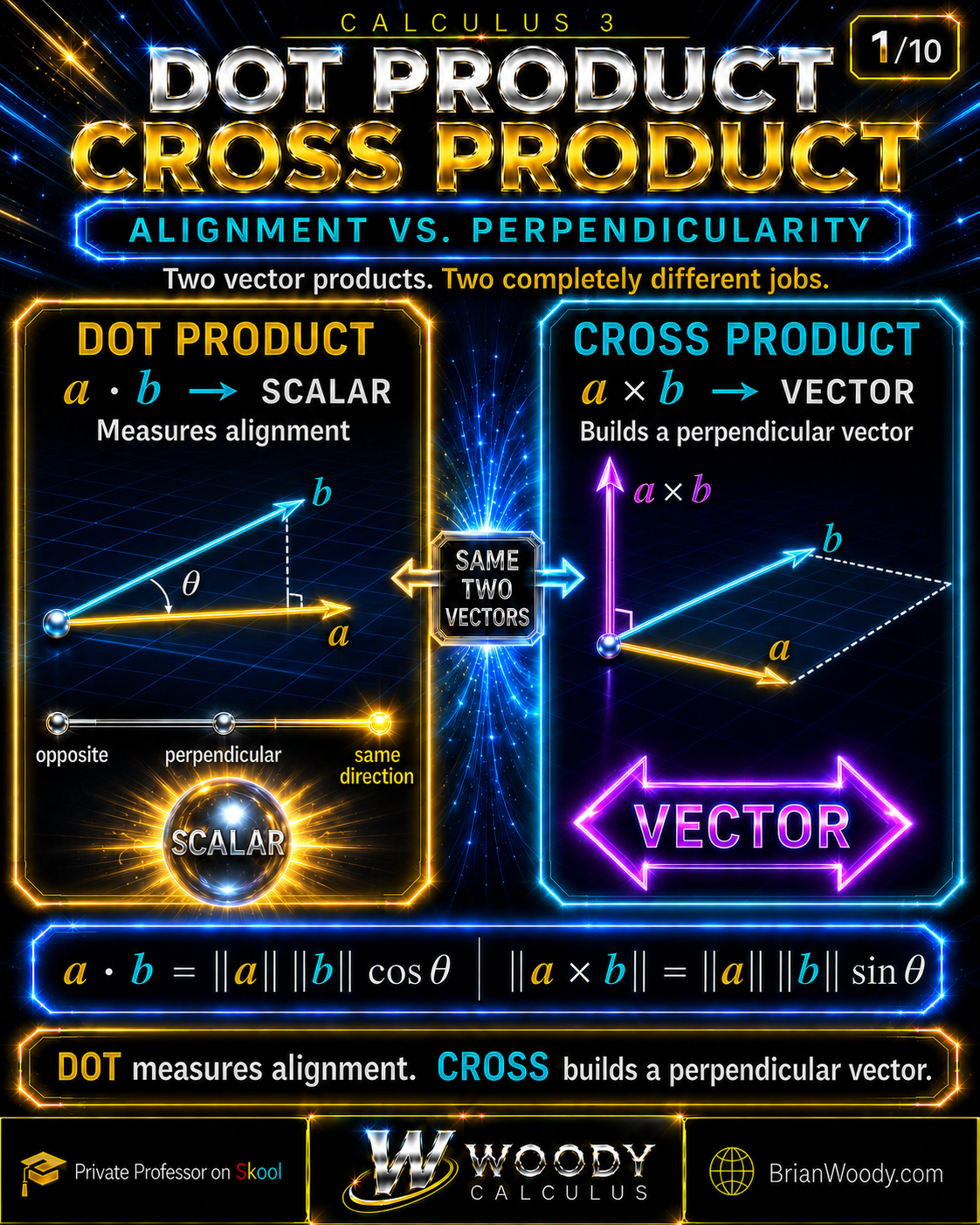
The dot product returns a scalar that measures alignment, while the cross product returns a vector perpendicular to two three-dimensional vectors. Learn the formulas, geometric meaning, right-hand rule, projections, work, area, plane normals, torque, flux, scalar triple products, Lagrange’s identity, and complete worked examples.
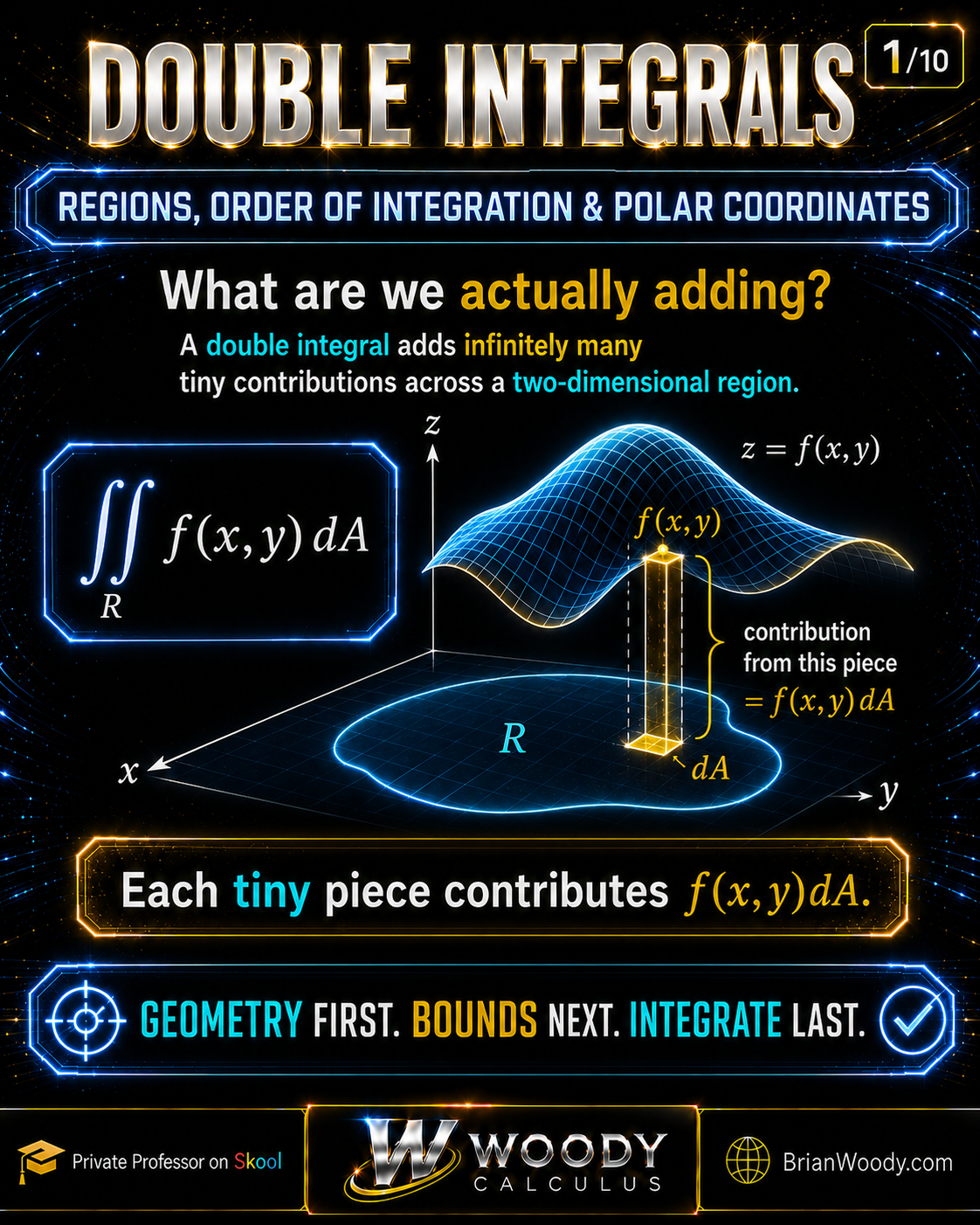
This complete Woody Calculus lesson explains double integrals from the ground up. Learn the geometric meaning of ∬R f(x,y) dA, how Fubini’s Theorem turns double integrals into iterated integrals, how to identify Type I and Type II regions, how to reverse the order of integration, and when polar coordinates make the setup easier.
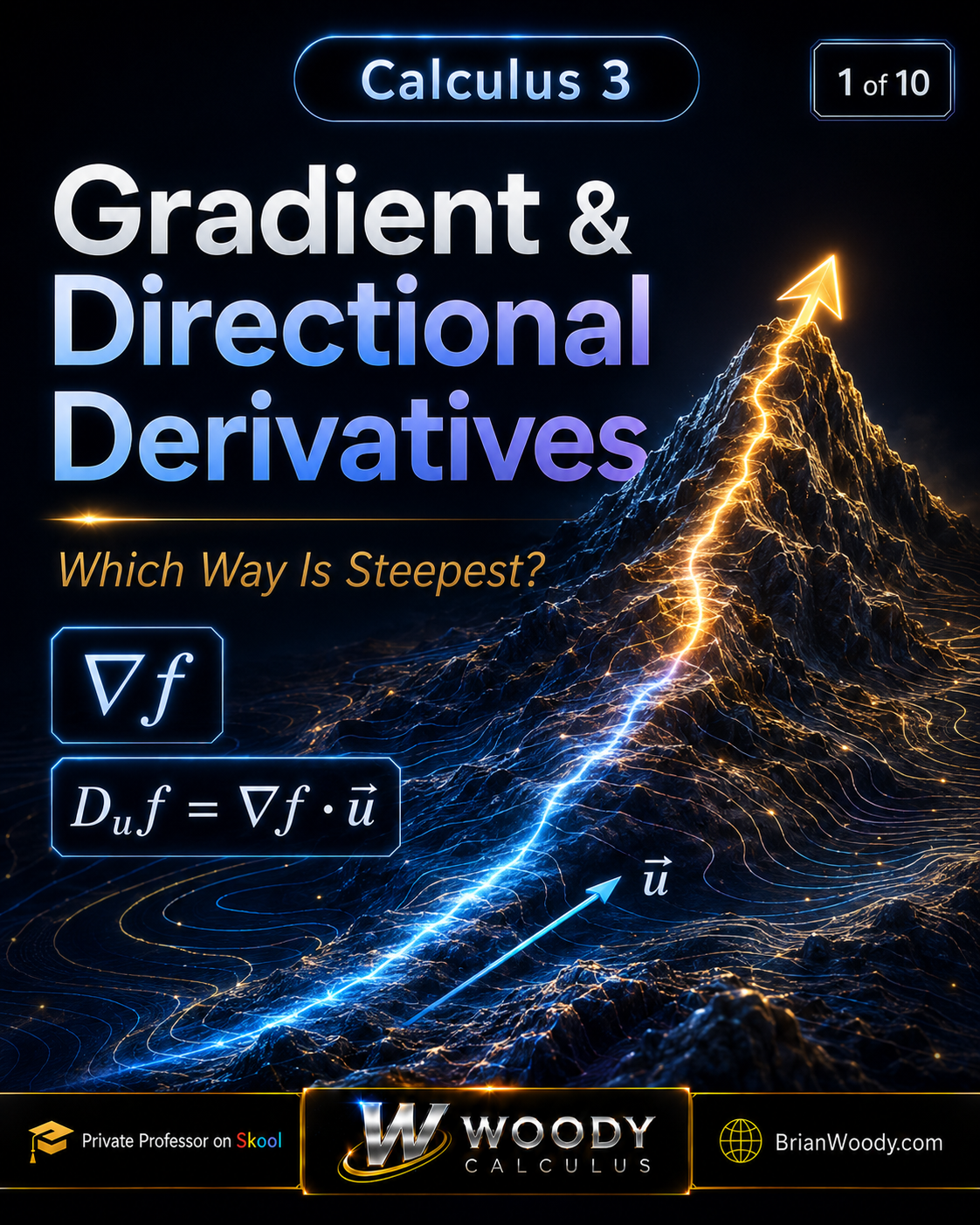
Which direction makes a multivariable function increase fastest? Learn how the gradient packages partial derivatives, how to calculate directional derivatives with unit vectors and dot products, and why gradients cross level curves at right angles.
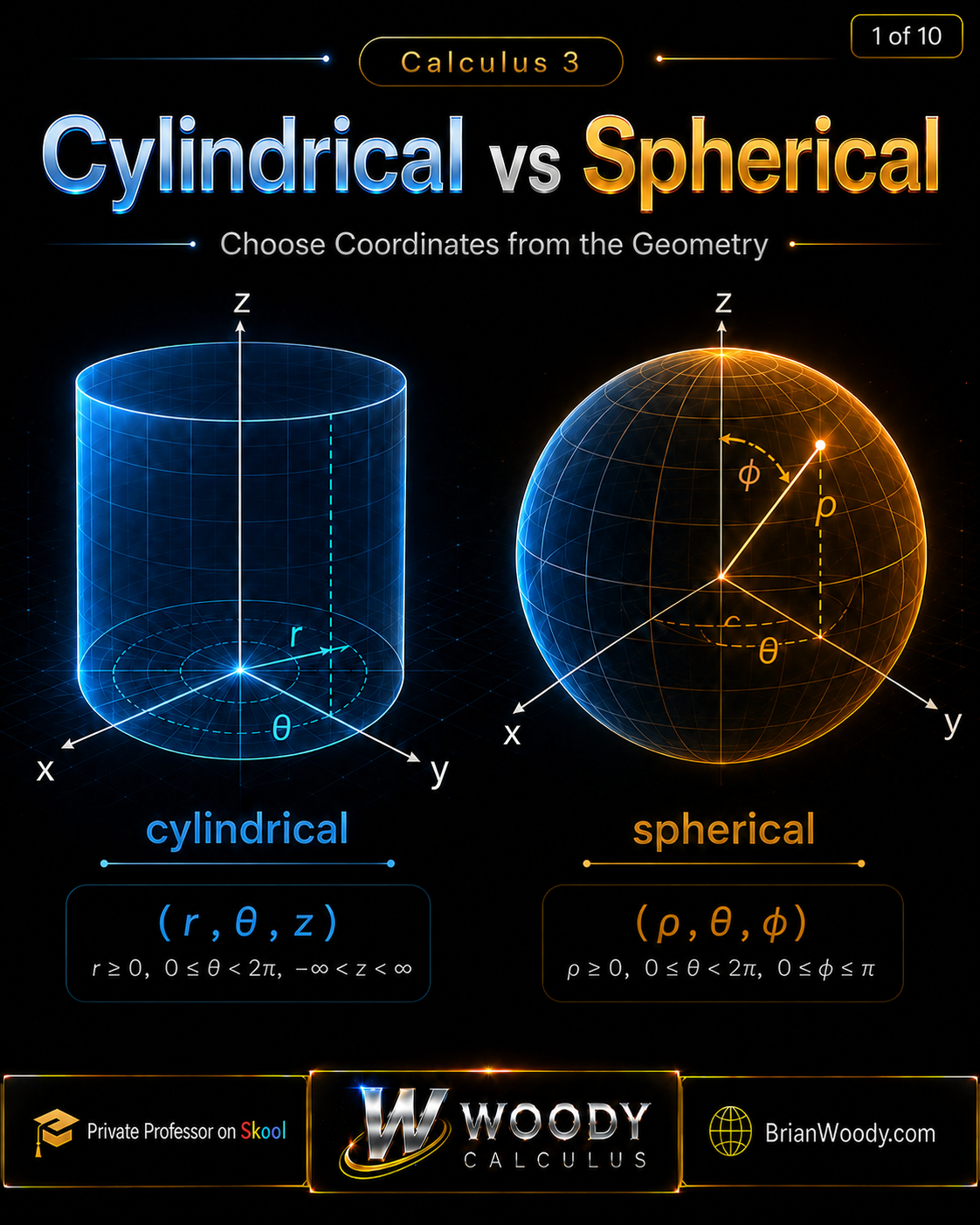
Master cylindrical and spherical coordinates through visual geometry, conversion formulas, Jacobians, bounds, and worked triple integrals. This Calculus 3 lesson compares both systems, solves an upper hemisphere in two ways, and shows how symmetry determines the best coordinates.
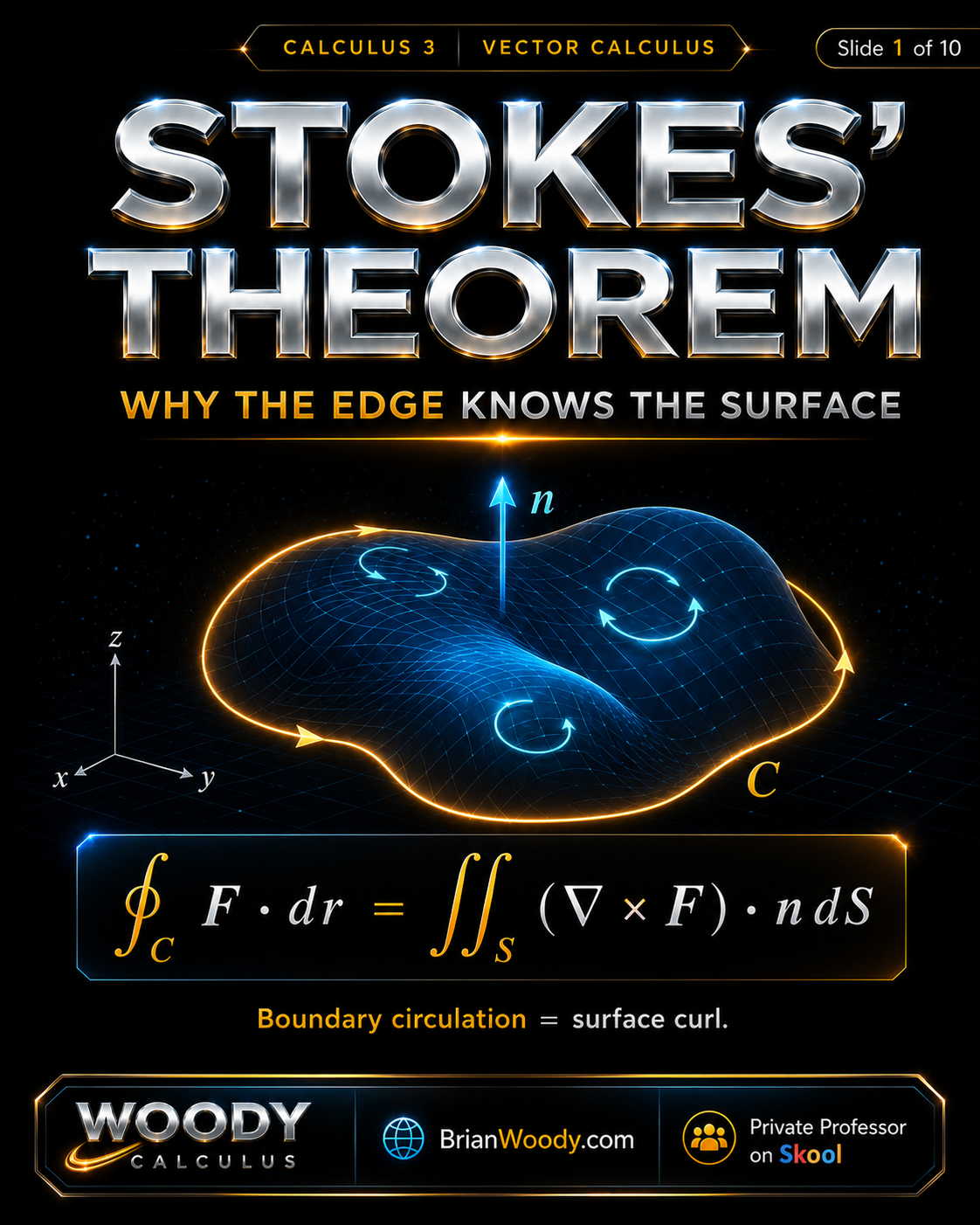
Stokes’ Theorem says that boundary circulation equals the total curl through a surface. In this Woody Calculus visual lesson, learn how Stokes’ Theorem connects line integrals, surface integrals, curl, orientation, the right-hand rule, Green’s Theorem, and vector calculus in Calculus 3.
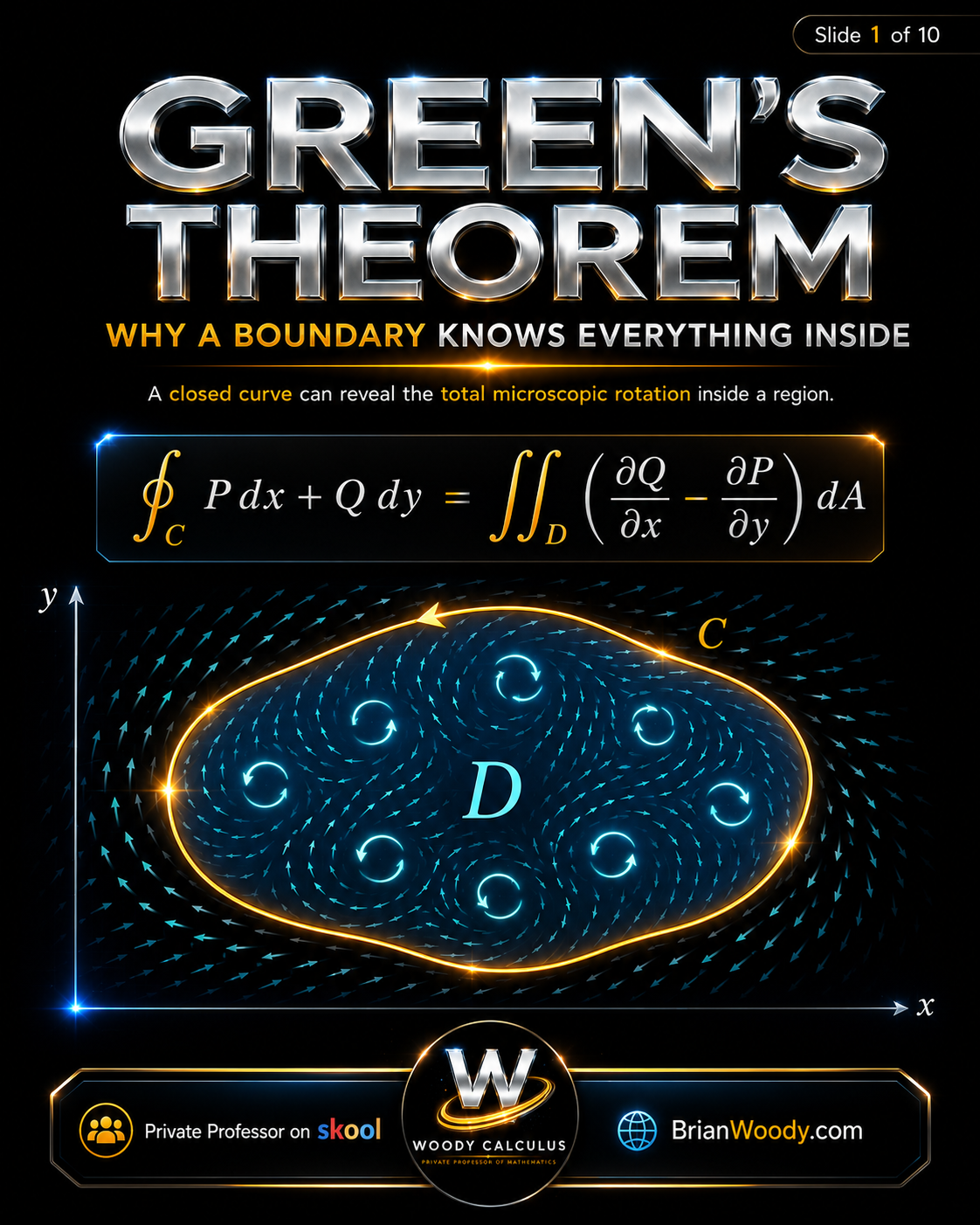
Green’s Theorem turns a boundary line integral into an interior double integral. In this Woody Calculus visual lesson, learn how Green’s Theorem connects circulation, curl, flux, area, line integrals, double integrals, Stokes’ Theorem, and the Divergence Theorem in Calculus 3.
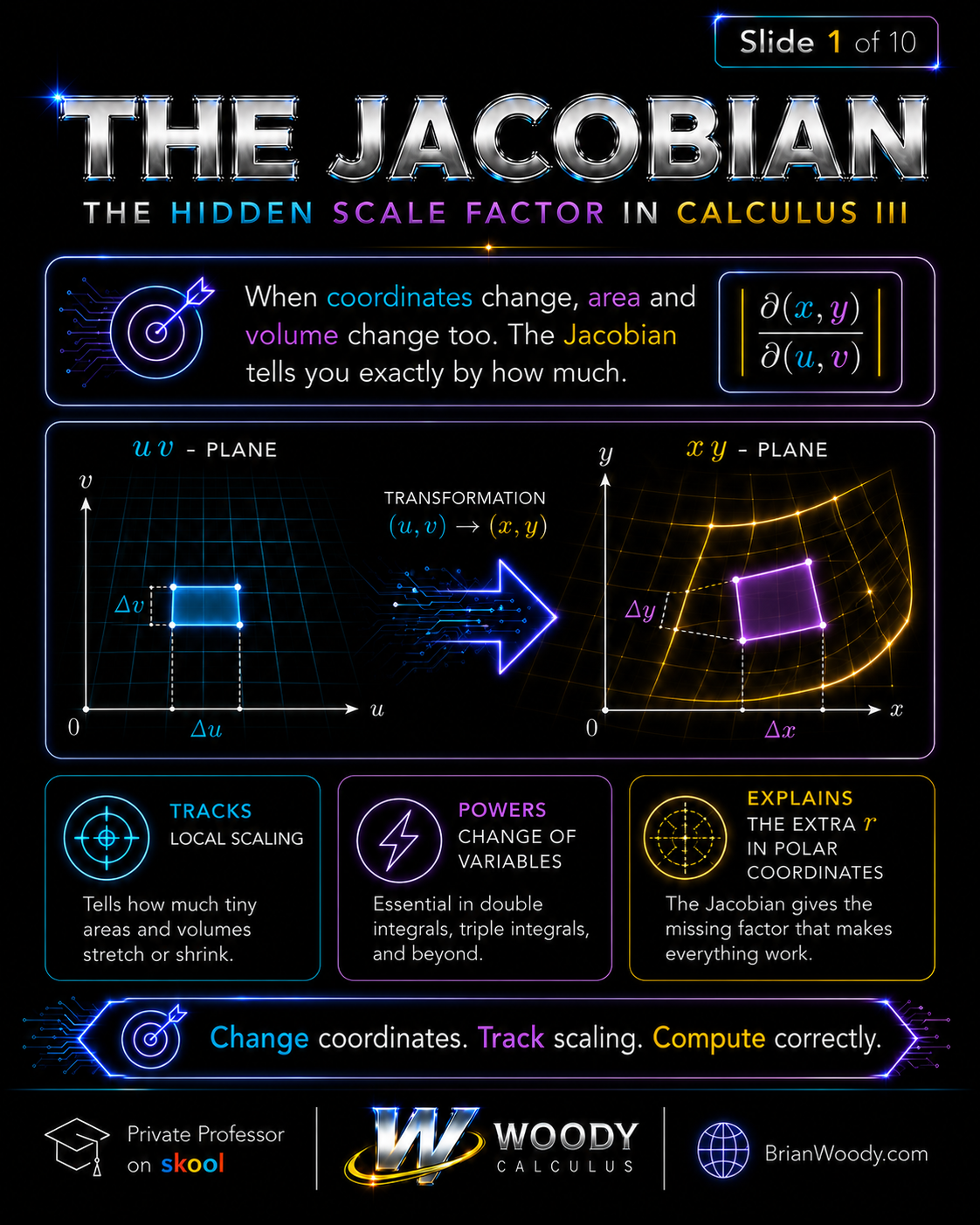
The Jacobian is the hidden scale factor behind every coordinate change in Calculus III. In this Woody Calculus visual lesson, learn how Jacobians explain area and volume scaling, change of variables, polar coordinates, cylindrical coordinates, spherical coordinates, double integrals, triple integrals, and why the mysterious extra factors r and ρ²sinφ appear.
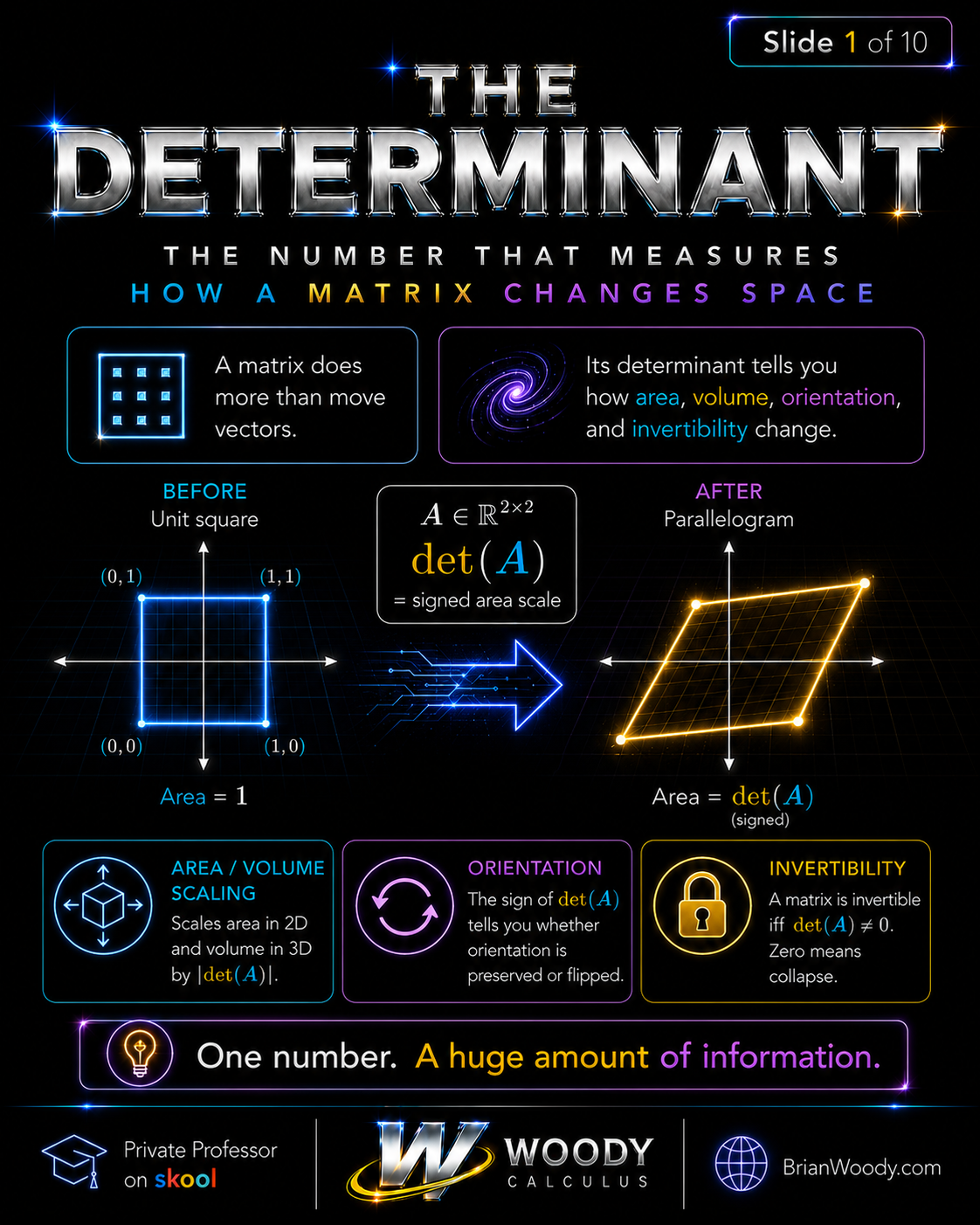
The determinant is the number that measures how a matrix changes space. In this Woody Calculus visual lesson, learn how determinants explain area and volume scaling, orientation, invertibility, matrix collapse, eigenvalues, Wronskians, and why det(A) connects Linear Algebra to Differential Equations.
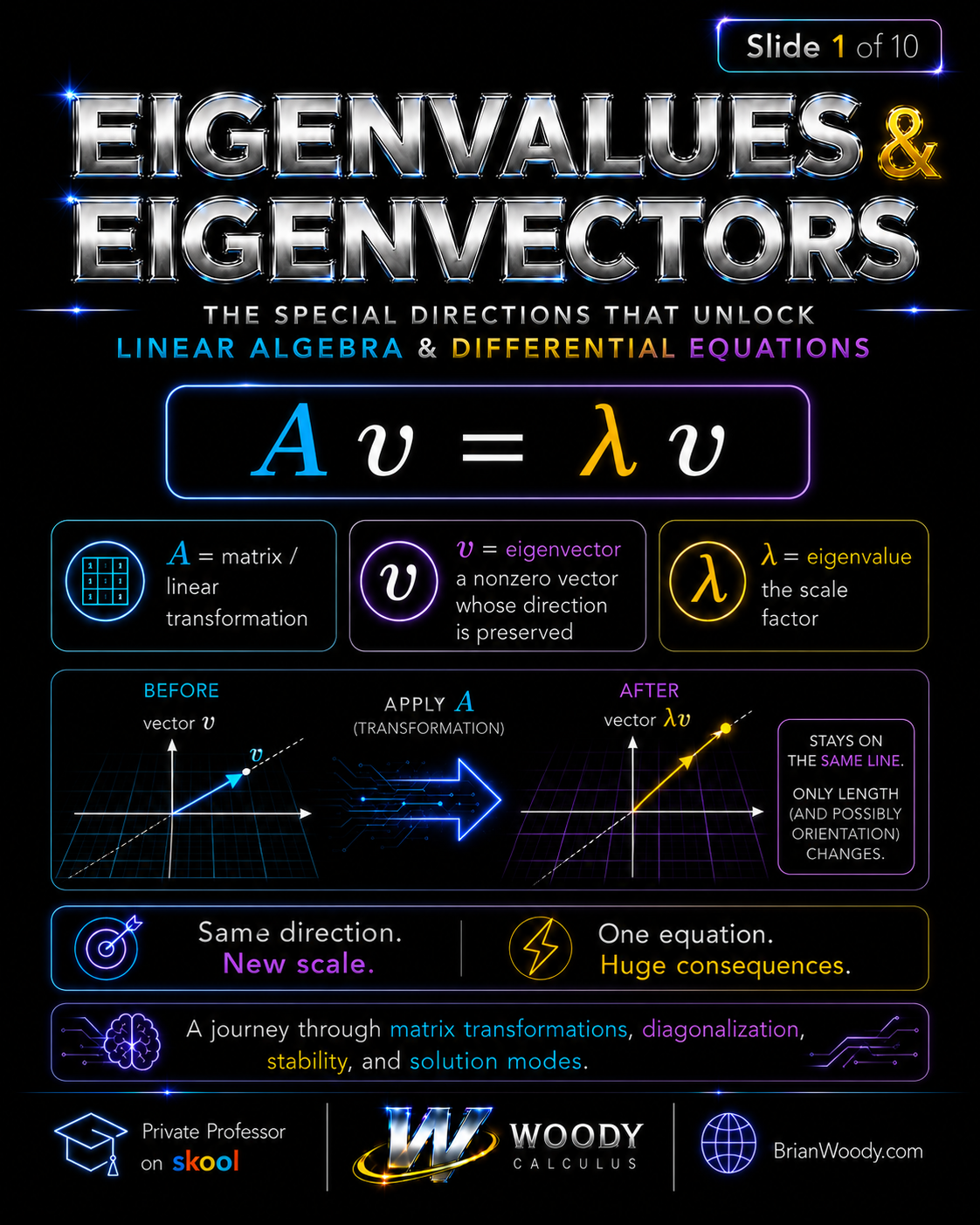
Eigenvalues and eigenvectors reveal the special directions that unlock Linear Algebra and Differential Equations. In this Woody Calculus visual lesson, learn how Av = λv explains matrix transformations, scaling, diagonalization, matrix powers, solution modes, stability, phase portraits, and why eigenvalues predict long-term behavior in systems before you even solve them.
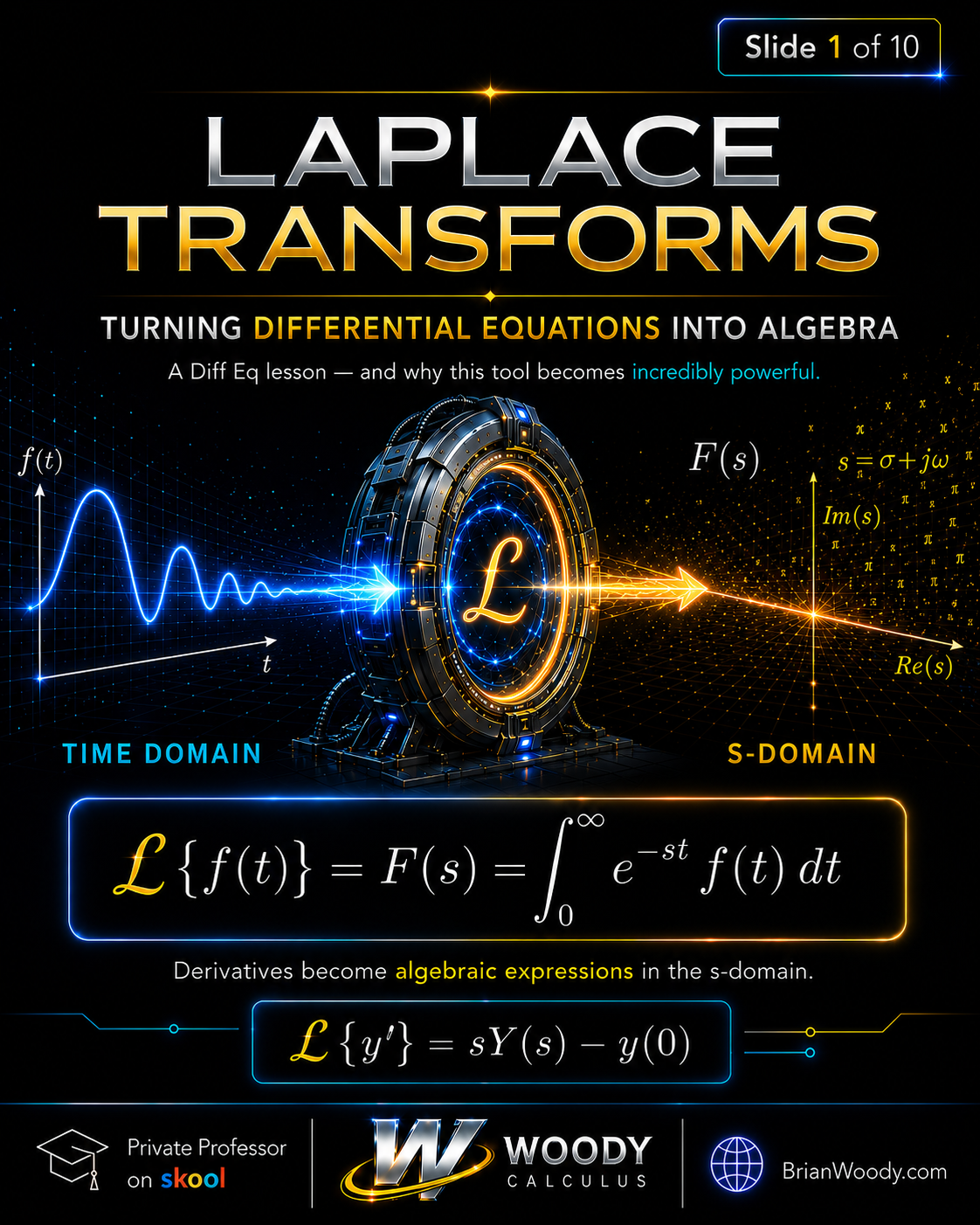
The Laplace Transform turns differential equations into algebra by moving time-domain functions into the s-domain. In this Woody Calculus visual lesson, learn the core formula, derivative rules, initial value problems, partial fractions, inverse Laplace transforms, unit step functions, and why Laplace transforms are so powerful for Differential Equations, engineering, circuits, and applied mathematics.