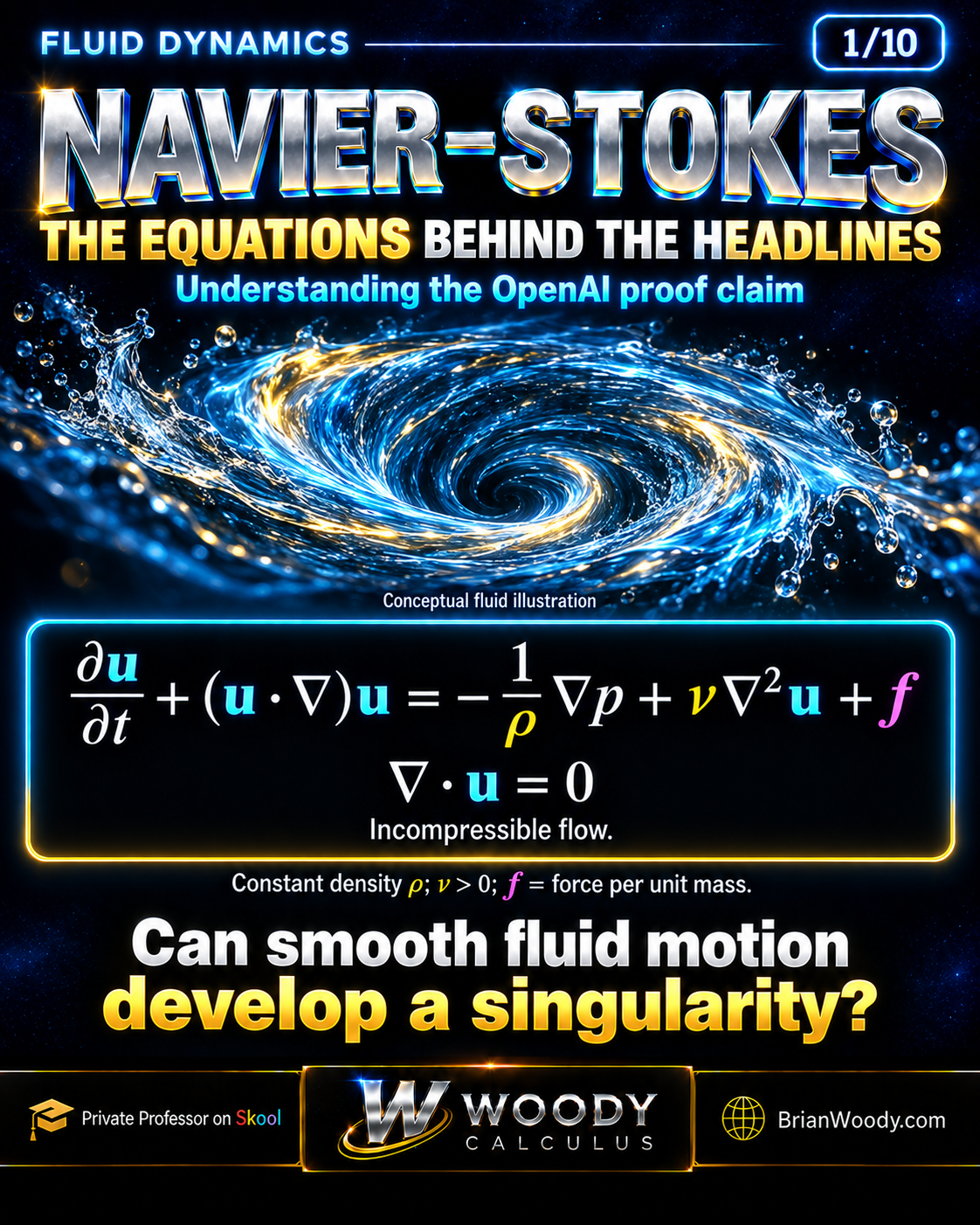

What does Navier–Stokes actually say—and what does the OpenAI announcement claim? Decode every term, verify exact fluid solutions, calculate energy decay, and test your understanding with 12 worked practice problems.
What does Navier–Stokes actually say—and what does the OpenAI announcement claim? Decode every term, verify exact fluid solutions, calculate energy decay, and test your understanding with 12 worked practice problems.
![Woody Calculus introduction to differential-equation mixing problems, showing a perfectly stirred saltwater tank with inflow and outflow. The governing model is Q′(t) = c_in r_in − [Q(t)/V(t)]r_out. Equal flow rates produce constant volume, while unequal flow rates produce changing volume.](https://k3p6r8v3.delivery.rocketcdn.me/wp-content/uploads/2026/08/Mixing_Problems_Slide_01.png)
Learn how to model and solve differential-equation mixing problems with rate in minus rate out. Work through constant-volume, draining-tank, and overflow examples, then practice the complete seven-step method.
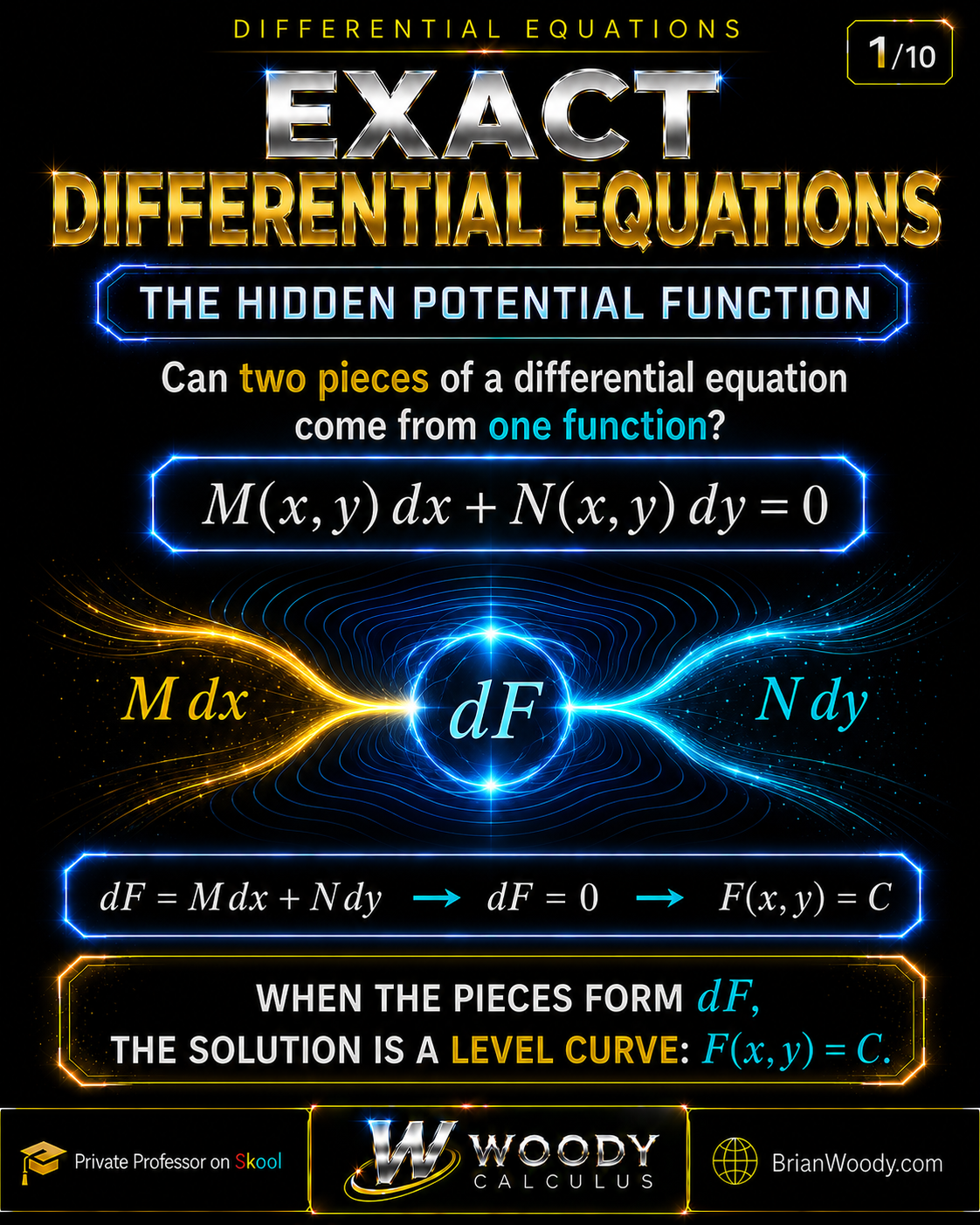
Learn how to recognize and solve exact differential equations using the exactness test M_y = N_x, recover a potential function F(x,y), apply initial conditions, verify implicit solutions, and use special integrating factors when an equation is not exact. This rigorous visual lesson also explains domain restrictions, conservative vector fields, line integrals, and the punctured-domain caveat.
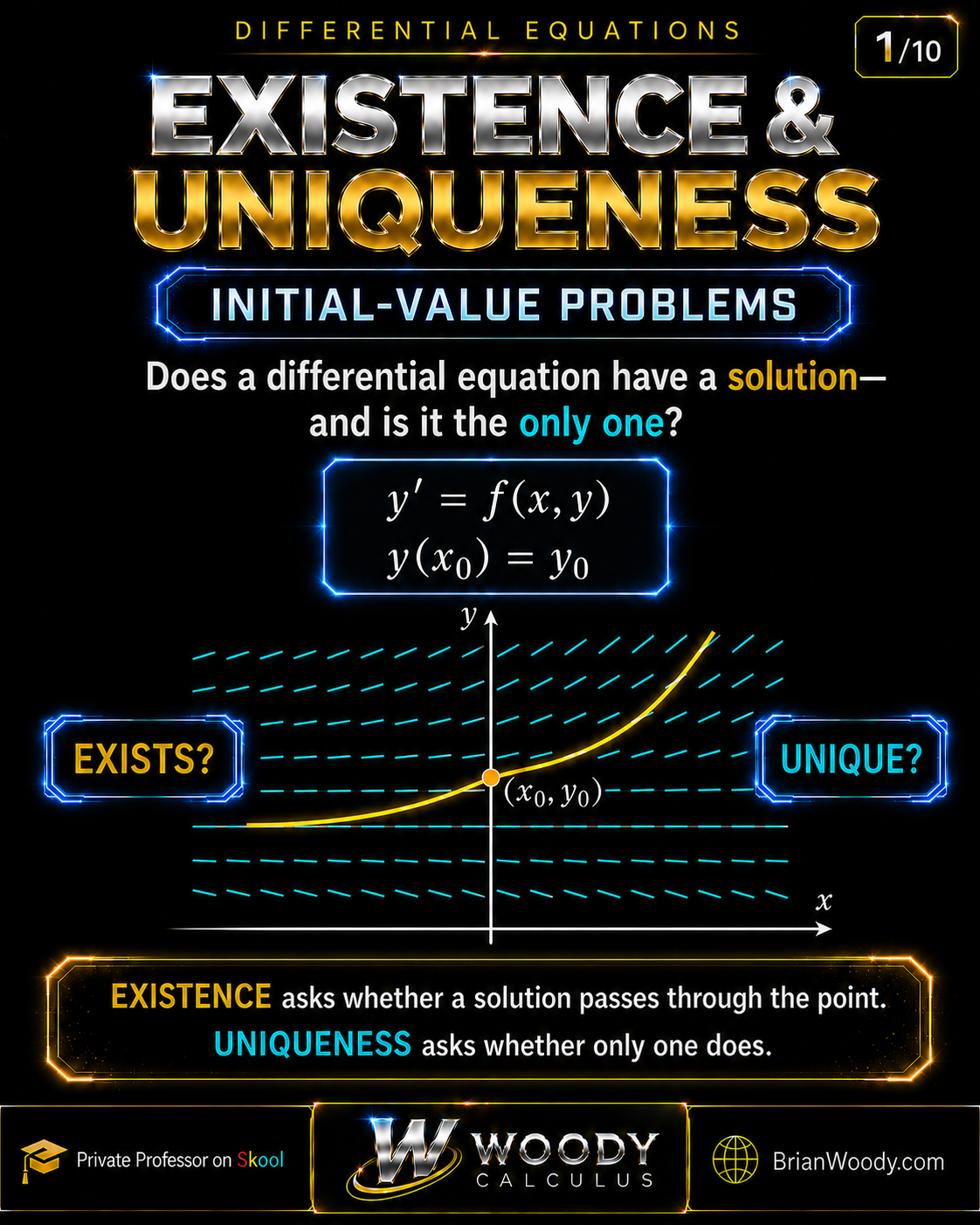
Does an initial-value problem have a solution, and is that solution the only one? This complete Woody Calculus lesson explains the existence and uniqueness theorem, the rectangle test, worked examples, nonunique solutions, finite-time blow-up, maximal intervals, the nonintersection principle, and higher-order linear ODEs.
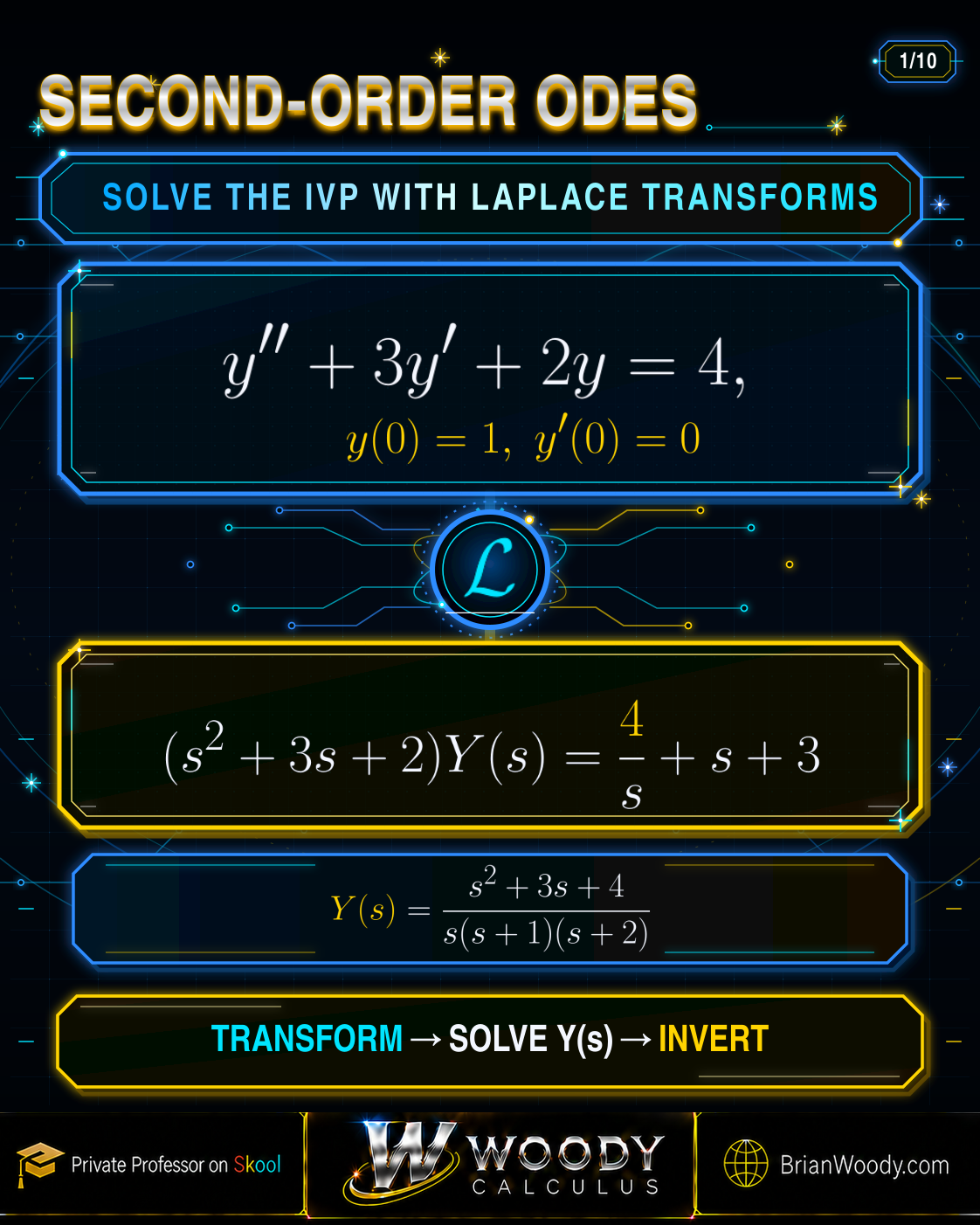
Laplace transforms turn second-order initial-value problems into algebra while carrying the initial conditions with them. Learn the complete seven-step method, partial fractions, delayed unit-step inputs, Dirac delta impulses, transfer functions, impulse response, convolution, stability, and verification through exact worked examples.
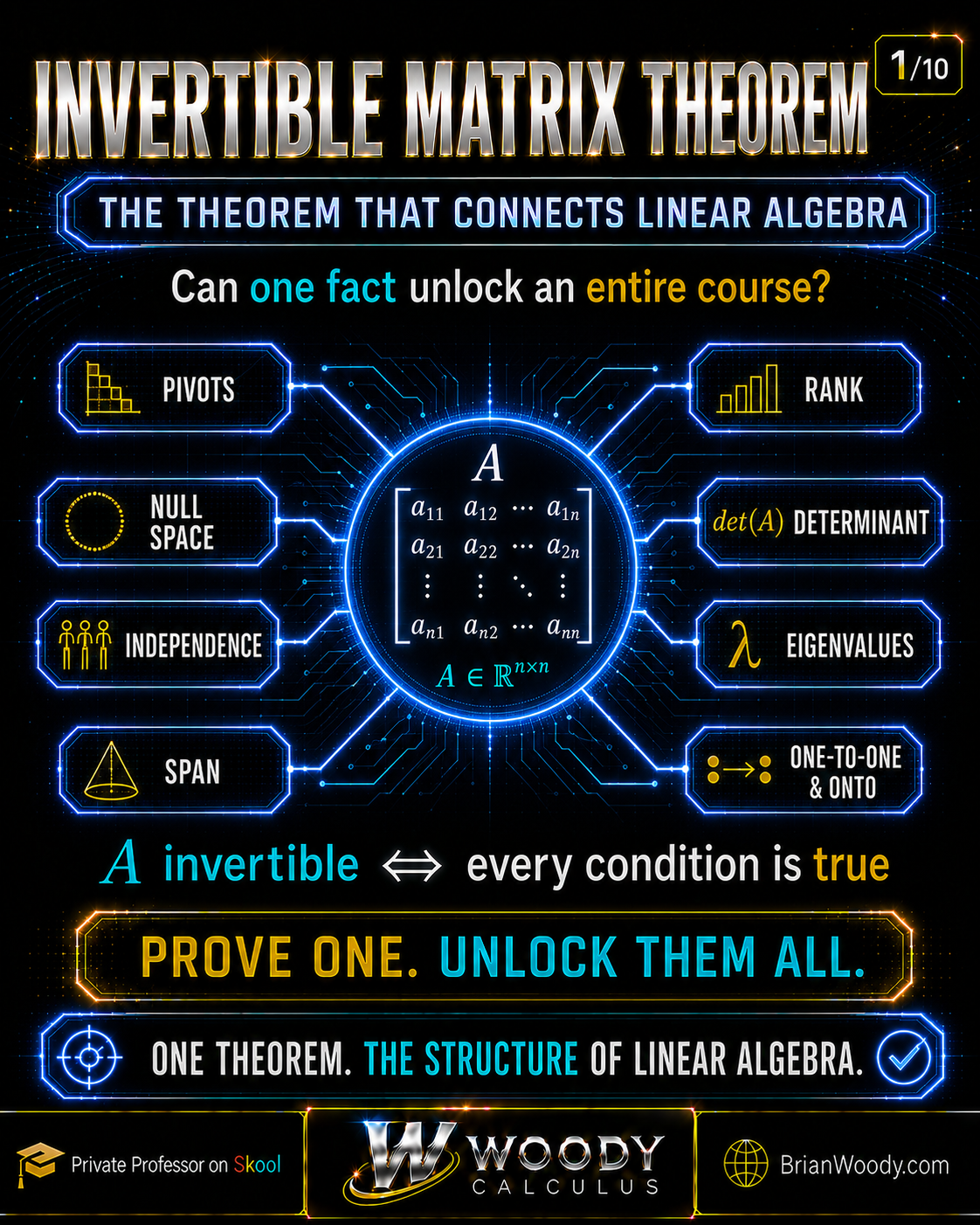
The Invertible Matrix Theorem is the master key to linear algebra. This visual lesson organizes 50 equivalent conditions connecting pivots, row reduction, rank, null spaces, bases, linear systems, one-to-one and onto transformations, determinants, eigenvalues, transposes, singular values, Gram matrices, and conditioning—with proofs, examples, and a practical mastery map.
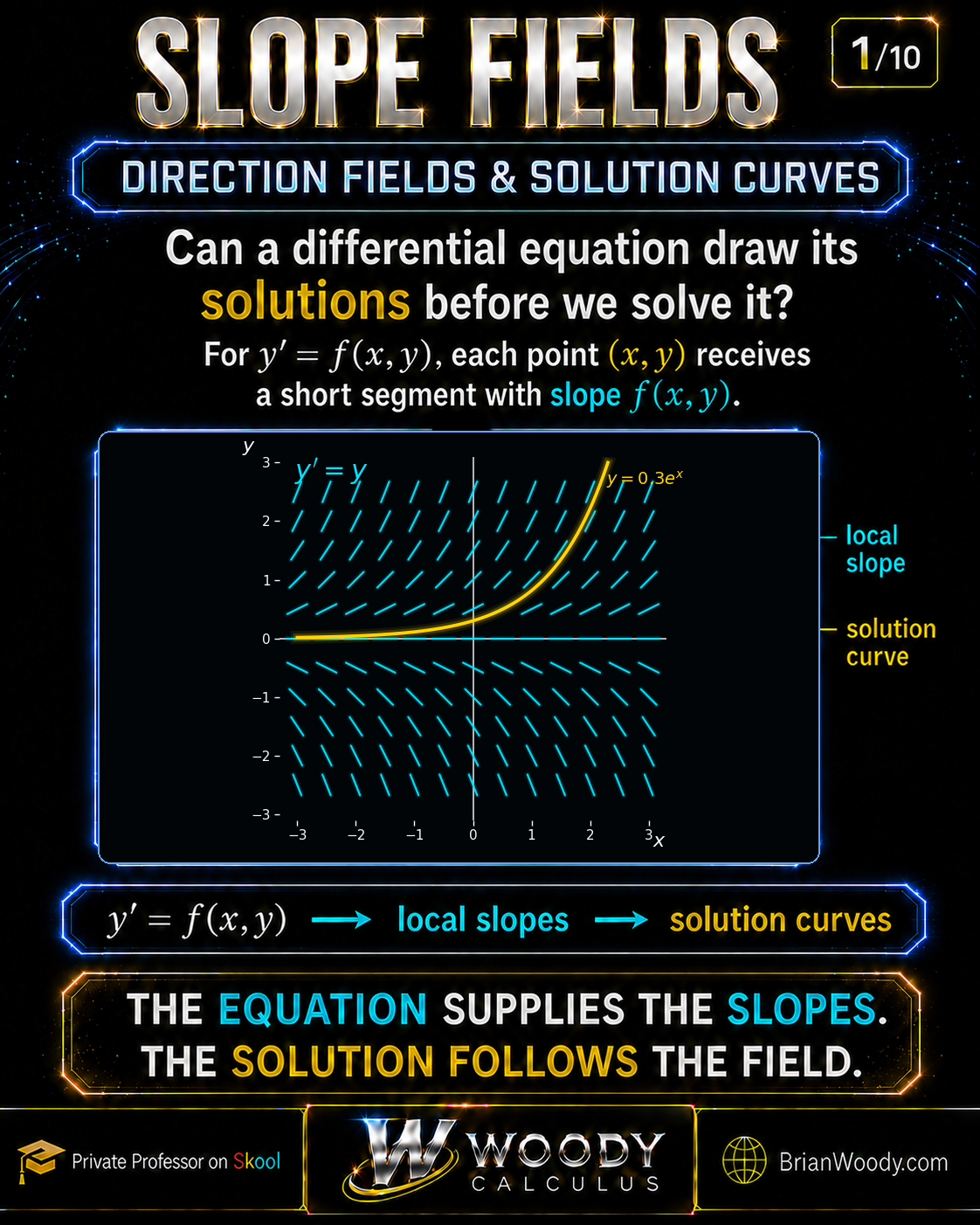
Slope fields make differential equations visible. Learn how to construct and read direction fields, use isoclines, sketch IVP solution curves, distinguish zero-slope curves from equilibria, understand uniqueness, analyze logistic stability, and apply Euler’s method through exact worked examples.
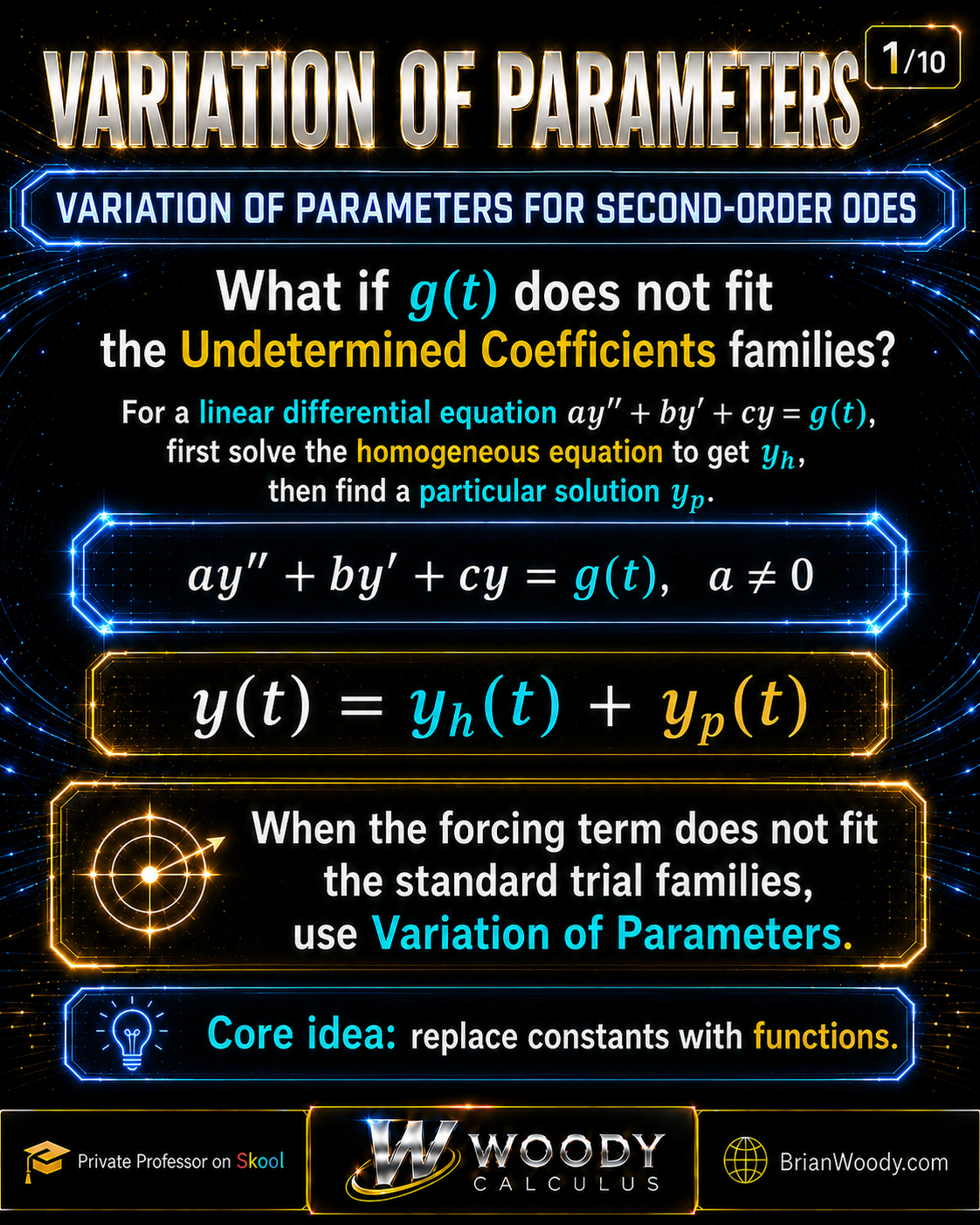
Differential Equations • Second-Order Linear ODEs • Visual Lesson Level: Undergraduate Differential Equations | Core skill: Find a particular solution…
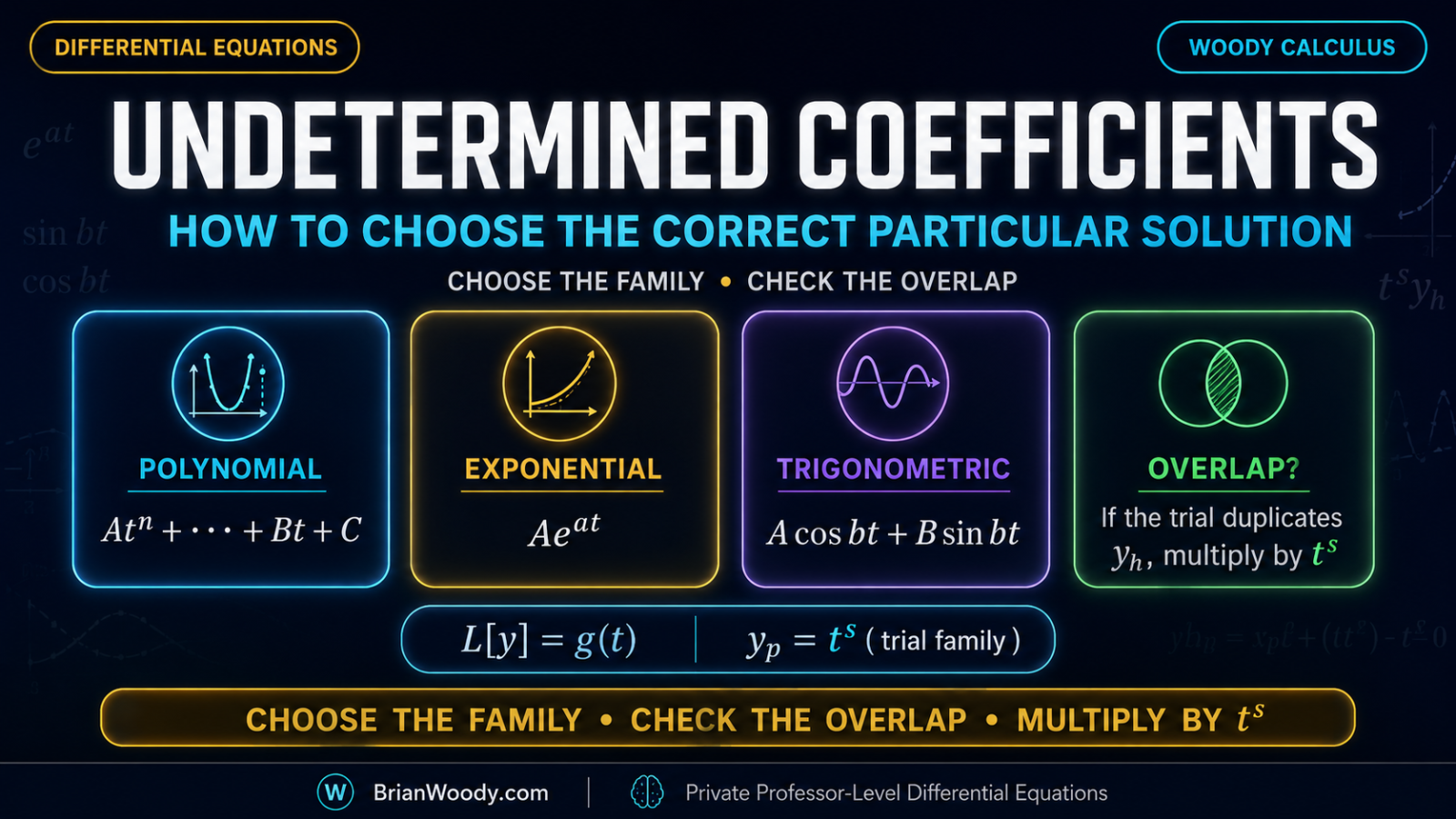
Learn the method of undetermined coefficients from the forcing term to the final solution. Use the Woody Calculus master y_p guess table, build polynomial, exponential, and trigonometric trial solutions, check for overlap with the homogeneous solution, apply the t^s rule, and work through resonance, repeated-root, and initial-value examples.
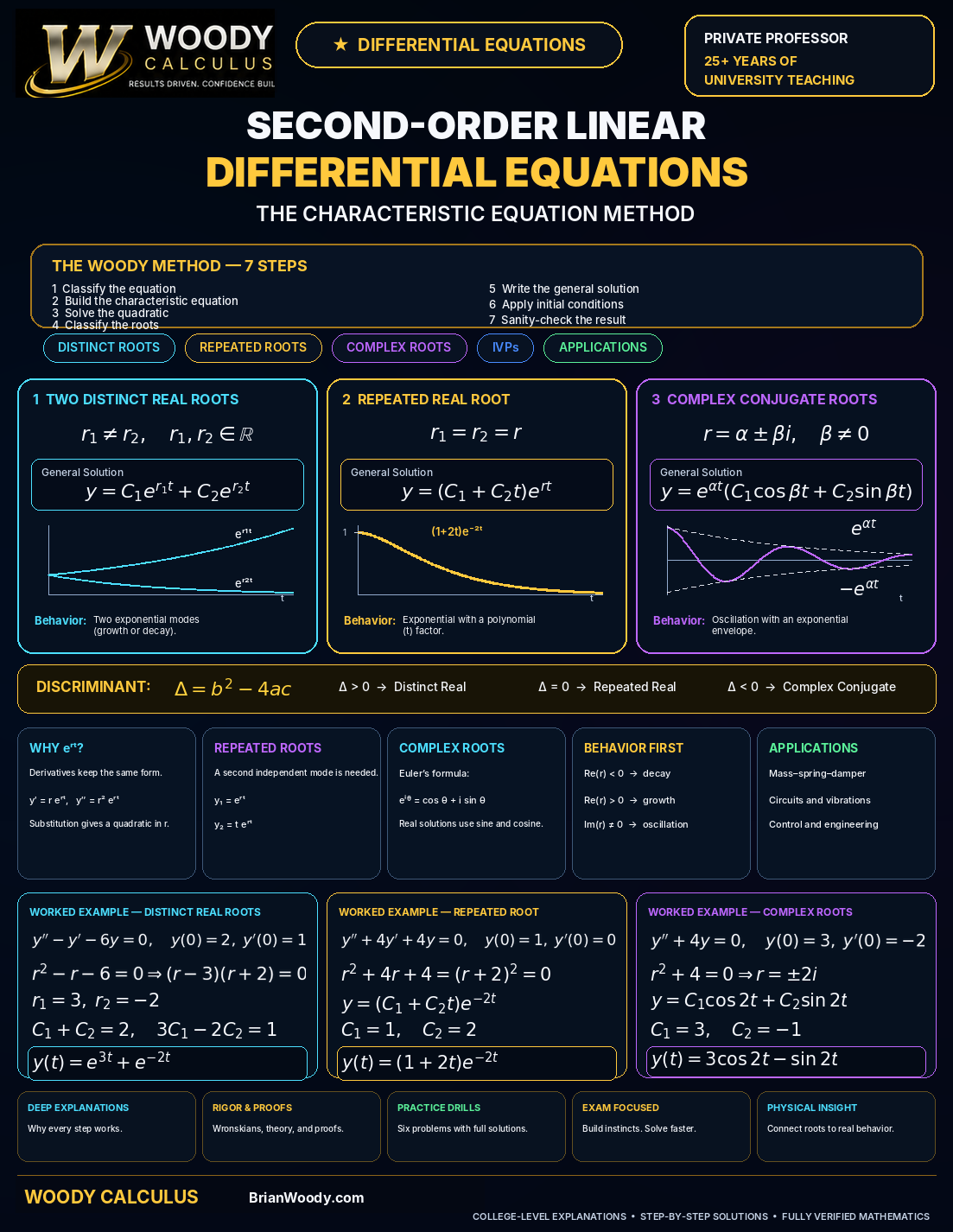
Learn to solve homogeneous second-order linear differential equations with constant coefficients using the characteristic equation. Master distinct real roots, repeated roots, complex conjugate roots, initial-value problems, boundary-value problems, damping, and the Woody Calculus root-classification method.