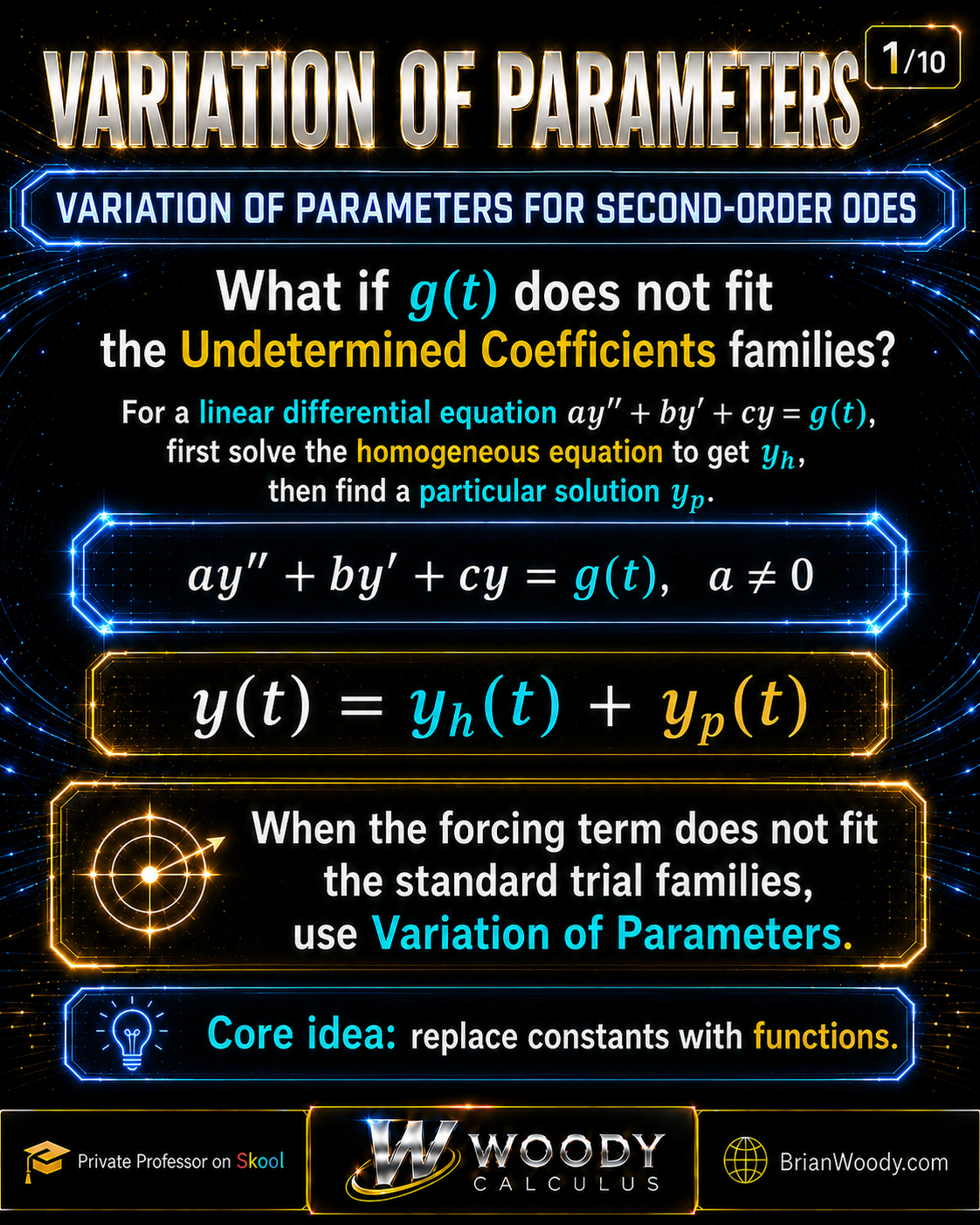

Differential Equations • Second-Order Linear ODEs • Visual Lesson Level: Undergraduate Differential Equations | Core skill: Find a particular solution…
Differential Equations • Second-Order Linear ODEs • Visual Lesson Level: Undergraduate Differential Equations | Core skill: Find a particular solution…
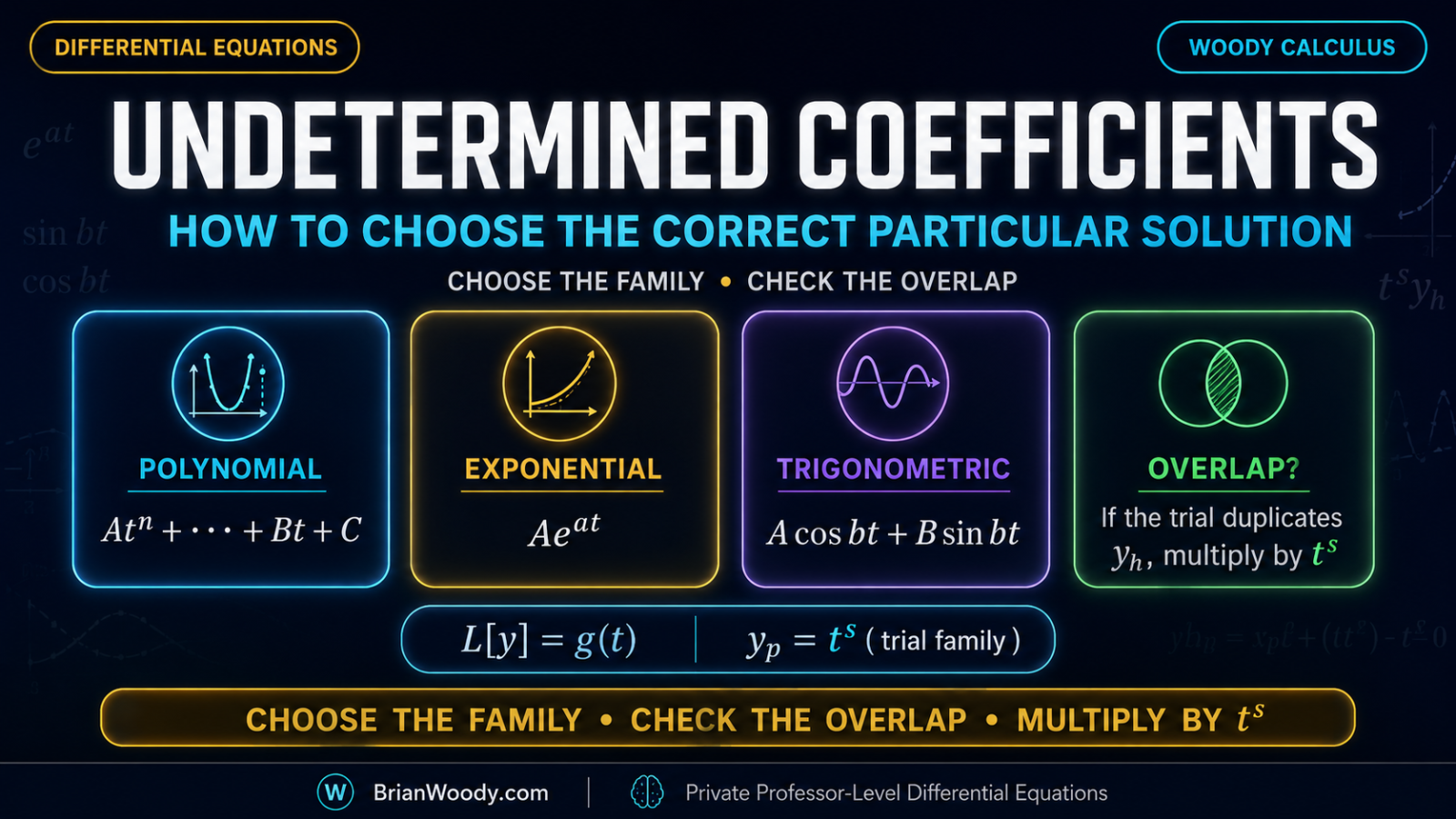
Learn the method of undetermined coefficients from the forcing term to the final solution. Use the Woody Calculus master y_p guess table, build polynomial, exponential, and trigonometric trial solutions, check for overlap with the homogeneous solution, apply the t^s rule, and work through resonance, repeated-root, and initial-value examples.
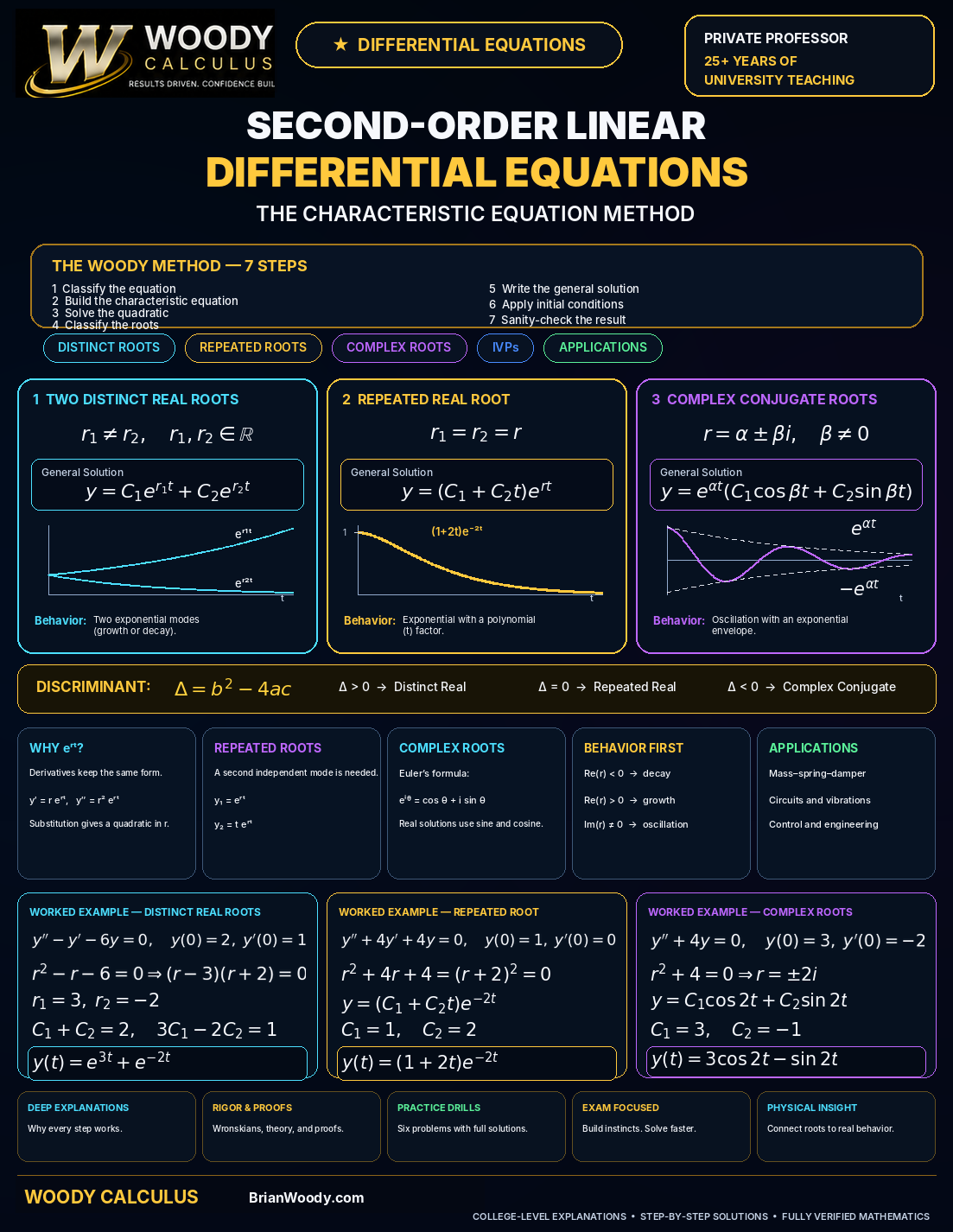
Learn to solve homogeneous second-order linear differential equations with constant coefficients using the characteristic equation. Master distinct real roots, repeated roots, complex conjugate roots, initial-value problems, boundary-value problems, damping, and the Woody Calculus root-classification method.
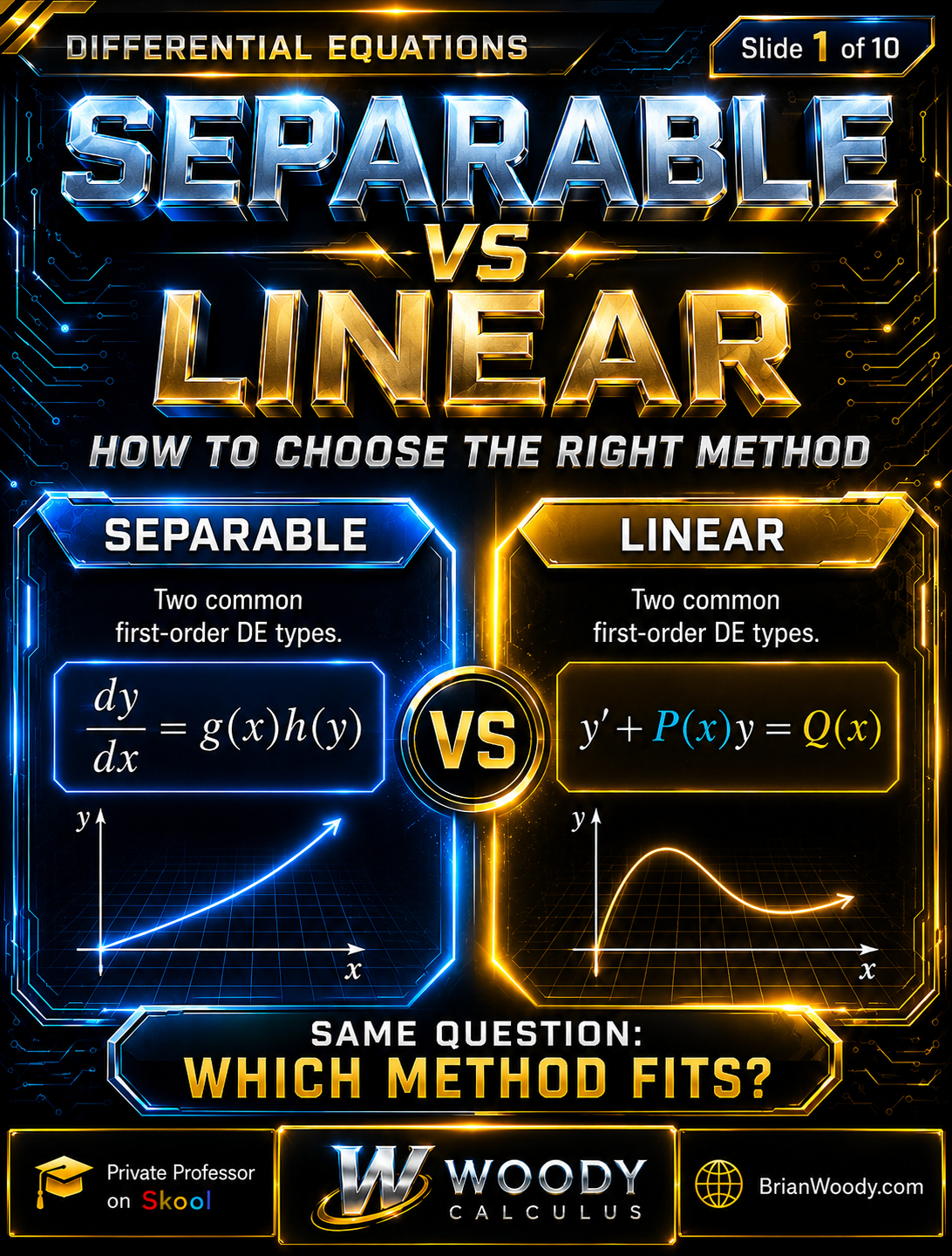
How do you decide whether to use separation of variables or an integrating factor? This Woody Calculus lesson explains how to classify separable and first-order linear differential equations, solve each type step by step, handle equations that fit both methods, and verify the final solution.
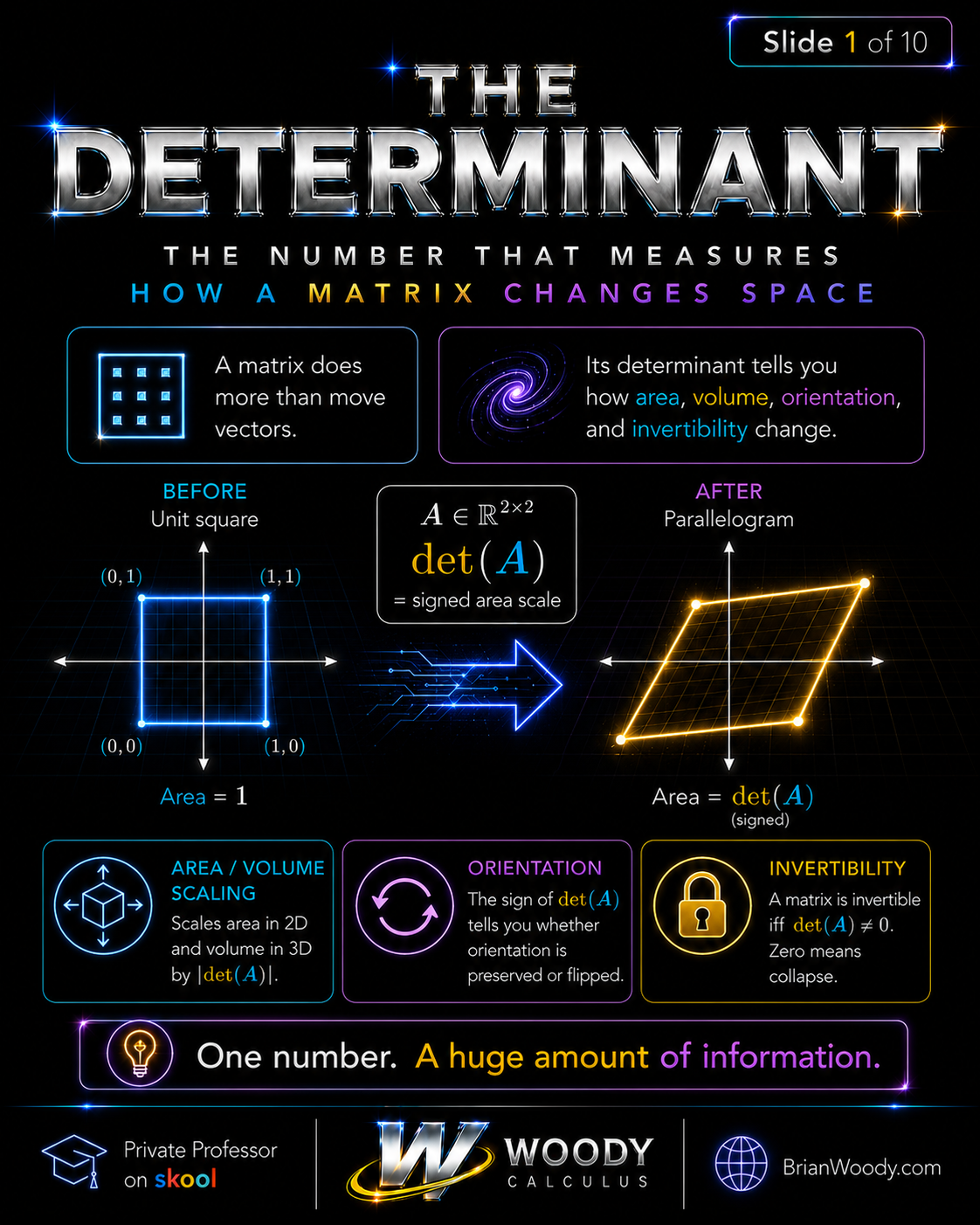
The determinant is the number that measures how a matrix changes space. In this Woody Calculus visual lesson, learn how determinants explain area and volume scaling, orientation, invertibility, matrix collapse, eigenvalues, Wronskians, and why det(A) connects Linear Algebra to Differential Equations.
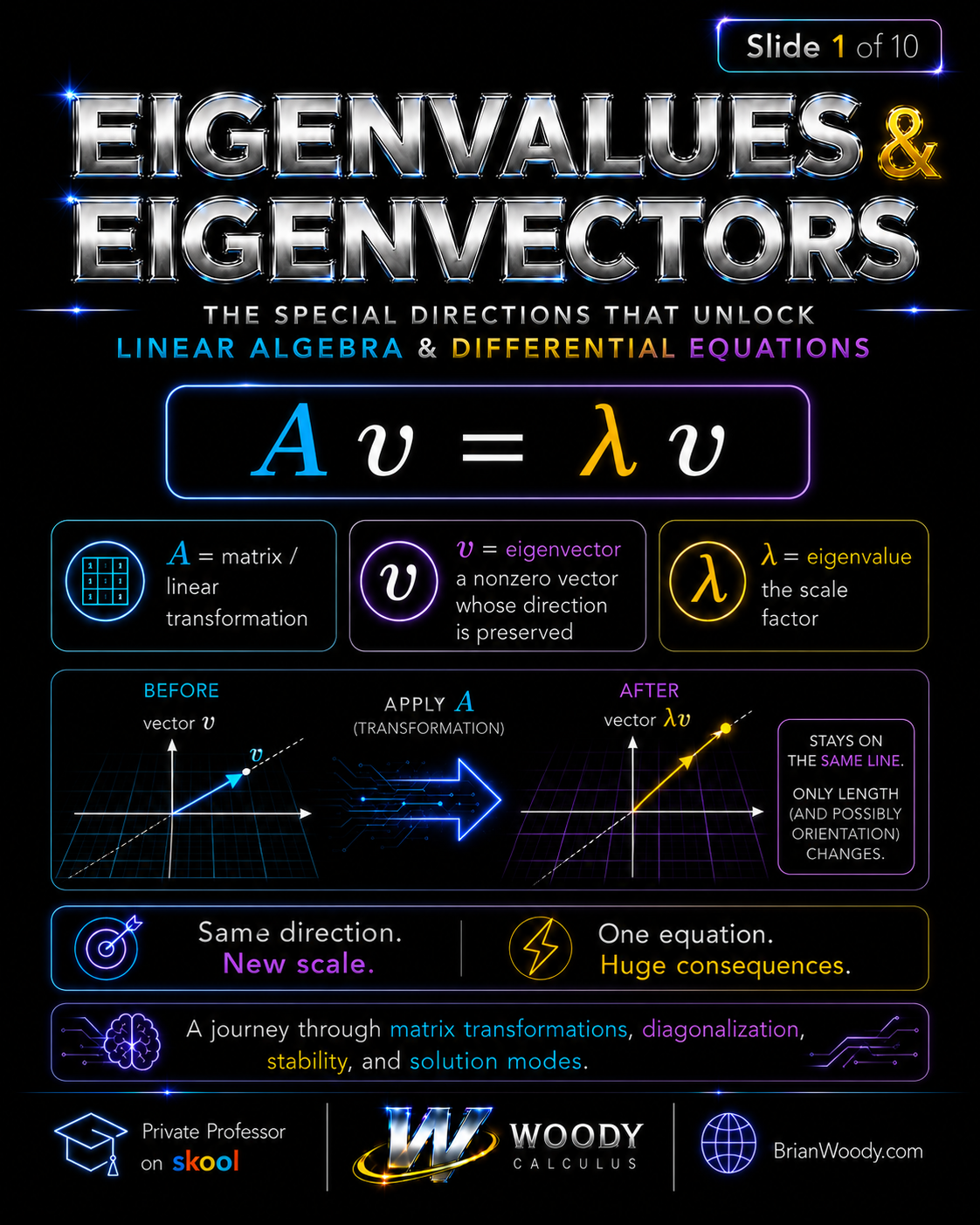
Eigenvalues and eigenvectors reveal the special directions that unlock Linear Algebra and Differential Equations. In this Woody Calculus visual lesson, learn how Av = λv explains matrix transformations, scaling, diagonalization, matrix powers, solution modes, stability, phase portraits, and why eigenvalues predict long-term behavior in systems before you even solve them.
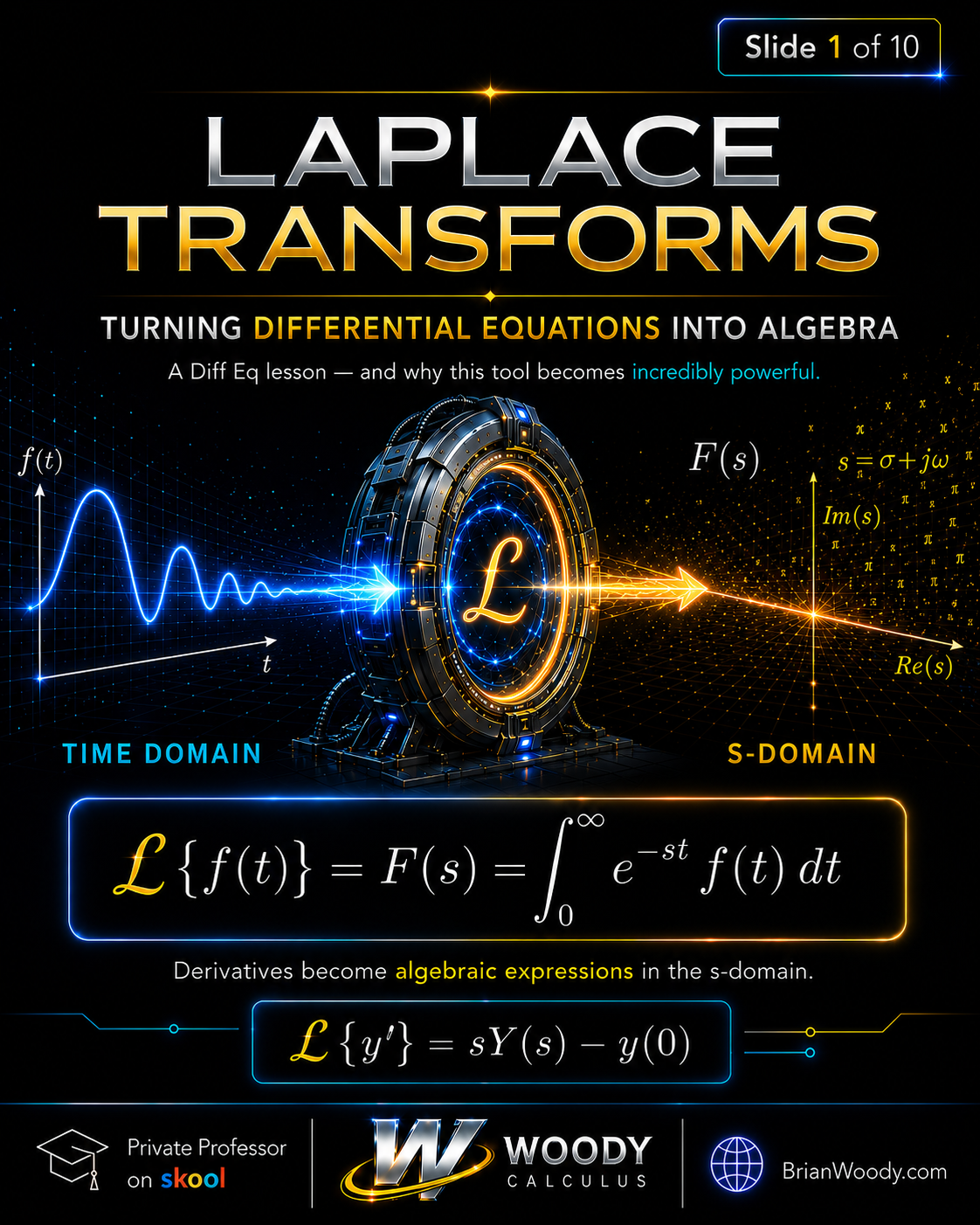
The Laplace Transform turns differential equations into algebra by moving time-domain functions into the s-domain. In this Woody Calculus visual lesson, learn the core formula, derivative rules, initial value problems, partial fractions, inverse Laplace transforms, unit step functions, and why Laplace transforms are so powerful for Differential Equations, engineering, circuits, and applied mathematics.