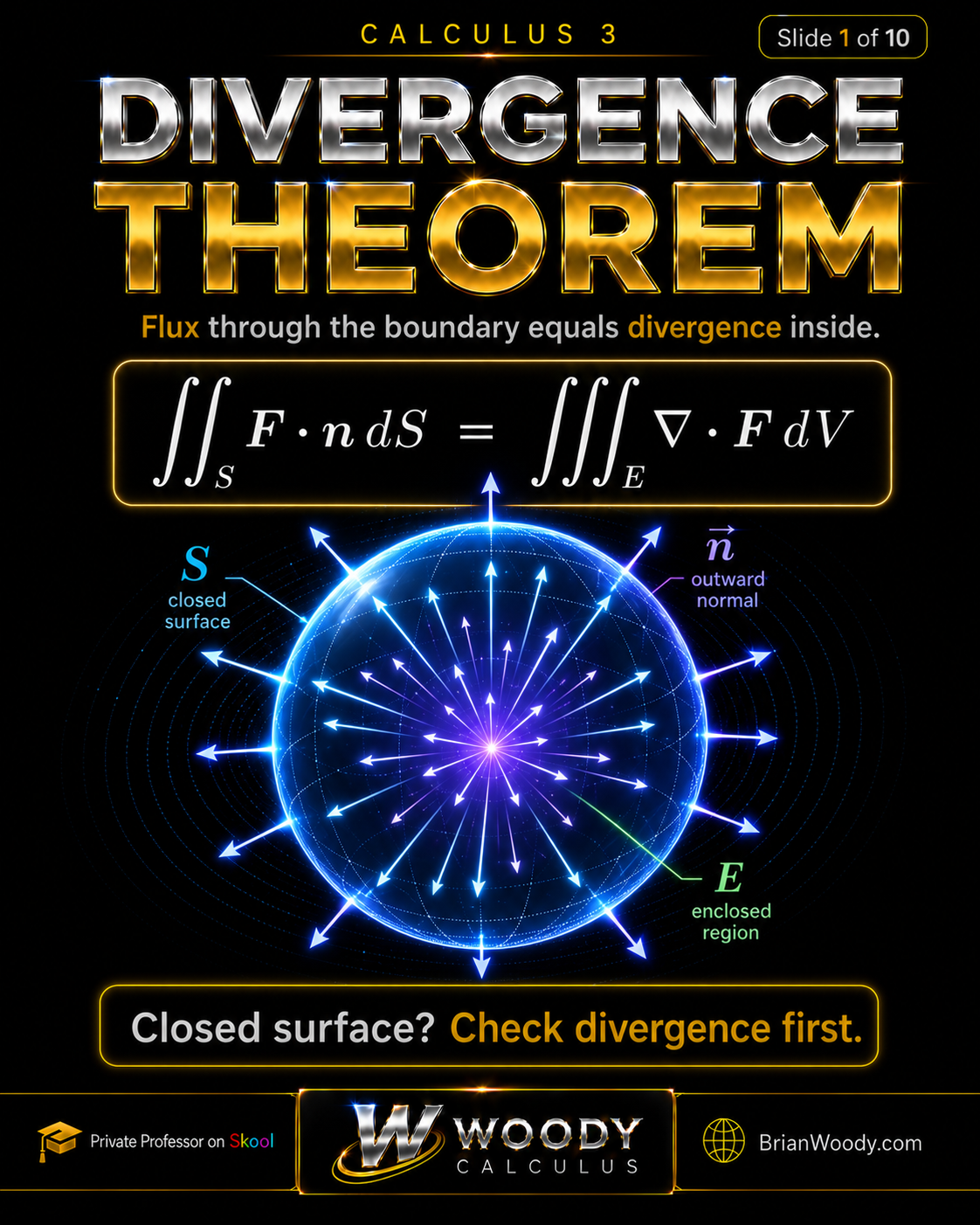
The Divergence Theorem converts outward flux through a closed surface into a triple integral of divergence over the enclosed solid. Learn the theorem’s conditions, flux and divergence meanings, method-selection rules, singularity warnings, and a complete sphere example with exact verification.
Improper integrals are Calculus 2 limit problems in disguise. This Woody Calculus lesson teaches how to handle infinite intervals, vertical asymptotes, bad points inside an interval, p-integrals, comparison tests, convergence, and divergence with a clear step-by-step system.
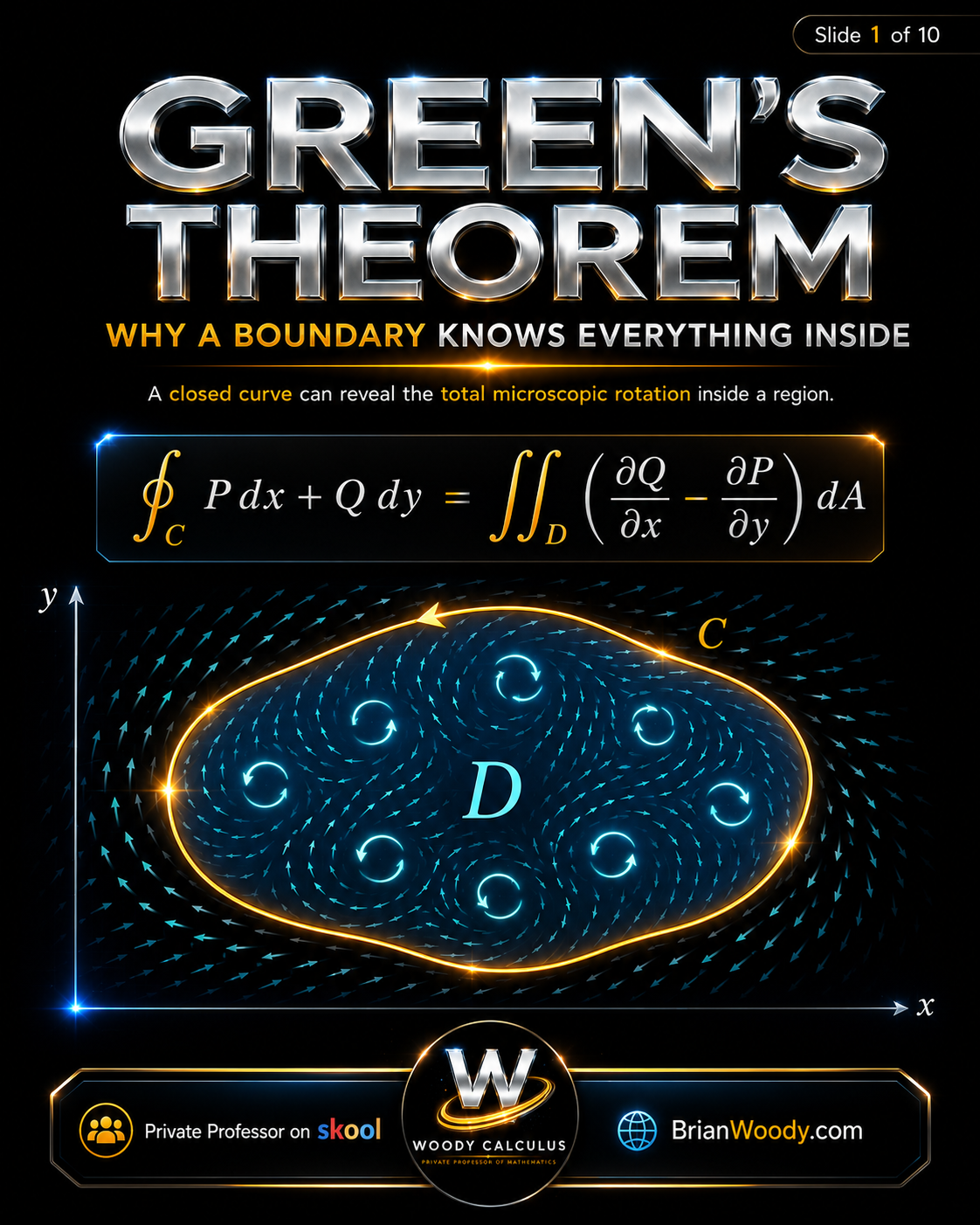
Green’s Theorem turns a boundary line integral into an interior double integral. In this Woody Calculus visual lesson, learn how Green’s Theorem connects circulation, curl, flux, area, line integrals, double integrals, Stokes’ Theorem, and the Divergence Theorem in Calculus 3.
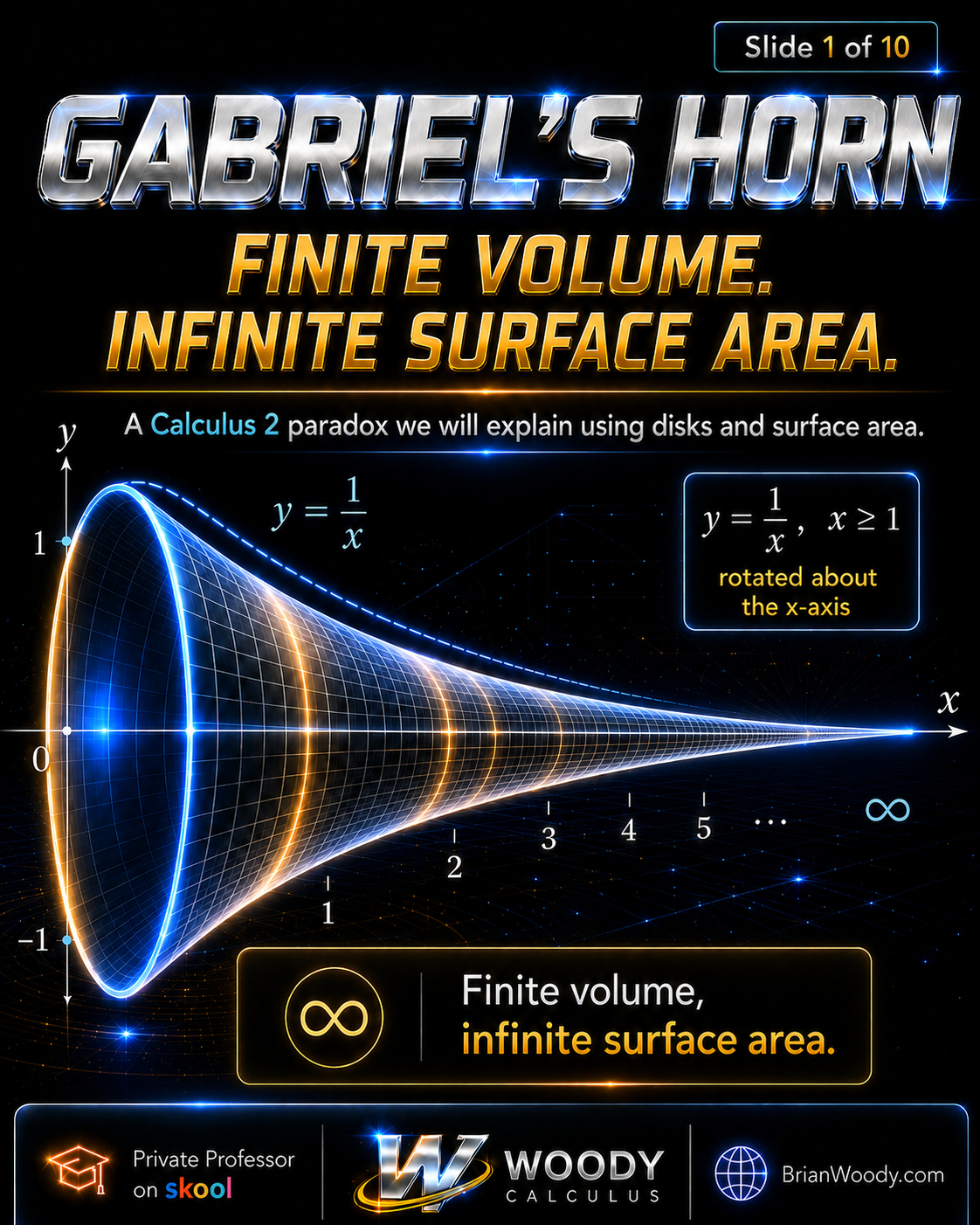
Gabriel’s Horn is one of the most unforgettable paradoxes in Calculus 2: a solid with finite volume but infinite surface area. Learn how the disk method gives volume π, while the surface area integral diverges using improper integrals and comparison.