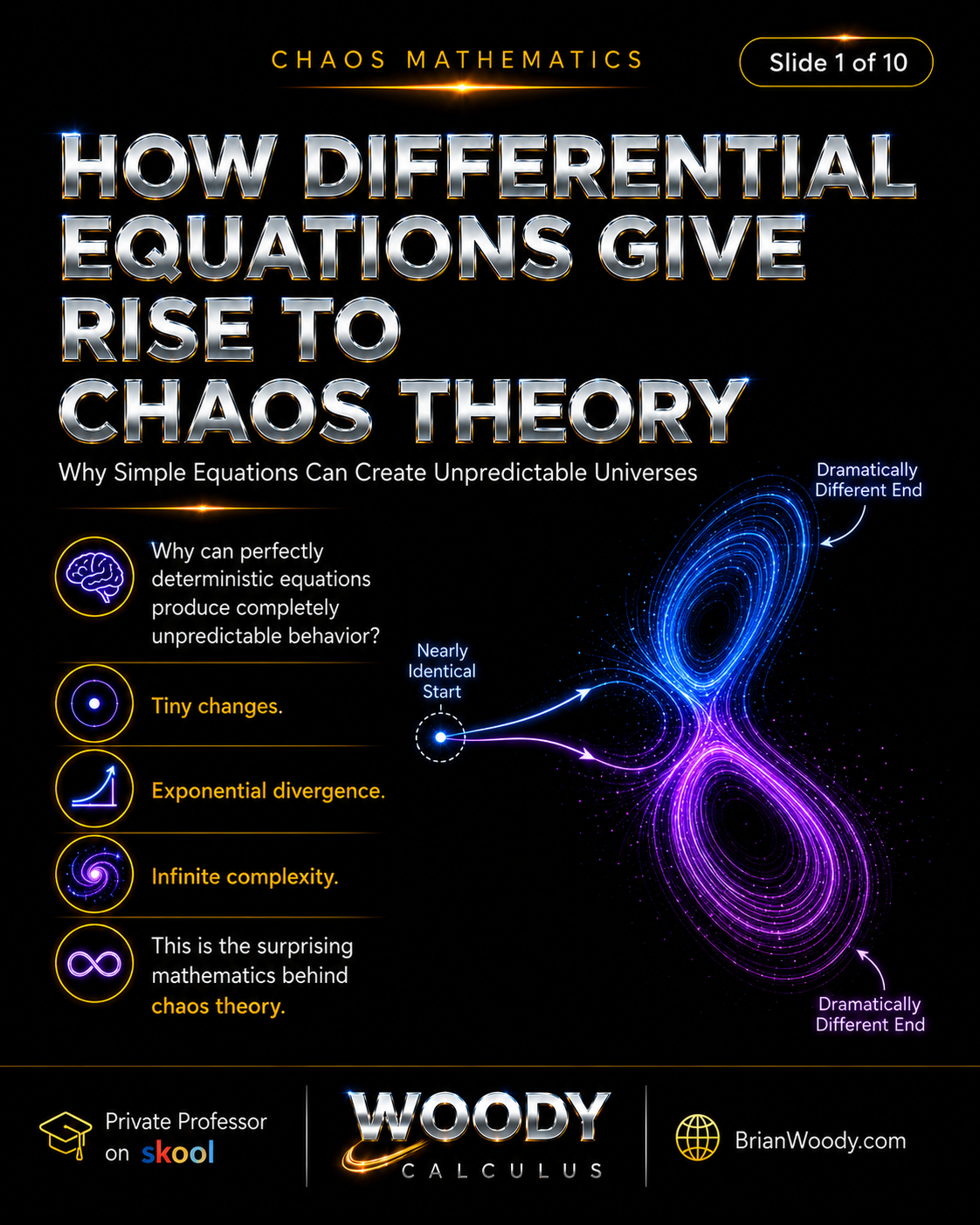
How Differential Equations Give Rise to Chaos Theory is one of the most fascinating lessons in advanced mathematics: perfectly deterministic equations can produce behavior that becomes practically impossible to predict far into the future.
That is the heart of chaos theory. A system may follow precise mathematical laws, yet tiny changes in the starting point can grow into dramatically different outcomes. Weather, fluid motion, biological rhythms, engineering systems, and financial models all show why Differential Equations tutor and Private Professor support matters for students who want to understand real-world complexity.
At Woody Calculus, this is exactly the kind of topic that connects Calculus 3 vector fields, eigenvalues and eigenvectors in differential equations, phase portraits, nonlinear systems, and real-world mathematical modeling.
We still memorize the important formulas, but we do it actively: rewrite them, repeat them, say them out loud with conviction, and connect each formula to the geometry of the problem until the method becomes automatic.
Estimated read time: 12–15 minutes.
Quick summary: Differential equations describe how systems evolve over time. Chaos appears when a deterministic nonlinear differential equation system is extremely sensitive to initial conditions, so two nearly identical starts can separate exponentially and create long-term unpredictability.
Differential Equations Give Rise to Chaos Theory Key Facts
- A differential equation gives a rule for how a quantity or state changes over time.
- A deterministic system follows fixed mathematical laws, but deterministic does not automatically mean predictable.
- Chaos often begins when tiny differences in initial conditions grow exponentially.
- For a chaotic system, nearby trajectories may separate according to a positive Lyapunov exponent.
- Nonlinearity is essential for chaos in finite-dimensional autonomous differential equation systems.
- The Lorenz system is one of the most famous examples of deterministic chaos.
- Chaos is not randomness; chaotic systems can have hidden geometric order.
This Woody Calculus lesson explains chaos theory in order: differential equations, deterministic systems, sensitivity to initial conditions, Lyapunov-type growth, the Lorenz system, nonlinearity, phase portraits, strange attractors, hidden order, and why chaos theory matters in real-world mathematics.
Differential Equations Describe Change
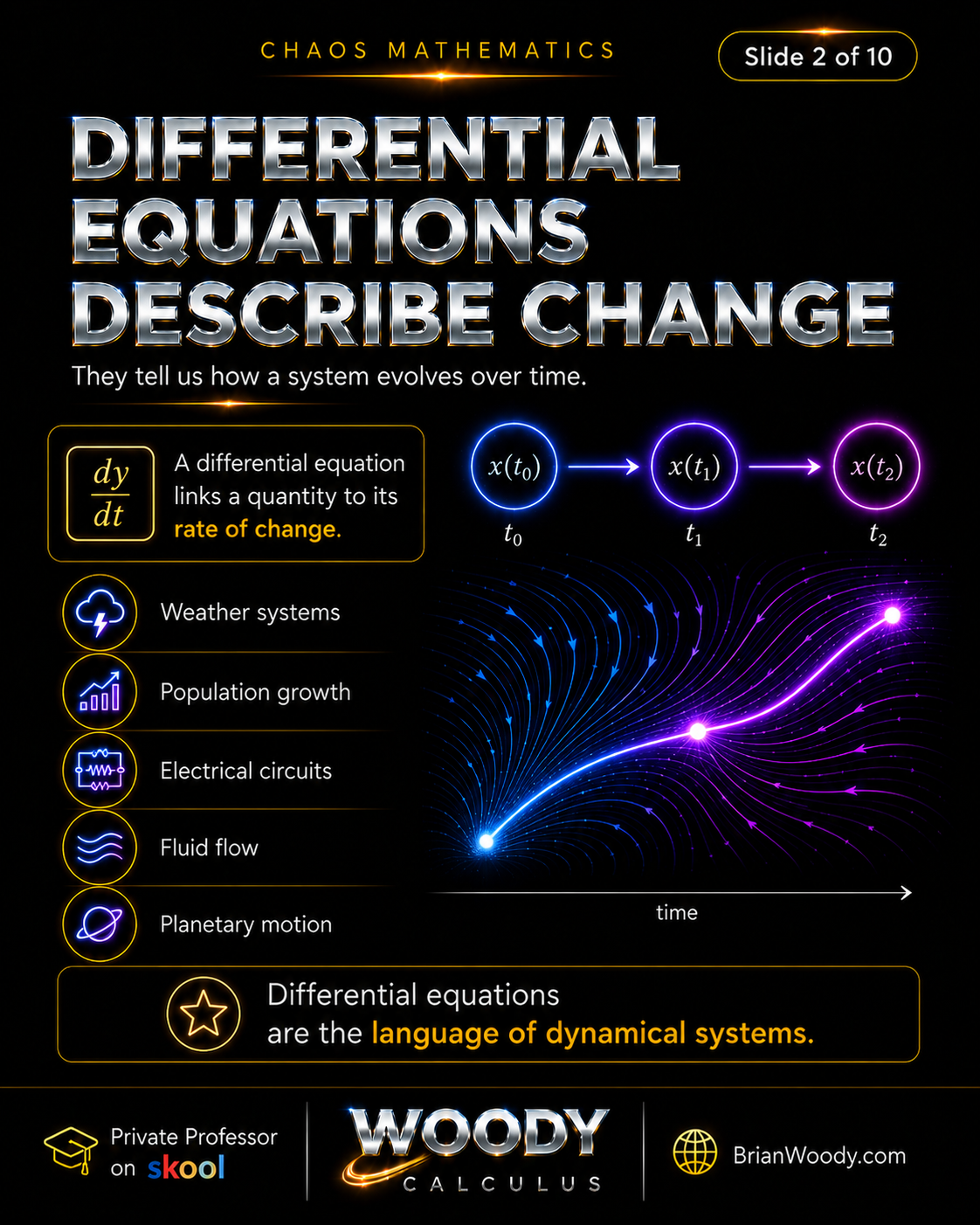
A differential equation links a quantity to its rate of change. In a first differential equations course, students often begin with equations like:
\frac{dy}{dt}=f(t,y)
\]
This says that the future behavior of \(y(t)\) depends on a rule involving time, the current value of \(y\), or both. In a system of differential equations, the state may have several components:
\frac{d\vec{x}}{dt}=\vec{F}(\vec{x})
\]
Here, \(\vec{x}(t)\) represents the state of the system at time \(t\), and \(\vec{F}\) tells the system how to move through state space. This is the language of dynamical systems, nonlinear modeling, and phase-space analysis.
Students who have studied line integrals and vector fields in Calculus 3 have already seen the geometric idea behind this: a vector field tells you a direction at each point. A differential equation turns that direction field into motion.
Why this matters for chaos theory
Chaos theory does not begin with randomness. It begins with a rule. The rule may describe weather, population growth, an electrical circuit, fluid flow, or planetary motion. Once the rule is written as a differential equation, the central question becomes:
If we know the rule and the starting point, can we predict the future?
The surprising answer is: sometimes only for a while.
Deterministic Does Not Mean Predictable
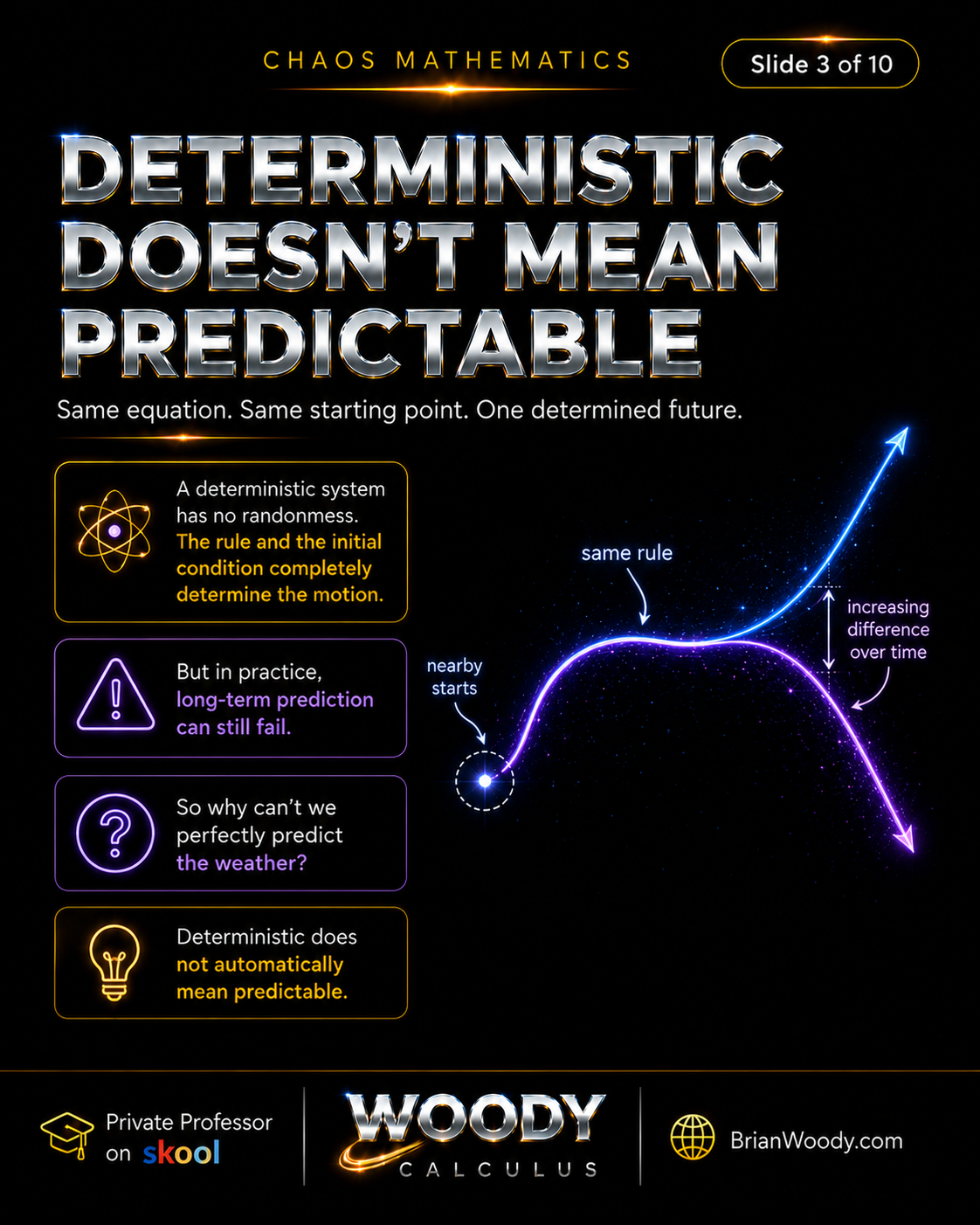
A system is deterministic when the same rule and the same initial condition produce the same future. For example, if a differential equation has a unique solution through the initial condition \(x(0)=x_0\), then the future path is determined.
\frac{d\vec{x}}{dt}=\vec{F}(\vec{x}), \qquad \vec{x}(0)=\vec{x}_0
\]
Under standard existence and uniqueness hypotheses, such as \(\vec{F}\) being sufficiently well-behaved near the initial condition, this initial value problem determines one solution curve.
But this does not mean that long-term prediction is practically reliable. If the system is highly sensitive to small measurement errors, then even a tiny uncertainty in the starting point can eventually dominate the prediction.
The weather example
Weather is not unpredictable because it has no laws. It is difficult to predict far in advance because the atmosphere is a nonlinear dynamical system with enormous sensitivity to initial conditions. We can measure temperature, pressure, wind, and humidity extremely well, but not with infinite precision.
In a chaotic system, small initial uncertainty can grow until two forecasts that began almost identically lead to noticeably different futures. This is one reason chaos theory, the Butterfly Effect, and the Lorenz system became such powerful ideas in modern mathematics.
Sensitivity to Initial Conditions
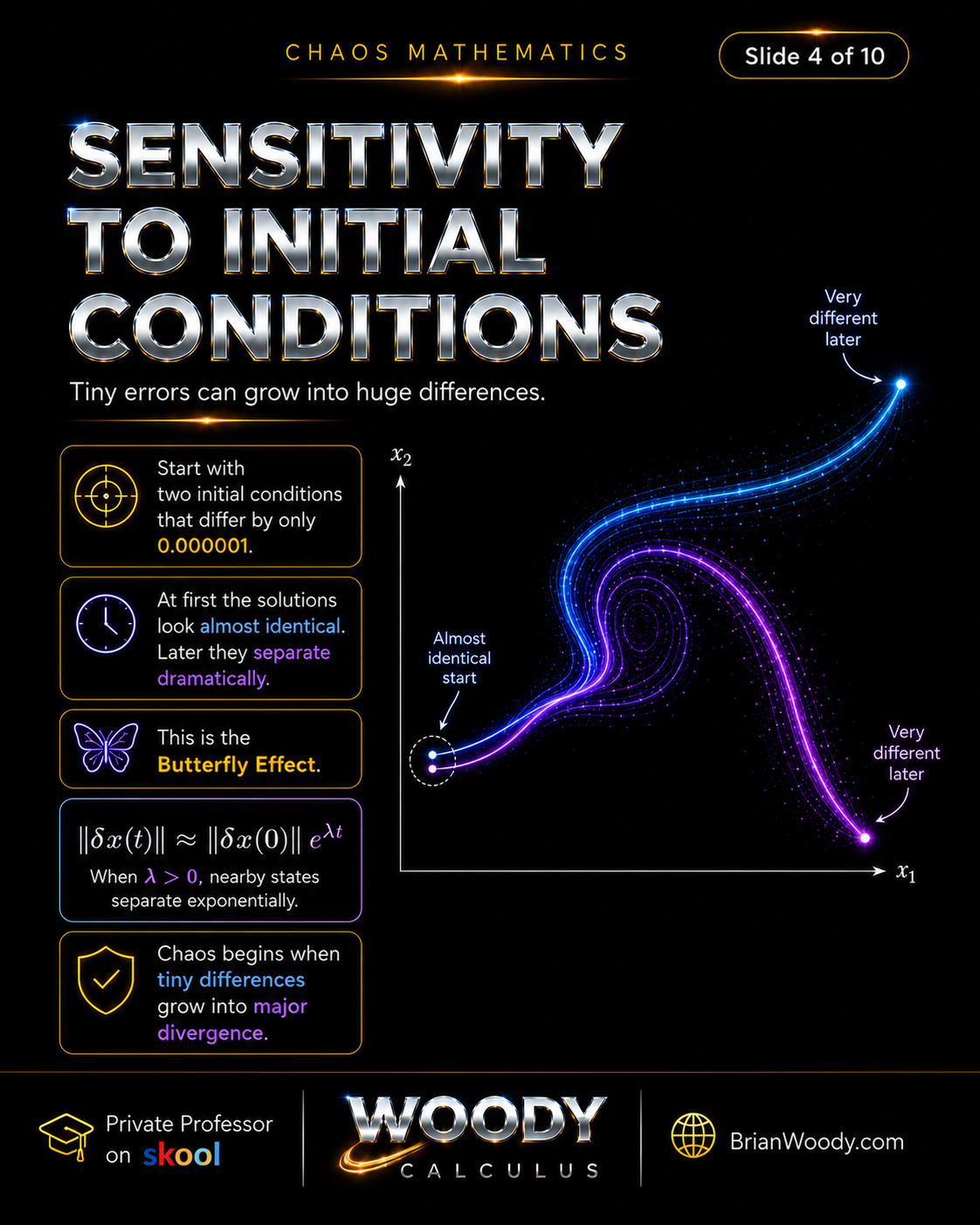
The most famous feature of chaos theory is sensitivity to initial conditions, often called the Butterfly Effect in chaos theory and the Lorenz system. The idea is not that butterflies magically control the weather. The mathematical idea is that tiny differences in starting data can grow into huge differences later.
If two nearby solutions begin with separation \(\|\delta x(0)\|\), then in a chaotic system the separation may behave approximately like:
\|\delta x(t)\|\approx \|\delta x(0)\|e^{\lambda t}
\]
Here, \(\lambda\) is related to a Lyapunov exponent. When the largest Lyapunov exponent is positive, nearby trajectories tend to separate exponentially on average.
What the Lyapunov exponent formula means
The expression
\|\delta x(t)\|\approx \|\delta x(0)\|e^{\lambda t}
\]
does not mean every chaotic system separates perfectly at every instant. It is a local or average description of how small errors may grow. The key point is that exponential growth turns tiny measurement errors into serious prediction errors.
This is why Lyapunov exponents are so important in nonlinear dynamics: they help measure how fast nearby trajectories separate in a differential equation system. The same exponential thinking also appears throughout Laplace transforms and differential equations, where exponential functions become a natural language for growth, decay, and system response.
The Lorenz System
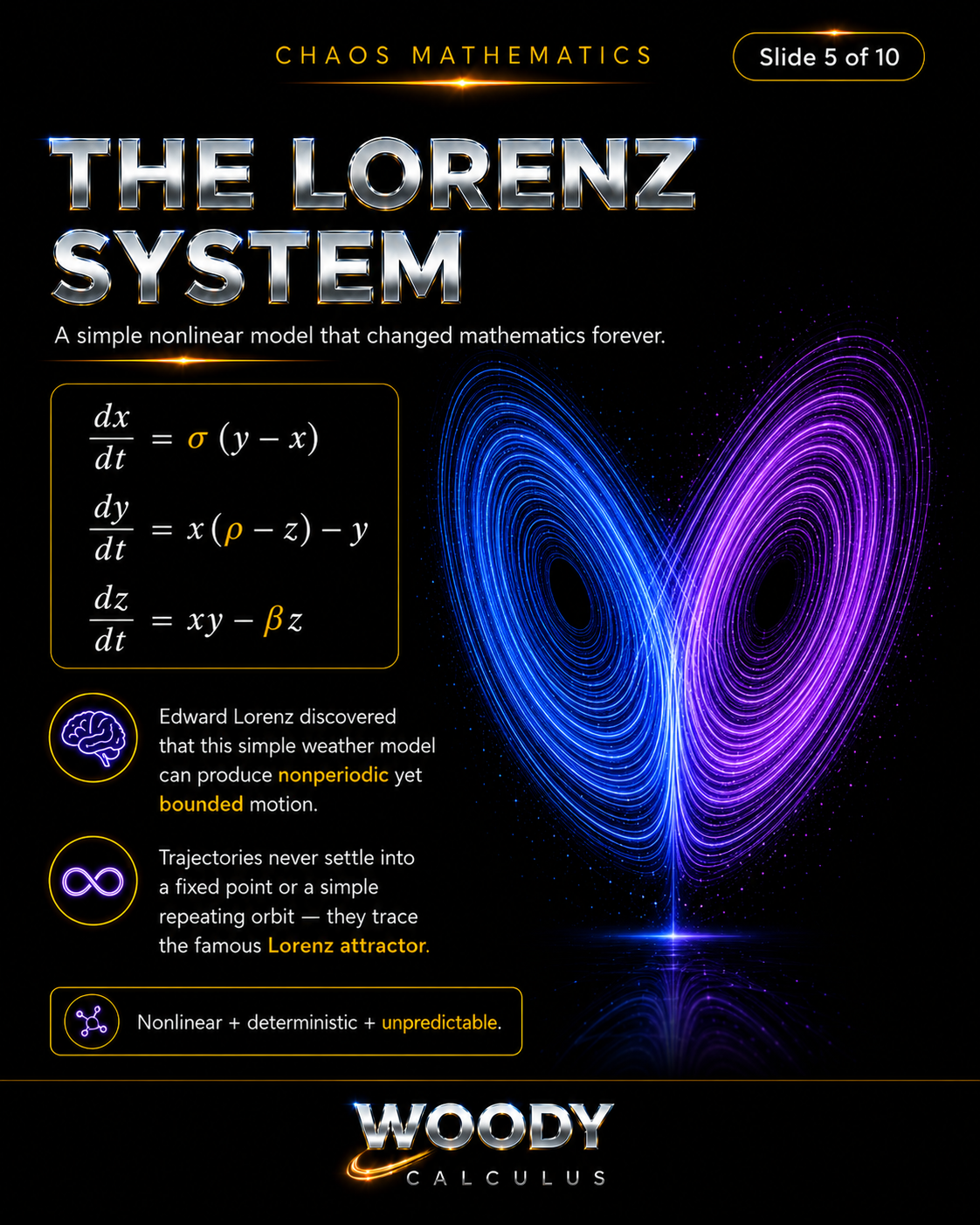
The Lorenz system is one of the most famous systems in chaos theory. It began as a simplified model connected to atmospheric convection, and it became a mathematical icon because it showed how a simple deterministic model can produce bounded, nonperiodic, unpredictable behavior.
The Lorenz system of nonlinear differential equations is:
\frac{dx}{dt}=\sigma(y-x)
\]
\frac{dy}{dt}=x(\rho-z)-y
\]
\frac{dz}{dt}=xy-\beta z
\]
The parameters \(\sigma\), \(\rho\), and \(\beta\) control the behavior of the system. For the classical parameter values
\sigma=10, \qquad \rho=28, \qquad \beta=\frac{8}{3},
\]
the system produces the famous Lorenz attractor: a butterfly-shaped strange attractor where trajectories remain bounded but do not settle into a simple repeating orbit.
Why the Lorenz system is nonlinear
The nonlinear terms in the Lorenz system are:
xz \qquad \text{and} \qquad xy.
\]
Those products create coupling between variables. The \(x\), \(y\), and \(z\) components do not evolve independently. They interact, feed back into each other, and create the stretching and folding behavior associated with deterministic chaos.
This kind of coupling is one reason nonlinear systems are so different from the linear systems students study through eigenvalues, eigenvectors, and differential equations.
Nonlinearity Changes Everything
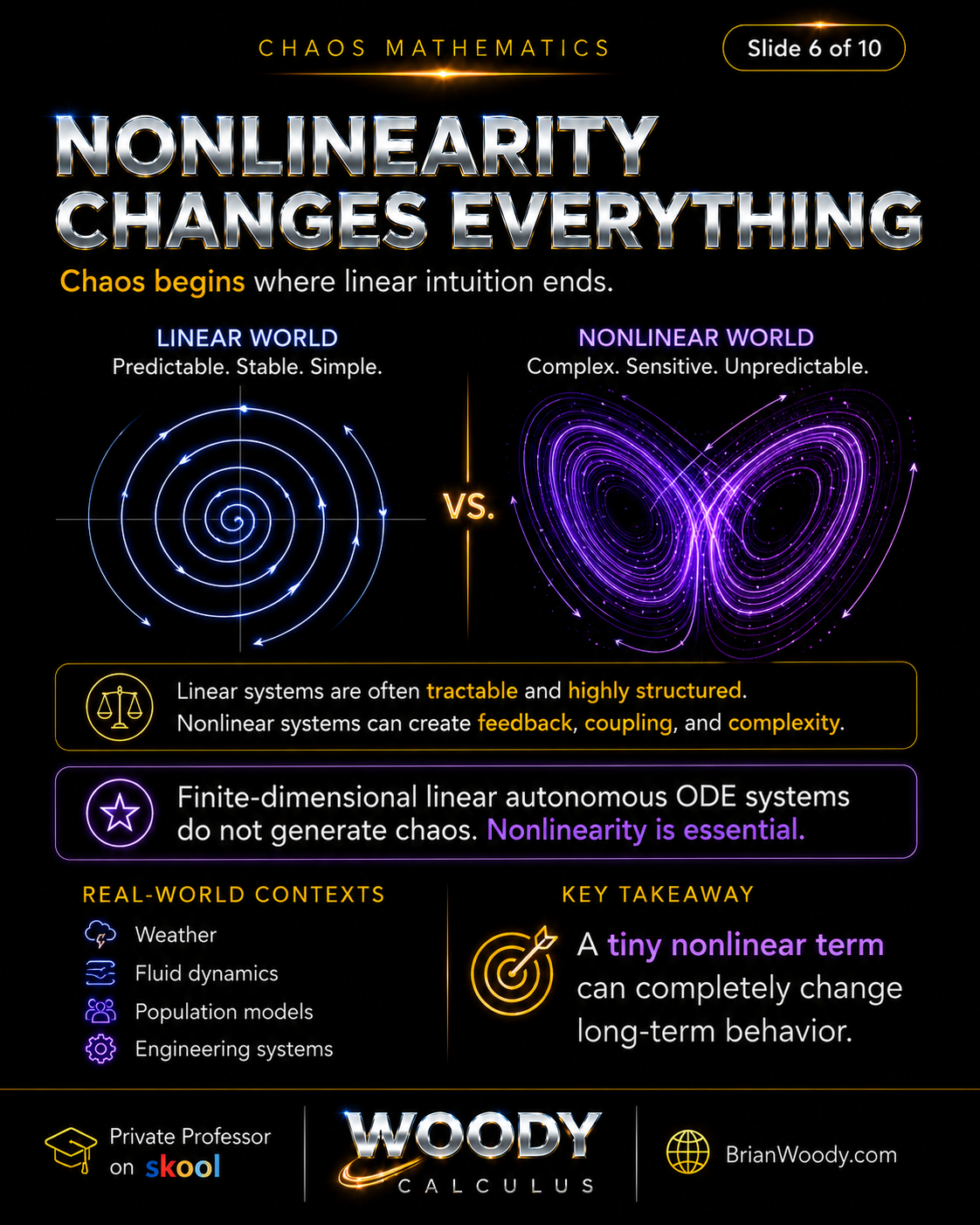
A linear autonomous differential equation system has the form:
\frac{d\vec{x}}{dt}=A\vec{x}.
\]
These systems are extremely important in Calculus 3 vector fields and trajectories, Differential Equations for engineering and physics systems, and local stability analysis. Their solutions are built from exponentials, eigenvalues, eigenvectors, and sometimes sines and cosines.
Linear systems can grow, decay, oscillate, spiral, or saddle. But finite-dimensional linear autonomous ODE systems do not generate chaos in the usual strange-attractor sense. They are too structured.
Chaos needs more than growth. It needs nonlinear feedback, stretching, folding, and bounded recurrence. This is why a tiny nonlinear term can completely change long-term behavior.
Nonlinear does not automatically mean chaotic
This is an important exam-level distinction. Nonlinearity is necessary for chaos in finite-dimensional autonomous ODE systems, but it is not sufficient by itself.
For example, the logistic differential equation
\frac{dP}{dt}=rP\left(1-\frac{P}{K}\right)
\]
is nonlinear, but it does not produce chaos as a one-dimensional autonomous differential equation. It usually approaches an equilibrium value. Chaos requires the right kind of nonlinear structure.
This is the same mathematical maturity students build in advanced courses such as Real Analysis: definitions matter, hypotheses matter, and one similar-looking condition does not automatically imply the whole conclusion.
Phase Portraits Reveal Hidden Structure
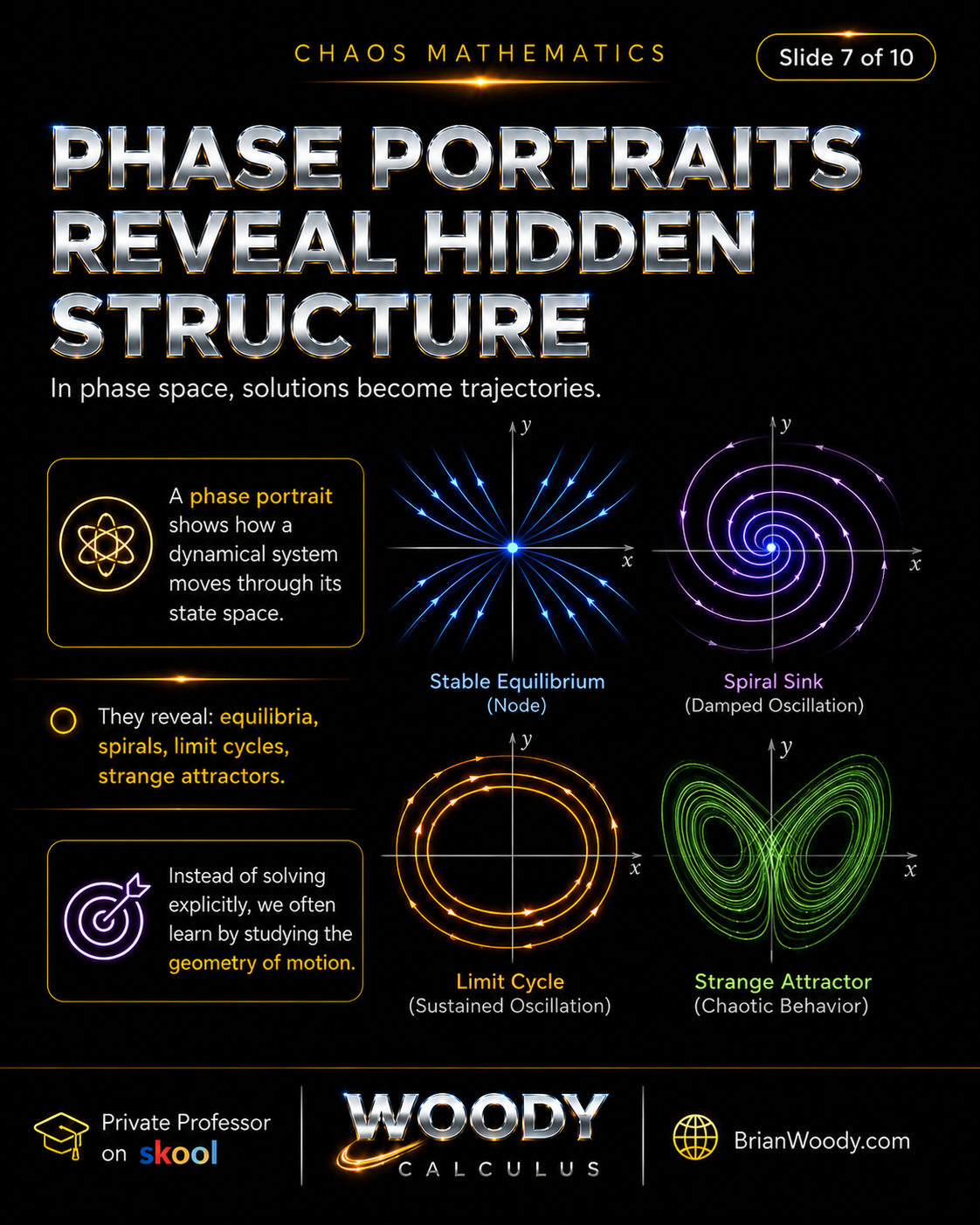
A phase portrait shows how solutions move through state space. Instead of only asking for a formula \(x(t)\), we study the geometry of motion.
In a phase portrait, each point represents a state of the system. A trajectory shows how that state evolves over time.
Phase portraits connect Differential Equations to the visual thinking students also use in Jacobians and change of variables in Calculus 3, where geometry reveals how space is transformed.
Common phase portrait features
Phase portraits help students recognize:
- Equilibria: points where the system stops moving.
- Nodes: trajectories move directly toward or away from equilibrium.
- Spirals: trajectories rotate while approaching or leaving equilibrium.
- Limit cycles: closed curves representing sustained oscillation.
- Strange attractors: complicated attracting sets associated with chaotic behavior.
This is why phase portraits are so powerful in Differential Equations. They show the structure before we have an explicit formula.
Chaos Has Hidden Order
Chaos vs. randomness
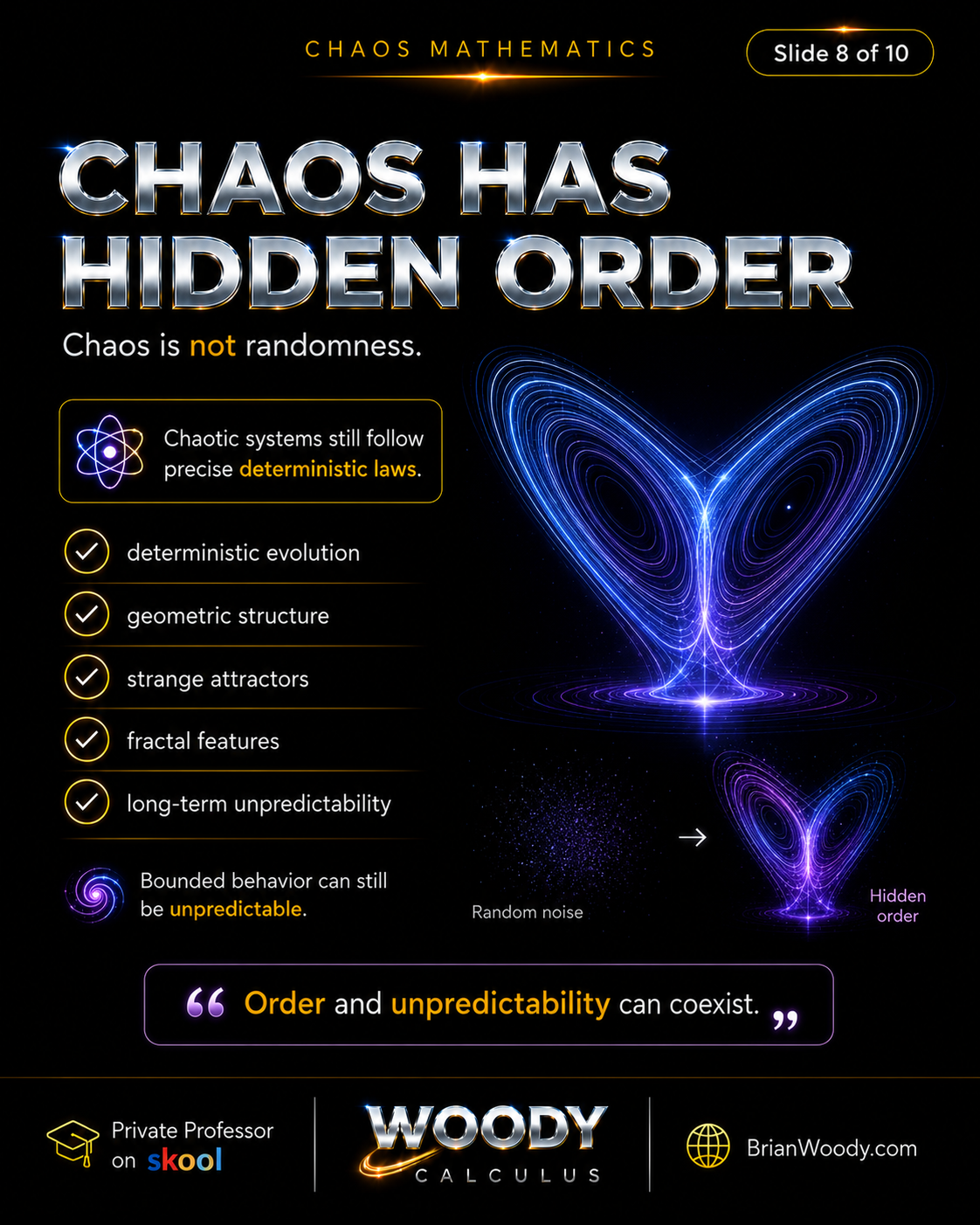
Chaos is not the same thing as randomness. A random process has no deterministic rule controlling every step. A chaotic system can follow a precise deterministic law and still become unpredictable over long time intervals.
In other words:
\text{chaos} \neq \text{randomness}.
\]
Features of chaotic systems
A chaotic system may have:
- deterministic evolution,
- geometric structure,
- bounded trajectories,
- strange attractors,
- fractal features,
- and long-term unpredictability.
The deep idea
The deep idea of chaos theory is that a system can be lawful without being practically predictable. The equations may be exact, but our measurements are never infinitely exact. When small errors grow exponentially, long-term prediction becomes limited.
This is also why chaos theory is connected to fractal structure and Real Analysis ideas: complicated sets can have precise rules, surprising geometry, and counterintuitive behavior.
Why Chaos Theory Matters
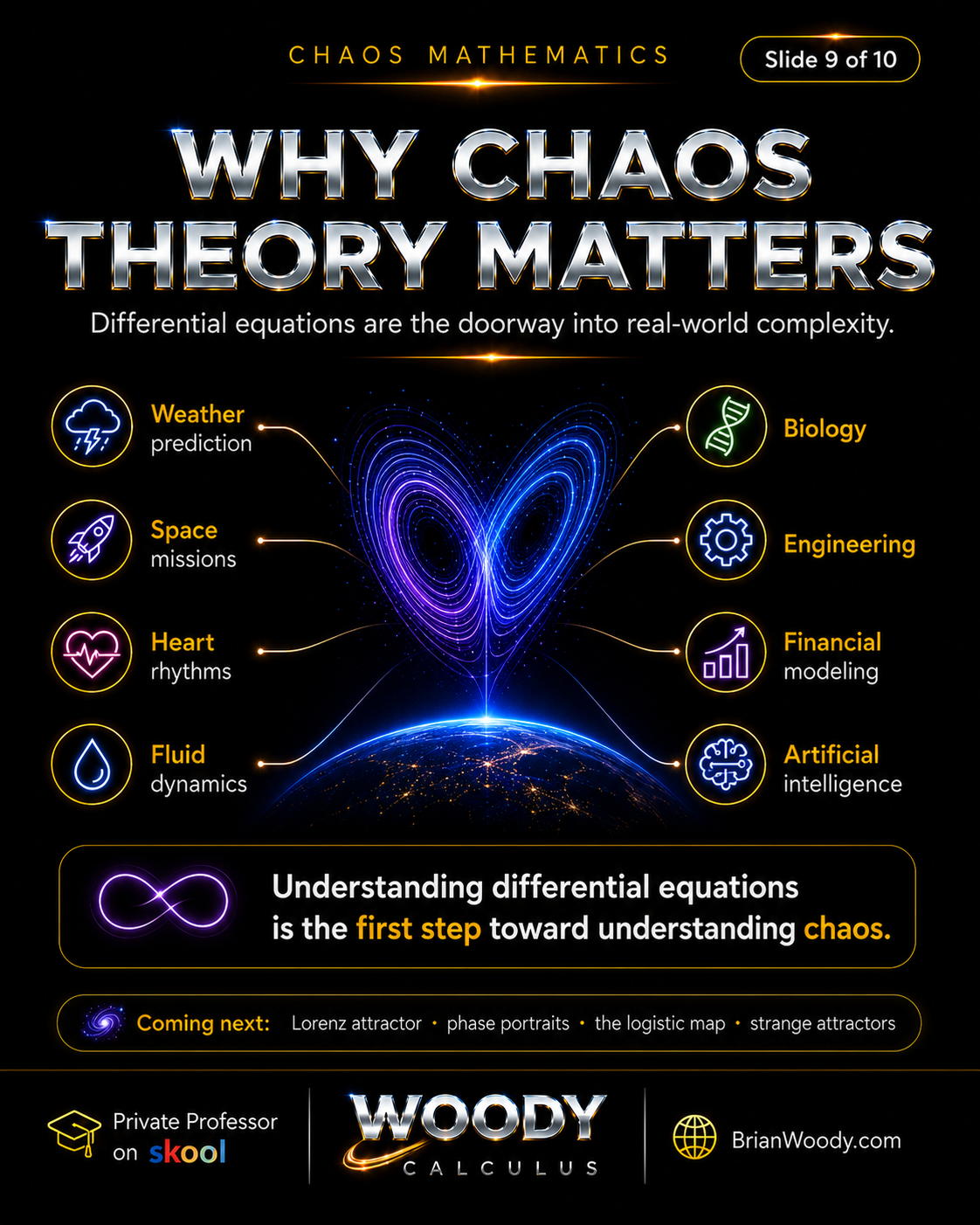
Differential equations are the doorway into complexity
Chaos theory matters because many real-world systems are nonlinear, interconnected, and sensitive to initial conditions. Differential equations give us the mathematical language to model those systems.
Where chaos appears
Chaos theory appears in:
- Weather prediction: small atmospheric measurement errors can grow over time.
- Fluid dynamics: turbulence and nonlinear flow can become extremely complex.
- Biology: rhythms, feedback loops, and population models can show complicated behavior.
- Engineering: nonlinear systems can oscillate, bifurcate, or become unstable.
- Space missions: orbital dynamics can be highly sensitive to initial conditions.
- Artificial intelligence: complex dynamical behavior appears in optimization, recurrence, and nonlinear modeling.
Why students should care
This is why mastering Differential Equations is not just about solving textbook problems. It is about learning the mathematics of motion, change, prediction, and complexity.
The same habits that help students master chaos theory also help with Green’s Theorem and line integrals, Stokes’ Theorem and curl, and other advanced topics where geometry and formulas must work together.
Worked Examples
Worked Example 1: Exponential error growth
Suppose two trajectories begin extremely close together:
\|\delta x(0)\|=10^{-6}.
\]
Assume their separation grows approximately like:
\|\delta x(t)\|\approx 10^{-6}e^{0.9t}.
\]
When will the separation become roughly \(1\)?
1\approx 10^{-6}e^{0.9t}
\]
10^6\approx e^{0.9t}
\]
\ln(10^6)\approx 0.9t
\]
t\approx \frac{\ln(10^6)}{0.9}\approx \frac{13.8155}{0.9}\approx 15.35.
\]
So an initial difference of only one millionth can become order-one after about \(15.35\) time units in this simplified model.
Interpretation: This is why long-term prediction can fail even when the differential equation is deterministic.
Worked Example 2: Linear growth is not the same as chaos
Consider the simple linear differential equation:
\frac{dx}{dt}=ax.
\]
The solution is:
x(t)=x_0e^{at}.
\]
If two solutions begin at \(x_0\) and \(x_0+\delta_0\), then their separation is:
\delta(t)=\delta_0e^{at}.
\]
If \(a>0\), the separation grows. But this system is not chaotic. It simply grows exponentially in a structured, predictable way.
Lesson: Exponential separation alone is not the whole story. Chaos also involves nonlinear feedback, bounded recurrence, and complicated geometry.
Worked Example 3: A nonlinear equation that is not chaotic
The logistic differential equation
\frac{dP}{dt}=rP\left(1-\frac{P}{K}\right)
\]
is nonlinear because of the \(P^2\) term. But for positive \(r\), positive \(K\), and reasonable positive initial values, the solution tends toward the carrying capacity \(K\).
This equation teaches an important distinction:
- Nonlinear does not automatically mean chaotic.
- Chaotic systems need the right nonlinear structure.
- In autonomous continuous-time systems, chaos typically requires higher-dimensional dynamics.
Common Mistakes
Mistake 1: Thinking chaos means randomness
Chaos is not randomness. A chaotic system can follow exact deterministic laws. The unpredictability comes from sensitivity to initial conditions, not from the absence of rules.
Mistake 2: Thinking deterministic always means predictable
Deterministic means the rule determines the future from the initial condition. It does not mean we can predict the future accurately when the initial condition is only approximately known.
Mistake 3: Thinking every nonlinear equation is chaotic
Many nonlinear differential equations are not chaotic. Some approach equilibrium. Some approach periodic behavior. Chaos requires a specific kind of nonlinear structure.
Mistake 4: Ignoring phase portraits
Students often try to solve everything symbolically. In dynamical systems, the geometry of the phase portrait may reveal more than an explicit formula.
Mistake 5: Confusing instability with chaos
An unstable linear system may send nearby points apart, but that alone is not chaos. Chaos involves sensitive dependence together with nonlinear geometric structure and long-term complexity.
Key Takeaways
- Differential equations describe how systems change over time.
- Chaos theory studies deterministic systems whose long-term behavior can become practically unpredictable.
- Sensitivity to initial conditions is the mathematical core of the Butterfly Effect.
- A positive Lyapunov exponent means nearby trajectories tend to separate exponentially on average.
- The Lorenz system is a famous nonlinear differential equation model that produces a strange attractor.
- Nonlinearity is essential for chaos in finite-dimensional autonomous ODE systems.
- Chaos is not randomness; chaotic systems can have hidden geometric order.
FAQ
How can differential equations give rise to chaos theory?
Differential equations give rise to chaos theory when deterministic rules create solutions that are extremely sensitive to initial conditions. In nonlinear systems, tiny differences in starting values can grow into dramatically different long-term behavior.
Does chaos mean randomness?
No. Chaos is not randomness. Chaotic systems can follow precise deterministic laws while still being practically unpredictable over long time intervals.
What is sensitivity to initial conditions?
Sensitivity to initial conditions means that two nearly identical starting points can eventually produce very different outcomes. This is the mathematical idea behind the Butterfly Effect.
What is the Lorenz system?
The Lorenz system is a nonlinear system of three differential equations famous for producing the Lorenz attractor, a butterfly-shaped strange attractor associated with deterministic chaos.
Why is nonlinearity important in chaos theory?
Nonlinearity allows variables to interact, feed back into each other, stretch trajectories, and fold them into complicated bounded structures. This kind of structure is essential for chaos in finite-dimensional autonomous ODE systems.
Can a linear differential equation be chaotic?
Finite-dimensional linear autonomous differential equation systems do not produce chaos in the usual strange-attractor sense. They may grow, decay, oscillate, or spiral, but they remain highly structured.
What is a phase portrait?
A phase portrait is a geometric picture of how solutions move through state space. It can reveal equilibria, spirals, limit cycles, and strange attractors.
Why should Differential Equations students study chaos theory?
Chaos theory shows why Differential Equations are essential for understanding real-world complexity. It connects classroom methods to weather, fluid dynamics, engineering, biology, space missions, and nonlinear modeling.
Master Differential Equations and Chaos Theory with Woody Calculus
Understanding chaos theory begins with mastering the mathematics behind it: Differential Equations, phase portraits, nonlinear systems, equilibrium analysis, eigenvalues, vector fields, and stability.
Woody Calculus provides structured, university-level instruction designed to build formula fluency, genuine mathematical understanding, and exam-ready execution. The goal is not just to recognize formulas. The goal is to know when to use them, how to set them up cleanly, how to interpret the answer, and how to write complete solutions under pressure.
Chaos theory is what happens when exact mathematical laws create motion too sensitive for long-term prediction.
— Brian M. Woody
Woody Calculus CTA
If you are studying Differential Equations, Calculus 2, Calculus 3, Abstract Algebra, Real Analysis, Number Theory, Topology, or advanced mathematics, Woody Calculus can help you build a serious system for learning.
Visit BrianWoody.com for Woody Calculus visual mathematics lessons covering free mathematical essays, visual lessons, exam-focused resources, and advanced university math support.
For structured training, join the Woody Calculus Mastery Lab for university mathematics, where students learn through clean definitions, clean setup, formula fluency, pattern recognition, rewriting perfect solutions, and saying each step out loud until the method becomes automatic.
Join Woody Calculus Mastery Lab on Skool
Related Woody Calculus Mathematical Essays
Explore more Woody Calculus visual lessons and deep-dive mathematical essays connecting Differential Equations, Calculus 2, Calculus 3, Linear Algebra, Real Analysis, Abstract Algebra, Number Theory, Topology, chaos mathematics, and peak performance study methods.
- How to Learn Calculus and Advanced Mathematics: A Peak Performance Study Guide
- Chaos Theory Explained: Butterfly Effect, Lorenz System, and Lyapunov Exponents
- Resonance Explained for Differential Equations: Forced Oscillations and Natural Frequency
- Laplace Transforms Explained: Turning Differential Equations Into Algebra
- Eigenvalues and Eigenvectors Explained: The Special Directions That Unlock Linear Algebra
- The Determinant Explained: The Number That Measures How a Matrix Changes Space
- The Jacobian Explained: The Hidden Scale Factor in Calculus III
- Line Integrals and Vector Fields: What They Measure in Calculus 3
- Green’s Theorem Explained: Why a Boundary Knows Everything Inside
- Stokes’ Theorem Explained: Why the Edge Knows the Surface
- Fourier Series Explained: Harmonics, Sound, Heat, and Quantum Mechanics
- Taylor Series Explained: Mathematical Time Travel in Calculus 2
- Cantor Set Explained: Infinite Points, Zero Length in Real Analysis
- View All Woody Calculus Blog Posts
Related University Math Help Pages
Woody Calculus supports students at major universities with structured help in Differential Equations, Calculus II, Calculus III, Linear Algebra, Real Analysis, Abstract Algebra, Number Theory, Topology, and advanced mathematics. For the full list of supported schools, visit the University Calculus Tutor Hub.
- University Calculus Tutor Hub
- MIT Calculus Tutor
- Purdue University Calculus Tutor
- University of Florida Calculus Tutor
- Colorado State University Calculus Help
- UCF Calculus Tutor
- Georgia Tech Calculus Tutor
- University of Michigan Calculus Tutor
- University of Nevada, Reno Calculus Tutor
- University of Wisconsin Calculus Tutor
Trusted by Students Nationwide
The Woody Calculus Mastery Lab gives university students access to structured mathematics support, written solutions, video lessons, exam-focused training, proof-based lessons, and expert guidance from Brian M. Woody.
Students use Woody Calculus for Differential Equations, Calculus II, Calculus III, Linear Algebra, Abstract Algebra, Real Analysis, Number Theory, Topology, and other advanced mathematics courses.