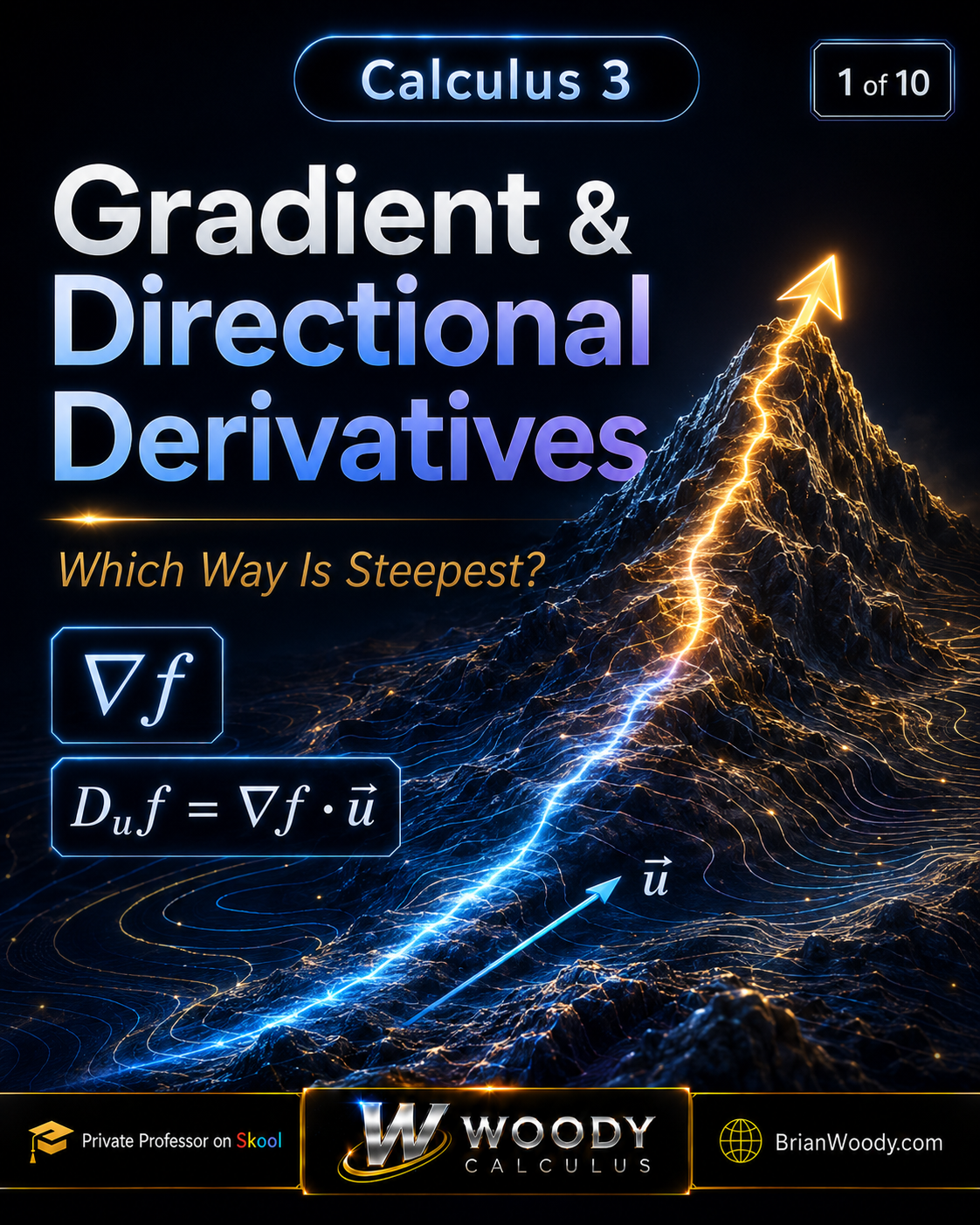

Which direction makes a multivariable function increase fastest? Learn how the gradient packages partial derivatives, how to calculate directional derivatives with unit vectors and dot products, and why gradients cross level curves at right angles.
Which direction makes a multivariable function increase fastest? Learn how the gradient packages partial derivatives, how to calculate directional derivatives with unit vectors and dot products, and why gradients cross level curves at right angles.
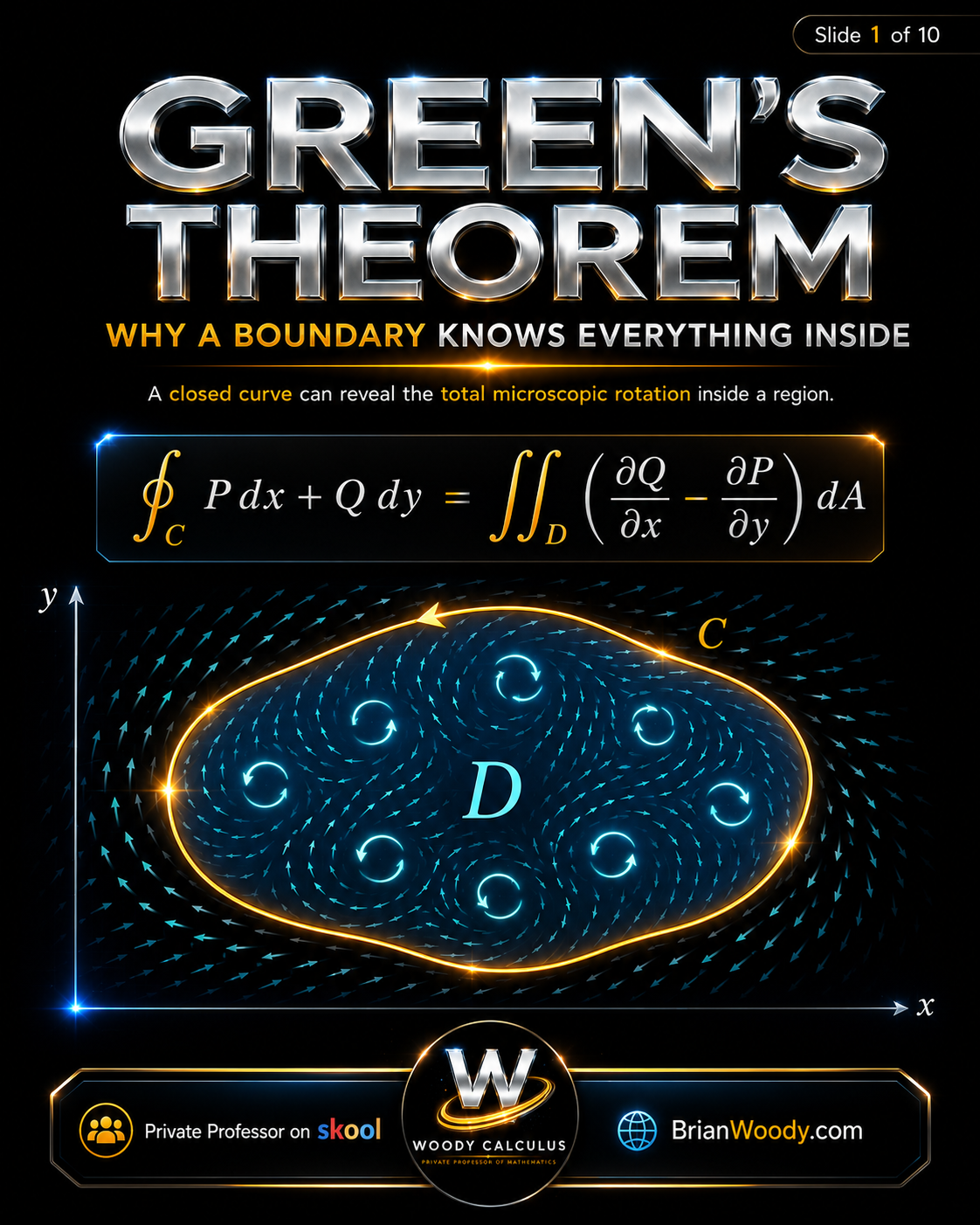
Green’s Theorem turns a boundary line integral into an interior double integral. In this Woody Calculus visual lesson, learn how Green’s Theorem connects circulation, curl, flux, area, line integrals, double integrals, Stokes’ Theorem, and the Divergence Theorem in Calculus 3.
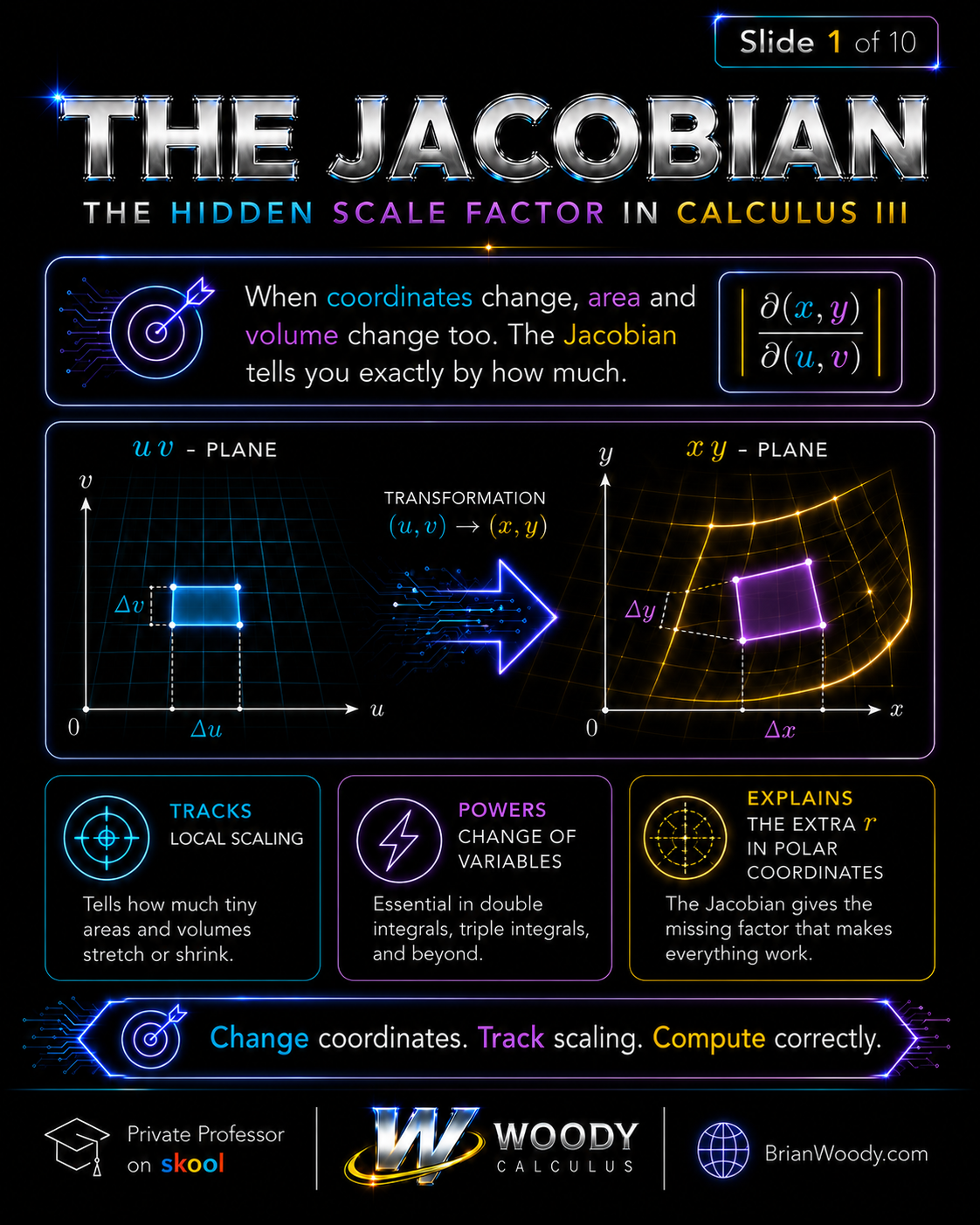
The Jacobian is the hidden scale factor behind every coordinate change in Calculus III. In this Woody Calculus visual lesson, learn how Jacobians explain area and volume scaling, change of variables, polar coordinates, cylindrical coordinates, spherical coordinates, double integrals, triple integrals, and why the mysterious extra factors r and ρ²sinφ appear.
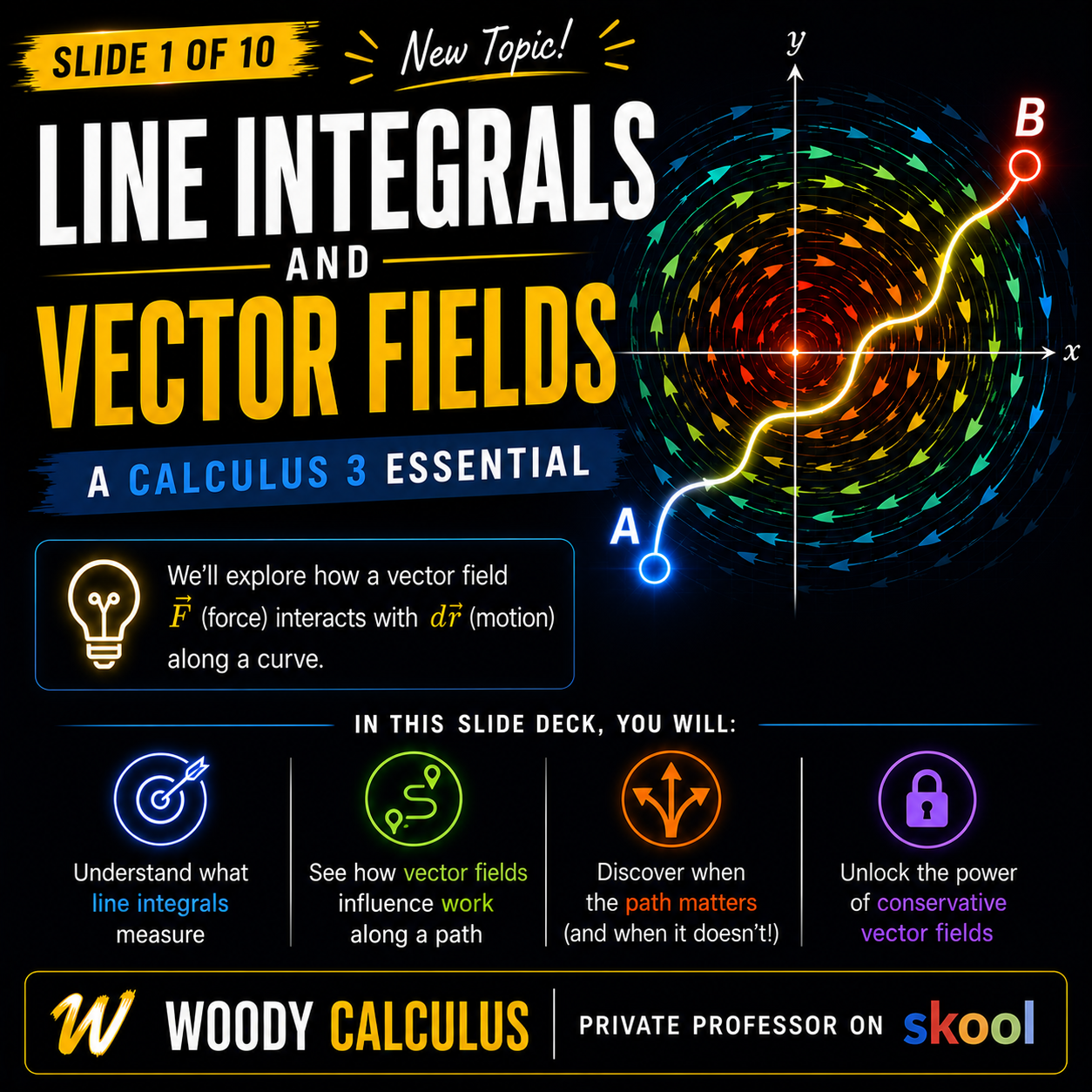
Line integrals are one of the core ideas in Calculus 3 and vector calculus. Learn what line integrals measure, how vector fields interact with paths, why direction matters, and when different paths from the same start to the same end can produce different work.