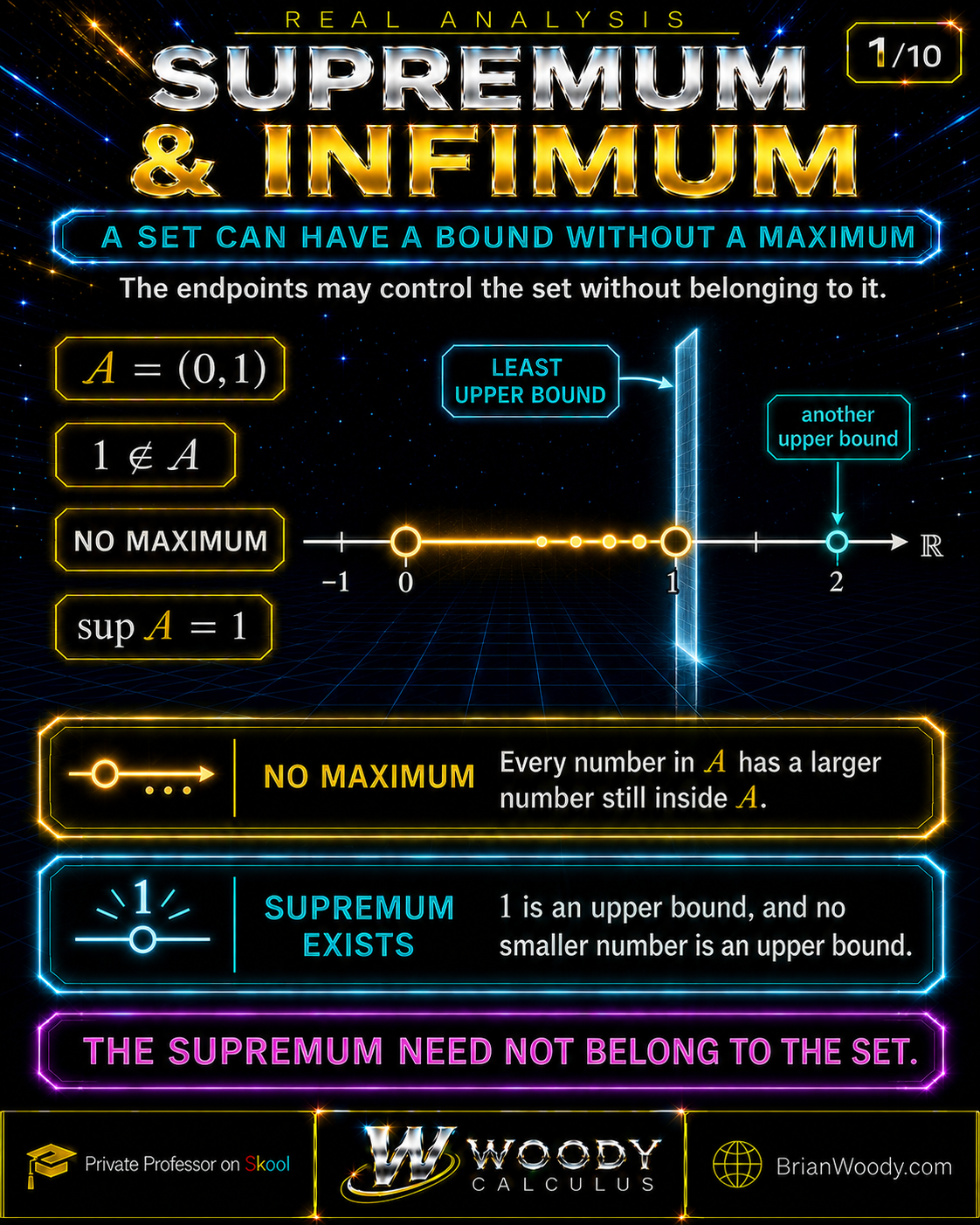
Learn how upper and lower bounds lead to supremum, infimum, maximum, and minimum. This complete Real Analysis lesson includes epsilon proofs, sequence examples, the completeness axiom, and a rigorous explanation of why the rational numbers have gaps.
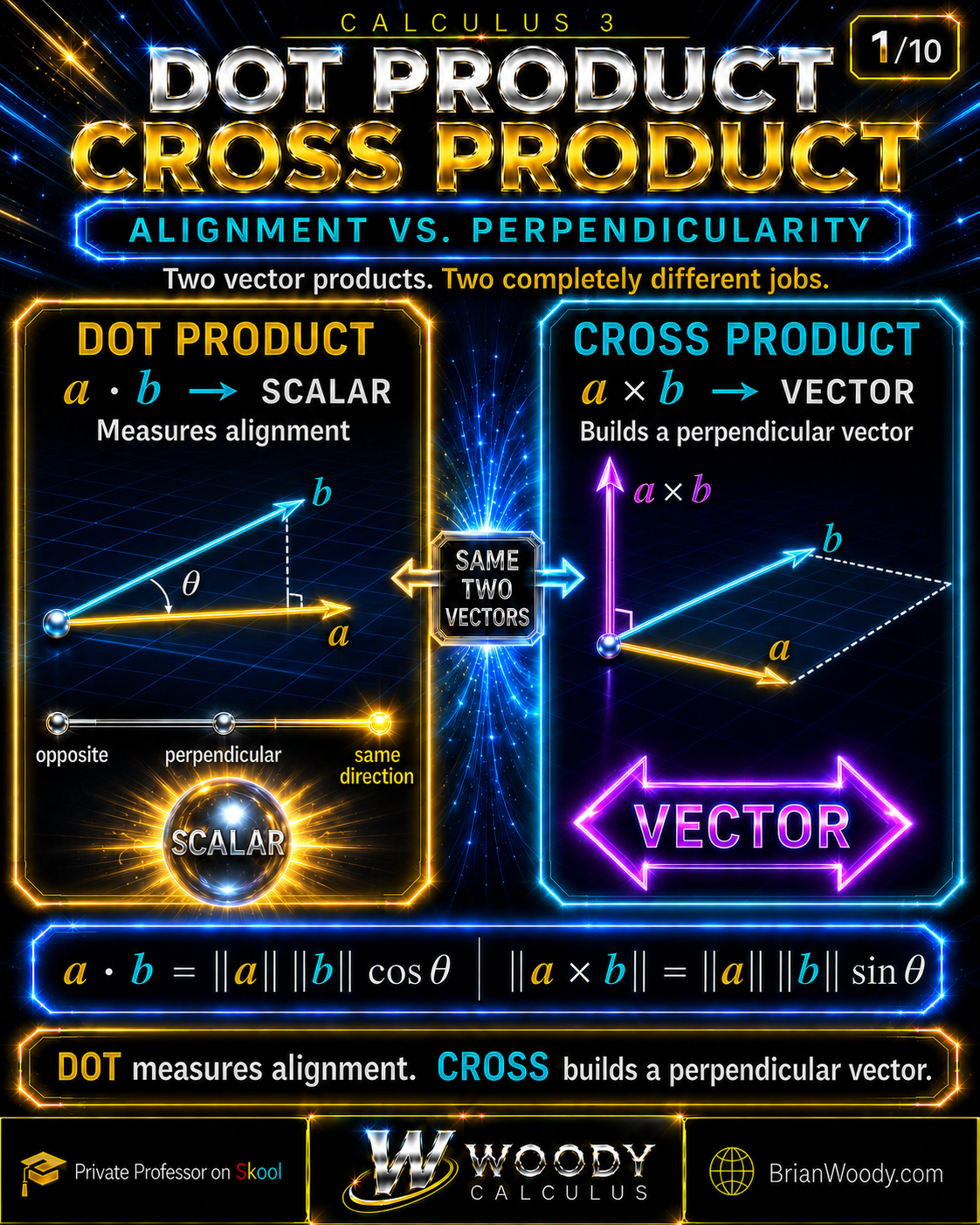
The dot product returns a scalar that measures alignment, while the cross product returns a vector perpendicular to two three-dimensional vectors. Learn the formulas, geometric meaning, right-hand rule, projections, work, area, plane normals, torque, flux, scalar triple products, Lagrange’s identity, and complete worked examples.
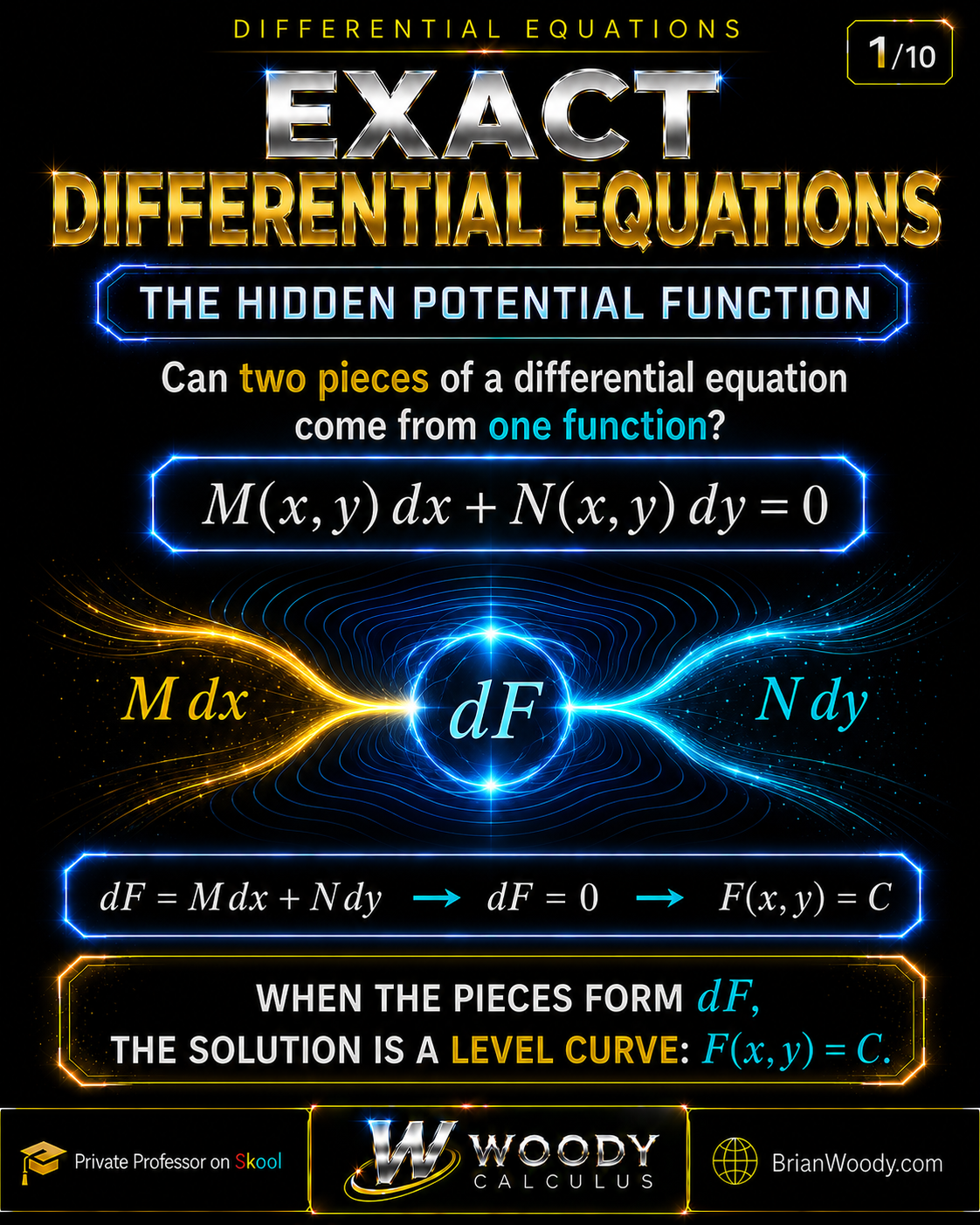
Learn how to recognize and solve exact differential equations using the exactness test M_y = N_x, recover a potential function F(x,y), apply initial conditions, verify implicit solutions, and use special integrating factors when an equation is not exact. This rigorous visual lesson also explains domain restrictions, conservative vector fields, line integrals, and the punctured-domain caveat.
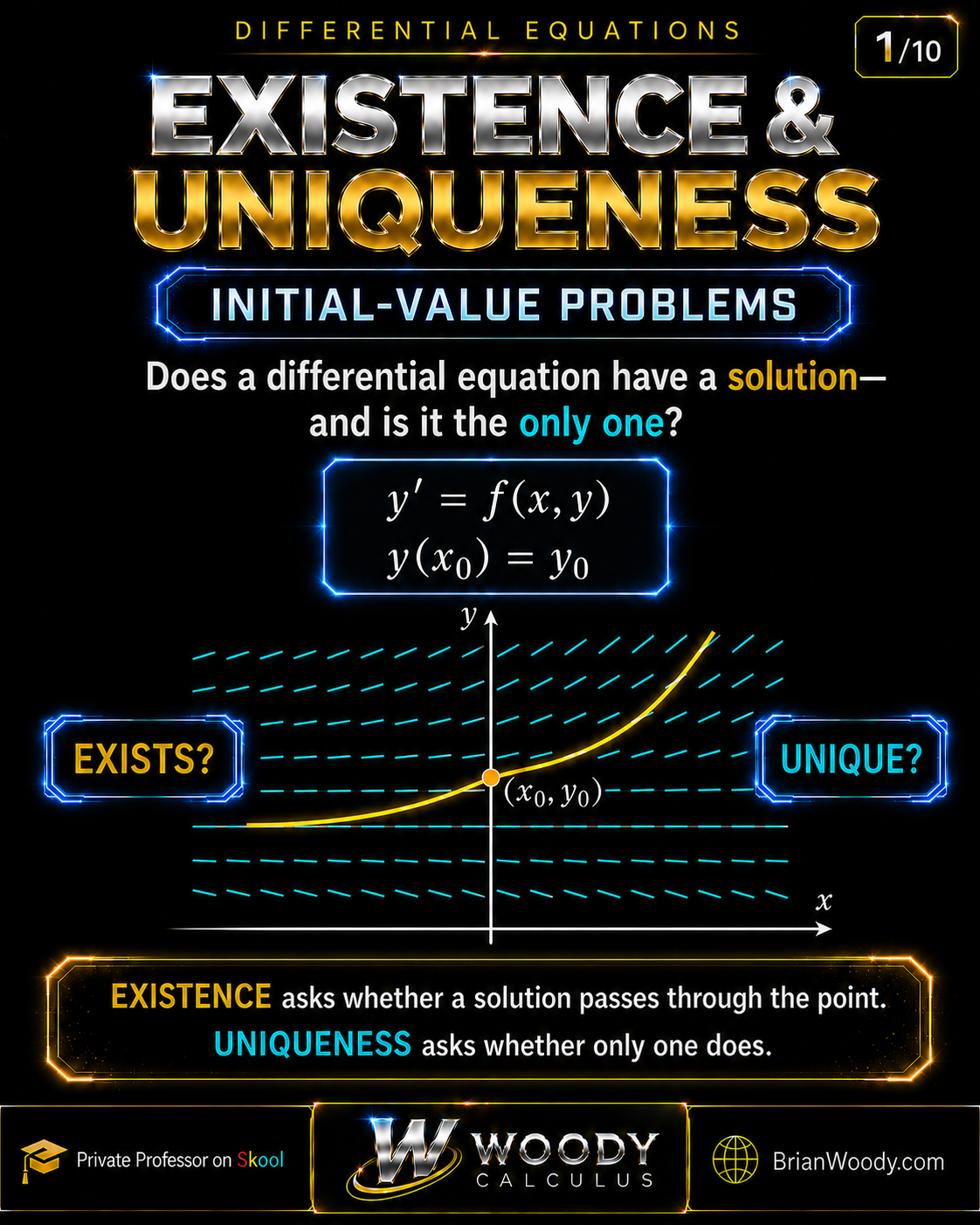
Does an initial-value problem have a solution, and is that solution the only one? This complete Woody Calculus lesson explains the existence and uniqueness theorem, the rectangle test, worked examples, nonunique solutions, finite-time blow-up, maximal intervals, the nonintersection principle, and higher-order linear ODEs.
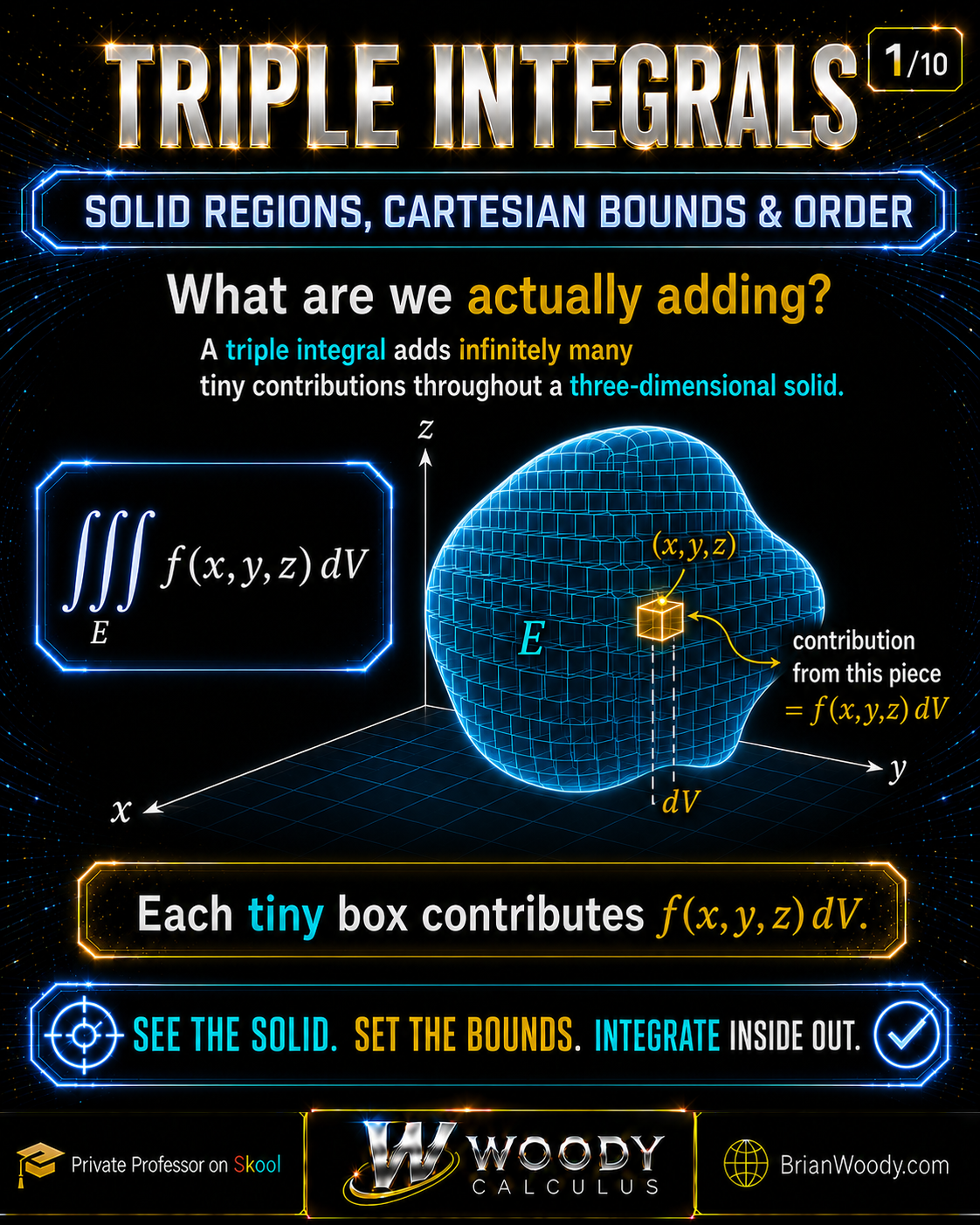
Triple integrals become manageable when you see the solid first. Learn how to choose a projection, write valid Cartesian bounds, integrate inside out, change the order of integration, and calculate volume, mass, average value, and center of mass through exact worked examples.
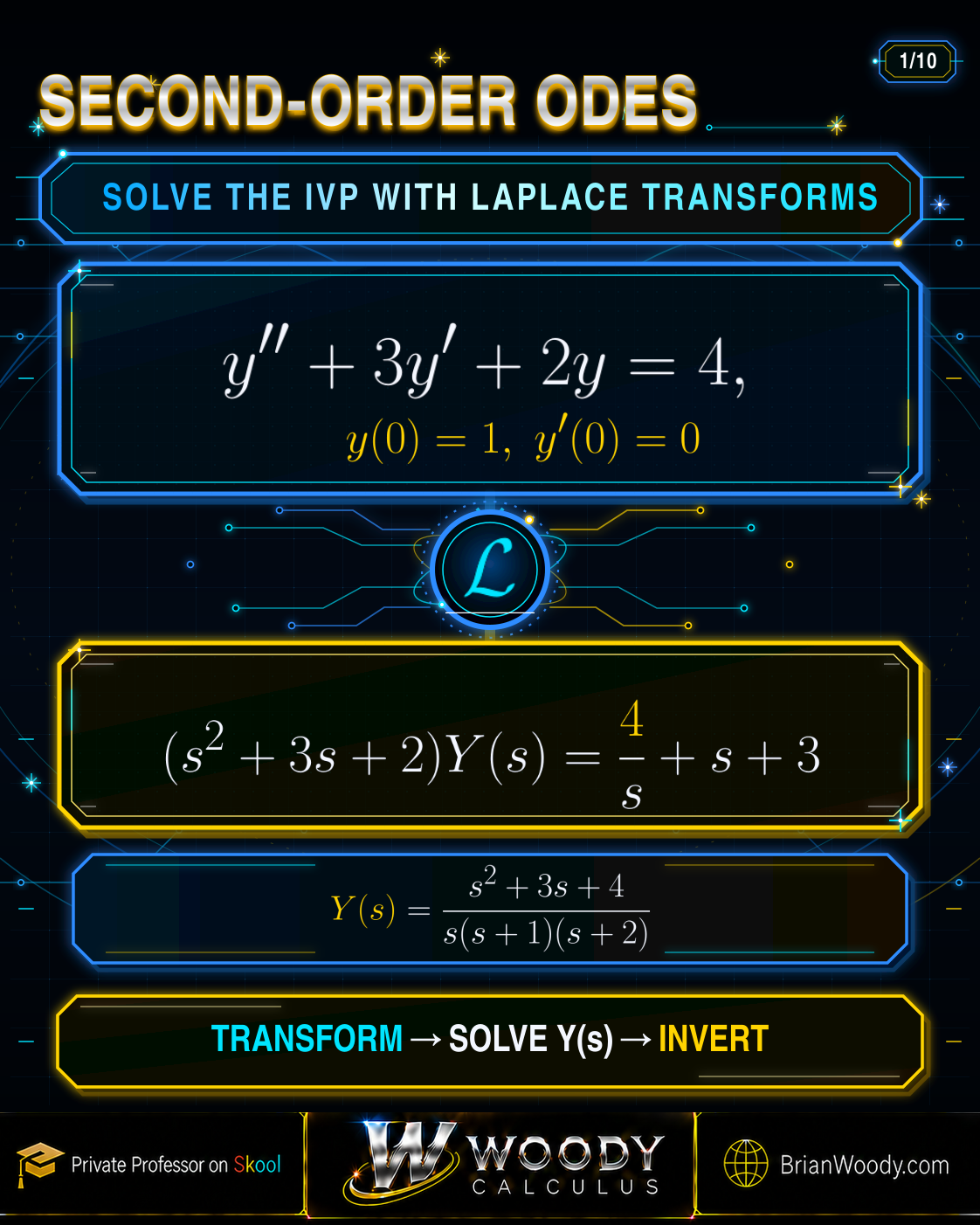
Laplace transforms turn second-order initial-value problems into algebra while carrying the initial conditions with them. Learn the complete seven-step method, partial fractions, delayed unit-step inputs, Dirac delta impulses, transfer functions, impulse response, convolution, stability, and verification through exact worked examples.
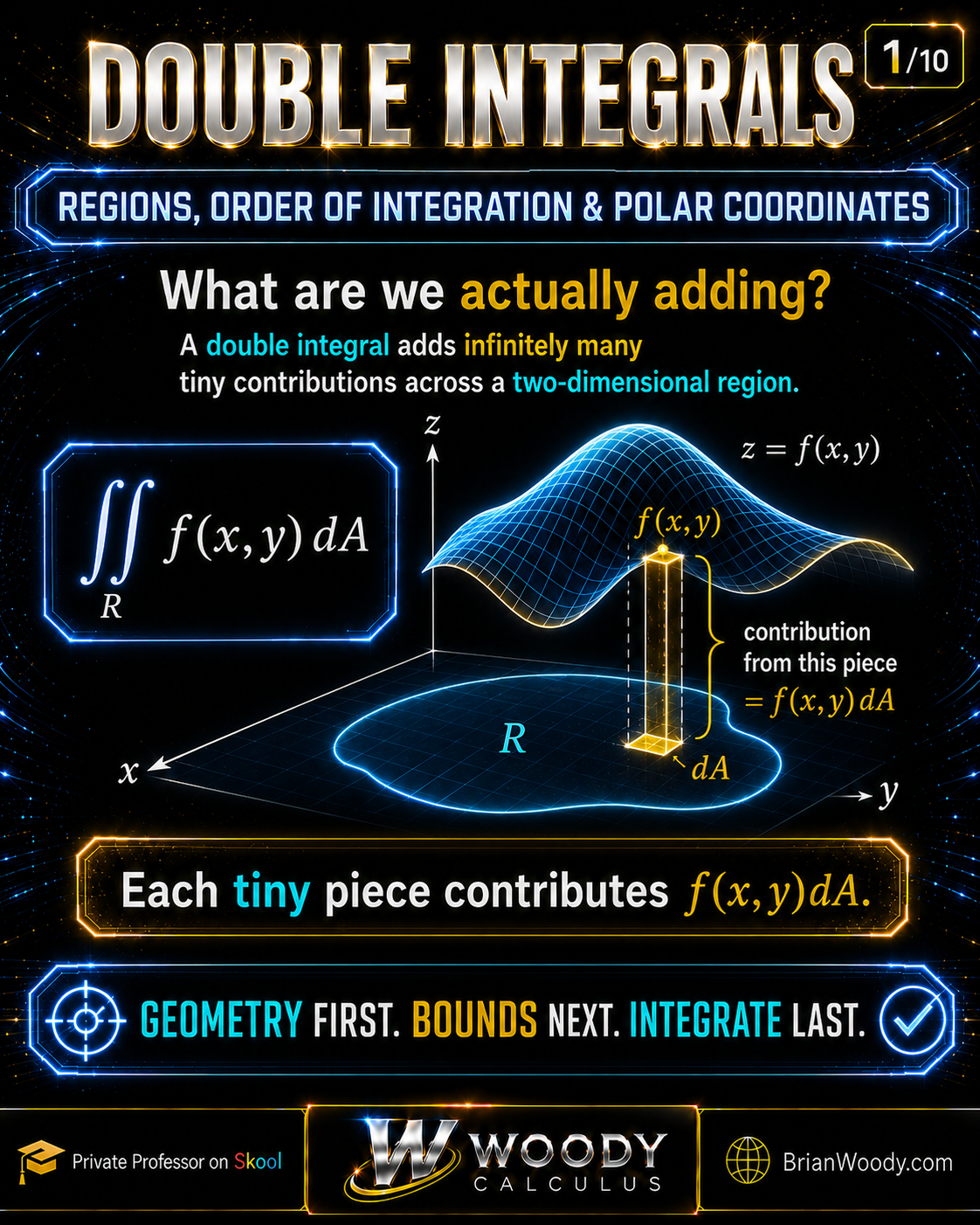
This complete Woody Calculus lesson explains double integrals from the ground up. Learn the geometric meaning of ∬R f(x,y) dA, how Fubini’s Theorem turns double integrals into iterated integrals, how to identify Type I and Type II regions, how to reverse the order of integration, and when polar coordinates make the setup easier.
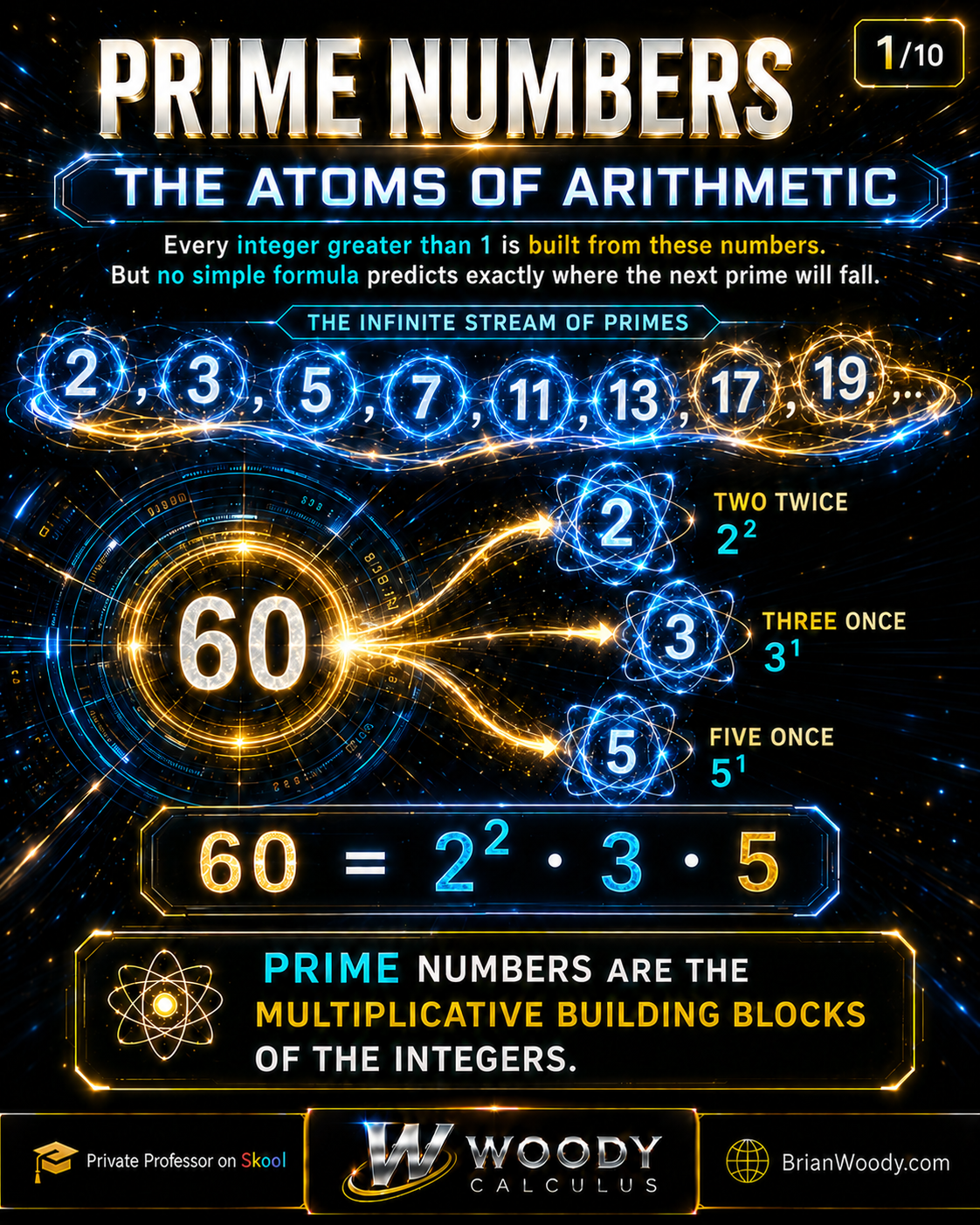
Prime numbers are the multiplicative building blocks of the integers. In this Woody Calculus lesson, learn the formal definition of a prime, why 1 is excluded, the Fundamental Theorem of Arithmetic, Euclid’s proof of infinitely many primes, the Sieve of Eratosthenes, prime patterns modulo 6, the Prime Number Theorem, modern cryptography, and the deep connection between primes and the Riemann Hypothesis.
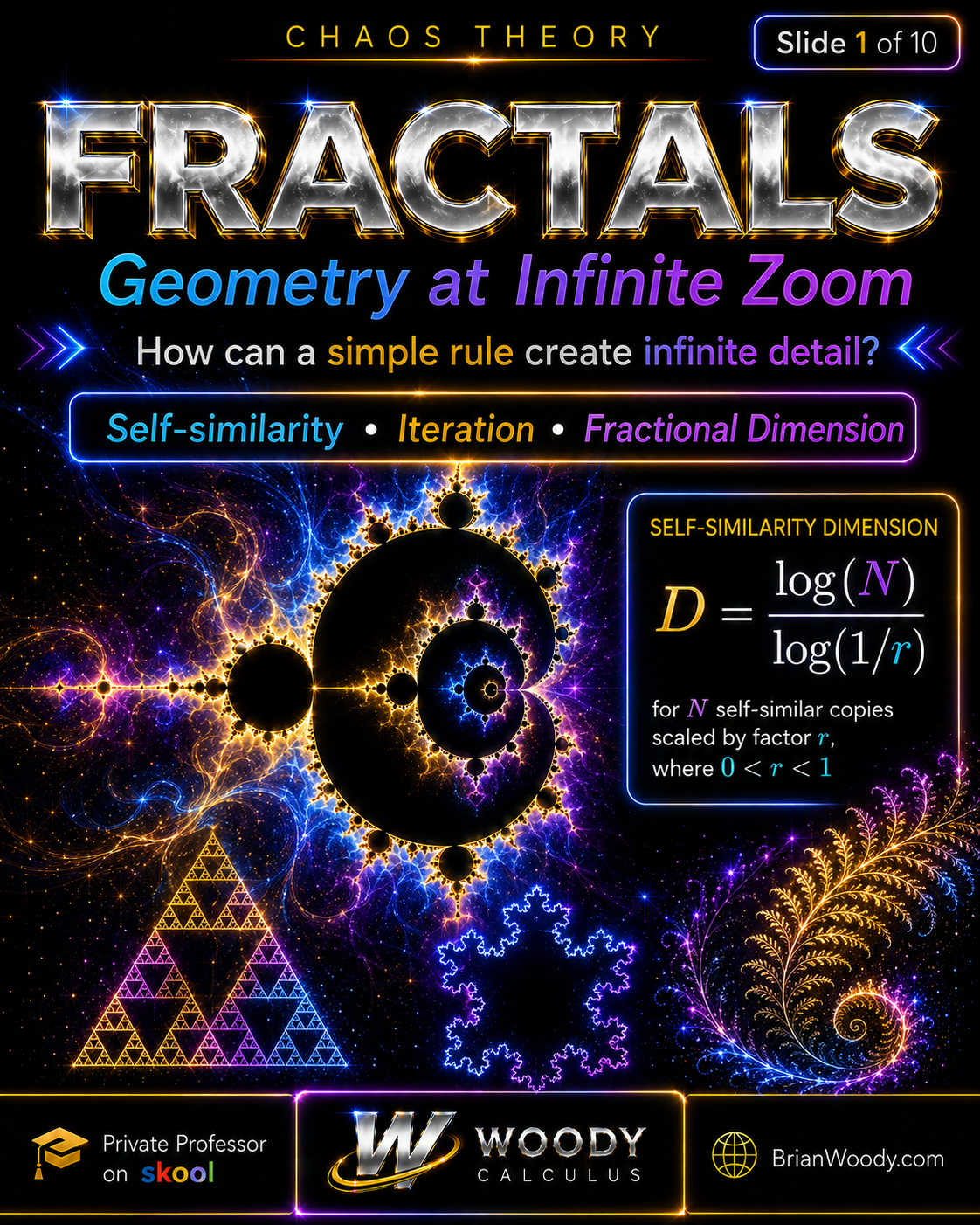
Fractals turn simple repeated rules into geometry with structure at every scale. This rigorous visual lesson explains the Mandelbrot set, escape orbits, Julia sets, fractal dimension, chaos theory, and the truth about fractals in nature.