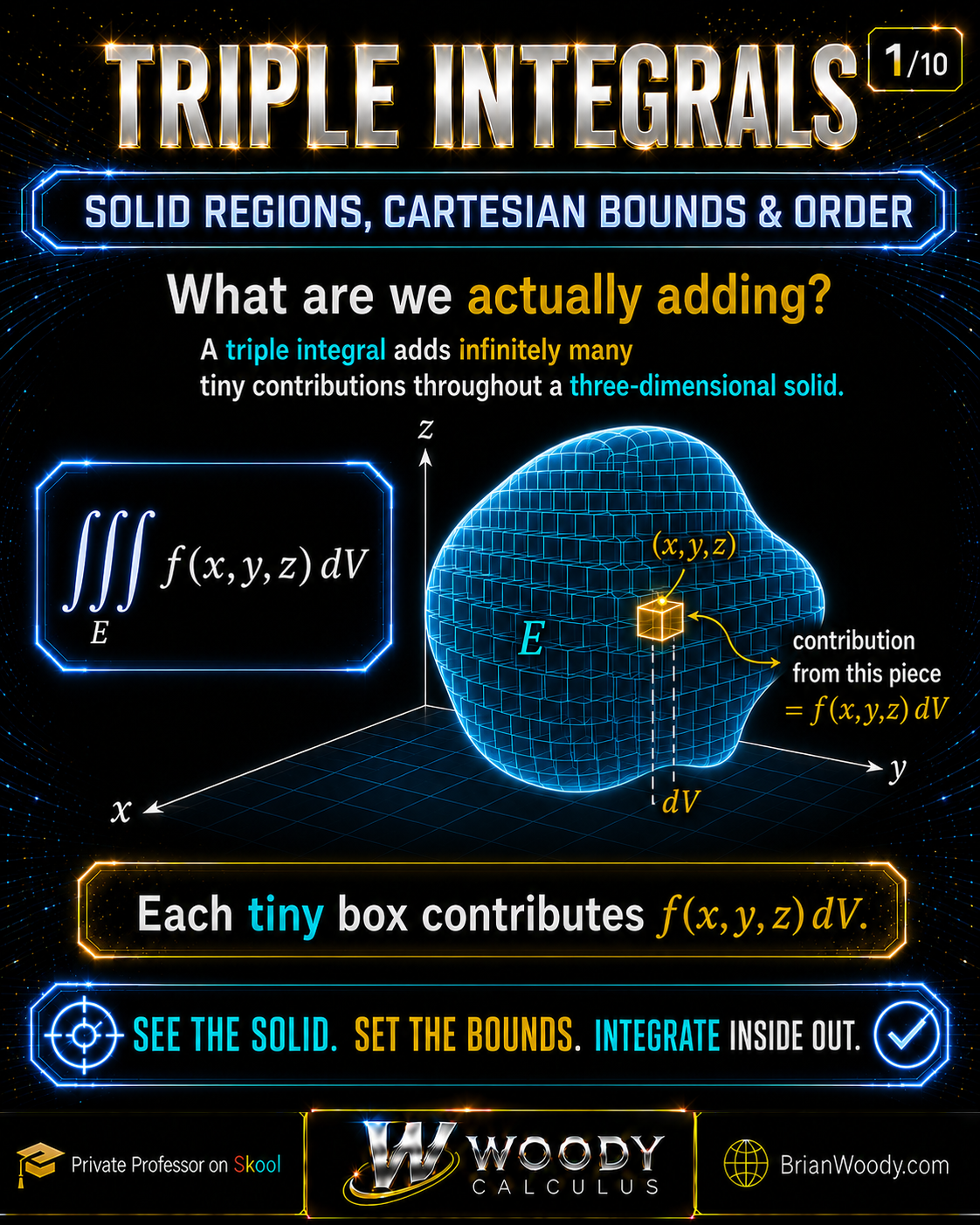
Triple integrals become manageable when you see the solid first. Learn how to choose a projection, write valid Cartesian bounds, integrate inside out, change the order of integration, and calculate volume, mass, average value, and center of mass through exact worked examples.
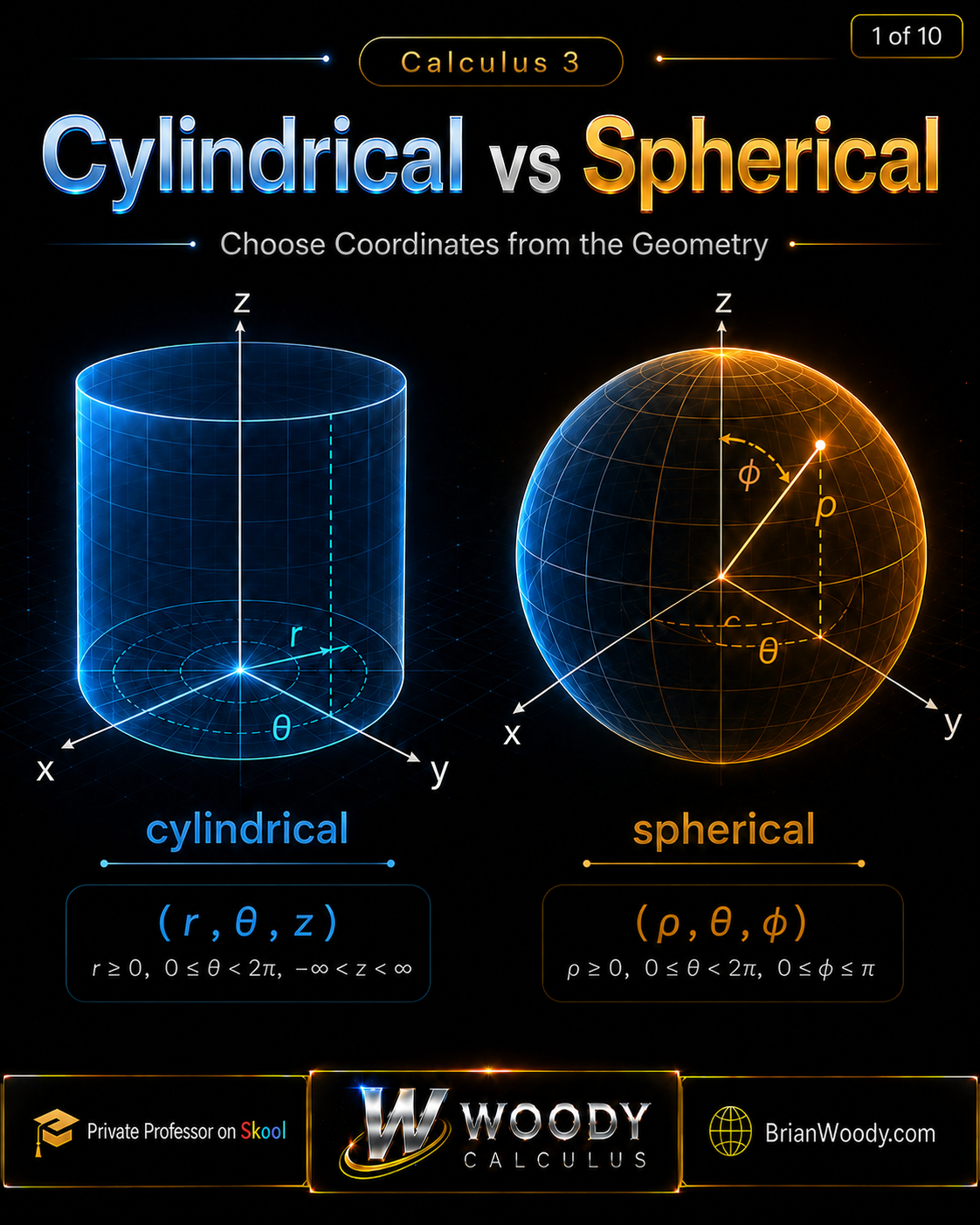
Master cylindrical and spherical coordinates through visual geometry, conversion formulas, Jacobians, bounds, and worked triple integrals. This Calculus 3 lesson compares both systems, solves an upper hemisphere in two ways, and shows how symmetry determines the best coordinates.
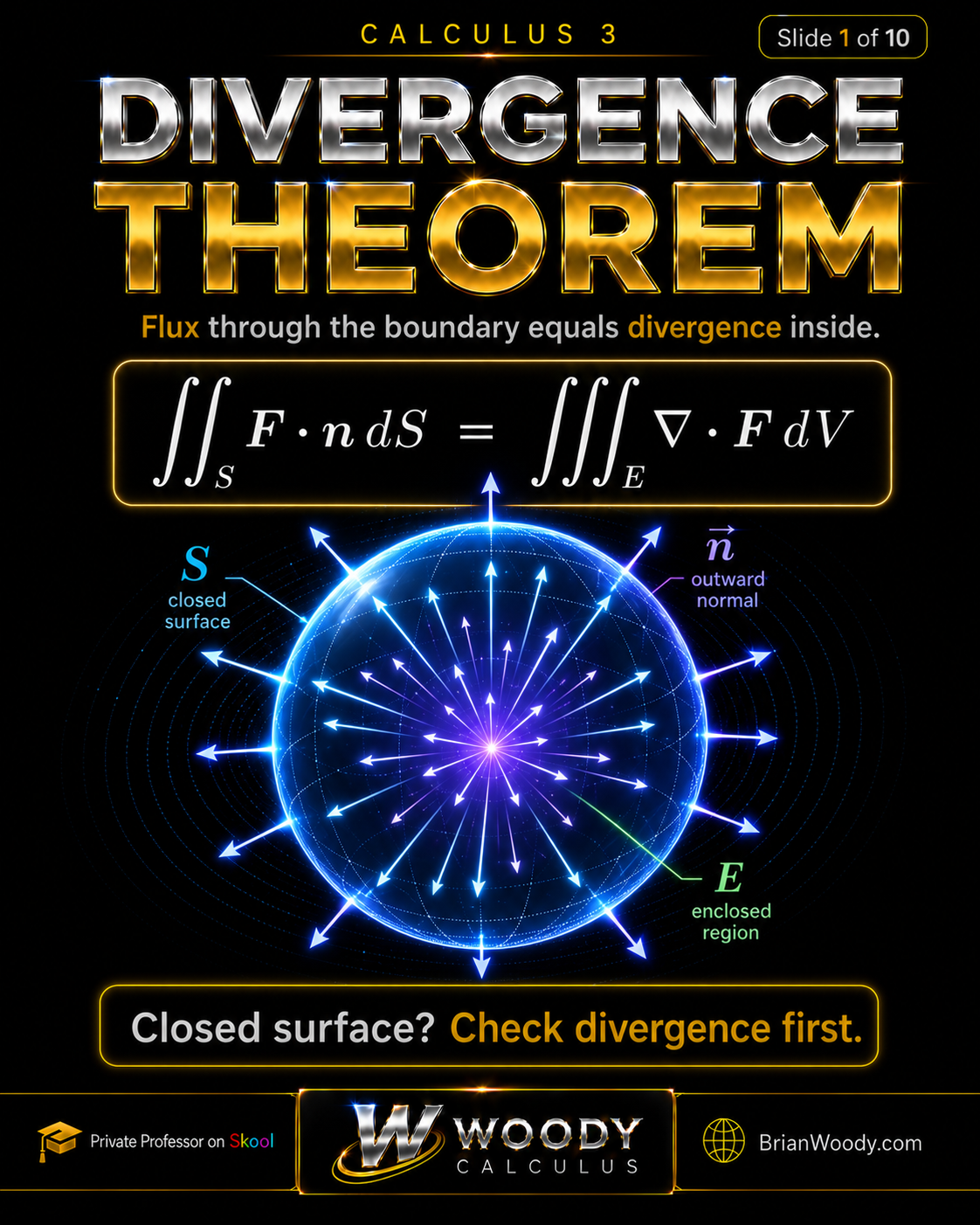
The Divergence Theorem converts outward flux through a closed surface into a triple integral of divergence over the enclosed solid. Learn the theorem’s conditions, flux and divergence meanings, method-selection rules, singularity warnings, and a complete sphere example with exact verification.
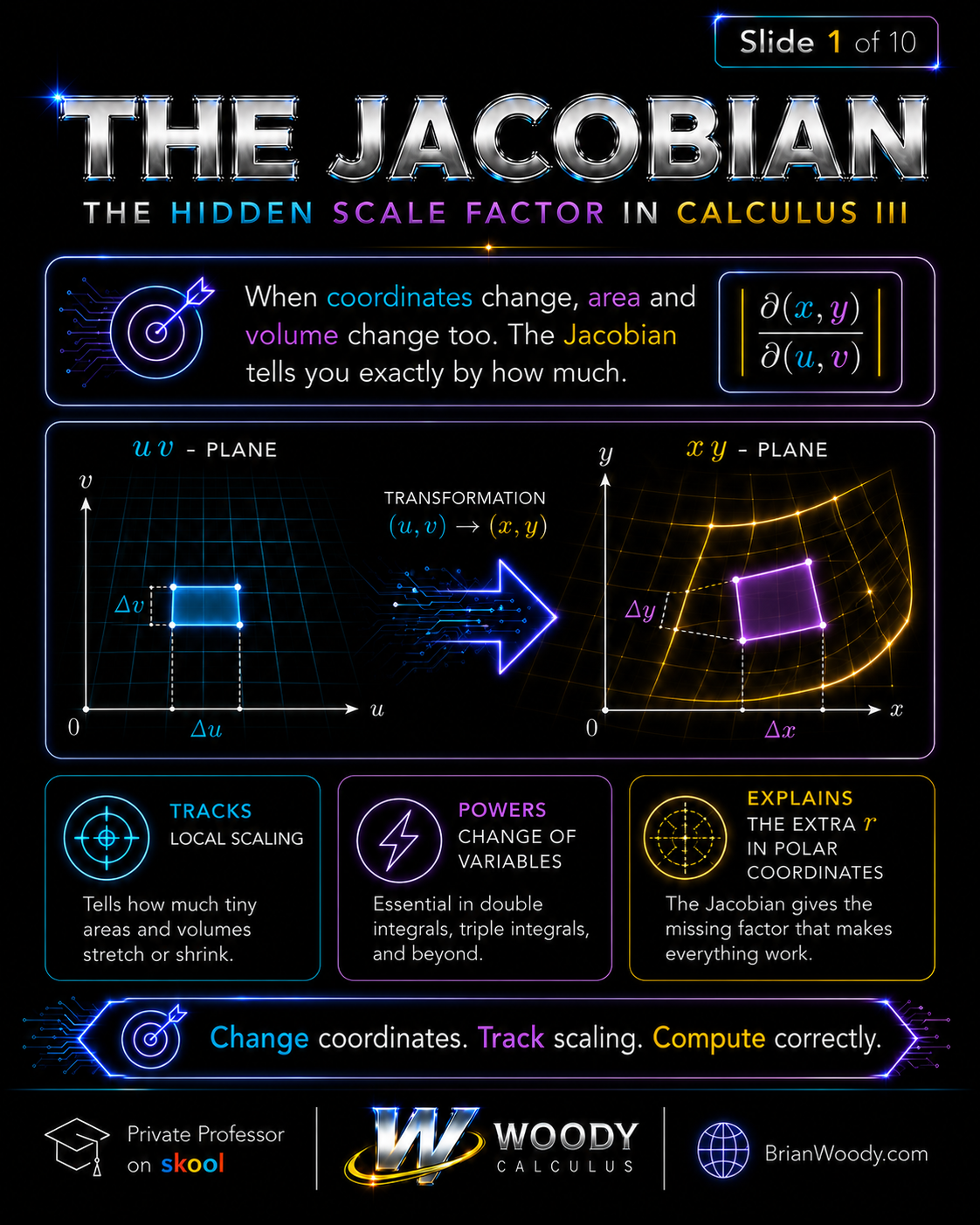
The Jacobian is the hidden scale factor behind every coordinate change in Calculus III. In this Woody Calculus visual lesson, learn how Jacobians explain area and volume scaling, change of variables, polar coordinates, cylindrical coordinates, spherical coordinates, double integrals, triple integrals, and why the mysterious extra factors r and ρ²sinφ appear.