This lesson explains ideals and quotient rings in a clear, visual way. Learn what an ideal is, how quotient rings are formed, why prime ideals correspond to integral domains, why maximal ideals correspond to fields, and how irreducible polynomials in F[x] create new field extensions.
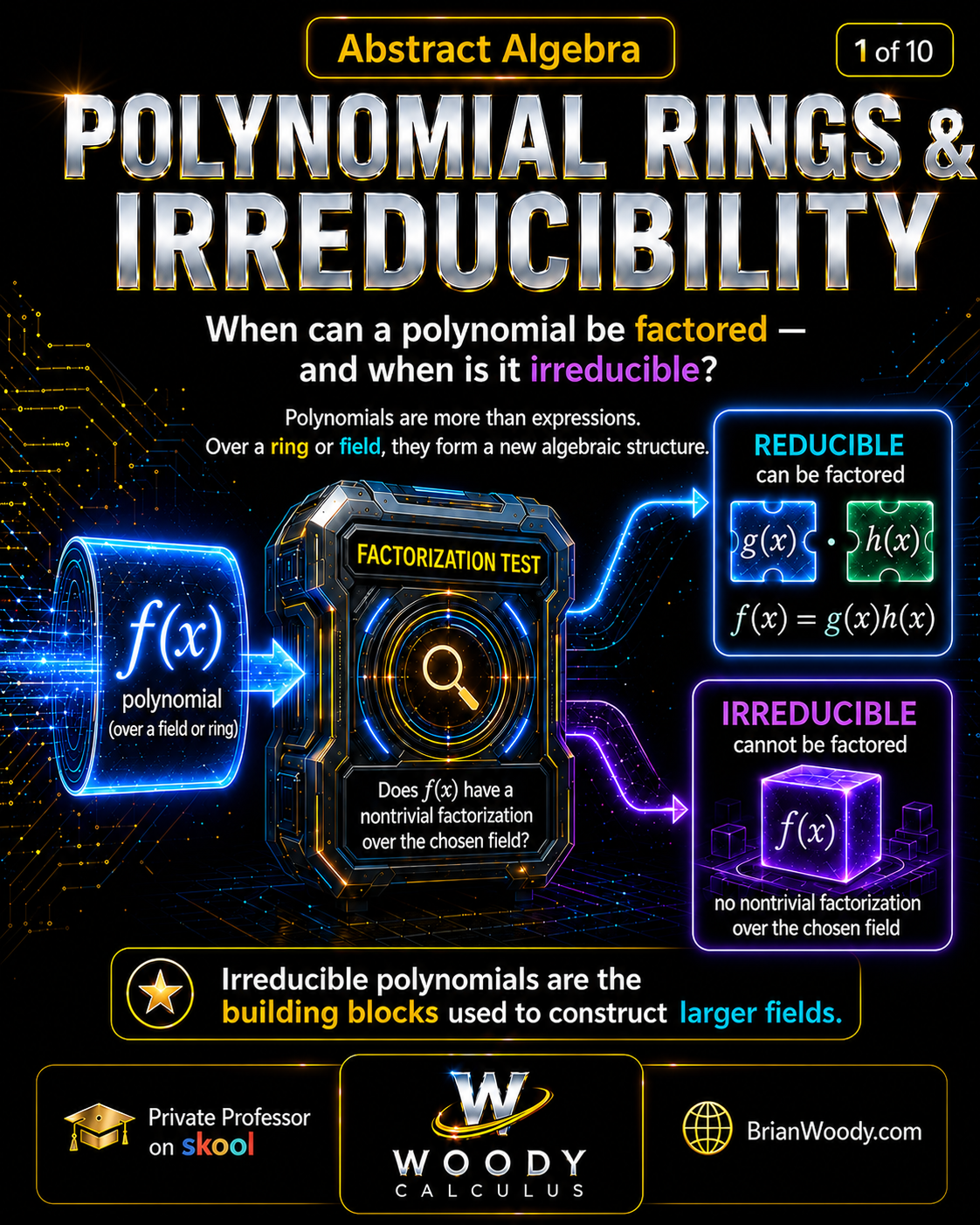
Polynomial irreducibility is never just about the polynomial—it depends on the coefficient ring or field. Learn a complete Abstract Algebra decision system using root tests, the Rational Root Theorem, Gauss’s Lemma, Eisenstein’s Criterion, reduction modulo p, finite-field factor tests, quotient rings, and field extensions.
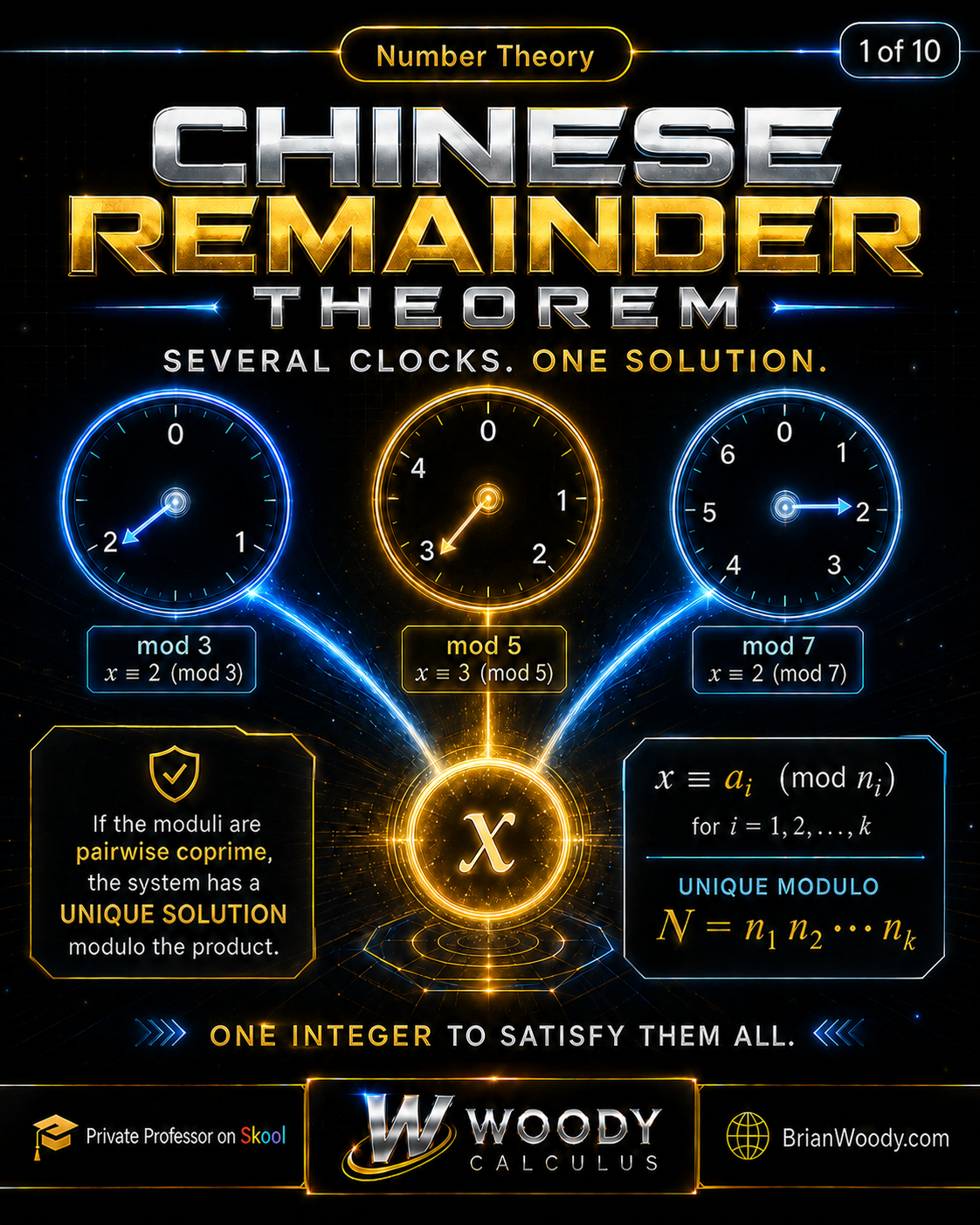
The Chinese Remainder Theorem combines simultaneous congruences into one residue class. Learn the modular-inverse algorithm, two complete examples, proof, verification, noncoprime cases, common mistakes, and exam-ready method selection.
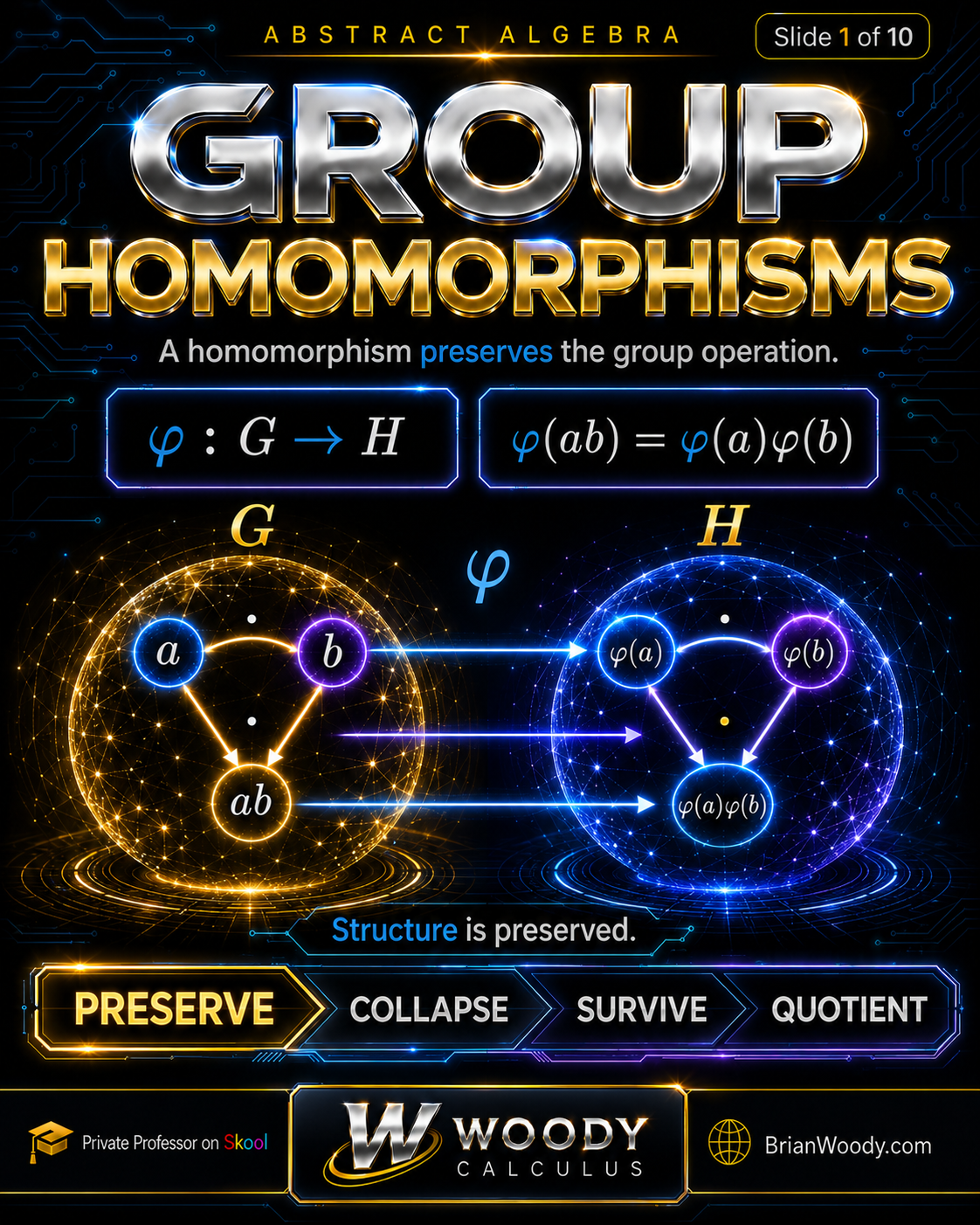
Learn group homomorphisms through visual intuition, exact definitions, complete proofs, and a detailed map from the integers to Z₄. This Woody Calculus lesson explains operation preservation, kernels, images, fibers, quotient groups, injectivity, surjectivity, and the First Isomorphism Theorem.
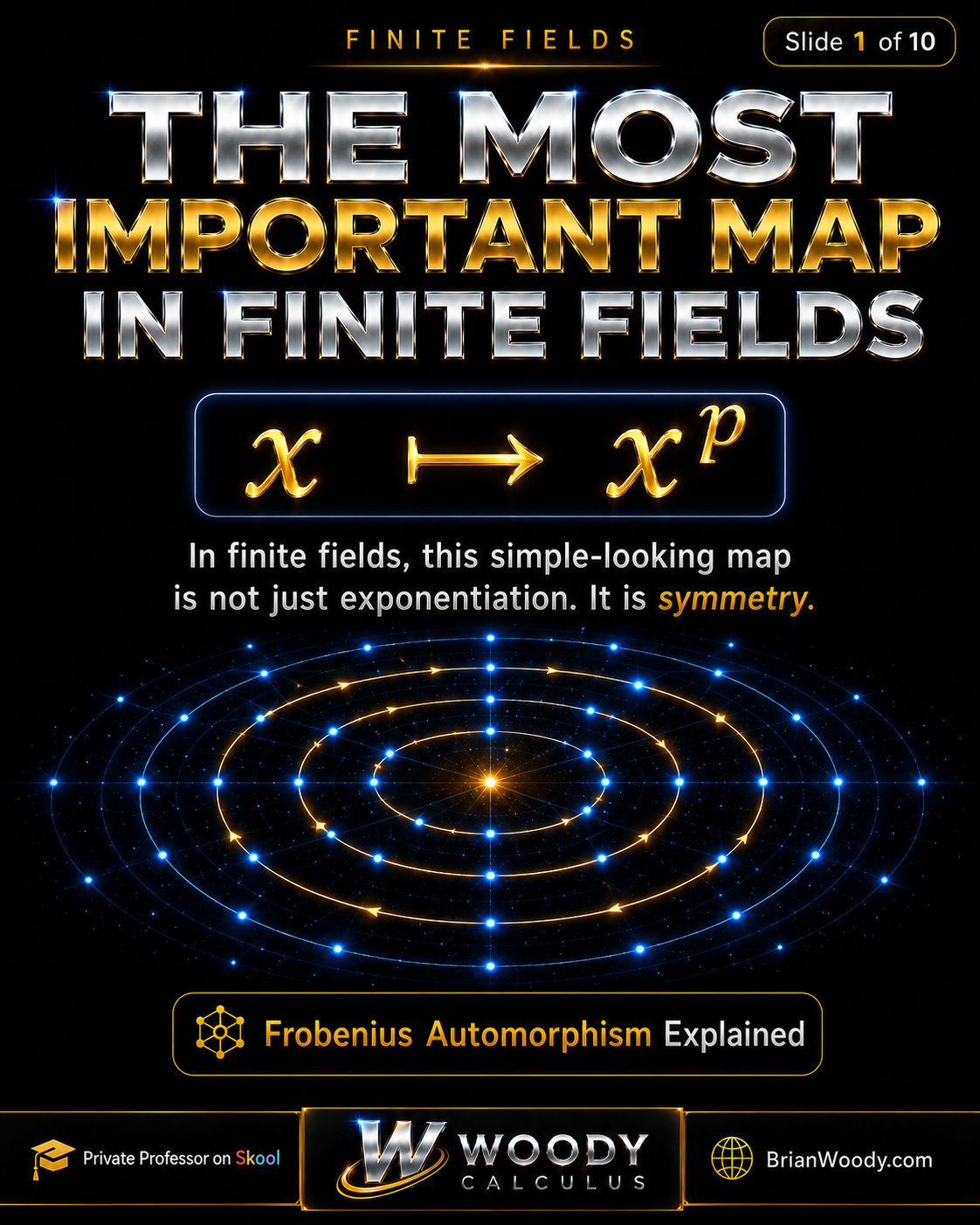
The Frobenius automorphism \(x\mapsto x^p\) is the central symmetry of finite fields. This Woody Calculus Abstract Algebra lesson explains characteristic \(p\), the Freshman’s Dream, cyclic finite-field Galois groups, Frobenius conjugates, trace, norm, unit circles, and how these ideas connect to modern finite-field research.
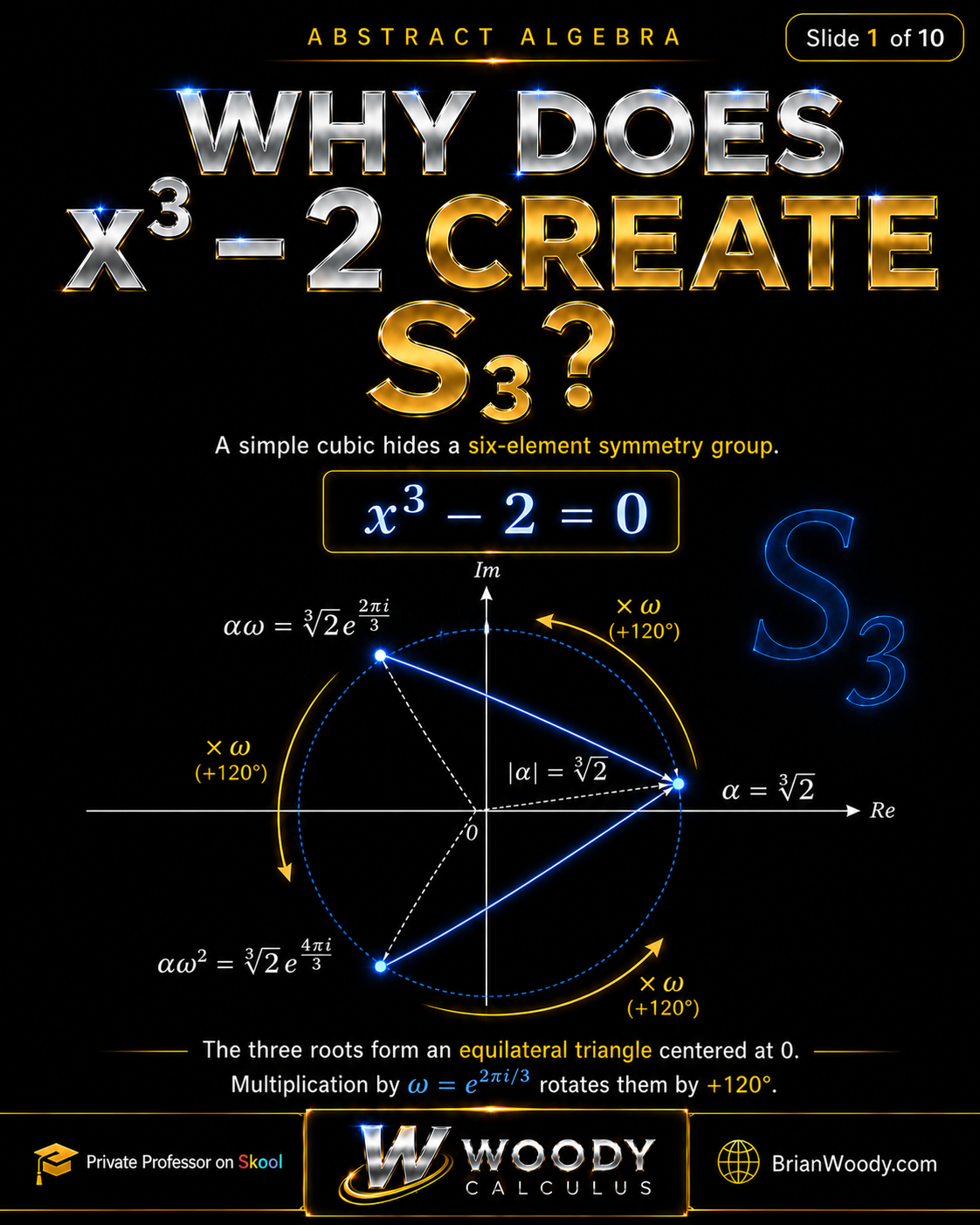
Why does the simple cubic x³ − 2 create the six-element symmetry group S₃? This Woody Calculus Abstract Algebra lesson explains the roots, splitting field, extension degree, automorphisms, triangle symmetries, and quotient group connection behind one of the cleanest examples in Galois theory.
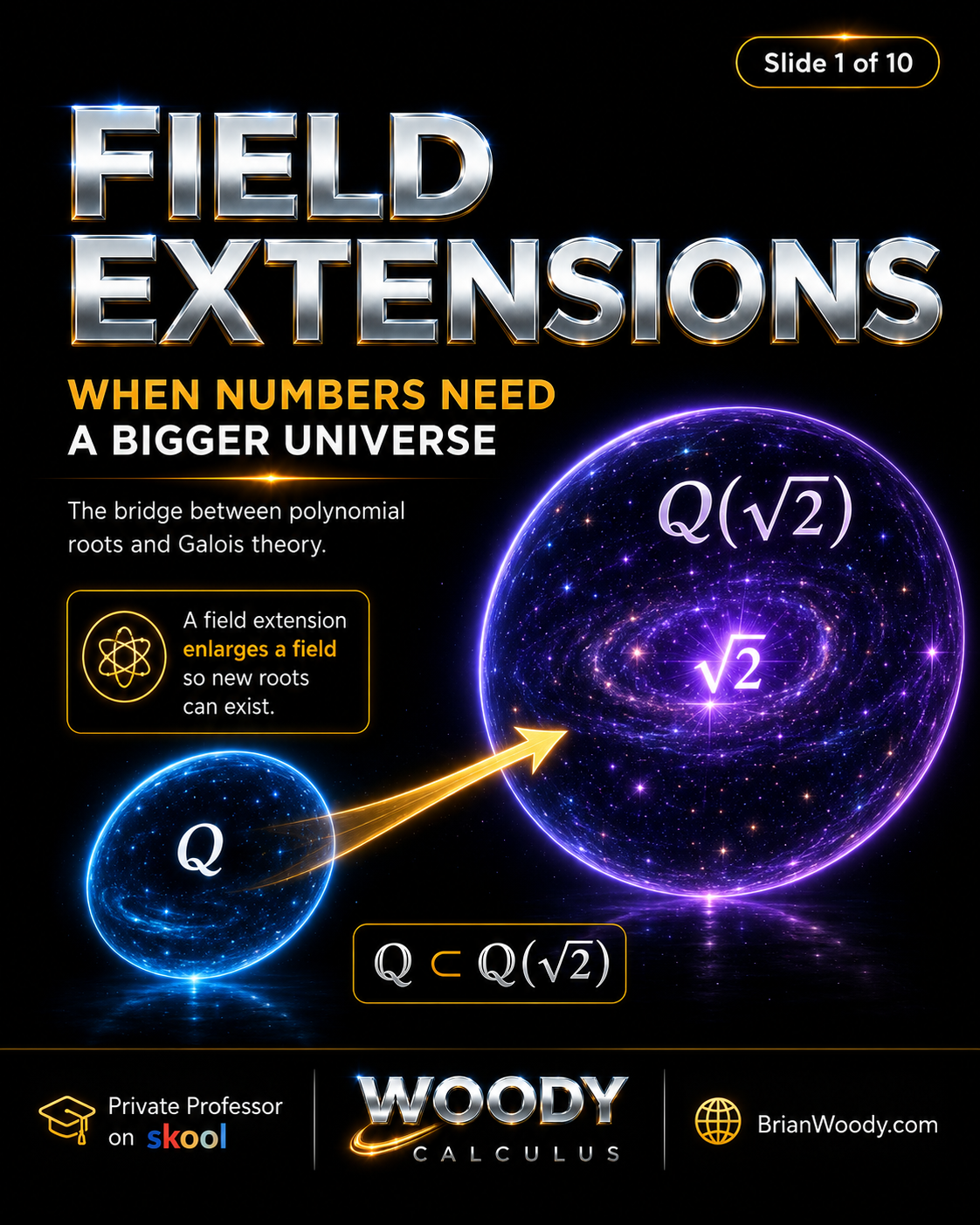
Field extensions are how Abstract Algebra builds a bigger number system when a polynomial has missing roots. In this Woody Calculus visual lesson, learn how Q becomes Q(√2), why x² − 2 has no rational root, how degree and minimal polynomials work, and why field extensions open the door to Galois theory.
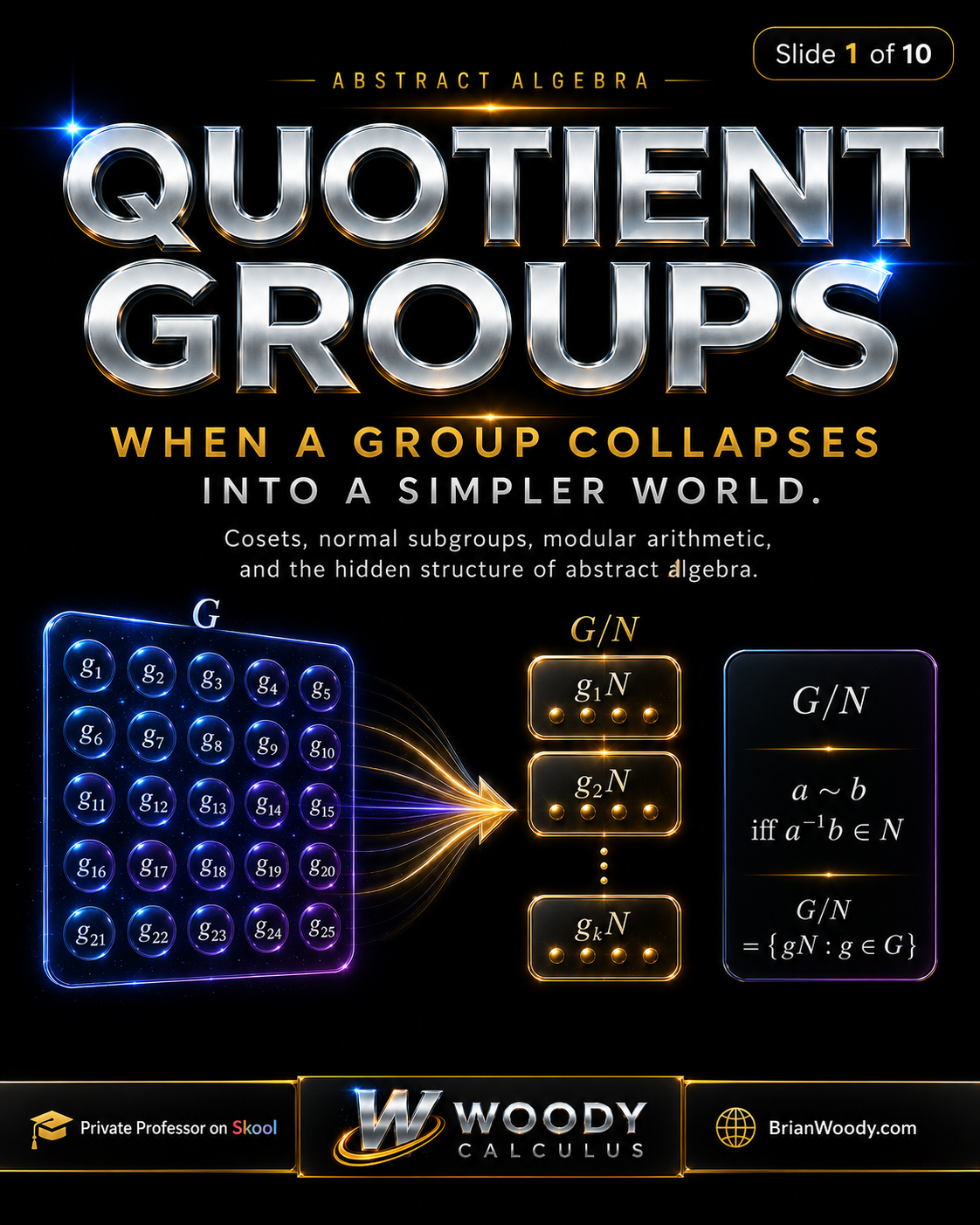
Quotient groups are how Abstract Algebra collapses a group into a simpler structure. In this Woody Calculus visual lesson, learn how cosets become the new elements, why normal subgroups are required, how modular arithmetic is a quotient group, and how kernels lead directly to the First Isomorphism Theorem.
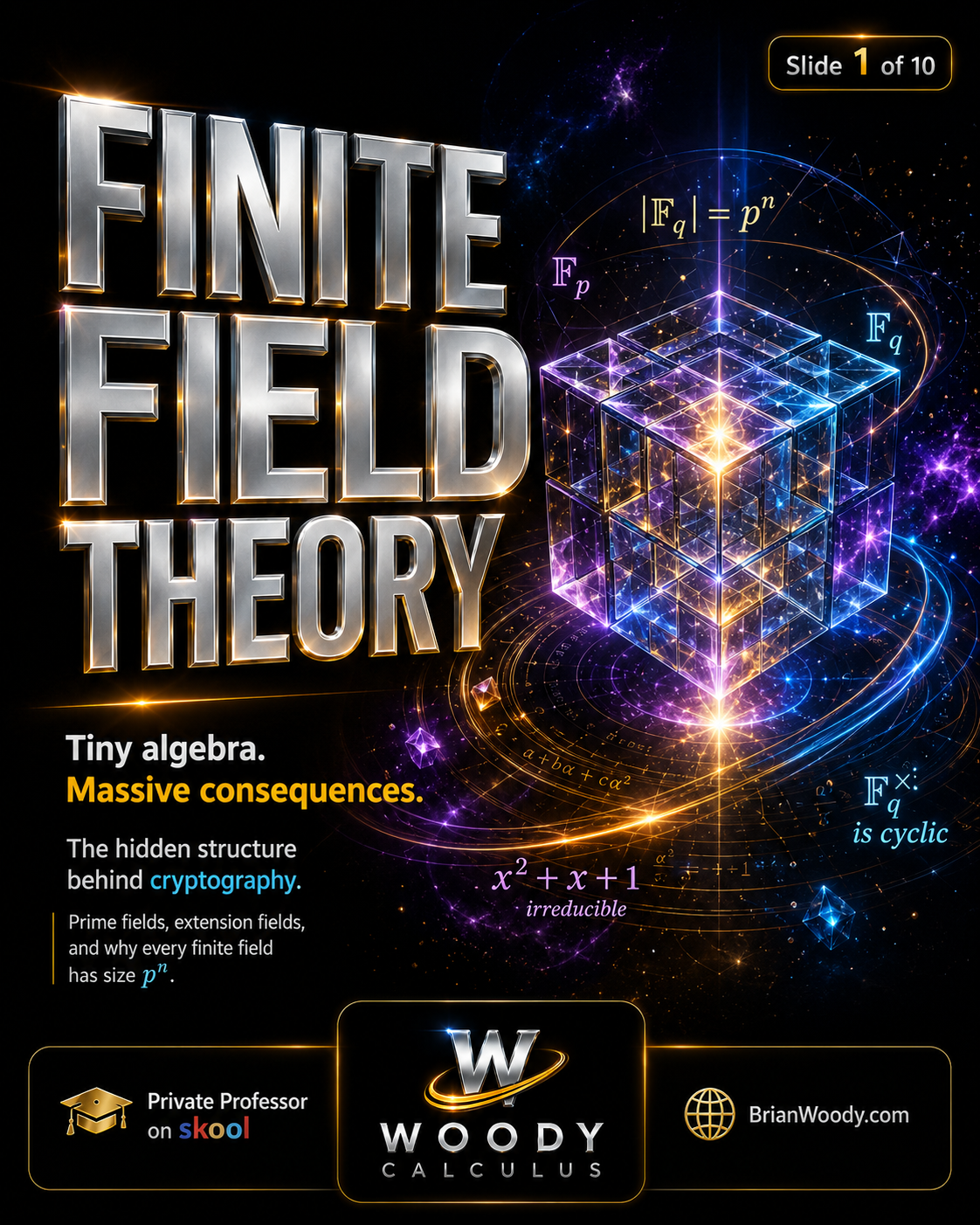
Finite field theory looks abstract until you realize it powers modern cryptography, error correction, QR codes, AES encryption, and elliptic curve cryptography. In this Woody Calculus visual lesson, learn what finite fields are, why prime fields matter, why every finite field has size q = p^n, how extension fields are built from irreducible polynomials, and why finite fields are the hidden algebra behind secure communication.
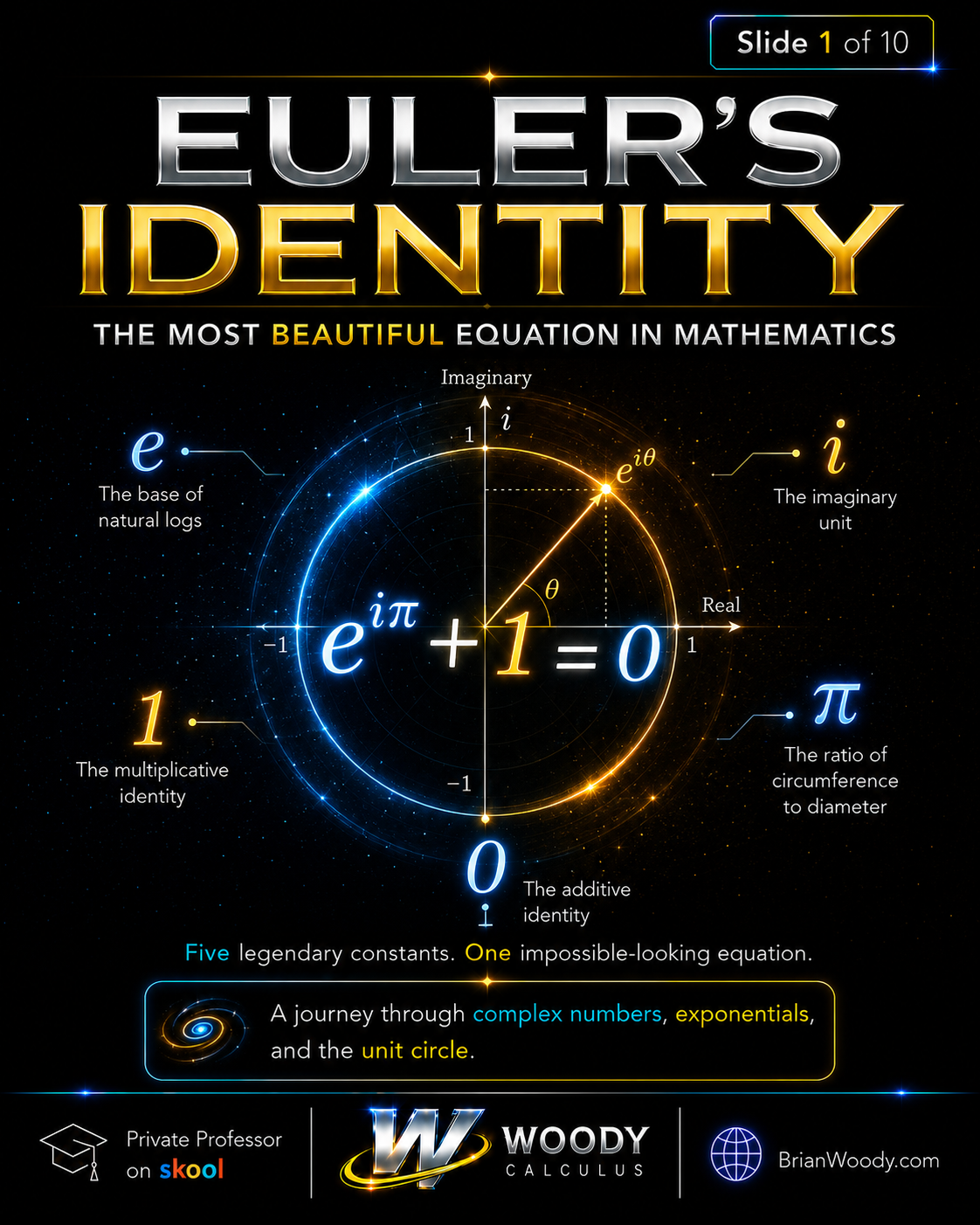
Euler’s Identity is often called the most beautiful equation in mathematics because it connects five legendary constants: e, i, π, 1, and 0. In this Woody Calculus visual lesson, we explain Euler’s formula, the complex plane, the unit circle, Taylor series, and why e^{iπ}+1=0 links algebra, geometry, analysis, waves, physics, and engineering.
![Ideals and quotient rings Abstract Algebra infographic comparing Z/5Z with Q[x]/(x^2-2) to show how collapsing an ideal to zero creates a new algebraic structure.](https://k3p6r8v3.delivery.rocketcdn.me/wp-content/uploads/2026/08/Ideals-and-Quotient-Rings-Slide-1.png)