Quotient groups are one of the most important ideas in Abstract Algebra. They explain how a group can collapse into a simpler structure by treating certain elements as equivalent.
At first, quotient groups can feel strange because the elements are no longer individual elements of the original group. The new elements are cosets.
That is the big mental shift.
A quotient group takes a group \(G\), chooses a normal subgroup \(N\), and forms a new group:
G/N=\{gN:g\in G\}.
\]
The new group \(G/N\) is made of cosets of \(N\), not individual elements of \(G\). This idea appears throughout group theory, ring theory, field theory, Galois Theory, and modern algebra.
One especially beautiful example appears in the Galois group of \(x^3-2\), where the quotient \(S_3/A_3\cong C_2\) records the difference between even and odd symmetries. For the full visual lesson, read Why Does \(x^3-2\) Create \(S_3\)? Galois Theory Explained.
Estimated read time: 12–15 minutes.
Quick summary: A quotient group \(G/N\) is a new group whose elements are cosets \(gN\). The subgroup \(N\) must be normal so that coset multiplication is well-defined. Quotient groups explain modular arithmetic, kernels of homomorphisms, the First Isomorphism Theorem, and the algebraic idea of collapsing structure while preserving what matters.
Quotient Groups Key Facts
- A quotient group has the form \(G/N\), where \(N\) is a normal subgroup of \(G\).
- The elements of \(G/N\) are cosets \(gN\).
- Two elements \(a,b\in G\) are equivalent modulo \(N\) when \(a^{-1}b\in N\).
- Cosets partition the original group \(G\).
- Coset multiplication is defined by \((aN)(bN)=(ab)N\).
- The operation is well-defined only when \(N\triangleleft G\).
- Modular arithmetic is a quotient group: \(\mathbb{Z}/n\mathbb{Z}\).
- Kernels of homomorphisms are normal subgroups.
- The First Isomorphism Theorem says \(G/\ker(\varphi)\cong \operatorname{im}(\varphi)\).
- The quotient \(S_3/A_3\cong C_2\) records parity: even versus odd permutations.
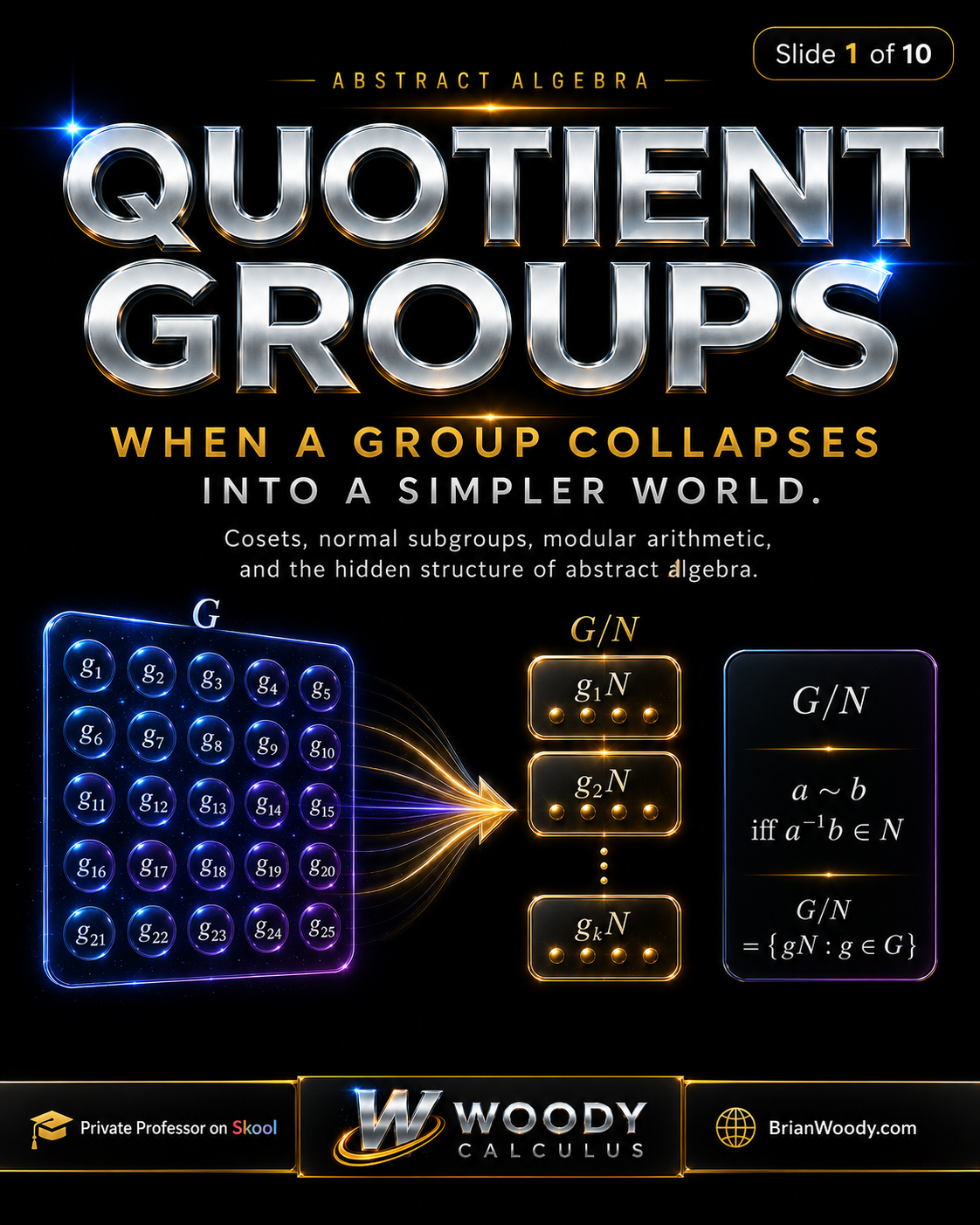
This Woody Calculus visual lesson explains quotient groups in order: what they are, why cosets become the new elements, how coset multiplication works, why normal subgroups are required, how modular arithmetic is a quotient group, how kernels create quotients, and why the First Isomorphism Theorem is one of the central results in group theory.
What Is a Quotient Group?
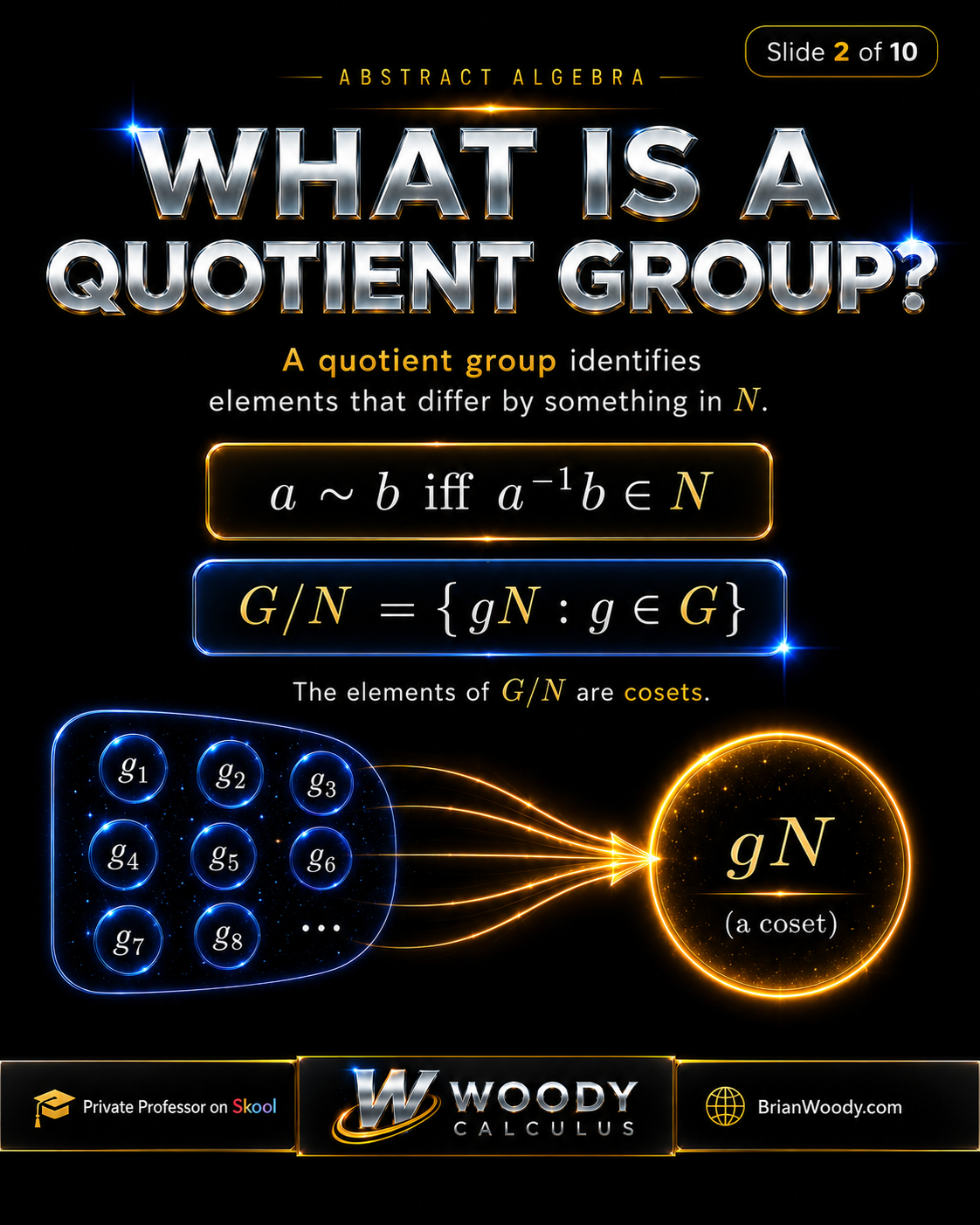
A quotient group is a new group formed by collapsing a normal subgroup \(N\) inside a group \(G\).
The notation is:
G/N.
\]
You can read this as “\(G\) modulo \(N\)” or “\(G\) quotient \(N\).”
The idea is that every element of \(N\) is treated like the identity in the quotient. More generally, two elements \(a,b\in G\) become equivalent if they differ by something in \(N\):
a\sim b
\quad\Longleftrightarrow\quad
a^{-1}b\in N.
\]
This equivalence relation groups the elements of \(G\) into chunks called cosets.
The quotient group is the set of those cosets:
G/N=\{gN:g\in G\}.
\]
So a quotient group is not made of the original elements \(g\). It is made of entire cosets \(gN\).
Cosets Are the New Elements
The most important mental shift is this:
The elements of \(G/N\) are not elements of \(G\). They are cosets.
— Brian M. Woody
If \(N\le G\), then the left coset of \(N\) by \(g\) is:
gN=\{gn:n\in N\}.
\]
This means \(gN\) is the set of all elements you get by multiplying \(g\) by elements of \(N\).
The quotient group is:
G/N=\{gN:g\in G\}.
\]
In the quotient world, a whole chunk of elements behaves like one new object.
This is why quotient groups are powerful: they compress a complicated group into a simpler structure by identifying elements that differ by something in \(N\).
Why Cosets Partition the Group
Cosets are the new elements of the quotient group.
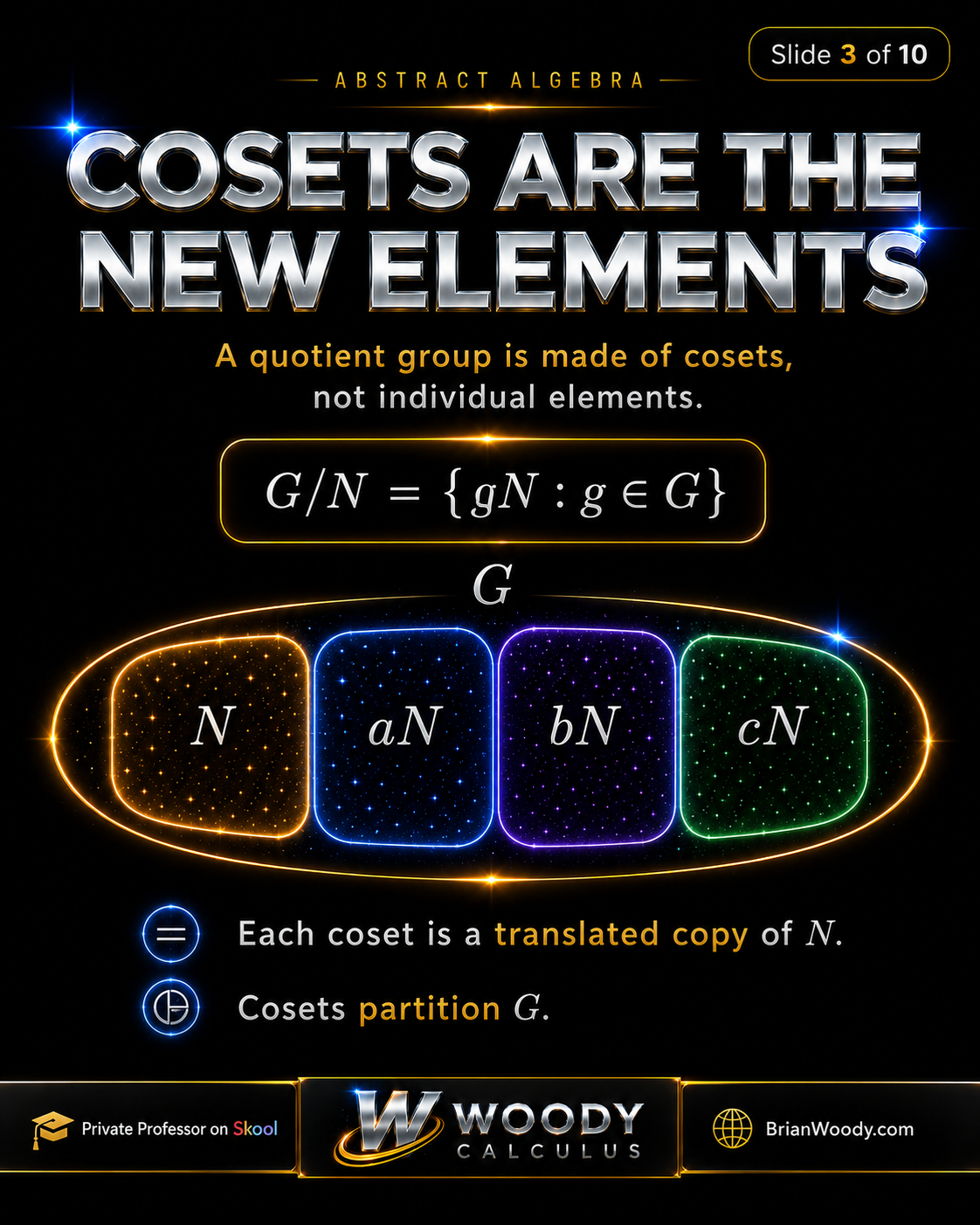
One of the most important facts about cosets is that they partition the original group \(G\).
That means:
- Every element of \(G\) belongs to some coset of \(N\).
- Two cosets are either identical or disjoint.
- No element is partly in one coset and partly in another.
So \(G\) breaks into non-overlapping blocks:
G=N\cup aN\cup bN\cup cN\cup \cdots.
\]
Each coset is a translated copy of \(N\).
If \(G\) is finite, every coset has the same number of elements as \(N\). Therefore:
|G/N|=[G:N]=\frac{|G|}{|N|}.
\]
This is one reason quotient groups feel like a clean compression of the original group.
The Quotient Group Operation
To turn the set of cosets into a group, we need an operation.
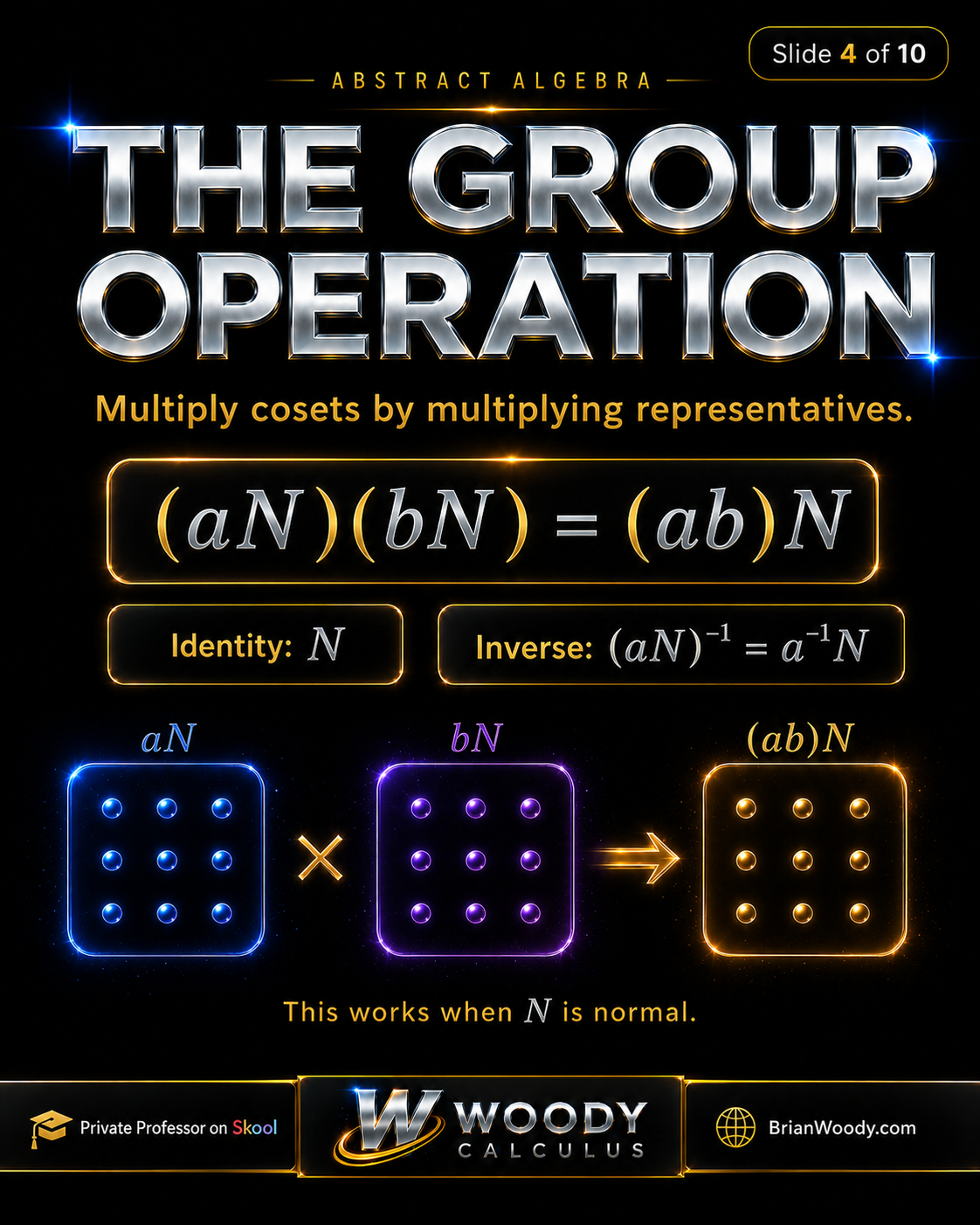
The natural operation is:
(aN)(bN)=(ab)N.
\]
In words:
Multiply the representatives first, then attach \(N\).
The identity element of \(G/N\) is:
N=eN.
\]
The inverse of \(aN\) is:
(aN)^{-1}=a^{-1}N.
\]
This looks clean, but there is a hidden issue.
A coset has many representatives. The coset \(aN\) may also be written as \(a_1N\), \(a_2N\), and so on. For multiplication to make sense, the answer must not depend on which representative we choose.
That is called being well-defined.
The quotient operation is well-defined precisely when \(N\) is normal in \(G\).
Why Normal Subgroups Matter
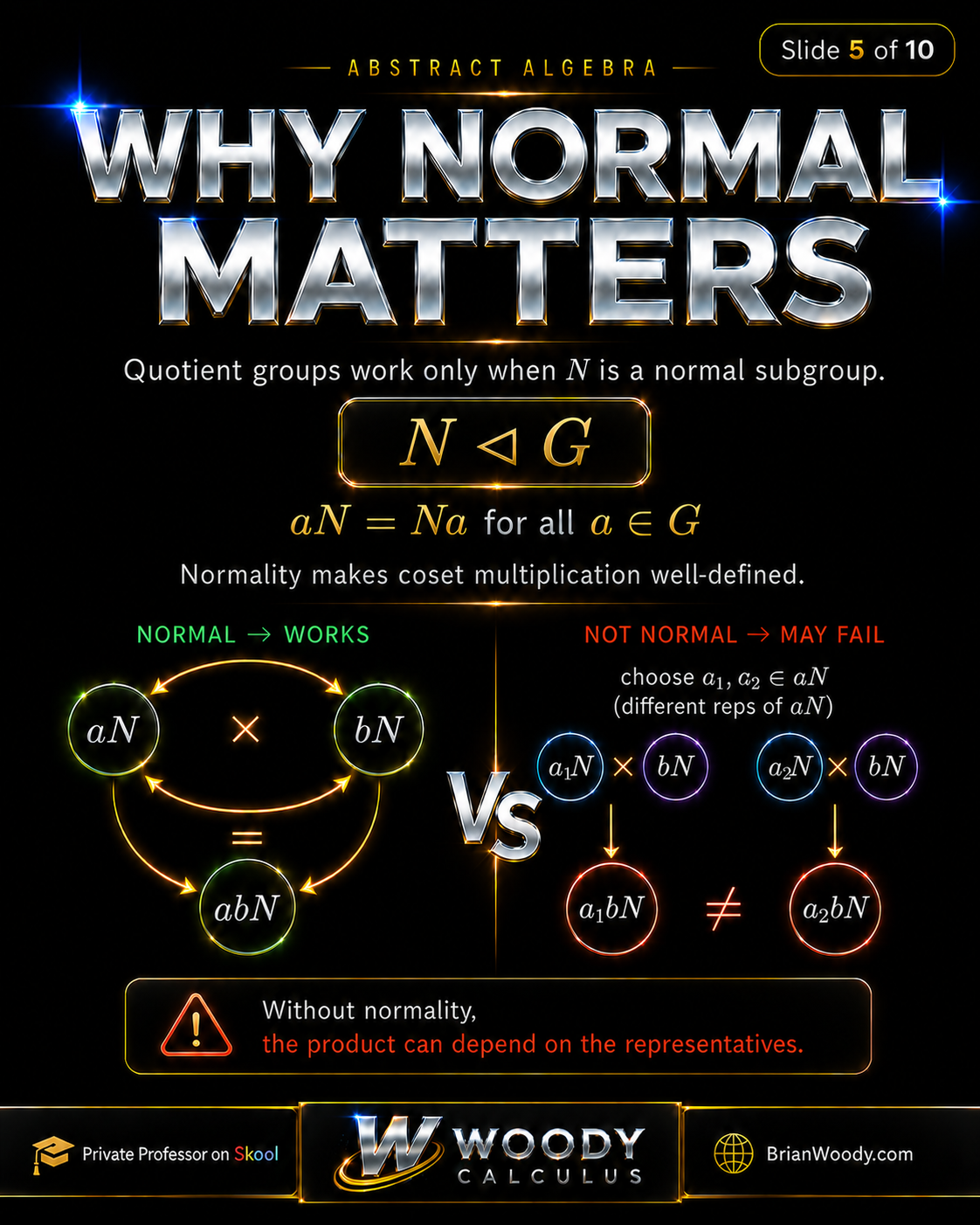
Quotient groups only work when \(N\) is a normal subgroup of \(G\).
We write:
N\triangleleft G.
\]
This means:
aN=Na
\quad\text{for all }a\in G.
\]
Equivalently:
aNa^{-1}=N
\quad\text{for all }a\in G.
\]
Normality guarantees that coset multiplication is well-defined.
Here is the issue. Suppose \(aN=a_1N\) and \(bN=b_1N\). If we multiply using representatives, we want:
(ab)N=(a_1b_1)N.
\]
If \(N\) is normal, this works.
If \(N\) is not normal, the product can depend on which representatives we choose. Then the quotient operation is not well-defined, and \(G/N\) is not a group.
This is why normality is not a technical detail. It is the condition that makes the quotient group possible.
Normal subgroups are also essential in Galois Theory, where quotient groups help describe how large symmetry groups collapse into simpler symmetry information.
Modular Arithmetic as a Quotient Group
The most familiar quotient group is modular arithmetic.
The classic example is:
\mathbb{Z}/5\mathbb{Z}.
\]
Here:
- \(\mathbb{Z}\) is the group of integers under addition.
- \(5\mathbb{Z}\) is the subgroup of multiples of \(5\).
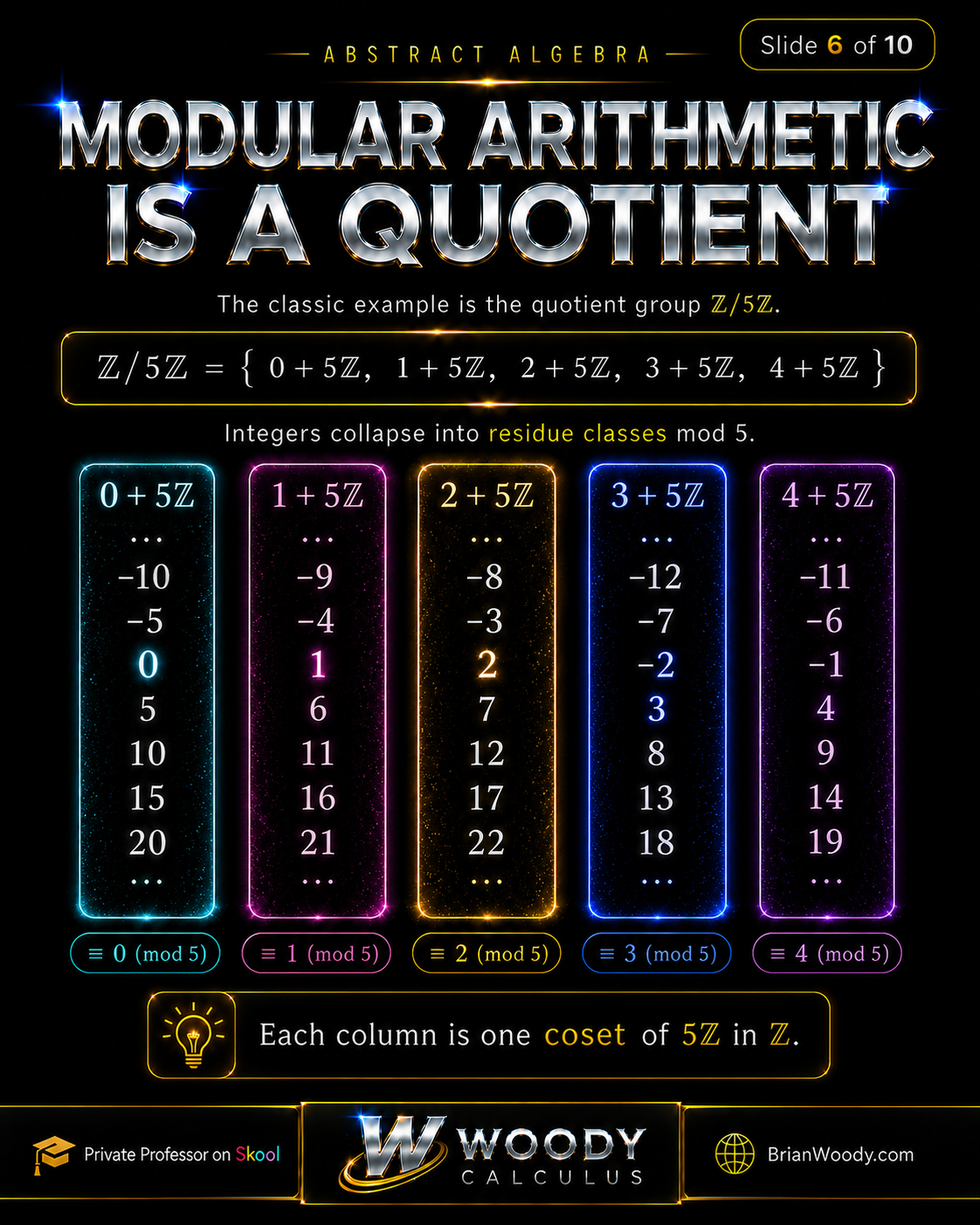
- The quotient \(\mathbb{Z}/5\mathbb{Z}\) collapses integers into residue classes modulo \(5\).
The quotient group is:
\mathbb{Z}/5\mathbb{Z}
=
\{0+5\mathbb{Z},1+5\mathbb{Z},2+5\mathbb{Z},3+5\mathbb{Z},4+5\mathbb{Z}\}.
\]
Each coset is a full column of integers with the same remainder modulo \(5\).
For example:
2+5\mathbb{Z}
=
\{\ldots,-8,-3,2,7,12,17,\ldots\}.
\]
Every integer belongs to exactly one of the five residue classes.
This is quotient group thinking in its most familiar form: the infinite group \(\mathbb{Z}\) collapses into the five-element group \(\mathbb{Z}/5\mathbb{Z}\).
How the Quotient Works in \(\mathbb{Z}/5\mathbb{Z}\)
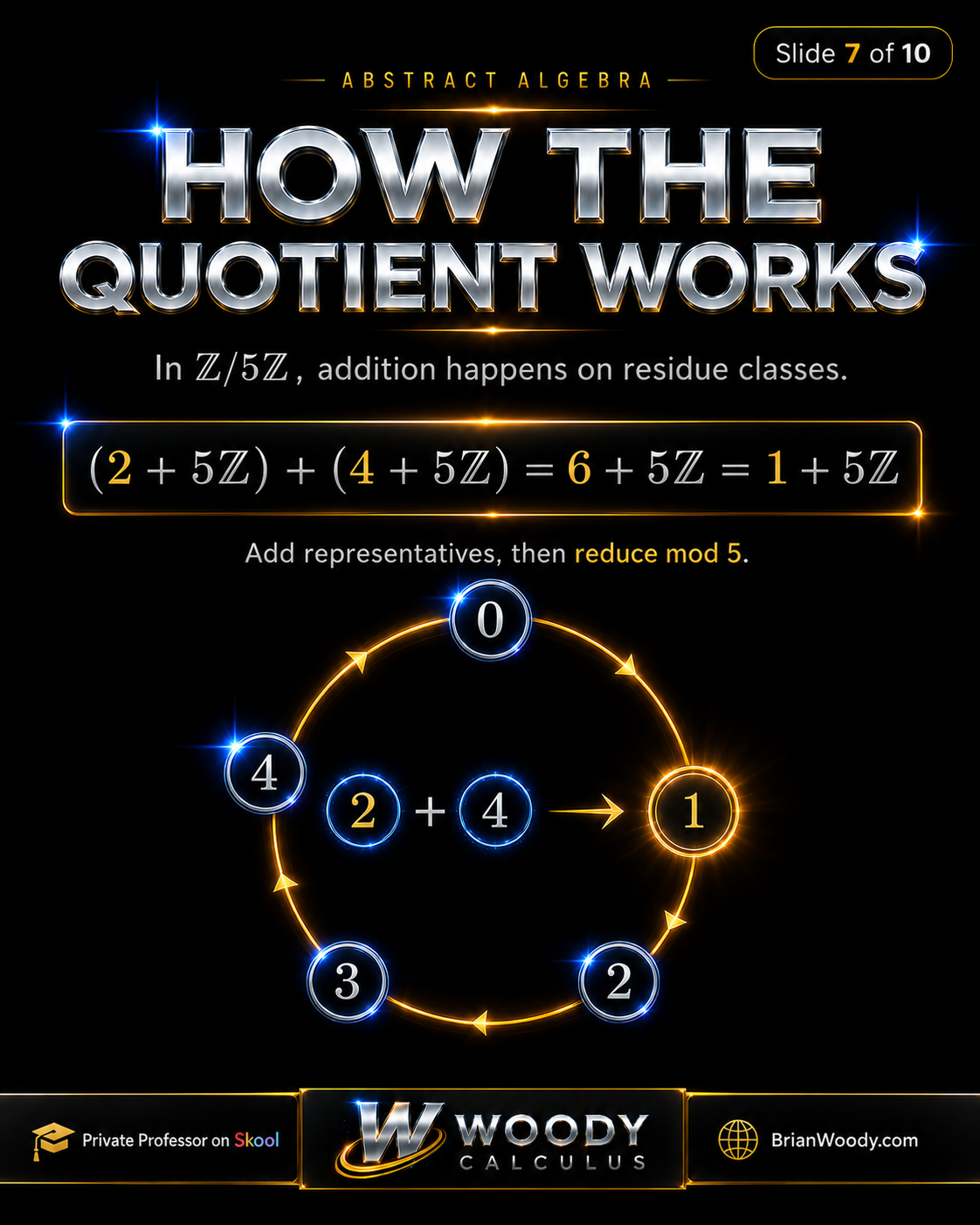
In \(\mathbb{Z}/5\mathbb{Z}\), addition happens on residue classes.
For example:
(2+5\mathbb{Z})+(4+5\mathbb{Z})
=
6+5\mathbb{Z}.
\]
But \(6\equiv 1\pmod 5\), so:
6+5\mathbb{Z}=1+5\mathbb{Z}.
\]
Therefore:
(2+5\mathbb{Z})+(4+5\mathbb{Z})
=
1+5\mathbb{Z}.
\]
This is exactly the same as saying:
2+4\equiv 1\pmod 5.
\]
The quotient group explains why modular arithmetic works:
You add representatives, then reduce to the correct coset.
Kernels Create Quotients
Quotient groups appear naturally from homomorphisms.
Let
\varphi:G\to H
\]
be a group homomorphism.
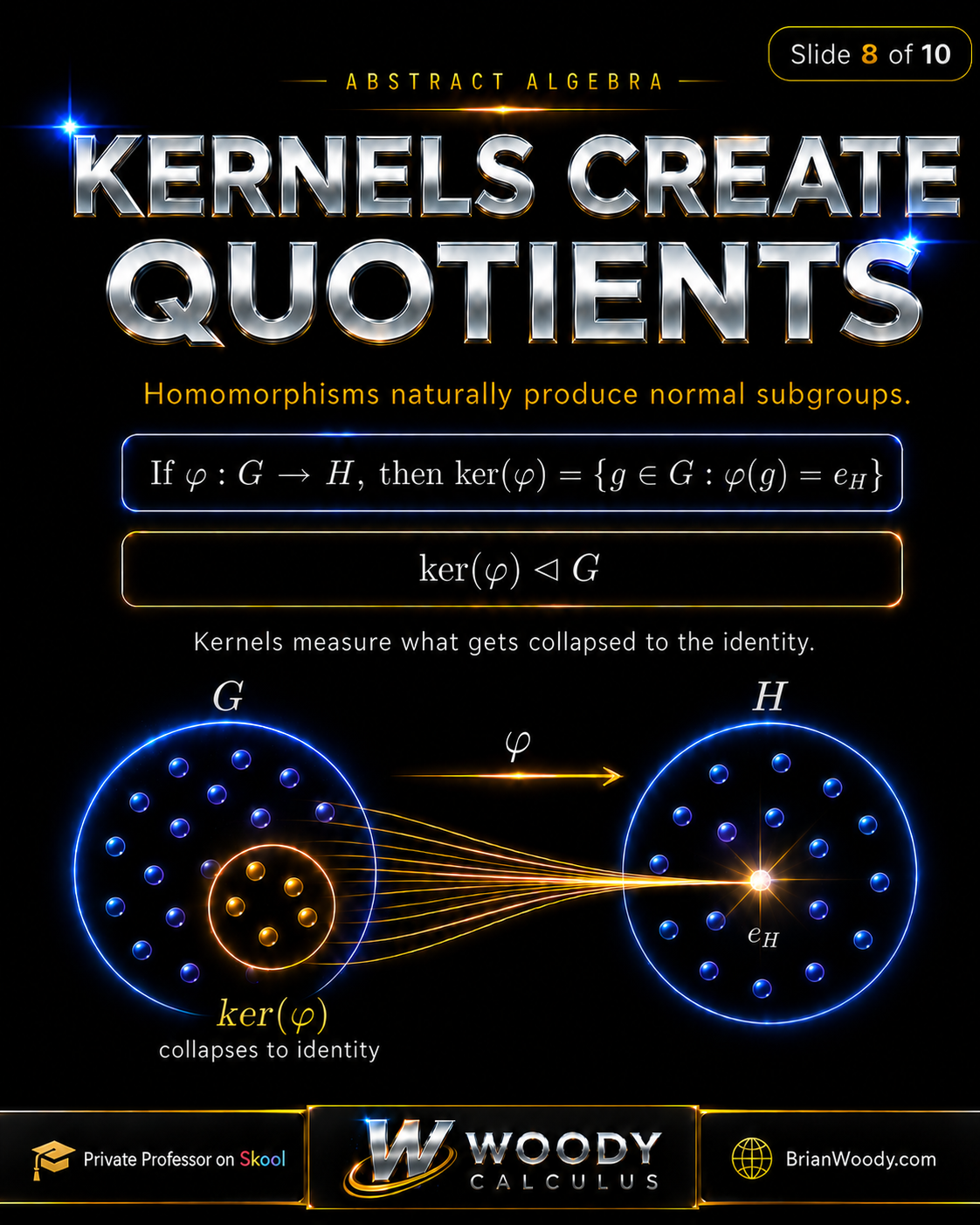
The kernel of \(\varphi\) is the set of elements in \(G\) that map to the identity in \(H\):
\ker(\varphi)=\{g\in G:\varphi(g)=e_H\}.
\]
The kernel measures what gets collapsed to the identity.
Even better:
\ker(\varphi)\triangleleft G.
\]
Every kernel is a normal subgroup.
Here is why normality appears. If \(k\in\ker(\varphi)\), then \(\varphi(k)=e_H\). For any \(g\in G\),
\varphi(gkg^{-1})
=
\varphi(g)\varphi(k)\varphi(g)^{-1}
=
\varphi(g)e_H\varphi(g)^{-1}
=
e_H.
\]
So \(gkg^{-1}\in\ker(\varphi)\), which means the kernel is normal.
This is not a coincidence. Kernels are exactly the kind of subgroups that can be collapsed to form quotient groups.
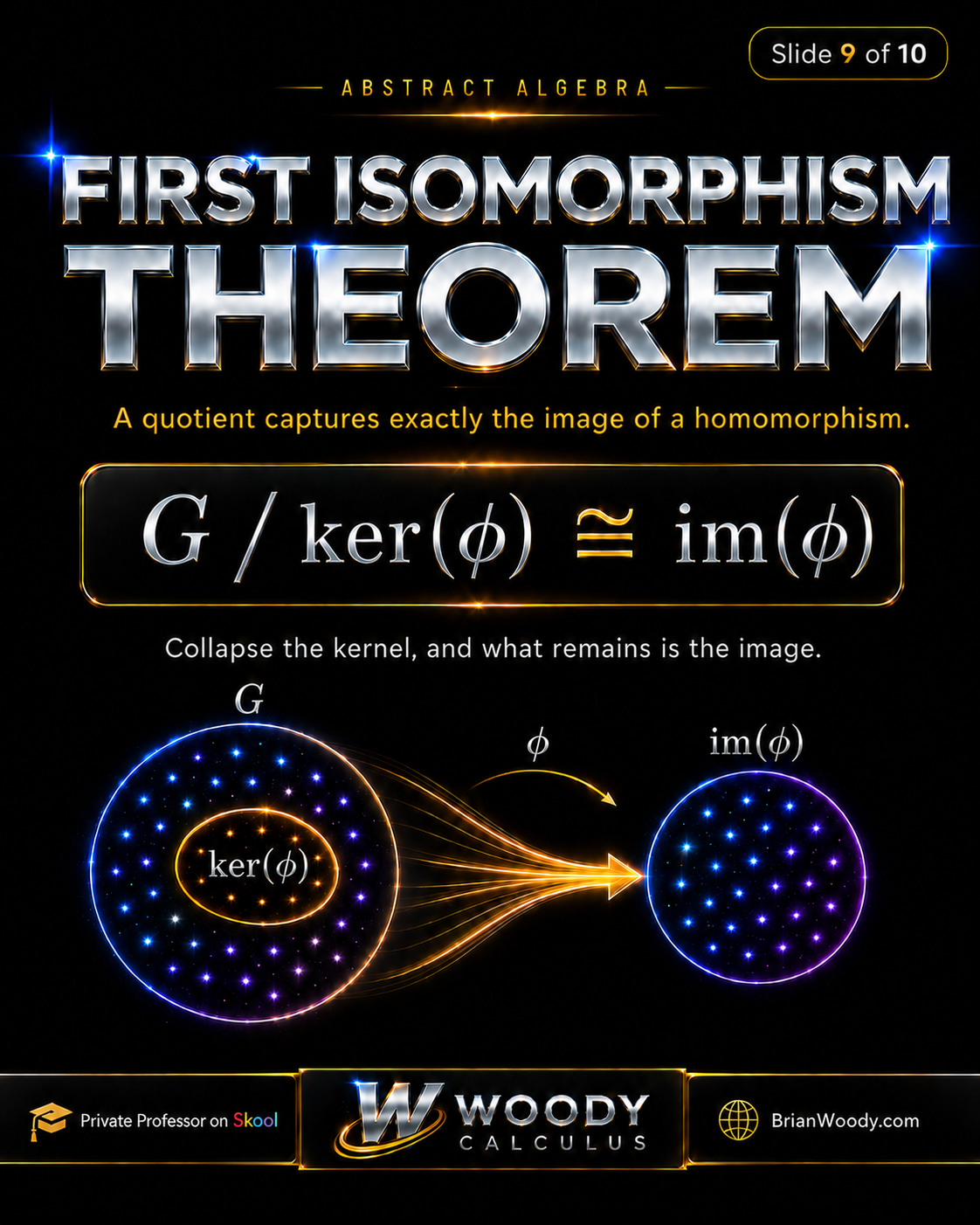
The First Isomorphism Theorem
The First Isomorphism Theorem is one of the most important results in Abstract Algebra.
If
\varphi:G\to H
\]
is a group homomorphism, then:
G/\ker(\varphi)\cong \operatorname{im}(\varphi).
\]
In words:
Collapse the kernel, and what remains is exactly the image.
The isomorphism is given by:
g\ker(\varphi)\mapsto \varphi(g).
\]
This map is well-defined because all elements inside the same coset of \(\ker(\varphi)\) have the same image under \(\varphi\).
That is the deep meaning of quotient groups.
They are not just artificial constructions. They describe exactly what a homomorphism does when it identifies elements.
The \(S_3/A_3\cong C_2\) Connection
A powerful quotient group appears inside the symmetry group \(S_3\). The subgroup of even permutations is:
A_3=\{e,r,r^2\}.
\]
This subgroup is normal:
A_3\triangleleft S_3.
\]
The quotient collapses all even permutations into one coset and all odd permutations into another:
S_3/A_3\cong C_2.
\]
This quotient remembers only parity: even versus odd.
This exact quotient appears naturally in the Galois-theory example where \(x^3-2\) has splitting field \(\mathbb{Q}(\sqrt[3]{2},\omega)\) and Galois group \(S_3\). The roots form a triangle, the six automorphisms act like triangle symmetries, and the quotient \(S_3/A_3\) collapses those symmetries into a two-element parity group.
For the full lesson, read Why Does \(x^3-2\) Create \(S_3\)? Galois Theory Explained.
More Quotient Group Examples
Example 1: \(\mathbb{Z}/12\mathbb{Z}\)
The quotient group
\mathbb{Z}/12\mathbb{Z}
\]
is the group of residue classes modulo \(12\).
Its elements are:
0+12\mathbb{Z},1+12\mathbb{Z},2+12\mathbb{Z},\ldots,11+12\mathbb{Z}.
\]
Addition is done by adding representatives and reducing modulo \(12\). For example:
(9+12\mathbb{Z})+(8+12\mathbb{Z})
=
17+12\mathbb{Z}
=
5+12\mathbb{Z}.
\]
So:
9+8\equiv 5\pmod{12}.
\]
Example 2: The sign homomorphism
Consider the sign homomorphism:
\operatorname{sgn}:S_n\to \{1,-1\}.
\]
The kernel is the alternating group:
\ker(\operatorname{sgn})=A_n.
\]
Therefore, \(A_n\triangleleft S_n\).
By the First Isomorphism Theorem:
S_n/A_n\cong \{1,-1\}.
\]
This means the quotient \(S_n/A_n\) records only whether a permutation is even or odd. When \(n=3\), this becomes:
S_3/A_3\cong C_2.
\]
That quotient is exactly the one that appears in the \(x^3-2\) Galois group lesson.
Example 3: The determinant homomorphism
Consider the determinant map:
\det:GL_n(\mathbb{R})\to \mathbb{R}^{\times}.
\]
The kernel is:
SL_n(\mathbb{R})=\{A\in GL_n(\mathbb{R}):\det(A)=1\}.
\]
So:
SL_n(\mathbb{R})\triangleleft GL_n(\mathbb{R}).
\]
By the First Isomorphism Theorem:
GL_n(\mathbb{R})/SL_n(\mathbb{R})\cong \mathbb{R}^{\times}.
\]
The quotient collapses all determinant-\(1\) behavior and leaves only the determinant value.
For more on determinant structure, see The Determinant Explained: The Number That Measures How a Matrix Changes Space.
Research and Galois Theory Connections
Quotient groups are a core part of the algebraic language behind symmetry, homomorphisms, Galois groups, finite fields, and polynomial structure.
Students who want to see how Abstract Algebra leads into modern research can explore the Brian M. Woody Research Hub. Brian M. Woody’s finite-field research studies polynomial classification, permutation behavior, roots of unity, finite fields, and algebraic structure over \(\mathbb{F}_{q^2}\).
- Brian M. Woody Research Hub
- Student Guide to the Degree-Five Finite Field Classification Paper
- Finite Field Theory Explained: Galois Fields, Cryptography, and Abstract Algebra
- Dickson Trace Curves and Reciprocal Quadrinomials over Finite Fields
- Official arXiv Record: arXiv:2607.01267
The connection is conceptual: quotient groups teach students how algebra collapses structure in a controlled way, while field theory and finite-field research study how algebraic maps preserve or identify structure.
Common Mistakes with Quotient Groups
Quotient groups are conceptually deep, so it is normal for students to struggle at first.
Here are the most common mistakes.
Mistake 1: Thinking the elements are individual elements of \(G\)
The elements of \(G/N\) are cosets \(gN\), not individual elements \(g\).
Mistake 2: Forgetting normality
The expression \(G/N\) is a quotient group only when \(N\triangleleft G\). Without normality, coset multiplication may not be well-defined.
Mistake 3: Confusing the subgroup \(N\) with the quotient \(G/N\)
The subgroup \(N\) lives inside \(G\). The quotient group \(G/N\) is a new group whose elements are cosets of \(N\).
Mistake 4: Treating coset representatives as unique
A coset has many representatives. If \(aN=bN\), then \(a\) and \(b\) represent the same element of the quotient group.
Mistake 5: Missing the meaning of the First Isomorphism Theorem
The theorem is not just a formula. It says that a homomorphism collapses its kernel and leaves behind its image.
Mistake 6: Missing the Galois theory connection
Quotient groups are not isolated from field theory. In Galois theory, quotient groups organize symmetry and help explain how complicated automorphism groups reduce to simpler information.
Key Takeaways
- A quotient group has the form \(G/N\).
- The elements of \(G/N\) are cosets \(gN\).
- Cosets partition the original group \(G\).
- Coset multiplication is \((aN)(bN)=(ab)N\).
- This multiplication is well-defined only when \(N\triangleleft G\).
- Modular arithmetic is the classic quotient group example.
- Kernels of homomorphisms are normal subgroups.
- The First Isomorphism Theorem says \(G/\ker(\varphi)\cong \operatorname{im}(\varphi)\).
- The quotient \(S_3/A_3\cong C_2\) records parity in the symmetry group of three objects.
- Quotient groups explain how algebra collapses structure while preserving what matters.
Quotient Groups FAQ
What is a quotient group?
A quotient group is a group of cosets \(G/N=\{gN:g\in G\}\), where \(N\) is a normal subgroup of \(G\). It is formed by collapsing \(N\) to the identity.
Why does \(N\) have to be normal?
Normality makes coset multiplication well-defined. If \(N\) is not normal, the product of cosets can depend on the representatives chosen, so \(G/N\) may not be a group.
What are the elements of a quotient group?
The elements of a quotient group are cosets \(gN\), not individual elements \(g\) of the original group.
Is modular arithmetic a quotient group?
Yes. Modular arithmetic modulo \(n\) is the quotient group \(\mathbb{Z}/n\mathbb{Z}\), where integers are grouped into residue classes modulo \(n\).
What is the operation in a quotient group?
For a quotient group \(G/N\), the operation is \((aN)(bN)=(ab)N\). In additive groups such as \(\mathbb{Z}/n\mathbb{Z}\), the operation is addition of cosets.
How are kernels related to quotient groups?
The kernel of a group homomorphism is always a normal subgroup. This means kernels naturally create quotient groups.
What does the First Isomorphism Theorem say?
The First Isomorphism Theorem says that if \(\varphi:G\to H\) is a group homomorphism, then \(G/\ker(\varphi)\cong \operatorname{im}(\varphi)\).
Why is \(S_3/A_3\cong C_2\)?
The subgroup \(A_3\) contains the even permutations in \(S_3\). Collapsing \(A_3\) leaves two cosets: even permutations and odd permutations. Therefore, the quotient has two elements and is isomorphic to \(C_2\).
How do quotient groups connect to Galois theory?
Galois theory studies automorphism groups of field extensions. Quotient groups help describe how large symmetry groups collapse into simpler symmetry information, such as the quotient \(S_3/A_3\cong C_2\) in the Galois group of \(x^3-2\).
Master Quotient Groups in Abstract Algebra
Quotient groups are not just another definition. They are one of the central ideas of Abstract Algebra because they explain how structure can be collapsed, simplified, and preserved.
To master quotient groups, students need to connect:
- Cosets: the new elements of the quotient group.
- Normal subgroups: the condition that makes the quotient operation work.
- Modular arithmetic: the most familiar quotient group.
- Kernels: the subgroup that a homomorphism collapses to the identity.
- Images: the structure left after the collapse.
- The First Isomorphism Theorem: the theorem that connects quotient groups and homomorphisms.
- Galois theory: the place where quotient groups organize field symmetries.
At Woody Calculus, students build fluency through clean definitions, proof structure, example repetition, formula memorization, rewriting perfect solutions, and saying each step out loud until the method becomes automatic.
A quotient group is what remains after algebra collapses everything that should count as the same.
— Brian M. Woody
If you are studying Abstract Algebra, group theory, normal subgroups, cosets, homomorphisms, kernels, Galois theory, or the First Isomorphism Theorem, quotient groups are one of the ideas you want to understand deeply.
For structured training, join the Woody Calculus Mastery Lab. Students can also visit Woody Calculus on Skool to learn more about the learning community.
Related Woody Calculus Mathematical Essays
Explore more Woody Calculus visual lessons and deep-dive mathematical essays connecting Abstract Algebra, Galois Theory, field extensions, finite fields, quotient groups, Real Analysis, Linear Algebra, Differential Equations, and peak performance study methods.
- How to Learn Calculus and Advanced Mathematics: A Peak Performance Study Guide
- Why Does x³ − 2 Create S₃? Galois Theory Explained
- Field Extensions Explained: When Numbers Need a Bigger Universe
- Galois Theory Explained: Hidden Symmetry Behind Equations
- Finite Field Theory Explained: Galois Fields, Cryptography, and Abstract Algebra
- Finite Field Permutation Polynomial Research
- Dickson Trace Curves and Reciprocal Quadrinomials over Finite Fields
- The Determinant Explained: The Number That Measures How a Matrix Changes Space
- Eigenvalues and Eigenvectors Explained: The Special Directions That Unlock Linear Algebra
- View All Woody Calculus Blog Posts
Private Instruction
Brian M. Woody also works privately with a limited number of serious students who need one-on-one help in Abstract Algebra, Real Analysis, Calculus II, Calculus III, and Differential Equations.
Private instruction is reserved for serious students, requires weekly sessions, requires enrollment in the Woody Calculus Mastery Lab first, and approval is not guaranteed.
Students interested in private instruction can learn more here: Private Math Tutor and Advanced Mathematics Instruction.
Related University Math Help Pages
Woody Calculus supports students at major universities with structured help in Abstract Algebra, Real Analysis, Calculus II, Calculus III, Differential Equations, Linear Algebra, and advanced mathematics. For a full list of supported schools, visit the University Calculus Tutor Hub.
- University Calculus Tutor Hub
- MIT Calculus Tutor
- Harvard Calculus Tutor
- Stanford Calculus Tutor
- Princeton Calculus Tutor
- Caltech Calculus Tutor
- Purdue University Calculus Tutor
- University of Florida Calculus Tutor
- Colorado State University Calculus Help
- UCF Calculus Tutor
- Georgia Tech Calculus Tutor
- University of Michigan Calculus Tutor
- University of Nevada, Reno Calculus Tutor
- UCLA Calculus Tutor
Trusted by Students Nationwide
The Woody Calculus Mastery Lab gives university students access to structured mathematics support, written solutions, video lessons, exam-focused training, proof-based lessons, and expert guidance from Brian M. Woody.
Students use Woody Calculus for Abstract Algebra, Real Analysis, Calculus II, Calculus III, Differential Equations, Linear Algebra, and other advanced mathematics courses.