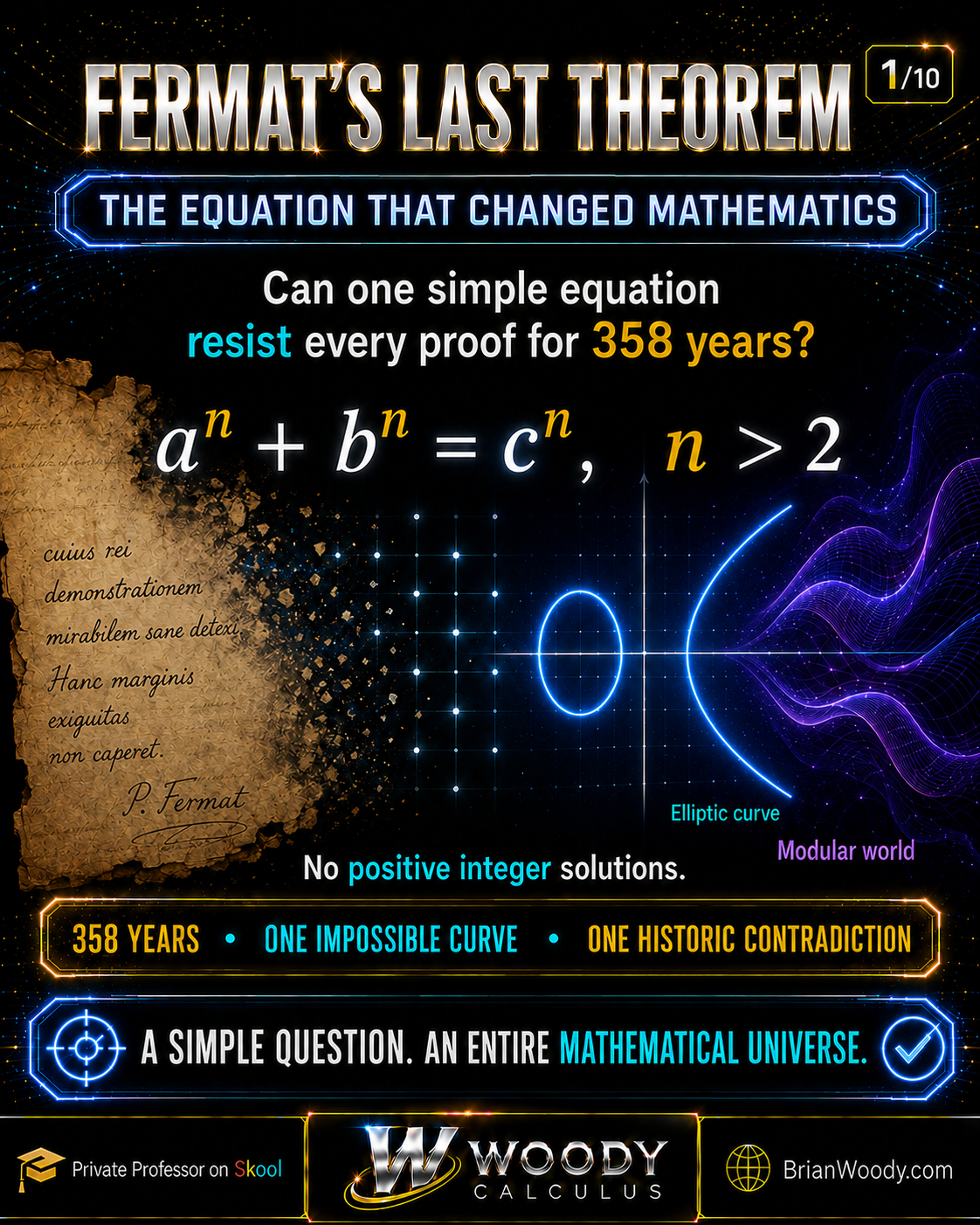
Fermat’s Last Theorem began with an equation a student can understand and ended in a proof joining number theory, ideals, elliptic curves, modular forms, Galois representations, and Taylor–Wiles patching. This visual master lesson develops the 358-year history, the complete contradiction architecture, verified worked examples, and the precise relationship to modern elliptic-curve cryptography.
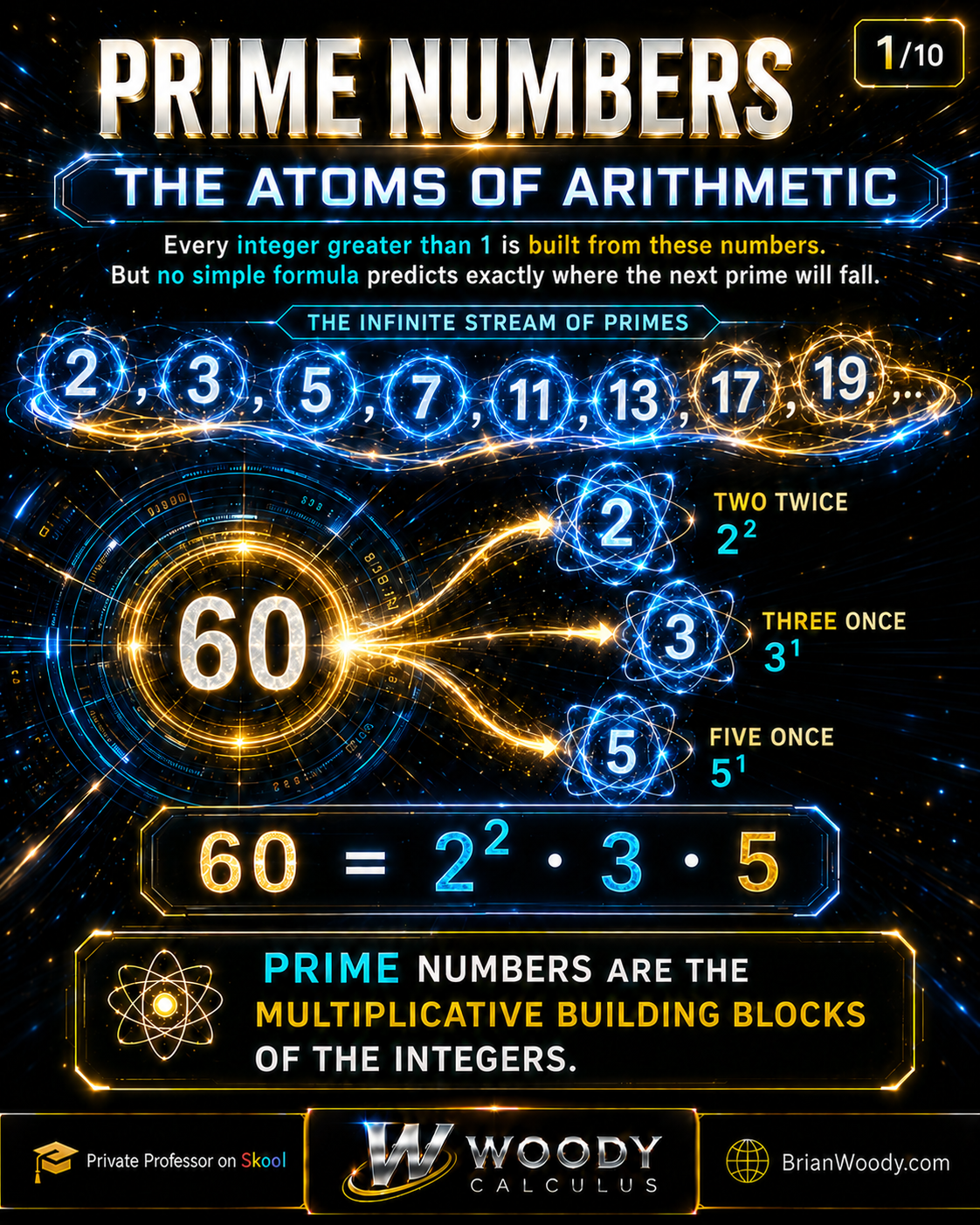
Prime numbers are the multiplicative building blocks of the integers. In this Woody Calculus lesson, learn the formal definition of a prime, why 1 is excluded, the Fundamental Theorem of Arithmetic, Euclid’s proof of infinitely many primes, the Sieve of Eratosthenes, prime patterns modulo 6, the Prime Number Theorem, modern cryptography, and the deep connection between primes and the Riemann Hypothesis.
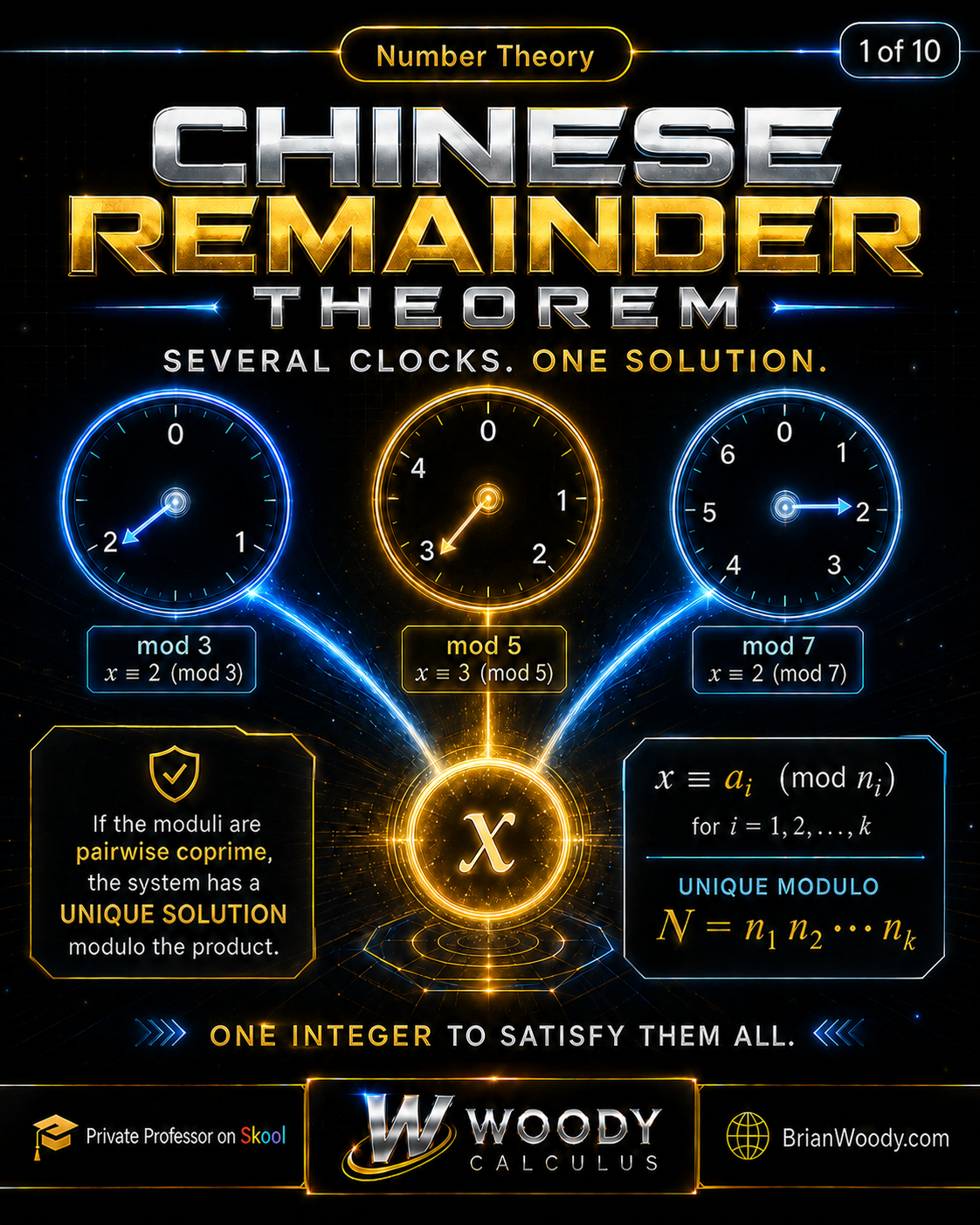
The Chinese Remainder Theorem combines simultaneous congruences into one residue class. Learn the modular-inverse algorithm, two complete examples, proof, verification, noncoprime cases, common mistakes, and exam-ready method selection.
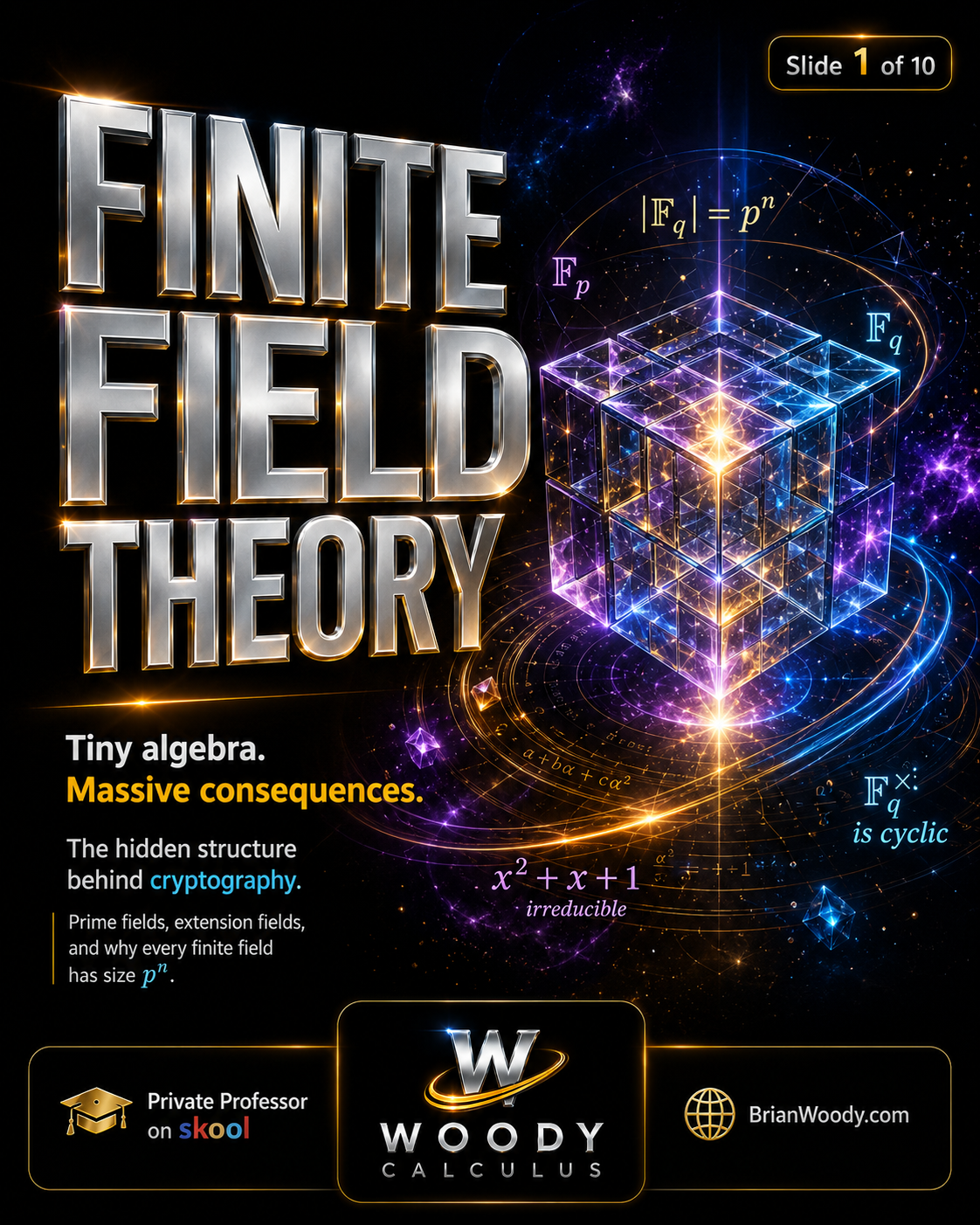
Finite field theory looks abstract until you realize it powers modern cryptography, error correction, QR codes, AES encryption, and elliptic curve cryptography. In this Woody Calculus visual lesson, learn what finite fields are, why prime fields matter, why every finite field has size q = p^n, how extension fields are built from irreducible polynomials, and why finite fields are the hidden algebra behind secure communication.
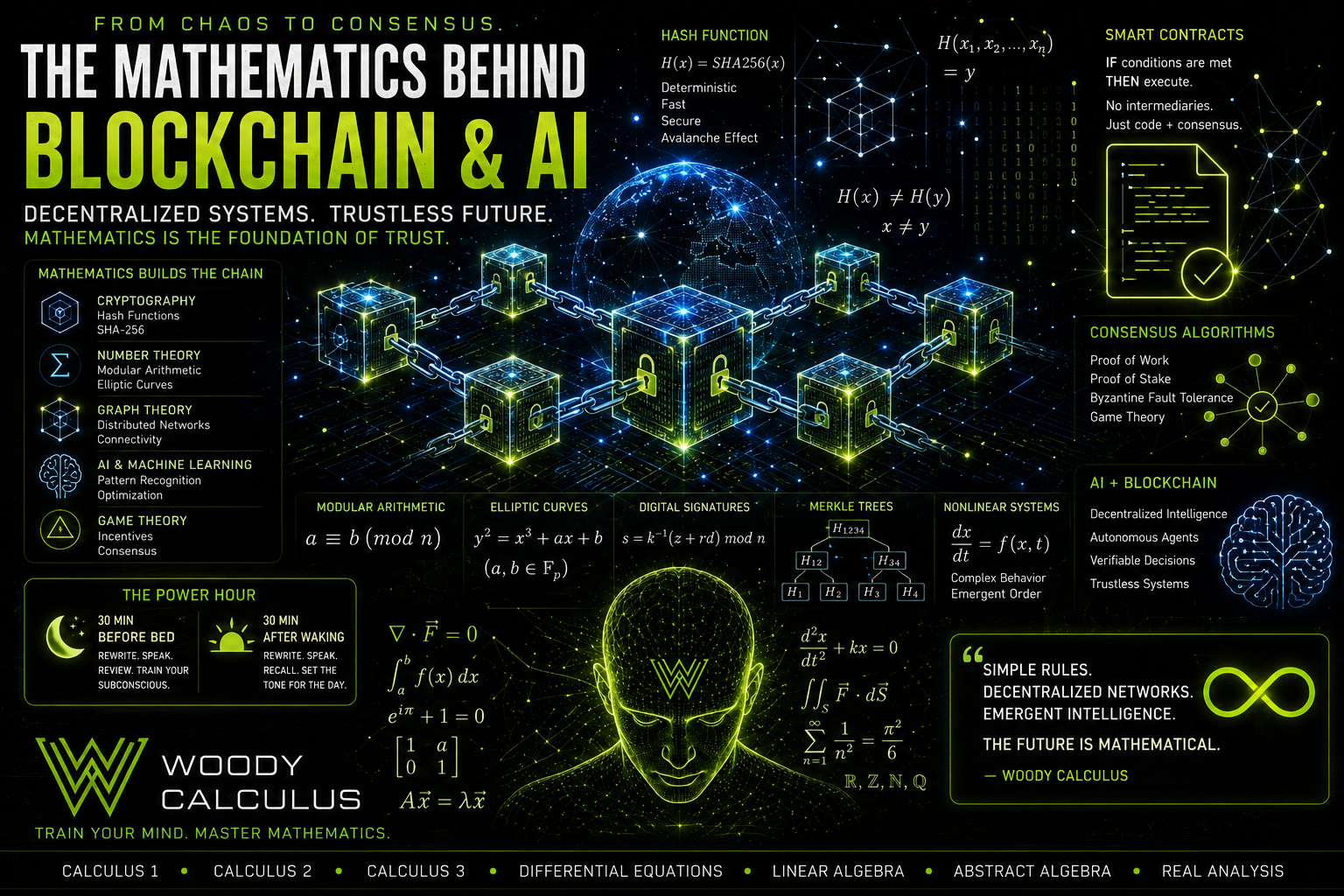
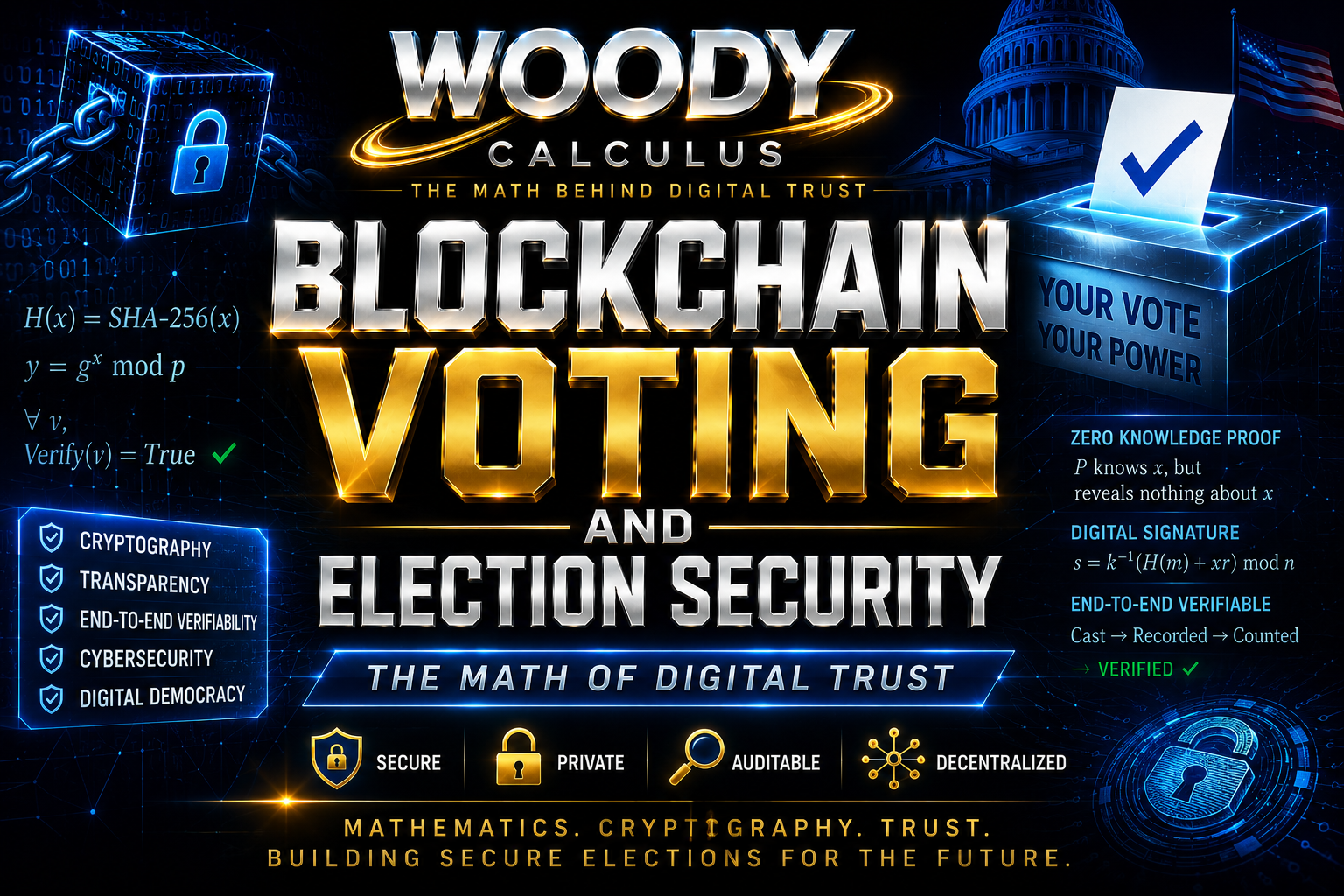
Blockchain is not merely a cryptocurrency technology. It is a system for creating verifiable agreement with mathematics, cryptography, computation, and…