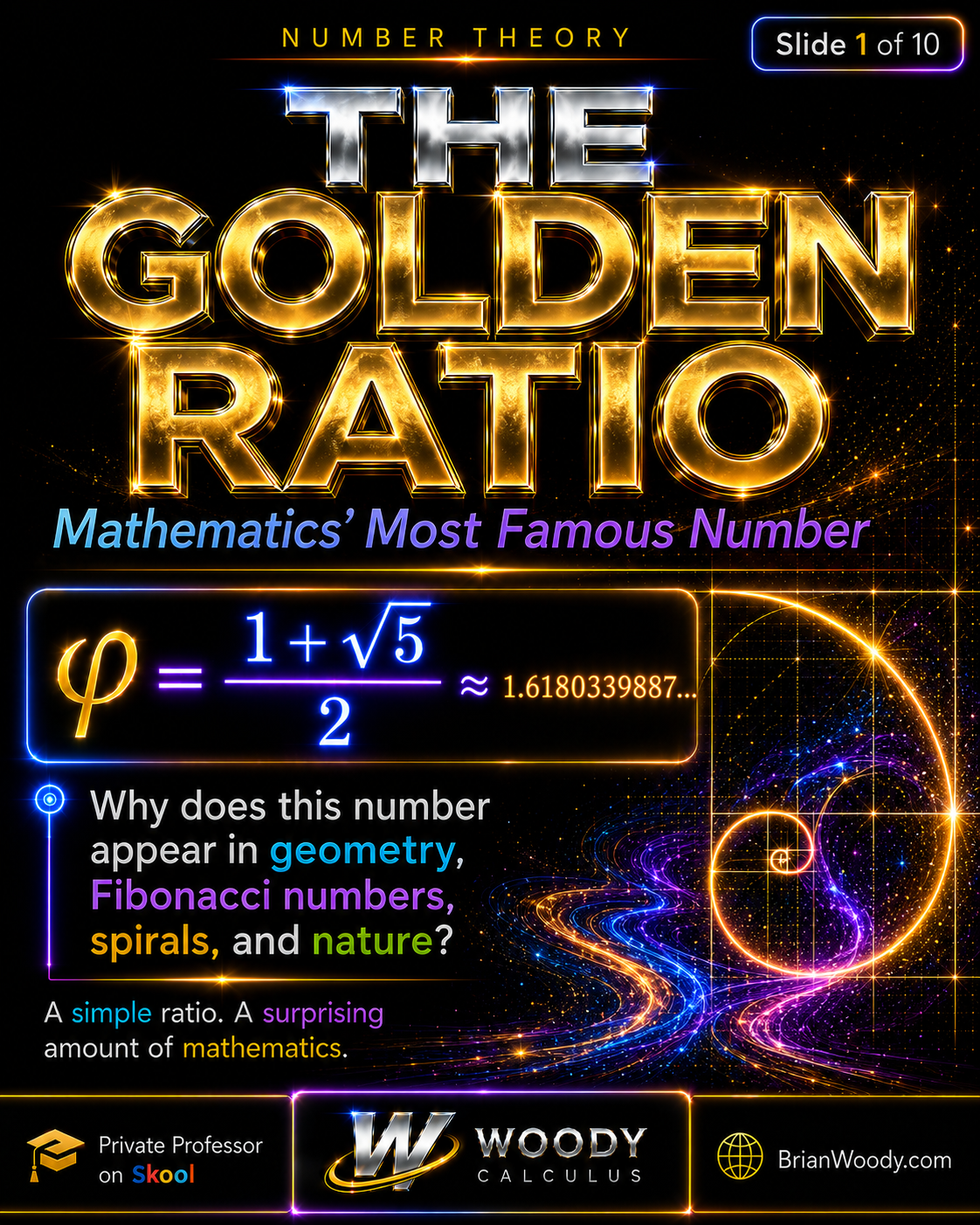
The golden ratio φ=(1+√5)/2 is where geometry, algebra, Fibonacci numbers, limits, continued fractions, pentagons, spirals, and phyllotaxis meet. This complete Woody Calculus visual lesson derives phi, proves the Fibonacci limit, distinguishes a true golden spiral from Fibonacci-style arcs, and separates real mathematics from popular mythology.
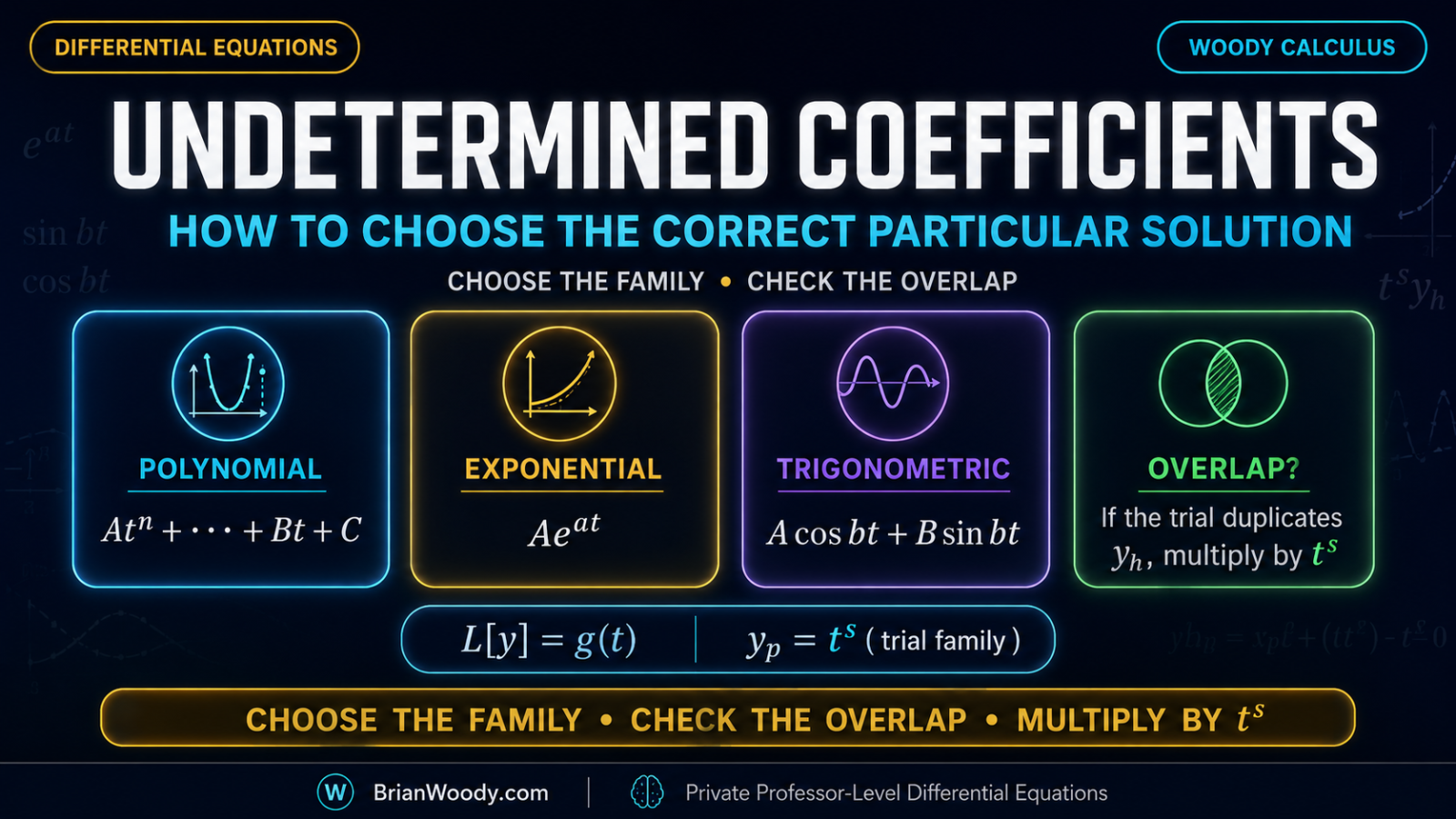
Learn the method of undetermined coefficients from the forcing term to the final solution. Use the Woody Calculus master y_p guess table, build polynomial, exponential, and trigonometric trial solutions, check for overlap with the homogeneous solution, apply the t^s rule, and work through resonance, repeated-root, and initial-value examples.
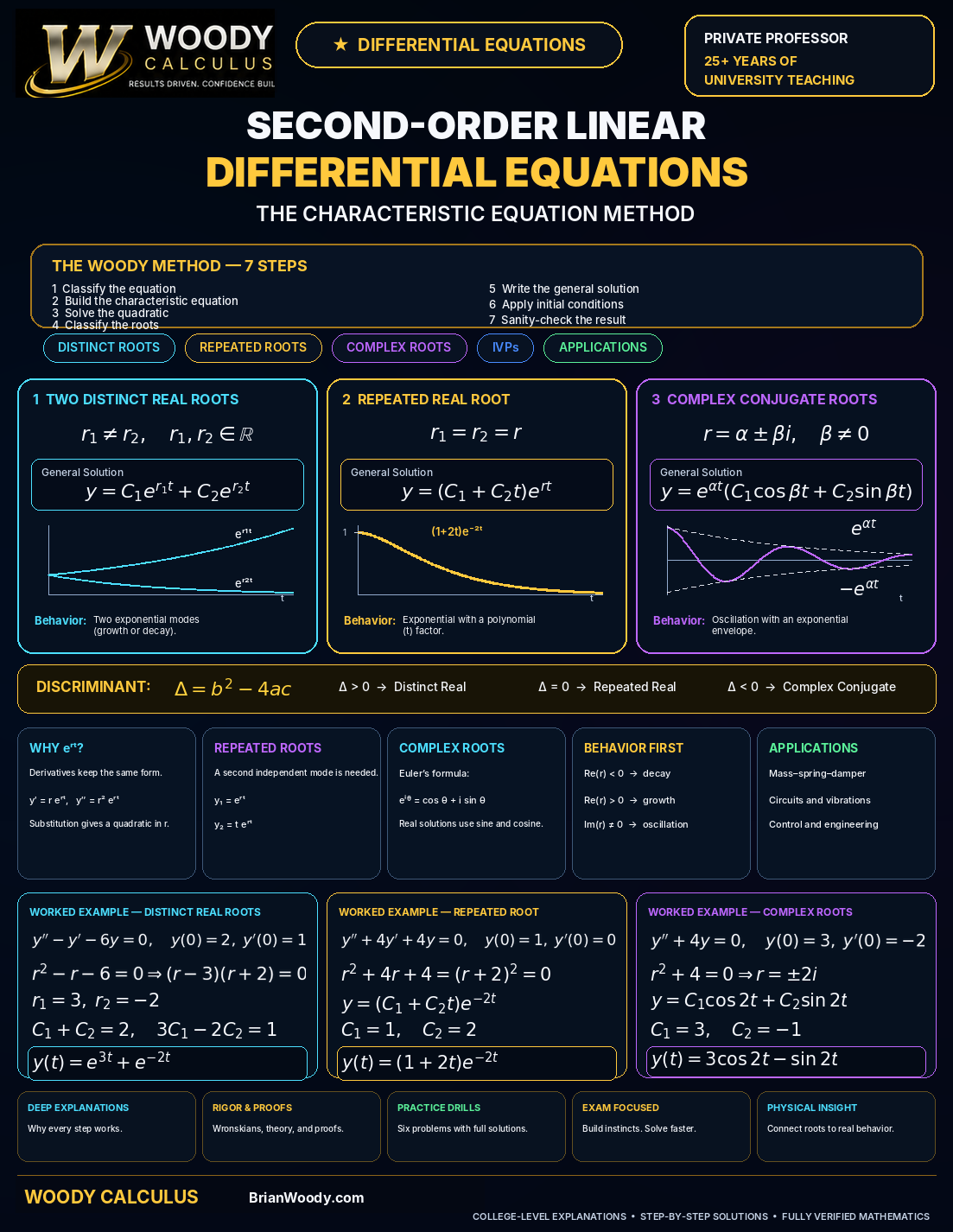
Learn to solve homogeneous second-order linear differential equations with constant coefficients using the characteristic equation. Master distinct real roots, repeated roots, complex conjugate roots, initial-value problems, boundary-value problems, damping, and the Woody Calculus root-classification method.
What does compactness mean in Real Analysis? Learn open covers, finite subcovers, the Heine–Borel Theorem, sequential compactness, Bolzano–Weierstrass, and why continuous functions become dramatically better behaved on compact sets.
Polynomial irreducibility is never just about the polynomial—it depends on the coefficient ring or field. Learn a complete Abstract Algebra decision system using root tests, the Rational Root Theorem, Gauss’s Lemma, Eisenstein’s Criterion, reduction modulo p, finite-field factor tests, quotient rings, and field extensions.
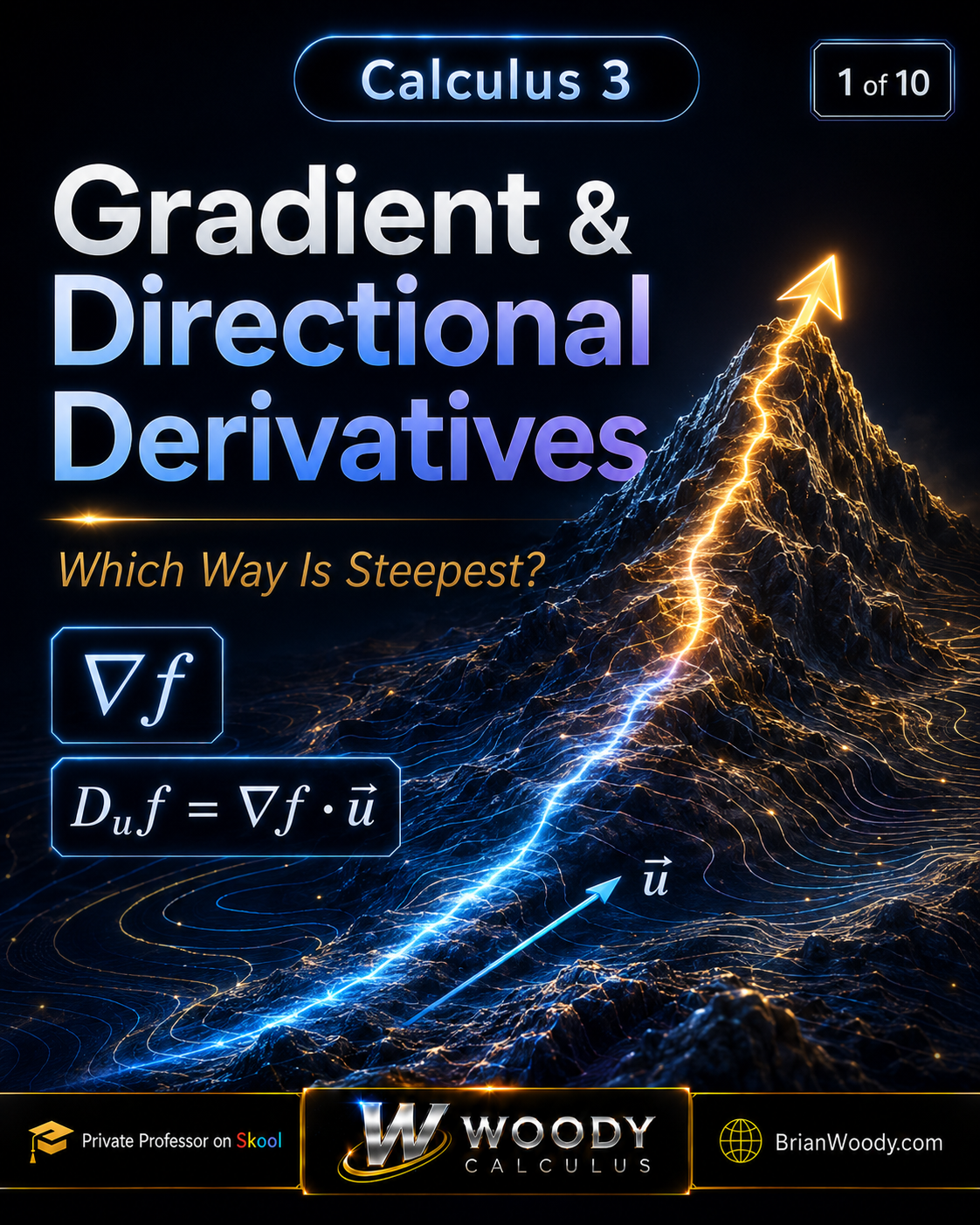
Which direction makes a multivariable function increase fastest? Learn how the gradient packages partial derivatives, how to calculate directional derivatives with unit vectors and dot products, and why gradients cross level curves at right angles.
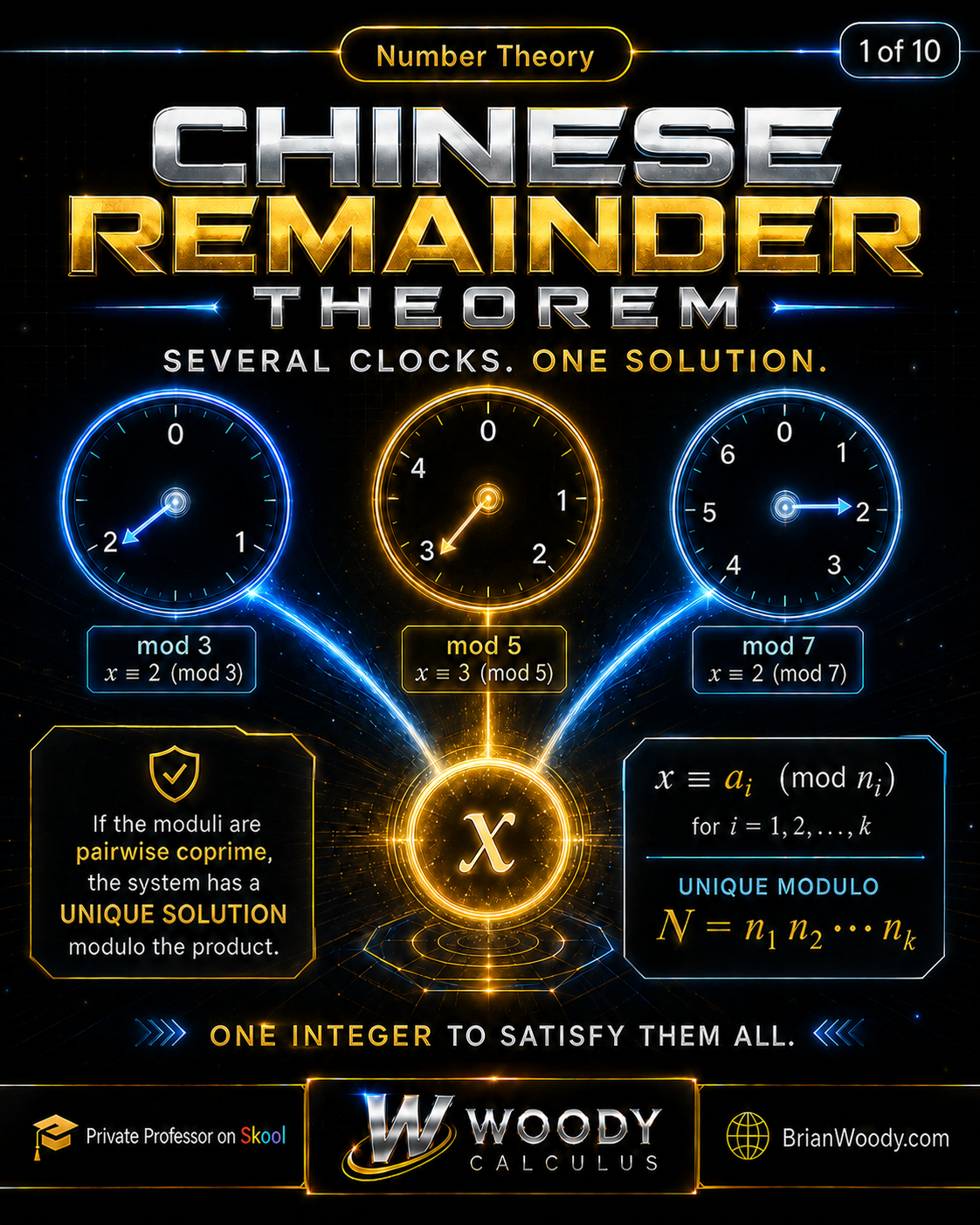
The Chinese Remainder Theorem combines simultaneous congruences into one residue class. Learn the modular-inverse algorithm, two complete examples, proof, verification, noncoprime cases, common mistakes, and exam-ready method selection.
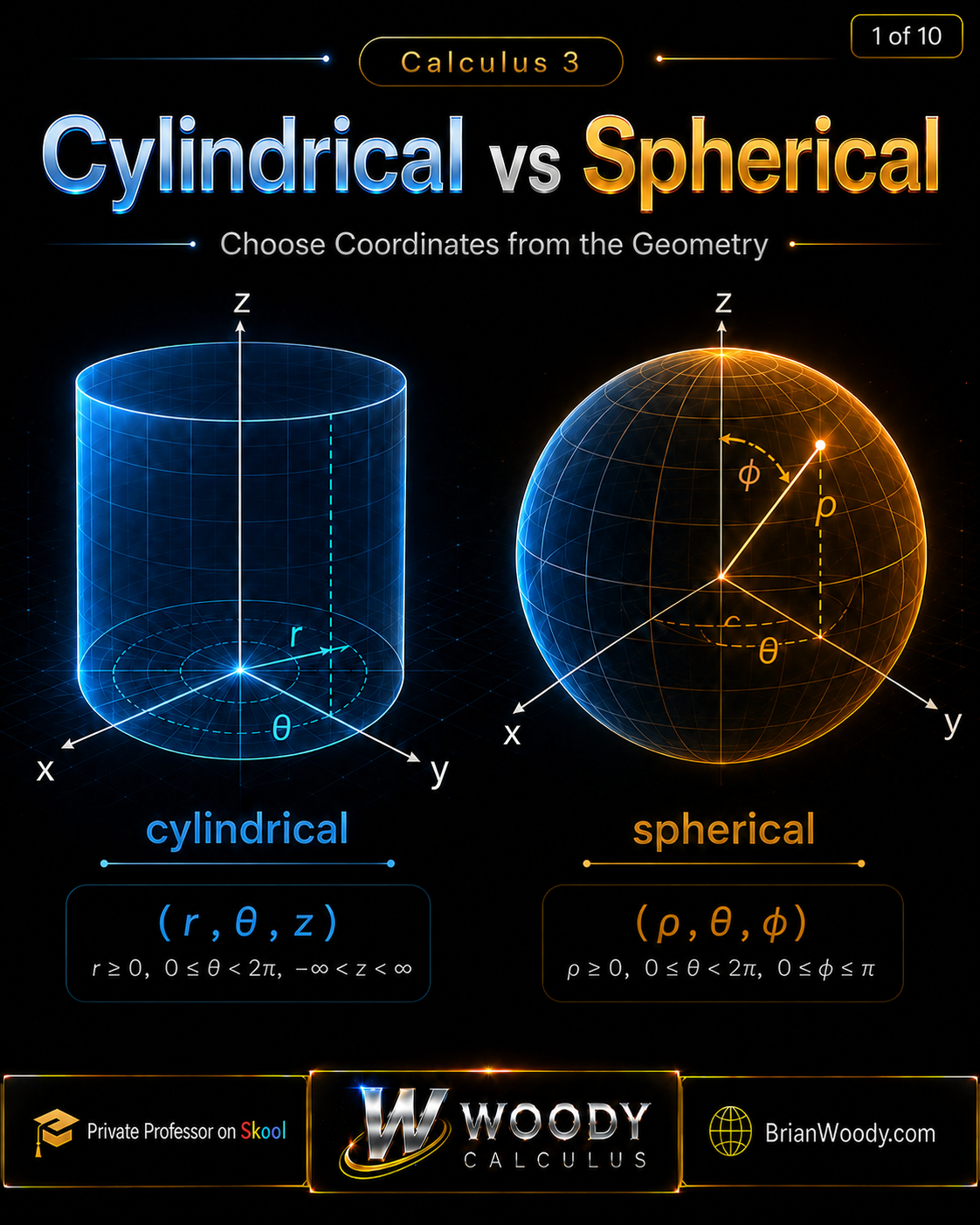
Master cylindrical and spherical coordinates through visual geometry, conversion formulas, Jacobians, bounds, and worked triple integrals. This Calculus 3 lesson compares both systems, solves an upper hemisphere in two ways, and shows how symmetry determines the best coordinates.
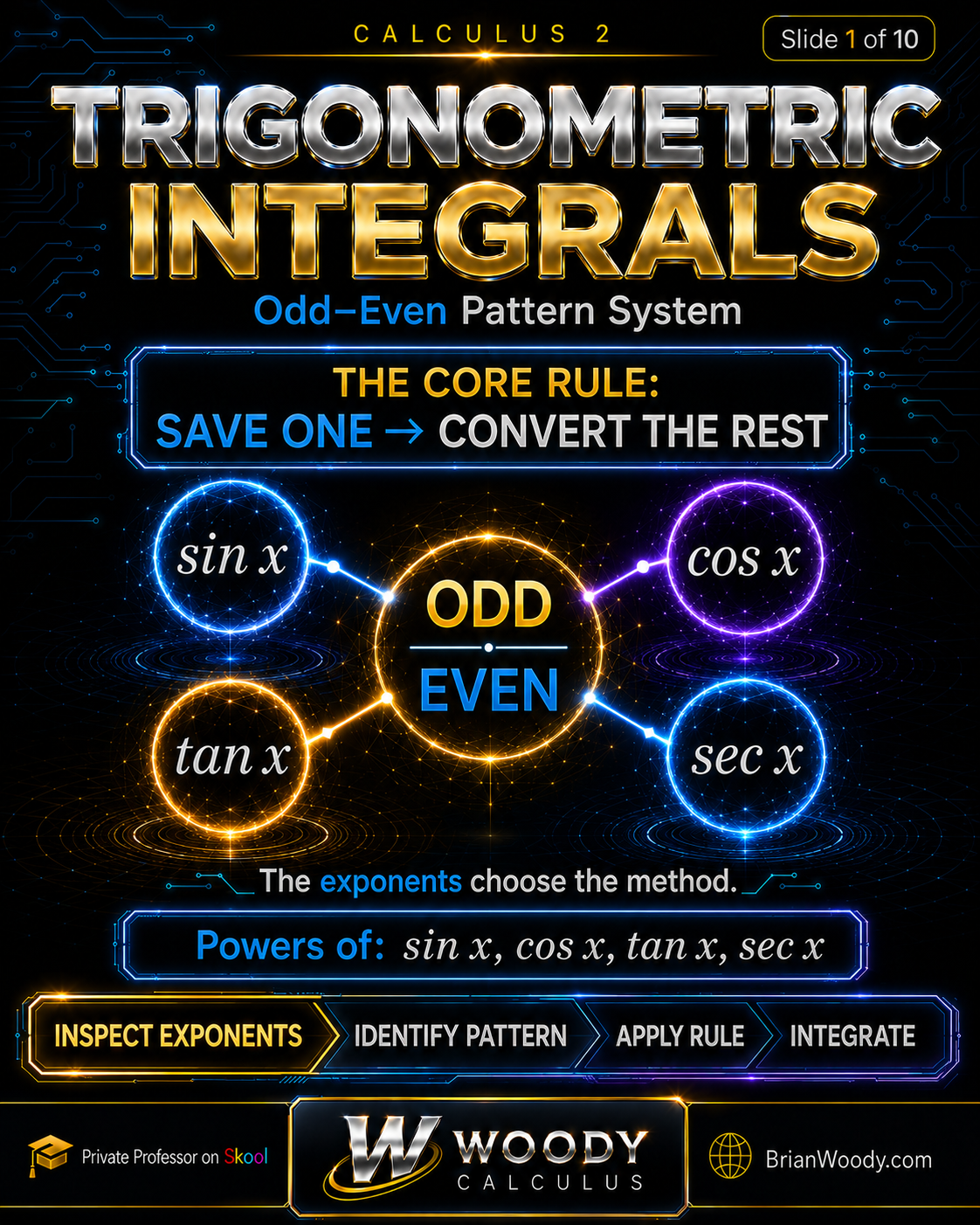
Learn trigonometric integrals through the Woody Calculus odd-even pattern system. This complete Calculus 2 lesson explains when to save one sine, cosine, secant-squared, or secant-tangent factor; when to use power reduction; how cosecant and cotangent mirror the pattern; and how to verify every answer by differentiation.
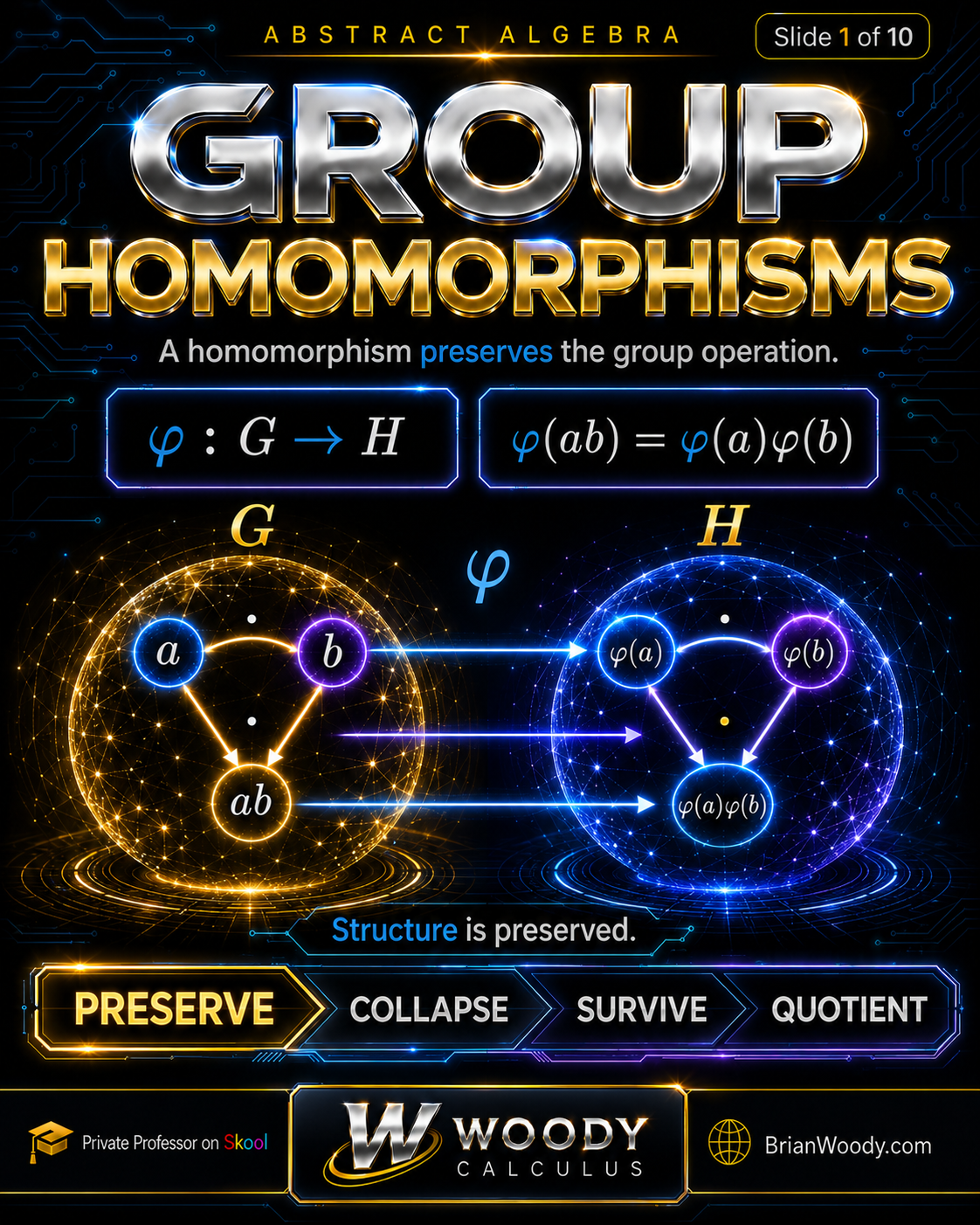
Learn group homomorphisms through visual intuition, exact definitions, complete proofs, and a detailed map from the integers to Z₄. This Woody Calculus lesson explains operation preservation, kernels, images, fibers, quotient groups, injectivity, surjectivity, and the First Isomorphism Theorem.

![Real Analysis compactness overview showing the closed interval [0,1] and three consequences: convergent subsequences, maxima and minima for continuous functions, and uniform continuity.](https://k3p6r8v3.delivery.rocketcdn.me/wp-content/uploads/2026/08/Compactness-Slide-1.png)