Learn how to recognize and solve exact differential equations using the exactness test M_y = N_x, recover a potential function F(x,y), apply initial conditions, verify implicit solutions, and use special integrating factors when an equation is not exact. This rigorous visual lesson also explains domain restrictions, conservative vector fields, line integrals, and the punctured-domain caveat.
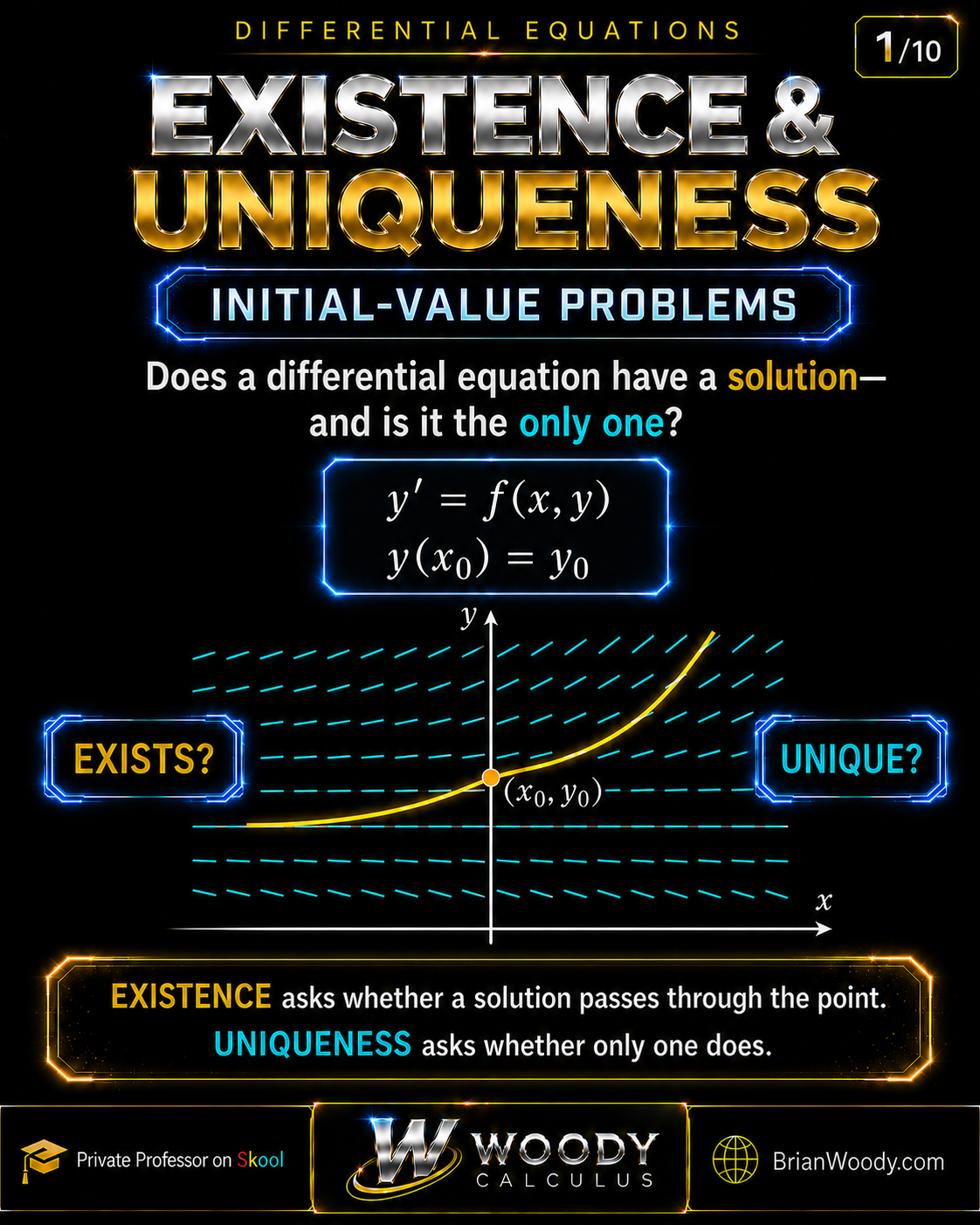
Does an initial-value problem have a solution, and is that solution the only one? This complete Woody Calculus lesson explains the existence and uniqueness theorem, the rectangle test, worked examples, nonunique solutions, finite-time blow-up, maximal intervals, the nonintersection principle, and higher-order linear ODEs.
Polynomial irreducibility is never just about the polynomial—it depends on the coefficient ring or field. Learn a complete Abstract Algebra decision system using root tests, the Rational Root Theorem, Gauss’s Lemma, Eisenstein’s Criterion, reduction modulo p, finite-field factor tests, quotient rings, and field extensions.
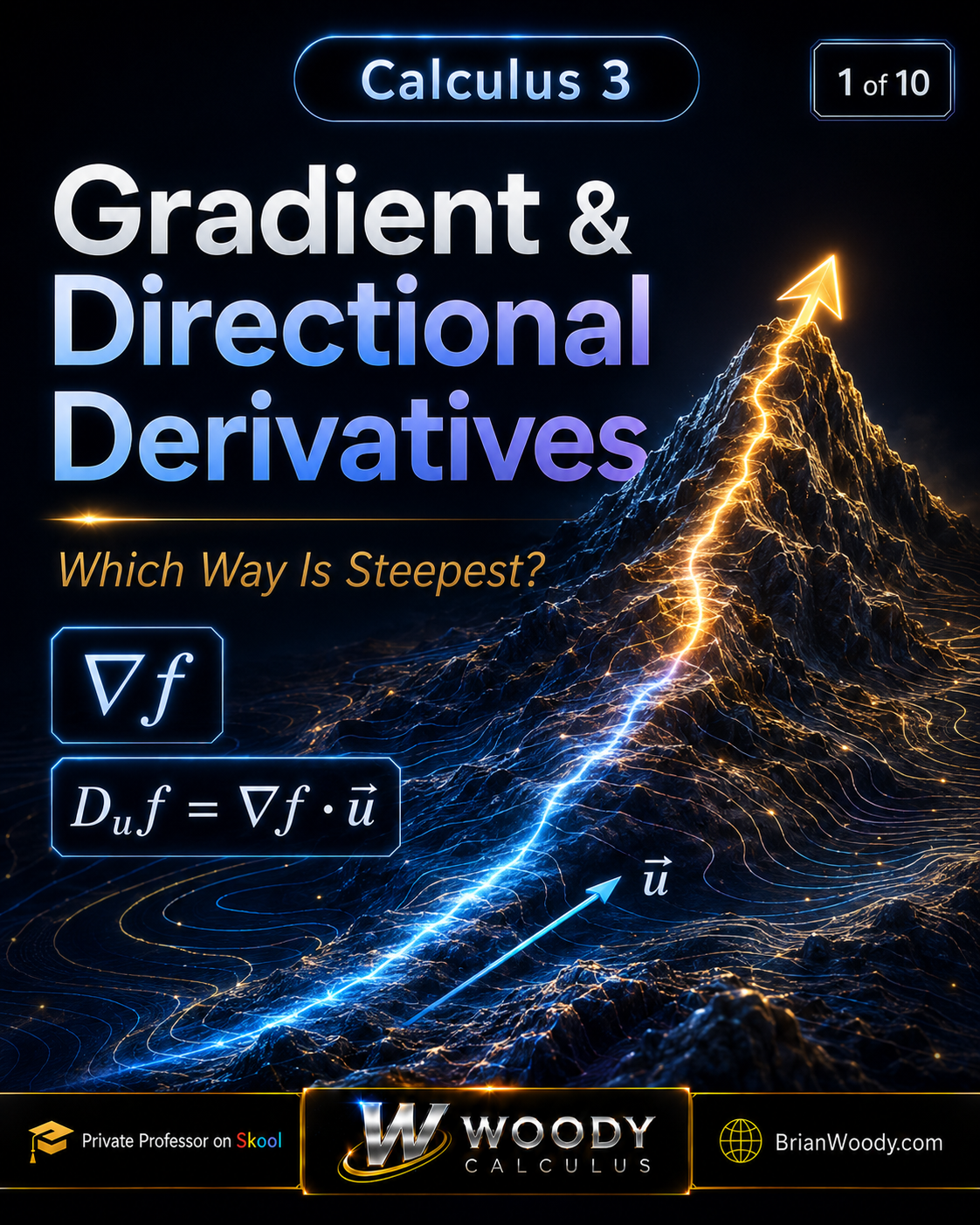
Which direction makes a multivariable function increase fastest? Learn how the gradient packages partial derivatives, how to calculate directional derivatives with unit vectors and dot products, and why gradients cross level curves at right angles.
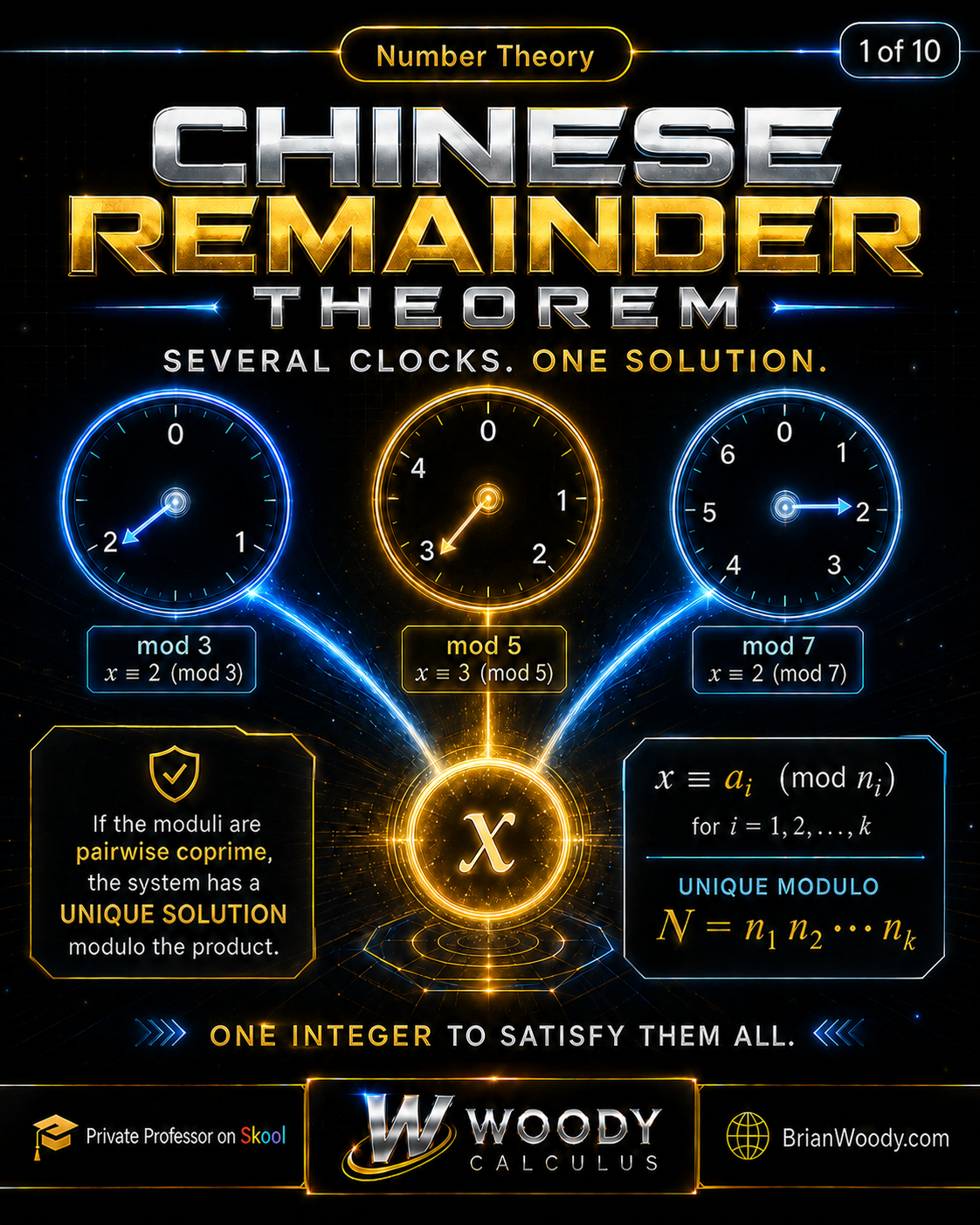
The Chinese Remainder Theorem combines simultaneous congruences into one residue class. Learn the modular-inverse algorithm, two complete examples, proof, verification, noncoprime cases, common mistakes, and exam-ready method selection.