Trigonometric integrals involving powers of sine, cosine,
tangent, secant, cotangent, or cosecant become systematic when you inspect
the exponents before choosing an identity. The Woody Calculus
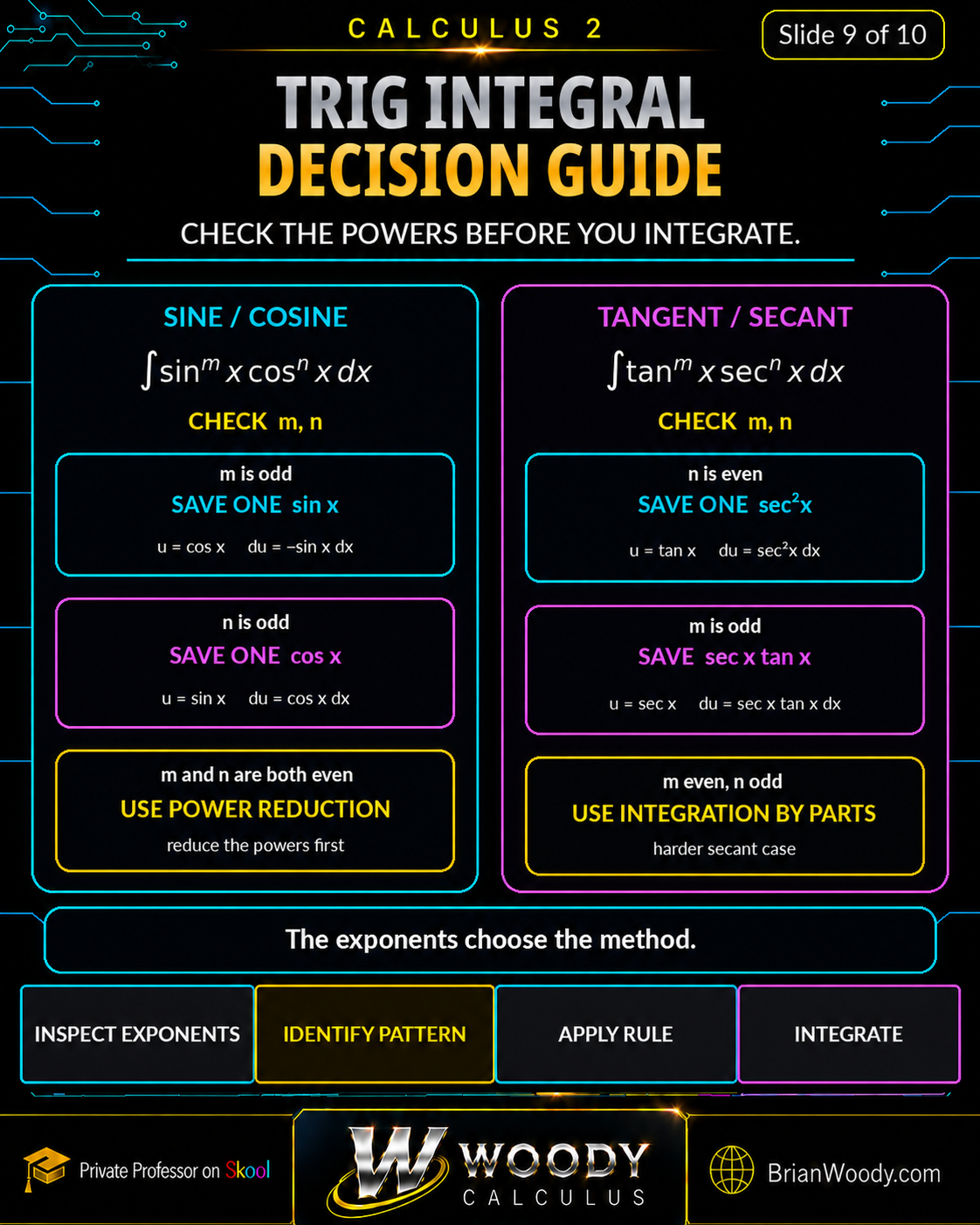
Odd–Even Pattern System is: check the powers, save the
factor that supplies the differential, convert the remaining even powers
with a Pythagorean identity, and integrate by substitution. For
sine–cosine products, an odd sine power means save one \(\sin x\), an
odd cosine power means save one \(\cos x\), and two even powers require
power reduction. For tangent–secant products, an even secant power means
save one \(\sec^2x\), while an odd tangent power with a secant factor
means save one \(\sec x\tan x\).
Plain-language answer:
do not begin by throwing identities at the integral. The exponents choose
the method: save one, convert the rest, then substitute.
What should you know before learning trigonometric integrals?
You should know basic antiderivatives, u-substitution, Pythagorean
identities, power-reduction identities, and the derivatives of all six
trigonometric functions.
- How to identify an inside function and its differential
- How to factor one trigonometric factor away from a power
- How to use \(\sin^2x+\cos^2x=1\)
- How to use \(1+\tan^2x=\sec^2x\)
- How to use \(1+\cot^2x=\csc^2x\)
- Why every indefinite integral must include \(+C\)
This lesson belongs to the larger
Woody Calculus Integration Techniques system
, where method selection comes before calculation.
Quick Summary: Trigonometric Integrals
Inspect the exponents first. Save a factor that matches a derivative,
convert the remaining even powers with an identity, and then use
u-substitution.
- Sine odd: save one \(\sin x\), then use \(u=\cos x\).
- Cosine odd: save one \(\cos x\), then use \(u=\sin x\).
- Both even: use power-reduction identities.
- Secant power even: save one \(\sec^2x\), then use \(u=\tan x\).
- Tangent power odd: save one \(\sec x\tan x\), then use \(u=\sec x\).
- Cosecant–cotangent: mirror the secant–tangent rules and protect the minus signs.
Key Facts
- Core rule: Save One → Convert the Rest.
- Decision signal: parity of the exponents.
- Why saving works: the saved factor becomes \(du\).
- Both odd: either sine or cosine may be saved; choose the cleaner polynomial.
- Hard secant case: even tangent power with odd secant power eventually requires secant reduction or integration by parts.
- Verification: differentiate the final antiderivative whenever practical.
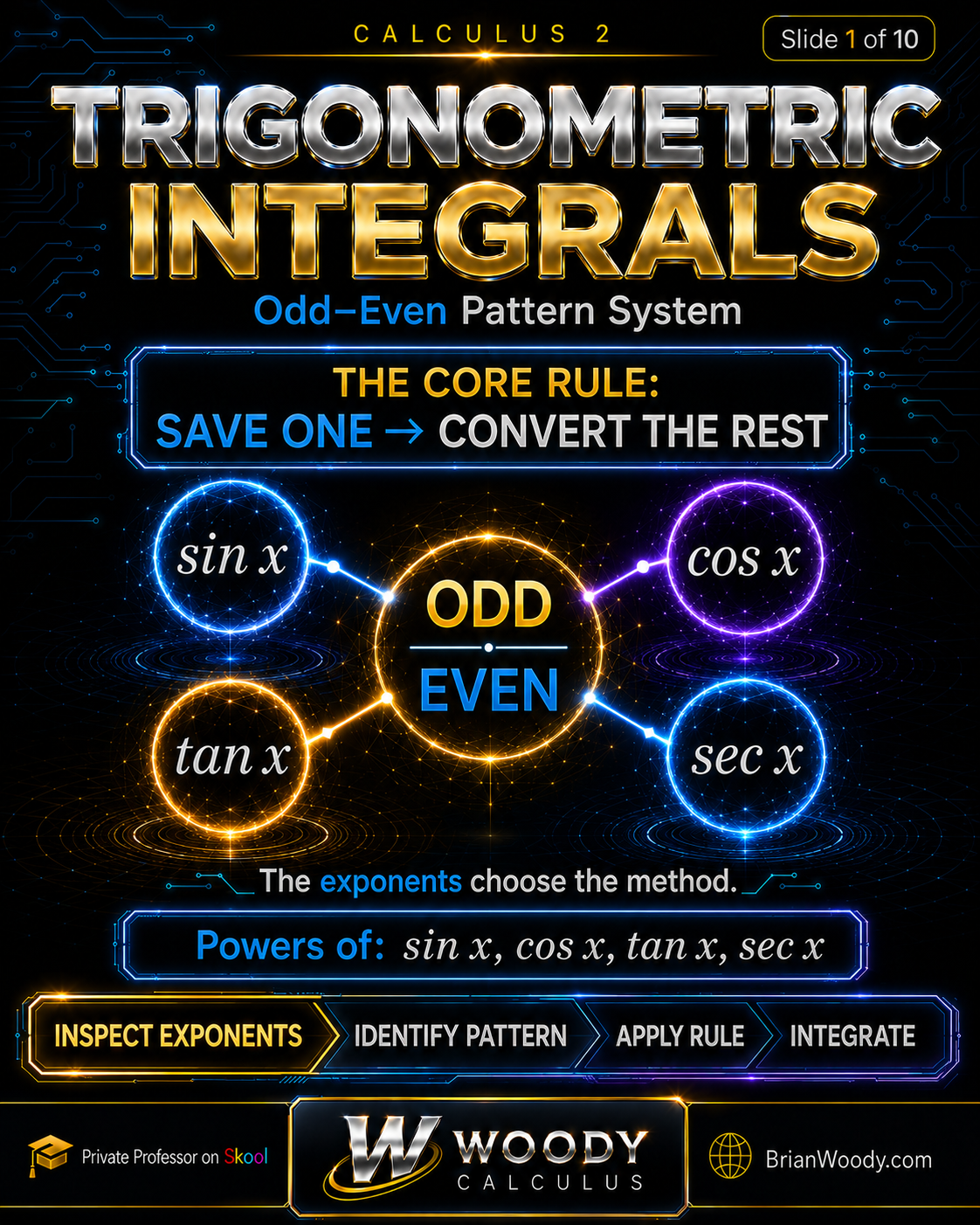
the exponents before choosing an identity.
What are trigonometric integrals?
Trigonometric integrals are integrals containing products or powers of
trigonometric functions that must be rewritten with identities before
basic substitution becomes available.
Two central families are
\[
\int \sin^m x\cos^n x\,dx
\]
and
\[
\int \tan^m x\sec^n x\,dx.
\]
The integral is not classified only by which functions appear. The
parity of \(m\) and \(n\)—whether each exponent is odd or even—determines
which factor should be saved and which identity should be used.
Plain-language answer:
the identities are not random tricks. They are tools for manufacturing
the derivative needed for substitution.
Which identities and derivative pairs control trigonometric integrals?
The method is built from three Pythagorean identities, two power-reduction
identities, and the derivative pairs that determine the substitution.
| Identity | Best use |
|---|---|
| \(\sin^2x+\cos^2x=1\) | Convert even powers of sine into cosine or even powers of cosine into sine. |
| \(1+\tan^2x=\sec^2x\) | Convert between tangent and secant powers. |
| \(1+\cot^2x=\csc^2x\) | Convert between cotangent and cosecant powers. |
| \(\sin^2x=\frac{1-\cos2x}{2}\) | Reduce an even sine power. |
| \(\cos^2x=\frac{1+\cos2x}{2}\) | Reduce an even cosine power. |
| Substitution | Differential | Factor to preserve |
|---|---|---|
| \(u=\cos x\) | \(du=-\sin x\,dx\) | Save one \(\sin x\). |
| \(u=\sin x\) | \(du=\cos x\,dx\) | Save one \(\cos x\). |
| \(u=\tan x\) | \(du=\sec^2x\,dx\) | Save one \(\sec^2x\). |
| \(u=\sec x\) | \(du=\sec x\tan x\,dx\) | Save one \(\sec x\tan x\). |
| \(u=\cot x\) | \(du=-\csc^2x\,dx\) | Save one \(\csc^2x\). |
| \(u=\csc x\) | \(du=-\csc x\cot x\,dx\) | Save one \(\csc x\cot x\). |
How do the exponents choose the trigonometric-integral method?
Inspect the exponents before selecting an identity: odd powers create a
derivative factor to save, while two even powers require power reduction.
| Pattern in \(\int\sin^m x\cos^n x\,dx\) | Save | Convert | Substitute |
|---|---|---|---|
| \(m\) odd | One \(\sin x\) | Remaining \(\sin^2x\) factors using \(1-\cos^2x\) | \(u=\cos x\) |
| \(n\) odd | One \(\cos x\) | Remaining \(\cos^2x\) factors using \(1-\sin^2x\) | \(u=\sin x\) |
| \(m,n\) both even | Nothing | Use power reduction | Integrate the reduced expression |
| \(m,n\) both odd | Either one sine or one cosine | Convert the remaining even power | Choose the cleaner polynomial |
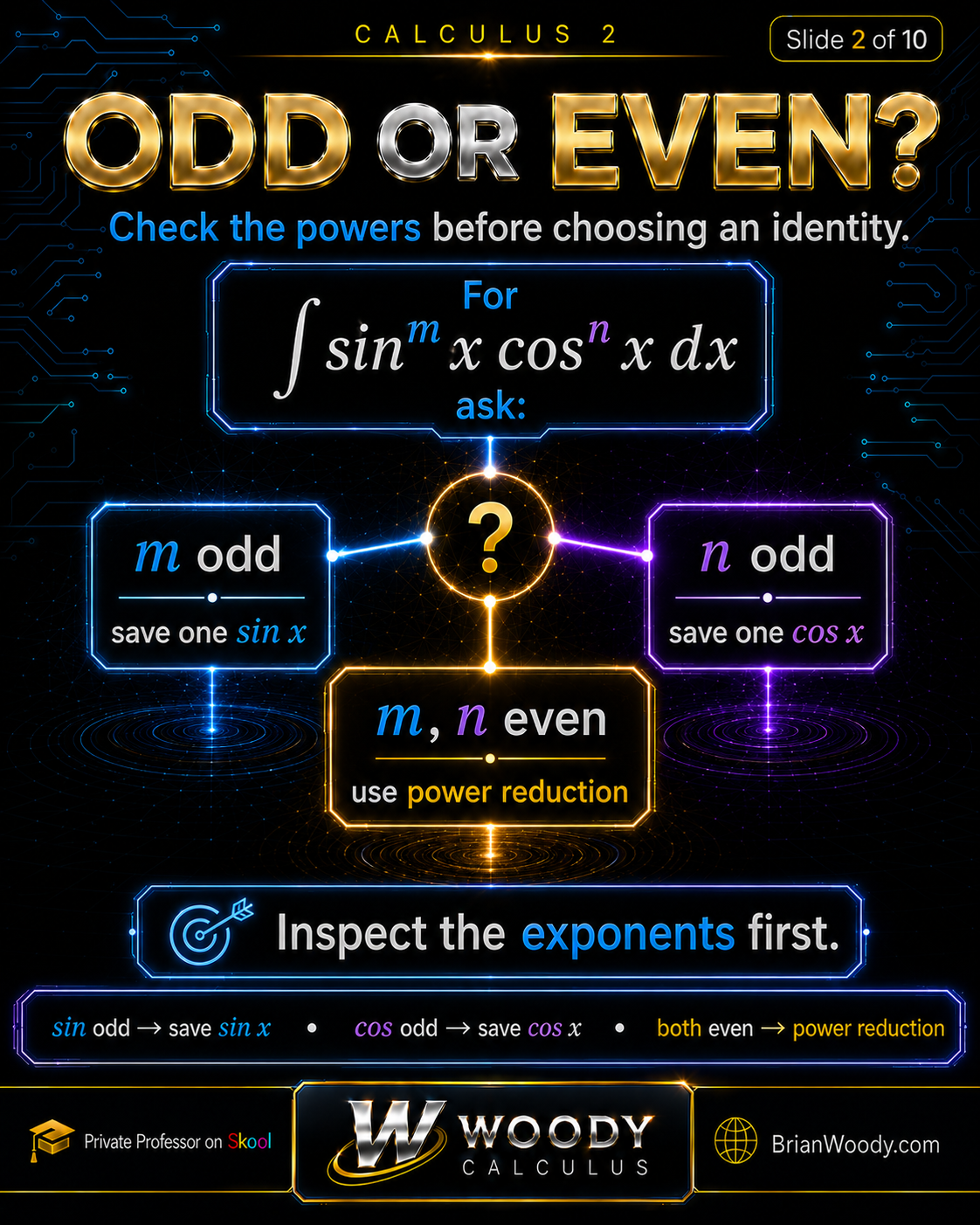
to a different first move.
What do you do when the sine power is odd?
Save one sine factor, convert every remaining pair of sines with
\(\sin^2x=1-\cos^2x\), and let \(u=\cos x\).
Worked Example: \(\int\sin^5x\cos^2x\,dx\)
\[
\int\sin^5x\cos^2x\,dx
=\int(\sin^2x)^2\sin x\cos^2x\,dx.
\]
\[
=\int(1-\cos^2x)^2\sin x\cos^2x\,dx.
\]
Let \(u=\cos x\), so \(du=-\sin x\,dx\). Then
\[
-\int(1-u^2)^2u^2\,du
=-\int(u^2-2u^4+u^6)\,du.
\]
\[
\boxed{
\int\sin^5x\cos^2x\,dx
=-\frac{\cos^3x}{3}
+\frac{2\cos^5x}{5}
-\frac{\cos^7x}{7}
+C
}.
\]
Plain-language answer:
the single saved \(\sin x\) supplies the differential, while the other
four sine factors become a polynomial in \(\cos x\).
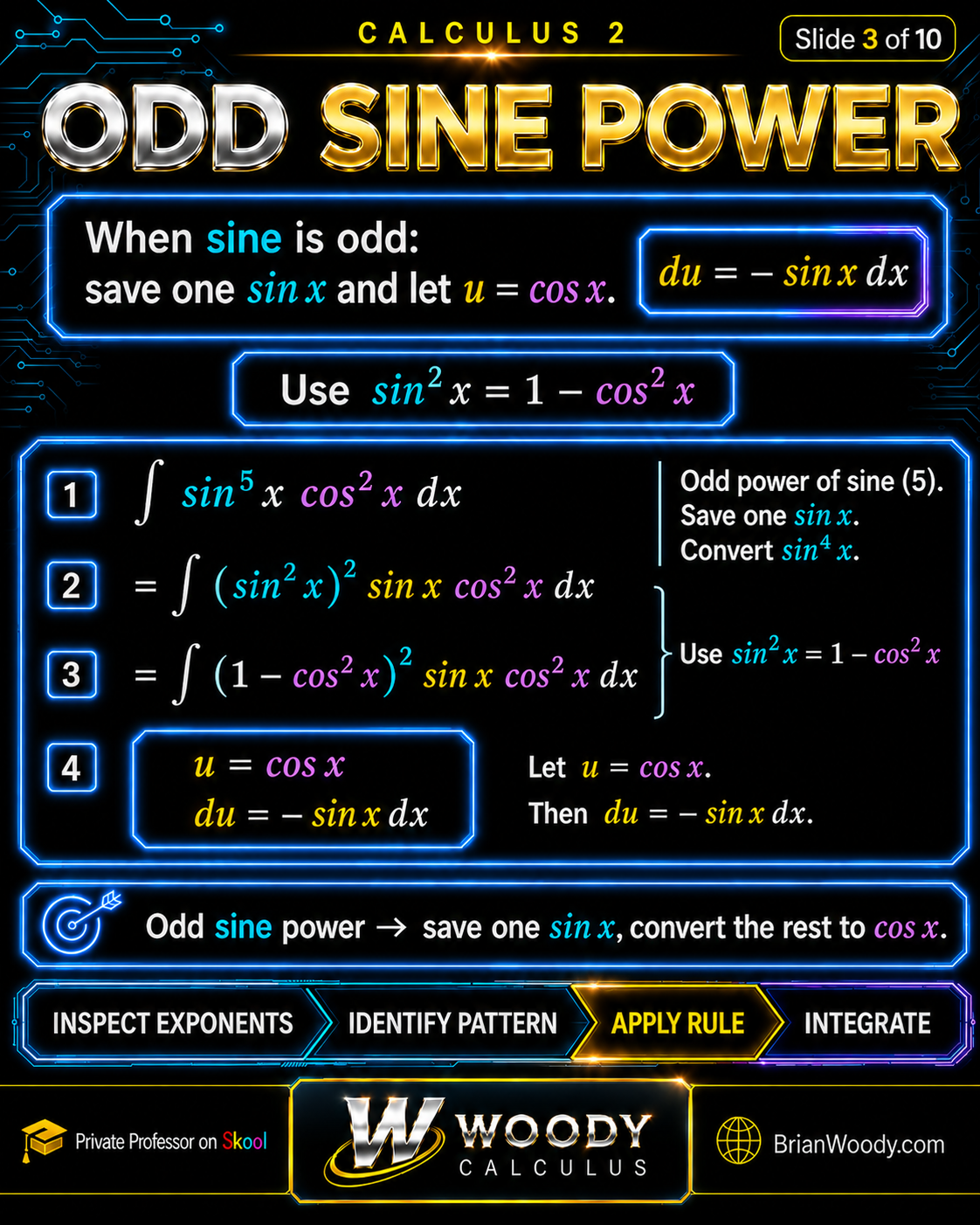
use \(u=\cos x\).
What do you do when the cosine power is odd?
Save one cosine factor, convert every remaining pair of cosines with
\(\cos^2x=1-\sin^2x\), and let \(u=\sin x\).
Worked Example: \(\int\sin^2x\cos^3x\,dx\)
\[
\int\sin^2x\cos^3x\,dx
=\int\sin^2x(\cos^2x)\cos x\,dx.
\]
\[
=\int\sin^2x(1-\sin^2x)\cos x\,dx.
\]
Let \(u=\sin x\), so \(du=\cos x\,dx\). Then
\[
\int u^2(1-u^2)\,du
=\int(u^2-u^4)\,du.
\]
\[
\boxed{
\int\sin^2x\cos^3x\,dx
=\frac{\sin^3x}{3}-\frac{\sin^5x}{5}+C
}.
\]
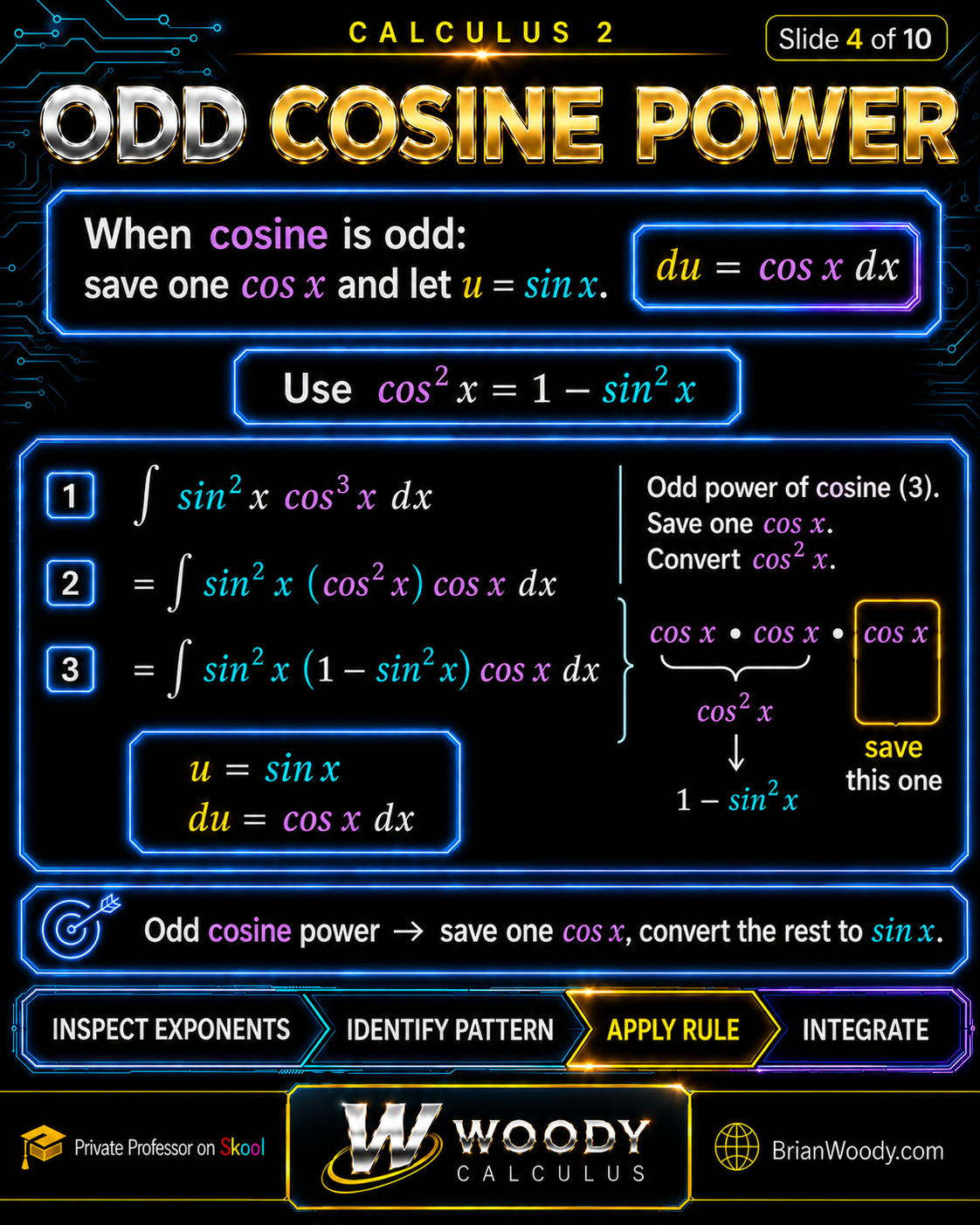
and use \(u=\sin x\).
What if both sine and cosine powers are odd?
If both exponents are odd, either odd-power rule works; save one sine
or one cosine and choose the substitution that produces the simpler
polynomial.
For example, in
\[
\int\sin^3x\cos^5x\,dx,
\]
you may save one sine and convert \(\sin^2x\), or save one cosine and
convert \(\cos^4x=(\cos^2x)^2\). Both routes are valid. A good exam
decision is to choose the route with the lower-degree polynomial after
substitution.
What do you do when both sine and cosine powers are even?
When both exponents are even, no single sine or cosine factor is
available for u-substitution, so reduce the powers with double-angle
identities.
Worked Example: \(\int\sin^2x\cos^2x\,dx\)
\[
\sin^2x\cos^2x
=\left(\frac{1-\cos2x}{2}\right)
\left(\frac{1+\cos2x}{2}\right)
=\frac14(1-\cos^22x).
\]
The slide correctly reaches this reduced form. To finish, reduce the
remaining square once more:
\[
\cos^22x=\frac{1+\cos4x}{2}.
\]
\[
\sin^2x\cos^2x
=\frac18(1-\cos4x).
\]
\[
\boxed{
\int\sin^2x\cos^2x\,dx
=\frac{x}{8}-\frac{\sin4x}{32}+C
}.
\]
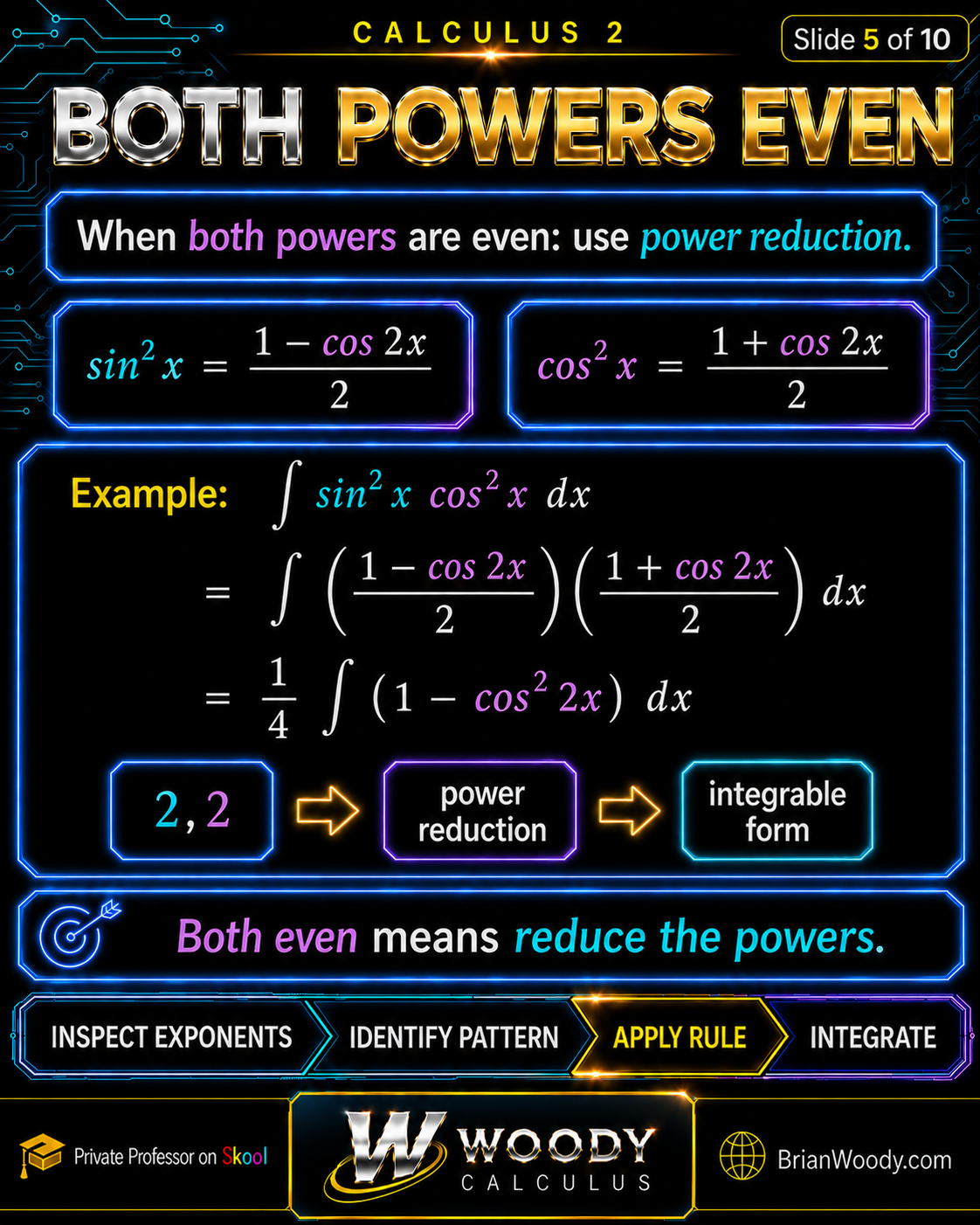
integrand becomes a basic trigonometric expression.
How do you integrate \(\sin^2x\) and \(\cos^2x\)?
Use the power-reduction identities once, then integrate the constant
term and the double-angle cosine term separately.
\sin^2x=\frac{1-\cos2x}{2}
\quad\Longrightarrow\quad
\boxed{
\int\sin^2x\,dx
=\frac{x}{2}-\frac{\sin2x}{4}+C
}.
\]
\cos^2x=\frac{1+\cos2x}{2}
\quad\Longrightarrow\quad
\boxed{
\int\cos^2x\,dx
=\frac{x}{2}+\frac{\sin2x}{4}+C
}.
\]
Plain-language answer:
a single square of sine or cosine is already a both-even case, so power
reduction is the correct first move.
How do tangent and secant powers determine the method?
For \(\int\tan^m x\sec^n x\,dx\), an even secant power supplies
\(\sec^2x\,dx\), while an odd tangent power paired with secant supplies
\(\sec x\tan x\,dx\).
| Pattern | Save | Convert | Substitute |
|---|---|---|---|
| Secant exponent even | One \(\sec^2x\) | Remaining secant pairs using \(\sec^2x=1+\tan^2x\) | \(u=\tan x\) |
| Tangent exponent odd and a secant factor is present | One \(\sec x\tan x\) | Remaining tangent pairs using \(\tan^2x=\sec^2x-1\) | \(u=\sec x\) |
| Tangent exponent even, secant exponent odd | No immediate substitution pair | Convert tangent pairs to secant powers | Use secant reduction or integration by parts |
What do you do when the secant power is even?
Save one \(\sec^2x\), convert every remaining secant pair with
\(\sec^2x=1+\tan^2x\), and let \(u=\tan x\).
Worked Example: \(\int\tan^3x\sec^4x\,dx\)
\[
\int\tan^3x\sec^4x\,dx
=\int\tan^3x(\sec^2x)\sec^2x\,dx.
\]
\[
=\int\tan^3x(1+\tan^2x)\sec^2x\,dx.
\]
Let \(u=\tan x\), so \(du=\sec^2x\,dx\). Then
\[
\int u^3(1+u^2)\,du
=\frac{u^4}{4}+\frac{u^6}{6}+C.
\]
\[
\boxed{
\int\tan^3x\sec^4x\,dx
=\frac{\tan^4x}{4}+\frac{\tan^6x}{6}+C
}.
\]
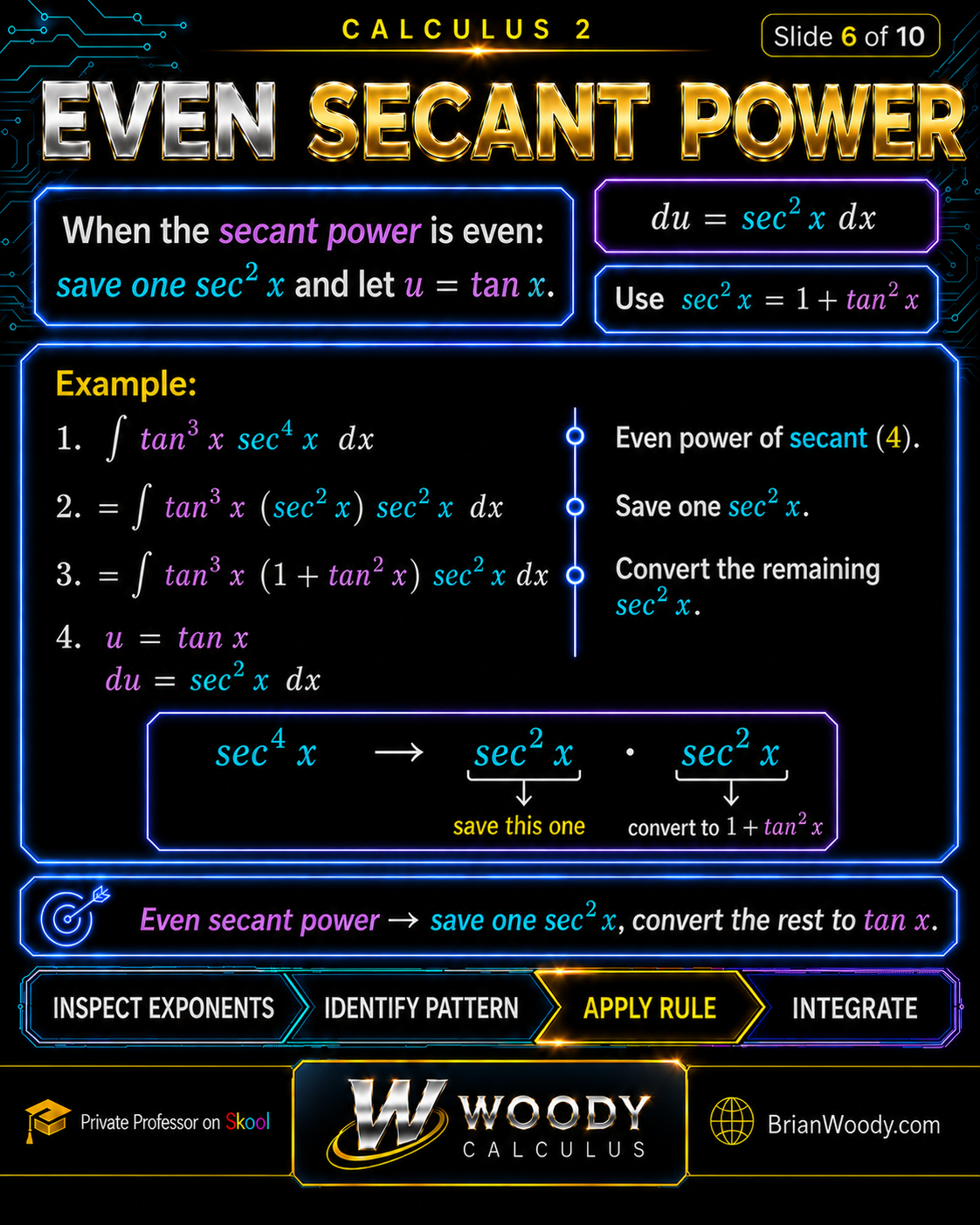
and use \(u=\tan x\).
What do you do when the tangent power is odd?
When an odd tangent power is accompanied by a secant factor, save one
\(\sec x\tan x\), convert the remaining tangent pairs with
\(\tan^2x=\sec^2x-1\), and let \(u=\sec x\).
Worked Example: \(\int\tan^3x\sec x\,dx\)
\[
\int\tan^3x\sec x\,dx
=\int\tan^2x(\sec x\tan x)\,dx.
\]
\[
=\int(\sec^2x-1)(\sec x\tan x)\,dx.
\]
Let \(u=\sec x\), so \(du=\sec x\tan x\,dx\). Then
\[
\int(u^2-1)\,du
=\frac{u^3}{3}-u+C.
\]
\[
\boxed{
\int\tan^3x\sec x\,dx
=\frac{\sec^3x}{3}-\sec x+C
}.
\]
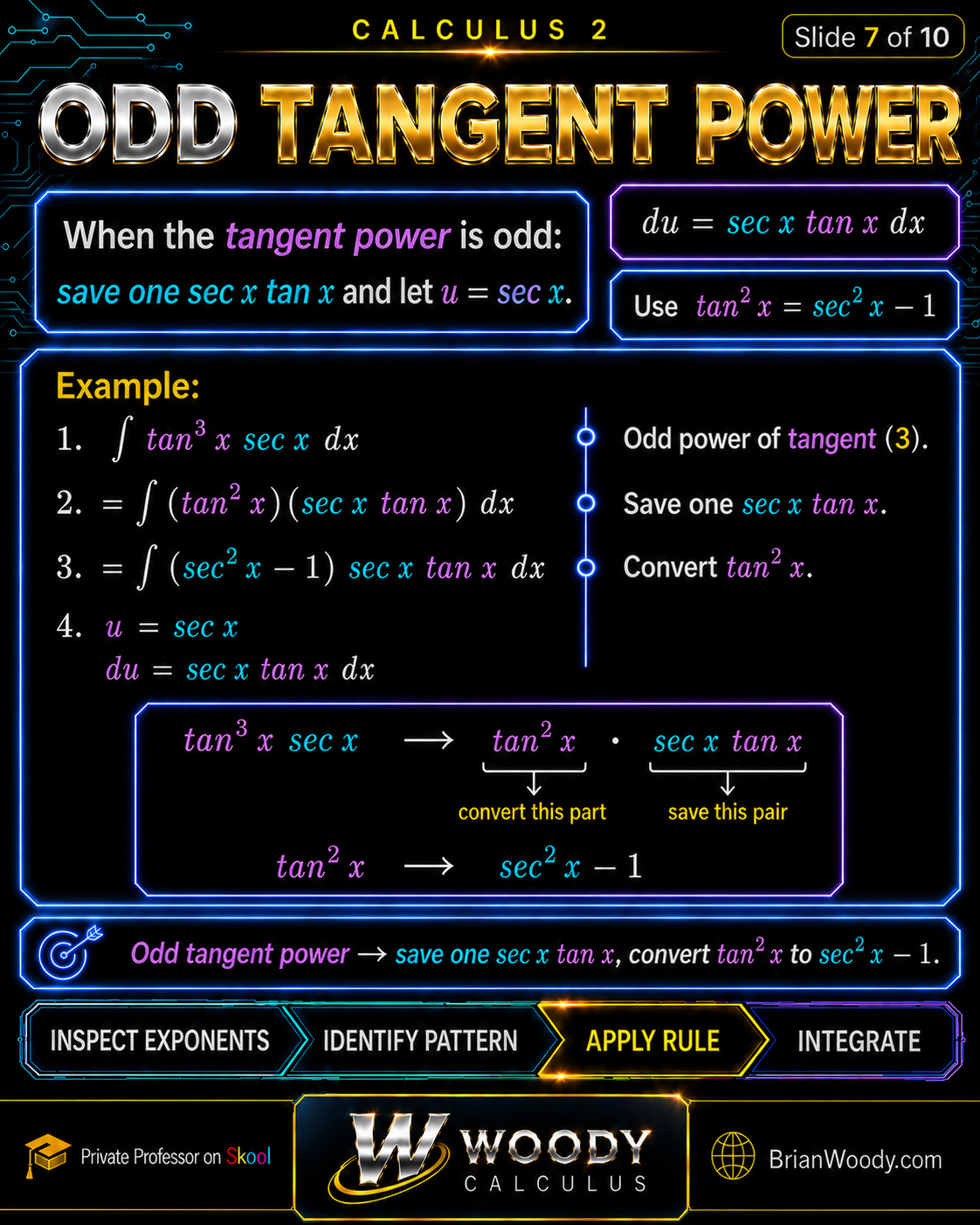
remaining tangent square, and use \(u=\sec x\).
What is the harder odd-secant case?
When the tangent exponent is even and the secant exponent is odd,
convert tangent pairs into secant powers and then use a secant
reduction formula or integration by parts.
The base odd-secant integral is
\[
\boxed{
\int\sec^3x\,dx
=\frac12\sec x\tan x
+\frac12\ln|\sec x+\tan x|+C
}.
\]
For higher odd powers, use the reduction formula
\[
\boxed{
\int\sec^n x\,dx
=\frac{\sec^{n-2}x\tan x}{n-1}
+\frac{n-2}{n-1}\int\sec^{n-2}x\,dx,
\qquad n>1
}.
\]
Why Slide 9 calls this the integration-by-parts case
If \(m\) is even and \(n\) is odd in
\(\int\tan^m x\sec^n x\,dx\), first rewrite the tangent pairs with
\(\tan^2x=\sec^2x-1\). The result is a combination of odd secant
powers, and the reduction formula above is derived by integration by
parts. The slide’s rule is correct shorthand; this section supplies
the full mechanism.
How do cosecant and cotangent follow the same pattern?
Cosecant–cotangent integrals mirror secant–tangent integrals, but the
derivatives of cotangent and cosecant introduce minus signs that must
be preserved.
Worked Example: \(\int\cot^3x\csc^4x\,dx\)
\[
\int\cot^3x\csc^4x\,dx
=\int\cot^3x(\csc^2x)\csc^2x\,dx.
\]
\[
=\int\cot^3x(1+\cot^2x)\csc^2x\,dx.
\]
Let \(u=\cot x\), so \(du=-\csc^2x\,dx\). Then
\[
-\int u^3(1+u^2)\,du
=-\frac{u^4}{4}-\frac{u^6}{6}+C.
\]
\[
\boxed{
\int\cot^3x\csc^4x\,dx
=-\frac{\cot^4x}{4}-\frac{\cot^6x}{6}+C
}.
\]
Minus-sign protection
Both \(\frac{d}{dx}(\cot x)=-\csc^2x\) and
\(\frac{d}{dx}(\csc x)=-\csc x\cot x\) carry a minus sign. Write
the differential before replacing the saved factor.
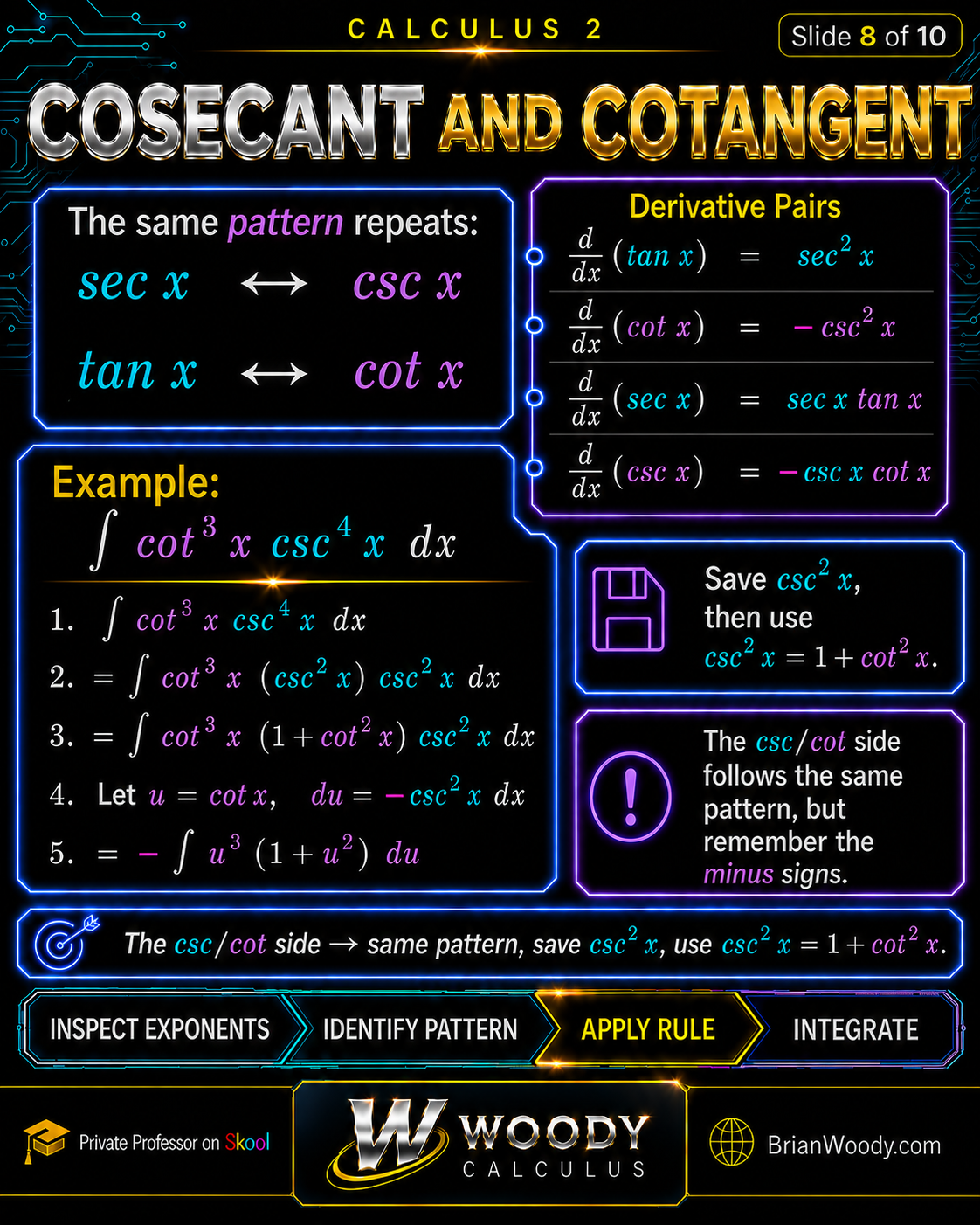
secant–tangent, with extra attention to negative differentials.
What is the difference between trigonometric integrals and trigonometric substitution?
Trigonometric integrals begin with powers or products of trig functions
and rewrite them with identities; trigonometric substitution begins
with an algebraic radical and introduces a trig function to remove it.
The difference between trigonometric integrals and trigonometric
substitution is the starting form and the purpose of the trig identity.
-
In a trigonometric integral, the trig functions are already present,
and identities expose a substitution or lower the powers. -
In trigonometric substitution, the original integral is algebraic,
and a new trig variable is introduced to simplify a radical. -
Trig integrals are classified by exponent parity; trig substitution is
classified by the radical form.
| Feature | Trigonometric integrals | Trigonometric substitution |
|---|---|---|
| Starting form | Powers or products of trig functions | Algebraic radicals such as \(\sqrt{a^2-x^2}\) |
| Main decision | Inspect odd and even exponents | Match the radical to sine, tangent, or secant substitution |
| Main tool | Identities plus u-substitution | A trig substitution plus a reference triangle or identity |
| Typical result | Polynomial in a new trig variable | A radical-free trig integral |
Study the separate
Woody Calculus trigonometric-substitution system
when the original problem contains one of the three standard radical
forms.
What is the complete trigonometric-integral decision guide?
Check the powers first, identify the derivative pair you can preserve,
convert every remaining factor into the substitution variable, and
only then integrate.
- If the sine exponent is odd, then save one sine factor.
- If the cosine exponent is odd, then save one cosine factor.
- If both sine and cosine exponents are even, then use power reduction.
- If the secant exponent is even, then save one secant-squared factor.
-
If the tangent exponent is even and the secant exponent is odd, then
convert tangent pairs to secant powers and use secant reduction.
| Integral family | Pattern | First move |
|---|---|---|
| \(\sin^m x\cos^n x\) | \(m\) odd | Save one sine; convert the remaining sine pairs. |
| \(\sin^m x\cos^n x\) | \(n\) odd | Save one cosine; convert the remaining cosine pairs. |
| \(\sin^m x\cos^n x\) | Both even | Use power reduction, possibly more than once. |
| \(\tan^m x\sec^n x\) | \(n\) even | Save one secant squared; convert the remaining secant pairs. |
| \(\tan^m x\sec^n x\) | \(m\) odd with a secant factor | Save secant tangent; convert the remaining tangent pairs. |
| \(\tan^m x\sec^n x\) | \(m\) even, \(n\) odd | Convert tangent pairs to secant powers, then use reduction or integration by parts. |
| \(\cot^m x\csc^n x\) | Mirror case | Use the corresponding cosecant–cotangent derivative pair and preserve the minus sign. |
integrate.
How can you independently verify a trigonometric integral?
Differentiate the final antiderivative and simplify with the same
identities used in the original solution.
What mistakes do students make with trigonometric integrals?
Most errors come from choosing an identity before inspecting the
exponents, saving the wrong factor, losing a minus sign, or stopping
before every remaining factor is written in the substitution variable.
Mistake: Choosing an identity before checking parity
Symptom: The algebra becomes longer and no substitution appears.
Cause: An identity was selected from memory instead of from the exponent pattern.
Fix: Label every exponent as odd or even before rewriting anything.
Mistake: Converting the factor that should have been saved
Symptom: The proposed \(du\) is missing from the integral.
Cause: Every sine, cosine, secant, or tangent factor was converted.
Fix: Isolate the derivative factor first; convert only the remaining powers.
Mistake: Using power reduction when one exponent is odd
Symptom: A short u-substitution problem becomes a long multiple-angle calculation.
Cause: Power reduction was treated as the default identity.
Fix: If an odd power supplies a derivative pair, save one factor and substitute.
Mistake: Stopping the both-even example too early
Symptom: The integral still contains \(\cos^22x\) or \(\sin^22x\).
Cause: Power reduction was applied only once.
Fix: Continue reducing until every remaining power is directly integrable.
Mistake: Forgetting the negative differential
Symptom: The final answer differentiates to the negative of the integrand.
Cause: The minus sign in \(d(\cos x)\), \(d(\cot x)\), or \(d(\csc x)\) was dropped.
Fix: Write the full differential before replacing any factor.
Mistake: Applying the odd tangent rule without a secant factor
Symptom: The student tries to save \(\sec x\tan x\) when no secant factor exists.
Cause: The rule was memorized without its structural requirement.
Fix: Confirm that the derivative pair is actually present; otherwise rewrite the integral by another identity.
Mistake: Confusing trig integrals with trig substitution
Symptom: A student substitutes \(x=a\sin\theta\) into an integral that already consists of trig powers.
Cause: Two different Calculus 2 techniques were merged.
Fix: Use trig identities for powers of trig functions; use trig substitution for specific algebraic radical forms.
Mistake: Forgetting \(+C\)
Symptom: A correct antiderivative is incomplete.
Cause: The answer was treated as a definite integral.
Fix: Every indefinite integral ends with the constant of integration.
Woody Calculus rule
Inspect exponents first. Identify the derivative pair second. Apply the
identity third. Integrate last. Most trig-integral mistakes begin when
those four steps are performed out of order.
What is the Woody Calculus exam checklist for trigonometric integrals?
Check powers first. Save the derivative factor. Convert the remaining
powers. Substitute. Integrate. Verify.
- Classify the integral as sine–cosine, tangent–secant, or cotangent–cosecant.
- Write the exponents clearly and mark each odd or even.
- State the rule before changing the integrand.
- Save the factor that will become \(du\).
- Convert every remaining factor into the substitution variable.
- Write \(u\) and \(du\) explicitly, including any minus sign.
- Integrate the resulting polynomial or reduced trig expression.
- Back-substitute unless the problem is definite and the bounds were changed.
- Include \(+C\) for every indefinite integral.
- Differentiate the answer when practical.
- Rebuild each worked example from a blank page.
- Say the pattern aloud: “save one, convert the rest.”
Formula memorization is required, but the exponents choose the method.
Memorize the identities and derivative pairs, then let the parity pattern
determine which one belongs in the solution.
How do you master trigonometric integrals?
Mastery means recognizing the exponent pattern before doing algebra and
producing the correct derivative pair automatically.
The Save One → Convert the Rest System
- Check powers: identify odd and even exponents.
- Save one: preserve the factor that becomes \(du\).
- Convert the rest: rewrite every remaining factor in one trig variable.
- Integrate: finish the polynomial, reduced-angle, or reduction-formula integral.
- Verify: differentiate and recover the original integrand.
Reading the rules once is not enough. Rewrite the six worked examples,
mix the problem types, and train until the first move is immediate.
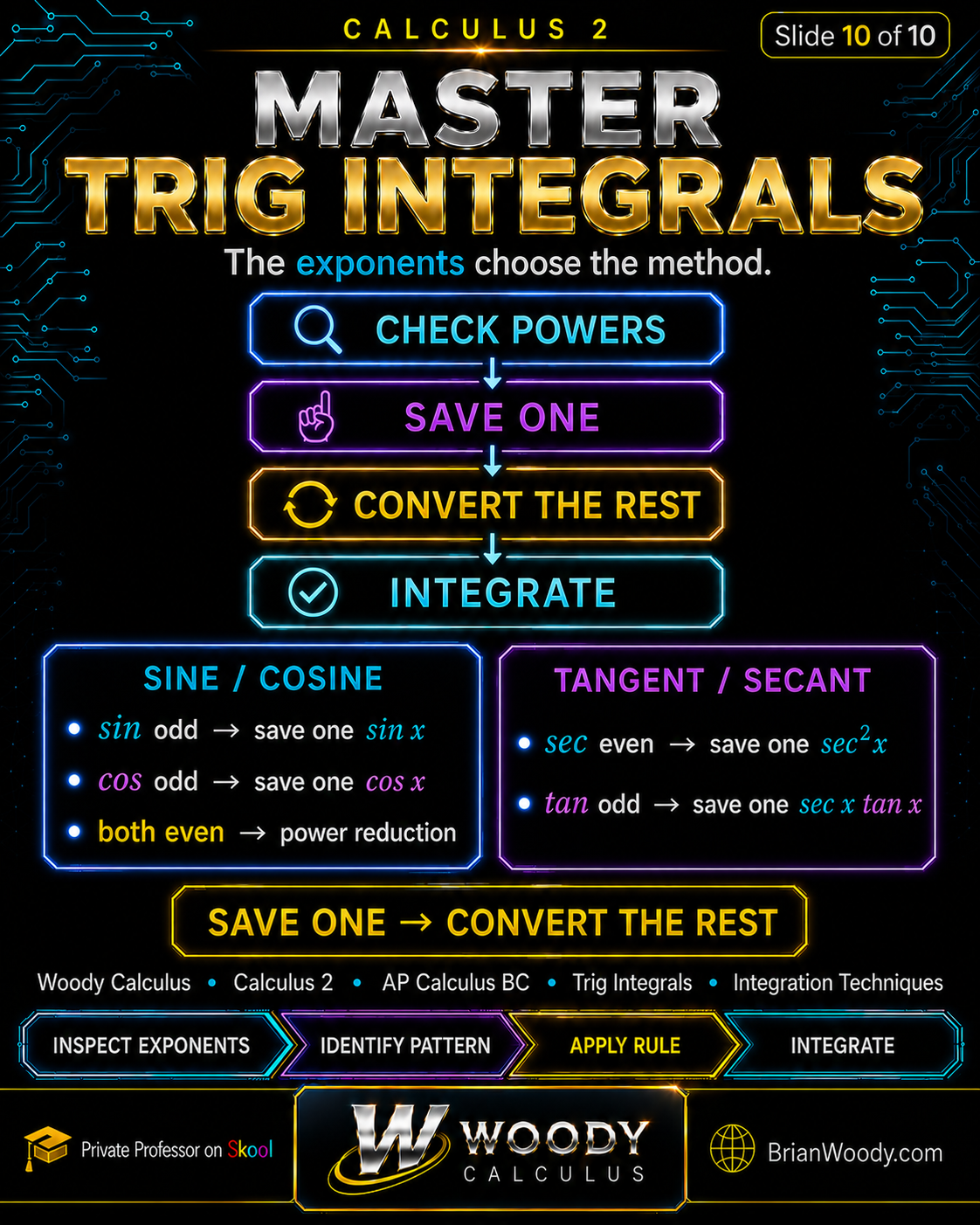
complete Woody Calculus trigonometric-integral workflow.
Frequently Asked Questions About Trigonometric Integrals
What is a trigonometric integral?
A trigonometric integral contains powers or products of trigonometric
functions that are rewritten with identities before substitution or
another integration technique is applied.
How do you integrate \(\sin^m x\cos^n x\)?
Inspect \(m\) and \(n\). If the sine power is odd, save one sine and
use \(u=\cos x\). If the cosine power is odd, save one cosine and use
\(u=\sin x\). If both powers are even, use power reduction.
Why do you save one sine or cosine factor?
The saved factor supplies the differential for u-substitution. Saving one
sine supports \(u=\cos x\), while saving one cosine supports
\(u=\sin x\).
What if both sine and cosine powers are odd?
Either odd-power rule works. Save one sine or one cosine and choose the
substitution that produces the simpler polynomial.
Why do both even powers require power reduction?
When both powers are even, no single sine or cosine factor is available
to serve as the differential. Power-reduction identities lower the powers
until the expression is directly integrable.
How do you integrate \(\tan^m x\sec^n x\)?
If the secant exponent is even, save one \(\sec^2x\) and use
\(u=\tan x\). If the tangent exponent is odd and a secant factor is
present, save \(\sec x\tan x\) and use \(u=\sec x\).
What happens when the tangent power is even and the secant power is odd?
Convert the even tangent powers with \(\tan^2x=\sec^2x-1\). The result
becomes a combination of odd secant powers, which are handled with a
secant reduction formula or integration by parts.
Do cosecant and cotangent use the same rules?
Yes. The structure mirrors secant and tangent, but the derivatives of
cotangent and cosecant are negative, so the minus signs must be preserved.
What is the difference between trigonometric integrals and trigonometric substitution?
Trigonometric integrals start with powers or products of trig functions
and use identities. Trigonometric substitution starts with an algebraic
radical and introduces a trig variable to remove the radical.
How do you integrate \(\sin^2x\)?
Use \(\sin^2x=(1-\cos2x)/2\). Then
\(\int\sin^2x\,dx=x/2-\sin2x/4+C\).
How do you integrate \(\cos^2x\)?
Use \(\cos^2x=(1+\cos2x)/2\). Then
\(\int\cos^2x\,dx=x/2+\sin2x/4+C\).
How do you integrate \(\sec^3x\)?
Use integration by parts to obtain
\(\int\sec^3x\,dx=\frac12\sec x\tan x+
\frac12\ln|\sec x+\tan x|+C\).
Can a trig integral require integration by parts?
Yes. Odd powers of secant or cosecant lead to reduction formulas derived
from integration by parts, and the base integral \(\int\sec^3x\,dx\)
is a standard example.
How do you check a trigonometric antiderivative?
Differentiate the final answer, simplify with the relevant trigonometric
identities, and confirm that the original integrand is recovered.
What is the best way to memorize the trig-integral rules?
Memorize the derivative pairs and repeat the phrase “save one, convert
the rest.” Then practice mixed problems so the parity pattern, not the
problem order, triggers the method.
Need help with Calculus 2 integration techniques?
The
Woody Calculus Mastery Lab
is the required starting point for students who want help with
trigonometric integrals, integration by parts, trig substitution, partial
fractions, improper integrals, applications, and exam preparation.
Limited
private instruction
may be available after Mastery Lab enrollment. It is selective, limited,
normally based on weekly sessions, and not guaranteed.
Visit the contact page
or explore the
Calculus 2 help page.
University Calculus 2 and integration help
Purdue integration-technique help
Train integration-technique recognition, clean setup, and exam-ready execution.
MAC 2312 help at the University of Florida
Get structured help with MAC 2312 integration techniques and series preparation.
UCF Calculus II integration support
Strengthen method selection for trig integrals, substitution, parts, and partial fractions.
UNR MATH 182 integration help
Prepare for MATH 182 with professor-led integration and exam strategy.
Auburn Calculus II technique support
Build a repeatable system for advanced integration problems and final-exam review.
University of Alabama Calculus II help
Practice Calculus 2 integration patterns with complete worked solutions.
Reviews and trust
Read
Woody Calculus 5-star Google reviews
and view
Brian M. Woody’s 5.0 RateMyProfessors rating
.
Woody Calculus provides university-level mathematical instruction,
structured practice, and long-term mastery—not generic tutoring and
not a shortcut answer service.