One number.
Endless connections.
The internet often treats 1.618 like a mystical celebrity.
It gets drawn over faces, temples, shells, flowers, and galaxies. The real
mathematics is more disciplined—and far more interesting. The golden ratio
is the unique positive number that reproduces itself through a simple
proportion, a quadratic equation, the Fibonacci recurrence, a continued
fraction, and the geometry of a regular pentagon.
The golden ratio, written \(\phi\), is the positive
number satisfying
\[
\phi=\frac{1+\sqrt5}{2}\approx1.6180339887\ldots
\]
It appears when a quantity is divided so that
the whole is to the larger part as the larger part is to the smaller.
Equivalently, \(\phi\) is the positive root of
\(x^2-x-1=0\).
The Golden Ratio at a Glance
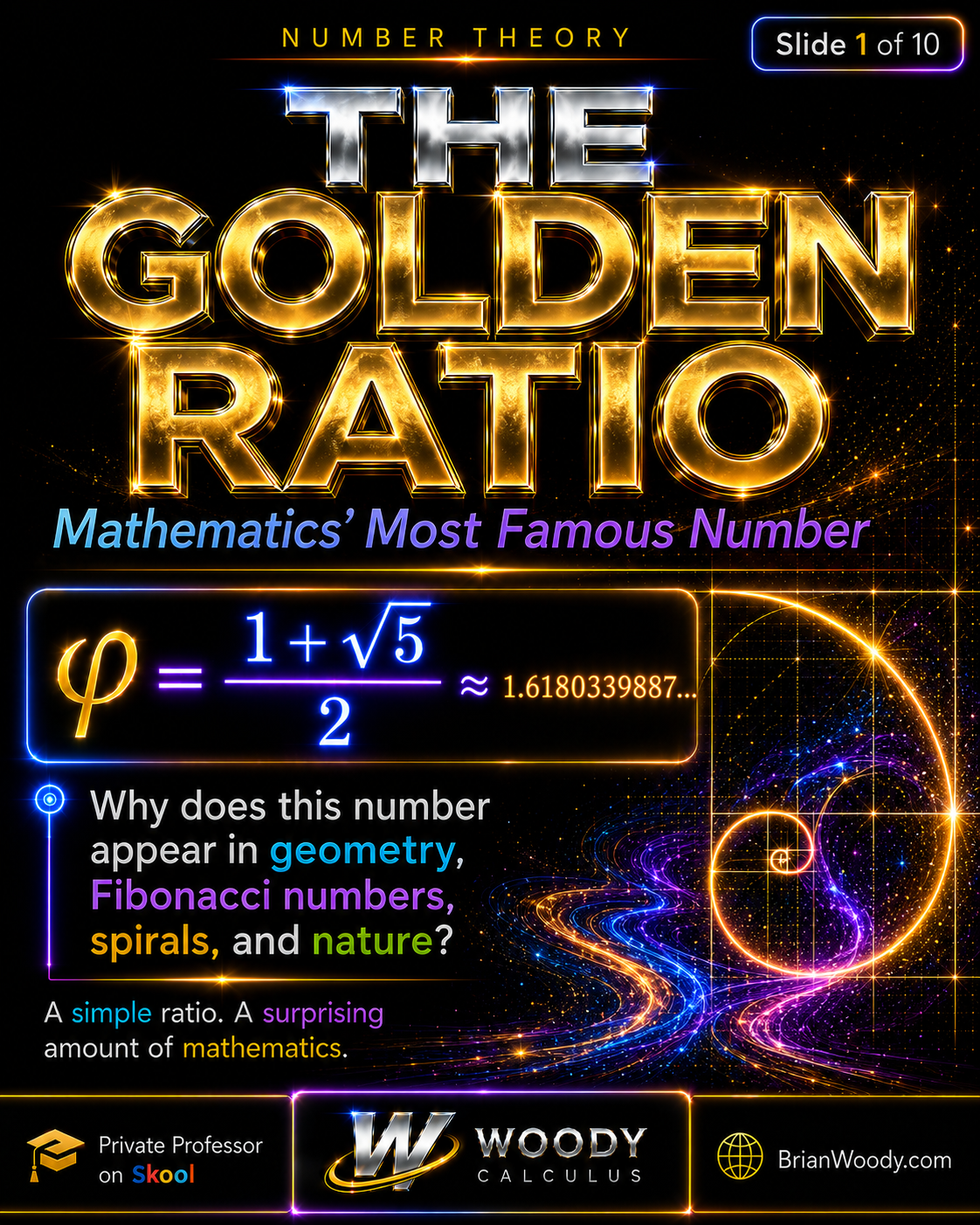
\(\phi=(1+\sqrt5)/2\) connects geometry, Fibonacci numbers,
spirals, algebra, analysis, and patterns in nature.
The golden ratio is famous because the
same mathematical structure keeps returning in different mathematical languages.
A line segment gives a proportion. The proportion gives a quadratic
equation. The quadratic equation gives the dominant growth rate of the
Fibonacci sequence. The same number controls a regular pentagon, a
special logarithmic spiral, and an extremal phenomenon in rational
approximation.
Not mystical beauty. Not a universal law hidden in every object.
Its real power is self-reproduction: subtract 1 and
you get its reciprocal; remove a square from a golden rectangle and
the same shape returns; shift one step in the Fibonacci recurrence
and the same quadratic equation appears.
-
\(\phi\) is irrational but algebraic: it solves a degree-two
polynomial with integer coefficients.
-
Its algebraic conjugate is
\(\psi=(1-\sqrt5)/2=-1/\phi\).
-
Consecutive Fibonacci ratios alternate above and below
\(\phi\) and converge to it.
-
A regular pentagon has diagonal-to-side ratio \(\phi\).
-
The golden angle is
\(360^\circ/\phi^2\approx137.5078^\circ\).
-
Its simple continued fraction is
\([1;1,1,1,\ldots]\), placing it in an extremal position
in Diophantine approximation.
What Is the Golden Ratio?
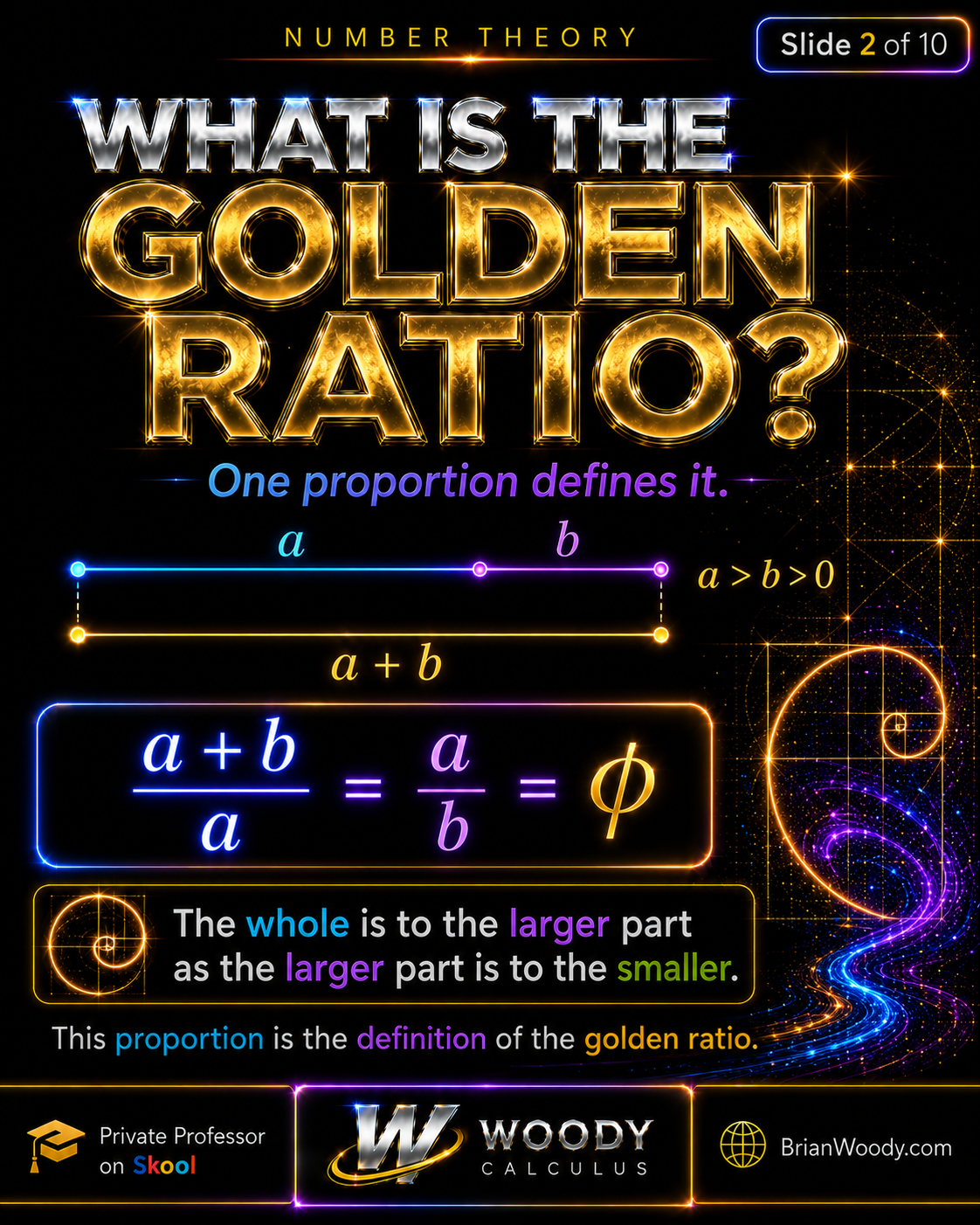
\((a+b)/a=a/b=\phi\) for \(a>b>0\)—the whole is to the larger part
as the larger part is to the smaller.
Start with a line divided into two positive lengths: a larger part
\(a\) and a smaller part \(b\). The total length is \(a+b\).
\[
\frac{a+b}{a}
=
\frac{a}{b}
=
\phi,
\qquad a>b>0.
\]
This sentence is the entire geometric definition:
The whole is to the larger part as the larger part is to the smaller.
How to Divide Any Total Length in the Golden Ratio
Suppose the total length is \(T=a+b\). Since \(T/a=\phi\),
the larger part is
\[
a=\frac{T}{\phi}.
\]
Since \(b=T-a\), we can also write
\[
b=\frac{T}{\phi^2}.
\]
Numerically,
\[
a\approx0.618034T,
\qquad
b\approx0.381966T.
\]
Worked Example: Divide 100 in the Golden Ratio
Let \(T=100\).
The larger part is
\(a=100/\phi\approx61.8034\).
The smaller part is
\(b=100/\phi^2\approx38.1966\).
Check the defining proportion:
\[
\frac{100}{61.8034}
\approx
\frac{61.8034}{38.1966}
\approx1.618034.
\]
Where Does 1.618 Come From?
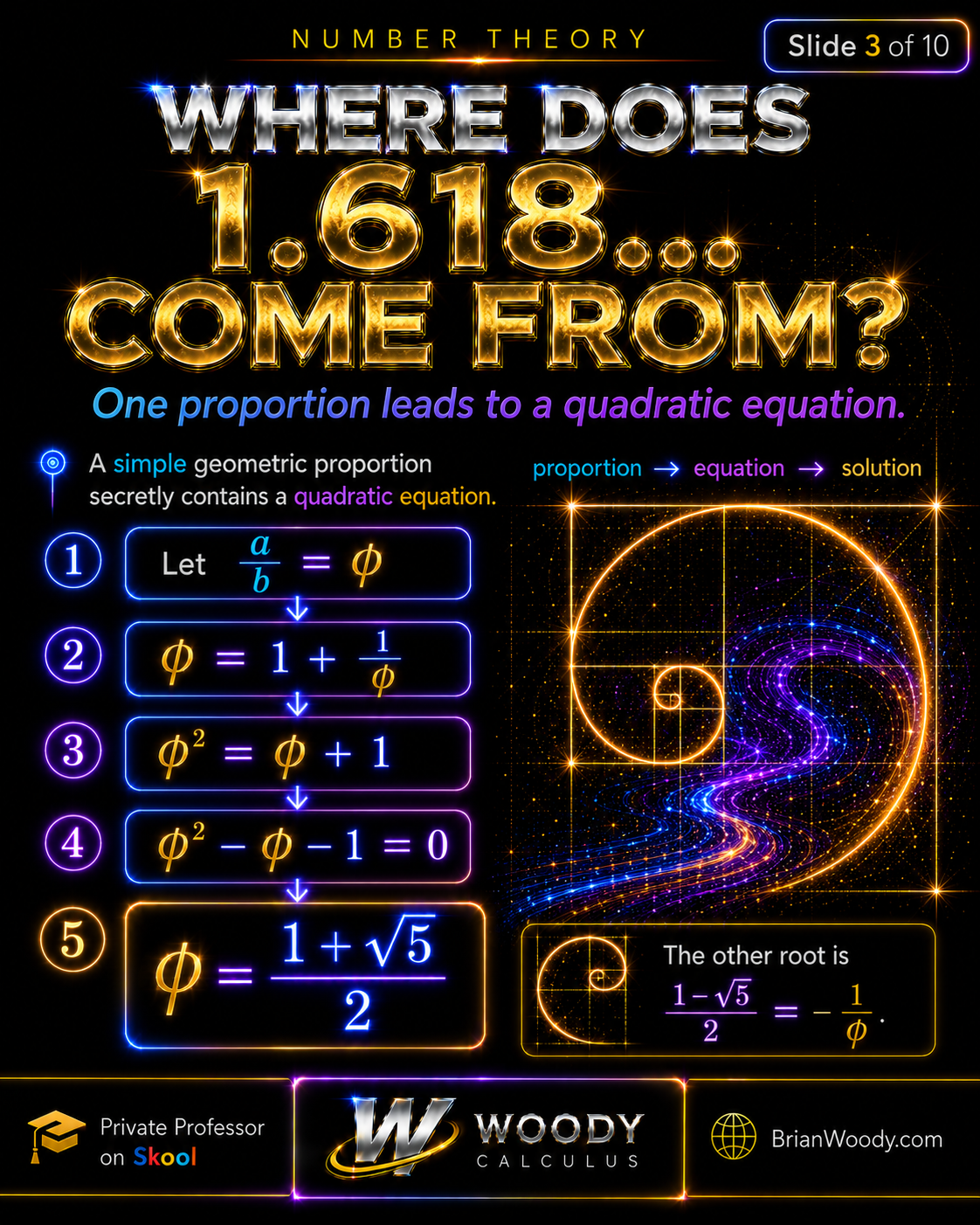
quadratic equation \(\phi^2-\phi-1=0\) and the positive solution
\(\phi=(1+\sqrt5)/2\).
The decimal \(1.6180339887\ldots\) is not an arbitrary numerical
coincidence. It comes directly from the golden proportion.
How to Derive the Golden Ratio From the Defining Proportion
Begin with the golden-ratio condition
\[
\frac{a+b}{a}
=
\frac{a}{b},
\qquad a>b>0.
\]
Let
\(\phi=a/b\). Then \(b/a=1/\phi\), so
\[
\phi
=
\frac{a+b}{a}
=
1+\frac{b}{a}
=
1+\frac1\phi.
\]
Multiply both sides by \(\phi\):
\[
\phi^2=\phi+1.
\]
Rearrange into a quadratic equation:
\[
\phi^2-\phi-1=0.
\]
Apply the quadratic formula:
\[
x=\frac{1\pm\sqrt5}{2}.
\]
Since the golden ratio is positive,
\[
\boxed{
\phi=\frac{1+\sqrt5}{2}
}.
\]
The Other Root
The second root is the algebraic conjugate
\[
\psi
=
\frac{1-\sqrt5}{2}
=
-\frac1\phi
\approx-0.6180339887\ldots
\]
Why \(\phi\) Is Irrational—but Still Algebraic
The polynomial \(x^2-x-1\) has integer coefficients. By the
Rational Root Theorem, its only possible rational
roots are \(1\) and \(-1\). Neither is a root.
Therefore \(\phi\) is irrational.
At the same time, \(\phi\) is algebraic of degree two
because it is a root of a degree-two polynomial with integer
coefficients.
The Identities Worth Memorizing
| Identity | Why It Is Useful |
|---|---|
| \(\phi^2=\phi+1\) | Reduces every higher power of \(\phi\) to a linear expression. |
| \(1/\phi=\phi-1\) | Explains why subtracting 1 reveals the reciprocal. |
| \(\phi+1/\phi=\sqrt5\) | Connects \(\phi\) directly to \(\sqrt5\). |
| \(\phi\psi=-1\) | Controls the alternating correction term in Binet’s formula. |
| \(\phi-\psi=\sqrt5\) | Produces the denominator in Binet’s formula. |
The identity
\(\phi=1+1/\phi\) says that \(\phi\) is the positive fixed point
of the transformation
\(f(x)=1+1/x\).
That one equation is the bridge to Fibonacci ratios and the infinite
continued fraction that appears later in this lesson.
Fibonacci Numbers Converge to the Golden Ratio
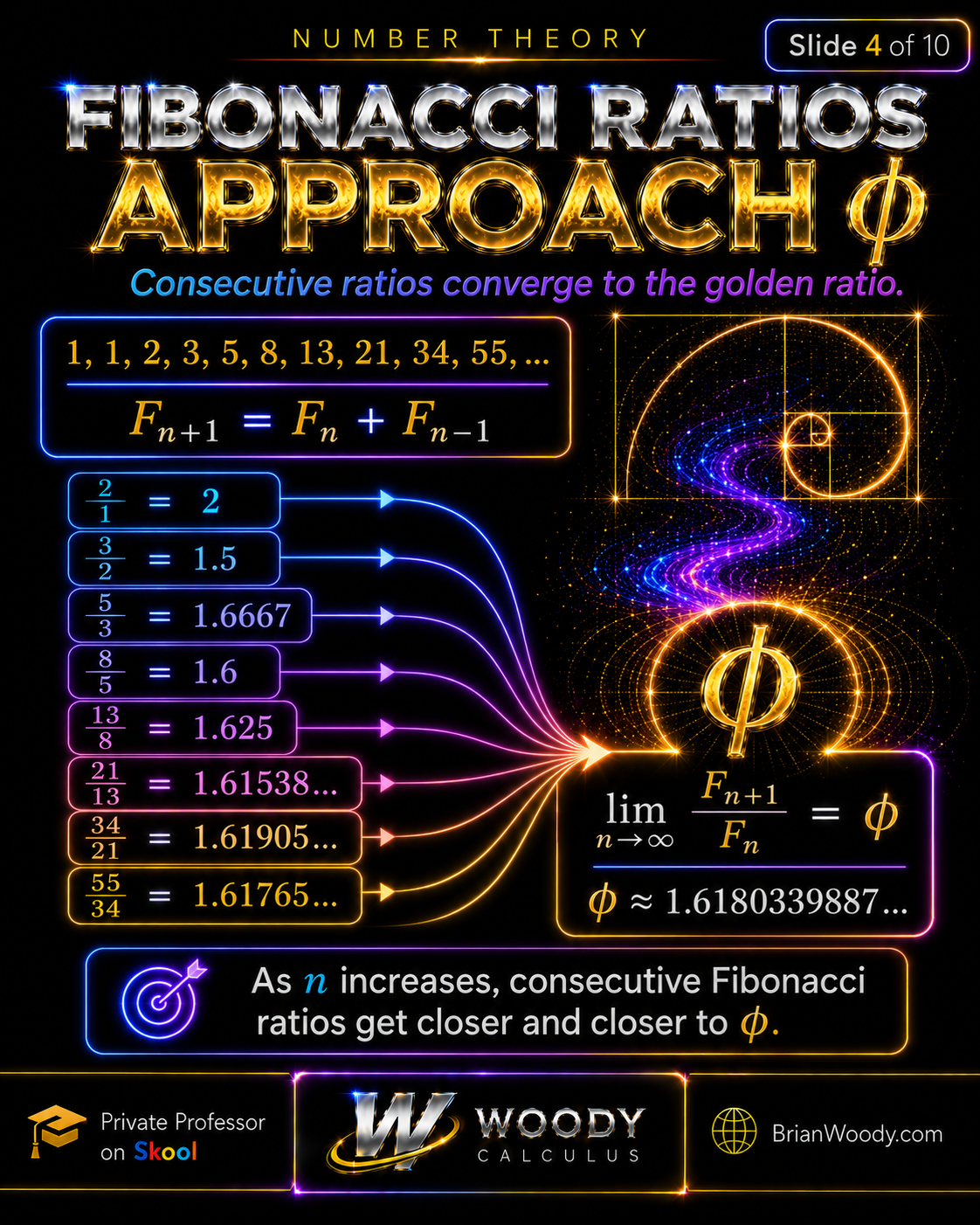
\(\phi\) and converge to the golden ratio.
Using the standard indexing convention, the Fibonacci sequence is
defined by
\[
F_0=0,
\qquad
F_1=1,
\qquad
F_{n+1}=F_n+F_{n-1},
\quad n\ge1.
\]
This produces
\[
0,1,1,2,3,5,8,13,21,34,55,89,\ldots
\]
Divide each positive term by the one immediately before it.
The ratios move back and forth around \(\phi\), getting closer each time.
| Consecutive Ratio | Decimal | Relative to \(\phi\) |
|---|---|---|
| \(1/1\) | 1.000000 | Below |
| \(2/1\) | 2.000000 | Above |
| \(3/2\) | 1.500000 | Below |
| \(5/3\) | 1.666667 | Above |
| \(8/5\) | 1.600000 | Below |
| \(13/8\) | 1.625000 | Above |
| \(21/13\) | 1.615385 | Below |
| \(34/21\) | 1.619048 | Above |
| \(55/34\) | 1.617647 | Below |
\[
\boxed{
\lim_{n\to\infty}
\frac{F_{n+1}}{F_n}
=
\phi
}.
\]
The standard Fibonacci recurrence and related identities are documented
in the
NIST Digital Library of Mathematical Functions
.
Why Fibonacci Produces \(\phi\)
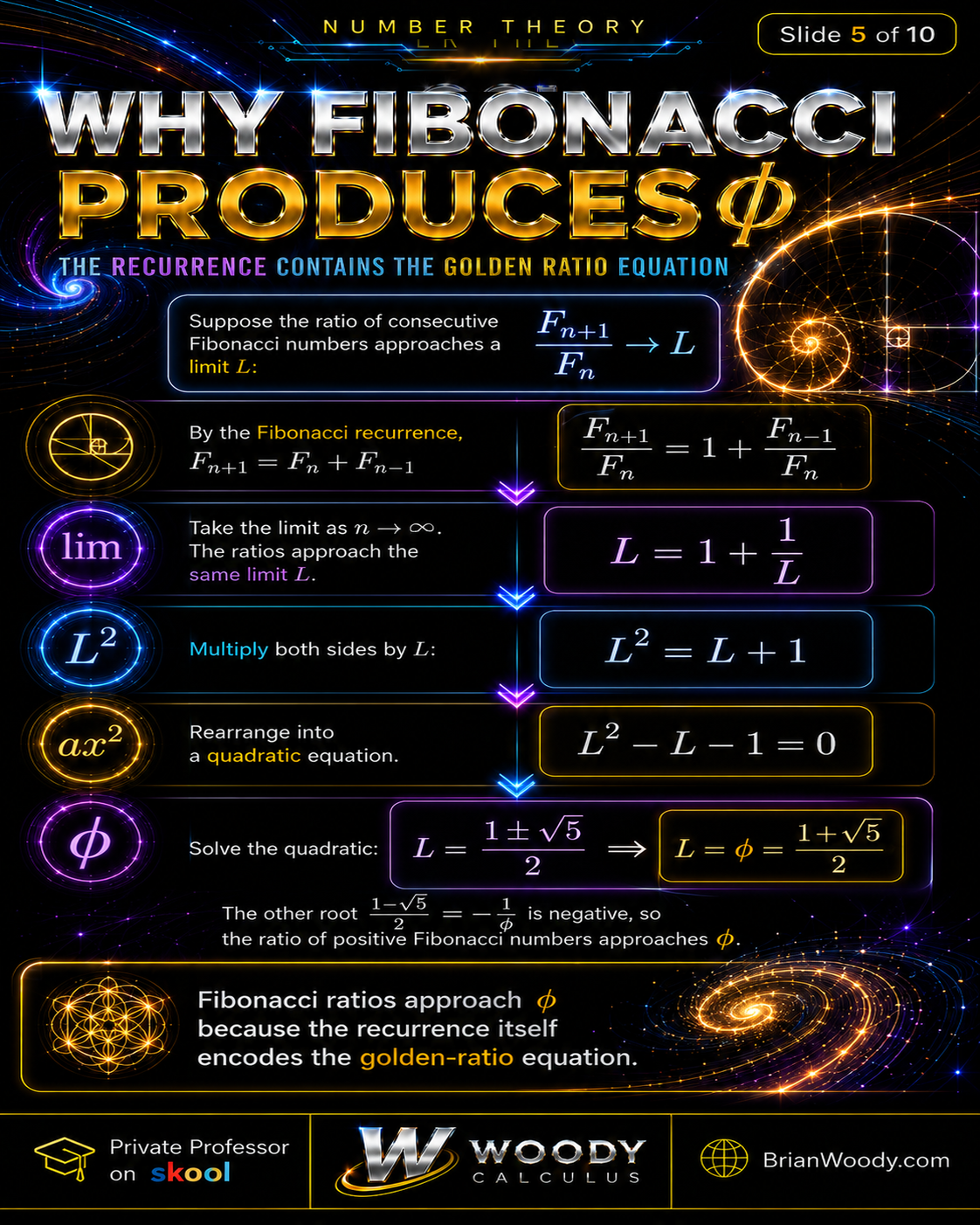
quadratic equation that defines the golden ratio.
The Fast Limit Argument
Suppose the ratio of consecutive Fibonacci numbers approaches a positive
limit \(L\):
\[
\frac{F_{n+1}}{F_n}\longrightarrow L.
\]
Divide the recurrence
\(F_{n+1}=F_n+F_{n-1}\)
by \(F_n\):
\[
\frac{F_{n+1}}{F_n}
=
1+\frac{F_{n-1}}{F_n}.
\]
Since
\(F_{n-1}/F_n\)
is the reciprocal of
\(F_n/F_{n-1}\),
taking limits gives
\[
L=1+\frac1L.
\]
Therefore
\[
L^2-L-1=0.
\]
Because every sufficiently indexed Fibonacci ratio is positive, the
only possible positive limit is
\[
\boxed{
L=\phi=\frac{1+\sqrt5}{2}
}.
\]
This argument identifies the value of the limit
if the ratio converges.
It does not by itself prove that convergence occurs.
For that, we need an additional argument.
A Rigorous Proof Using Binet’s Formula
The Fibonacci recurrence has characteristic equation
\[
r^2-r-1=0.
\]
Its roots are \(\phi\) and \(\psi\). Solving for the constants using
\(F_0=0\) and \(F_1=1\) gives Binet’s formula:
\[
\boxed{
F_n=
\frac{\phi^n-\psi^n}{\sqrt5}
},
\qquad
\psi=
\frac{1-\sqrt5}{2}
=
-\frac1\phi.
\]
Now form the ratio:
\[
\frac{F_{n+1}}{F_n}
=
\phi
\frac{
1-\left(\frac{\psi}{\phi}\right)^{n+1}
}{
1-\left(\frac{\psi}{\phi}\right)^n
}.
\]
But
\[
\left|
\frac{\psi}{\phi}
\right|
=
\frac1{\phi^2}
<1. \]
Therefore
\((\psi/\phi)^n\to0\), and hence
\[
\boxed{
\lim_{n\to\infty}
\frac{F_{n+1}}{F_n}
=
\phi
}.
\]
Why the Convergence Alternates
The quantity
\(\psi/\phi=-1/\phi^2\)
is negative. Its powers alternate in sign, which is why consecutive
Fibonacci ratios alternate above and below \(\phi\).
Their error shrinks exponentially, on the scale of
\(\phi^{-2n}\).
Advanced Connection: The Fibonacci Matrix
The same phenomenon appears in linear algebra:
\[
\begin{pmatrix}
F_{n+1}\\
F_n
\end{pmatrix}
=
\begin{pmatrix}
1&1\\
1&0
\end{pmatrix}^{n}
\begin{pmatrix}
1\\
0
\end{pmatrix}.
\]
The eigenvalues of the matrix are precisely \(\phi\) and \(\psi\).
Since
\(|\phi|>|\psi|\),
the \(\phi\)-eigencomponent dominates as \(n\) grows.
The golden ratio is not merely a decimal that Fibonacci ratios happen
to approach. It is the dominant eigenvalue and dominant growth
rate of the Fibonacci recurrence itself.
The Golden Rectangle and the True Golden Spiral
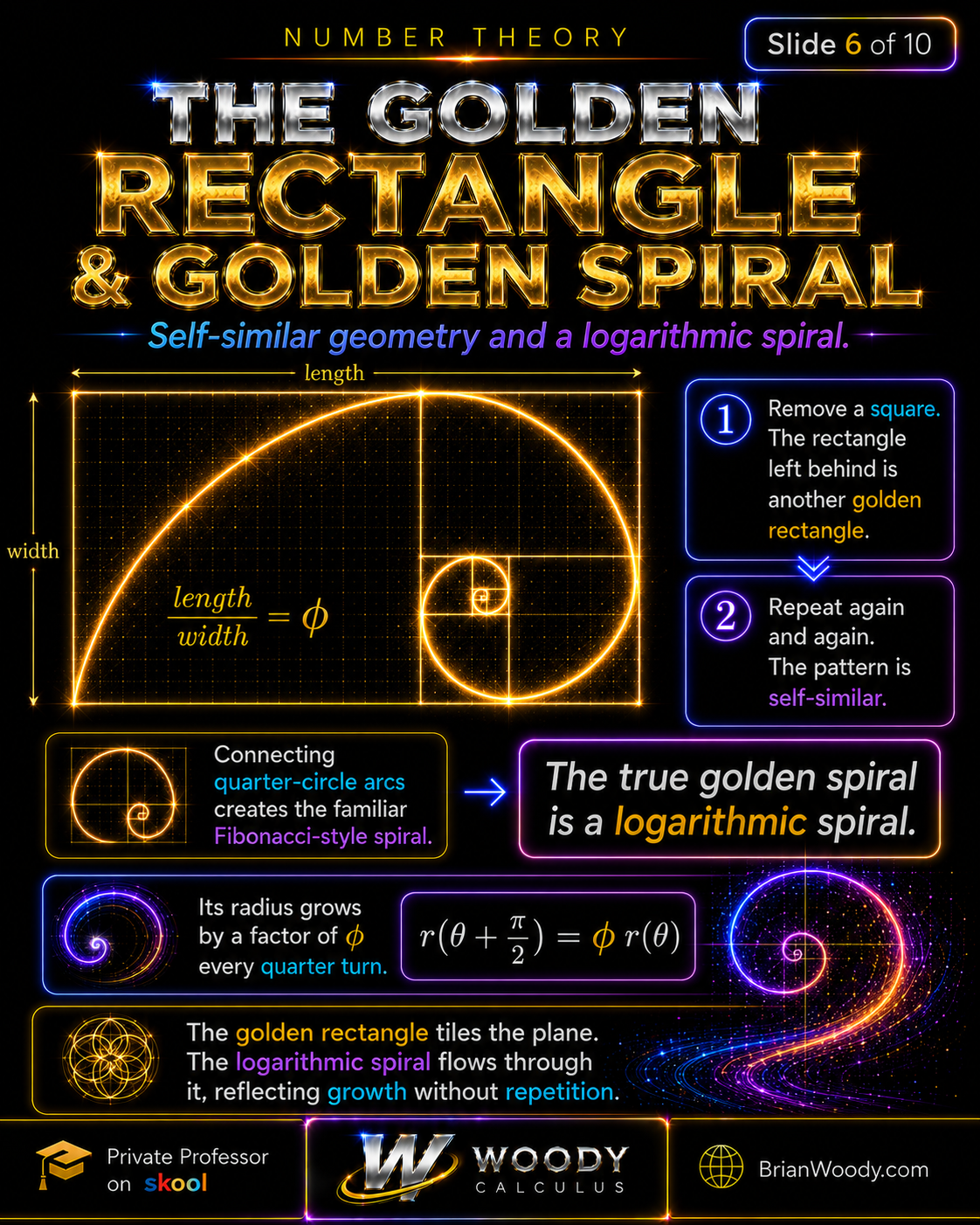
golden rectangle; quarter-circle arcs create a familiar approximation,
while the true golden spiral is logarithmic.
Why the Smaller Rectangle Has the Same Shape
Let a rectangle have length \(L\) and width \(W\) with
\[
\frac{L}{W}=\phi.
\]
Remove a square of side \(W\). The leftover rectangle has side lengths
\(W\) and \(L-W\). Since \(L=\phi W\),
\[
L-W
=
(\phi-1)W
=
\frac{W}{\phi}.
\]
Therefore
\[
\frac{W}{L-W}
=
\phi.
\]
The leftover rectangle has the same length-to-width ratio as the
original. It is similar to the original golden rectangle.
Fibonacci-Style Spiral vs. Golden Spiral
| Object | Construction | Exact Status |
|---|---|---|
| Quarter-circle or Fibonacci-style spiral | Draw a quarter-circle in each successive square. |
A chain of circular arcs. It looks spiral-like, but its curvature changes from one arc to the next. |
| Golden spiral |
Use one logarithmic spiral whose radius grows by a factor of \(\phi\) every quarter-turn. |
A single smooth logarithmic spiral with continuously varying radius and curvature. |
A logarithmic spiral has polar equation
\[
r(\theta)=r_0e^{b\theta}.
\]
For an exact golden spiral, require the radius to grow by \(\phi\)
every quarter-turn:
\[
r\!\left(
\theta+\frac{\pi}{2}
\right)
=
\phi r(\theta).
\]
This forces
\[
b
=
\frac{2\ln\phi}{\pi}
\approx0.3063489625.
\]
Therefore an exact golden spiral can be written as
\[
\boxed{
r(\theta)
=
r_0
e^{(2\ln\phi/\pi)\theta}
}.
\]
Many shells and galaxies are approximately logarithmic spirals, but
their growth constants generally are not the golden-spiral value.
The familiar quarter-circle construction is also an approximation,
not the exact logarithmic spiral.
The Golden Ratio Is Hidden Inside a Regular Pentagon
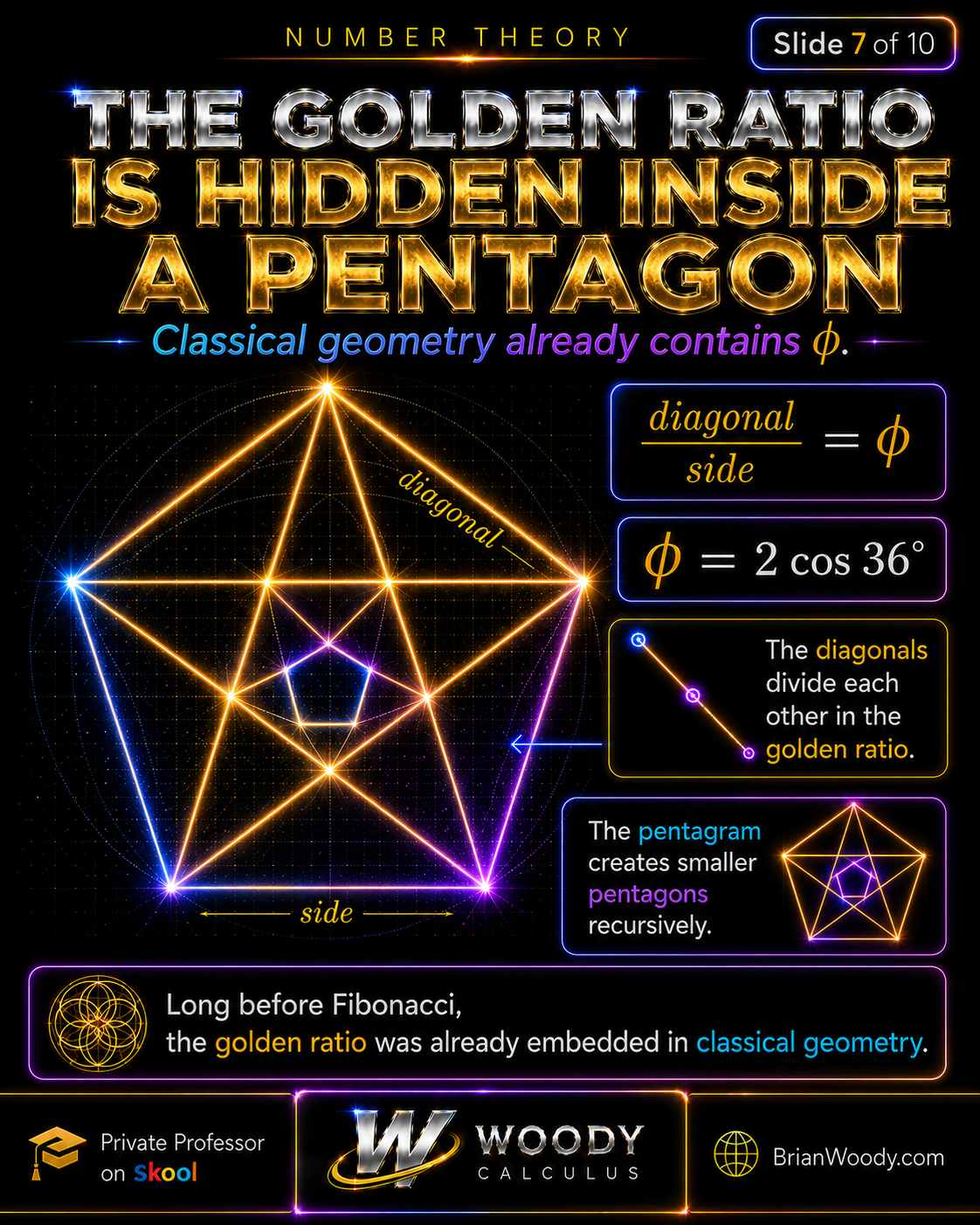
\(\phi=2\cos36^\circ\), and the pentagram reproduces smaller
pentagons recursively.
Let \(s\) be the side length and \(d\) the diagonal length of a
regular pentagon. Then
\[
\boxed{
\frac{d}{s}
=
\phi
}.
\]
A Short Trigonometric Derivation
If the regular pentagon is inscribed in a circle of radius \(R\),
a side corresponds to a
central angle of \(72^\circ\),
while a diagonal corresponds to a central angle of \(144^\circ\).
Using the chord-length formula,
\[
s
=
2R\sin36^\circ,
\qquad
d
=
2R\sin72^\circ.
\]
Hence
\[
\frac{d}{s}
=
\frac{\sin72^\circ}{\sin36^\circ}
=
2\cos36^\circ.
\]
Since
\(\cos36^\circ=(1+\sqrt5)/4\),
\[
\boxed{
2\cos36^\circ
=
\frac{1+\sqrt5}{2}
=
\phi
}.
\]
Draw all five diagonals and a pentagram appears. The diagonal
intersections divide segments in golden proportion, and a smaller
regular pentagon appears at the center.
Repeating the construction generates nested pentagons and pentagrams,
so the same geometry—and the same number \(\phi\)—returns at smaller
and smaller scales.
The golden ratio was embedded in classical geometry long before
mathematicians studied the limiting ratio of consecutive Fibonacci
numbers.
Who Discovered the Golden Ratio?
There is no single clean discovery moment. The ratio emerged naturally
from ancient Greek problems involving line division, regular pentagons,
pentagrams, and regular solids.
Ancient Greek geometry:
the ratio occurs naturally in regular pentagons and related
geometric constructions.
Euclid:
Elements contains the first surviving systematic
mathematical treatment of what was called division in
“extreme and mean ratio.”
Fibonacci:
Leonardo of Pisa presented the famous rabbit sequence in
Liber Abaci and treated extreme-and-mean-ratio
geometry separately in his mathematical work. He did not connect
the rabbit sequence to the limiting ratio \(\phi\).
Later mathematicians:
the relationship between consecutive Fibonacci ratios and the
golden ratio was recognized and developed centuries later,
including work associated with Kepler and later proofs of
convergence.
Modern terminology:
names such as “golden section” and the now-standard symbol
\(\phi\) are much more recent than the mathematics itself.
For a documented historical timeline, see the
MacTutor History of Mathematics archive
.
Fibonacci did not invent the golden ratio.
Its geometry was known long before him. His name became associated
with the famous recurrence, while the limiting connection between
Fibonacci ratios and \(\phi\) was recognized later.
Why \(\phi\) Is Called the “Most Irrational” Number
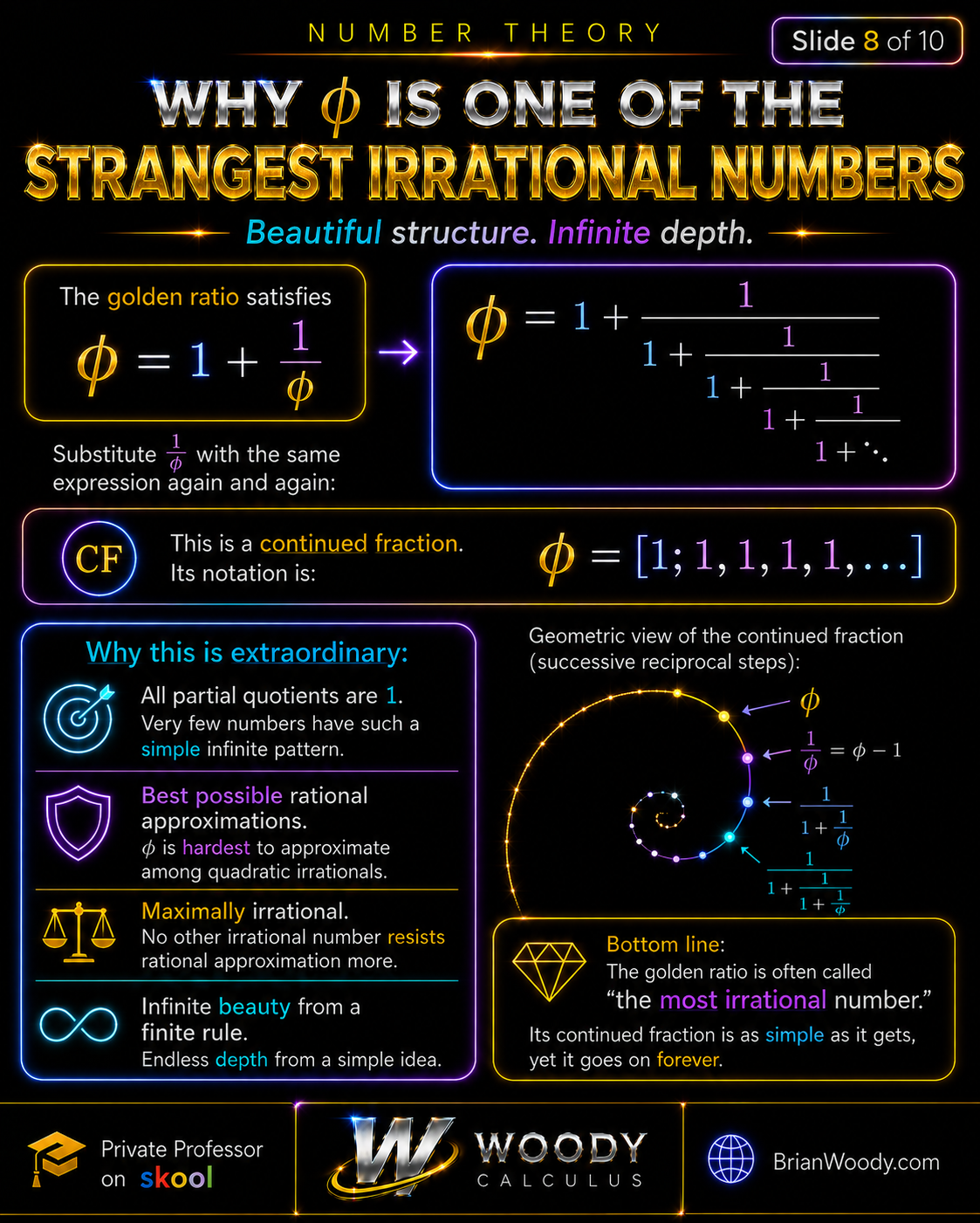
\(\phi=[1;1,1,1,\ldots]\)
makes the golden ratio extremal for rational approximation in the
precise Hurwitz-theorem sense.
Begin with the fixed-point identity
\[
\phi
=
1+\frac1\phi.
\]
Replace the \(\phi\) in the denominator with the same expression.
Then do it again. And again.
\[
\boxed{
\phi
=
1+\cfrac1{
1+\cfrac1{
1+\cfrac1{
1+\ddots
}
}
}
}.
\]
In simple continued-fraction notation,
\[
\boxed{
\phi=[1;1,1,1,1,\ldots]
}.
\]
The Convergents Are Fibonacci Ratios
| Continued-Fraction Truncation | Convergent | Fibonacci Form |
|---|---|---|
| \([1]\) | \(1\) | \(F_2/F_1\) |
| \([1;1]\) | \(2\) | \(F_3/F_2\) |
| \([1;1,1]\) | \(3/2\) | \(F_4/F_3\) |
| \([1;1,1,1]\) | \(5/3\) | \(F_5/F_4\) |
| \([1;1,1,1,1]\) | \(8/5\) | \(F_6/F_5\) |
What “Most Irrational” Actually Means
The phrase most irrational is informal.
It does not mean that the decimal digits of
\(\phi\) are somehow more random than those of other irrational
numbers.
The real issue is
rational approximation:
how closely can an irrational number be approximated by fractions
\(p/q\) whose denominators are not too large?
For every irrational number \(\alpha\), there are infinitely many
rational numbers \(p/q\) satisfying
\[
\left|
\alpha-\frac pq
\right|
< \frac1{\sqrt5\,q^2}. \]
The constant \(1/\sqrt5\) is sharp. The golden ratio, together
with numbers equivalent to it under integer fractional-linear
transformations, supplies the extremal case.
In a simple continued fraction, every partial quotient after the first
is a positive integer. The smallest possible value is \(1\).
The golden ratio uses \(1\) forever:
\[
[1;1,1,1,1,\ldots].
\]
That endless string of ones is why \(\phi\) sits at the extremal
boundary of Hurwitz’s theorem.
The mathematically responsible statement is:
“The golden ratio is extremal for rational approximation in the
Hurwitz-theorem sense.”
Avoid interpreting “most irrational” as a universal ranking under
every possible definition of approximation.
Is the Golden Ratio Really Everywhere in Nature?
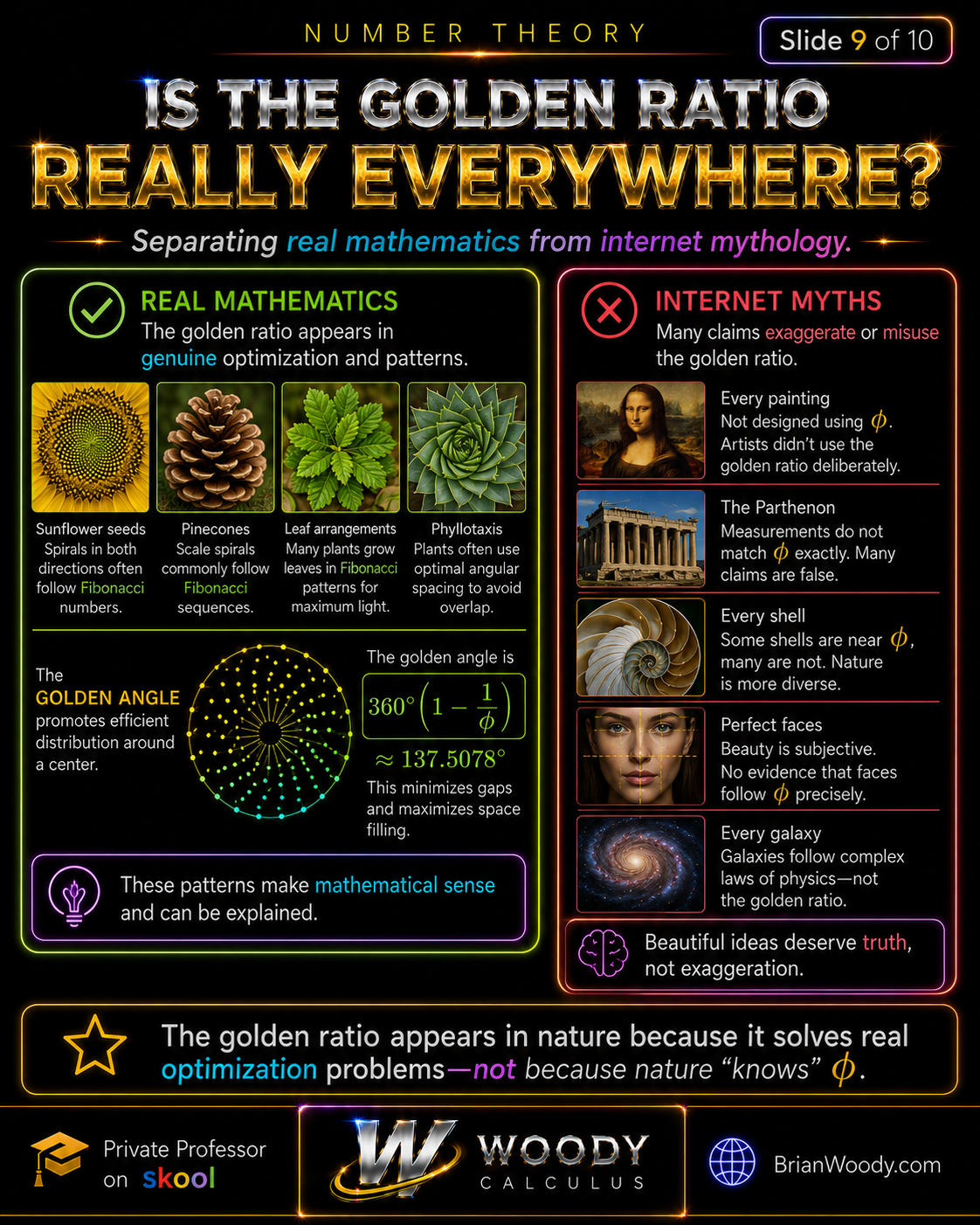
are real, while many universal claims about art, architecture,
shells, faces, and galaxies are exaggerated or unsupported.
The honest answer is:
sometimes, approximately, and for mathematically understandable
reasons—but not everywhere.
The Golden Angle
Divide a full turn according to the golden ratio. The smaller resulting
angle is
\[
\boxed{
\theta_g
=
360^\circ
\left(
1-\frac1\phi
\right)
=
\frac{360^\circ}{\phi^2}
\approx137.507764^\circ
}.
\]
Why is an irrational fraction of a turn useful?
A rational rotation eventually repeats exact angular positions.
An irrational rotation does not.
The golden angle has an especially strong resistance to simple rational
approximations because its arithmetic is inherited from the continued
fraction of \(\phi\).
Phyllotaxis: Where the Connection Is Real
Phyllotaxis is the arrangement of leaves, florets,
seeds, scales, or similar structures around a stem or center.
Many plant systems exhibit divergence angles near the golden angle.
Visible spiral families can occur in neighboring Fibonacci counts such
as \(34\) and \(55\), or \(55\) and \(89\).
The biology is more sophisticated than a slogan.
Different models involve developmental mechanics, packing geometry,
robustness, stem shape, evolutionary cost, and—in some settings—light
capture.
The golden angle has rigorous optimality properties in specific
mathematical and biophysical models, but no single optimization story
explains every plant.
See
Biophysical Optimality of the Golden Angle in Phyllotaxis
and
Phyllotaxis: Is the Golden Angle Optimal for Light Capture?
.
Why Fibonacci Spiral Counts Appear
As a fraction of one complete turn, the golden angle is
\[
\frac{\theta_g}{360^\circ}
=
\frac1{\phi^2}
=
0.381966\ldots
\]
Rational approximations related to Fibonacci numbers create
near-alignments among successively placed points. Those near-alignments
can become visible as families of spirals, called
parastichies.
That is a genuine mathematical bridge:
continued fractions → rational approximations → near-alignments →
visible spiral families.
Golden Ratio Myths: What Is Actually True?
| Claim | Verdict | Better Statement |
|---|---|---|
| Every shell is a golden spiral. | False |
Many shells resemble logarithmic spirals, but their growth constants generally are not the golden-spiral value. |
| Every galaxy follows \(\phi\). | False |
Galaxy arms arise from astrophysical dynamics and display a range of pitch angles rather than one universal golden ratio. |
| Every beautiful face has golden-ratio proportions. | Unsupported as a universal law |
Beauty judgments vary, facial landmarks can be selected in different ways, and no single ratio universally determines facial beauty. |
| All famous art was designed using \(\phi\). | False |
Some later artists and designers deliberately used golden-ratio constructions. Universal retroactive overlays are not evidence that every famous artwork was designed that way. |
| The Parthenon was definitely designed from one golden rectangle. | Not securely established |
The Parthenon contains sophisticated geometric proportions, but intentional golden-ratio claims depend heavily on which architectural boundaries are selected for measurement. |
| Fibonacci numbers occur in every plant. | False |
Fibonacci-related spiral counts occur frequently in phyllotaxis, but plants also display exceptions and other arrangements. |
Define the object and the measurement points first.
Measure second.
Compare with \(\phi\) third.
Do not begin with a golden rectangle and move its boundaries until
it appears to fit what you already wanted to prove.
A scholarly review of golden-ratio claims emphasizes that broad claims
connecting the ratio to universal facial beauty are not supported as
simple universal facts.
See
The Golden Ratio—Dispelling the Myth
.
The mature mathematical position is not cynical.
It is better:
the genuine mathematics is fascinating enough that it does not need
exaggeration.
Why the Golden Ratio Matters
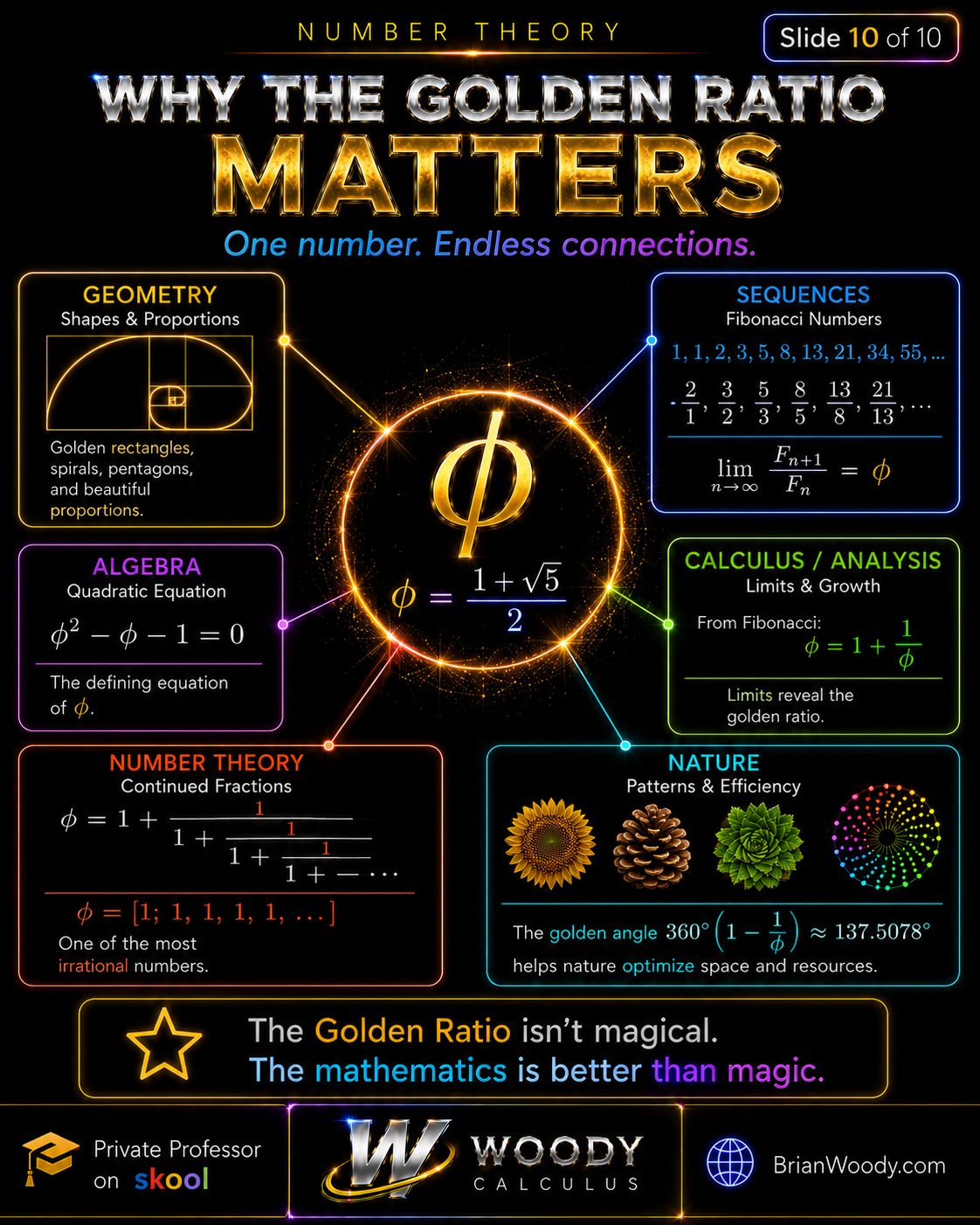
sequences, limits, linear algebra, continued fractions, the golden
angle, and selected natural patterns.
The golden ratio matters because it is a remarkably compact meeting
point for several important branches of mathematics.
| Area | How \(\phi\) Appears | Core Formula |
|---|---|---|
| Geometry | Golden division, rectangles, pentagons, and pentagrams | \((a+b)/a=a/b\) |
| Algebra | Quadratic equation and algebraic conjugates | \(x^2-x-1=0\) |
| Sequences | Dominant growth rate of Fibonacci numbers | \(F_{n+1}/F_n\to\phi\) |
| Calculus / Analysis | Limits, convergence, exponential error, and asymptotics | \(F_n\sim\phi^n/\sqrt5\) |
| Linear Algebra | Dominant eigenvalue of the Fibonacci matrix | \(\lambda_{\max}=\phi\) |
| Number Theory | Continued fractions and Diophantine approximation | \(\phi=[1;1,1,1,\ldots]\) |
| Nature | Golden-angle phyllotaxis in many plant systems | \(360^\circ/\phi^2\) |
Golden Ratio Formula Sheet
These are the core identities and formulas that organize the entire lesson.
\[
\phi=\frac{1+\sqrt5}{2}\approx1.6180339887
\]
\[
\psi=\frac{1-\sqrt5}{2}=-\frac1\phi
\]
\[
\phi^2=\phi+1
\]
\[
\frac1\phi=\phi-1
\]
\[
F_n=\frac{\phi^n-\psi^n}{\sqrt5}
\]
\[
\lim_{n\to\infty}\frac{F_{n+1}}{F_n}=\phi
\]
\[
\phi=[1;1,1,1,\ldots]
\]
\[
\theta_g=\frac{360^\circ}{\phi^2}\approx137.507764^\circ
\]
\[
r(\theta)=r_0e^{(2\ln\phi/\pi)\theta}
\]
A Beautiful Power Identity
For every integer \(n\ge1\),
\[
\boxed{
\phi^n
=
F_n\phi+F_{n-1}
}.
\]
This follows immediately by induction from
\(\phi^2=\phi+1\).
For example,
\[
\phi^5=5\phi+3.
\]
Worked Example 1: Pentagon Diagonal
A regular pentagon has side length \(8\).
Since diagonal divided by side equals \(\phi\),
\[
d
=
8\phi
\approx12.9443.
\]
Worked Example 2: Golden-Spiral Growth
A golden spiral grows by a factor of \(\phi\) every quarter-turn.
A half-turn therefore produces two such growth factors:
\[
r(\theta+\pi)
=
\phi^2r(\theta)
=
(\phi+1)r(\theta).
\]
Worked Example 3: Estimating Fibonacci Numbers
Binet’s formula implies that \(F_n\) is the nearest integer to
\(\phi^n/\sqrt5\). Equivalently,
\[
\boxed{
F_n
=
\left\lfloor
\frac{\phi^n}{\sqrt5}
+
\frac12
\right\rfloor,
\qquad n\ge0.
}
\]
The reason this rounding formula works is that the conjugate term
\(\psi^n/\sqrt5\) rapidly becomes tiny because \(|\psi|<1\).
Common Golden Ratio Mistakes
-
Using 1.618 as an exact value.
It is only an approximation. The exact value is
\((1+\sqrt5)/2\).
-
Reversing the line-segment ratio.
With \(a>b>0\), the correct defining equation is
\((a+b)/a=a/b\).
-
Calling the quarter-circle construction an exact golden spiral.
It is a piecewise chain of circular arcs, not one logarithmic spiral.
-
Assuming every shell, face, painting, or building uses \(\phi\).
Define the measurements before testing the claim.
-
Saying Fibonacci discovered the golden ratio.
The ratio was studied in ancient geometry; the Fibonacci-sequence
connection came later.
-
Using the quick limit argument as a complete proof.
It identifies a possible limiting value. Binet’s formula or another
convergence argument proves that the limit actually exists.
-
Misunderstanding “most irrational.”
The phrase concerns rational approximation and continued fractions,
not randomness of decimal digits.
-
Overstating biological optimization.
Golden-angle patterns have rigorous mathematical and biological
models, but no single mechanism explains every organism.
Golden Ratio Key Takeaways
-
The golden ratio is
\(\phi=(1+\sqrt5)/2\approx1.6180339887\).
-
It is defined by
\((a+b)/a=a/b\)
for \(a>b>0\).
-
Its defining polynomial is
\(x^2-x-1\).
-
The identity
\(\phi=1+1/\phi\)
drives its self-reproducing structure.
-
Consecutive Fibonacci ratios converge to \(\phi\) because
\(\phi\) is the dominant root—and dominant eigenvalue—of the
Fibonacci recurrence.
-
A golden rectangle reproduces its shape after a square is removed.
-
The true golden spiral is logarithmic; the familiar quarter-circle
construction is an approximation.
-
A regular pentagon has diagonal-to-side ratio \(\phi\).
-
The continued fraction
\([1;1,1,\ldots]\)
makes \(\phi\) extremal for rational approximation in the Hurwitz sense.
-
Golden-angle phyllotaxis is real mathematics, but universal claims
about shells, faces, art, buildings, and galaxies require evidence.
The golden ratio is not magical.
The mathematics is better than magic.
Golden Ratio FAQ
What is the golden ratio?
The golden ratio is the positive number
φ = (1 + √5)/2 ≈ 1.6180339887.
It occurs when the whole-to-larger-part ratio equals the
larger-to-smaller-part ratio.
What is the exact value of phi?
The exact value is φ = (1 + √5)/2.
The decimal 1.618 is only an approximation.
Why is the golden ratio special?
It is the positive solution of x = 1 + 1/x, so it reproduces itself
under a reciprocal transformation. The same structure appears in
golden rectangles, Fibonacci growth, pentagon geometry, continued
fractions, and Diophantine approximation.
How are Fibonacci numbers related to the golden ratio?
The ratio of consecutive Fibonacci numbers approaches the golden ratio:
F(n+1)/F(n) → φ. Binet’s formula proves this because the φⁿ term
dominates the smaller conjugate term.
Do Fibonacci ratios ever equal the golden ratio exactly?
No. Every Fibonacci ratio is rational, while φ is irrational.
The ratios alternate above and below φ and approach it without
ever becoming equal to it.
Is a Fibonacci spiral the same as a golden spiral?
No. The common Fibonacci-style construction joins quarter-circle arcs
inside successive squares. A true golden spiral is one smooth
logarithmic spiral whose radius grows by a factor of φ every
quarter-turn.
Why does the golden ratio appear in a pentagon?
In a regular pentagon, the diagonal-to-side ratio is
2 cos(36°) = (1 + √5)/2 = φ.
Intersecting diagonals also divide one another in golden proportion.
Is the golden ratio really the most irrational number?
“Most irrational” is informal. Precisely, φ has continued fraction
[1;1,1,1,…] and is extremal for rational approximation in the
Hurwitz-theorem sense. The phrase does not mean its decimal digits
are more random.
What is the golden angle?
The golden angle is 360°/φ² ≈ 137.507764°.
Divergence angles near this value occur in many phyllotactic
plant patterns.
Is the golden ratio everywhere in nature?
No. Golden-angle and Fibonacci-related patterns occur in many plants,
but not every shell, flower, face, storm, or galaxy follows the
golden ratio. Claims should be tested using clearly defined
measurements.
Did Fibonacci discover the golden ratio?
No. The ratio was studied in ancient Greek geometry.
Fibonacci became associated with the famous recurrence, while the
limiting connection between consecutive Fibonacci ratios and φ was
recognized later.
Was the Parthenon designed with the golden ratio?
Intentional use is not securely established. The Parthenon has
sophisticated proportions, but golden-ratio claims depend heavily
on which architectural boundaries are selected for measurement.
Is the golden ratio rational or irrational?
The golden ratio is irrational. It is also algebraic because it
solves the polynomial x² − x − 1 = 0.
How do you divide a length in the golden ratio?
For total length T, the larger part is T/φ ≈ 0.618034T and the
smaller part is T/φ² ≈ 0.381966T.
Prove You Understand the Structure
Reading mathematics is not the same thing as owning it.
Work these without copying from the page.
-
Close the screen.
Starting only from
\((a+b)/a=a/b\),
rewrite the complete derivation of
\(\phi=(1+\sqrt5)/2\)
from memory.
-
Say the logic out loud.
Explain why the Rational Root Theorem shows that
\(x^2-x-1\) has no rational roots and therefore \(\phi\) is irrational.
-
Use only
\(\phi^2=\phi+1\)
to prove from memory that
\(\phi^6=8\phi+5\).
-
Explain why the quick Fibonacci limit argument identifies the
candidate limit but does not, by itself, prove convergence.
-
Explain—in one precise sentence—the difference between a
Fibonacci-style quarter-circle construction and a true golden spiral.
-
Explain—in one mathematically responsible sentence—what people mean
when they call \(\phi\) the “most irrational” number.
-
Choose one online golden-ratio claim about nature, art, architecture,
or beauty. State exactly what would have to be measured before the
claim could be tested honestly.
Rewrite the derivations more than once.
Say the transitions aloud.
If you cannot explain why one line becomes the next line,
you are not finished yet.
Fact-Check References
Related Woody Calculus Lessons