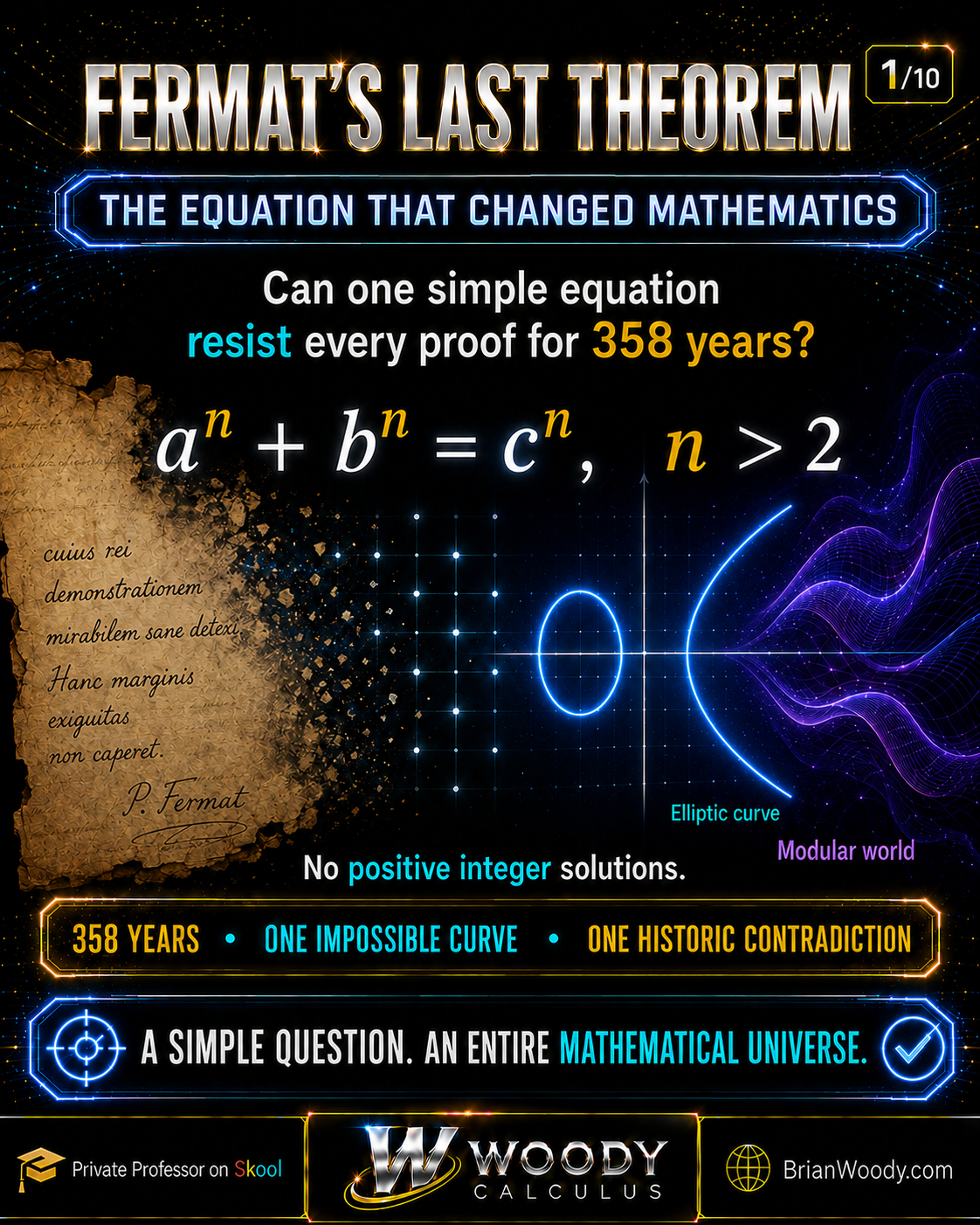
Fermat’s Last Theorem began with an equation a student can understand and ended in a proof joining number theory, ideals, elliptic curves, modular forms, Galois representations, and Taylor–Wiles patching. This visual master lesson develops the 358-year history, the complete contradiction architecture, verified worked examples, and the precise relationship to modern elliptic-curve cryptography.
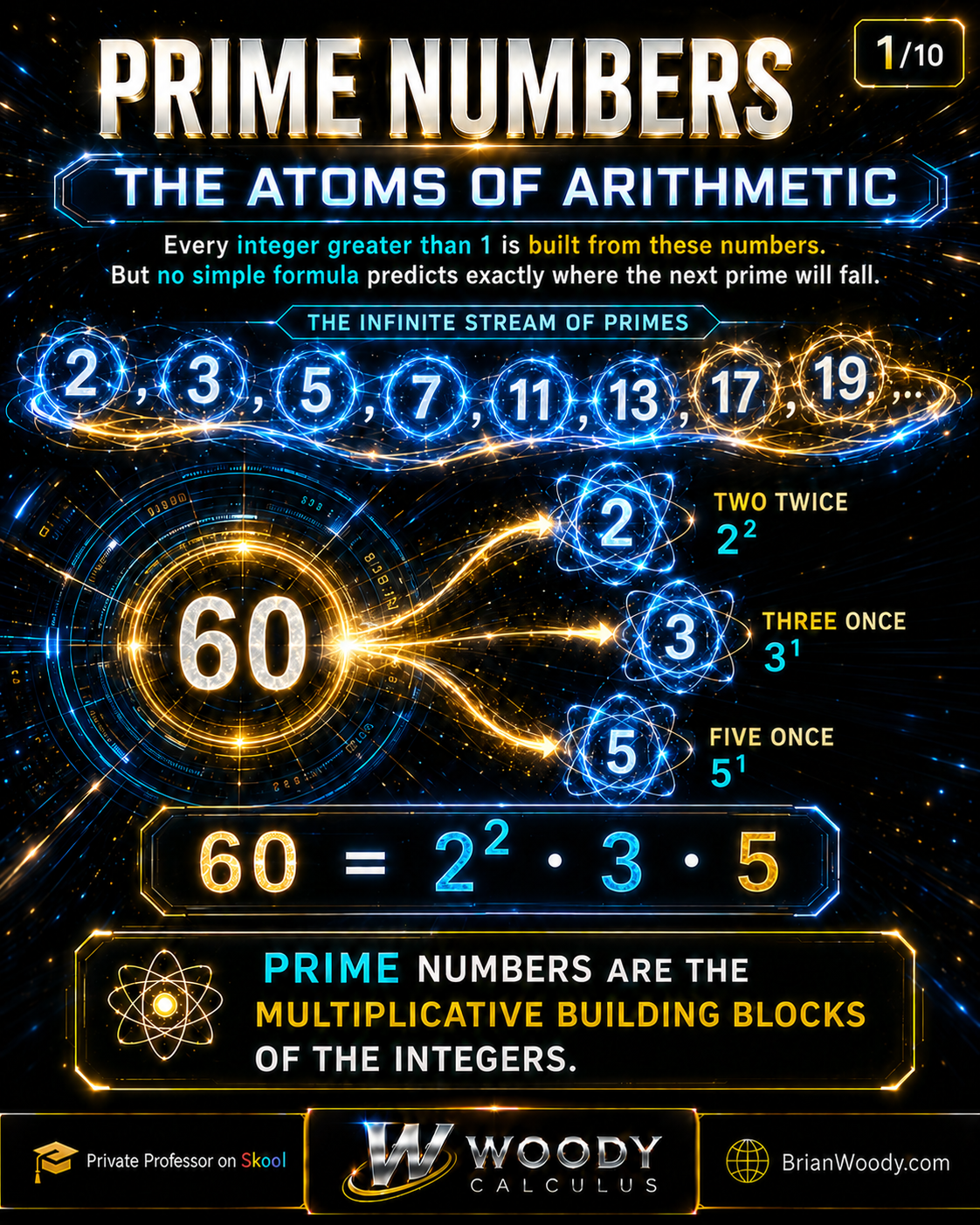
Prime numbers are the multiplicative building blocks of the integers. In this Woody Calculus lesson, learn the formal definition of a prime, why 1 is excluded, the Fundamental Theorem of Arithmetic, Euclid’s proof of infinitely many primes, the Sieve of Eratosthenes, prime patterns modulo 6, the Prime Number Theorem, modern cryptography, and the deep connection between primes and the Riemann Hypothesis.
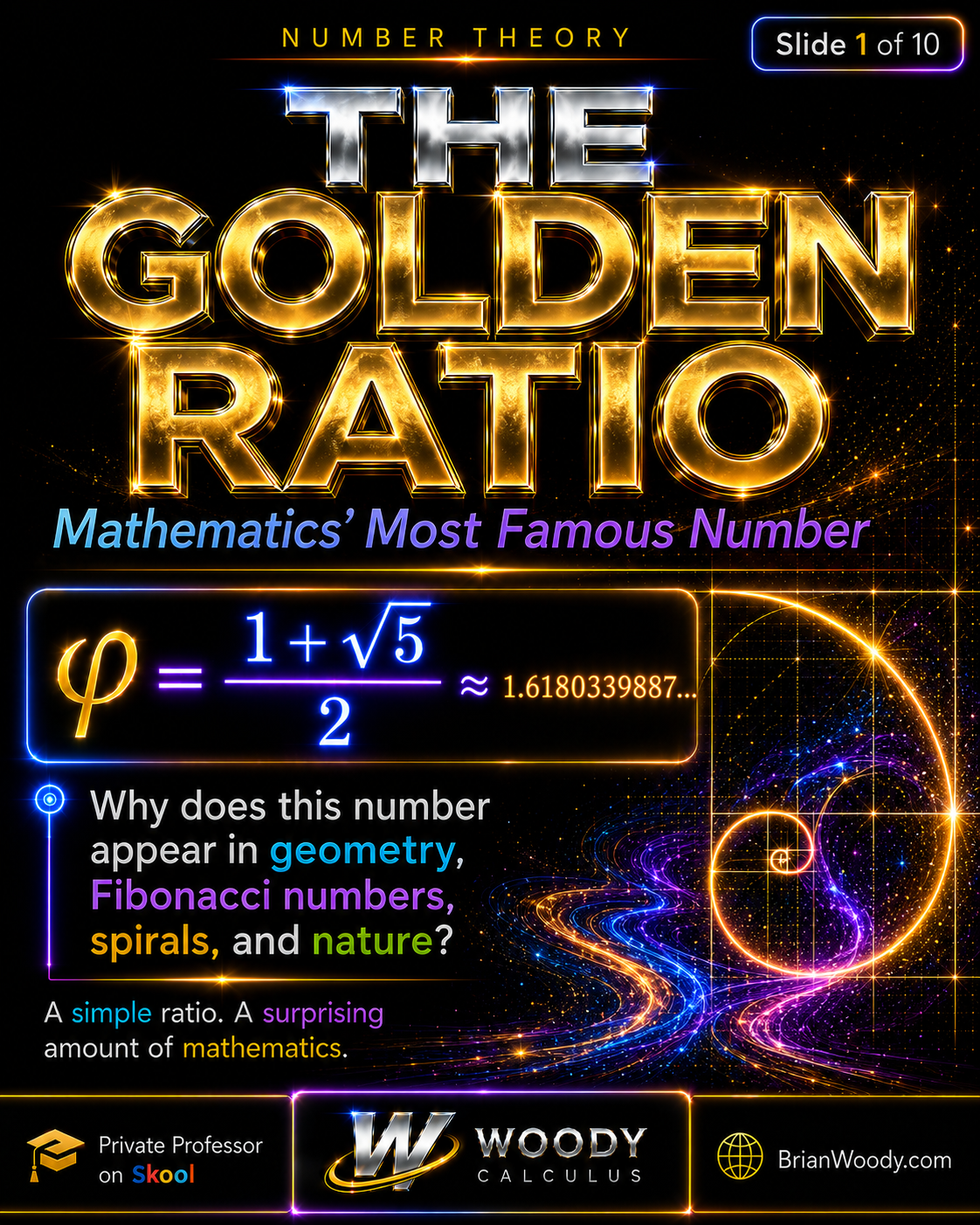
The golden ratio φ=(1+√5)/2 is where geometry, algebra, Fibonacci numbers, limits, continued fractions, pentagons, spirals, and phyllotaxis meet. This complete Woody Calculus visual lesson derives phi, proves the Fibonacci limit, distinguishes a true golden spiral from Fibonacci-style arcs, and separates real mathematics from popular mythology.
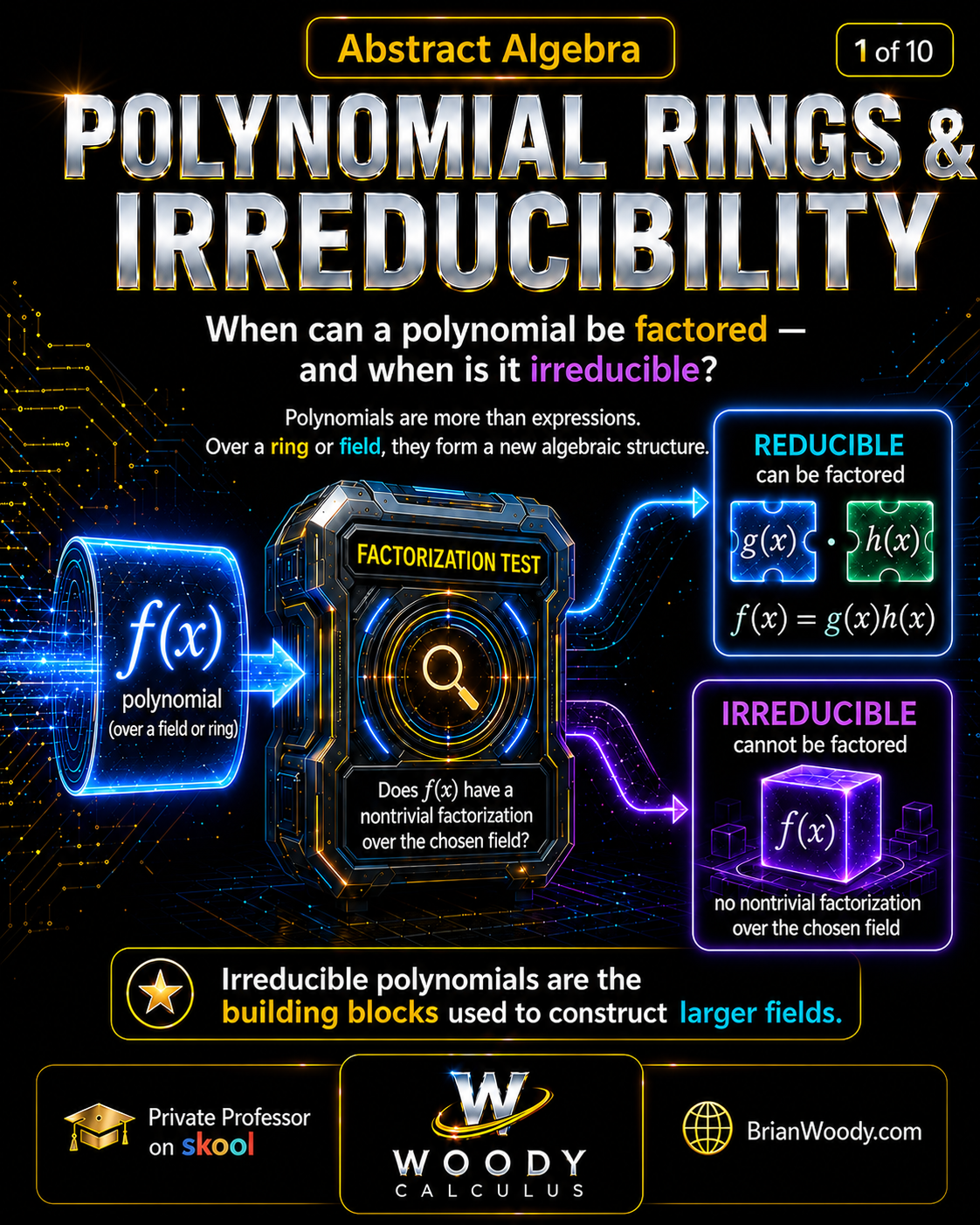
Polynomial irreducibility is never just about the polynomial—it depends on the coefficient ring or field. Learn a complete Abstract Algebra decision system using root tests, the Rational Root Theorem, Gauss’s Lemma, Eisenstein’s Criterion, reduction modulo p, finite-field factor tests, quotient rings, and field extensions.
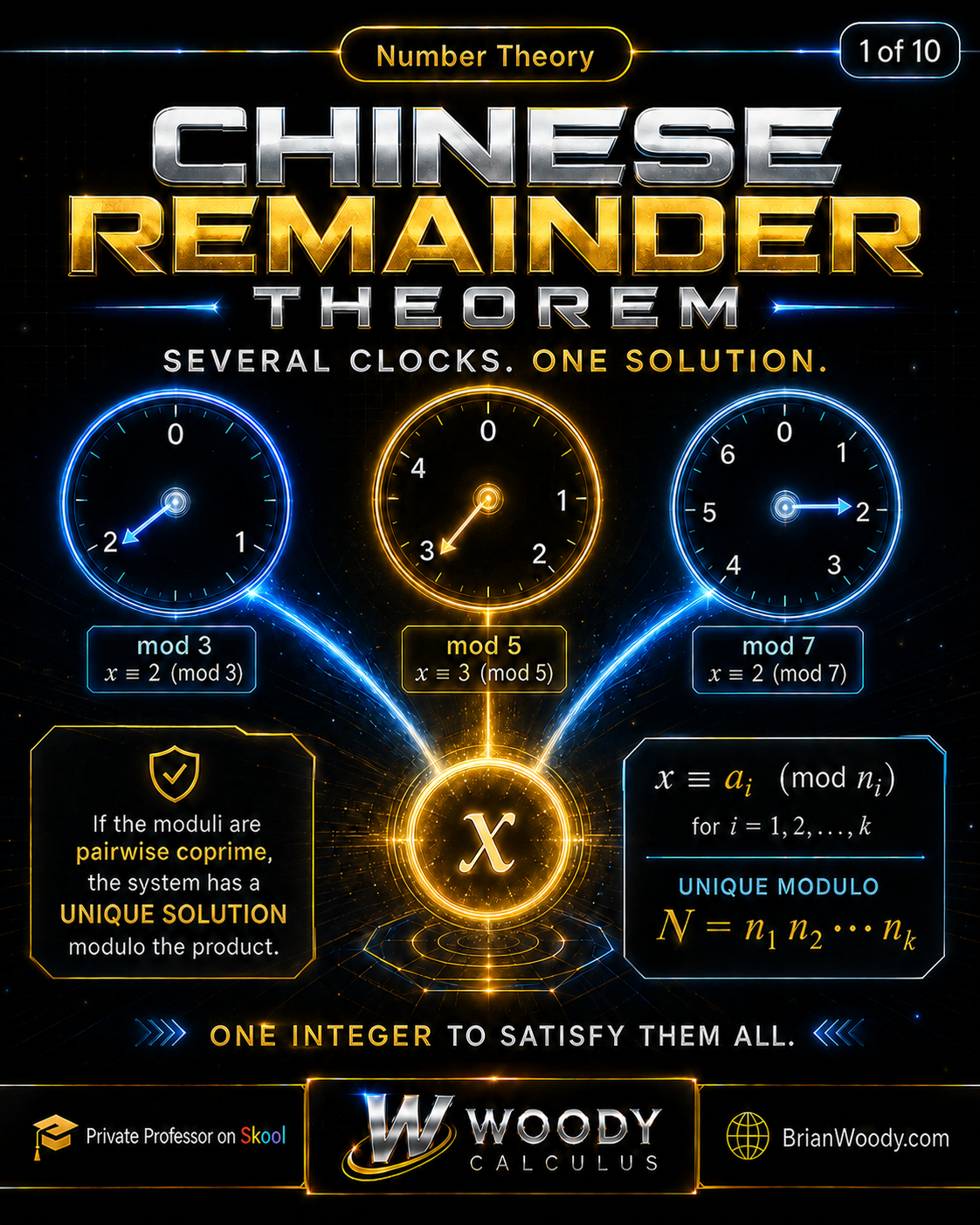
The Chinese Remainder Theorem combines simultaneous congruences into one residue class. Learn the modular-inverse algorithm, two complete examples, proof, verification, noncoprime cases, common mistakes, and exam-ready method selection.
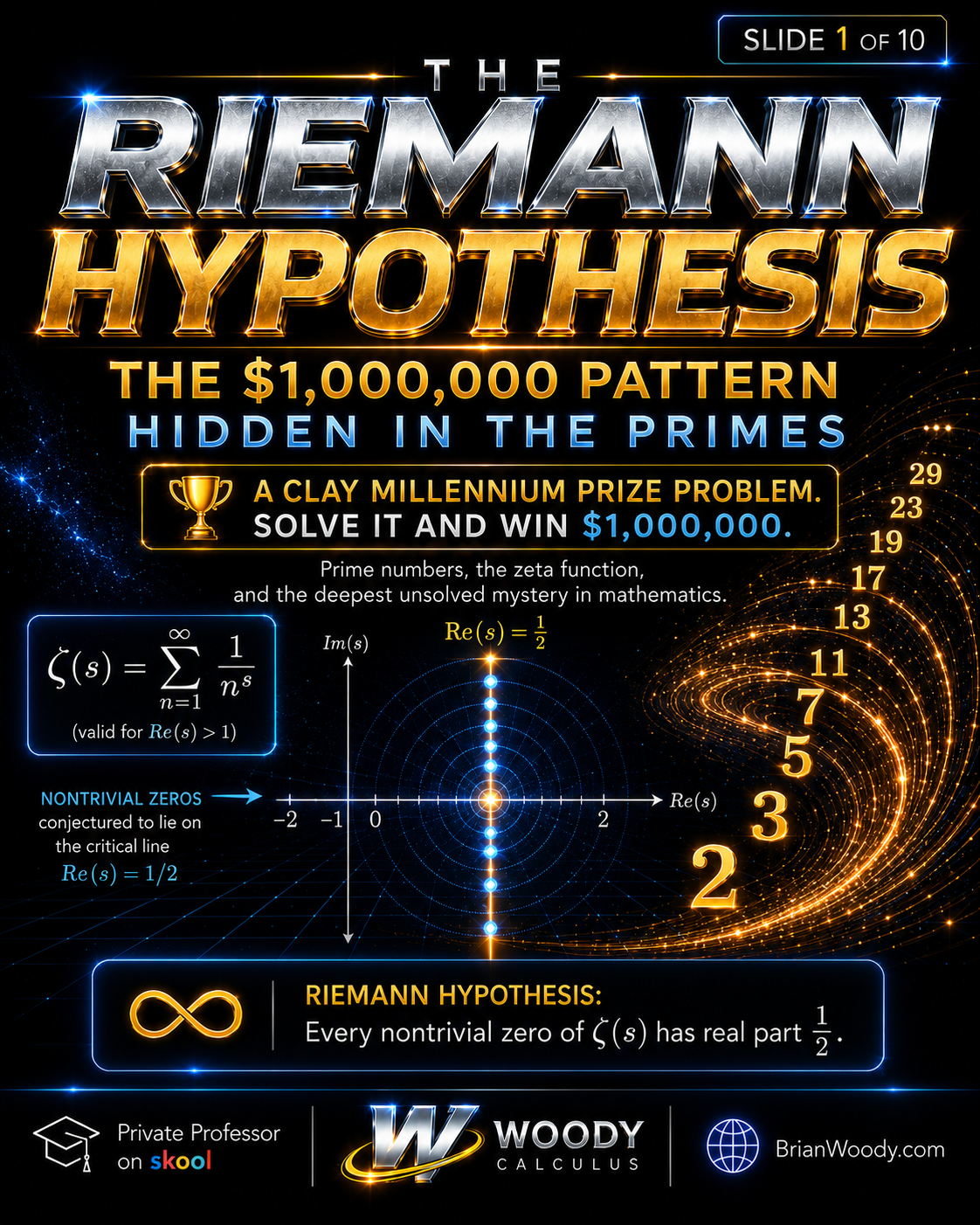
The Riemann Hypothesis is one of the deepest unsolved problems in mathematics. It connects prime numbers, the zeta function, complex analysis, randomness, and hidden order — with a $1,000,000 Clay Mathematics Institute prize for a proof.