![Woody Calculus introduction to differential-equation mixing problems, showing a perfectly stirred saltwater tank with inflow and outflow. The governing model is Q′(t) = c_in r_in − [Q(t)/V(t)]r_out. Equal flow rates produce constant volume, while unequal flow rates produce changing volume.](https://k3p6r8v3.delivery.rocketcdn.me/wp-content/uploads/2026/08/Mixing_Problems_Slide_01.png)

Learn how to model and solve differential-equation mixing problems with rate in minus rate out. Work through constant-volume, draining-tank, and overflow examples, then practice the complete seven-step method.
Learn how to model and solve differential-equation mixing problems with rate in minus rate out. Work through constant-volume, draining-tank, and overflow examples, then practice the complete seven-step method.
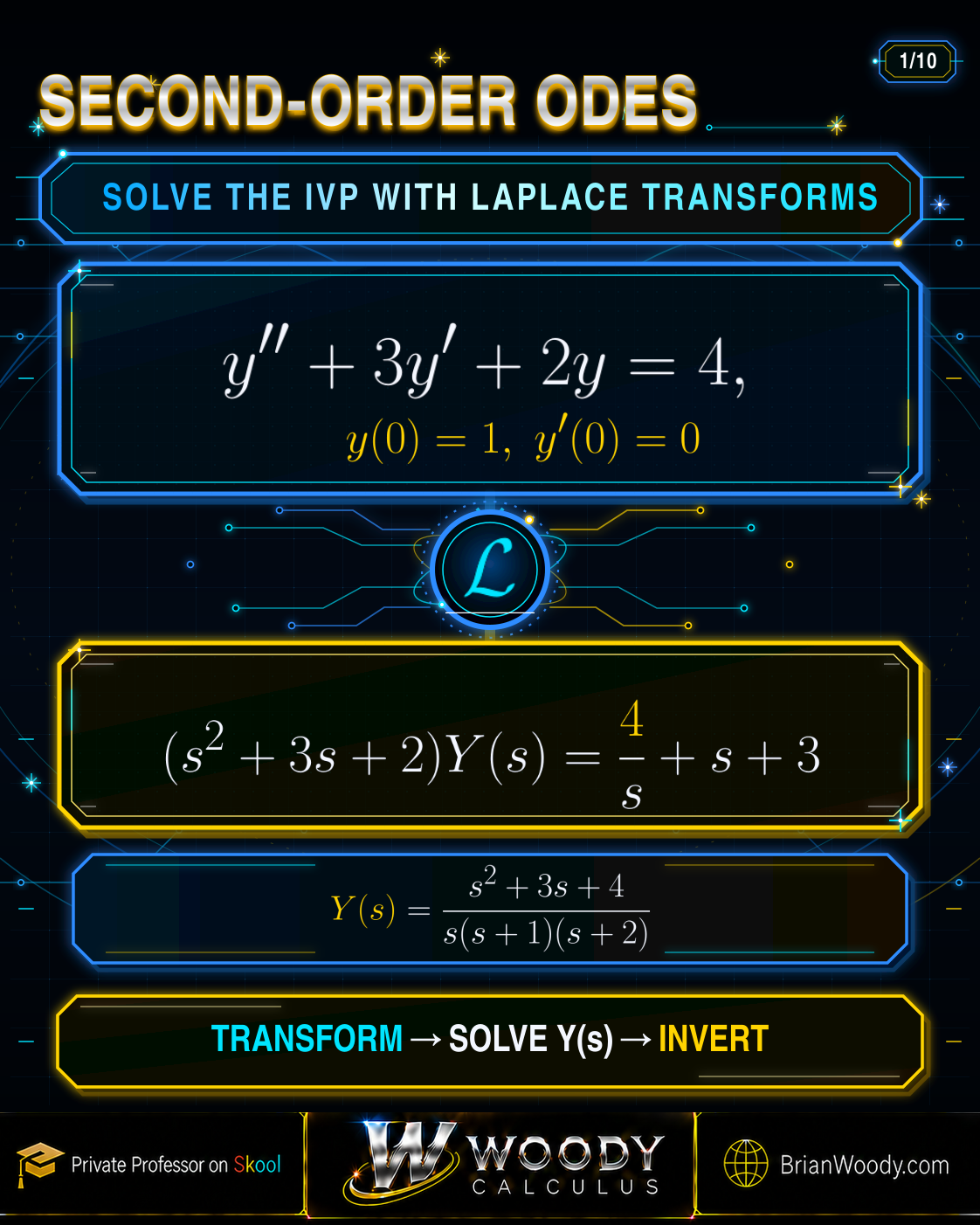
Laplace transforms turn second-order initial-value problems into algebra while carrying the initial conditions with them. Learn the complete seven-step method, partial fractions, delayed unit-step inputs, Dirac delta impulses, transfer functions, impulse response, convolution, stability, and verification through exact worked examples.
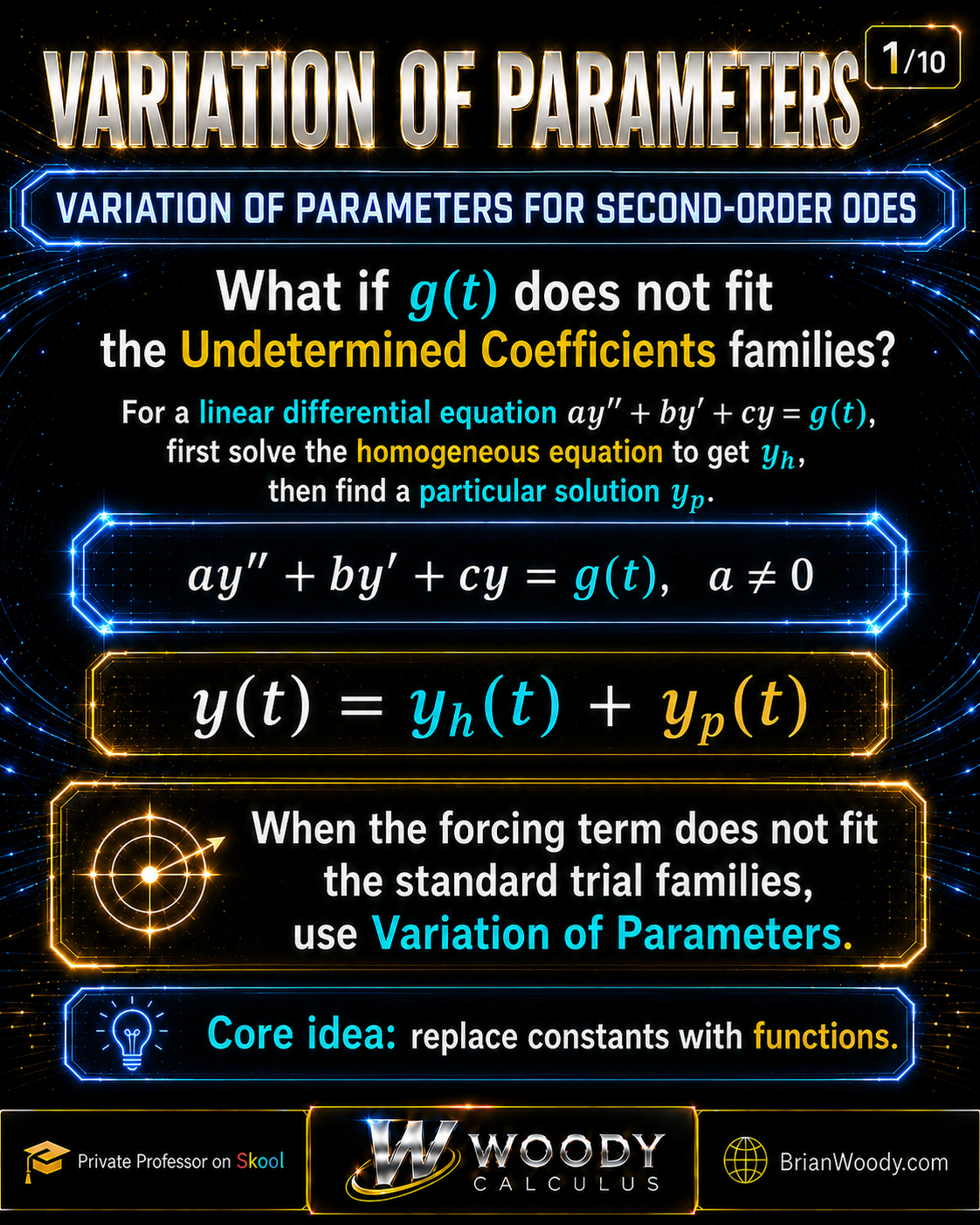
Differential Equations • Second-Order Linear ODEs • Visual Lesson Level: Undergraduate Differential Equations | Core skill: Find a particular solution…
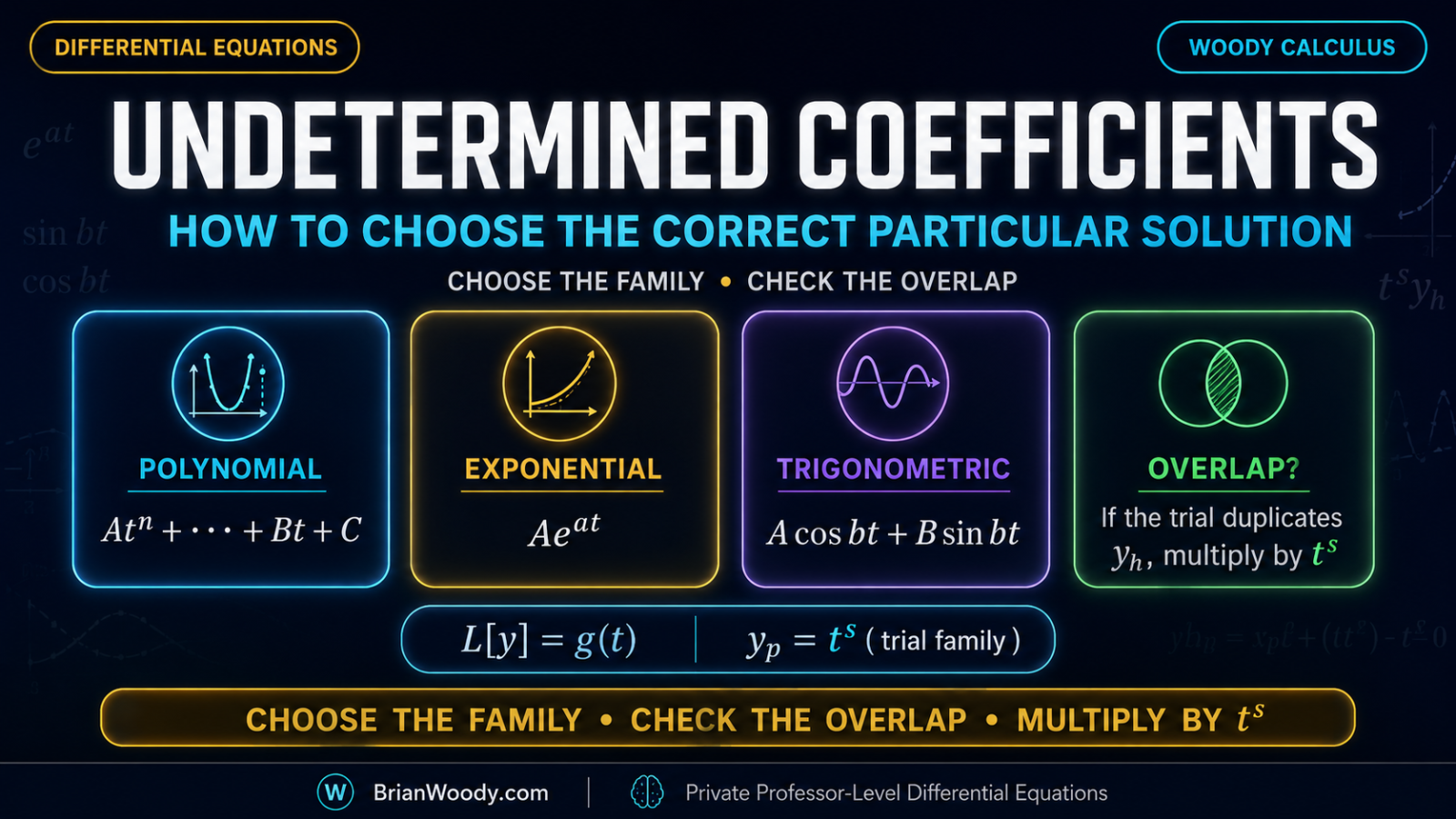
Learn the method of undetermined coefficients from the forcing term to the final solution. Use the Woody Calculus master y_p guess table, build polynomial, exponential, and trigonometric trial solutions, check for overlap with the homogeneous solution, apply the t^s rule, and work through resonance, repeated-root, and initial-value examples.
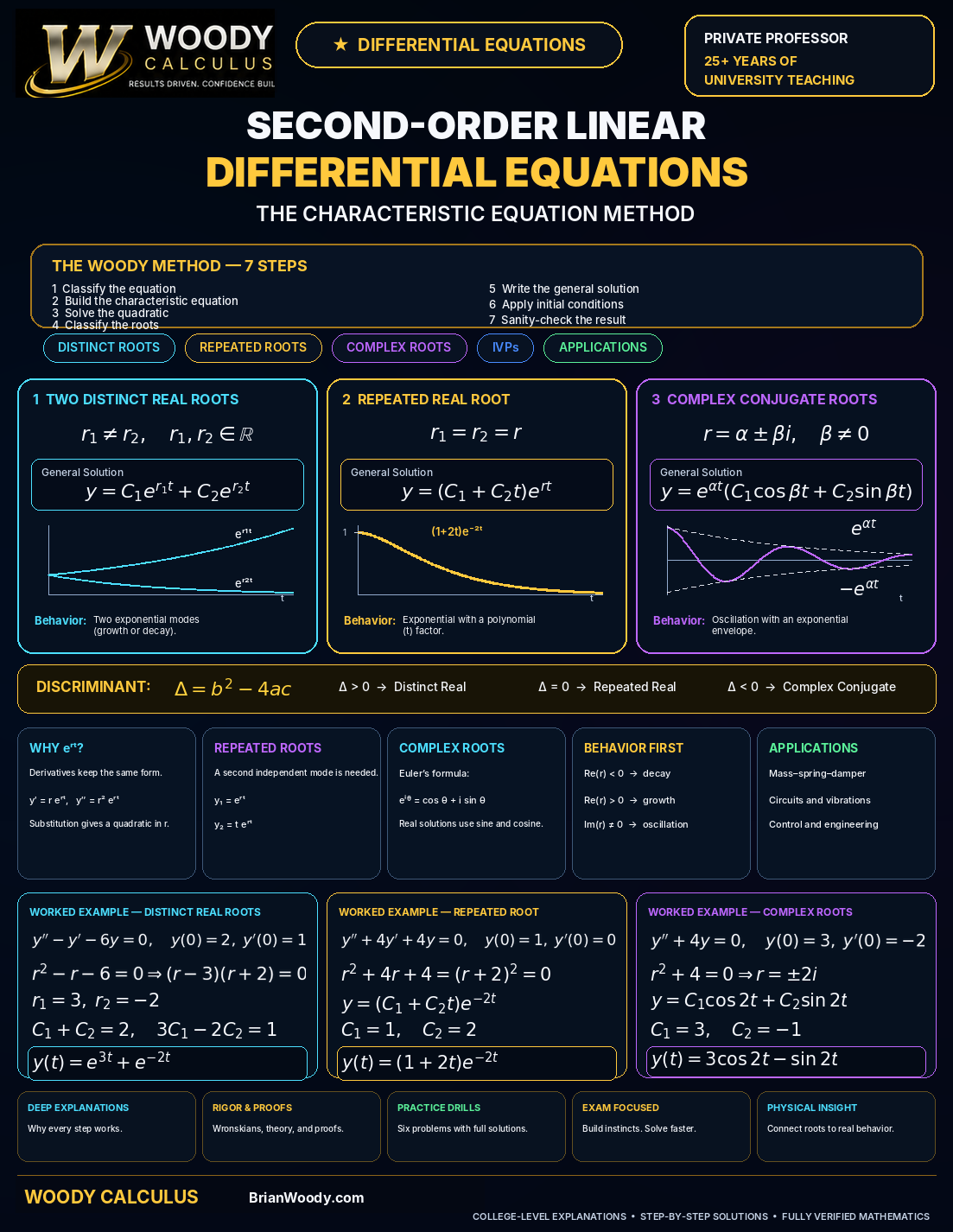
Learn to solve homogeneous second-order linear differential equations with constant coefficients using the characteristic equation. Master distinct real roots, repeated roots, complex conjugate roots, initial-value problems, boundary-value problems, damping, and the Woody Calculus root-classification method.
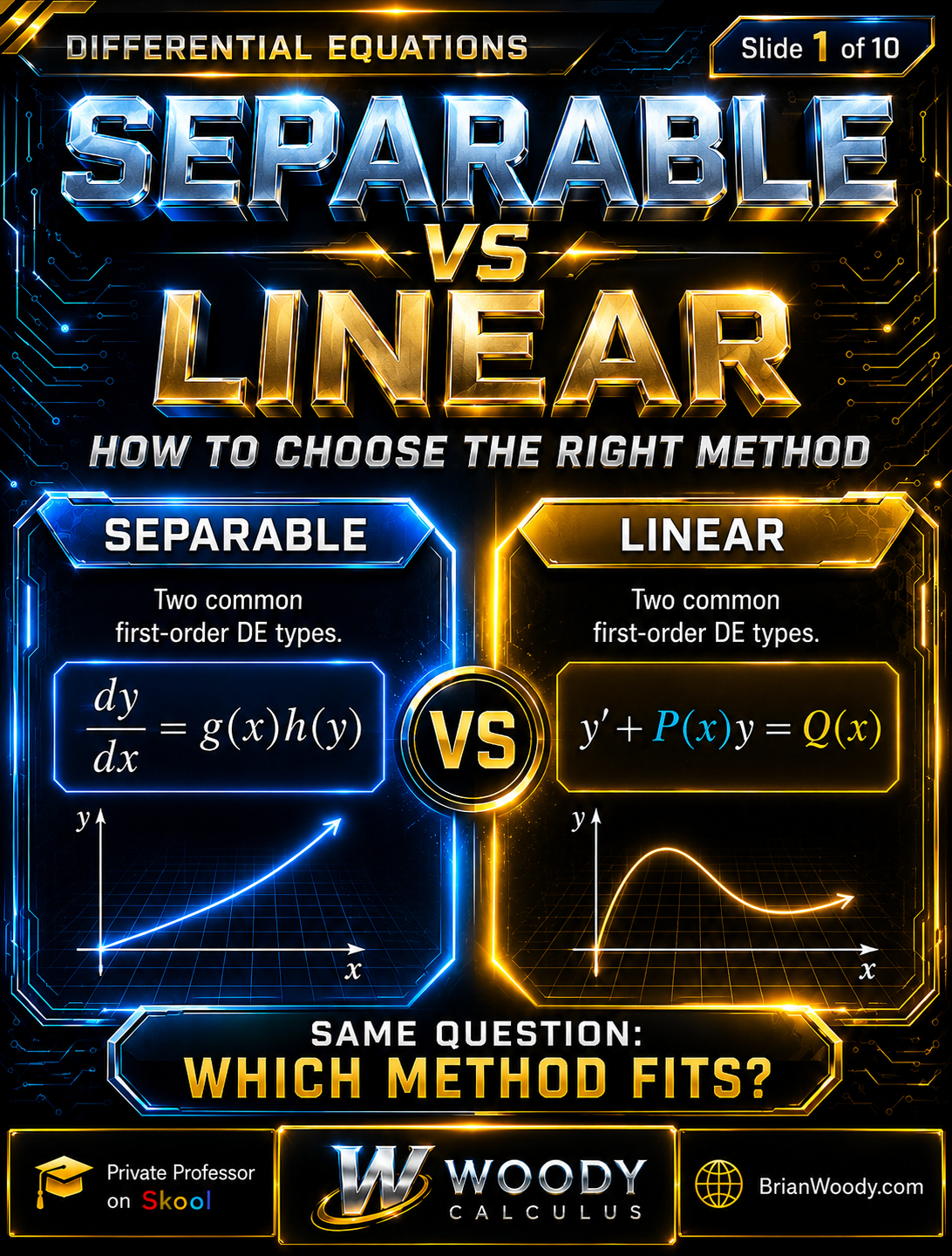
How do you decide whether to use separation of variables or an integrating factor? This Woody Calculus lesson explains how to classify separable and first-order linear differential equations, solve each type step by step, handle equations that fit both methods, and verify the final solution.