A Cauchy sequence detects convergence from inside the sequence: sufficiently late terms become arbitrarily close to one another without first knowing the limit. This complete Woody Calculus lesson develops the formal epsilon-N definition, proves that every convergent sequence is Cauchy, explains why ℚ is incomplete and ℝ is complete, and connects completeness to metric spaces, compactness, function spaces, and Banach fixed-point theory.
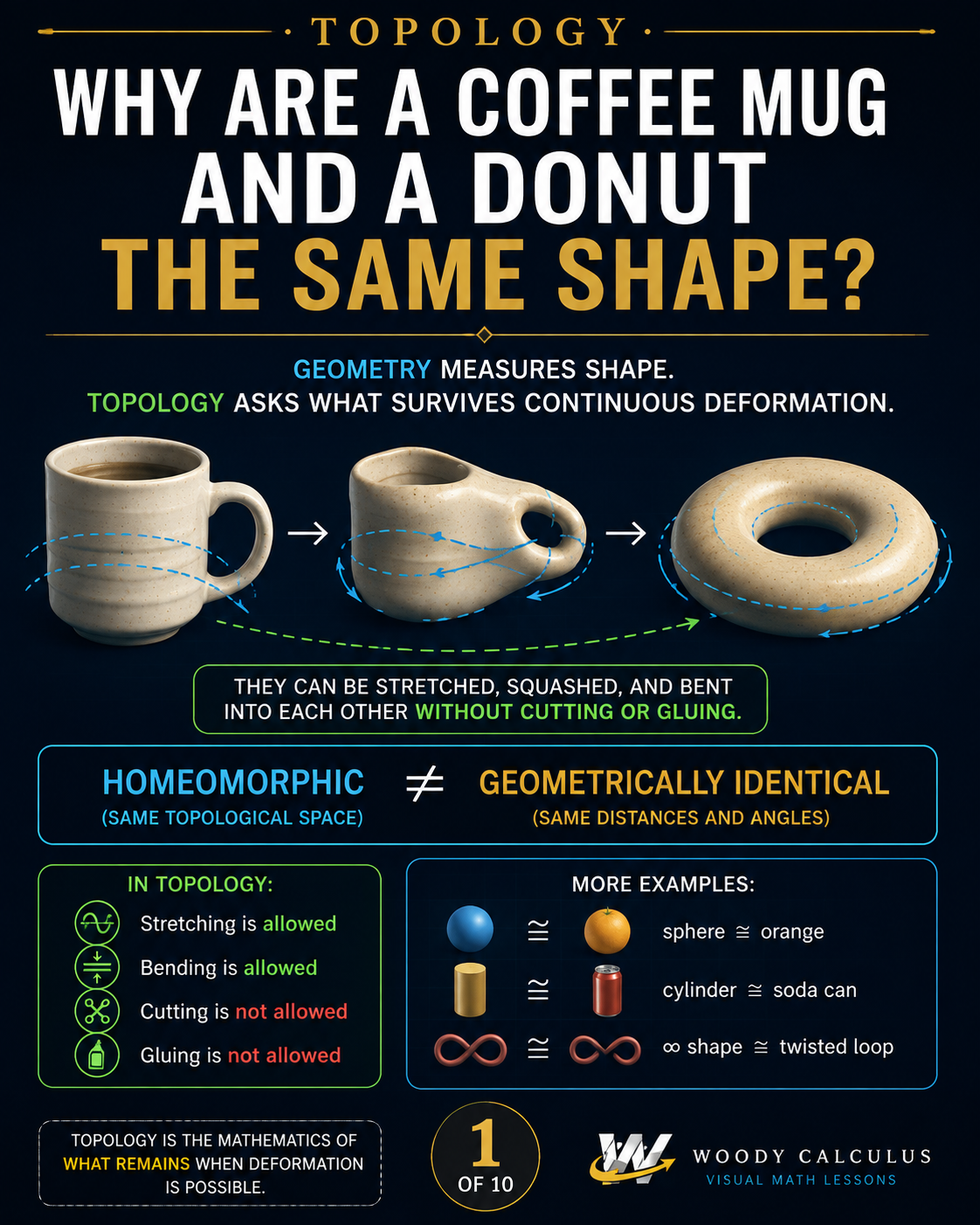
What is topology really about? Start with the famous coffee mug and donut, then learn open sets, continuity, homeomorphisms, connectedness, compactness, Euler characteristic, orientability, and the fundamental group.
What does compactness mean in Real Analysis? Learn open covers, finite subcovers, the Heine–Borel Theorem, sequential compactness, Bolzano–Weierstrass, and why continuous functions become dramatically better behaved on compact sets.


![Real Analysis compactness overview showing the closed interval [0,1] and three consequences: convergent subsequences, maxima and minima for continuous functions, and uniform continuity.](https://k3p6r8v3.delivery.rocketcdn.me/wp-content/uploads/2026/08/Compactness-Slide-1.png)