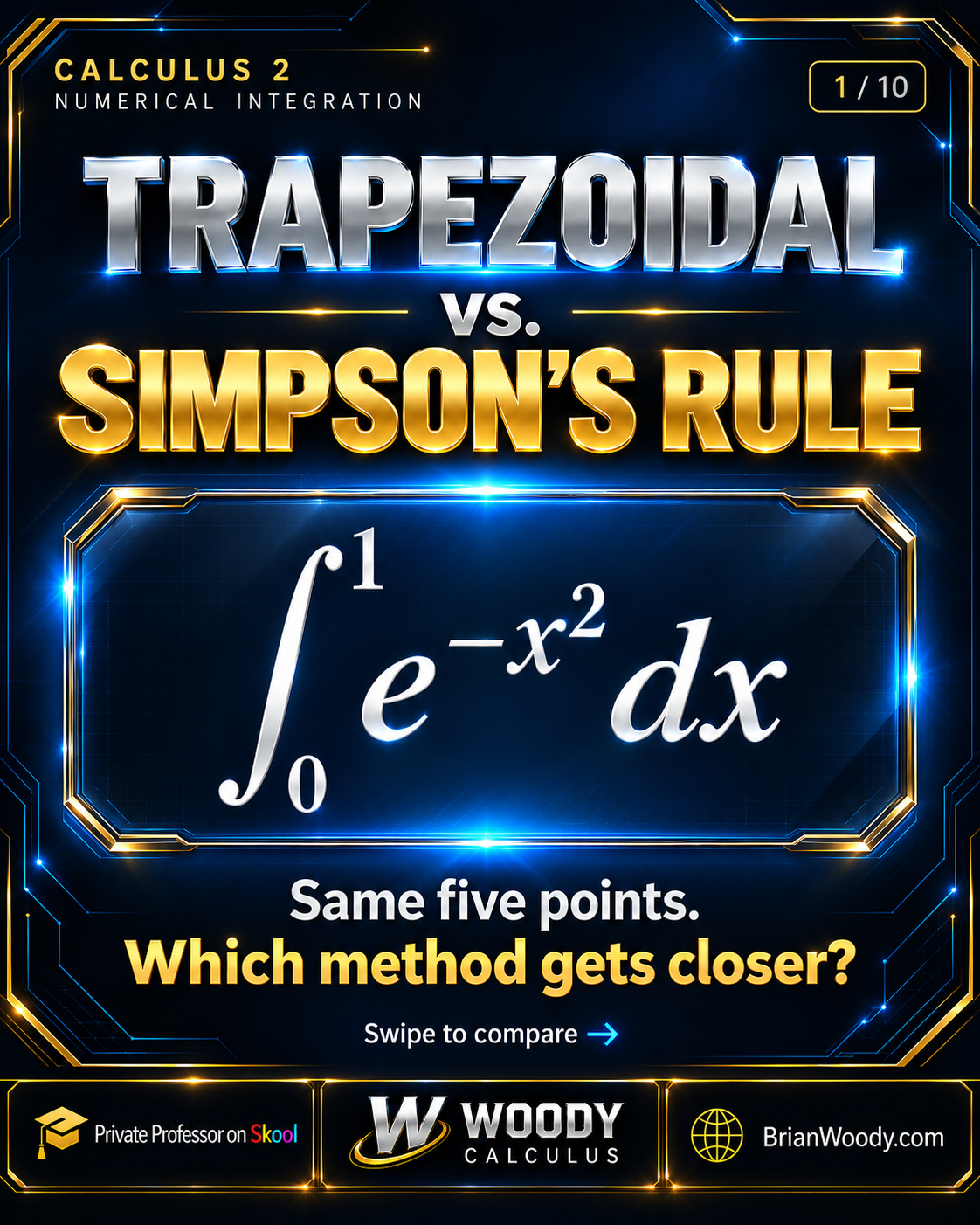
The same five points can produce very different integral estimates. Work through the trapezoidal rule and Simpson’s rule step by step, compare their absolute errors, and learn how error bounds guide your choice of subintervals. Then connect the methods to midpoint and Romberg integration and test your skills on a practice problem with a complete solution.
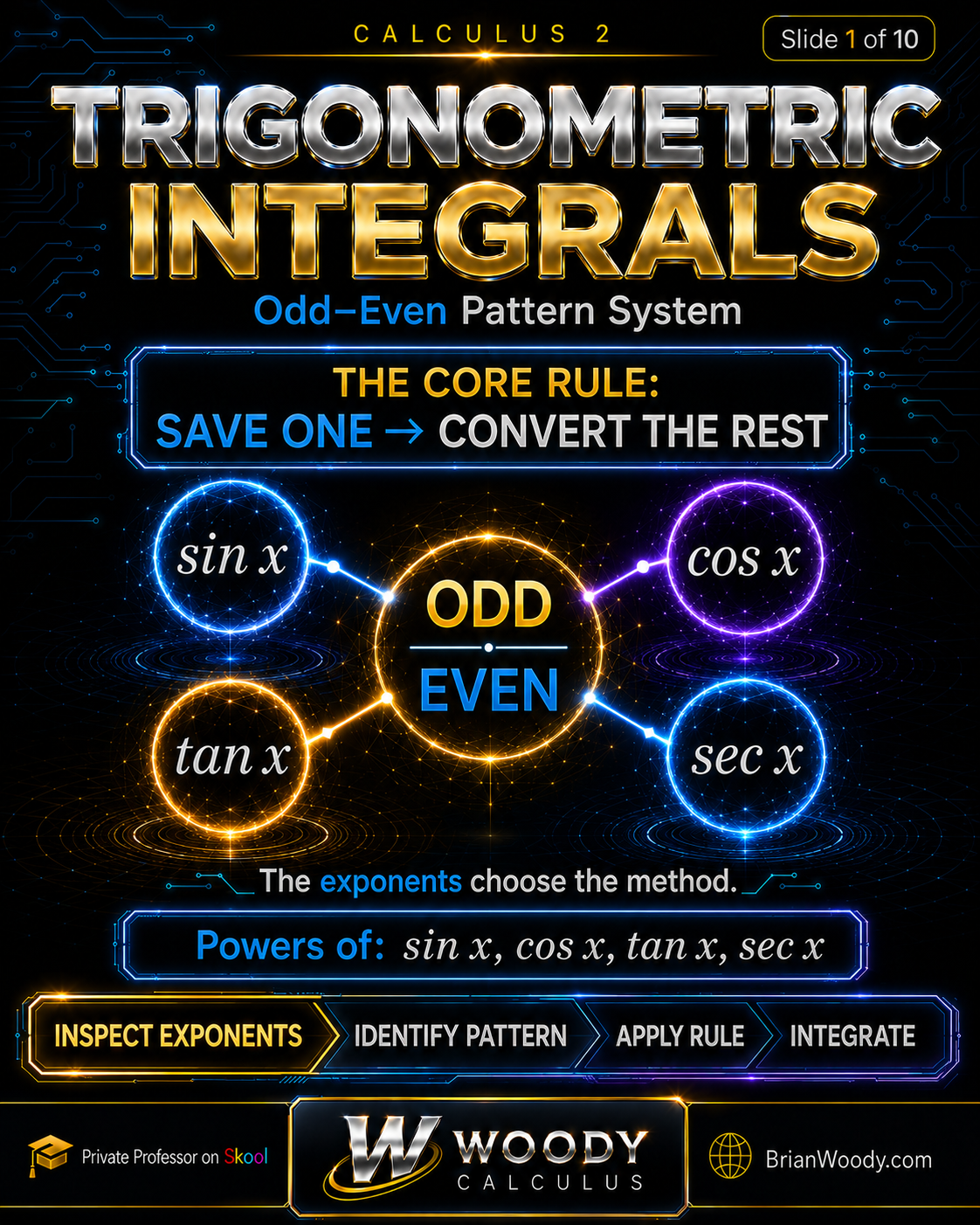
Learn trigonometric integrals through the Woody Calculus odd-even pattern system. This complete Calculus 2 lesson explains when to save one sine, cosine, secant-squared, or secant-tangent factor; when to use power reduction; how cosecant and cotangent mirror the pattern; and how to verify every answer by differentiation.
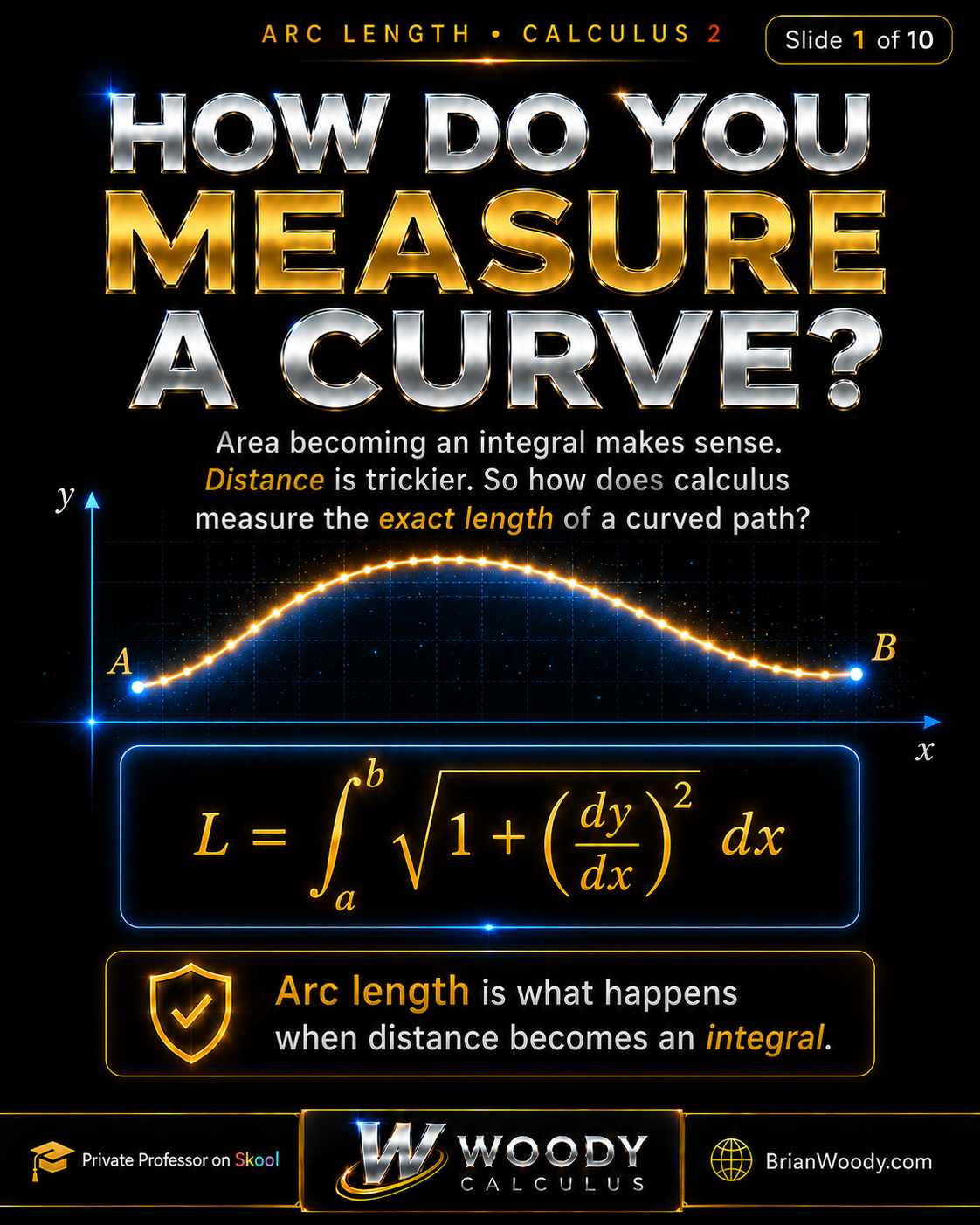
Arc length measures the exact distance along a curve by adding infinitely many tiny straight-line distances. This Woody Calculus lesson derives the formula, explains the ds triangle, and solves the classic hard arc length example step by step.
Improper integrals are Calculus 2 limit problems in disguise. This Woody Calculus lesson teaches how to handle infinite intervals, vertical asymptotes, bad points inside an interval, p-integrals, comparison tests, convergence, and divergence with a clear step-by-step system.
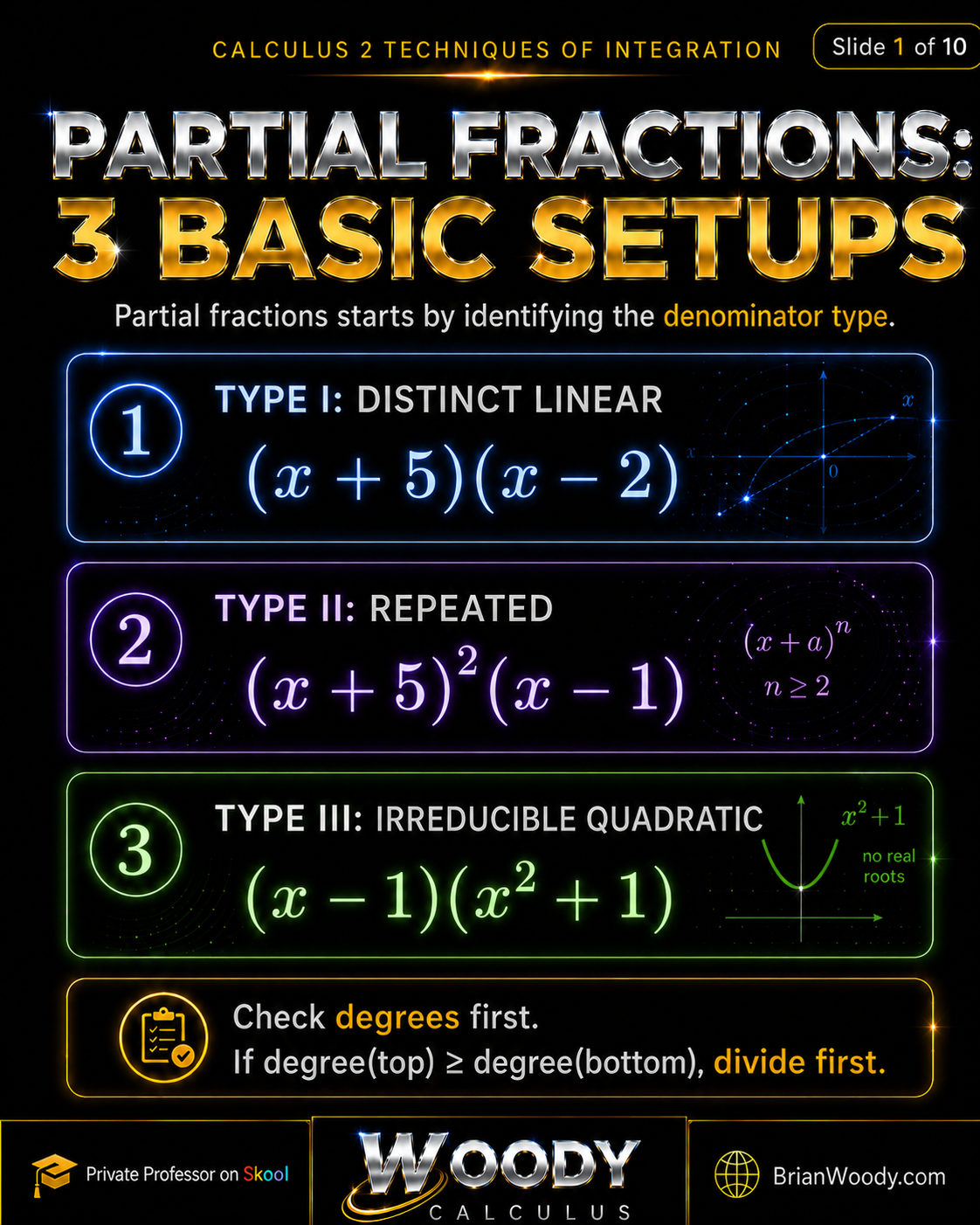
Partial fraction decomposition becomes easier when students stop guessing and identify the denominator type first. This Woody Calculus lesson teaches the complete Calculus 2 system: distinct linear factors, repeated factors, irreducible quadratics, solving for constants, and integrating each piece.
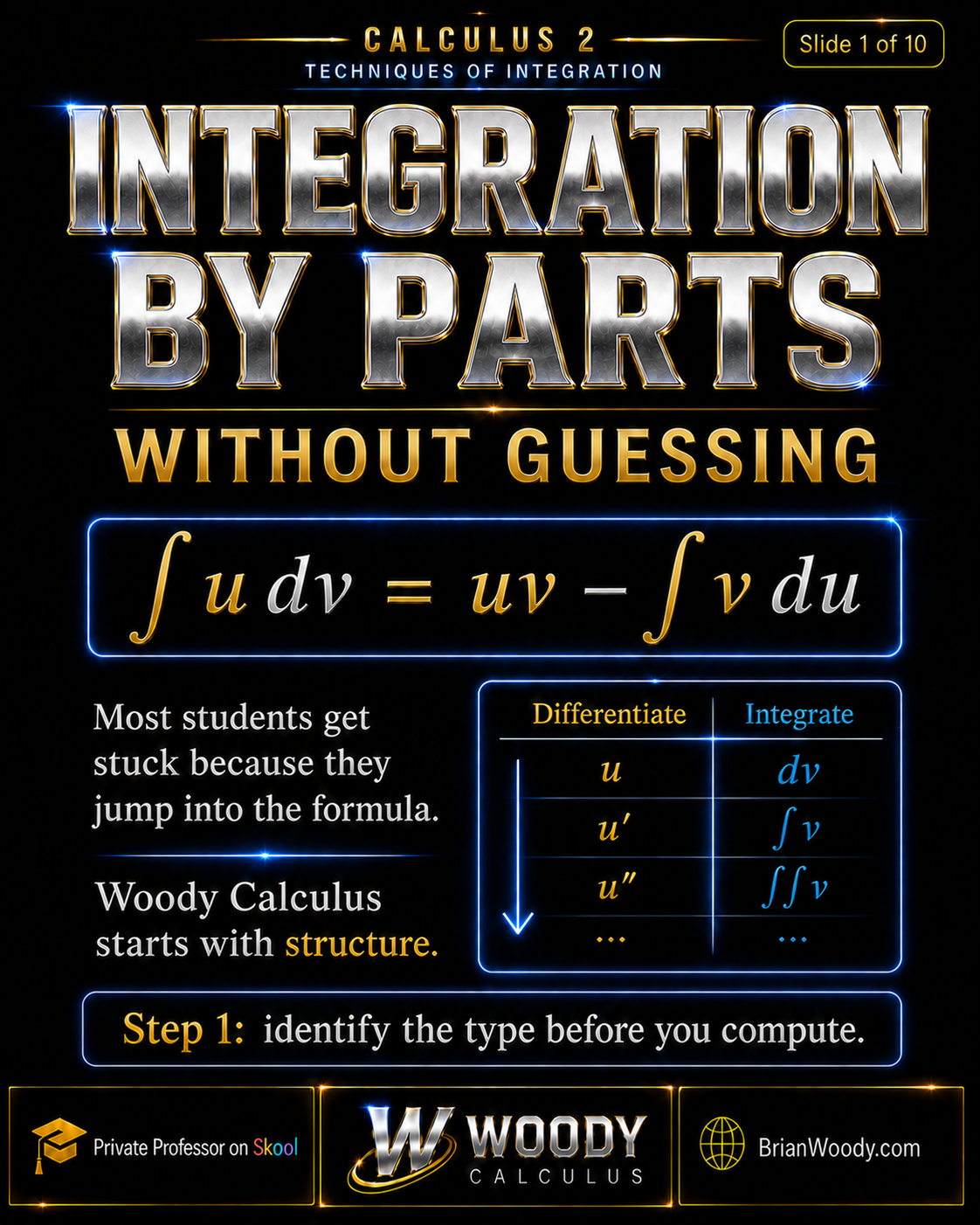
Integration by parts becomes easier when students stop guessing and identify the structure first. This Woody Calculus lesson teaches the complete 3-type IBP system for Calculus 2, including tabular integration by parts, exponential-trig loops, logarithms, inverse trig, and worked examples.
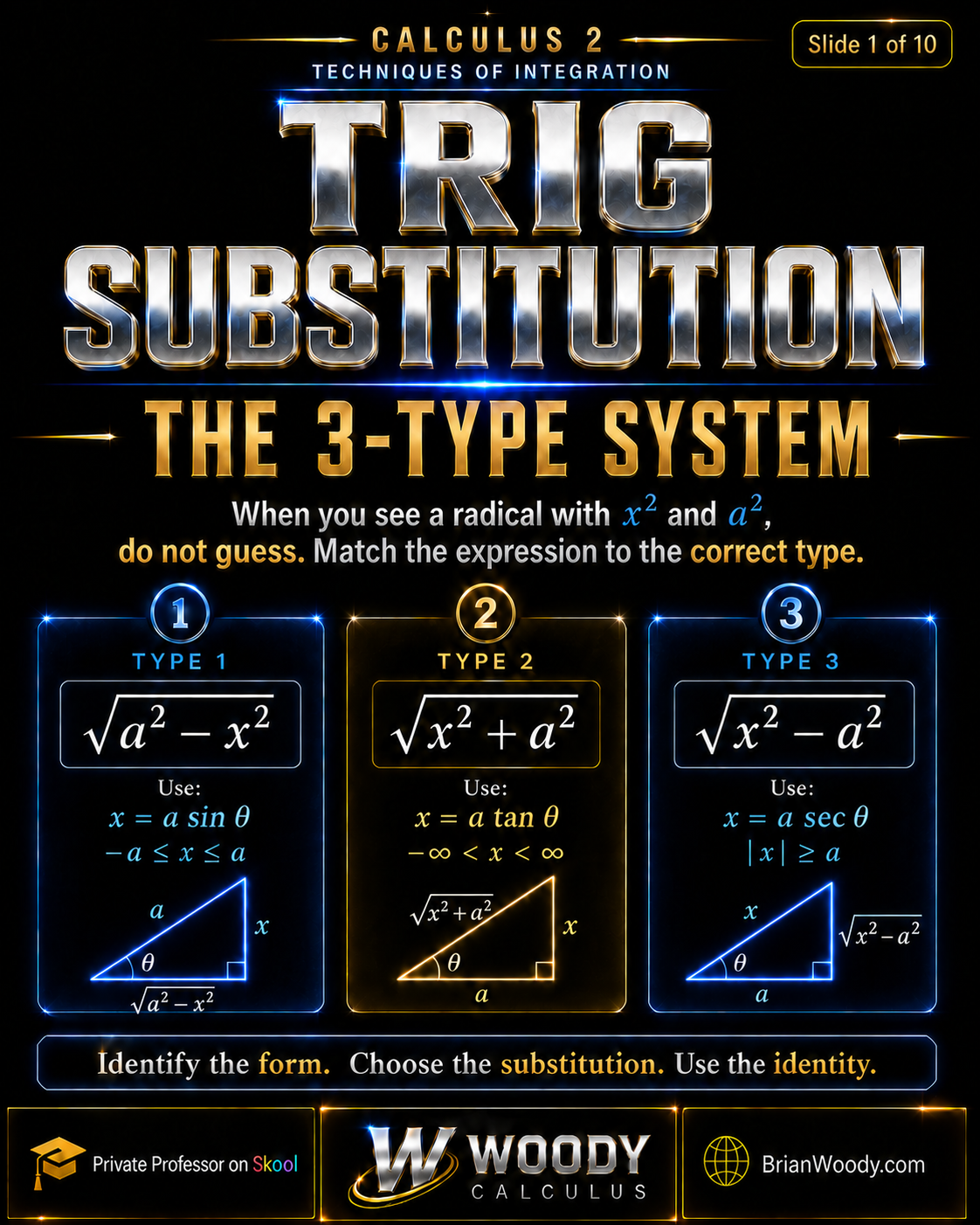
Trig substitution becomes much easier when students stop guessing and match the radical to one of three forms. This Woody Calculus lesson teaches the complete 3-type system for Calculus 2: sine for sqrt(a²−x²), tangent for sqrt(x²+a²), and secant for sqrt(x²−a²).