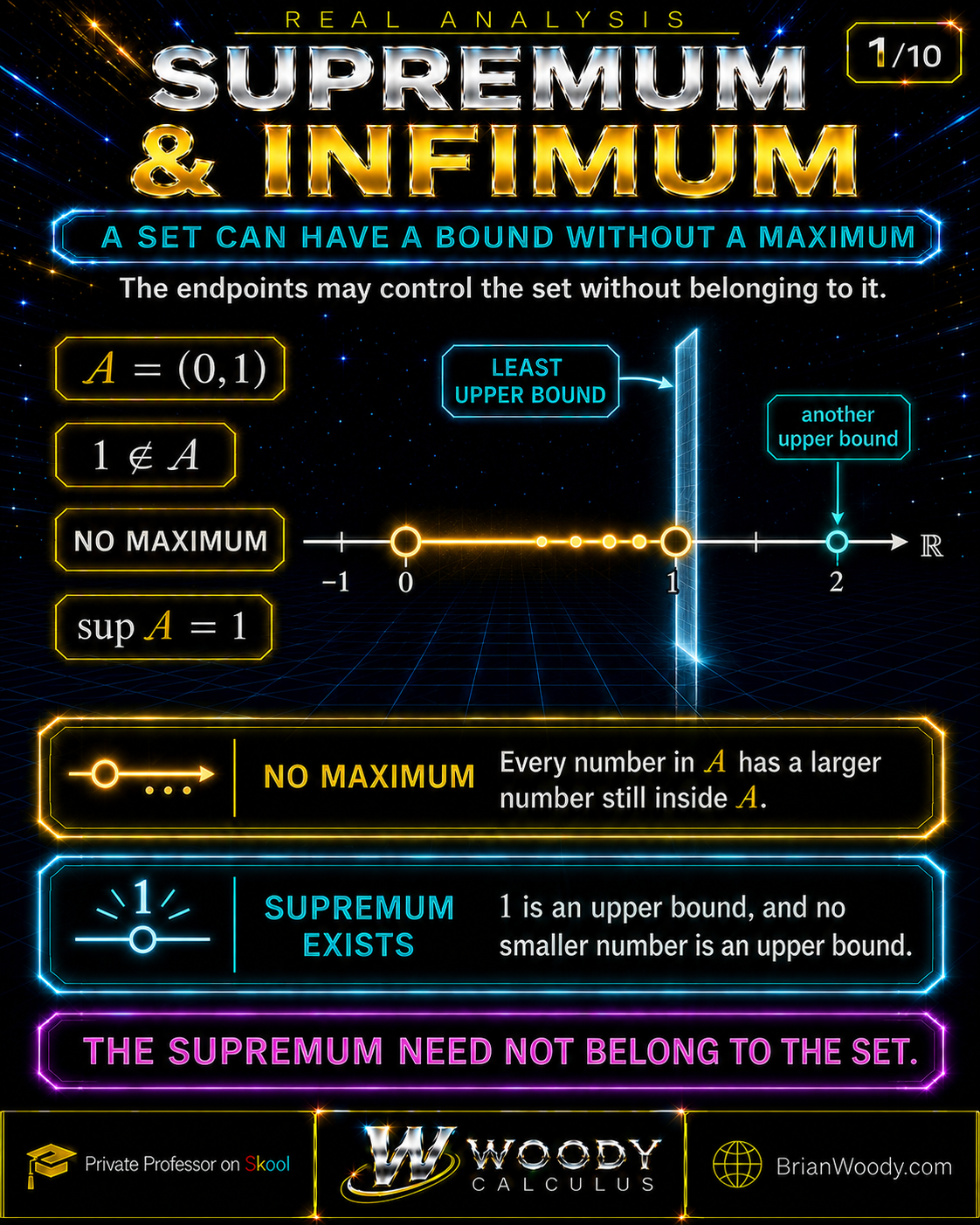
Learn how upper and lower bounds lead to supremum, infimum, maximum, and minimum. This complete Real Analysis lesson includes epsilon proofs, sequence examples, the completeness axiom, and a rigorous explanation of why the rational numbers have gaps.
A Cauchy sequence detects convergence from inside the sequence: sufficiently late terms become arbitrarily close to one another without first knowing the limit. This complete Woody Calculus lesson develops the formal epsilon-N definition, proves that every convergent sequence is Cauchy, explains why ℚ is incomplete and ℝ is complete, and connects completeness to metric spaces, compactness, function spaces, and Banach fixed-point theory.
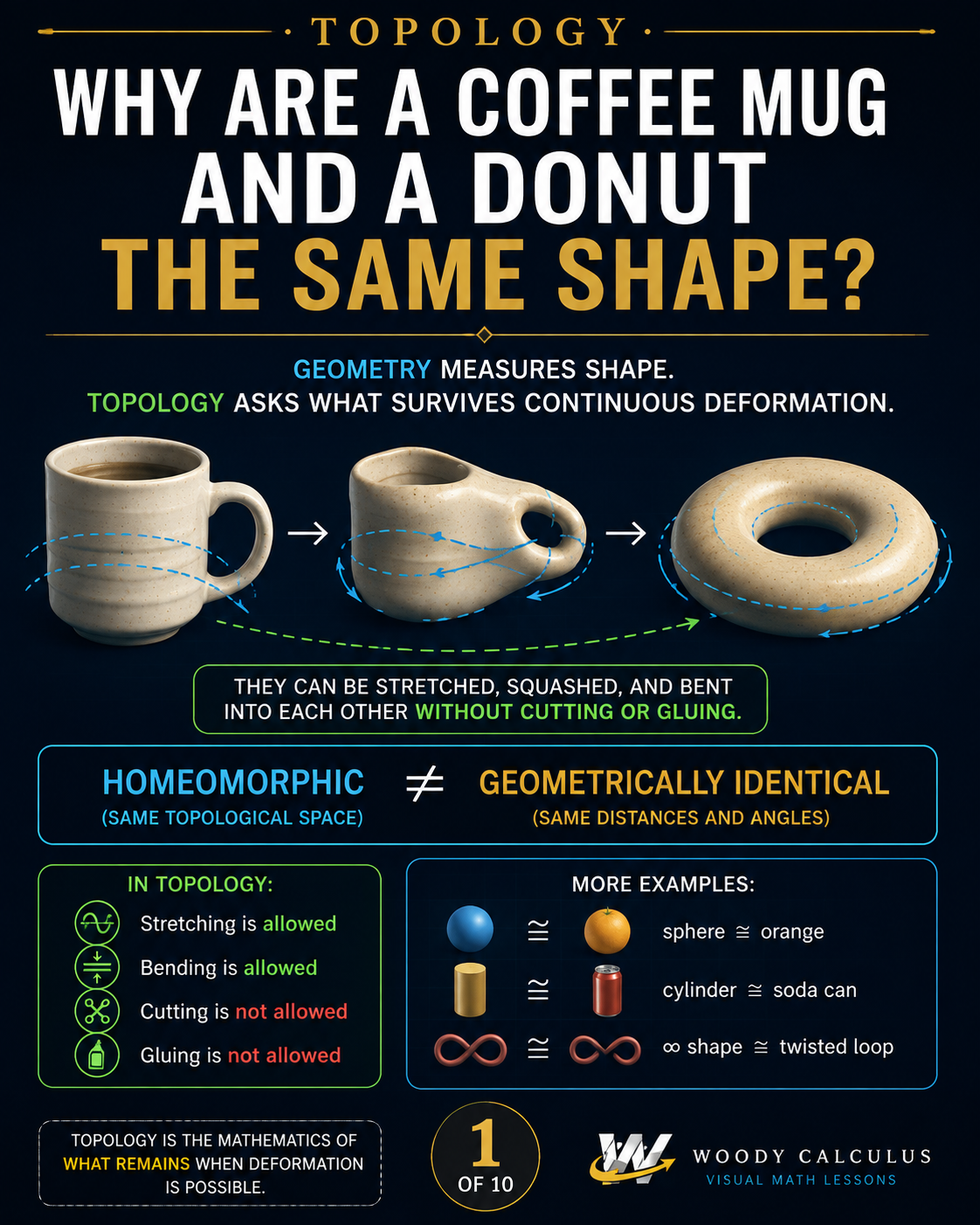
What is topology really about? Start with the famous coffee mug and donut, then learn open sets, continuity, homeomorphisms, connectedness, compactness, Euler characteristic, orientability, and the fundamental group.
What does compactness mean in Real Analysis? Learn open covers, finite subcovers, the Heine–Borel Theorem, sequential compactness, Bolzano–Weierstrass, and why continuous functions become dramatically better behaved on compact sets.
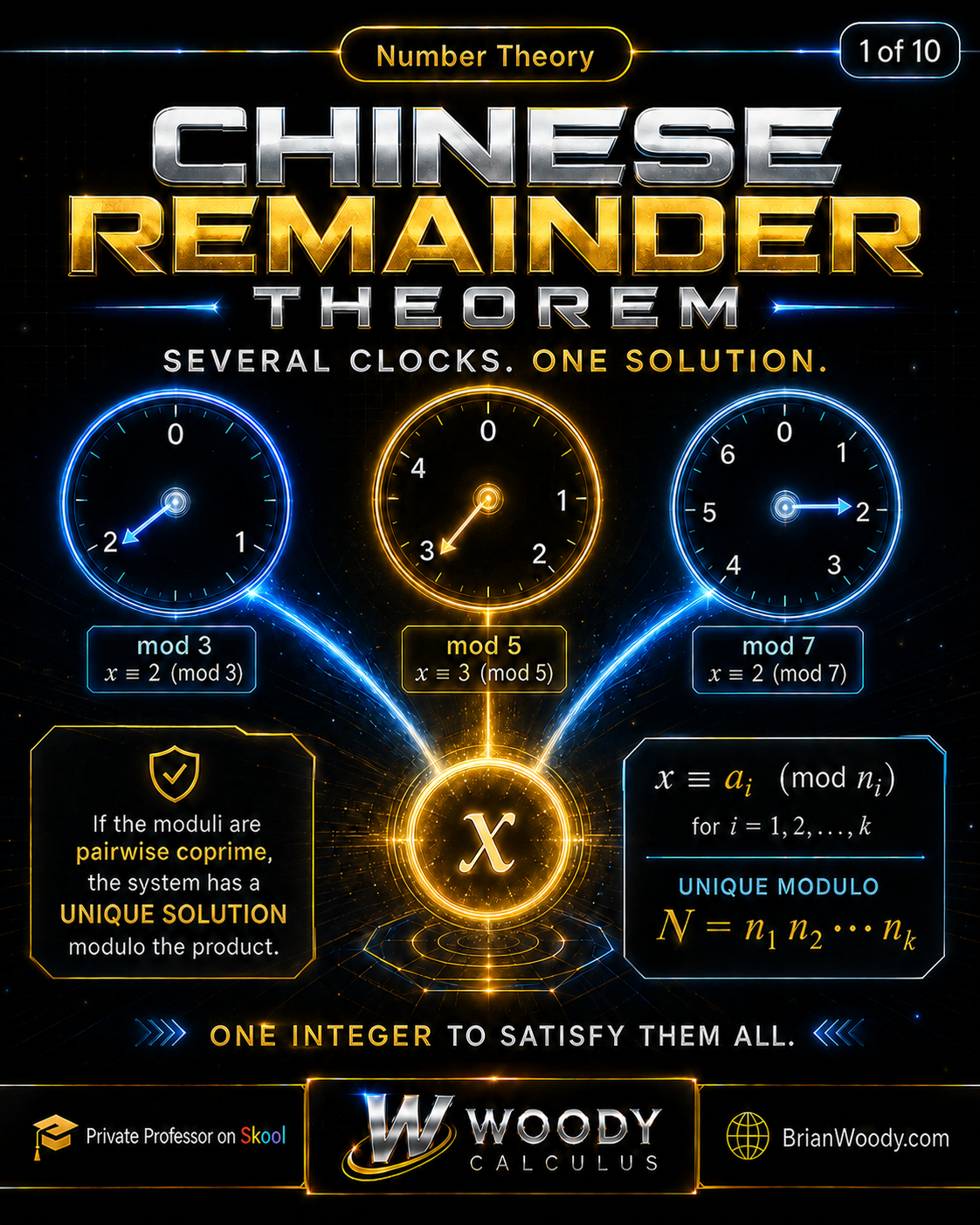
The Chinese Remainder Theorem combines simultaneous congruences into one residue class. Learn the modular-inverse algorithm, two complete examples, proof, verification, noncoprime cases, common mistakes, and exam-ready method selection.
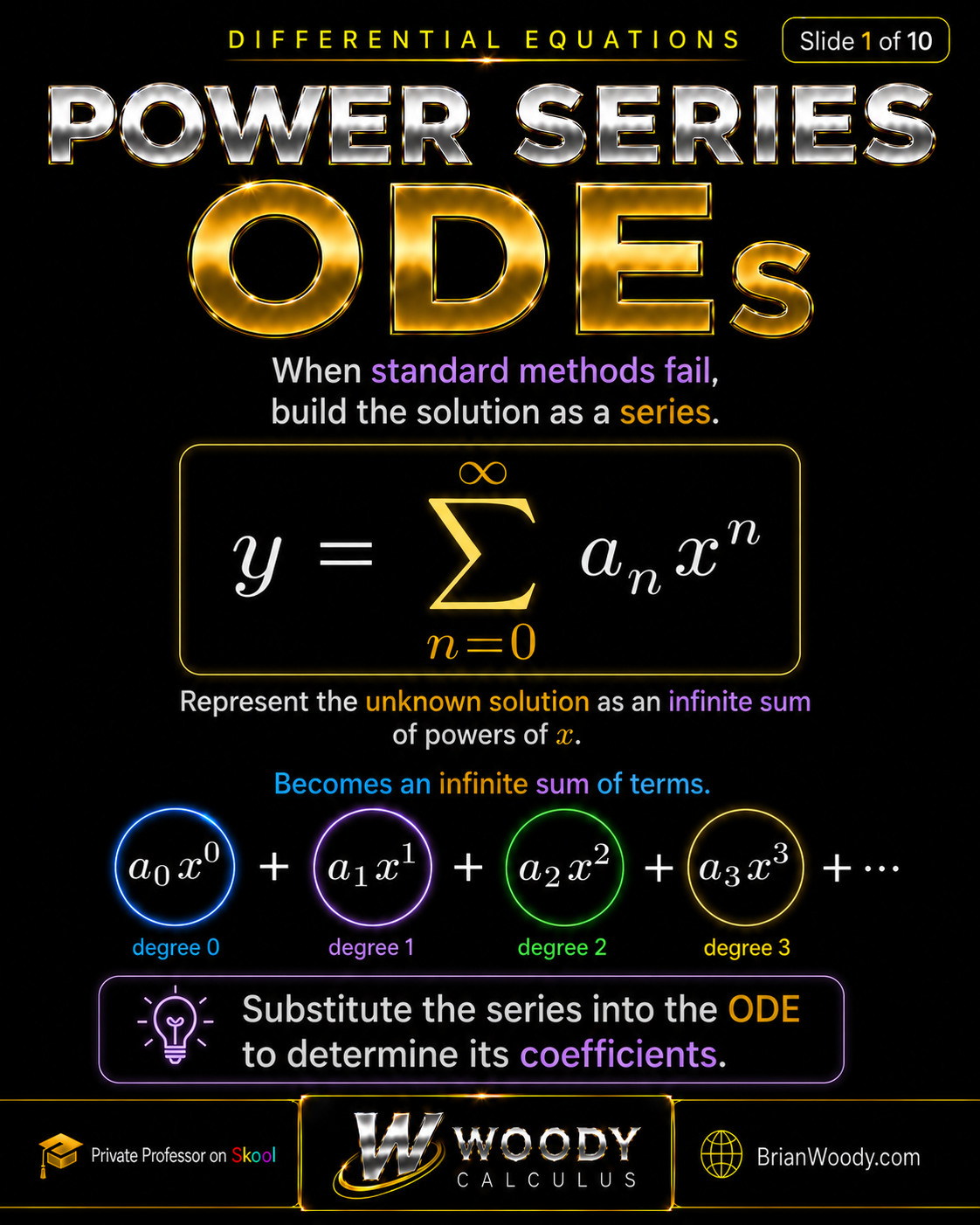
Learn how to solve differential equations with power series through a complete Airy equation example. This Woody Calculus lesson explains ordinary points, term-by-term differentiation, reindexing, recurrence relations, coefficient chains, initial conditions, and independent verification.
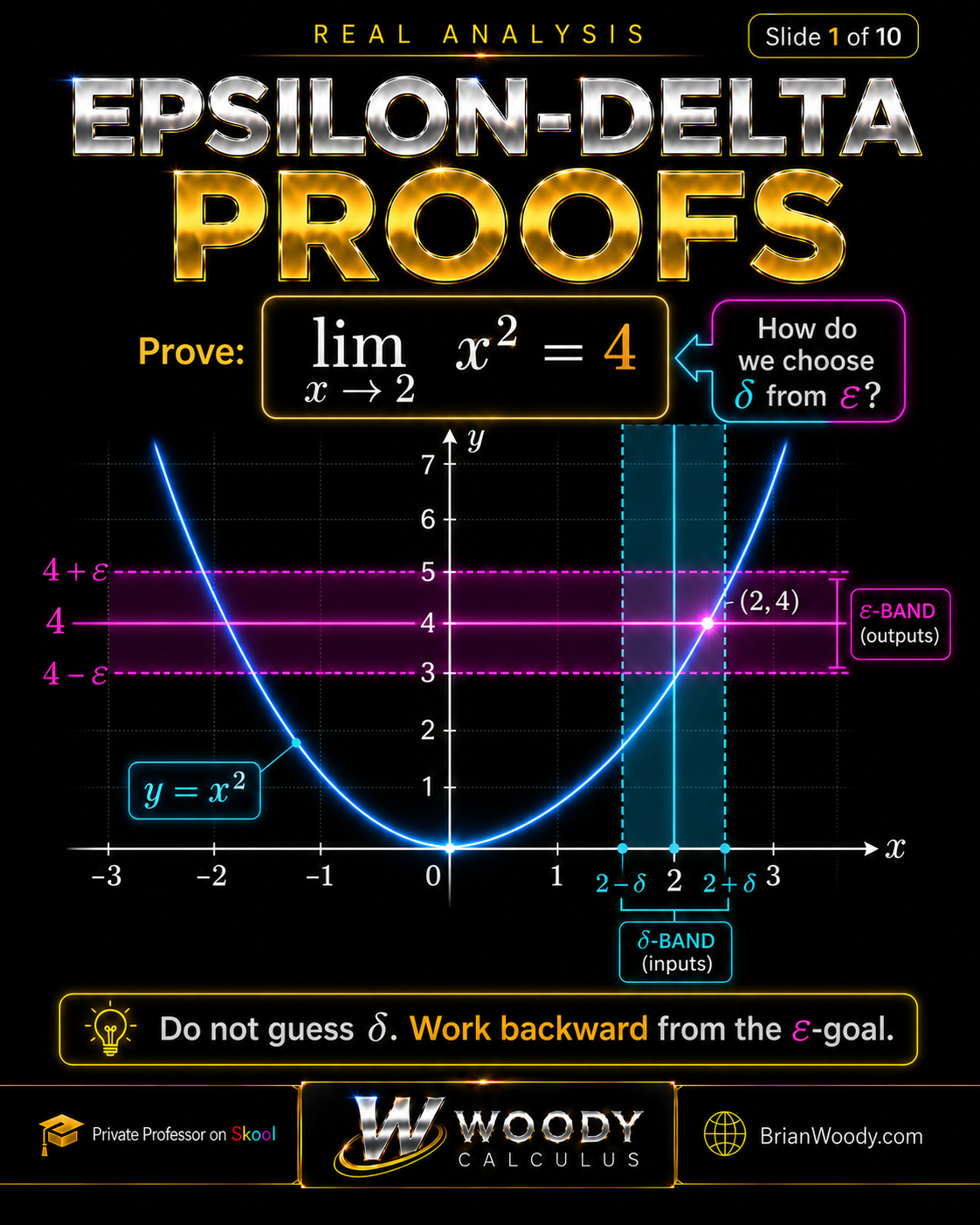
Learn epsilon-delta proofs through visual intuition, exact definitions, and complete worked examples. This Woody Calculus real analysis lesson explains how to choose delta from epsilon, build local bounds, avoid common proof mistakes, and prove limits rigorously.
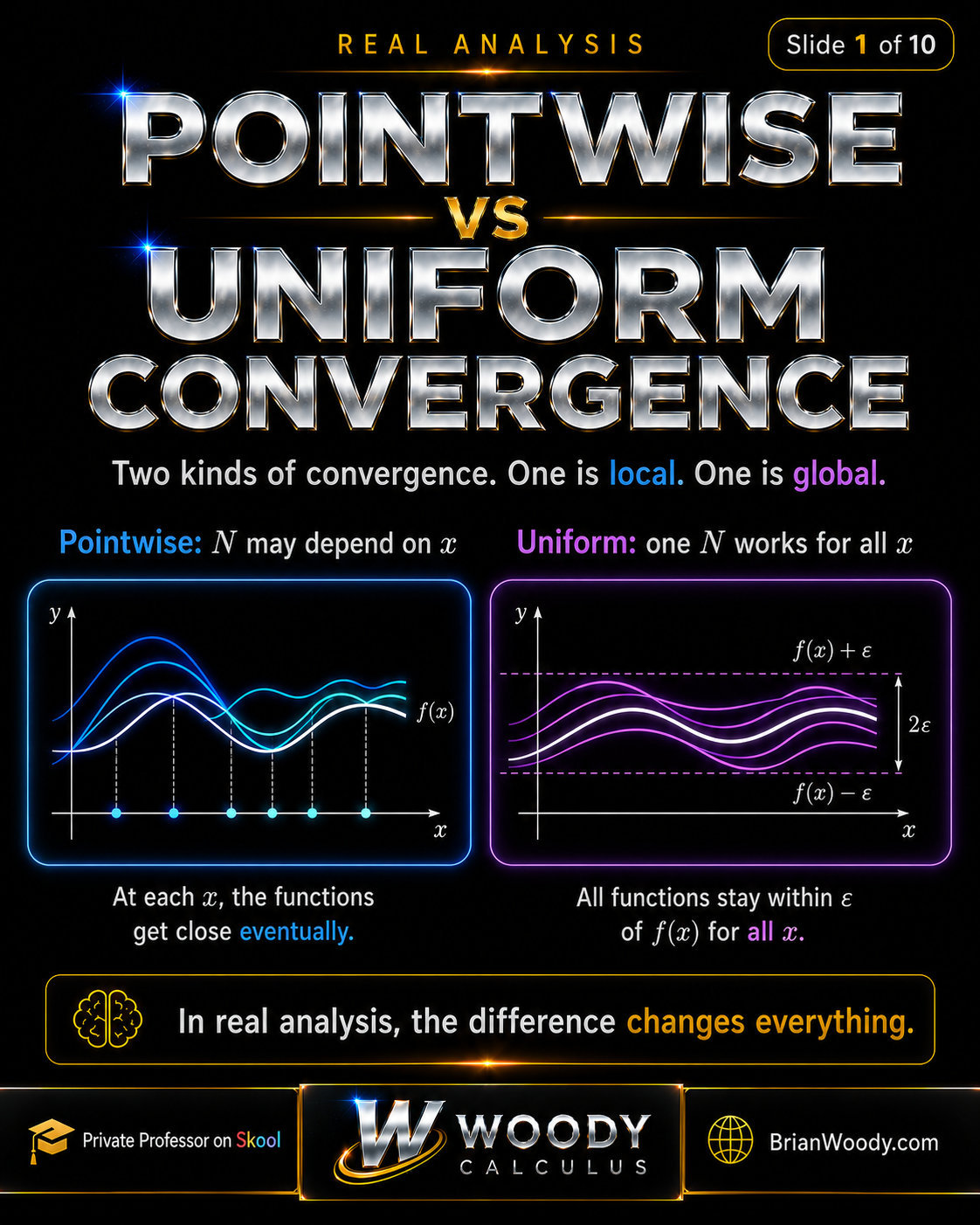
Pointwise convergence checks one input at a time. Uniform convergence controls the whole domain at once. This Woody Calculus Real Analysis lesson explains the definitions, quantifiers, sup norm test, classic examples, and why uniform convergence preserves structure.
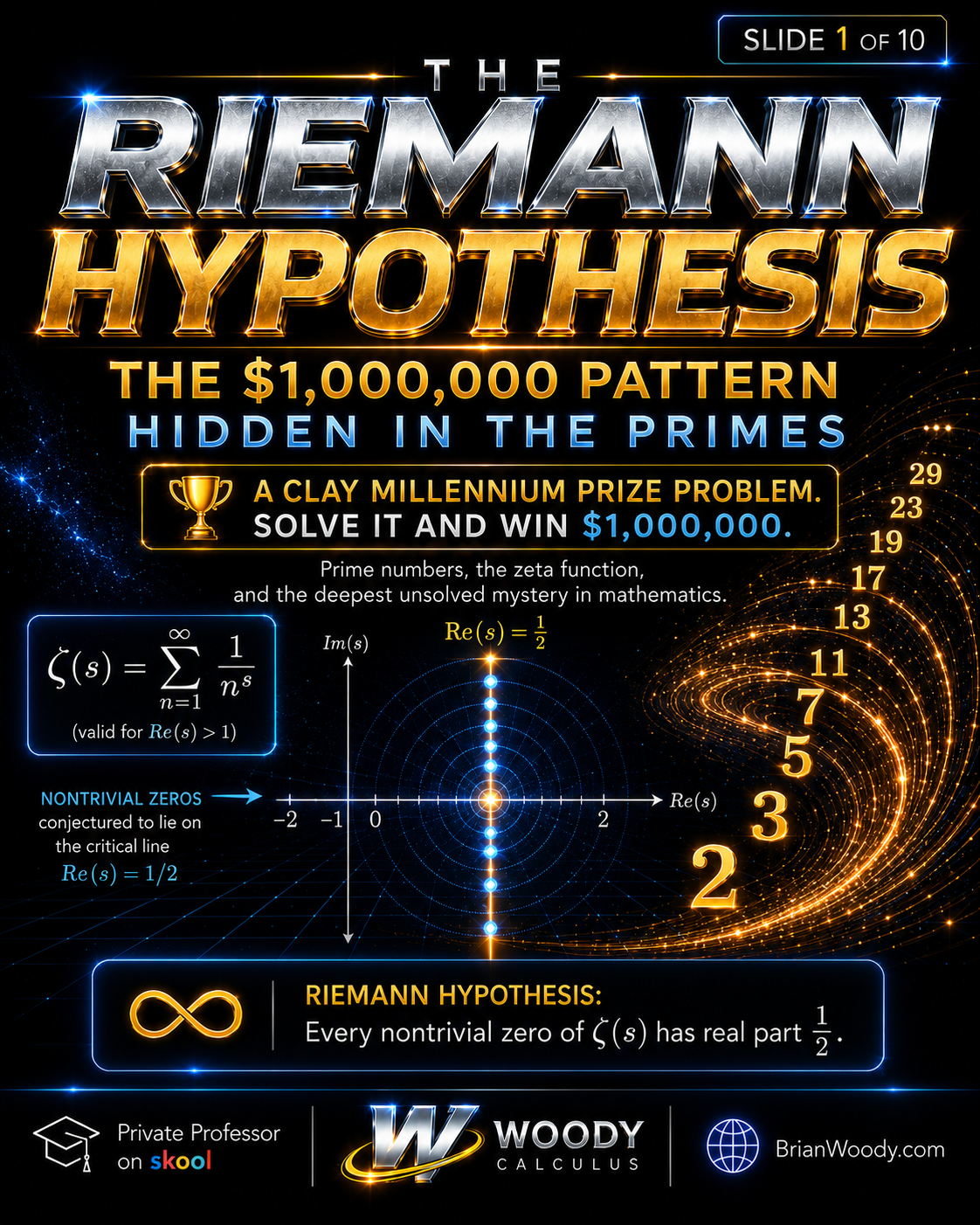
The Riemann Hypothesis is one of the deepest unsolved problems in mathematics. It connects prime numbers, the zeta function, complex analysis, randomness, and hidden order — with a $1,000,000 Clay Mathematics Institute prize for a proof.
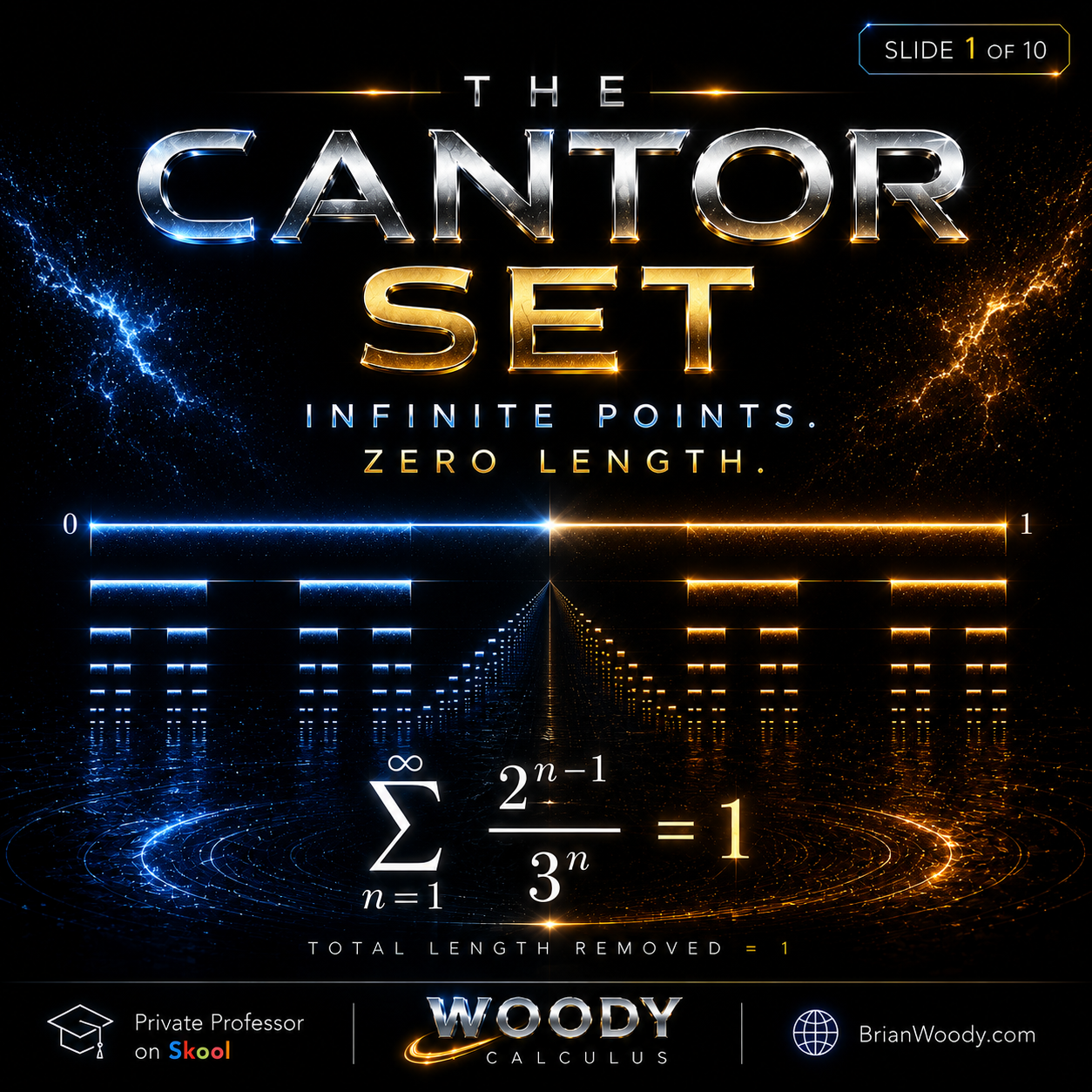
The Cantor Set is one of the strangest objects in Real Analysis: infinitely many points, zero total length, and self-similar structure at every scale. Learn how removing middle thirds creates a set with measure zero but uncountably infinite points.


![Real Analysis compactness overview showing the closed interval [0,1] and three consequences: convergent subsequences, maxima and minima for continuous functions, and uniform continuity.](https://k3p6r8v3.delivery.rocketcdn.me/wp-content/uploads/2026/08/Compactness-Slide-1.png)