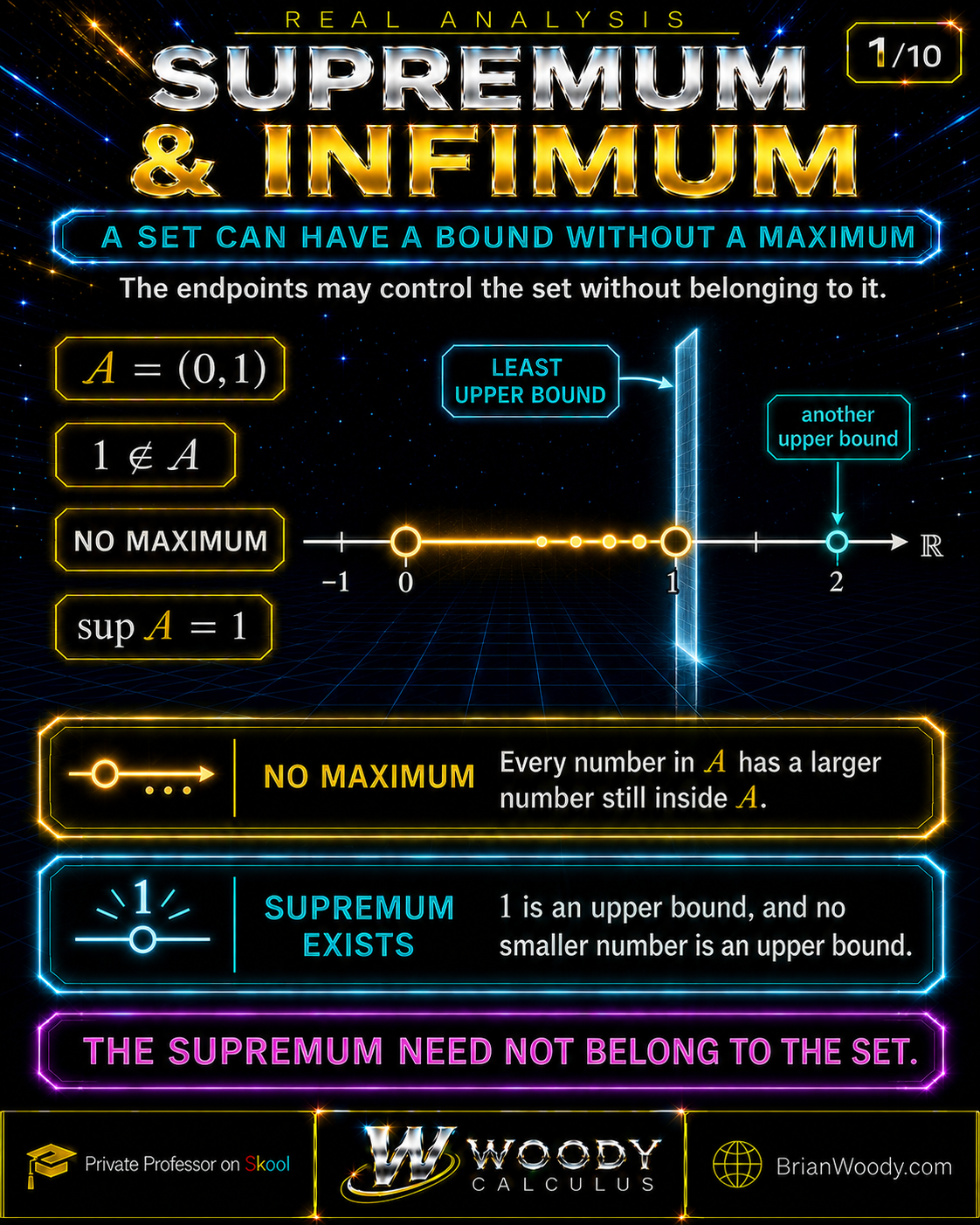
Learn how upper and lower bounds lead to supremum, infimum, maximum, and minimum. This complete Real Analysis lesson includes epsilon proofs, sequence examples, the completeness axiom, and a rigorous explanation of why the rational numbers have gaps.
A Cauchy sequence detects convergence from inside the sequence: sufficiently late terms become arbitrarily close to one another without first knowing the limit. This complete Woody Calculus lesson develops the formal epsilon-N definition, proves that every convergent sequence is Cauchy, explains why ℚ is incomplete and ℝ is complete, and connects completeness to metric spaces, compactness, function spaces, and Banach fixed-point theory.
What does compactness mean in Real Analysis? Learn open covers, finite subcovers, the Heine–Borel Theorem, sequential compactness, Bolzano–Weierstrass, and why continuous functions become dramatically better behaved on compact sets.
Polynomial irreducibility is never just about the polynomial—it depends on the coefficient ring or field. Learn a complete Abstract Algebra decision system using root tests, the Rational Root Theorem, Gauss’s Lemma, Eisenstein’s Criterion, reduction modulo p, finite-field factor tests, quotient rings, and field extensions.
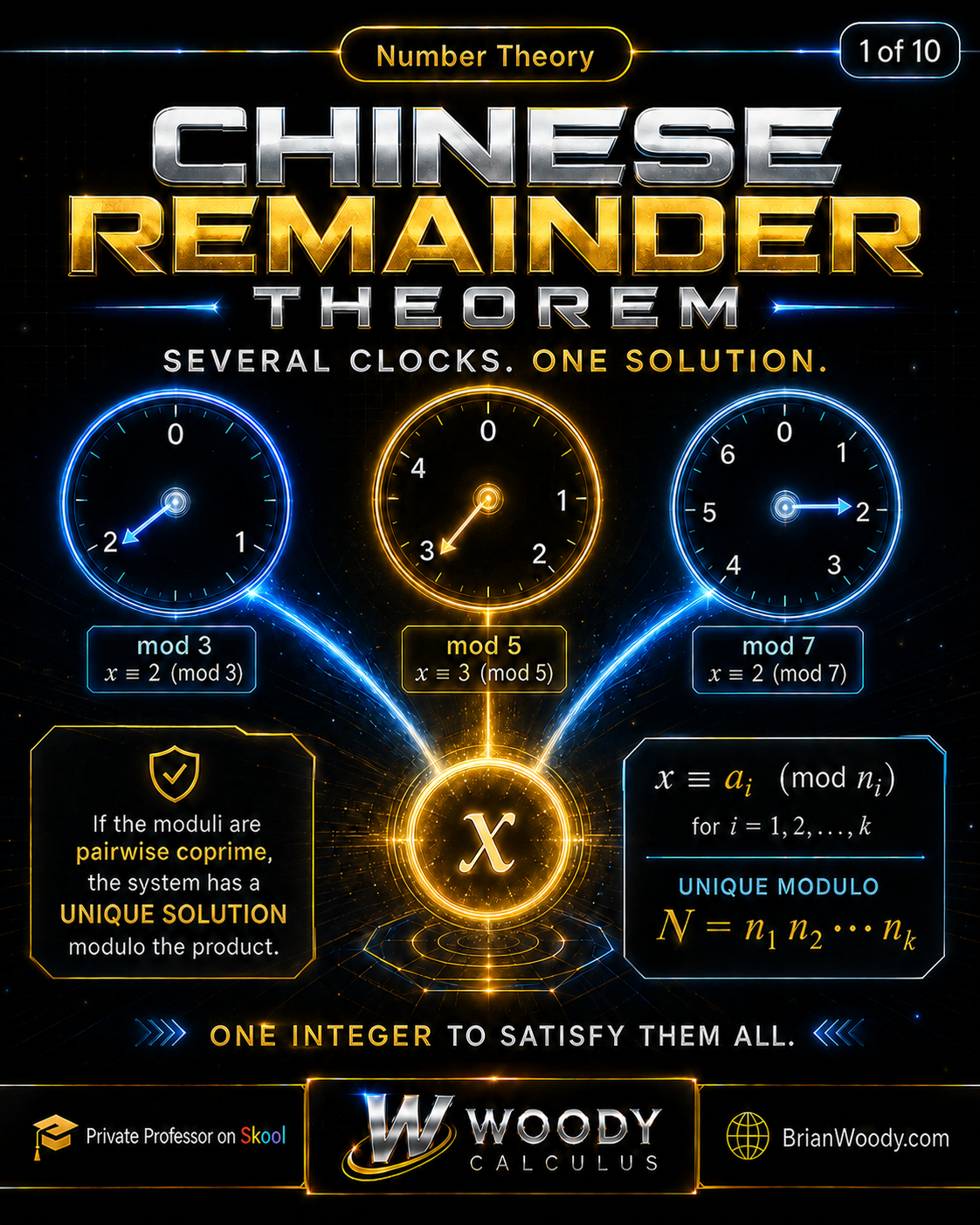
The Chinese Remainder Theorem combines simultaneous congruences into one residue class. Learn the modular-inverse algorithm, two complete examples, proof, verification, noncoprime cases, common mistakes, and exam-ready method selection.
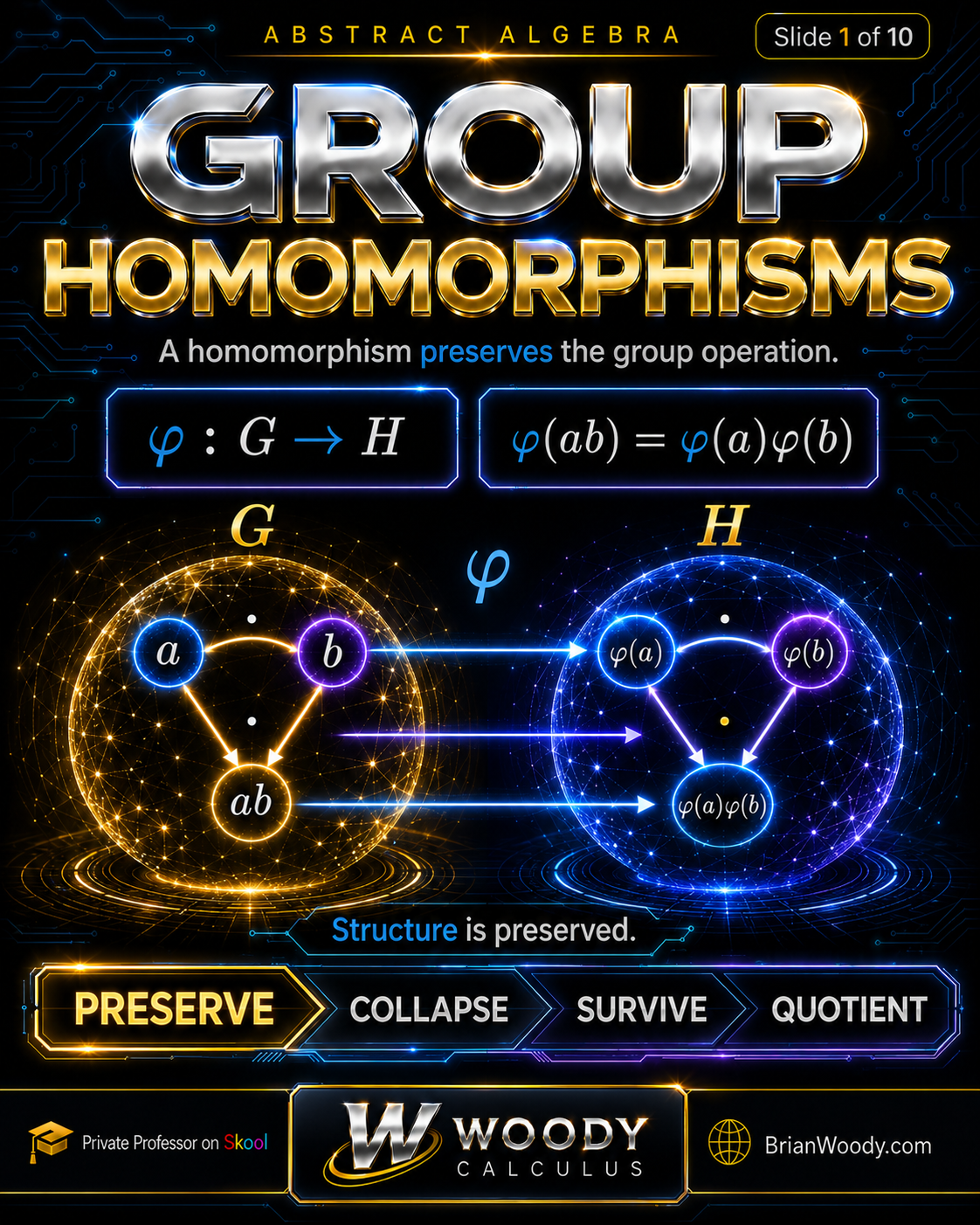
Learn group homomorphisms through visual intuition, exact definitions, complete proofs, and a detailed map from the integers to Z₄. This Woody Calculus lesson explains operation preservation, kernels, images, fibers, quotient groups, injectivity, surjectivity, and the First Isomorphism Theorem.
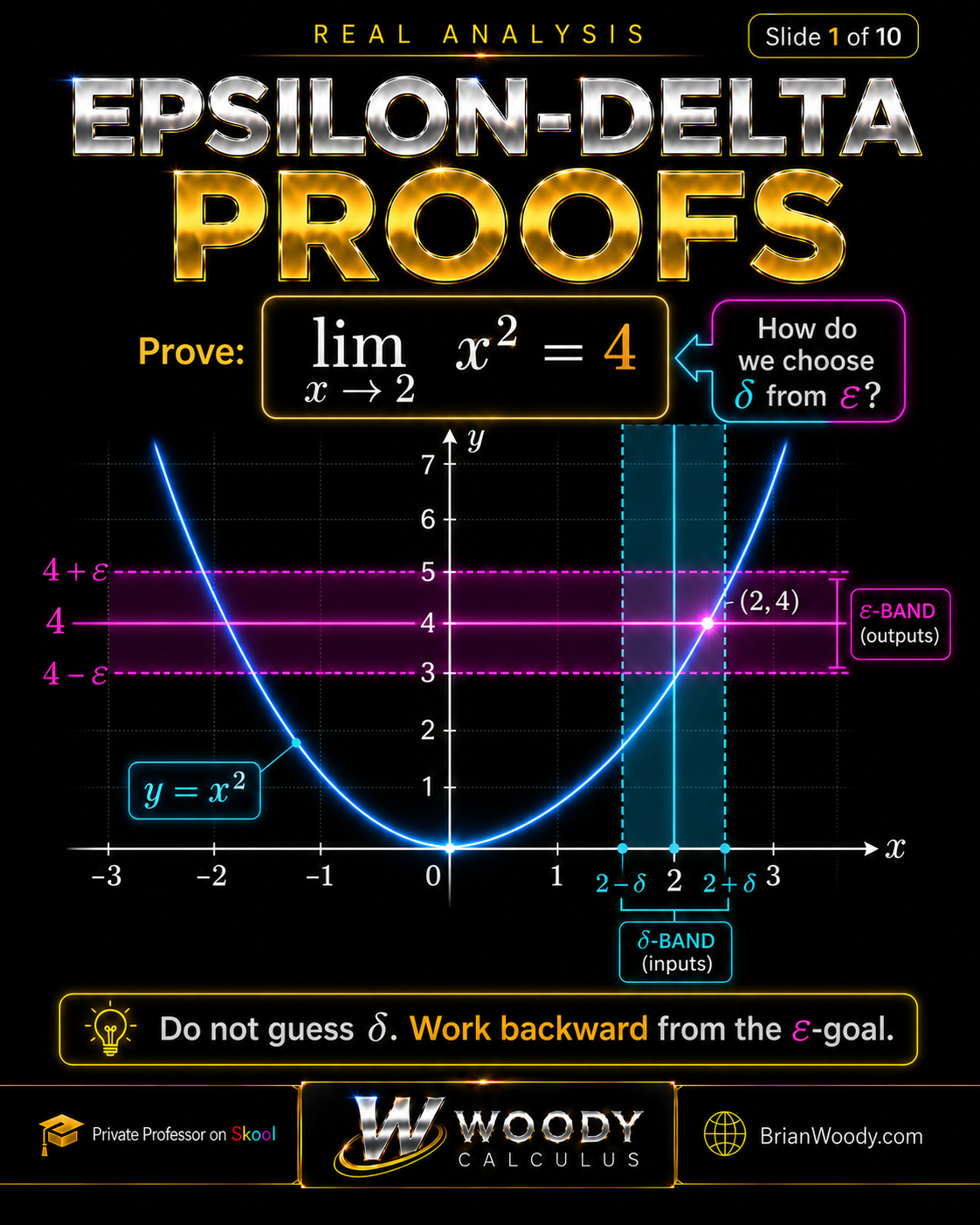
Learn epsilon-delta proofs through visual intuition, exact definitions, and complete worked examples. This Woody Calculus real analysis lesson explains how to choose delta from epsilon, build local bounds, avoid common proof mistakes, and prove limits rigorously.
Woody Calculus presents a number theory paper on odd perfect numbers, modular valuations, Euler’s form, the abundancy index, and Zsigmondy’s theorem, developing a finite framework for analyzing the structure of hypothetical odd perfect numbers.


![Real Analysis compactness overview showing the closed interval [0,1] and three consequences: convergent subsequences, maxima and minima for continuous functions, and uniform continuity.](https://k3p6r8v3.delivery.rocketcdn.me/wp-content/uploads/2026/08/Compactness-Slide-1.png)