Cylindrical and spherical coordinates are alternative
coordinate systems for triple integrals. Cylindrical coordinates
\((r,\theta,z)\) extend polar coordinates vertically and are usually
best for geometry organized around the \(z\)-axis. Spherical coordinates
\((\rho,\theta,\phi)\) use distance from the origin and two angles, so
they are usually best for spheres, hemispheres, spherical shells, and
cones with vertex at the origin. The correct choice is the system that
simplifies the region, integrand, bounds, and Jacobian together.
Plain-language answer:
cylindrical coordinates measure distance from the \(z\)-axis; spherical
coordinates measure distance from the origin. See the solid first, match
the symmetry second, write the bounds third, and include the Jacobian last.
What should you know before using cylindrical and spherical coordinates?
You should know polar coordinates, triple integrals, projections, trigonometric identities, and how iterated bounds describe a three-dimensional region.
- How \(x=r\cos\theta\) and \(y=r\sin\theta\) work in polar coordinates
- How to sketch cylinders, spheres, hemispheres, cones, and paraboloids
- How to read an iterated integral from the inside differential outward
- Why a change of variables requires a Jacobian factor
- How to distinguish a surface equation from the solid it bounds
Cylindrical coordinates are polar coordinates in the \(xy\)-plane with height added. Review
Polar Coordinates Explained
for the two-dimensional foundation, and use
The Jacobian Explained
for the scale-factor theory behind the volume elements used here.
Quick Summary: Cylindrical vs. Spherical Coordinates
Use cylindrical coordinates for symmetry around the \(z\)-axis and spherical coordinates for symmetry around the origin. Convert the equations, rewrite the integrand, choose bounds from the geometry, and multiply by the correct Jacobian.
- Cylindrical: \(x=r\cos\theta\), \(y=r\sin\theta\), \(z=z\), and \(dV=r\,dr\,d\theta\,dz\).
- Spherical: \(x=\rho\sin\phi\cos\theta\), \(y=\rho\sin\phi\sin\theta\), \(z=\rho\cos\phi\), and \(dV=\rho^2\sin\phi\,d\rho\,d\phi\,d\theta\).
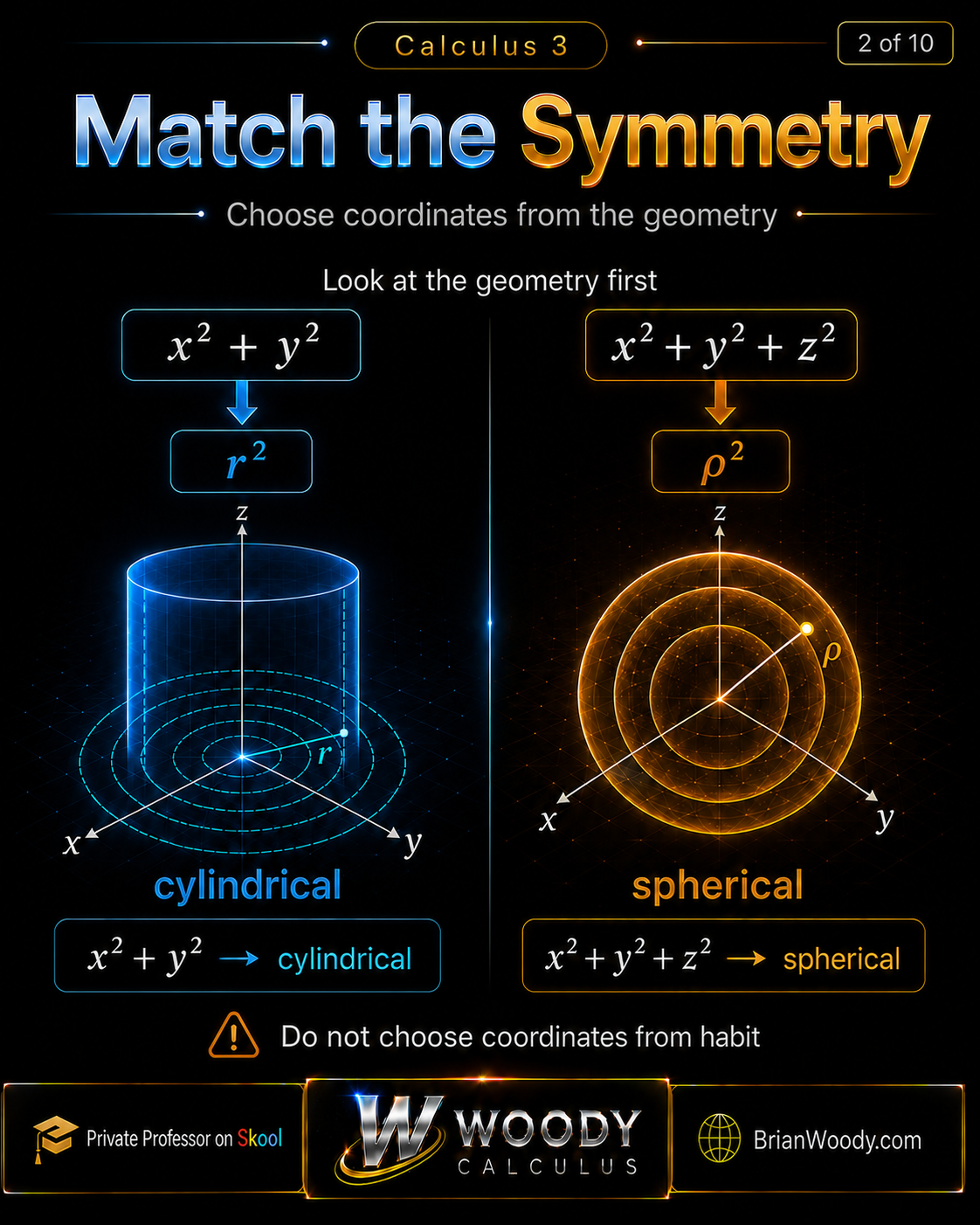
- Recognition: \(x^2+y^2=r^2\), while \(x^2+y^2+z^2=\rho^2\).
- Upper hemisphere of radius 3: spherical bounds are constant and the volume is \(18\pi\).
Key Facts
- Coordinate convention used here: \(\theta\) is the azimuth in the \(xy\)-plane and \(\phi\) is measured downward from the positive \(z\)-axis.
- Cylindrical radius: \(r\) is distance from the \(z\)-axis.
- Spherical radius: \(\rho\) is distance from the origin.
- Relationship: \(r=\rho\sin\phi\) and \(z=\rho\cos\phi\).
- Jacobians: cylindrical contributes \(r\); spherical contributes \(\rho^2\sin\phi\).
- Best practice: choose coordinates from the complete structure of the problem, not from habit.
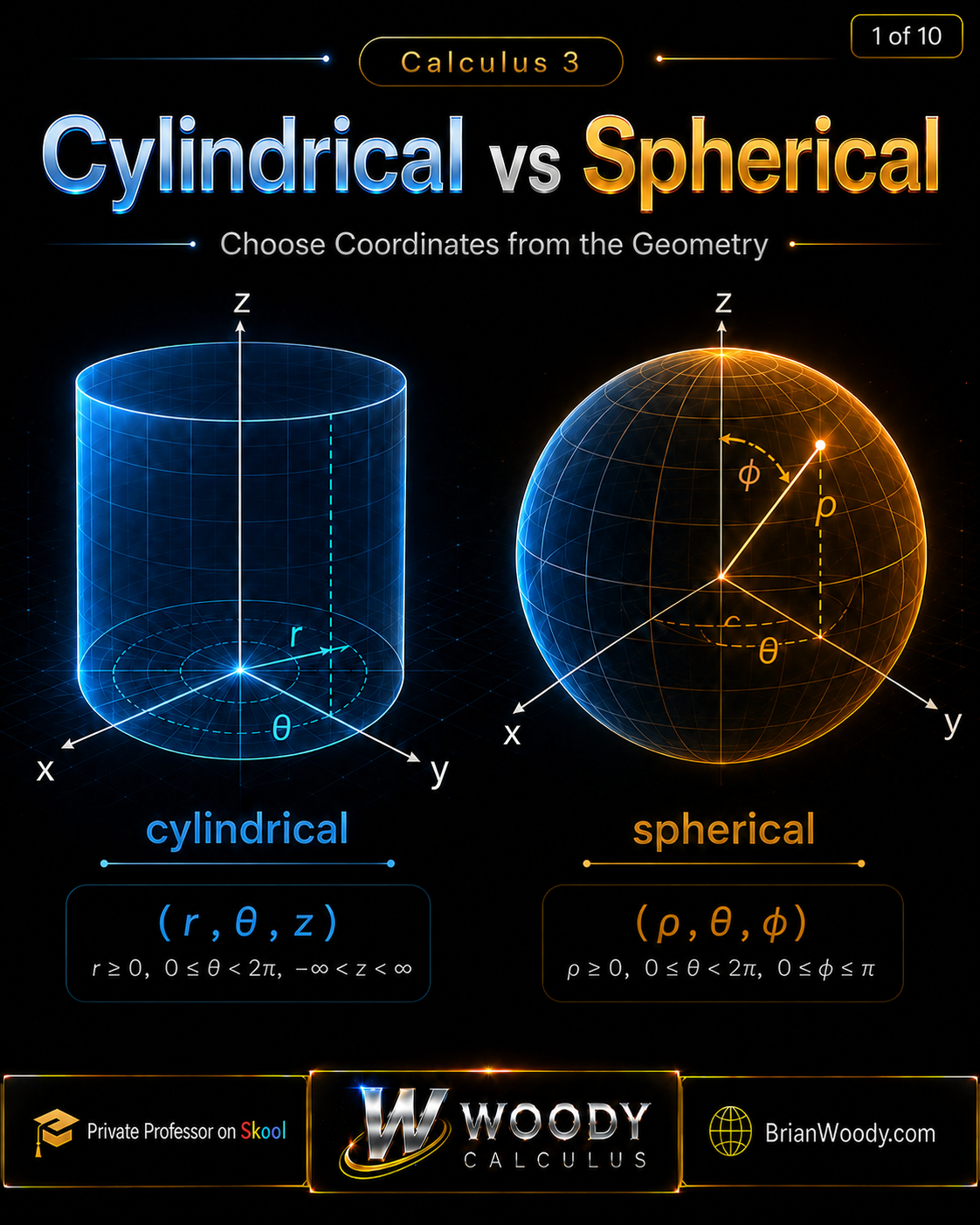
What is the difference between cylindrical and spherical coordinates?
Cylindrical coordinates locate a point by its distance from the \(z\)-axis, its azimuthal angle, and its height; spherical coordinates locate a point by its distance from the origin, its azimuthal angle, and its polar angle.
| Feature | Cylindrical | Spherical |
|---|---|---|
| Coordinates | \((r,\theta,z)\) | \((\rho,\theta,\phi)\) |
| Radial meaning | \(r\): distance from the \(z\)-axis | \(\rho\): distance from the origin |
| Natural symmetry | Cylinders, disks, annuli, vertical solids, and surfaces of revolution around the \(z\)-axis | Spheres, hemispheres, spherical shells, and origin-centered cones |
| Volume element | \(dV=r\,dr\,d\theta\,dz\) | \(dV=\rho^2\sin\phi\,d\rho\,d\phi\,d\theta\) |
| Signature expression | \(x^2+y^2=r^2\) | \(x^2+y^2+z^2=\rho^2\) |
Which spherical-coordinate angle convention does this lesson use?
This lesson uses \(\theta\) for the azimuthal angle in the \(xy\)-plane and \(\phi\) for the angle measured downward from the positive \(z\)-axis.
Convention warning
Some textbooks swap the symbols \(\theta\) and \(\phi\), and some measure elevation upward from the \(xy\)-plane. Never copy spherical formulas until you confirm how your course defines the angles. The formulas in this article match the convention shown on the slides.
What are the Cartesian, cylindrical, and spherical conversion formulas?
Convert every equation and every factor in the integrand before writing the new triple integral.
| Conversion | Formulas |
|---|---|
| Cylindrical to Cartesian | \(x=r\cos\theta\), \(y=r\sin\theta\), \(z=z\) |
| Cartesian to cylindrical | \(r=\sqrt{x^2+y^2}\), \(\theta=\operatorname{atan2}(y,x)\), \(z=z\) |
| Spherical to Cartesian | \(x=\rho\sin\phi\cos\theta\), \(y=\rho\sin\phi\sin\theta\), \(z=\rho\cos\phi\) |
| Cartesian to spherical | \(\rho=\sqrt{x^2+y^2+z^2}\), \(\theta=\operatorname{atan2}(y,x)\), \(\phi=\arccos(z/\rho)\) for \(\rho>0\) |
x^2+y^2=r^2=\rho^2\sin^2\phi,
\qquad
x^2+y^2+z^2=\rho^2.
\]
The cylindrical formulas are exactly the familiar polar-coordinate formulas in the \(xy\)-plane, with \(z\) left unchanged. For graphing, conversion, symmetry, and polar-area foundations, see
Polar Coordinates Explained: Graphing, Symmetry, Rose Curves, and Polar Area.
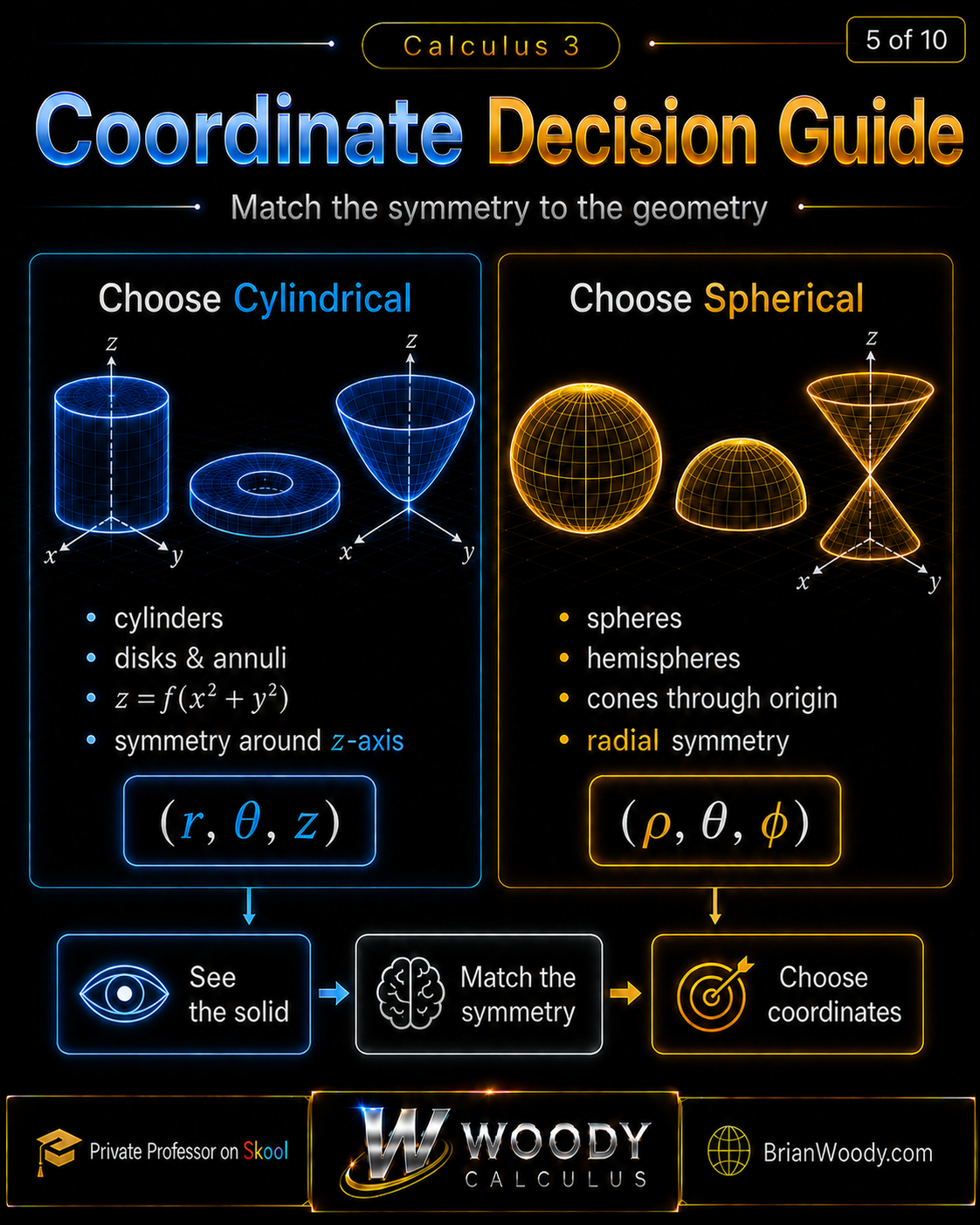
How do you match the coordinate system to the symmetry?
Look for repeated geometric expressions: \(x^2+y^2\) signals cylindrical structure, while \(x^2+y^2+z^2\) signals spherical structure.
The geometry is the first clue, but not the only clue. The integrand also matters. A spherical region with an integrand built from \(x^2+y^2\) may still require comparison, because that factor becomes \(r^2\) in cylindrical coordinates but \(\rho^2\sin^2\phi\) in spherical coordinates. The winning system simplifies the total problem, not merely the boundary.
How do cylindrical coordinates work in triple integrals?
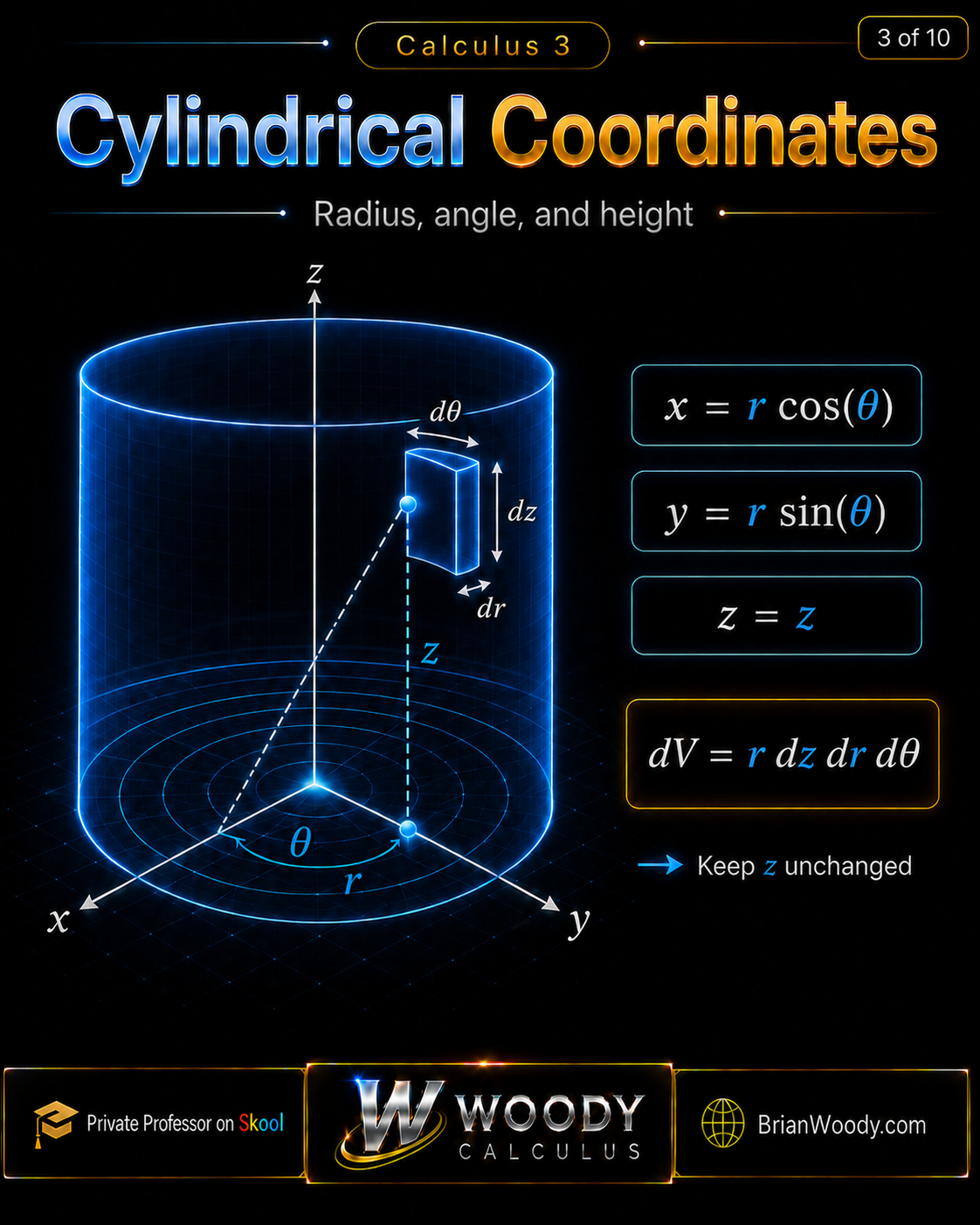
Cylindrical coordinates retain the vertical coordinate \(z\) and replace the \(xy\)-plane by polar coordinates.
x=r\cos\theta,
\qquad
y=r\sin\theta,
\qquad
z=z.
\]
dV=r\,dr\,d\theta\,dz.
\]
The order of the differentials may be changed when the bounds are changed consistently. The factor \(r\), however, must remain. Cylindrical coordinates are especially effective when the projection onto the \(xy\)-plane is a disk or annulus and the upper and lower surfaces are easy to write as functions of \(r\) and \(\theta\).
How do spherical coordinates work in triple integrals?
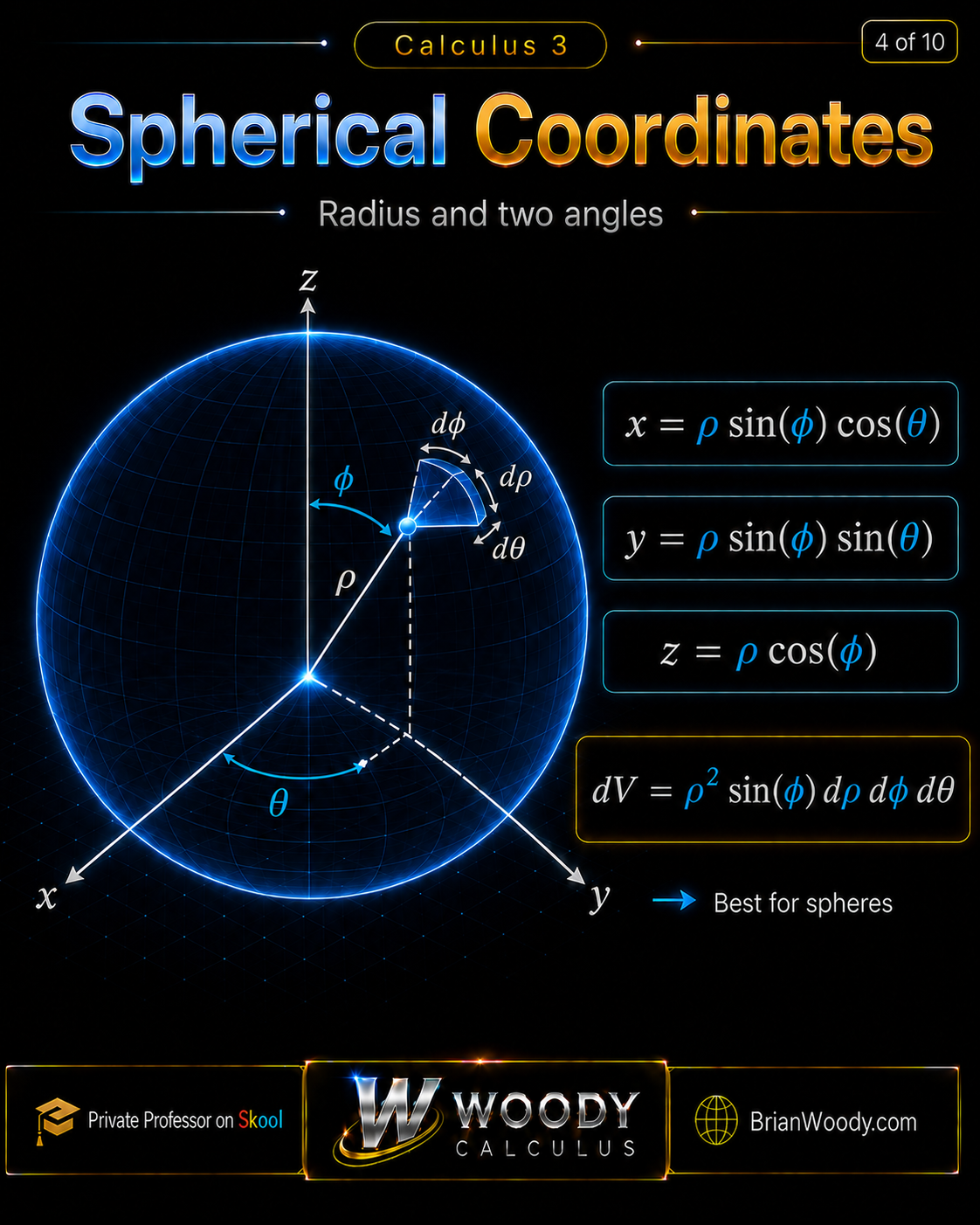
Spherical coordinates describe a point by its distance \(\rho\) from the origin, its azimuth \(\theta\), and its polar angle \(\phi\).
x=\rho\sin\phi\cos\theta,
\qquad
y=\rho\sin\phi\sin\theta,
\qquad
z=\rho\cos\phi.
\]
dV=\rho^2\sin\phi\,d\rho\,d\phi\,d\theta.
\]
A sphere centered at the origin becomes a constant-\(\rho\) surface. A cone with vertex at the origin and axis along the \(z\)-axis becomes a constant-\(\phi\) surface. Those two facts make many sphere-and-cone regions dramatically easier in spherical coordinates.
How are cylindrical and spherical coordinates related?
The cylindrical radius is the horizontal projection of the spherical radius: \(r=\rho\sin\phi\), while the height is \(z=\rho\cos\phi\).
r=\rho\sin\phi,
\qquad
z=\rho\cos\phi,
\qquad
\rho=\sqrt{r^2+z^2}.
\]
The two systems share the same azimuthal angle \(\theta\). The difference is the second coordinate: cylindrical coordinates keep height \(z\), while spherical coordinates replace height with a polar angle \(\phi\).
Which coordinate system should you choose?
Choose cylindrical coordinates when rotation around the \(z\)-axis dominates; choose spherical coordinates when distance from the origin dominates.
| Geometry or algebra | Preferred system | Why |
|---|---|---|
| \(x^2+y^2=a^2\) | Cylindrical | The cylinder becomes \(r=a\). |
| \(z=f(x^2+y^2)\) | Cylindrical | The surface becomes \(z=f(r^2)\). |
| Disk or annulus projection | Cylindrical | The base has simple \(r\)- and \(\theta\)-bounds. |
| \(x^2+y^2+z^2=a^2\) | Spherical | The sphere becomes \(\rho=a\). |
| Spherical shell \(a\le\sqrt{x^2+y^2+z^2}\le b\) | Spherical | The radial bounds become \(a\le\rho\le b\). |
| Cone through the origin | Spherical | A circular cone around the \(z\)-axis becomes \(\phi=\text{constant}\). |
| Integrand \(x^2+y^2+z^2\) | Spherical | The integrand becomes \(\rho^2\). |
Where do the cylindrical and spherical Jacobian factors come from?
The Jacobian measures how a small coordinate box stretches into a curved three-dimensional volume element.
The curved-side-length argument below is the fastest geometric way to remember the factors. For the determinant-based change-of-variables derivation, see
The Jacobian Explained: The Hidden Scale Factor in Calculus 3.
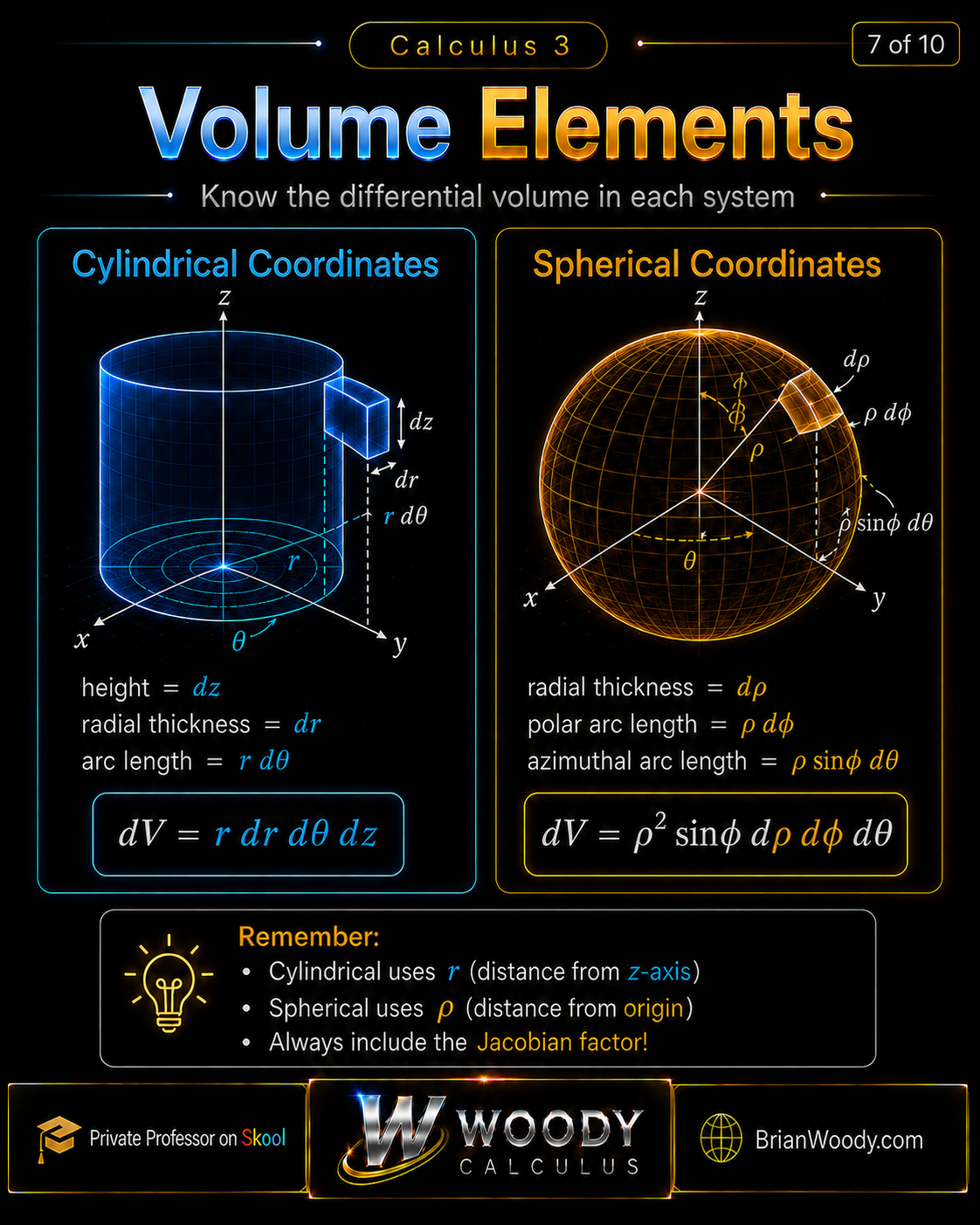
Cylindrical volume element
A small cylindrical wedge has approximate side lengths
dr,
\qquad
r\,d\theta,
\qquad
dz.
\]
Multiplying them gives
dV=r\,dr\,d\theta\,dz.
\]
Spherical volume element
A small spherical wedge has approximate side lengths
d\rho,
\qquad
\rho\,d\phi,
\qquad
\rho\sin\phi\,d\theta.
\]
Multiplying them gives
dV=\rho^2\sin\phi\,d\rho\,d\phi\,d\theta.
\]
The factor \(\sin\phi\) appears because circles of constant \(\phi\) shrink near the poles. At \(\phi=0\), the azimuthal arc length collapses to zero.
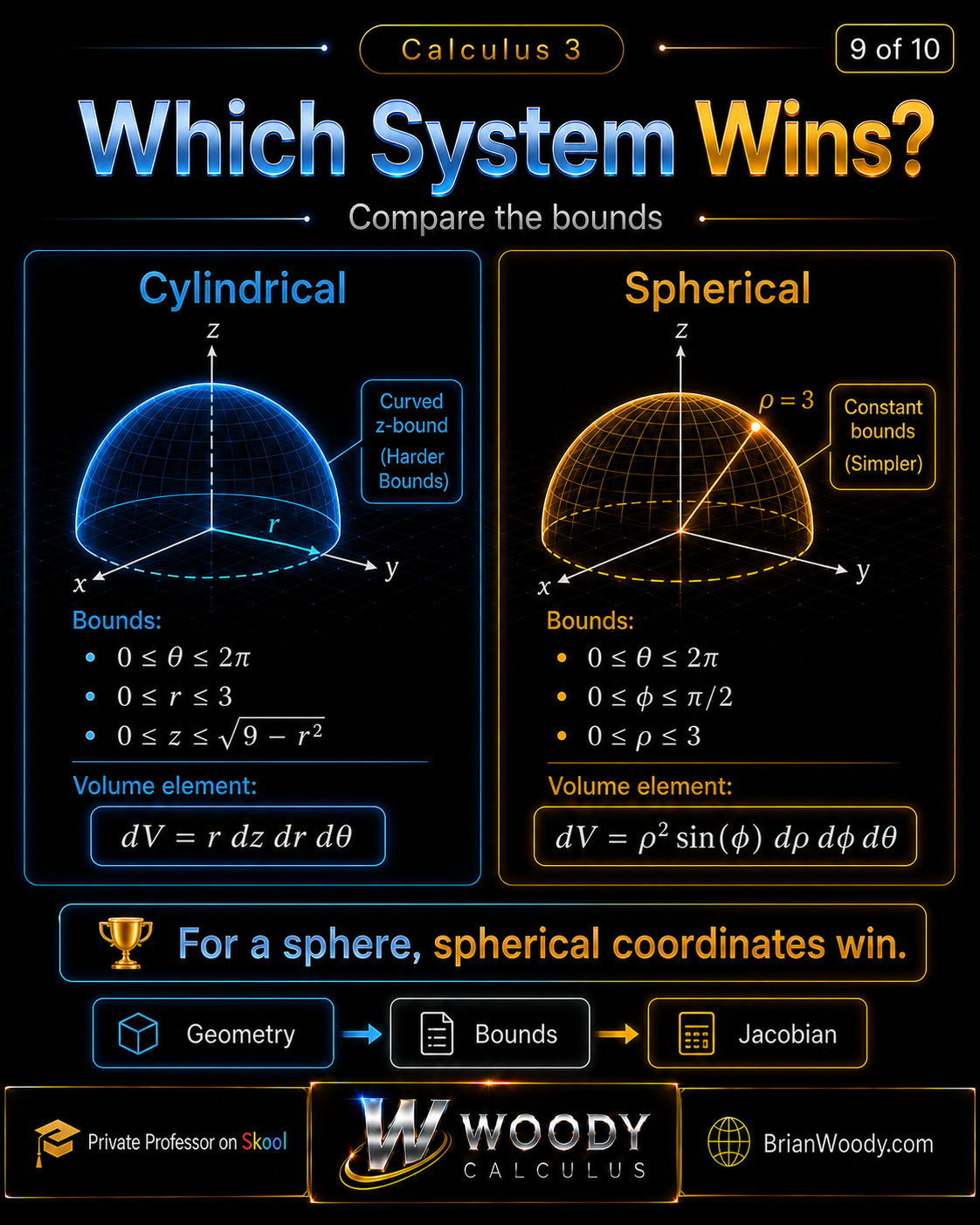
How do you choose coordinates for the upper hemisphere of radius 3?
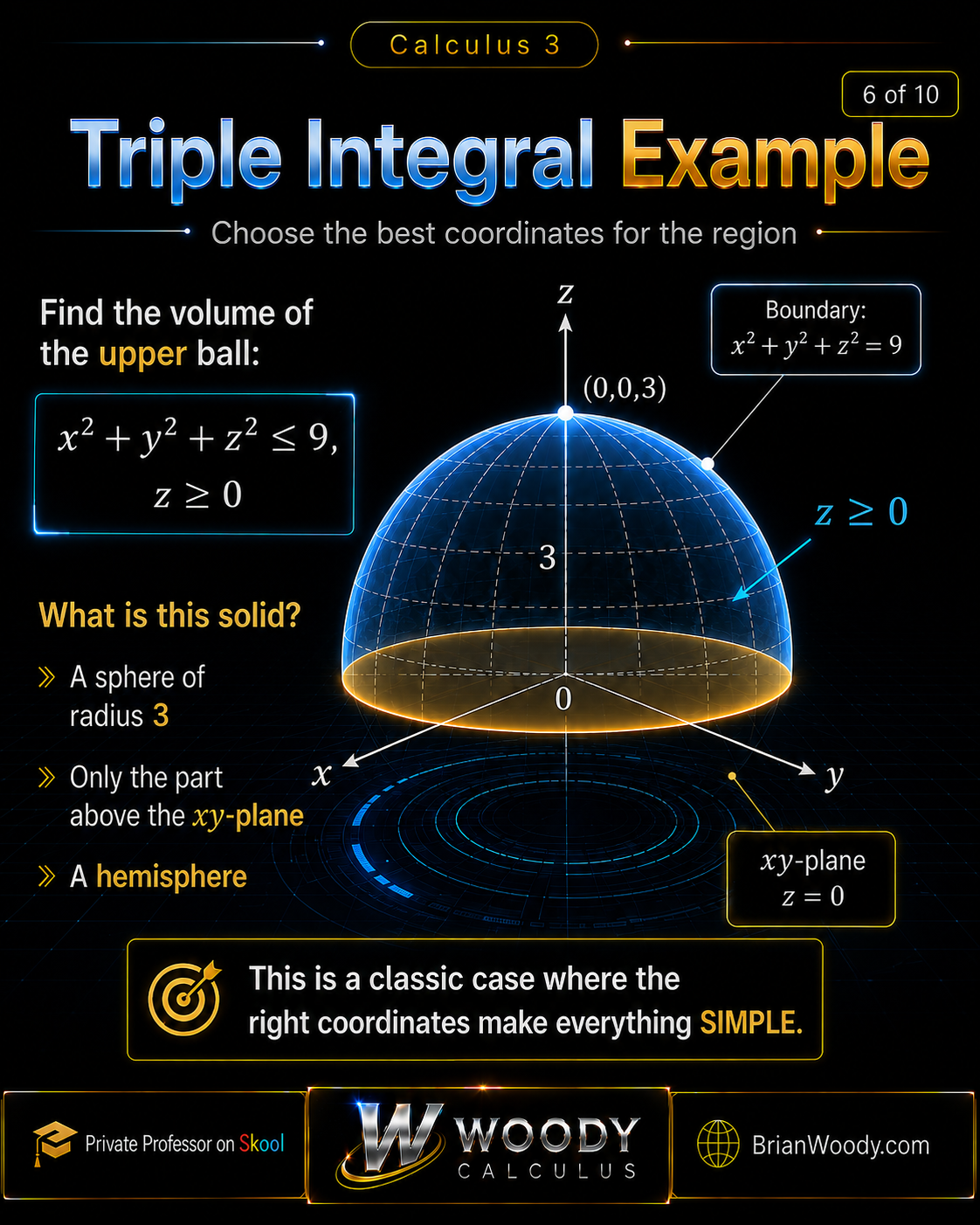
The region \(x^2+y^2+z^2\le9\) with \(z\ge0\) is centered at the origin and bounded by a sphere, so spherical coordinates give constant bounds.
E=\{(x,y,z):x^2+y^2+z^2\le9,\ z\ge0\}.
\]
The sphere has radius 3. The condition \(z\ge0\) keeps the half above the \(xy\)-plane, so the polar angle runs only from the positive \(z\)-axis down to the equator.
How do you evaluate the upper-hemisphere volume in spherical coordinates?
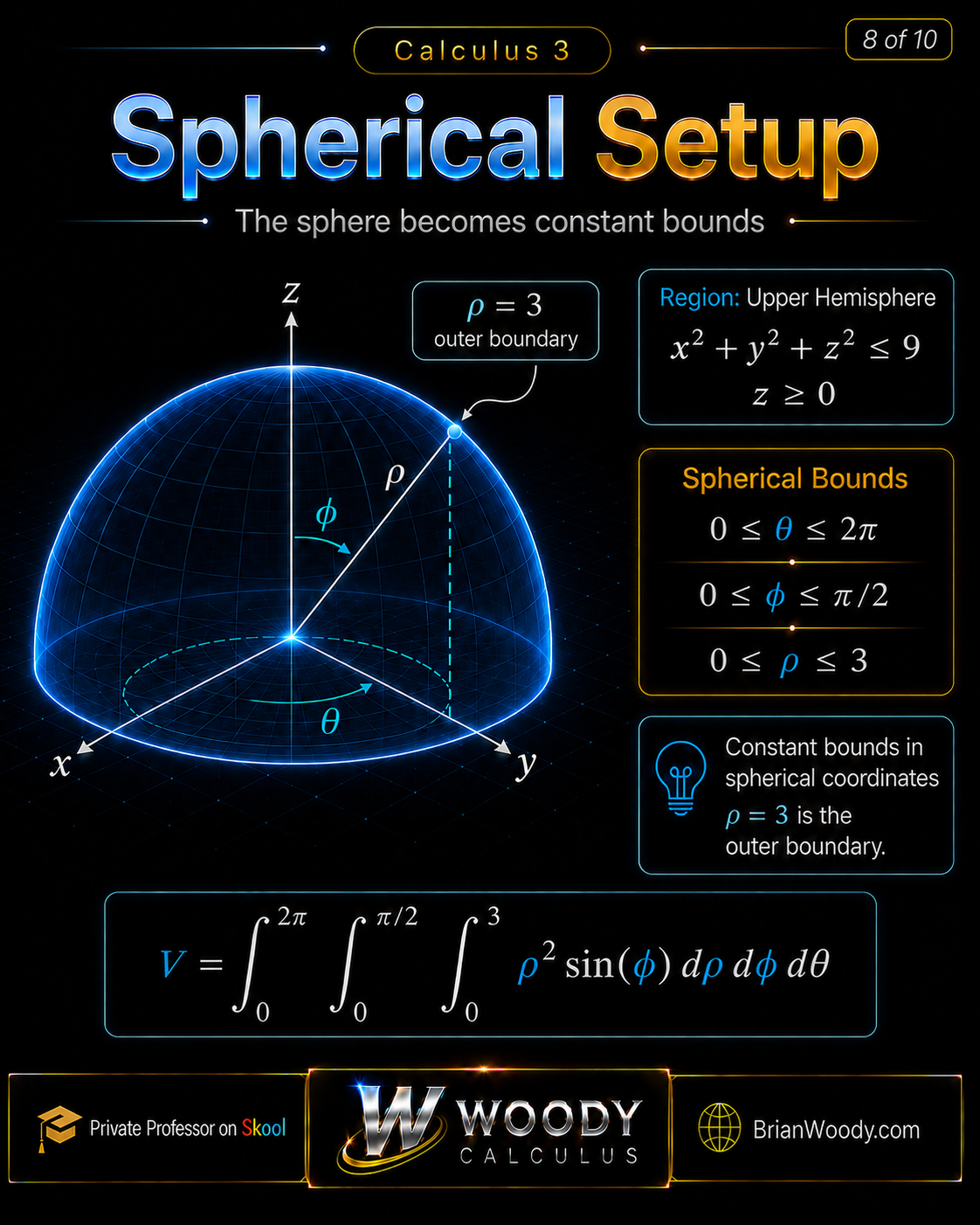
Use full azimuth, half the polar-angle range, and radial distance from 0 to 3.
0\le\theta\le2\pi,
\qquad
0\le\phi\le\frac{\pi}{2},
\qquad
0\le\rho\le3.
\]
V
=\int_0^{2\pi}\int_0^{\pi/2}\int_0^3
\rho^2\sin\phi\,d\rho\,d\phi\,d\theta.
\]
\int_0^3\rho^2\,d\rho=9,
\qquad
\int_0^{\pi/2}\sin\phi\,d\phi=1,
\qquad
\int_0^{2\pi}d\theta=2\pi.
\]
\boxed{V=18\pi}.
\]
How do you evaluate the same hemisphere in cylindrical coordinates?
Cylindrical coordinates also work, but the upper boundary becomes the curved function \(z=\sqrt{9-r^2}\).
0\le\theta\le2\pi,
\qquad
0\le r\le3,
\qquad
0\le z\le\sqrt{9-r^2}.
\]
V
=\int_0^{2\pi}\int_0^3\int_0^{\sqrt{9-r^2}}
r\,dz\,dr\,d\theta.
\]
V=2\pi\int_0^3 r\sqrt{9-r^2}\,dr.
\]
Let \(u=9-r^2\), so \(du=-2r\,dr\). Then
V
=\pi\int_0^9u^{1/2}\,du
=\pi\left[\frac{2}{3}u^{3/2}\right]_0^9
=18\pi.
\]
\boxed{V=18\pi}.
\]
Which coordinate system wins for the hemisphere?
Spherical coordinates win because all three bounds are constant, while cylindrical coordinates require a square-root boundary.
| System | Bounds | Difficulty |
|---|---|---|
| Cylindrical | \(0\le\theta\le2\pi\), \(0\le r\le3\), \(0\le z\le\sqrt{9-r^2}\) | Curved inner bound and a substitution |
| Spherical | \(0\le\theta\le2\pi\), \(0\le\phi\le\pi/2\), \(0\le\rho\le3\) | Constant bounds and separated factors |
When do cylindrical coordinates beat spherical coordinates?
Cylindrical coordinates win when a vertical solid is bounded by a surface such as \(z=f(x^2+y^2)\) over a disk or annulus.
Worked Example: Volume under a paraboloid
Find the volume below \(z=4-x^2-y^2\) and above the \(xy\)-plane.
In cylindrical coordinates,
z=4-r^2,
\qquad
0\le r\le2,
\qquad
0\le\theta\le2\pi.
\]
V
=\int_0^{2\pi}\int_0^2\int_0^{4-r^2}
r\,dz\,dr\,d\theta.
\]
V
=2\pi\int_0^2(4-r^2)r\,dr
=2\pi\left[2r^2-\frac{r^4}{4}\right]_0^2
=\boxed{8\pi}.
\]
When do spherical coordinates simplify a sphere-and-cone region?
Spherical coordinates are ideal when the region lies inside a sphere and inside or above a cone whose vertex is at the origin.
Worked Example: Inside a sphere and above a cone
Find the volume inside the sphere \(\rho\le2\) and inside the upward cone \(0\le\phi\le\pi/4\).
V
=\int_0^{2\pi}\int_0^{\pi/4}\int_0^2
\rho^2\sin\phi\,d\rho\,d\phi\,d\theta.
\]
V
=2\pi\cdot\frac{8}{3}\cdot\left(1-\cos\frac{\pi}{4}\right)
=\boxed{\frac{8\pi}{3}(2-\sqrt2)}.
\]
What mistakes do students make with cylindrical and spherical coordinates?
Most errors come from choosing coordinates by habit, using the wrong angle convention, forgetting the Jacobian, or converting the region without converting the integrand.
Mistake: Choosing coordinates from the shape name alone
Symptom: A sphere automatically triggers spherical coordinates even though the integrand or additional boundaries become worse.
Cause: Only the outer surface was considered.
Fix: Compare the region, integrand, bounds, and Jacobian together.
Mistake: Confusing \(r\) and \(\rho\)
Symptom: The cylindrical radius is treated as distance from the origin.
Cause: Both variables were called “radius” without geometric precision.
Fix: Say it aloud: \(r\) is distance from the \(z\)-axis; \(\rho\) is distance from the origin.
Mistake: Swapping \(\theta\) and \(\phi\)
Symptom: A hemisphere receives the wrong angular bounds.
Cause: Formulas from a different convention were used.
Fix: Draw the angles and verify the convention before writing any equation.
Mistake: Forgetting the Jacobian
Symptom: The integral has \(d\rho\,d\phi\,d\theta\) but no \(\rho^2\sin\phi\), or has \(dr\,d\theta\,dz\) but no \(r\).
Cause: Coordinate substitution was treated like a simple renaming.
Fix: Write the volume element before writing the bounds.
Mistake: Using a surface equation as a solid bound
Symptom: A ball is written only as \(\rho=3\).
Cause: The boundary sphere was confused with the interior solid.
Fix: The sphere is \(\rho=3\); the solid ball is \(0\le\rho\le3\).
Mistake: Using \(0\le\phi\le\pi\) for an upper hemisphere
Symptom: The integral computes the full ball instead of half.
Cause: The default full-sphere range was copied automatically.
Fix: For \(z\ge0\), use \(0\le\phi\le\pi/2\).
Mistake: Converting the boundary but not the integrand
Symptom: The new integral still contains \(x\), \(y\), or \(z\) after the bounds have been changed.
Cause: Only the geometry was transformed.
Fix: Convert the integrand, equations, and differential volume element before integrating.
Mistake: Mismatching bounds and differential order
Symptom: A limit depends on a variable integrated earlier instead of later.
Cause: The order was changed without rebuilding the bounds.
Fix: Read the integral from the inside differential outward and identify which variables are allowed in each bound.
Woody Calculus rule
See the solid. Match the symmetry. Convert everything. Write the bounds. Include the Jacobian. Do not integrate until all five decisions are complete.
What is the Woody Calculus exam checklist for cylindrical and spherical triple integrals?
Geometry first, algebra second, bounds third, Jacobian fourth, integration last.
- Sketch or mentally identify the three-dimensional region.
- Locate the axis or center of symmetry.
- Inspect both the boundary equations and the integrand.
- Choose cylindrical or spherical coordinates deliberately.
- State the angle convention if spherical coordinates are used.
- Write every conversion formula needed.
- Transform the entire integrand.
- Write the correct differential volume element with its Jacobian.
- Determine the inner bound from the fastest-moving coordinate.
- Check whether each bound depends only on variables integrated later.
- Test the bounds at an easy angle or edge point.
- Integrate only after the setup is complete.
- Check the final answer for units, positivity, and geometric scale.
- Rebuild the setup from a blank page and explain each bound aloud.
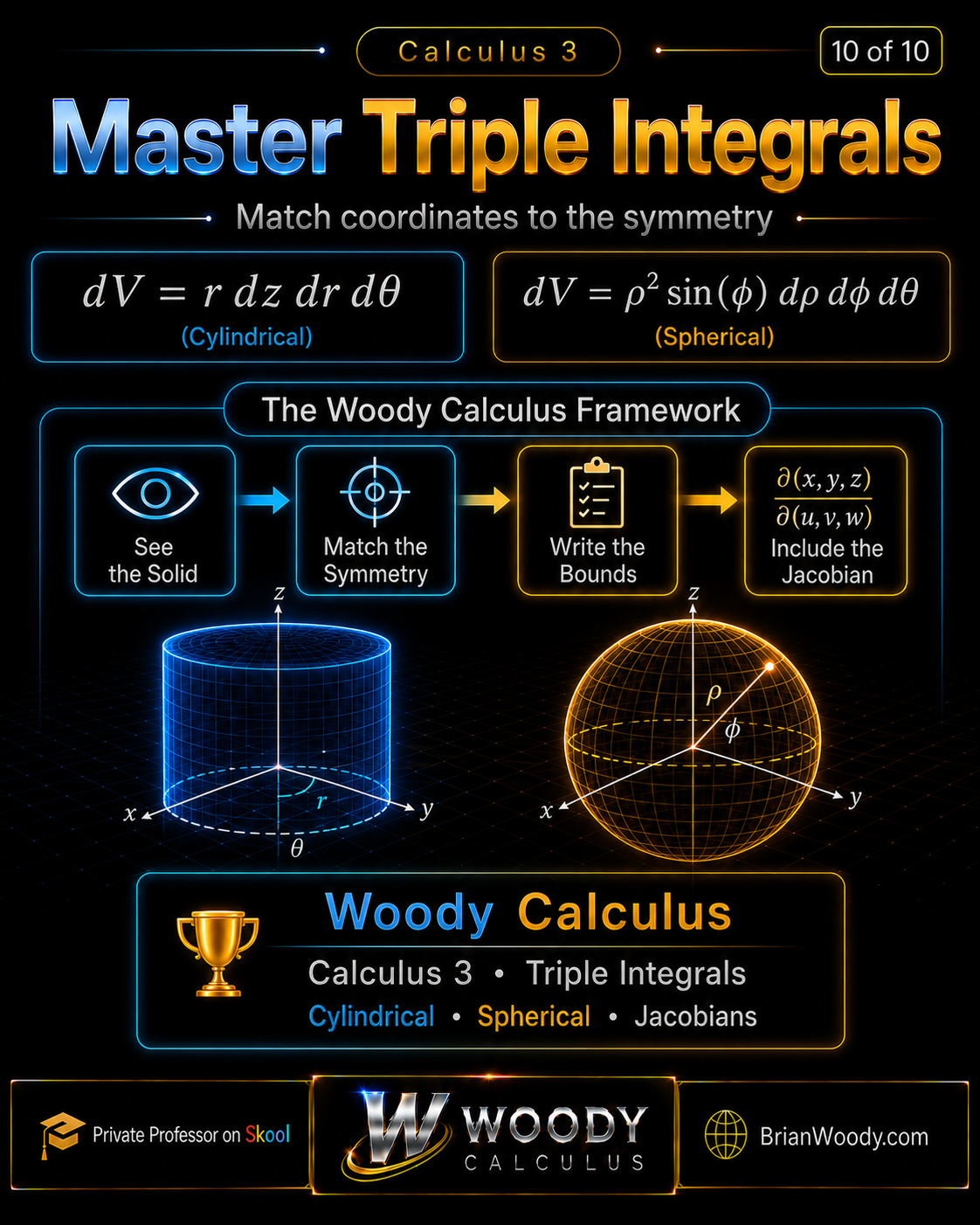
How do you master cylindrical and spherical triple integrals?
Mastery means seeing the symmetry before writing formulas and being able to explain why every bound and every Jacobian factor belongs.
The Woody Calculus Coordinate Framework
- See the solid: identify every boundary and intersection.
- Match the symmetry: decide whether the axis or origin controls the geometry.
- Convert everything: equations, integrand, and differential volume.
- Write the bounds: make each coordinate sweep through the region exactly once.
- Include the Jacobian: \(r\) or \(\rho^2\sin\phi\).
- Verify: compare with known geometry or solve in a second system when practical.
Do not memorize isolated bounds. Memorize what each coordinate measures, then derive the bounds from the solid every time.
Frequently Asked Questions About Cylindrical and Spherical Coordinates
What is the difference between cylindrical and spherical coordinates?
Cylindrical coordinates use distance from the \(z\)-axis, an azimuthal angle, and height. Spherical coordinates use distance from the origin, an azimuthal angle, and a polar angle.
When should you use cylindrical coordinates?
Use cylindrical coordinates for regions with circular symmetry around the \(z\)-axis, including cylinders, disks, annuli, vertical solids, and surfaces such as \(z=f(x^2+y^2)\).
When should you use spherical coordinates?
Use spherical coordinates for origin-centered spheres, hemispheres, spherical shells, radial integrands, and circular cones with vertex at the origin.
What are the cylindrical-coordinate formulas?
The formulas are \(x=r\cos\theta\), \(y=r\sin\theta\), and \(z=z\), with volume element \(dV=r\,dr\,d\theta\,dz\).
What are the spherical-coordinate formulas?
The formulas are \(x=\rho\sin\phi\cos\theta\), \(y=\rho\sin\phi\sin\theta\), and \(z=\rho\cos\phi\), with volume element \(dV=\rho^2\sin\phi\,d\rho\,d\phi\,d\theta\).
Why is there an r in the cylindrical volume element?
A small angular change \(d\theta\) creates an arc length \(r\,d\theta\). Multiplying that arc length by radial thickness \(dr\) and height \(dz\) gives \(dV=r\,dr\,d\theta\,dz\).
Why is there a ρ² sin φ in the spherical volume element?
The three local side lengths are approximately \(d\rho\), \(\rho\,d\phi\), and \(\rho\sin\phi\,d\theta\). Their product is \(\rho^2\sin\phi\,d\rho\,d\phi\,d\theta\).
What does φ measure in spherical coordinates?
In this lesson, \(\phi\) is the angle measured from the positive \(z\)-axis. The upper hemisphere therefore uses \(0\le\phi\le\pi/2\).
How are cylindrical and spherical coordinates related?
They share the azimuthal angle \(\theta\), and the conversion is \(r=\rho\sin\phi\), \(z=\rho\cos\phi\), and \(\rho=\sqrt{r^2+z^2}\).
What are the spherical bounds for the upper hemisphere of radius 3?
Use \(0\le\theta\le2\pi\), \(0\le\phi\le\pi/2\), and \(0\le\rho\le3\).
What is the volume of the upper hemisphere of radius 3?
The spherical triple integral evaluates to \(18\pi\), which agrees with one half of the sphere-volume formula \((4/3)\pi(3^3)\).
Can the same region be integrated in both coordinate systems?
Yes. A valid region can often be described in Cartesian, cylindrical, or spherical coordinates. The best system is the one that gives the simplest total setup.
Does a sphere always mean spherical coordinates?
No. An off-center sphere, an asymmetric restriction, or an integrand that simplifies strongly in another system may change the best choice.
How does a cone appear in spherical coordinates?
A circular cone with vertex at the origin and axis along the \(z\)-axis becomes a constant polar angle \(\phi=\phi_0\).
How do you find the volume of a full sphere in spherical coordinates?
For a sphere of radius \(a\), use \(0\le\theta\le2\pi\), \(0\le\phi\le\pi\), and \(0\le\rho\le a\). Then
\(V=\int_0^{2\pi}\int_0^\pi\int_0^a \rho^2\sin\phi\,d\rho\,d\phi\,d\theta=\frac{4}{3}\pi a^3\).
What is the Jacobian for spherical coordinates?
The spherical-coordinate Jacobian is \(\rho^2\sin\phi\). Therefore the volume element is
\(dV=\rho^2\sin\phi\,d\rho\,d\phi\,d\theta\) for the angle convention used in this lesson.
Why do physics textbooks sometimes swap θ and φ?
There are two widespread spherical-coordinate conventions. Many calculus texts use \(\theta\) for azimuth and \(\phi\) for the angle from the positive \(z\)-axis, while many physics texts reverse those symbols. The geometry is unchanged, but the formulas must be read using the convention defined by the source.
What is the most common triple-integral mistake?
The most common mistake is setting bounds before understanding the geometry. The second most common is forgetting the Jacobian factor.
Need help with university Calculus 3?
The
Woody Calculus Mastery Lab
is the required starting point for students who want help with triple integrals, cylindrical and spherical coordinates, vector fields, line integrals, surface integrals, Stokes’ Theorem, and the Divergence Theorem.
Limited
private instruction
may be available after Mastery Lab enrollment. It is selective, limited, normally based on weekly sessions, and not guaranteed.
Visit the contact page or explore the Calculus 3 help page.
University Calculus 3 and triple-integral help
Purdue multivariable calculus support
Build reliable triple-integral setups, coordinate conversions, and exam-ready geometric reasoning.
University of Florida Calculus 3 help
Get structured support with multiple integrals, vectors, and vector calculus.
UCF multivariable calculus preparation
Practice coordinate choice, bounds, Jacobians, and complete triple-integral solutions.
UNR Calculus 3 support
Prepare for university-level multivariable calculus with a former UNR mathematics lecturer.
Auburn triple-integral and vector-calculus help
Strengthen coordinate-system selection, spatial visualization, and integration technique.
University of Alabama multivariable calculus support
Build a repeatable system for multiple integrals and the major vector-calculus theorems.
Reviews and trust
Read Woody Calculus 5-star Google reviews and view Brian M. Woody’s 5.0 RateMyProfessors rating.
Woody Calculus provides university-level mathematical instruction, structured practice, and long-term mastery—not generic tutoring and not a shortcut answer service.