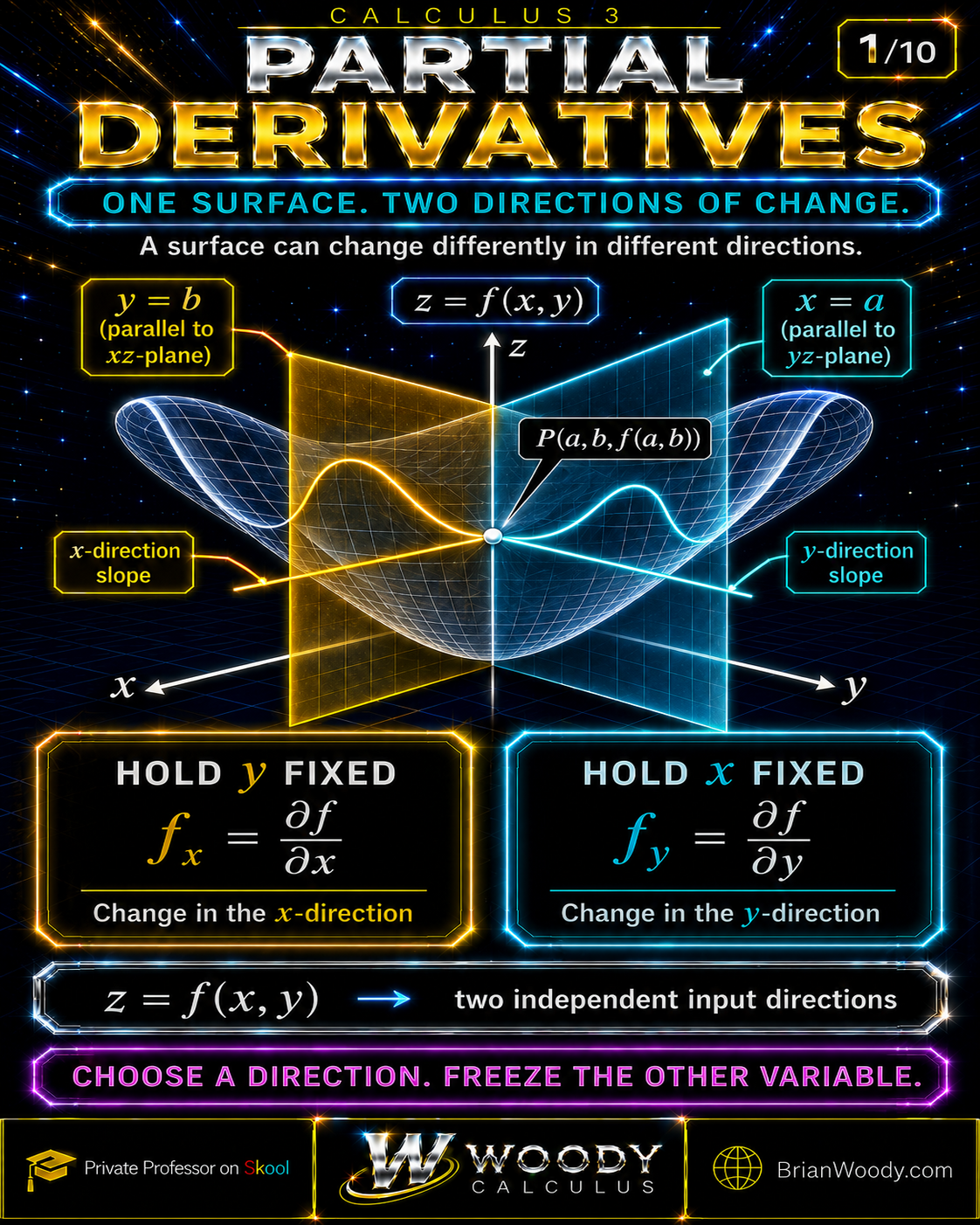
Partial derivatives measure how a multivariable function changes when one input varies and the others are held constant. This complete Calculus 3 lesson develops limit definitions, trace curves, first and mixed partials, tangent planes, the multivariable chain rule, linear approximation, rigorous counterexamples, and solved practice problems.
Learn how to recognize and solve exact differential equations using the exactness test M_y = N_x, recover a potential function F(x,y), apply initial conditions, verify implicit solutions, and use special integrating factors when an equation is not exact. This rigorous visual lesson also explains domain restrictions, conservative vector fields, line integrals, and the punctured-domain caveat.
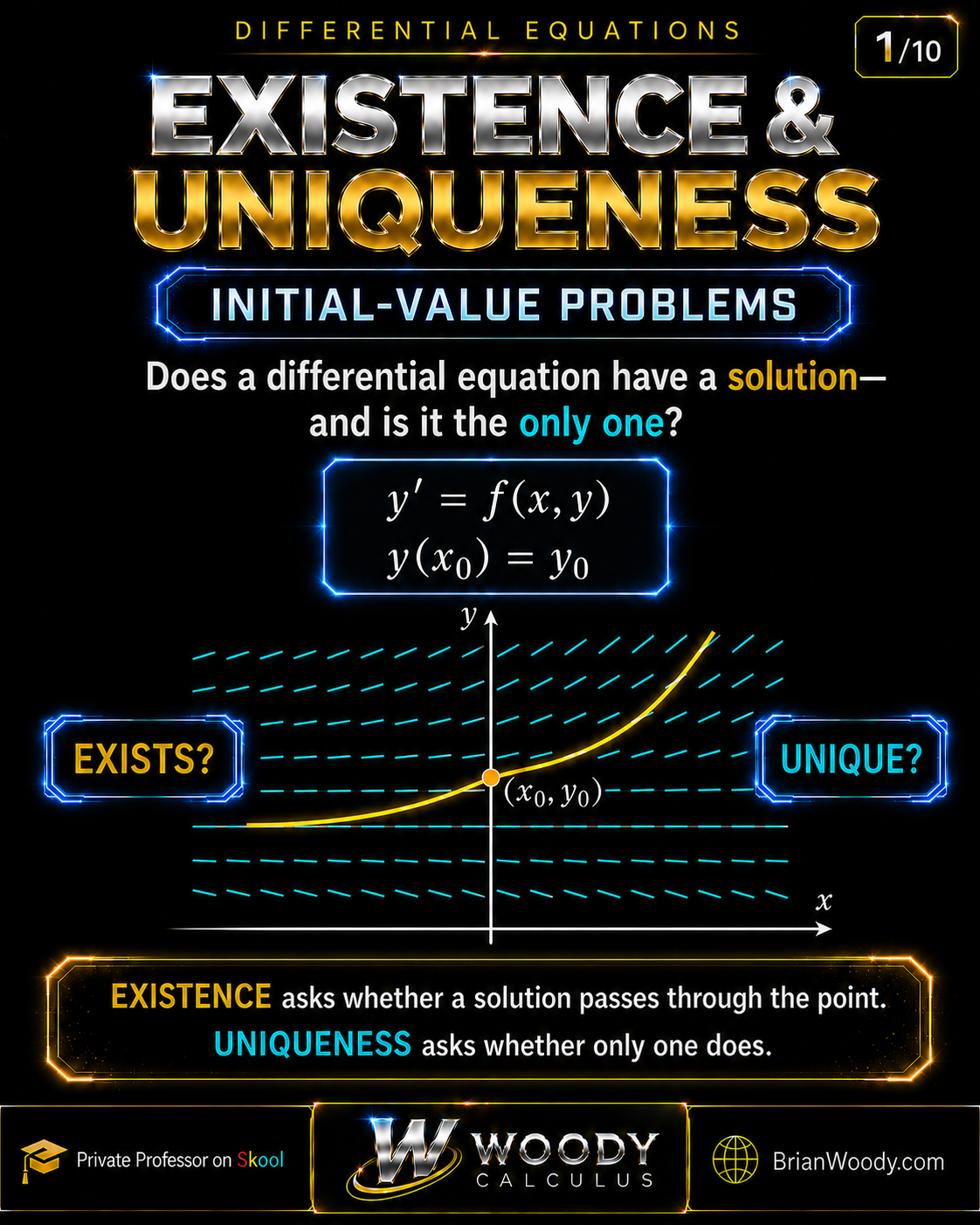
Does an initial-value problem have a solution, and is that solution the only one? This complete Woody Calculus lesson explains the existence and uniqueness theorem, the rectangle test, worked examples, nonunique solutions, finite-time blow-up, maximal intervals, the nonintersection principle, and higher-order linear ODEs.
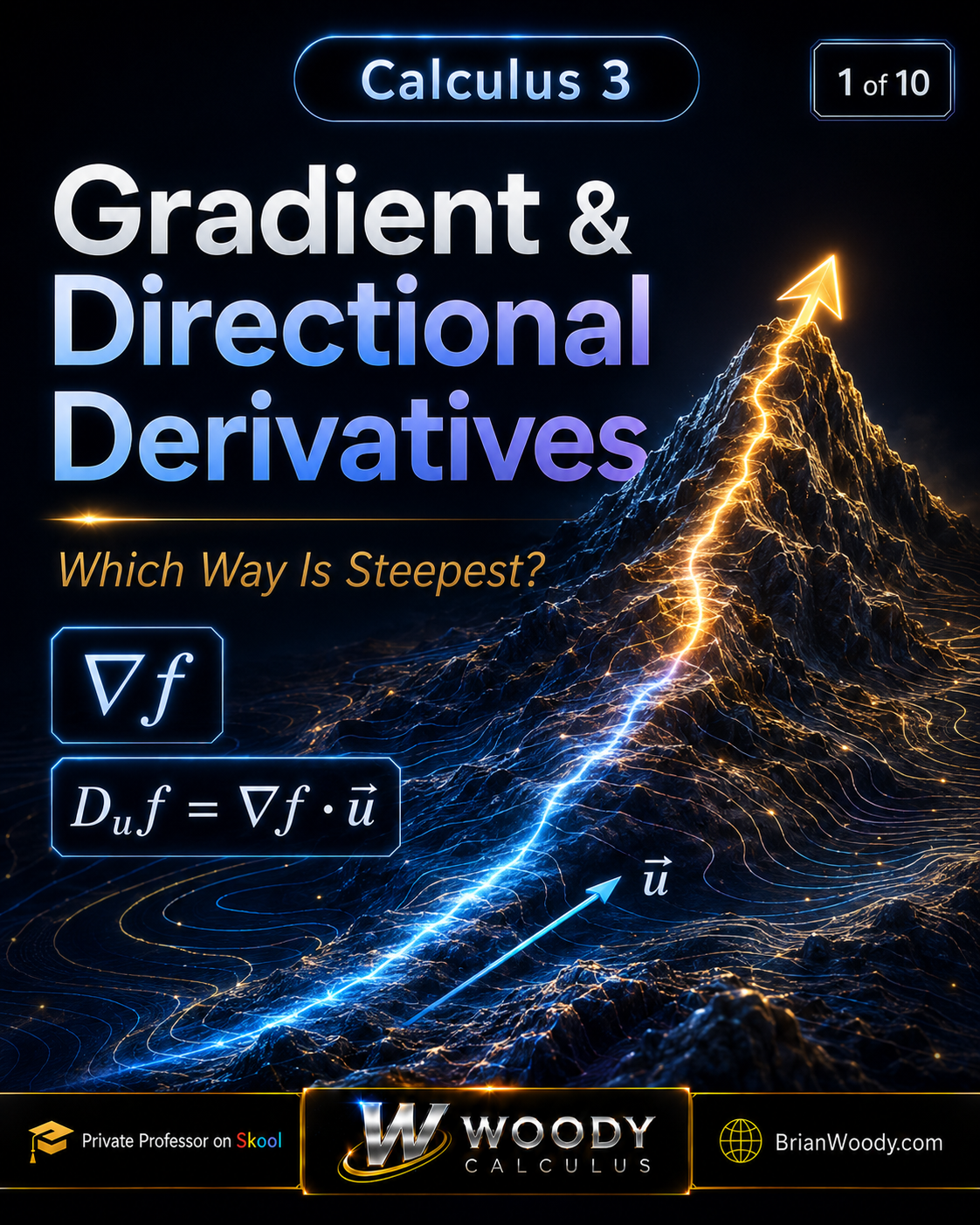
Which direction makes a multivariable function increase fastest? Learn how the gradient packages partial derivatives, how to calculate directional derivatives with unit vectors and dot products, and why gradients cross level curves at right angles.
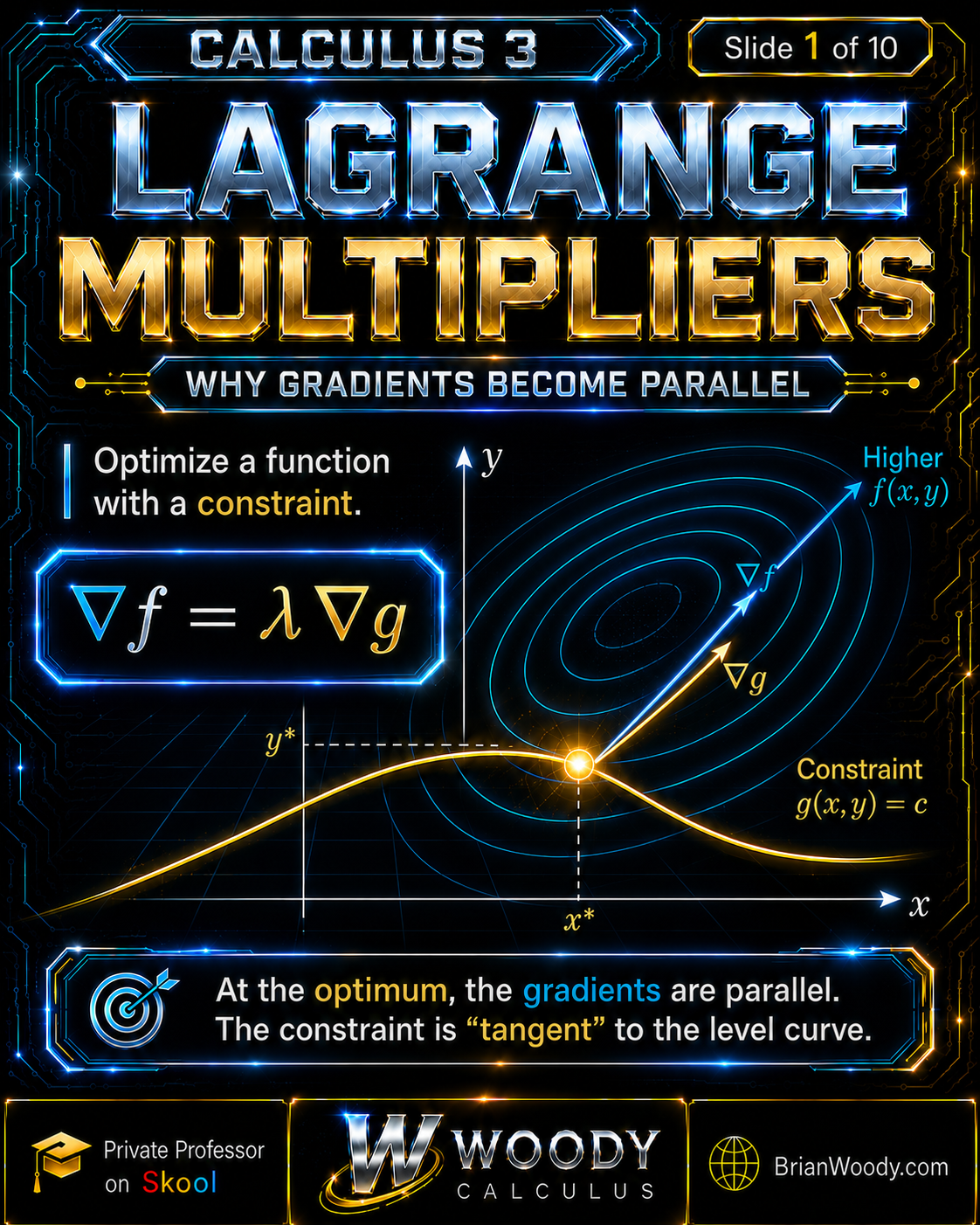
Why do gradients become parallel in constrained optimization? This Woody Calculus lesson explains the geometry and algebra of Lagrange multipliers, derives the system ∇f = λ∇g, and solves complete rectangle and box optimization examples.