A group homomorphism is a function between groups that
preserves the group operation. In symbols,
\(\varphi(ab)=\varphi(a)\varphi(b)\). From that one law come four
automatic consequences: identities, inverses, integer powers, and
element-order divisibility are preserved. The kernel records what
collapses to the identity, the image records what survives, every
nonempty fiber is a coset of the kernel, and the First Isomorphism
Theorem states that
\(G/\ker\varphi\cong\operatorname{im}\varphi\). For the map
\(\varphi:\mathbb Z\to\mathbb Z_4\), \(\varphi(n)=[n]_4\), the
kernel is \(4\mathbb Z\), the image is all of \(\mathbb Z_4\), and
therefore \(\mathbb Z/4\mathbb Z\cong\mathbb Z_4\).
Plain-language answer:
a homomorphism may identify different elements, but it preserves every
relationship created by the operation. Quotient by what the map cannot
distinguish, and the structure left behind is exactly the image.
What should you know before studying group homomorphisms?
You should know the group axioms, identities, inverses, subgroups,
cosets, normal subgroups, and quotient groups.
- How a group is specified by both a set and an operation
- How additive and multiplicative notation differ
- How cosets partition a group
-
Why a quotient-group element is a coset rather than a single
original element -
Why normality is required for a quotient operation to be
well-defined
Review the
four group axioms and Cayley tables
first, and use the
quotient-groups lesson
if cosets or normality still feel unfamiliar.
Quick Summary: Group Homomorphisms
A homomorphism preserves the operation; its kernel measures
collapse, its image measures survival, its nonempty fibers are
kernel cosets, and quotienting by the kernel produces a group
isomorphic to the image.
-
Preserve:
\(\varphi(ab)=\varphi(a)\varphi(b)\). -
Collapse:
\(\ker\varphi=\{g\in G:\varphi(g)=e_H\}\). -
Survive:
\(\operatorname{im}\varphi=\{\varphi(g):g\in G\}\). -
Fibers:
elements with the same image differ by an element of the kernel. -
Quotient:
kernel cosets become the elements of \(G/\ker\varphi\). -
Recognize:
\(G/\ker\varphi\cong\operatorname{im}\varphi\).
Key Facts
-
Identity:
\(\varphi(e_G)=e_H\). -
Inverse:
\(\varphi(g^{-1})=\varphi(g)^{-1}\). -
Powers:
\(\varphi(g^n)=\varphi(g)^n\) for every integer \(n\). -
Order:
if \(g\) has finite order, then \(|\varphi(g)|\) divides \(|g|\). -
Kernel:
always a normal subgroup of the domain. -
Image:
always a subgroup of the codomain. -
Injective test:
\(\ker\varphi=\{e_G\}\). -
Surjective test:
\(\operatorname{im}\varphi=H\).
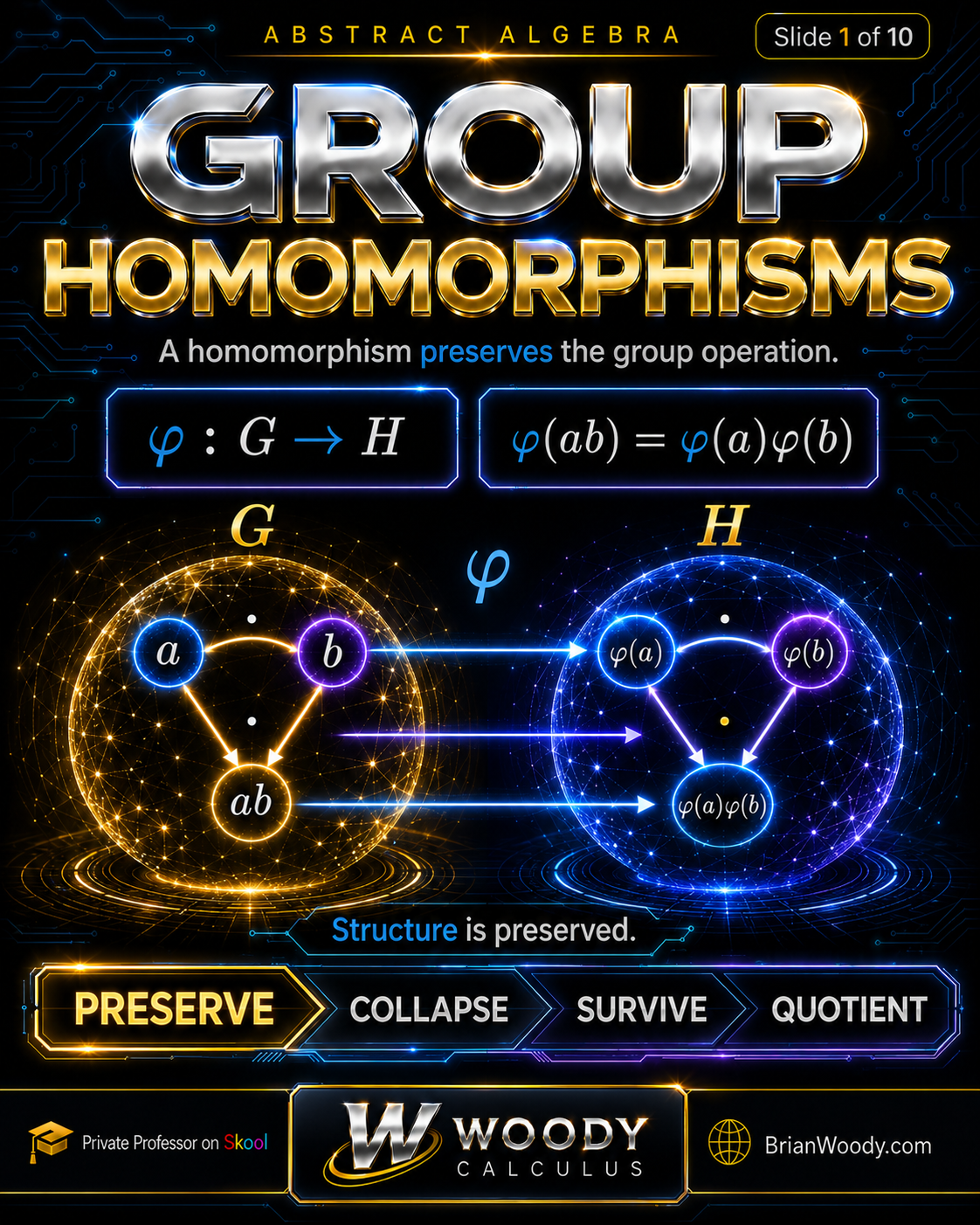
translating elements from one group into another.
What is a group homomorphism?
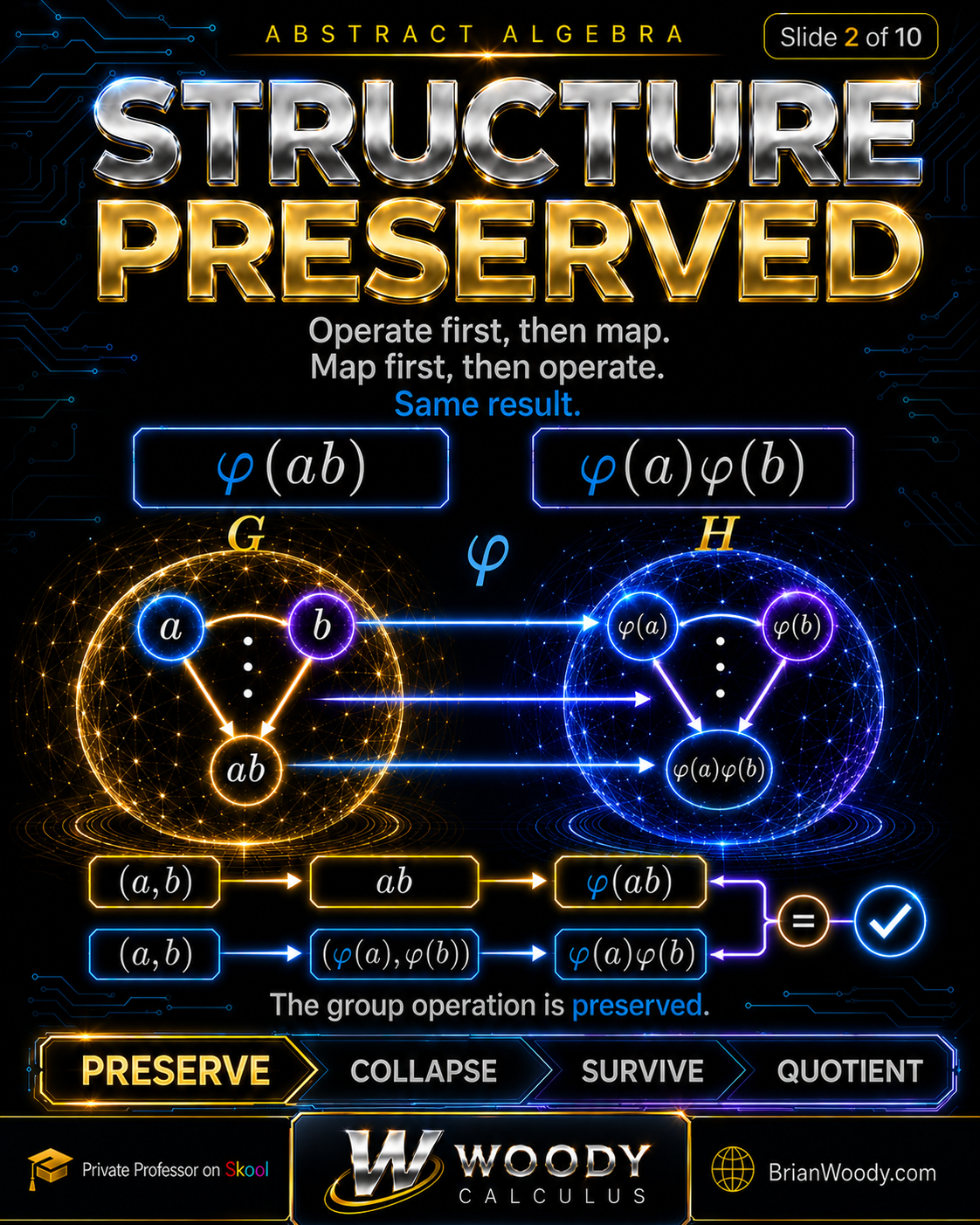
A group homomorphism is a function between groups that gives the same
result whether you operate first and then map, or map first and then
operate.
Formal Definition
Let \((G,\ast)\) and \((H,\circ)\) be groups. A function
\(\varphi:G\to H\) is a group homomorphism when
\varphi(a\ast b)=\varphi(a)\circ\varphi(b)
\qquad\text{for every }a,b\in G.
\]
In multiplicative notation:
\boxed{\varphi(ab)=\varphi(a)\varphi(b)}.
\]
In additive notation:
\boxed{\varphi(a+b)=\varphi(a)+\varphi(b)}.
\]
Plain-language answer:
the map may rename, compress, or reorganize elements, but it does not
alter how the operation combines them.
What does the group homomorphism notation mean?
The domain is where inputs begin, the codomain is where outputs live,
and the kernel and image record the map’s collapse and survival.
| Notation | Meaning | Important distinction |
|---|---|---|
| \(\varphi:G\to H\) | A function from group \(G\) to group \(H\) | The operation on each group must be known. |
| \(e_G,e_H\) | The identities of the domain and codomain | The kernel maps to \(e_H\), not to \(e_G\). |
| \(\ker\varphi\) | All elements sent to \(e_H\) | It is a normal subgroup of \(G\). |
| \(\operatorname{im}\varphi\) | All outputs actually attained | It may be smaller than the codomain \(H\). |
| \(\varphi^{-1}(h)\) | The fiber over \(h\) | This is a preimage set, not necessarily an inverse function. |
| \(G/\ker\varphi\) | The quotient by the kernel | Its elements are cosets of the kernel. |
What are the four automatic consequences of the homomorphism law?
The Four Fundamental Consequences are identity preservation, inverse
preservation, power preservation, and divisibility of element
orders.
These consequences explain why homomorphisms matter far beyond group
theory. The same structure-preserving philosophy leads to ring
homomorphisms, linear transformations, field embeddings, and the
automorphisms used in
field extensions and Galois theory
.
What is the difference between a homomorphism, an isomorphism, and an
automorphism?
A homomorphism preserves structure, an isomorphism preserves
structure bijectively between two groups, and an automorphism is an
isomorphism from a group to itself.
| Map type | Required properties | Structural meaning | Typical notation |
|---|---|---|---|
| Homomorphism | Preserves the group operation | May collapse elements or miss codomain elements | \(\varphi:G\to H\) |
| Monomorphism | Injective homomorphism | Embeds \(G\) as a subgroup of \(H\) | \(G\hookrightarrow H\) |
| Epimorphism | Surjective homomorphism | Every element of \(H\) is reached | \(G\twoheadrightarrow H\) |
| Isomorphism | Bijective homomorphism | The groups have the same structure up to relabeling | \(G\cong H\) |
| Automorphism | Isomorphism from \(G\) to itself | A symmetry of the group structure | \(\operatorname{Aut}(G)\) |
Is every homomorphism an isomorphism?
No. A homomorphism becomes an isomorphism only when it is both
injective and surjective.
How does the homomorphism from \(\mathbb Z\) to \(\mathbb Z_4\) work?
The canonical reduction map sends each integer to its residue class
modulo 4, so integers with the same remainder receive the same image.
\varphi:(\mathbb Z,+)\longrightarrow(\mathbb Z_4,+),
\qquad
\varphi(n)=[n]_4.
\]
For example,
\varphi(7)=[7]_4=[3]_4.
\]
The residue class \([3]_4\) is
[3]_4
=\{\ldots,-5,-1,3,7,11,\ldots\}
=3+4\mathbb Z.
\]
Notation convention
Many textbooks use \(\mathbb Z_4\), \(\mathbb Z/4\mathbb Z\), or
\(\mathbb Z/(4)\). They describe canonically isomorphic cyclic
groups, although a course may use the symbols with slightly
different emphasis.
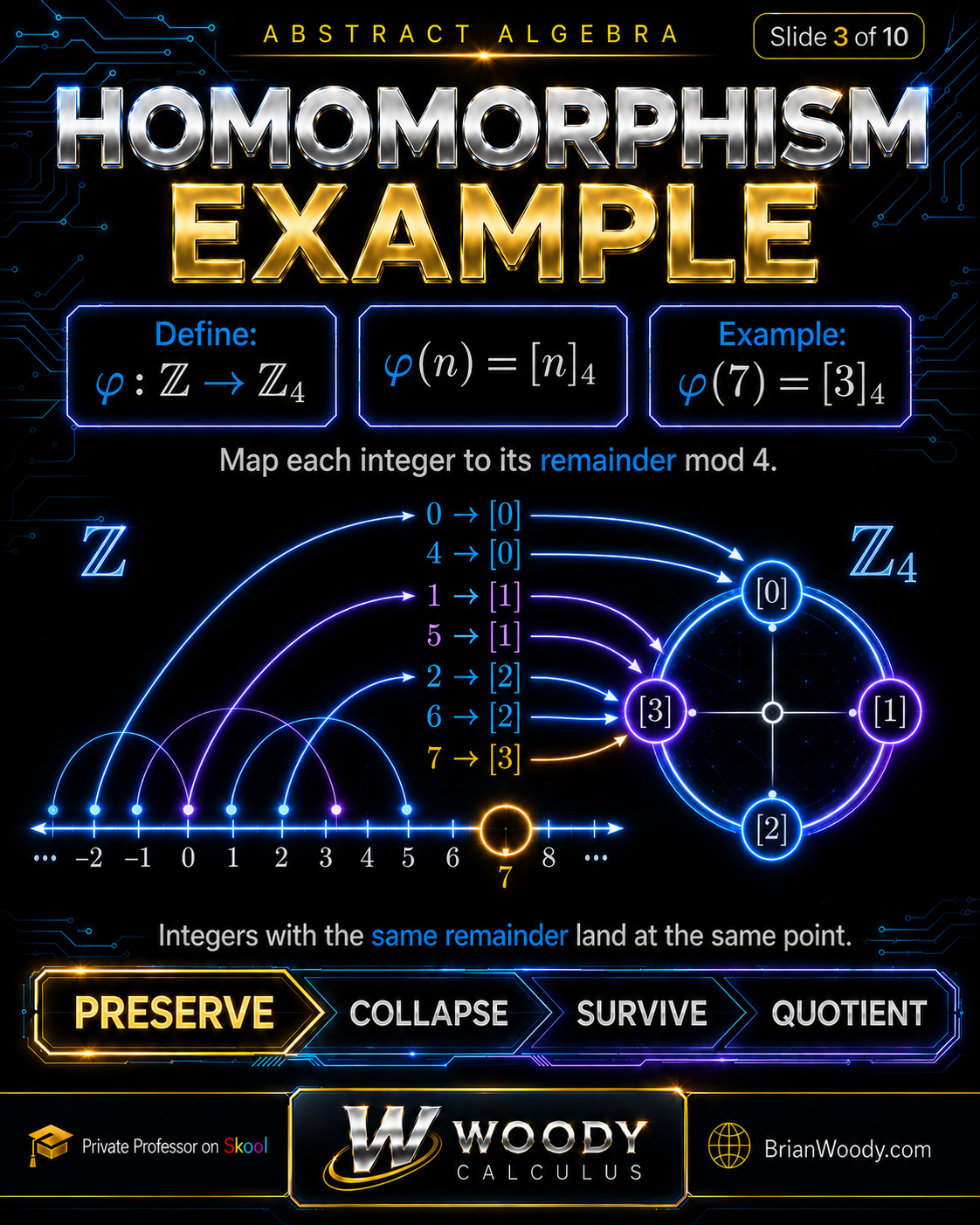
residue class modulo 4.
How do you verify that a map is a group homomorphism?
Take arbitrary elements of the domain and prove that the map
preserves the operation for every possible pair.
Let \(a,b\in\mathbb Z\). Then
\begin{aligned}
\varphi(a+b)
&=[a+b]_4\\
&=[a]_4+[b]_4\\
&=\varphi(a)+\varphi(b).
\end{aligned}
\]
Therefore \(\varphi\) is a homomorphism of additive groups.
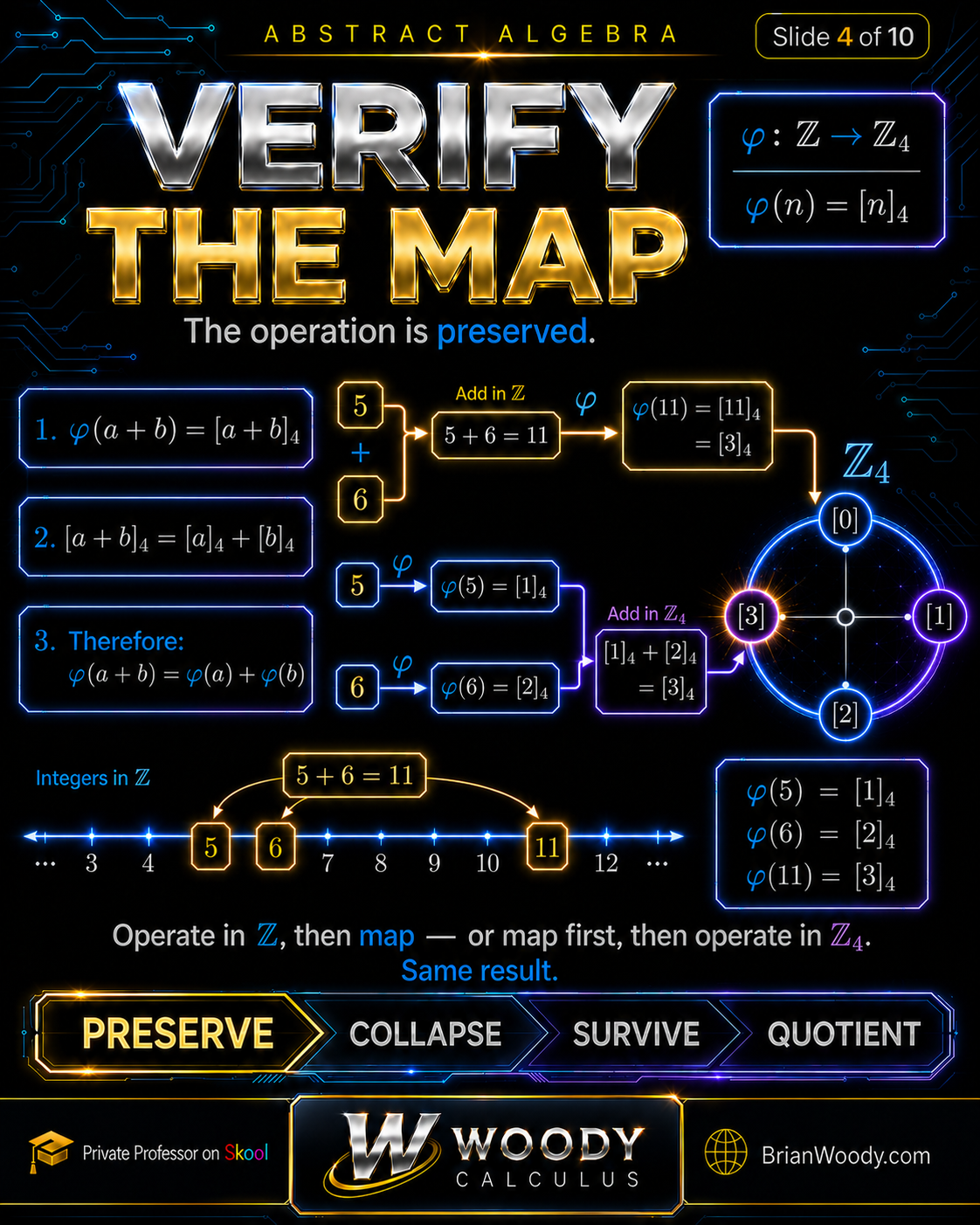
agrees with reduction first and addition in \(\mathbb Z_4\).
What is the kernel of a group homomorphism?
The kernel is the set of every domain element sent to the identity
of the codomain.
\ker\varphi
=\{g\in G:\varphi(g)=e_H\}.
\]
For reduction modulo 4, the codomain identity is \([0]_4\), so
\begin{aligned}
\ker\varphi
&=\{n\in\mathbb Z:[n]_4=[0]_4\}\\
&=\{\ldots,-8,-4,0,4,8,\ldots\}\\
&=\boxed{4\mathbb Z}.
\end{aligned}
\]
Plain-language answer:
the kernel is precisely the part of the domain that becomes invisible
after mapping.
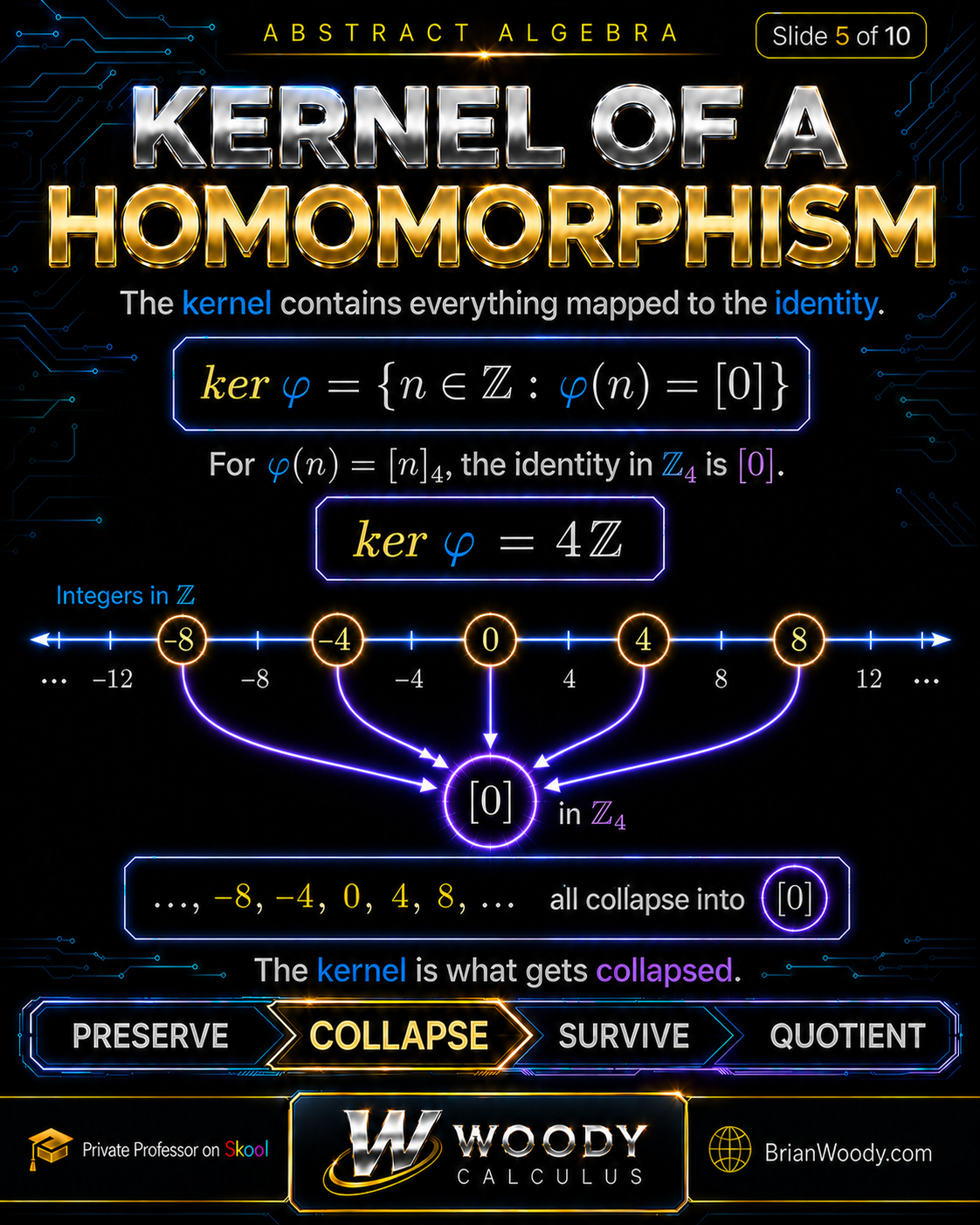
collapsed to the identity class.
What is the image of a group homomorphism?
The image is the subgroup of the codomain consisting of every
output the map actually reaches.
\operatorname{im}\varphi
=\{\varphi(g):g\in G\}.
\]
The reduction map reaches each residue class:
\varphi(0)=[0]_4,\quad
\varphi(1)=[1]_4,\quad
\varphi(2)=[2]_4,\quad
\varphi(3)=[3]_4.
\]
Hence
\boxed{\operatorname{im}\varphi=\mathbb Z_4}.
\]
Image is not automatically the codomain
The codomain is the declared destination. The image is the portion
actually reached. They agree only when the map is surjective.
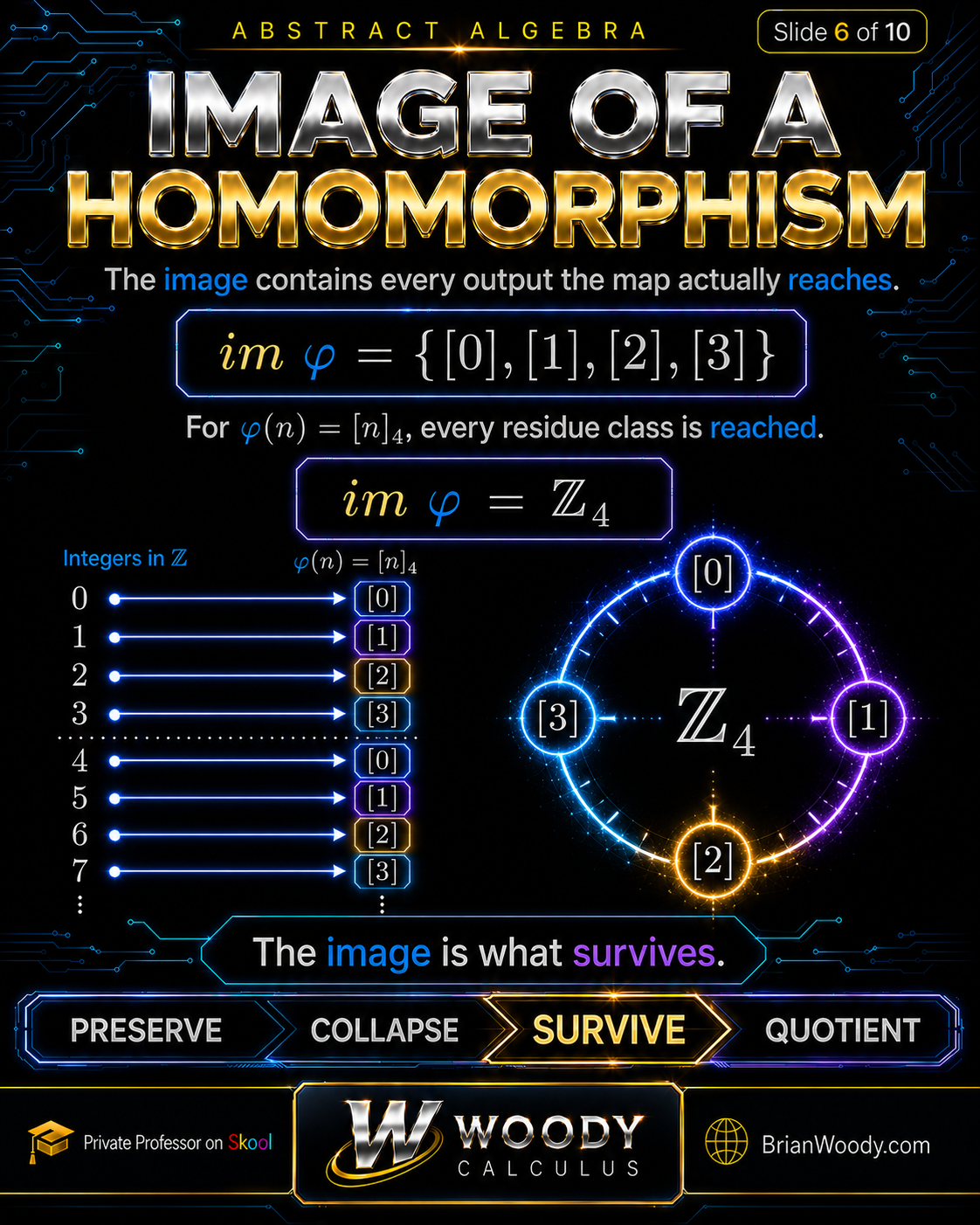
surjective.
Why are the fibers of a homomorphism cosets of the kernel?
If \(h\) lies in the image and \(\varphi(g)=h\), then the entire
fiber over \(h\) is the coset \(g\ker\varphi\).
Let \(K=\ker\varphi\). If \(x=gk\) with \(k\in K\), then
\varphi(x)
=\varphi(gk)
=\varphi(g)\varphi(k)
=he_H
=h.
\]
Conversely, if \(\varphi(x)=h=\varphi(g)\), then
\varphi(g^{-1}x)
=\varphi(g)^{-1}\varphi(x)
=h^{-1}h
=e_H,
\]
so \(g^{-1}x\in K\), and therefore \(x\in gK\). Hence
\boxed{
\varphi^{-1}(h)
=g\ker\varphi
\qquad
(h\in\operatorname{im}\varphi)
}.
\]
For the mod-4 map:
\varphi^{-1}([0])=4\mathbb Z,\quad
\varphi^{-1}([1])=1+4\mathbb Z,\quad
\varphi^{-1}([2])=2+4\mathbb Z,\quad
\varphi^{-1}([3])=3+4\mathbb Z.
\]
Theorem-hypothesis trap
A fiber over an element outside the image is empty, not a coset.
The precise theorem says that every nonempty
fiber is a coset of the kernel.
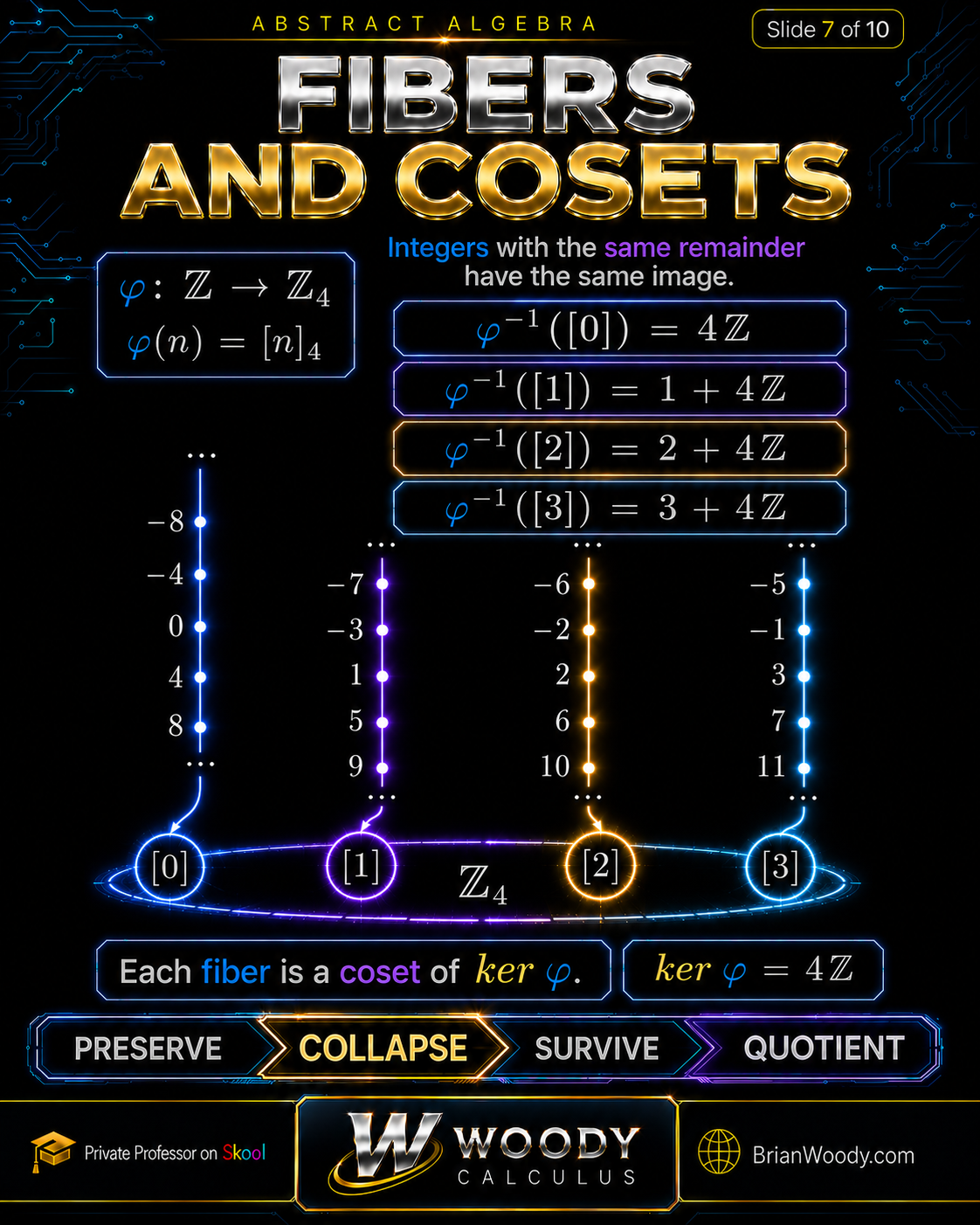
kernel.
Why do normal subgroups matter in the First Isomorphism Theorem?
Normality is what makes multiplication of kernel cosets independent
of the representatives chosen, so the quotient is genuinely a
group.
If \(N\trianglelefteq G\), define
(aN)(bN)=abN.
\]
To be well-defined, replacing \(a\) and \(b\) by other representatives
from the same cosets must produce the same product coset. Normality
guarantees that it does.
Why kernels are perfect quotient subgroups
Every homomorphism kernel is automatically normal. Therefore the
expression \(G/\ker\varphi\) always defines a quotient group, not
merely a set of cosets.
How does the quotient group arise from a homomorphism?
The quotient group replaces every kernel coset with one element,
exactly matching the distinctions the homomorphism can still
detect.
Since \(\ker\varphi=4\mathbb Z\),
\mathbb Z/4\mathbb Z
=
\{
4\mathbb Z,
1+4\mathbb Z,
2+4\mathbb Z,
3+4\mathbb Z
\}.
\]
The quotient operation is
(a+4\mathbb Z)+(b+4\mathbb Z)
=
(a+b)+4\mathbb Z.
\]
Plain-language answer:
the quotient forgets exactly the distinctions the map cannot see and
keeps exactly the distinctions the image can see.
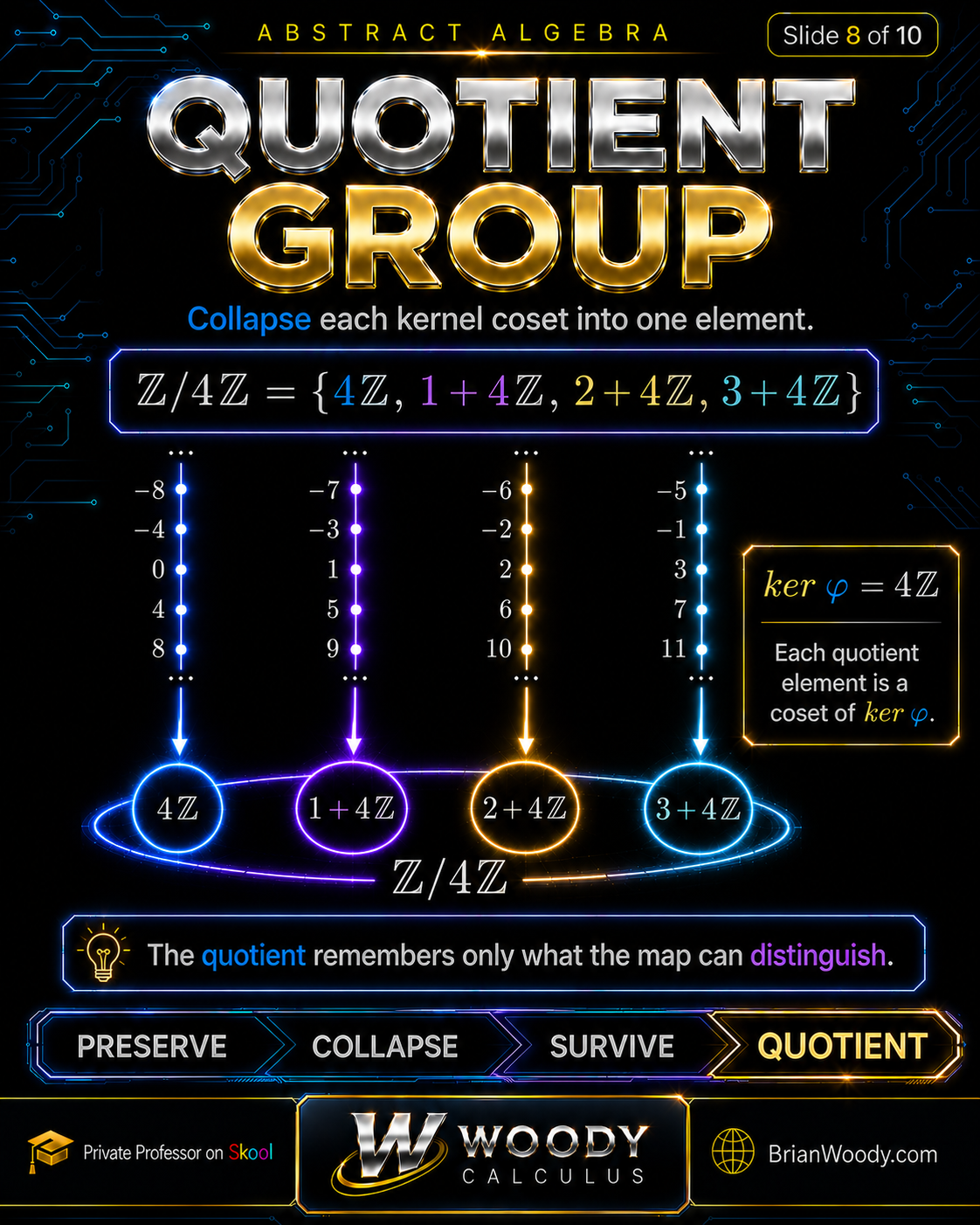
\(\mathbb Z/4\mathbb Z\).
What does the First Isomorphism Theorem say?
The First Isomorphism Theorem says that quotienting the domain by
everything the map collapses produces a group isomorphic to
everything the map reaches.
First Isomorphism Theorem for Groups
If \(\varphi:G\to H\) is a group homomorphism, then
\(\ker\varphi\trianglelefteq G\) and
\boxed{
G/\ker\varphi
\cong
\operatorname{im}\varphi
}.
\]
For reduction modulo 4:
\boxed{
\mathbb Z/4\mathbb Z
\cong
\mathbb Z_4
}.
\]
Quotient by what collapses, and you obtain exactly what survives.
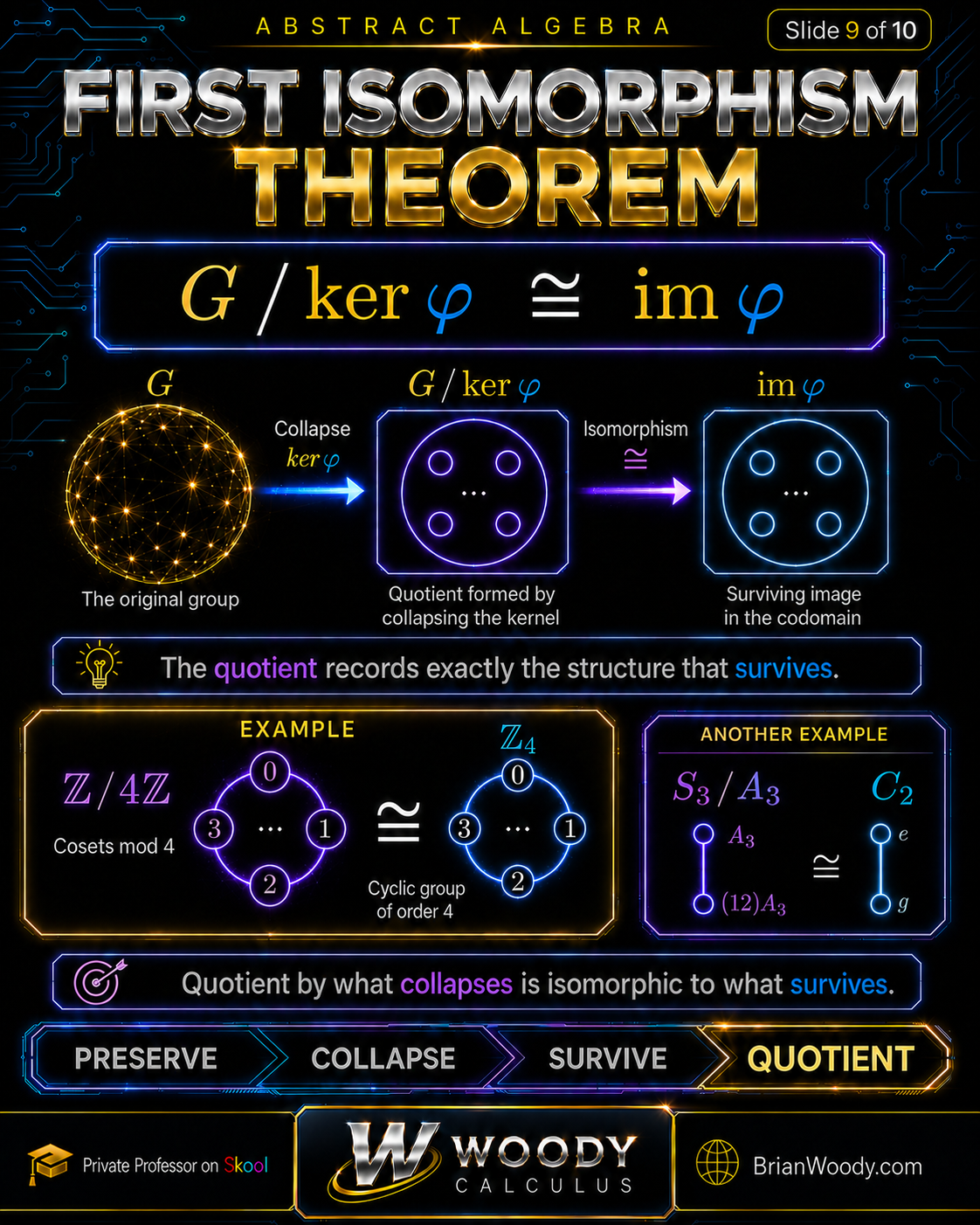
isomorphic to the image.
How is the First Isomorphism Theorem proved?
Send each kernel coset \(g\ker\varphi\) to \(\varphi(g)\), then prove
that this induced map is well-defined, homomorphic, surjective, and
injective.
How does the First Isomorphism Theorem show that
\(S_3/A_3\cong C_2\)?
The sign homomorphism sends even permutations to the identity and
odd permutations to the other element of \(C_2\), so its kernel is
\(A_3\) and its image is \(C_2\).
\operatorname{sgn}:S_3
\longrightarrow
\{1,-1\}
\cong
C_2.
\]
\ker(\operatorname{sgn})=A_3,
\qquad
\operatorname{im}(\operatorname{sgn})=C_2.
\]
The theorem gives
\boxed{
S_3/A_3
\cong
C_2
}.
\]
The two quotient elements are the coset of even permutations and the
coset of odd permutations.
How do the kernel and image test injectivity and surjectivity?
A homomorphism is injective exactly when only the identity
collapses, and it is surjective exactly when every codomain element
is reached.
| Property | Equivalent condition | Structural meaning |
|---|---|---|
| Injective | \(\ker\varphi=\{e_G\}\) | No two distinct elements collapse together. |
| Surjective | \(\operatorname{im}\varphi=H\) | Every codomain element is reached. |
| Isomorphism | Injective and surjective | The groups have the same structure up to relabeling. |
What does a homomorphism tell us about the size of a finite group?
For a homomorphism from a finite group, the size of the domain
equals the size of the kernel times the size of the image.
\boxed{
|G|
=
|\ker\varphi|\,
|\operatorname{im}\varphi|
}.
\]
Every nonempty fiber has \(|\ker\varphi|\) elements, and there is one
fiber for each element of the image. Equivalently,
|G/\ker\varphi|
=
\frac{|G|}{|\ker\varphi|}
=
|\operatorname{im}\varphi|.
\]
What mistakes do students make with group homomorphisms?
Most mistakes come from ignoring the operations, checking only
examples, confusing image with codomain, or applying quotient and
isomorphism theorems without their hypotheses.
Mistake: Naming only the sets
Symptom:
The map is written as \(\varphi:G\to H\) with no operations specified.
Cause:
A group has been treated as a bare set.
Fix:
Name the operation on both groups, especially when one is additive
and the other is multiplicative.
Mistake: Checking one example instead of proving the law
Symptom:
One numerical calculation is used as the entire homomorphism proof.
Cause:
An example has been confused with a universal argument.
Fix:
Start with arbitrary \(a,b\in G\).
Mistake: Using the wrong identity in the kernel
Symptom:
The kernel is defined by \(\varphi(g)=e_G\).
Cause:
Domain and codomain identities were mixed.
Fix:
Use the codomain identity: \(\varphi(g)=e_H\).
Mistake: Confusing image and codomain
Symptom:
The student assumes \(\operatorname{im}\varphi=H\).
Cause:
The declared destination was confused with the outputs actually
attained.
Fix:
Compute the image, then decide whether the map is surjective.
Mistake: Saying every fiber is a coset
Symptom:
A coset is assigned to an element outside the image.
Cause:
Empty fibers were ignored.
Fix:
State that every nonempty fiber is a kernel coset.
Mistake: Writing \(G/\ker\varphi\cong H\) without surjectivity
Symptom:
The codomain replaces the image in the theorem.
Cause:
The theorem was memorized imprecisely.
Fix:
Always write
\(G/\ker\varphi\cong\operatorname{im}\varphi\). Replace the image
with \(H\) only after proving surjectivity.
Mistake: Forming a quotient by a nonnormal subgroup
Symptom:
A set of cosets is automatically treated as a quotient group.
Cause:
Normality and well-definedness were skipped.
Fix:
Verify \(N\trianglelefteq G\). A kernel automatically passes this
test.
Mistake: Confusing \(4\mathbb Z\) with \(\mathbb Z_4\)
Symptom:
The kernel is written as \(\mathbb Z_4\).
Cause:
Multiples of 4 were confused with residue classes modulo 4.
Fix:
\(4\mathbb Z\subseteq\mathbb Z\) is infinite; \(\mathbb Z_4\) has
four elements.
Woody Calculus rule
Definition first. Operation second. Kernel and image third.
Theorem last. Do not invoke an isomorphism theorem before you can
explain exactly what collapses and exactly what survives.
What is the Woody Calculus exam checklist for group homomorphisms?
Preserve first. Compute collapse second. Identify survival third.
Form the quotient fourth. Verify the isomorphism last.
- Name the domain, codomain, and both operations.
- Write the homomorphism law from memory.
- Use arbitrary elements to prove operation preservation.
- Recall the Four Fundamental Consequences.
- Compute the kernel using the codomain identity.
- Use normality before forming the quotient group.
- Compute the image and test surjectivity.
- Describe nonempty fibers as cosets of the kernel.
- Write the quotient elements as kernel cosets.
-
State \(G/\ker\varphi\cong\operatorname{im}\varphi\), not
automatically \(H\). - Check well-definedness for every induced map on cosets.
- Use the kernel test for injectivity and image test for surjectivity.
- Verify the finite-order formula when the groups are finite.
- Rebuild the proof from a blank page and say each implication aloud.
Formula memorization is required, but the structure chooses the
theorem. Memorize the definitions precisely, then let the kernel and
image tell you what applies.
How do you master group homomorphisms?
Mastery means moving fluently from operation preservation to
kernel, image, fibers, quotient groups, and the First Isomorphism
Theorem without confusing any object or hypothesis.
The Preserve–Collapse–Survive–Quotient Framework
-
Preserve:
verify the homomorphism law. -
Collapse:
compute the kernel. -
Survive:
compute the image. -
Quotient:
form the quotient by the kernel. -
Recognize:
identify the quotient with the image.
Reading the theorem is not enough. Re-prove the mod-4 example,
rebuild the well-definedness argument, and repeat the entire process
for the sign map on \(S_3\).
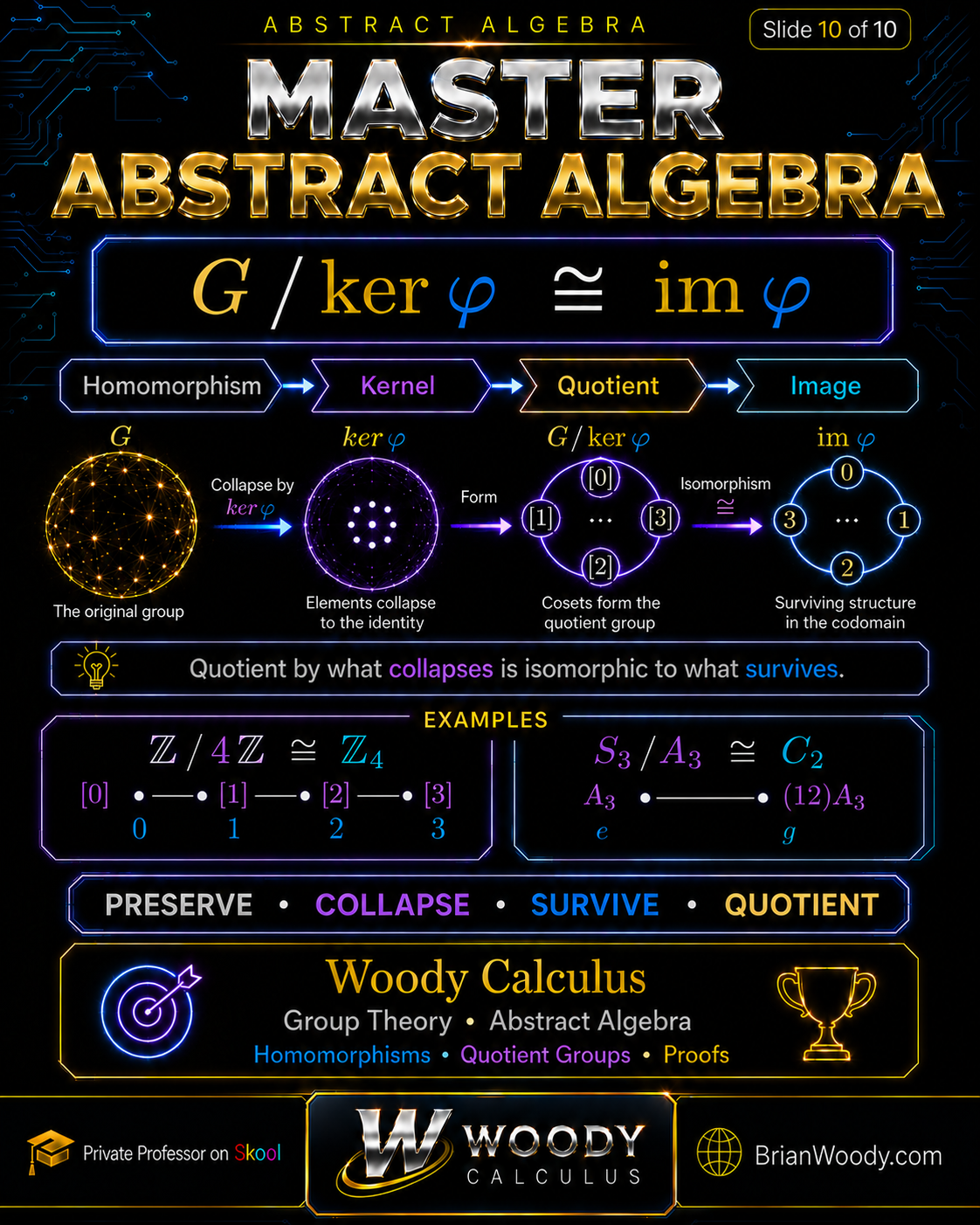
structural story of a group homomorphism.
Frequently Asked Questions About Group Homomorphisms
What is a group homomorphism?
A group homomorphism is a function \(\varphi:G\to H\) that preserves
the group operation. In multiplicative notation, it satisfies
\(\varphi(ab)=\varphi(a)\varphi(b)\) for every \(a,b\in G\).
What is the difference between a homomorphism and an isomorphism?
A homomorphism only has to preserve the operation. An isomorphism is
a bijective homomorphism, so it preserves the operation and gives a
one-to-one correspondence between the two groups.
Is every homomorphism an isomorphism?
No. A homomorphism is an isomorphism only when it is both injective
and surjective.
What is an automorphism?
An automorphism is an isomorphism from a group to itself.
Automorphisms describe internal symmetries of the group structure.
What is the kernel of a group homomorphism?
The kernel is the set of all domain elements mapped to the identity
of the codomain. It is always a normal subgroup of the domain.
What is the image of a group homomorphism?
The image is the set of codomain elements actually reached by the map.
It is always a subgroup of the codomain.
How do you prove that a map is a homomorphism?
Take arbitrary elements of the domain and prove that applying the map
after the domain operation gives the same result as mapping first and
then using the codomain operation.
Why is the kernel normal?
If \(k\) lies in the kernel and \(g\) lies in the domain, then
\(\varphi(gkg^{-1})=\varphi(g)e_H\varphi(g)^{-1}=e_H\). Therefore
every conjugate of a kernel element remains in the kernel.
Why do normal subgroups matter for quotient groups?
Normality makes the product of cosets independent of the
representatives chosen. That is what turns a set of cosets into a
well-defined quotient group.
Why are fibers cosets of the kernel?
If \(\varphi(g)=h\), then every element with image \(h\) differs from
\(g\) by an element of the kernel. Therefore the nonempty fiber over
\(h\) is \(g\ker\varphi\).
What does the First Isomorphism Theorem say?
For a group homomorphism \(\varphi:G\to H\), the quotient group
\(G/\ker\varphi\) is isomorphic to
\(\operatorname{im}\varphi\).
When is a group homomorphism injective?
A group homomorphism is injective exactly when its kernel contains
only the identity element of the domain.
When is a group homomorphism surjective?
A group homomorphism is surjective exactly when its image equals its
codomain.
Does a group homomorphism preserve element order?
If an element has finite order, the order of its image divides the
order of the original element. An injective homomorphism preserves the
order exactly.
What are the kernel and image of \(\varphi(n)=[n]_4\)?
For reduction from \(\mathbb Z\) to \(\mathbb Z_4\), the kernel is
\(4\mathbb Z\) and the image is all of \(\mathbb Z_4\). Therefore
\(\mathbb Z/4\mathbb Z\cong\mathbb Z_4\).
Why is \(S_3/A_3\cong C_2\)?
The sign homomorphism from \(S_3\) to \(C_2\) has kernel \(A_3\) and
image \(C_2\). The First Isomorphism Theorem gives
\(S_3/A_3\cong C_2\).
Need help with university abstract algebra?
The
Woody Calculus Mastery Lab
is the required starting point for students who want help with group
theory, homomorphisms, quotient groups, field theory, Galois theory,
and proof writing.
Limited
private instruction
may be available after Mastery Lab enrollment. It is selective,
limited, normally based on weekly sessions, and not guaranteed.
Visit the
contact page
or explore the
Abstract Algebra help page
.
University abstract algebra and group theory help
MIT mathematics support
Professor-led support for proof-based algebra, group structure,
quotient constructions, and advanced reasoning.
Harvard mathematics support
Build stronger definitions, proof structure, and
theorem-recognition skills.
Caltech mathematics support
Structured help with rigorous algebra, group theory, and advanced
mathematics.
UCLA mathematics support
Prepare for abstract algebra, proofs, homomorphisms, and quotient
groups.
Purdue mathematics support
Strengthen group theory, algebraic structure, and exam-ready proof
writing.
University of Florida mathematics support
Get support across abstract algebra, advanced calculus, and
proof-based courses.
Reviews and trust
Read
Woody Calculus 5-star Google reviews
and view
Brian M. Woody’s 5.0 RateMyProfessors rating
.
Woody Calculus provides university-level mathematical instruction,
structured practice, and long-term mastery—not generic tutoring and
not a shortcut answer service.