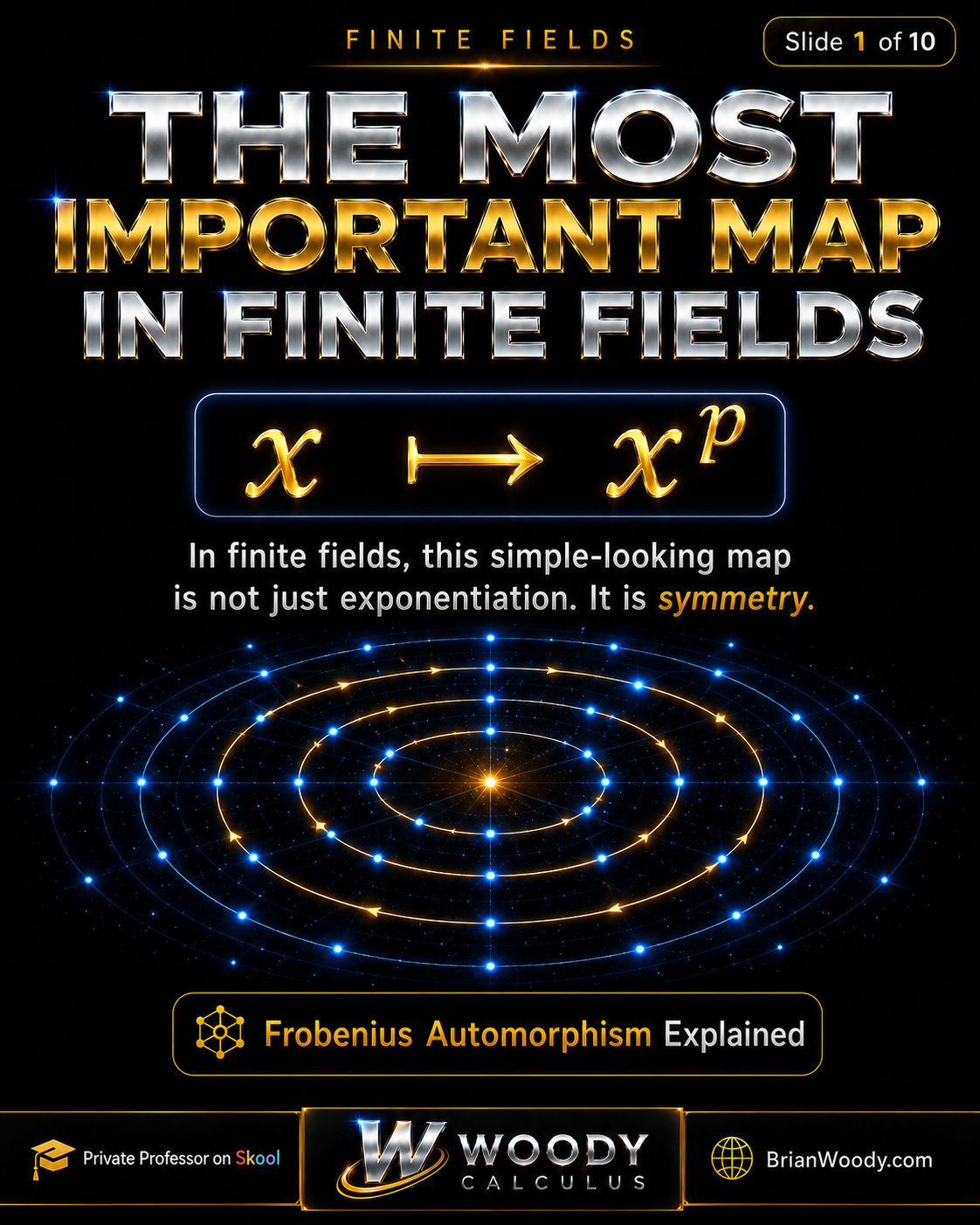
The Frobenius automorphism \(x\mapsto x^p\) is the central symmetry of finite fields. This Woody Calculus Abstract Algebra lesson explains characteristic \(p\), the Freshman’s Dream, cyclic finite-field Galois groups, Frobenius conjugates, trace, norm, unit circles, and how these ideas connect to modern finite-field research.
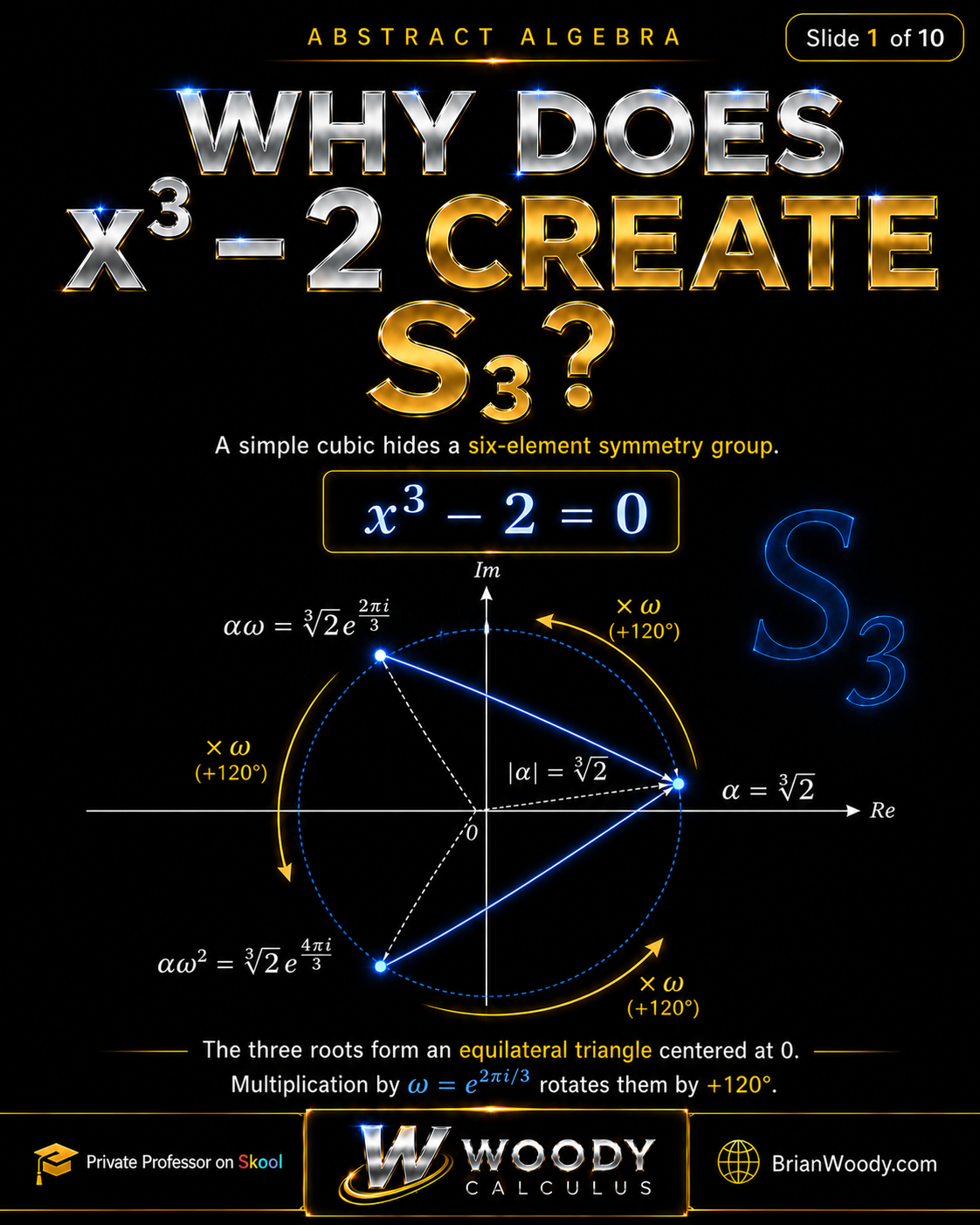
Why does the simple cubic x³ − 2 create the six-element symmetry group S₃? This Woody Calculus Abstract Algebra lesson explains the roots, splitting field, extension degree, automorphisms, triangle symmetries, and quotient group connection behind one of the cleanest examples in Galois theory.
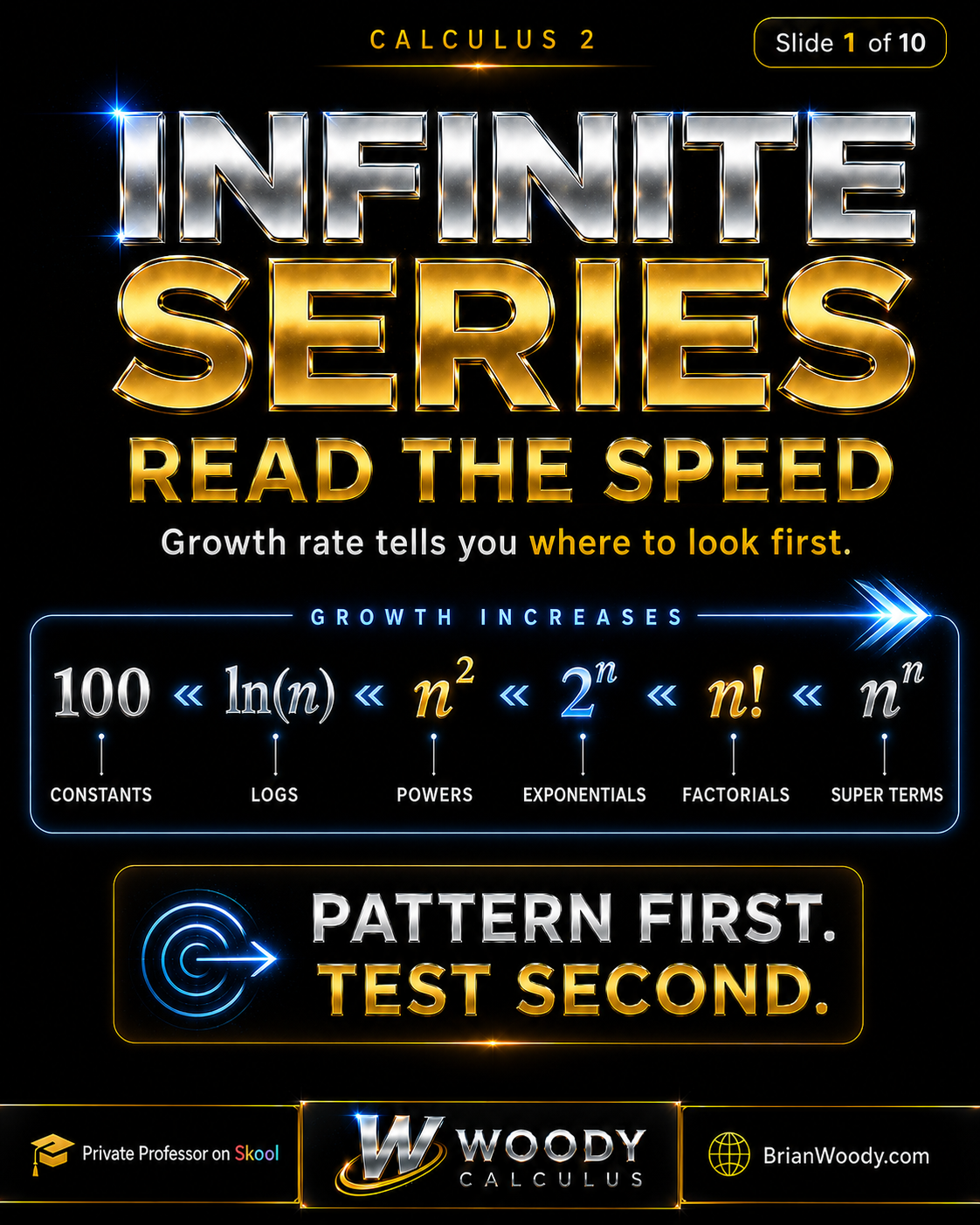
Learn how to choose the right infinite series test in Calculus 2. This Woody Calculus guide explains the Test for Divergence, p-test, geometric series, Limit Comparison Test, Direct Comparison Test, Ratio Test, Root Test, Integral Test, Alternating Series Test, and telescoping series.
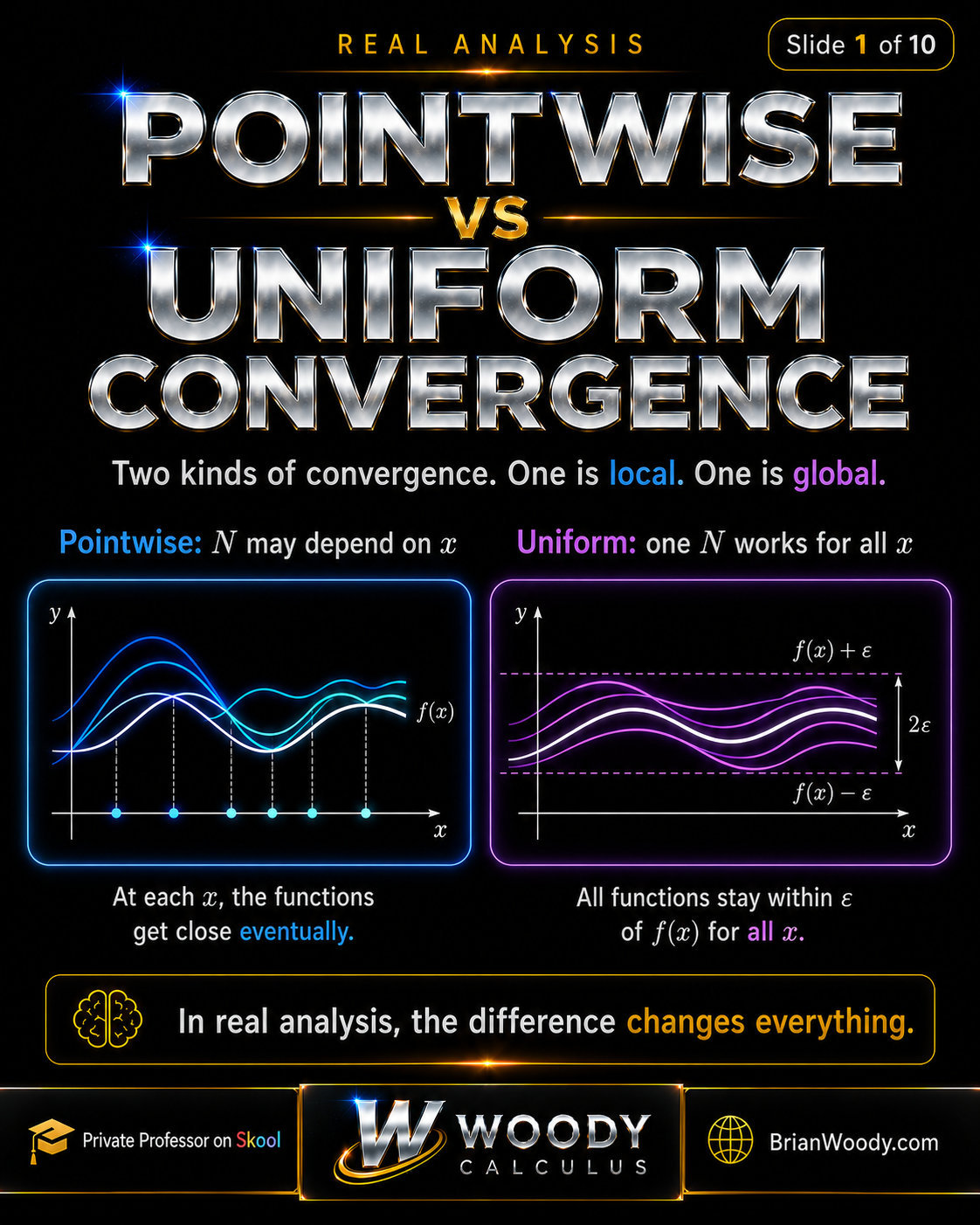
Pointwise convergence checks one input at a time. Uniform convergence controls the whole domain at once. This Woody Calculus Real Analysis lesson explains the definitions, quantifiers, sup norm test, classic examples, and why uniform convergence preserves structure.
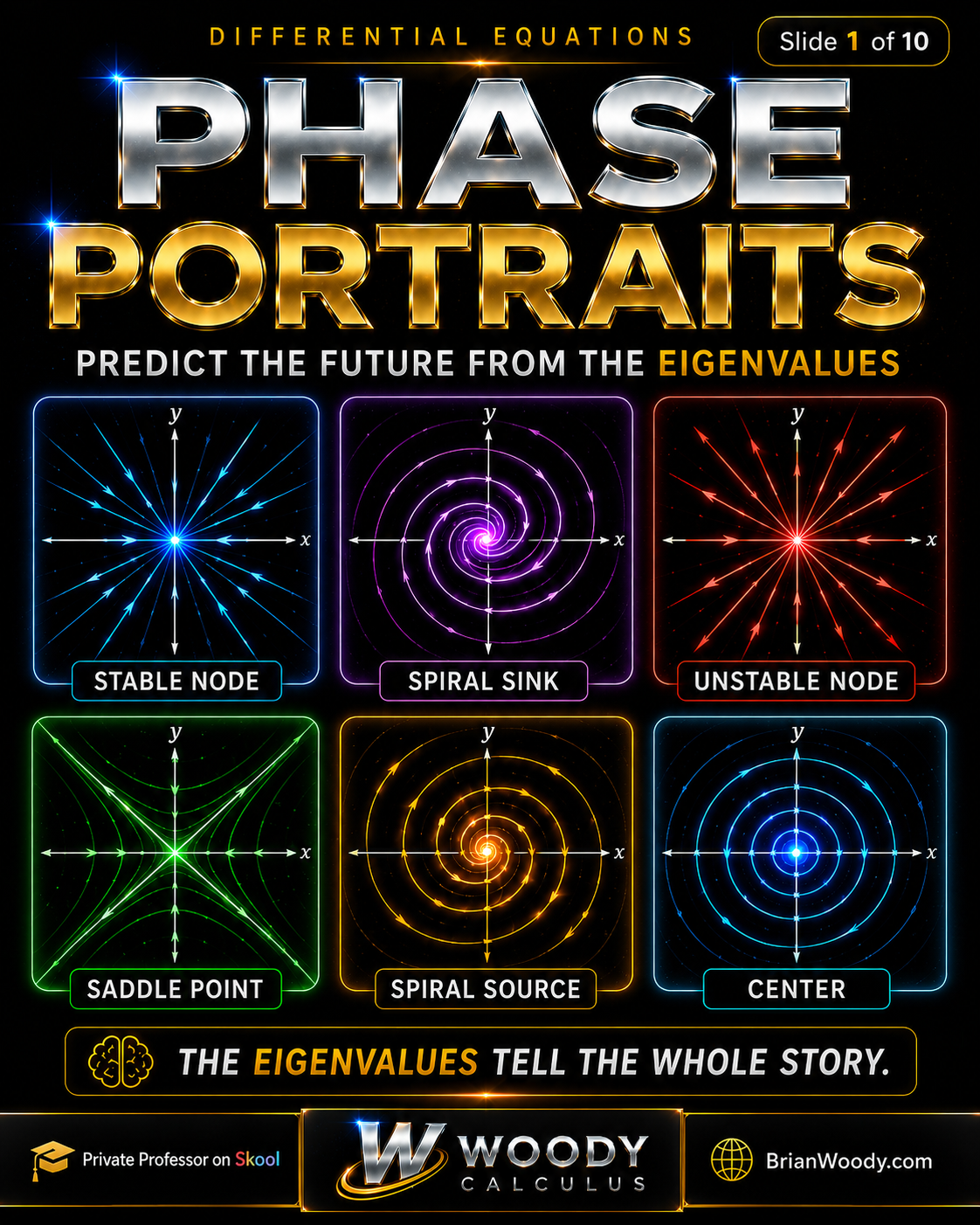
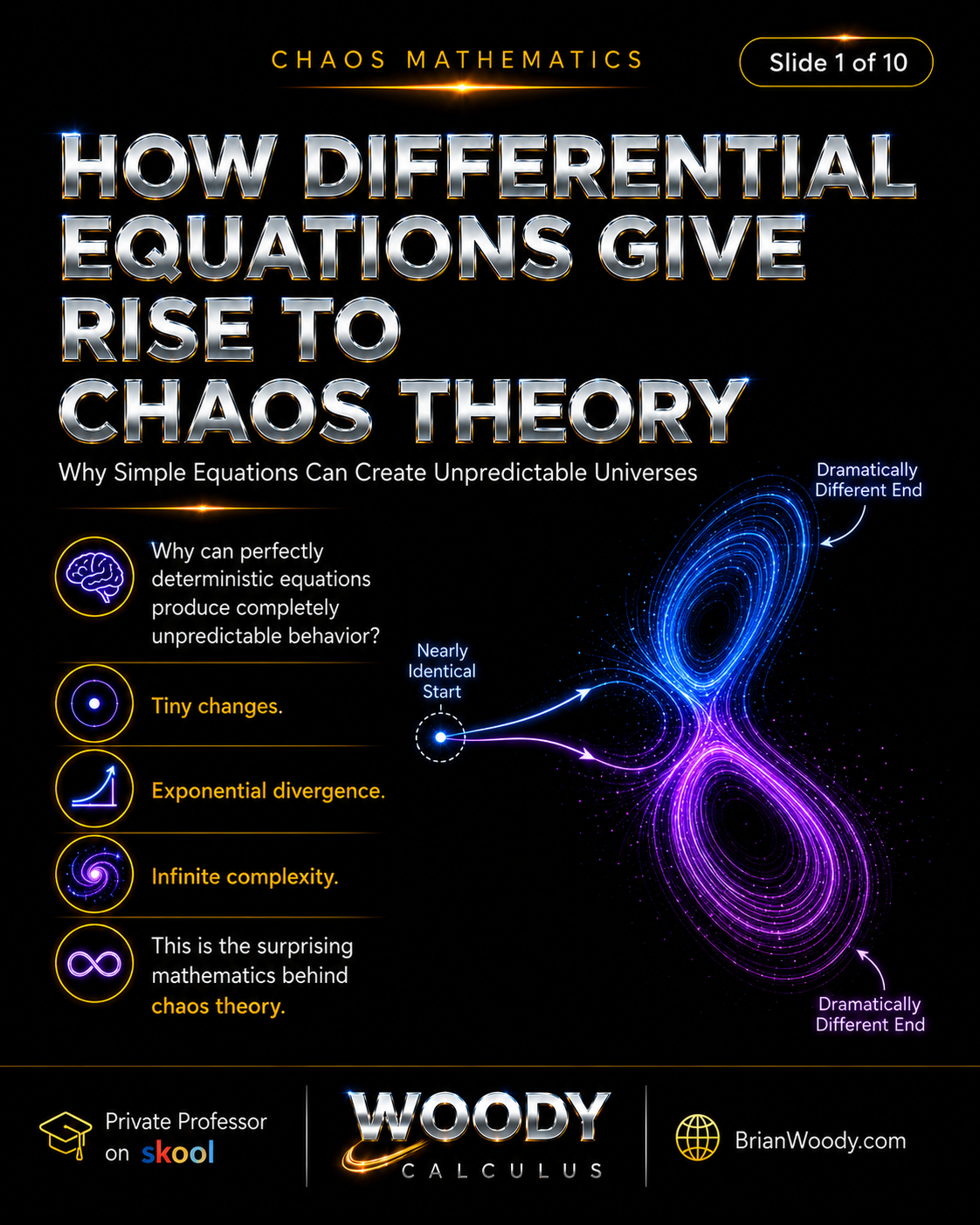
How can deterministic differential equations create unpredictable behavior? This Woody Calculus lesson explains chaos theory through sensitivity to initial conditions, nonlinear systems, phase portraits, Lyapunov exponents, and the Lorenz attractor.
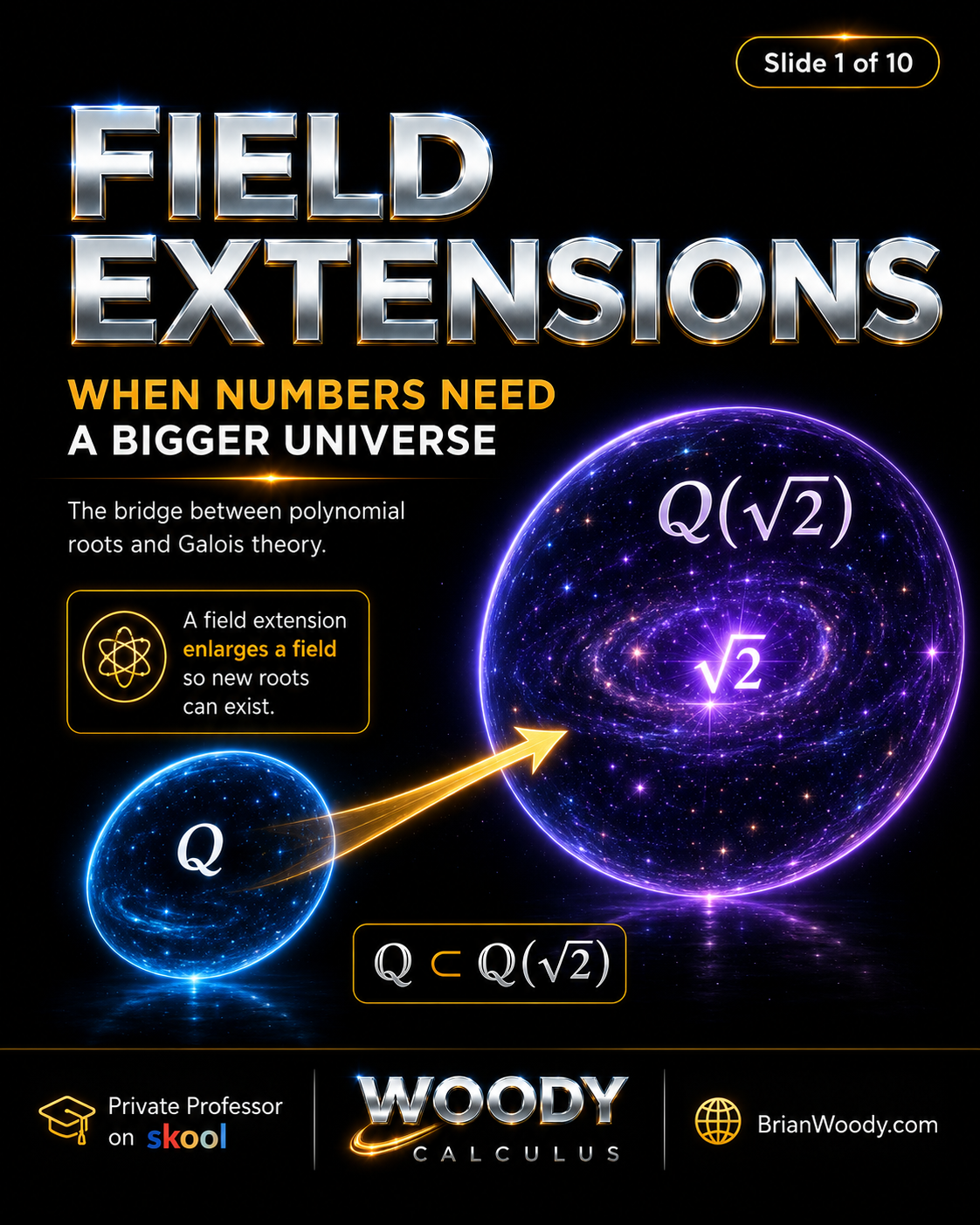
Field extensions are how Abstract Algebra builds a bigger number system when a polynomial has missing roots. In this Woody Calculus visual lesson, learn how Q becomes Q(√2), why x² − 2 has no rational root, how degree and minimal polynomials work, and why field extensions open the door to Galois theory.
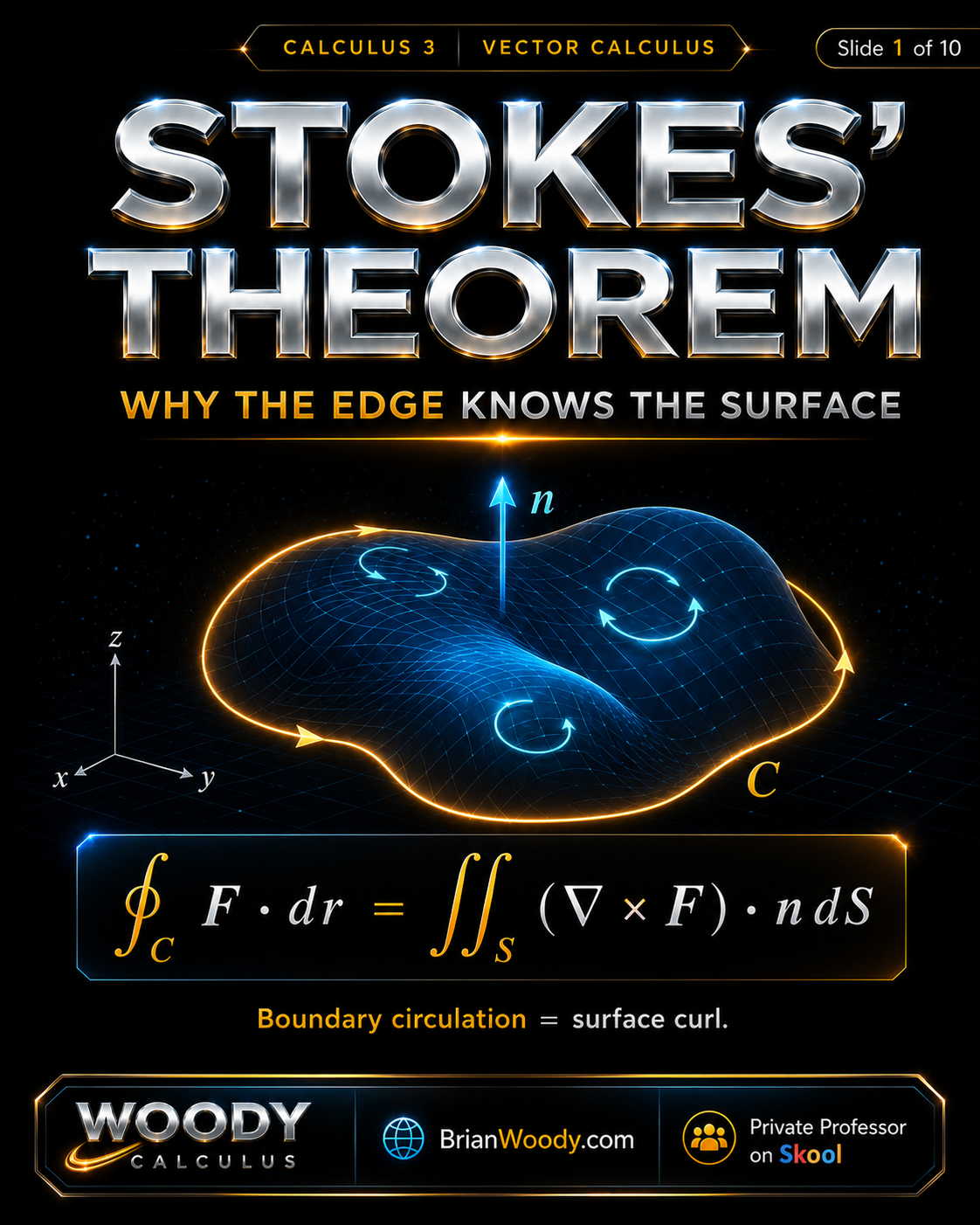
Stokes’ Theorem says that boundary circulation equals the total curl through a surface. In this Woody Calculus visual lesson, learn how Stokes’ Theorem connects line integrals, surface integrals, curl, orientation, the right-hand rule, Green’s Theorem, and vector calculus in Calculus 3.
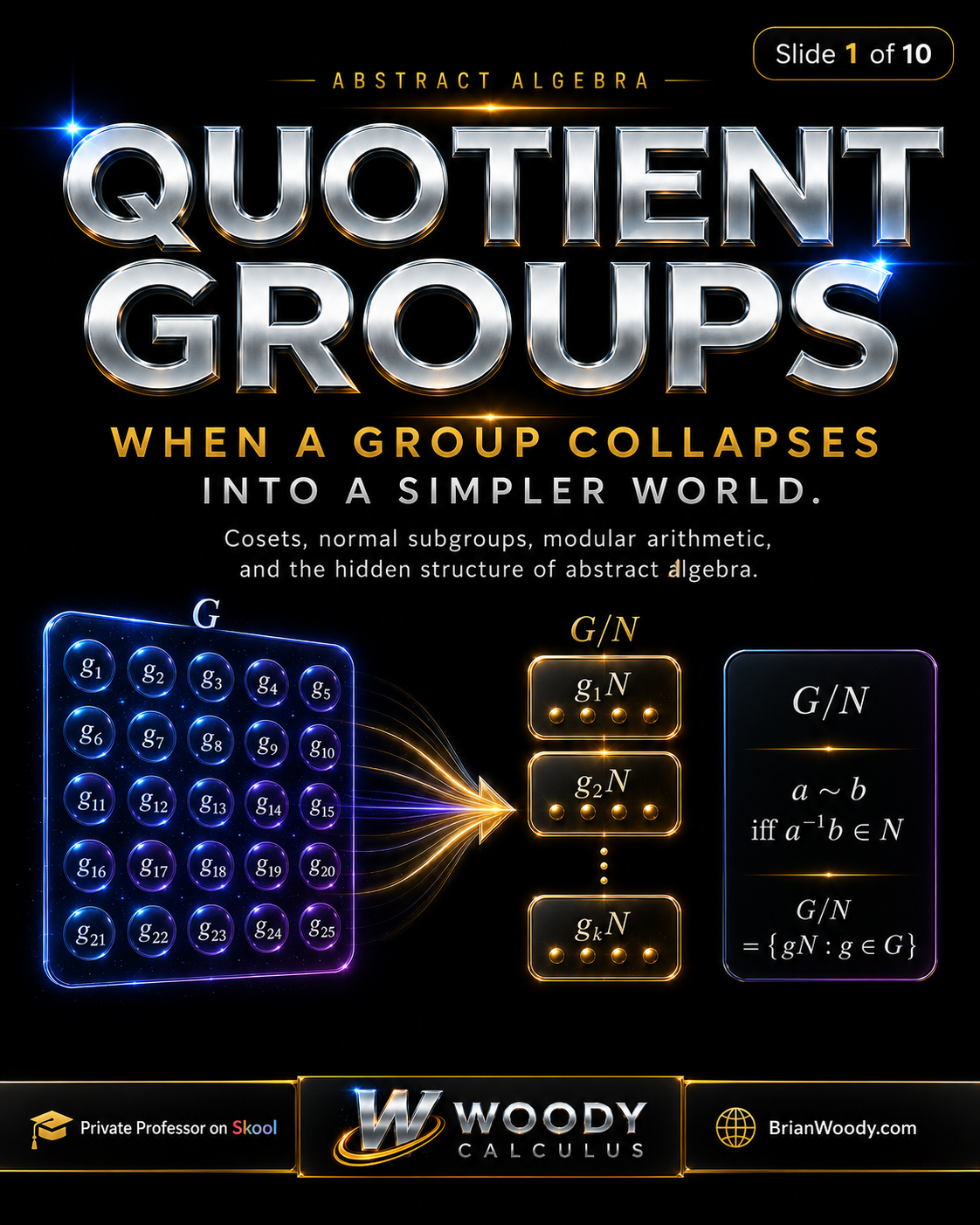
Quotient groups are how Abstract Algebra collapses a group into a simpler structure. In this Woody Calculus visual lesson, learn how cosets become the new elements, why normal subgroups are required, how modular arithmetic is a quotient group, and how kernels lead directly to the First Isomorphism Theorem.
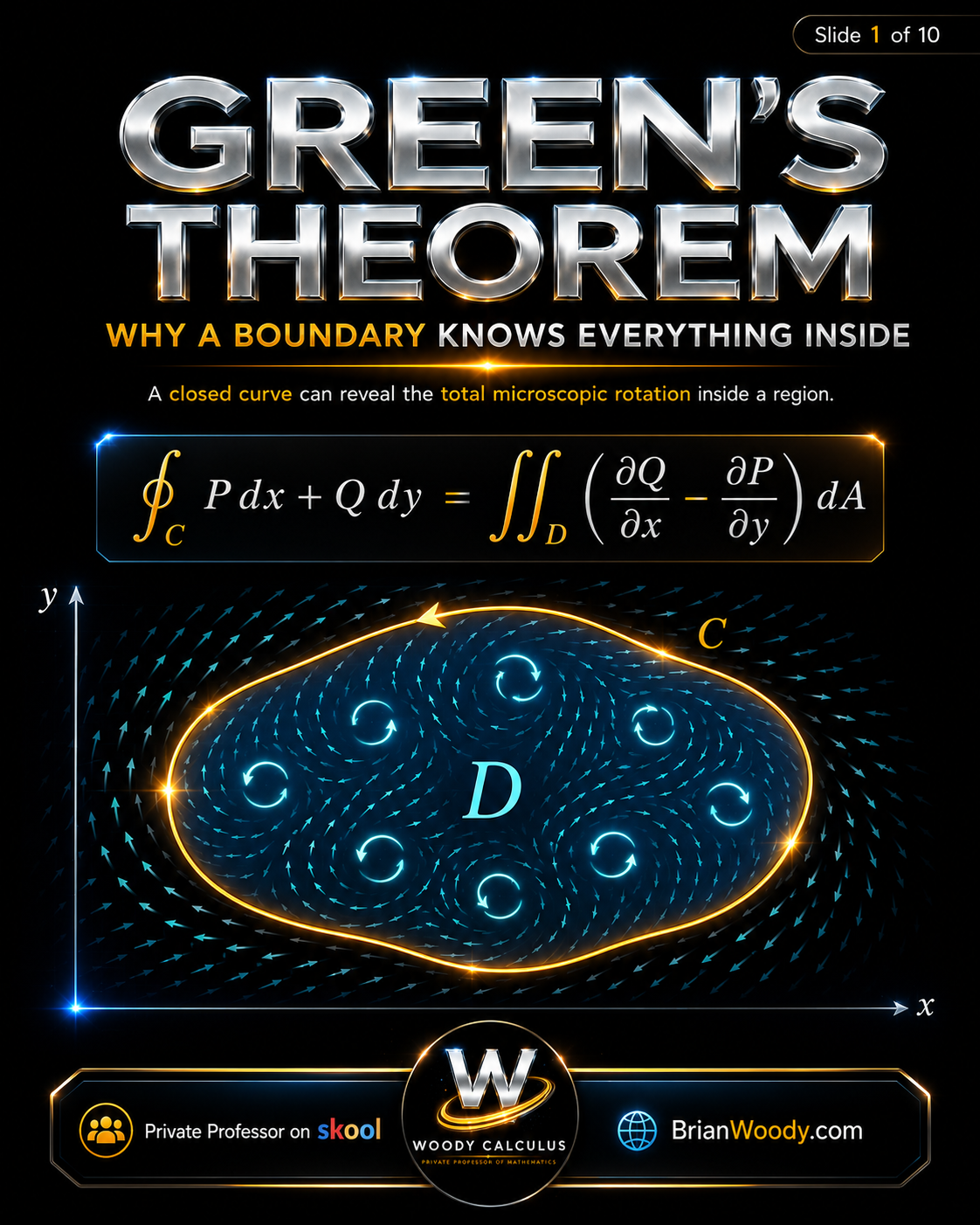
Green’s Theorem turns a boundary line integral into an interior double integral. In this Woody Calculus visual lesson, learn how Green’s Theorem connects circulation, curl, flux, area, line integrals, double integrals, Stokes’ Theorem, and the Divergence Theorem in Calculus 3.