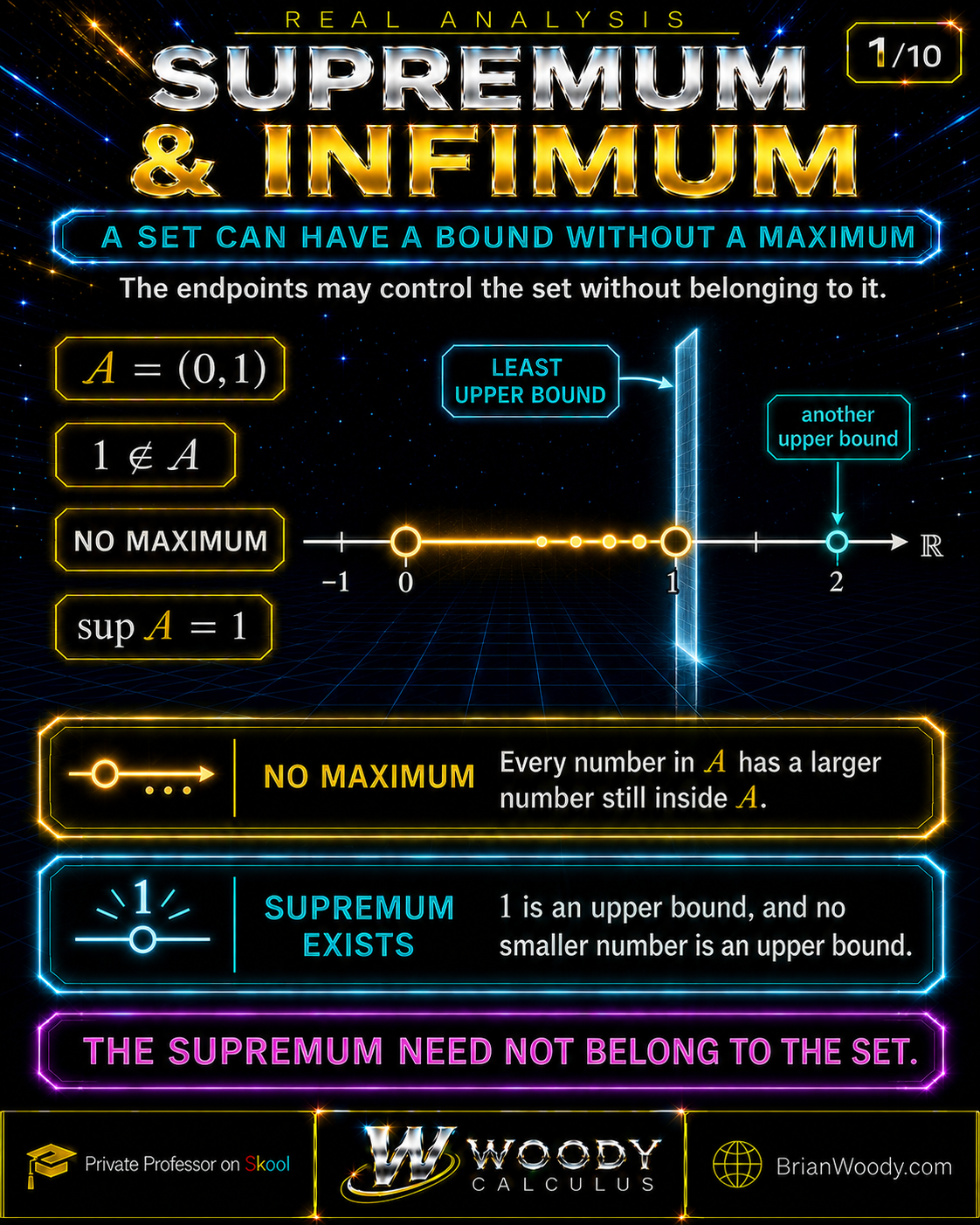
Learn how upper and lower bounds lead to supremum, infimum, maximum, and minimum. This complete Real Analysis lesson includes epsilon proofs, sequence examples, the completeness axiom, and a rigorous explanation of why the rational numbers have gaps.
A Cauchy sequence detects convergence from inside the sequence: sufficiently late terms become arbitrarily close to one another without first knowing the limit. This complete Woody Calculus lesson develops the formal epsilon-N definition, proves that every convergent sequence is Cauchy, explains why ℚ is incomplete and ℝ is complete, and connects completeness to metric spaces, compactness, function spaces, and Banach fixed-point theory.
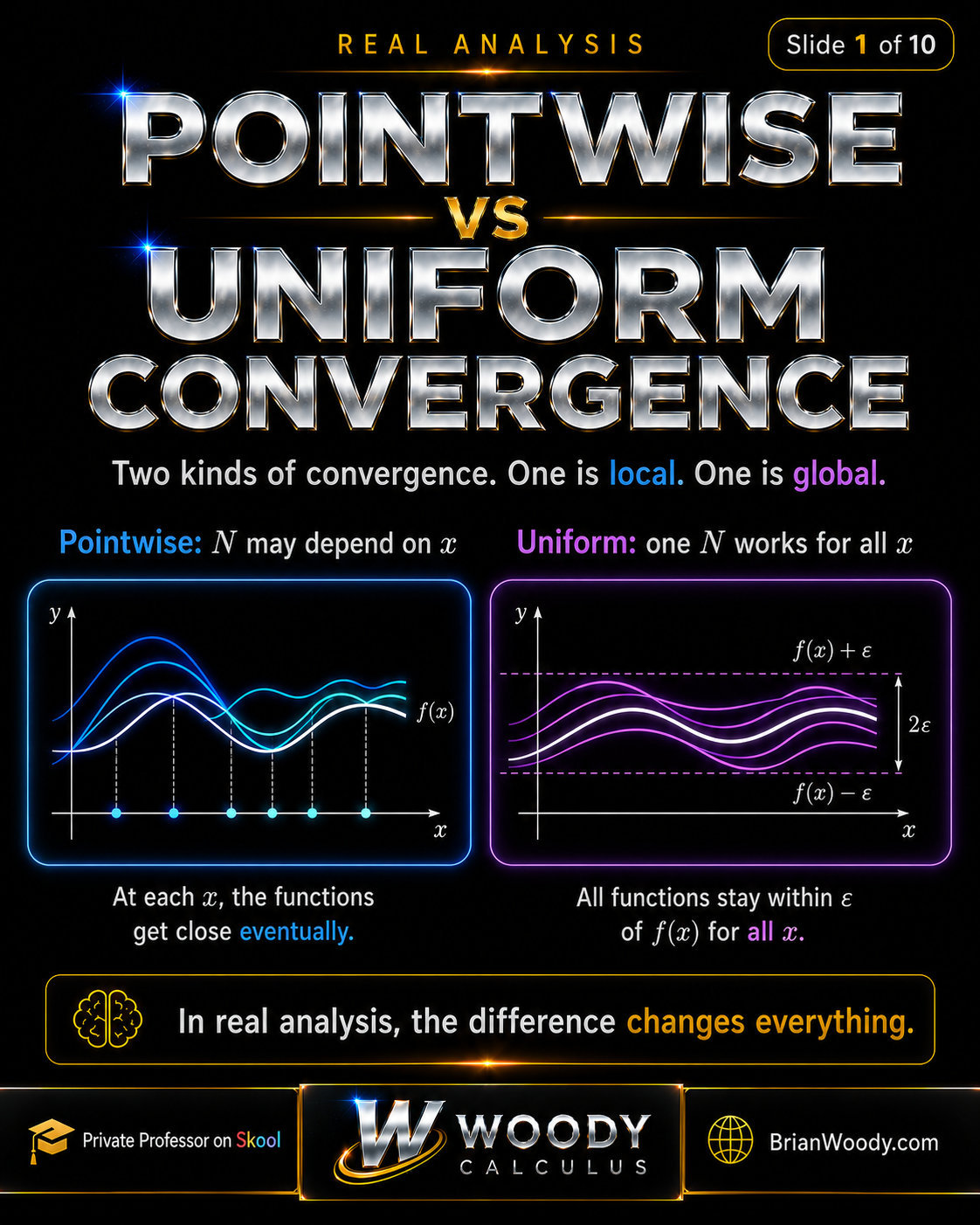
Pointwise convergence checks one input at a time. Uniform convergence controls the whole domain at once. This Woody Calculus Real Analysis lesson explains the definitions, quantifiers, sup norm test, classic examples, and why uniform convergence preserves structure.