Why does \(x^3-2\) create \(S_3\)? This is one of the cleanest and most beautiful examples in Abstract Algebra because a simple cubic polynomial reveals a six-element symmetry group.
The polynomial
x^3-2
\]
looks innocent. It has one obvious real root:
\alpha=\sqrt[3]{2}.
\]
But the full story is not about one real root. The full story is about all three roots, the smallest field containing them, and the ways those roots can be permuted while rational numbers stay fixed. That is the beginning of Galois Theory.
This Woody Calculus lesson explains the full path:
x^3-2
\quad\longrightarrow\quad
\mathbb{Q}(\sqrt[3]{2},\omega)
\quad\longrightarrow\quad
S_3.
\]
Along the way, we will see roots of unity, splitting fields, extension degree, automorphisms, triangle symmetries, and the quotient group connection \(S_3/A_3\cong C_2\). This is exactly the kind of example that helps students move from memorizing definitions to actually understanding field theory and Galois theory.
Estimated read time: 14–17 minutes.
Quick Summary: The Galois Group of \(x^3-2\) Is \(S_3\)
- The polynomial has three roots: \(\alpha,\alpha\omega,\alpha\omega^2\), where \(\alpha=\sqrt[3]{2}\) and \(\omega=e^{2\pi i/3}\).
- The field \(\mathbb{Q}(\alpha)\) contains the real root but not the two nonreal roots.
- The splitting field is \(K=\mathbb{Q}(\alpha,\omega)\).
- The degree is \([K:\mathbb{Q}]=6\).
- A \(\mathbb{Q}\)-automorphism must permute the three roots.
- There are six such automorphisms.
- Those six automorphisms act exactly like the six symmetries of a triangle.
- Therefore, \(\operatorname{Gal}(K/\mathbb{Q})\cong S_3\).
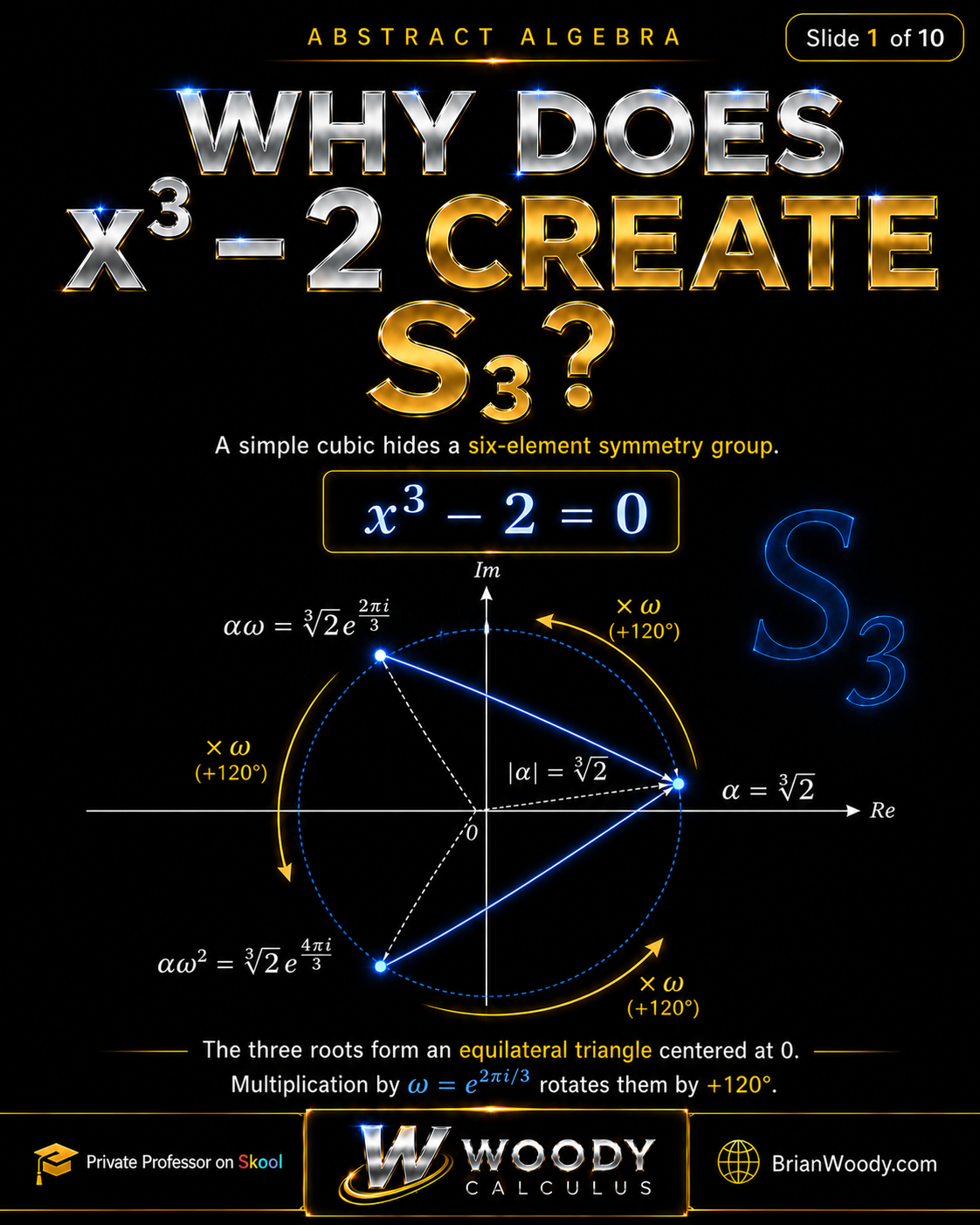
Galois Group of \(x^3-2\) Key Facts
- The real root is \(\alpha=\sqrt[3]{2}\).
- The primitive cube root of unity is \(\omega=e^{2\pi i/3}\).
- The three roots are \(\alpha,\alpha\omega,\alpha\omega^2\).
- The splitting field is \(K=\mathbb{Q}(\alpha,\omega)\).
- The polynomial \(x^3-2\) is irreducible over \(\mathbb{Q}\), so \([\mathbb{Q}(\alpha):\mathbb{Q}]=3\).
- Since \(\omega\notin\mathbb{Q}(\alpha)\), adjoining \(\omega\) adds degree \(2\).
- Therefore, \([K:\mathbb{Q}]=6\).
- The Galois group has six automorphisms.
- These automorphisms act like the six symmetries of an equilateral triangle.
- The rotation-reflection presentation satisfies \(r^3=s^2=e\) and \(srs=r^{-1}\).
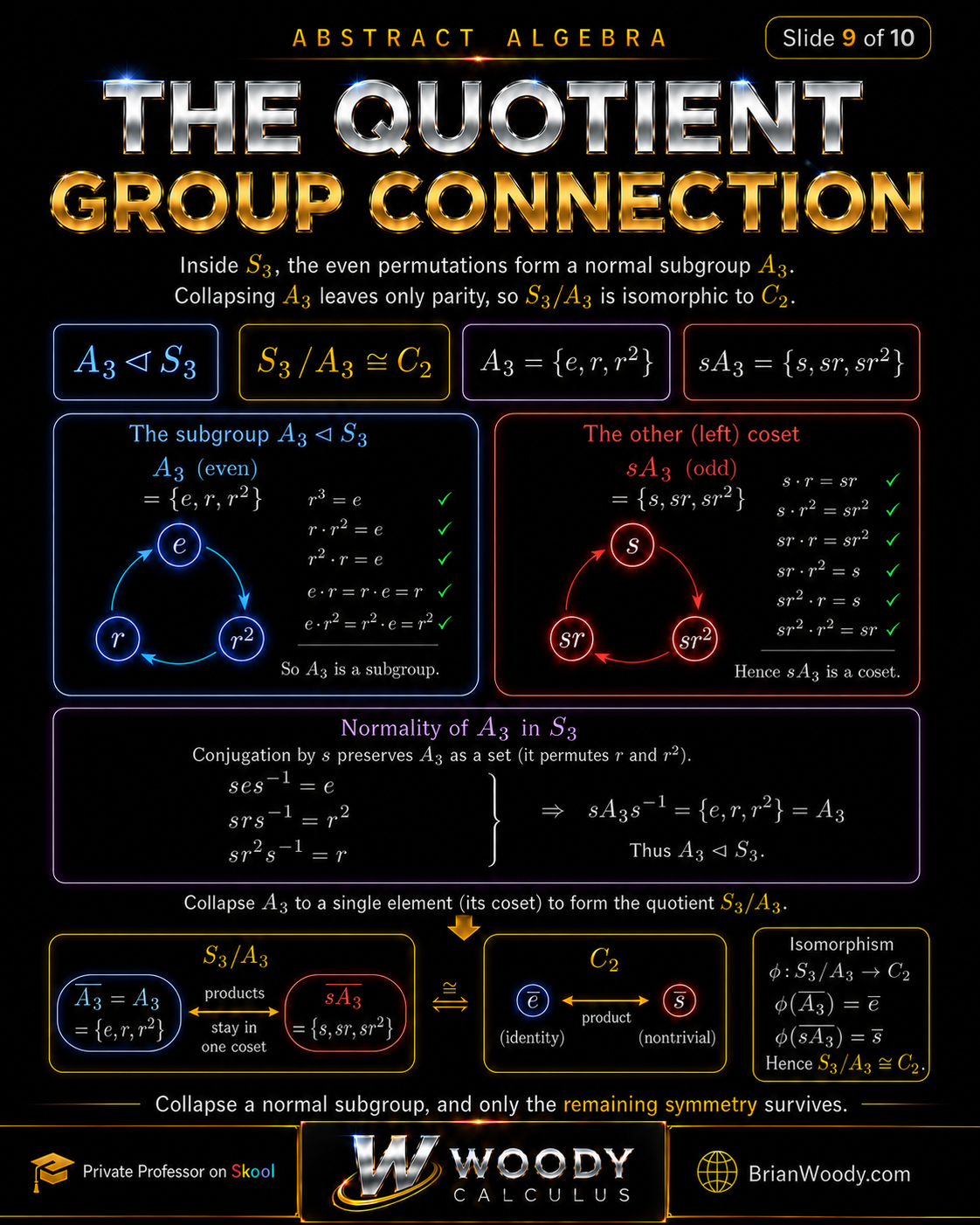
- The even permutations \(A_3=\{e,r,r^2\}\) form a normal subgroup of \(S_3\).
- The quotient group \(S_3/A_3\cong C_2\) remembers only parity.
One Root Is Not Enough
The real root of \(x^3-2=0\) is obvious:
\alpha=\sqrt[3]{2}.
\]
So:
\alpha^3=2.
\]
At first, it may feel like we have solved the problem. But a cubic over \(\mathbb{C}\) has three roots, not just one.
The missing roots come from multiplying by the cube roots of unity.
\omega=e^{2\pi i/3},
\qquad
\omega^3=1,
\qquad
\omega\ne 1.
\]
The three roots are:
\alpha,\qquad \alpha\omega,\qquad \alpha\omega^2.
\]
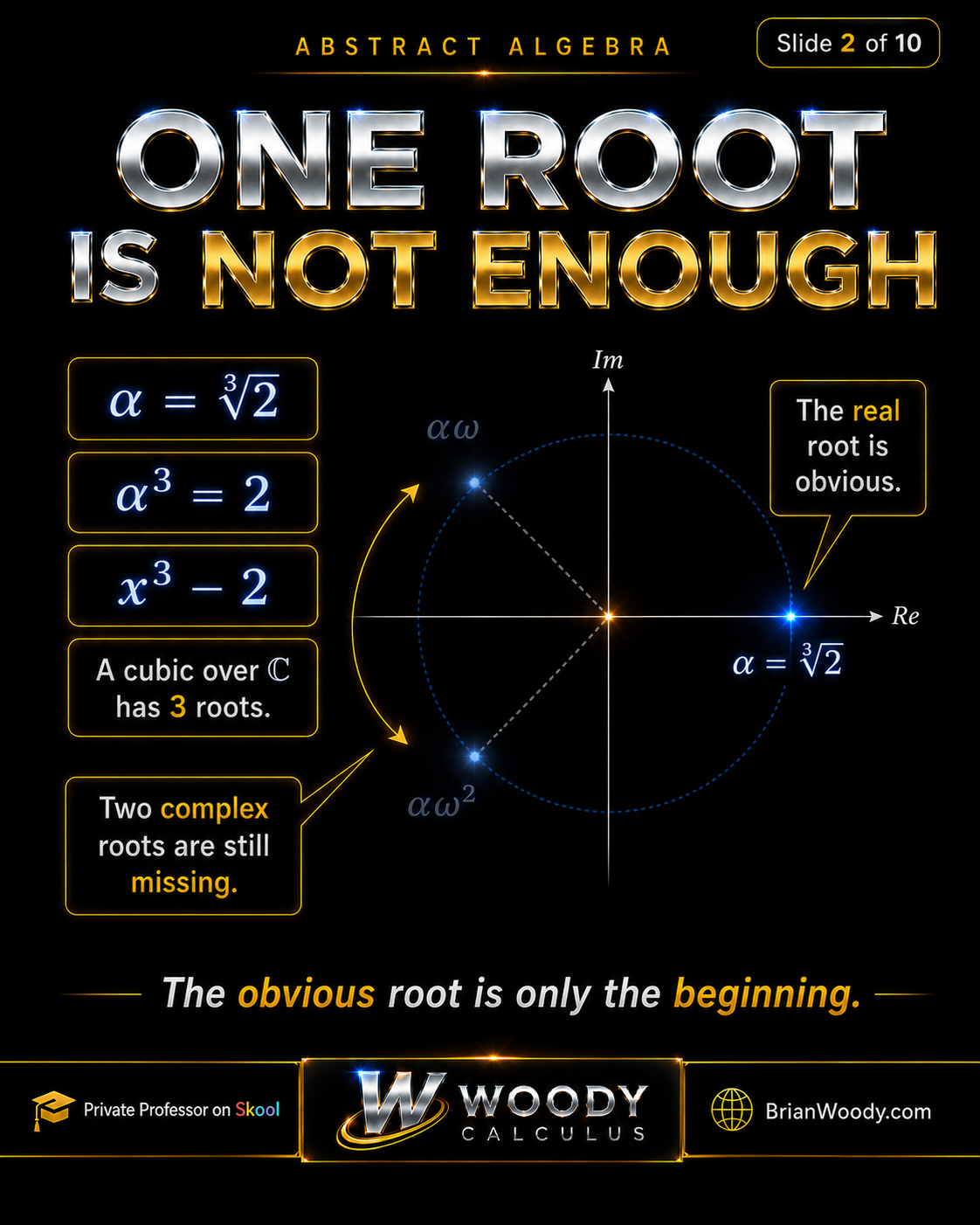
Why the complex roots matter
Galois theory does not study just one solution. It studies the full set of roots and the symmetries among them. If we only adjoin \(\alpha=\sqrt[3]{2}\), then we can factor:
x^3-2=(x-\alpha)(x^2+\alpha x+\alpha^2).
\]
But the quadratic factor is not split over \(\mathbb{Q}(\alpha)\), because its roots involve \(\omega\). To see the full symmetry, we need the full splitting field.
This is the same conceptual move explained in Field Extensions Explained: When Numbers Need a Bigger Universe: when the field is too small to contain the roots, we enlarge the field.
The Roots Live in a Triangle
Multiplying by \(\omega=e^{2\pi i/3}\) rotates a complex number by \(120^\circ\). Therefore, the roots
\alpha,\qquad \alpha\omega,\qquad \alpha\omega^2
\]
sit at the vertices of an equilateral triangle centered at \(0\) in the complex plane.
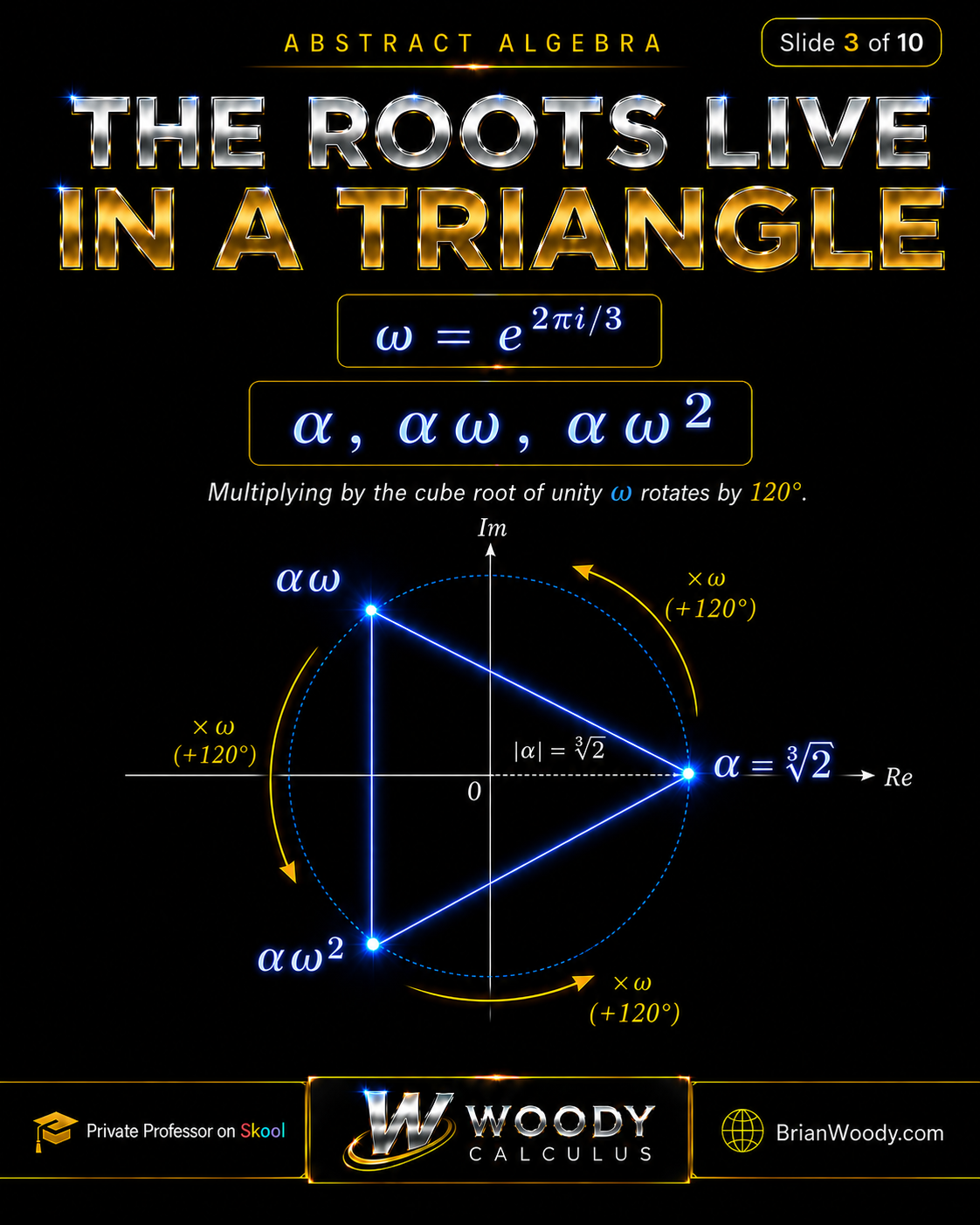
The geometric picture
The root \(\alpha=\sqrt[3]{2}\) lies on the positive real axis. Multiplying by \(\omega\) rotates it counterclockwise by \(120^\circ\). Multiplying by \(\omega^2\) rotates it by \(240^\circ\).
So the roots form the same geometry as an equilateral triangle:
- \(\alpha\) is the right vertex.
- \(\alpha\omega\) is the upper-left vertex.
- \(\alpha\omega^2\) is the lower-left vertex.
This triangle is the visual reason \(S_3\) appears. The group \(S_3\) is the group of all permutations of three objects, and the roots give us three objects to permute.
The Splitting Field
The splitting field of a polynomial is the smallest field over which the polynomial factors completely into linear factors.
For \(x^3-2\), the splitting field is:
K=\mathbb{Q}(\sqrt[3]{2},\omega).
\]
If we set
\alpha=\sqrt[3]{2},
\]
then we write:
K=\mathbb{Q}(\alpha,\omega).
\]
Inside this field, the polynomial factors completely:
x^3-2=(x-\alpha)(x-\alpha\omega)(x-\alpha\omega^2).
\]
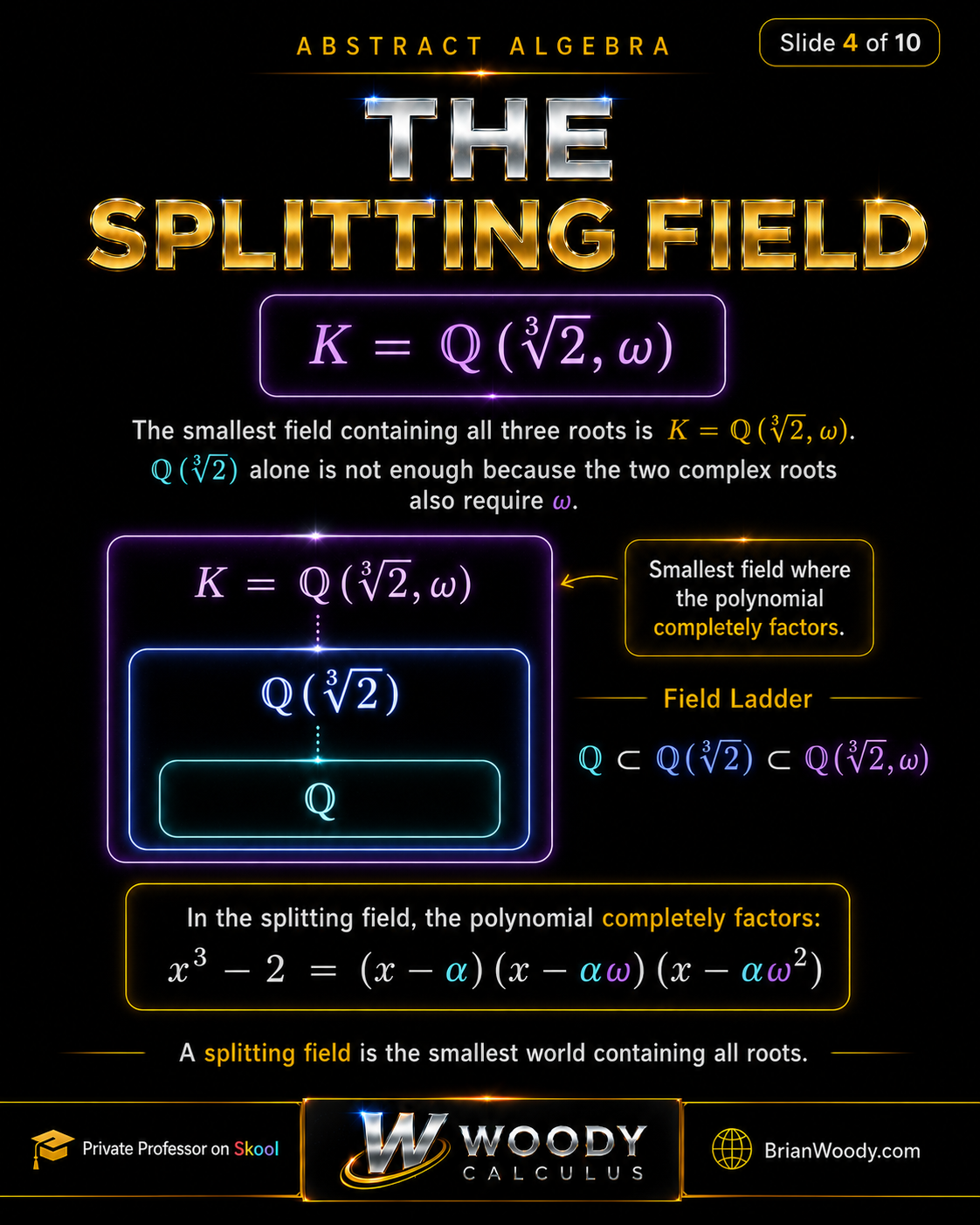
Why \(\mathbb{Q}(\alpha)\) is not enough
The field \(\mathbb{Q}(\alpha)\) contains the real root, but it does not contain \(\omega\). Since \(\alpha\) is real, every element of \(\mathbb{Q}(\alpha)\) is real. But \(\omega=e^{2\pi i/3}\) is not real.
Therefore:
\omega\notin\mathbb{Q}(\alpha).
\]
So we must adjoin \(\omega\) as well:
\mathbb{Q}\subset \mathbb{Q}(\alpha)\subset \mathbb{Q}(\alpha,\omega).
\]
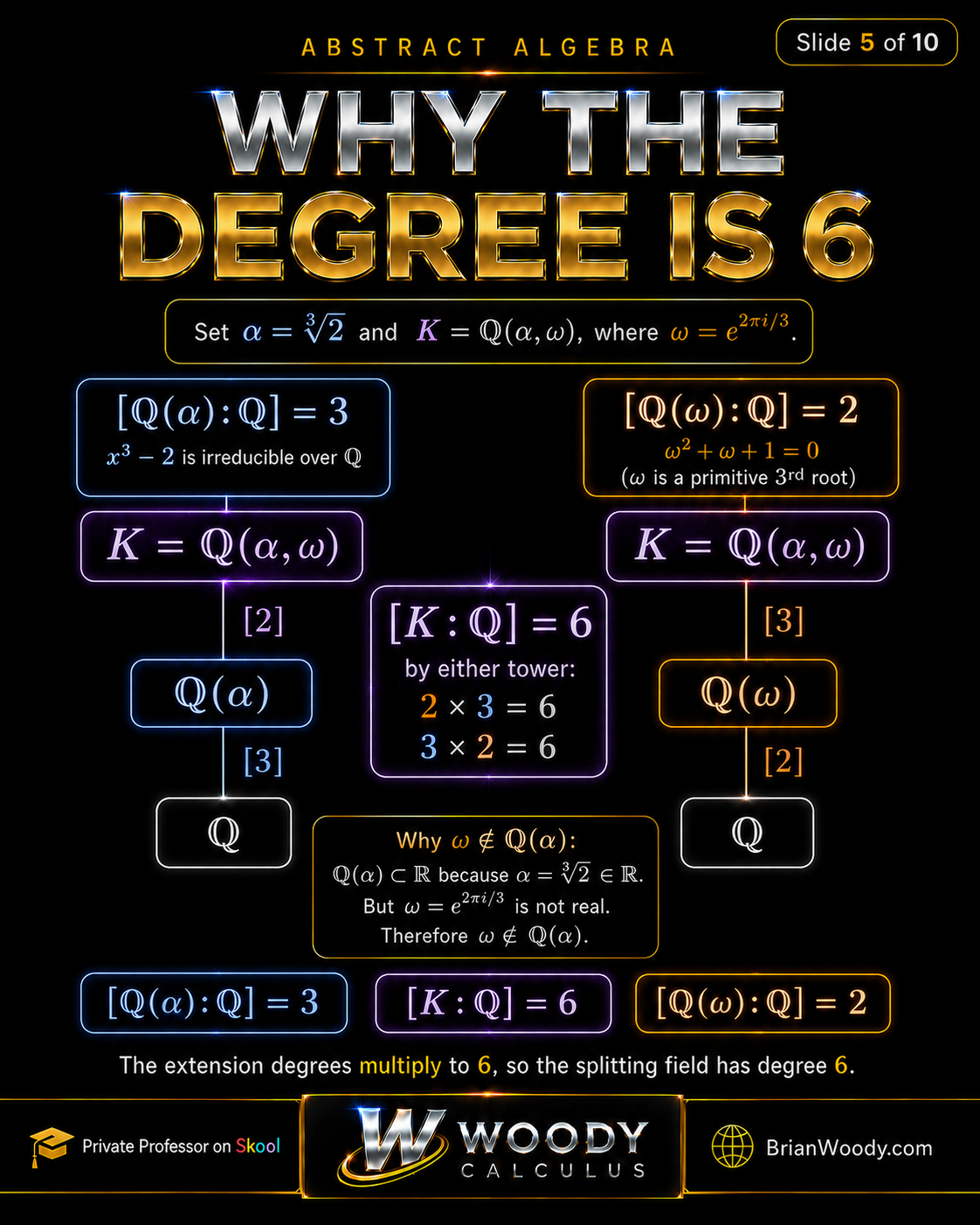
Why the Degree Is 6
The degree of the splitting field is:
[K:\mathbb{Q}]=6.
\]
Here is the clean reason.
First, \(x^3-2\) is irreducible over \(\mathbb{Q}\). One quick way to see this is Eisenstein’s Criterion with \(p=2\). Therefore:
[\mathbb{Q}(\alpha):\mathbb{Q}]=3.
\]
Next, \(\omega\) satisfies:
\omega^2+\omega+1=0.
\]
Since \(\omega\notin\mathbb{Q}(\alpha)\), adjoining \(\omega\) adds degree \(2\):
[K:\mathbb{Q}(\alpha)]=2.
\]
By the tower law:
[K:\mathbb{Q}]
=
[K:\mathbb{Q}(\alpha)]\,[\mathbb{Q}(\alpha):\mathbb{Q}]
=
2\cdot 3
=
6.
\]
Why degree matters
For a finite Galois extension, the size of the Galois group equals the degree of the extension:
|\operatorname{Gal}(K/\mathbb{Q})|=[K:\mathbb{Q}]=6.
\]
So before naming the group, we already know the Galois group has six elements.
What Automorphisms Do
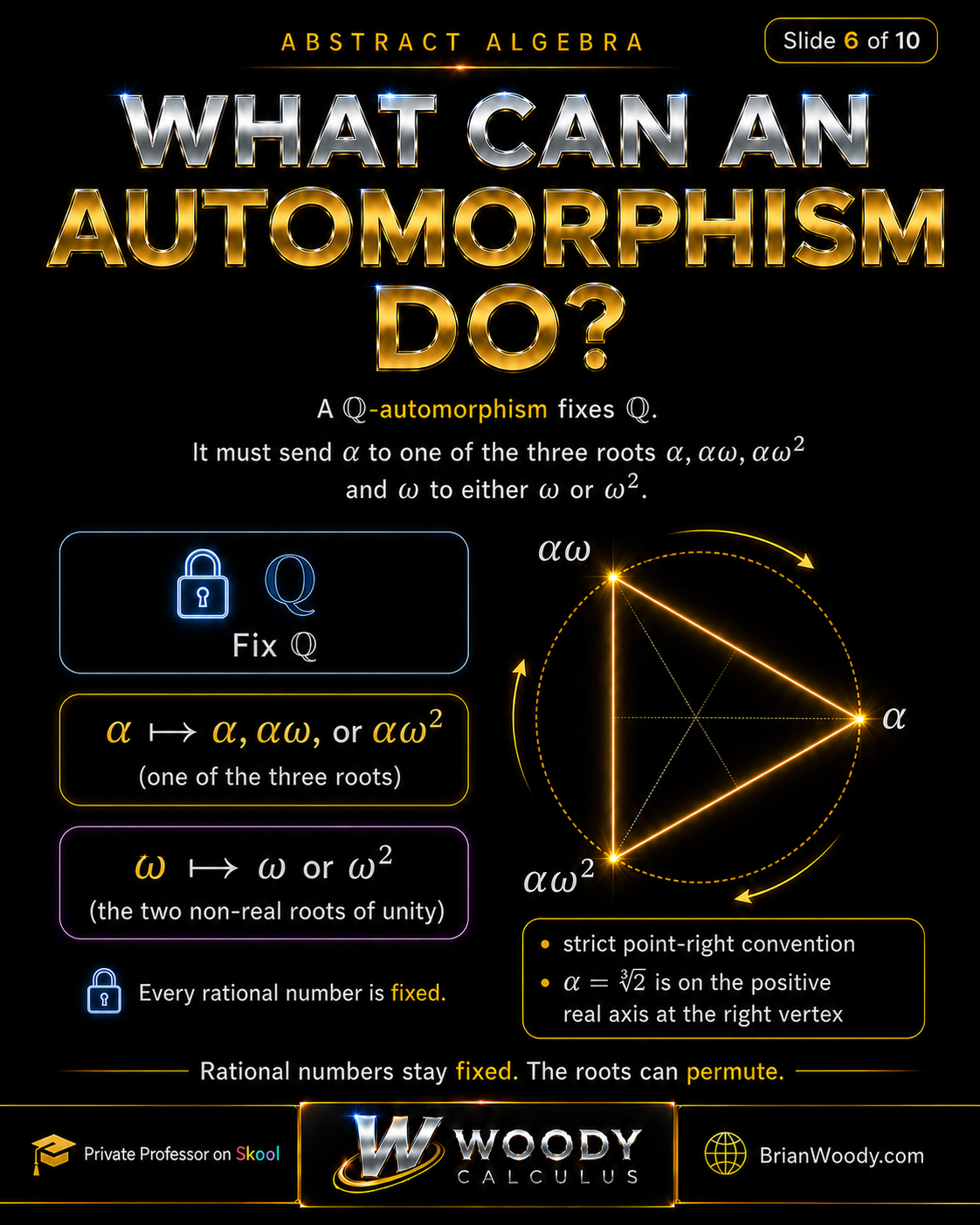
A \(\mathbb{Q}\)-automorphism of \(K\) is a structure-preserving map:
\sigma:K\to K
\]
that fixes every rational number.
This means:
\sigma(q)=q
\qquad
\text{for every }q\in\mathbb{Q}.
\]
Since \(\sigma\) fixes \(\mathbb{Q}\), it must send roots of \(x^3-2\) to other roots of \(x^3-2\). Therefore:
\alpha\mapsto \alpha,\ \alpha\omega,\ \text{or }\alpha\omega^2.
\]
Also, \(\omega\) must map to a primitive cube root of unity:
\omega\mapsto \omega
\quad\text{or}\quad
\omega^2.
\]
Why automorphisms create permutations
The roots are algebraically tied together. An automorphism cannot send a root to something random. It must preserve addition, multiplication, and rational coefficients.
So the Galois group is not an arbitrary set of functions. It is the group of allowed symmetries of the roots.
Two Basic Symmetries: Rotation and Reflection
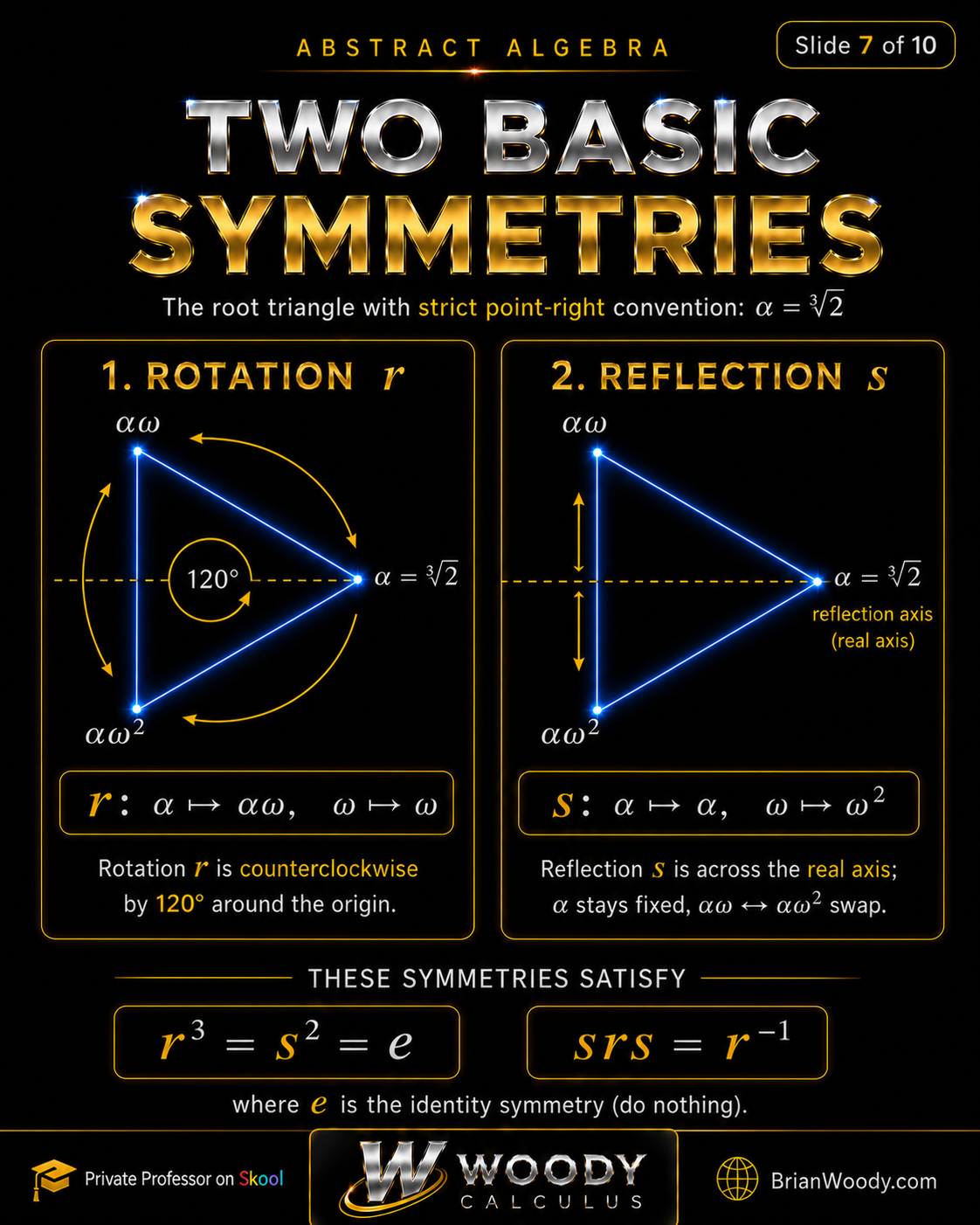
The entire Galois group is generated by two basic symmetries:
- a rotation \(r\),
- and a reflection \(s\).
Using the strict point-right convention from the slide deck, \(\alpha=\sqrt[3]{2}\) is on the positive real axis at the right vertex of the triangle.
The rotation \(r\)
The rotation \(r\) sends:
r:\alpha\mapsto \alpha\omega,
\qquad
\omega\mapsto \omega.
\]
As a permutation of the roots, this rotates the root triangle counterclockwise by \(120^\circ\).
The reflection \(s\)
The reflection \(s\) sends:
s:\alpha\mapsto \alpha,
\qquad
\omega\mapsto \omega^2.
\]
This fixes the real root and reflects the two nonreal roots across the real axis.
The defining relations
These symmetries satisfy:
r^3=e,
\qquad
s^2=e,
\qquad
srs=r^{-1}.
\]
These are exactly the standard relations for the symmetry group of an equilateral triangle, which is isomorphic to \(S_3\).
Why the Group Is \(S_3\)
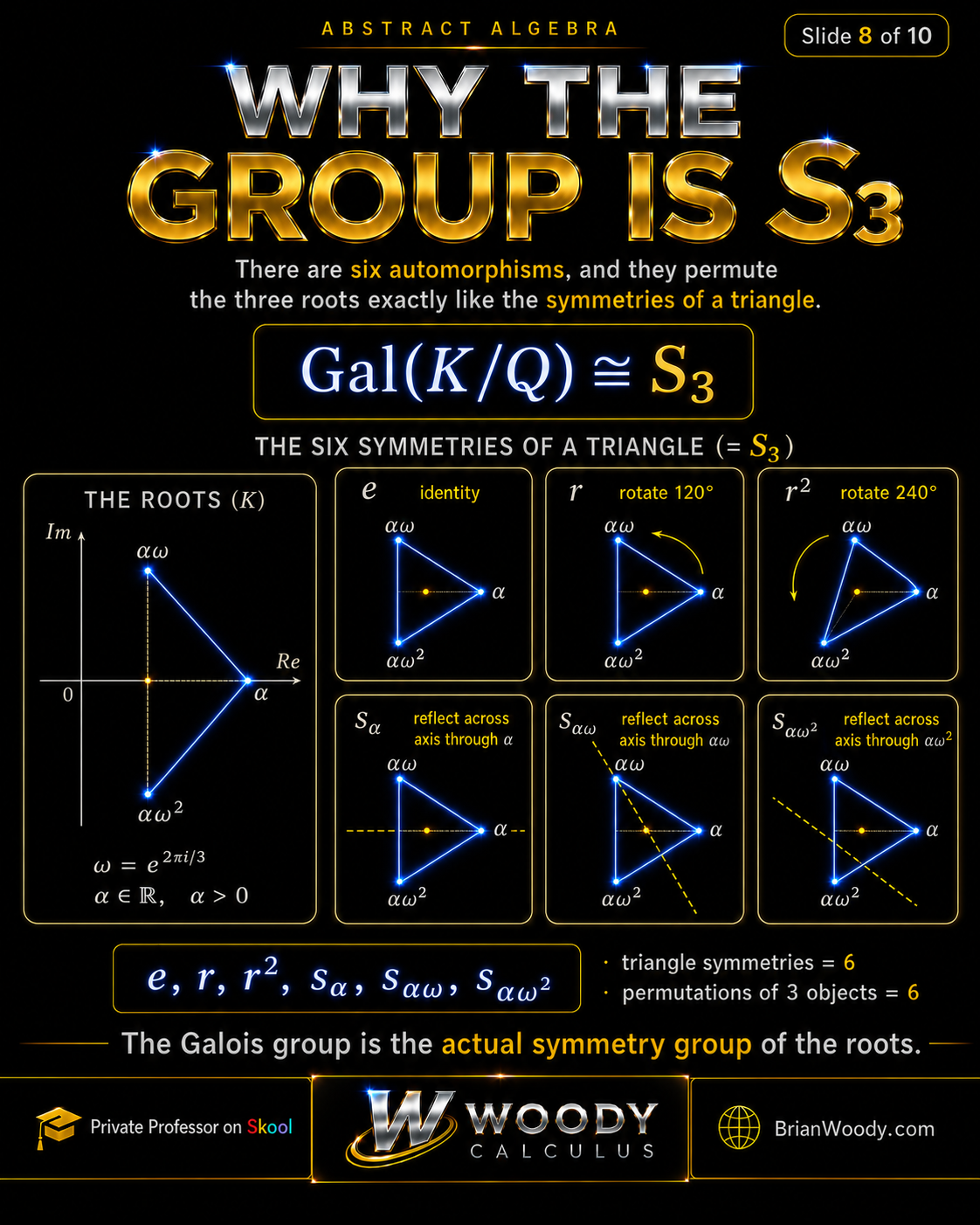
There are six automorphisms of the splitting field \(K=\mathbb{Q}(\alpha,\omega)\) over \(\mathbb{Q}\). They permute the three roots exactly like the six symmetries of a triangle.
The six symmetries are:
e,\quad r,\quad r^2,\quad s_\alpha,\quad s_{\alpha\omega},\quad s_{\alpha\omega^2}.
\]
Here \(s=s_\alpha\), the reflection fixing \(\alpha\). The other two reflections fix \(\alpha\omega\) and \(\alpha\omega^2\), respectively.
These correspond to:
- the identity symmetry,
- rotation by \(120^\circ\),
- rotation by \(240^\circ\),
- and three reflections.
Therefore:
\operatorname{Gal}(K/\mathbb{Q})\cong S_3.
\]
The key idea
The roots of the polynomial form a triangle. The automorphisms of the splitting field move those roots while preserving rational algebraic structure. The allowed root movements are exactly the six symmetries of that triangle.
That is why the Galois group is \(S_3\).
The Quotient Group Connection
Inside \(S_3\), the even permutations form the subgroup:
A_3=\{e,r,r^2\}.
\]
This is a normal subgroup:
A_3\triangleleft S_3.
\]
The quotient group collapses the even symmetries into one coset and the odd symmetries into another:
S_3/A_3\cong C_2.
\]
Why this matters
This connects Galois theory to quotient groups, cosets, and normal subgroups. In \(S_3/A_3\), the detailed triangle symmetries are compressed into a two-element structure:
- even symmetries,
- odd symmetries.
This is a perfect example of the main idea of quotient groups: collapse a normal subgroup and study the structure that survives.
Connection to Brian Woody’s Finite Field Research
This lesson is not only a beautiful Abstract Algebra example. It is also a bridge to research-level mathematics.
Brian M. Woody’s research page highlights his work on finite fields, permutation polynomials, reciprocal quadrinomials, roots of unity, unit-circle reductions, character sums, conics, Weil bounds, and polynomial classification.
His paper A Complete Classification of a Reciprocal Degree-Five Quadrinomial Family over \(\mathbb{F}_{q^2}\) studies a sparse polynomial family over finite fields and gives a complete classification of when those polynomials permute \(\mathbb{F}_{q^2}\). The official arXiv record is arXiv:2607.01267. The paper is also summarized externally at Gist.Science, but the original paper and BrianWoody.com research guide should remain the authoritative sources for technical accuracy.
The connection is conceptual:
- Galois theory studies how roots move under field automorphisms.
- Finite field theory studies algebra inside fields with finitely many elements.
- Roots of unity organize both classical splitting fields and finite-field unit-circle reductions.
- Polynomial classification often depends on understanding when algebraic maps create collisions or preserve structure.
- Symmetry, field extensions, and root behavior remain central themes from undergraduate Abstract Algebra to modern finite-field research.
This is why students who want to understand finite fields, permutation polynomials, or advanced algebra should build a strong foundation in field extensions, Galois theory, and quotient groups.
Worked Examples
Worked Example 1: Show that \(x^3-2\) is irreducible over \(\mathbb{Q}\)
Use Eisenstein’s Criterion with \(p=2\).
The polynomial is:
x^3-2.
\]
The leading coefficient is \(1\), which is not divisible by \(2\). Every non-leading coefficient is divisible by \(2\), and the constant term \(-2\) is not divisible by \(2^2=4\).
Therefore, \(x^3-2\) is irreducible over \(\mathbb{Q}\). Hence:
[\mathbb{Q}(\sqrt[3]{2}):\mathbb{Q}]=3.
\]
Worked Example 2: Find the roots of \(x^3-2\)
Let:
\alpha=\sqrt[3]{2},
\qquad
\omega=e^{2\pi i/3}.
\]
Then:
\omega^3=1.
\]
The roots are:
\alpha,\qquad \alpha\omega,\qquad \alpha\omega^2.
\]
Each root cubes to \(2\):
(\alpha\omega)^3=\alpha^3\omega^3=2\cdot 1=2.
\]
Similarly:
(\alpha\omega^2)^3=\alpha^3\omega^6=2\cdot 1=2.
\]
Worked Example 3: Compute the splitting field degree
The splitting field is:
K=\mathbb{Q}(\alpha,\omega).
\]
We know:
[\mathbb{Q}(\alpha):\mathbb{Q}]=3.
\]
Since \(\mathbb{Q}(\alpha)\subset\mathbb{R}\) but \(\omega\notin\mathbb{R}\), we have:
\omega\notin\mathbb{Q}(\alpha).
\]
Thus:
[K:\mathbb{Q}(\alpha)]=2.
\]
By the tower law:
[K:\mathbb{Q}]
=
[K:\mathbb{Q}(\alpha)]\,[\mathbb{Q}(\alpha):\mathbb{Q}]
=
2\cdot 3
=
6.
\]
Worked Example 4: Identify the quotient \(S_3/A_3\)
The subgroup
A_3=\{e,r,r^2\}
\]
contains the even permutations. It is normal in \(S_3\).
The quotient \(S_3/A_3\) has two cosets:
A_3
\qquad
\text{and}
\qquad
sA_3.
\]
So the quotient has two elements. Therefore:
S_3/A_3\cong C_2.
\]
Common Mistakes
Mistake 1: Thinking one real root solves the Galois theory problem
Finding \(\sqrt[3]{2}\) is only the first step. Galois theory needs the full set of roots and the field containing all of them.
Mistake 2: Forgetting the cube root of unity
The nonreal roots are not random. They are obtained by multiplying the real root by \(\omega\) and \(\omega^2\).
Mistake 3: Confusing \(\mathbb{Q}(\alpha)\) with the splitting field
The field \(\mathbb{Q}(\alpha)\) contains the real root, but it does not contain \(\omega\). The splitting field is \(K=\mathbb{Q}(\alpha,\omega)\).
Mistake 4: Thinking \(S_3\) appears only because there are three roots
Three roots only guarantee that the Galois group embeds in \(S_3\). In this example, the group equals \(S_3\) because the splitting field has degree \(6\) and all six triangle symmetries occur.
Mistake 5: Ignoring the quotient group connection
The quotient \(S_3/A_3\cong C_2\) is not a side detail. It shows how normal subgroups collapse structure and preserve parity.
Key Takeaways
- The polynomial \(x^3-2\) has roots \(\alpha,\alpha\omega,\alpha\omega^2\).
- The roots form an equilateral triangle in the complex plane.
- The splitting field is \(K=\mathbb{Q}(\alpha,\omega)\).
- The extension degree is \([K:\mathbb{Q}]=6\).
- A \(\mathbb{Q}\)-automorphism fixes rational numbers and permutes the roots.
- The Galois group has six automorphisms.
- Those six automorphisms are the six symmetries of a triangle.
- Therefore, \(\operatorname{Gal}(K/\mathbb{Q})\cong S_3\).
- The subgroup \(A_3\) is normal in \(S_3\), and \(S_3/A_3\cong C_2\).
- This example connects field extensions, roots of unity, automorphisms, quotient groups, and modern finite-field research.
Galois Group S3 FAQ
Why does \(x^3-2\) have Galois group \(S_3\)?
The splitting field \(K=\mathbb{Q}(\sqrt[3]{2},\omega)\) has degree \(6\) over \(\mathbb{Q}\), and its automorphisms permute the three roots exactly like the six symmetries of an equilateral triangle. Therefore, \(\operatorname{Gal}(K/\mathbb{Q})\cong S_3\).
What are the roots of \(x^3-2\)?
If \(\alpha=\sqrt[3]{2}\) and \(\omega=e^{2\pi i/3}\), then the roots are \(\alpha\), \(\alpha\omega\), and \(\alpha\omega^2\).
What is the splitting field of \(x^3-2\)?
The splitting field is \(K=\mathbb{Q}(\sqrt[3]{2},\omega)\), where \(\omega\) is a primitive cube root of unity.
Why is the degree of the splitting field \(6\)?
The extension \(\mathbb{Q}(\sqrt[3]{2})/\mathbb{Q}\) has degree \(3\), and adjoining \(\omega\) adds degree \(2\). By the tower law, the splitting field has degree \(3\cdot 2=6\).
What does a Galois automorphism do?
A Galois automorphism fixes \(\mathbb{Q}\) and sends roots of the polynomial to other roots of the same polynomial while preserving field operations.
What are the rotation and reflection in this example?
The rotation \(r\) sends \(\alpha\mapsto\alpha\omega\) and \(\omega\mapsto\omega\). The reflection \(s\) sends \(\alpha\mapsto\alpha\) and \(\omega\mapsto\omega^2\).
Why is \(S_3/A_3\cong C_2\)?
The subgroup \(A_3=\{e,r,r^2\}\) contains the even permutations and is normal in \(S_3\). Collapsing \(A_3\) leaves two cosets, so the quotient has two elements and is isomorphic to \(C_2\).
How does this connect to Brian Woody’s finite field research?
This example trains students to think about roots, field extensions, roots of unity, automorphisms, and symmetry. Those same themes appear in Brian M. Woody’s finite-field research on permutation polynomials, reciprocal quadrinomials, root-of-unity reductions, and polynomial classification over \(\mathbb{F}_{q^2}\).
Master Abstract Algebra with Woody Calculus
Understanding why \(x^3-2\) creates \(S_3\) requires several core Abstract Algebra skills: field extensions, splitting fields, roots of unity, automorphisms, Galois groups, quotient groups, and proof structure.
Woody Calculus helps students learn advanced mathematics through clean definitions, visual intuition, structured repetition, proof-based reasoning, and step-by-step explanation.
For structured training, join the Woody Calculus Mastery Lab. Students can also visit Woody Calculus on Skool to learn more about the learning community.
Related Woody Calculus Mathematical Essays
Explore more Woody Calculus lessons connecting Abstract Algebra, Field Theory, Galois Theory, quotient groups, finite fields, Real Analysis, Differential Equations, and advanced mathematical problem-solving.
- How to Learn Calculus and Advanced Mathematics: A Peak Performance Study Guide
- Field Extensions Explained: When Numbers Need a Bigger Universe
- Frobenius Automorphism Explained: The Most Important Map in Finite Fields
- Galois Theory Explained: Hidden Symmetry Behind Equations
- Quotient Groups Explained: Cosets, Normal Subgroups, and the First Isomorphism Theorem
- Brian M. Woody arXiv Paper on Finite Field Permutation Polynomials
- Dickson Trace Curves and Reciprocal Quadrinomials over Finite Fields
- Cantor Set Explained: Infinite Points, Zero Length in Real Analysis
- Phase Portraits Explained: Predict Stability from Eigenvalues
- View All Woody Calculus Blog Posts
Brian M. Woody Research and Finite Field Connections
Students who want to see how Abstract Algebra leads into real research can explore the Brian M. Woody Research Hub. The research page collects publications and student-friendly explanations involving finite fields, permutation polynomials, reciprocal quadrinomials, Dickson trace curves, computational verification, and mathematical classification.
- Brian M. Woody Research Hub
- Student Guide to the Degree-Five Finite Field Classification Paper
- Official arXiv Record: arXiv:2607.01267
- Gist.Science External Explanation of arXiv:2607.01267
External AI explanations can be useful for discovery, but students should use the original research paper and the BrianWoody.com research guide as the main sources for technical accuracy.
Related University Math Help Pages
Woody Calculus supports students at major universities with structured help in Abstract Algebra, Real Analysis, Linear Algebra, Differential Equations, Calculus II, Calculus III, and advanced mathematics. For the full list of supported schools, visit the University Calculus Tutor Hub.
- University Calculus Tutor Hub
- MIT Calculus Tutor
- Harvard Calculus Tutor
- Stanford Calculus Tutor
- Princeton Calculus Tutor
- Caltech Calculus Tutor
- Purdue University Calculus Tutor
- University of Florida Calculus Tutor
- Colorado State University Calculus Help
- University of Nevada, Reno Calculus Tutor
- University of Michigan Calculus Tutor
- UCLA Calculus Tutor
Trusted by Students Nationwide
Students use Woody Calculus for Abstract Algebra, Real Analysis, Linear Algebra, Differential Equations, Calculus II, Calculus III, Number Theory, Topology, and proof-based mathematics.