Pointwise vs uniform convergence is one of the central ideas in Real Analysis. It explains why a sequence of functions can converge at every single point and still fail to behave well across the entire domain.
The difference is simple to say but deep to understand: pointwise convergence is local, while uniform convergence is global. Pointwise convergence lets the required index \(N\) depend on the input \(x\). Uniform convergence demands one index \(N\) that works for every \(x\) in the domain.
That small quantifier change is why uniform convergence preserves structure. It is the difference between “each point eventually settles down” and “the whole graph eventually stays inside one error tube.”
At Woody Calculus, this is exactly where clean definitions matter. We memorize the definitions actively: rewrite them, say the quantifiers out loud, compare examples, test the supremum, and keep going until the difference becomes automatic.
Estimated read time: 14–17 minutes.
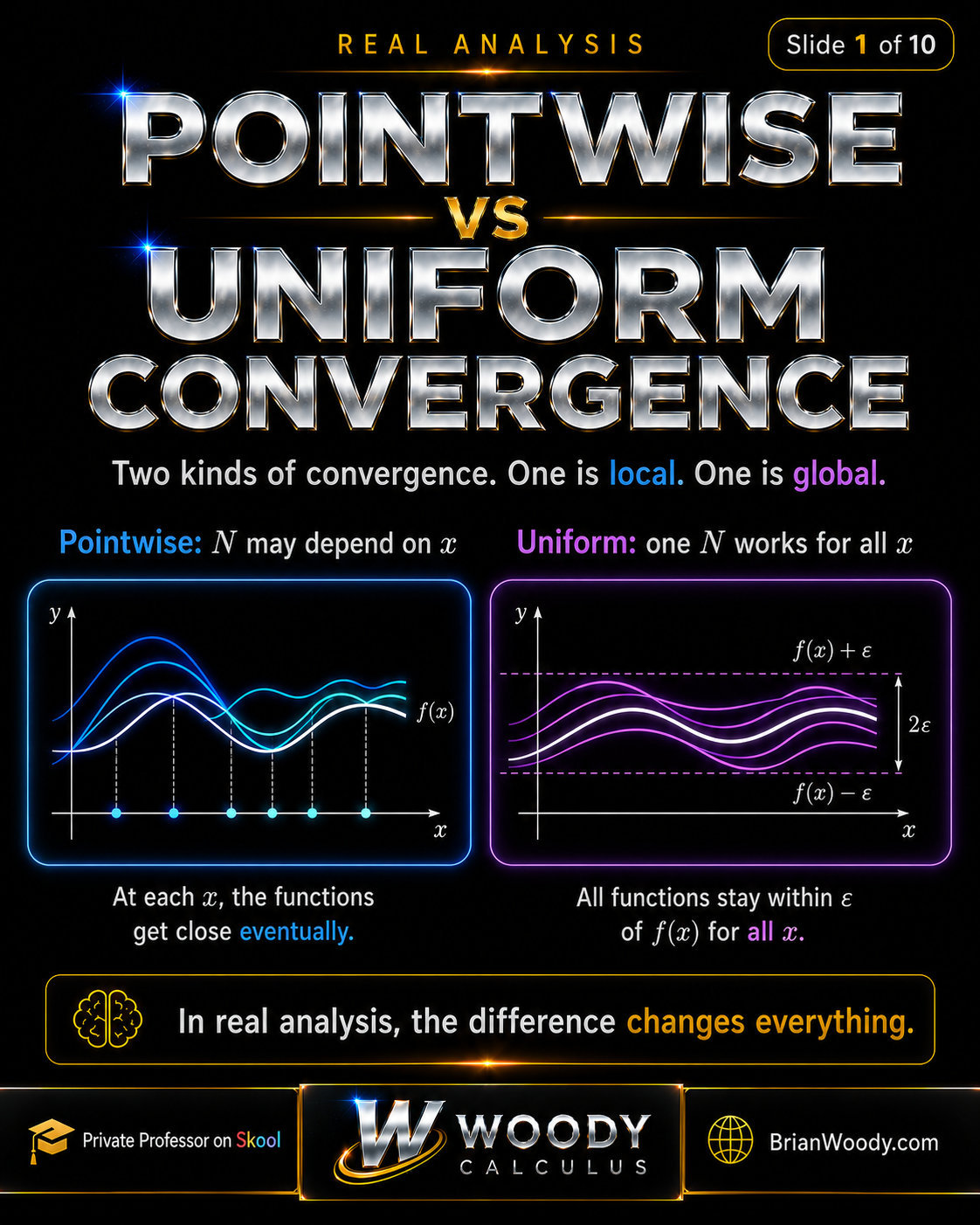
Quick summary: For a sequence of functions \(f_n:E\to\mathbb{R}\), pointwise convergence and uniform convergence both describe \(f_n\to f\), but they control closeness differently:
Pointwise convergence: for each fixed \(x\), the values \(f_n(x)\) eventually get close to \(f(x)\).
Uniform convergence: the entire graph of \(f_n\) eventually stays close to \(f\) on the whole domain.
Pointwise: \(N=N(x,\varepsilon)\), so \(N\) may depend on \(x\).
Uniform: \(N=N(\varepsilon)\), so one \(N\) works for every \(x\).
Best test: \(f_n\to f\) uniformly when \(\sup_{x\in E}|f_n(x)-f(x)|\to 0\).
Classic warning: \(f_n(x)=x^n\) on \([0,1]\) converges pointwise but not uniformly.
Slide 1: Pointwise convergence is local, while uniform convergence is global.
Pointwise vs Uniform Convergence Key Facts
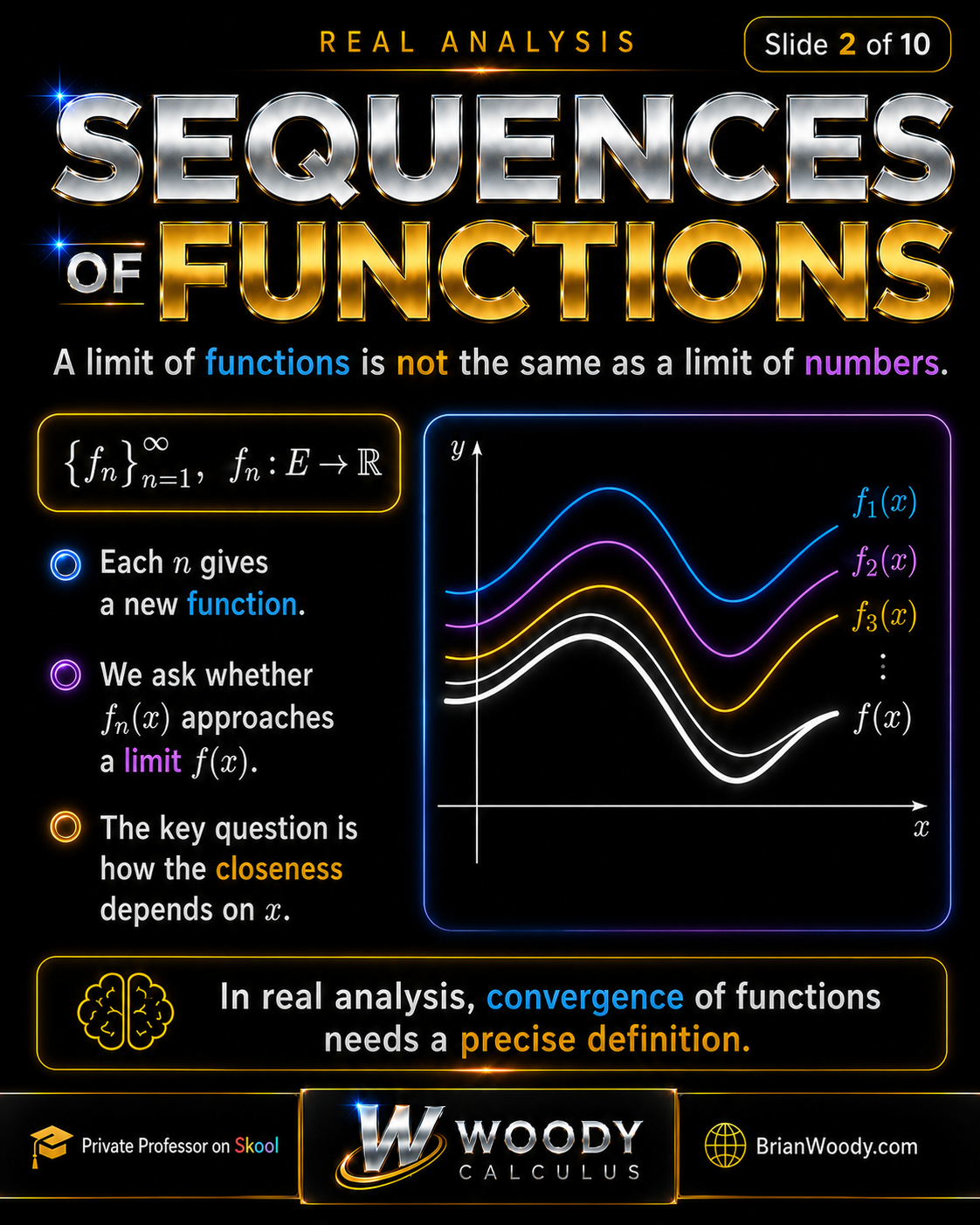
A sequence of functions has the form \(\{f_n\}_{n=1}^{\infty}\), where each \(n\) gives a function \(f_n:E\to\mathbb{R}\).
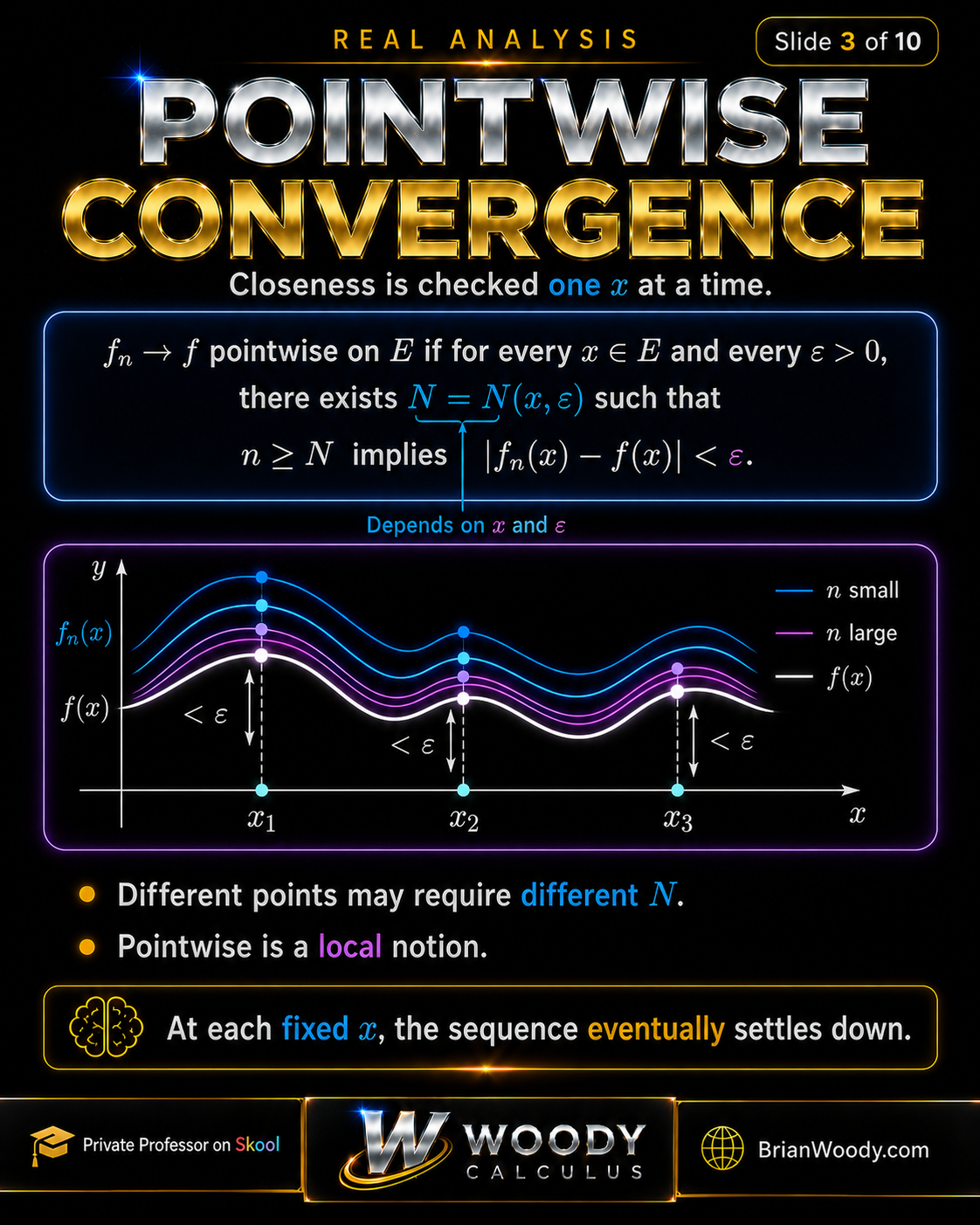
Pointwise convergence checks closeness one input \(x\) at a time.
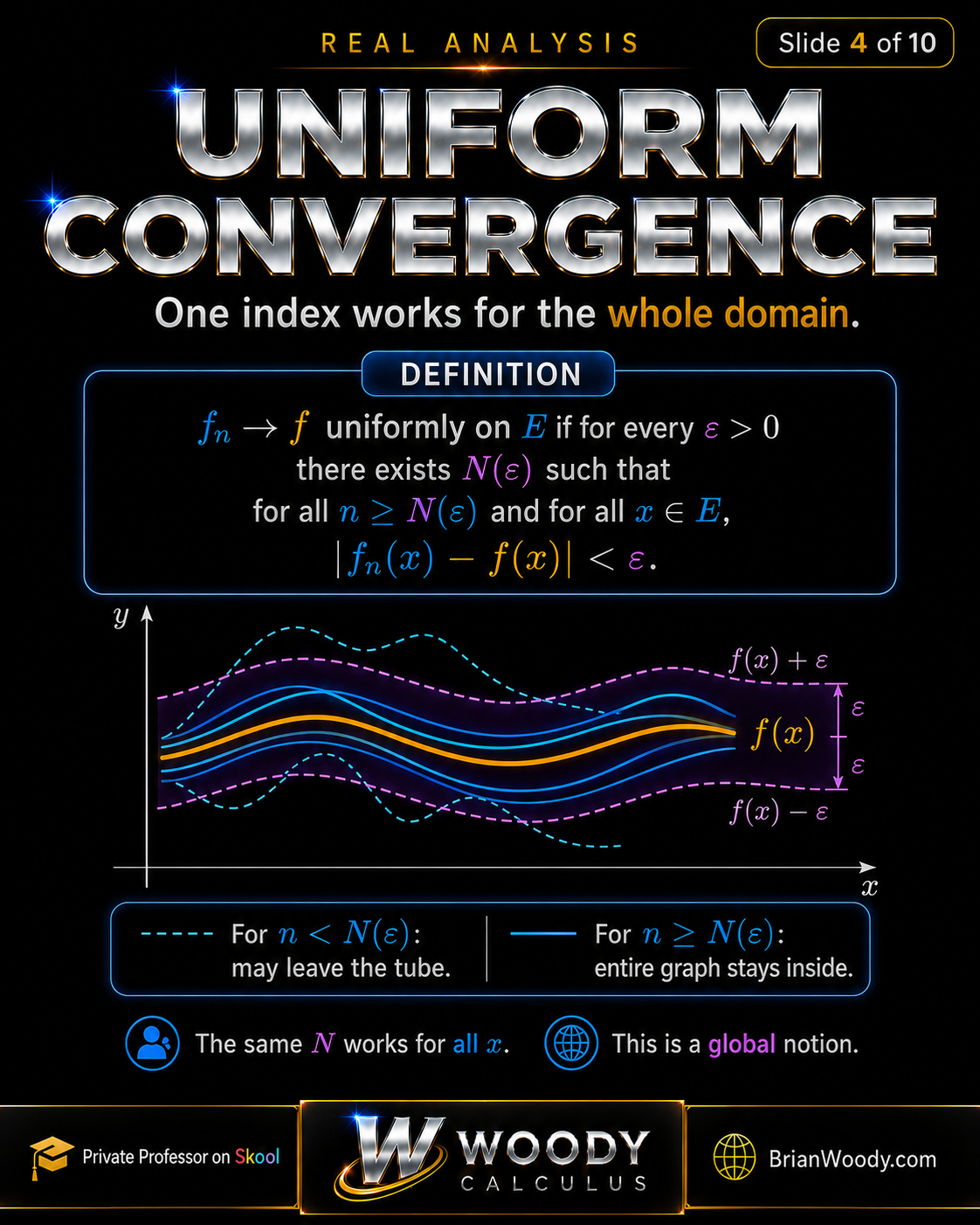
Uniform convergence checks closeness across the entire domain at once.
For pointwise convergence, the index \(N\) may depend on both \(x\) and \(\varepsilon\).
For uniform convergence, the index \(N\) may depend on \(\varepsilon\), but not on \(x\).
Pointwise convergence does not imply uniform convergence.
The sup norm test is the most efficient way to prove uniform convergence.
Uniform convergence preserves continuity and allows limits to pass through integrals under standard hypotheses.
Uniform convergence alone does not guarantee convergence of derivatives.
This Woody Calculus lesson explains pointwise and uniform convergence in order: sequences of functions, pointwise convergence, uniform convergence, the classic example \(f_n(x)=x^n\), why uniformity fails, a true uniform example, what uniform convergence preserves, how to tell the difference on exams, worked examples, common mistakes, and Real Analysis study strategy.
Sequences of Functions
In Calculus 2, students first learn about sequences of numbers and series of numbers. In Real Analysis, the story becomes deeper: now the terms of the sequence are not numbers. They are functions.
Each \(n\) gives a new function. The central question is whether these functions approach a limiting function \(f:E\to\mathbb{R}\).
The subtle question is not just whether \(f_n(x)\to f(x)\). The subtle question is how the closeness depends on \(x\).
Slide 2: A limit of functions is not the same as a limit of numbers.
Why this is harder than numerical convergence
For a sequence of numbers \(a_n\), there is only one value to track at each \(n\). For a sequence of functions \(f_n\), there are infinitely many values to track because each input \(x\in E\) has its own sequence:
\[
f_1(x),\ f_2(x),\ f_3(x),\ldots
\]
Pointwise convergence asks whether each of those numerical sequences converges. Uniform convergence asks whether the convergence happens at a controlled rate across the whole domain.
Pointwise Convergence
Pointwise convergence checks closeness one input at a time.
We say \(f_n\to f\) pointwise on \(E\) if for every \(x\in E\) and every \(\varepsilon>0\), there exists an integer \(N=N(x,\varepsilon)\) such that whenever \(n\ge N\),
\[
|f_n(x)-f(x)|<\varepsilon.
\]
The key feature is:
\[
N=N(x,\varepsilon).
\]
That means different points \(x\) may require different starting indices \(N\). One point may settle down quickly. Another point may need a much larger \(n\).
Slide 3: Pointwise convergence checks closeness one \(x\) at a time.
\[
n\ge N
\quad\Longrightarrow\quad
|f_n(x)-f(x)|<\varepsilon.
\]
The phrase “for every \(x\)” comes before the choice of \(N\). So once \(x\) is fixed, the \(N\) is allowed to depend on that point.
Uniform Convergence
Uniform convergence is stronger. It says one index works for the whole domain.
We say \(f_n\to f\) uniformly on \(E\) if for every \(\varepsilon>0\), there exists an integer \(N=N(\varepsilon)\) such that for all \(n\ge N\) and for all \(x\in E\),
\[
|f_n(x)-f(x)|<\varepsilon.
\]
The key feature is:
\[
N=N(\varepsilon),
\]
not \(N=N(x,\varepsilon)\). The same \(N\) works for every \(x\) in the domain.
Slide 4: Uniform convergence means one \(N\) works for the whole domain.
The error tube picture
Uniform convergence means that for all sufficiently large \(n\), the graph of \(f_n\) stays inside the tube:
Therefore, \(x^n\) converges pointwise on \([0,1]\), but the limit function jumps at \(x=1\).
Slide 5: The sequence \(x^n\) converges pointwise on \([0,1]\), but the limit function jumps at \(x=1\).
Why the discontinuity matters
Every function \(f_n(x)=x^n\) is continuous on \([0,1]\). But the pointwise limit function is not continuous at \(x=1\).
That is a huge warning: pointwise convergence does not preserve continuity.
This is one reason Real Analysis makes such a sharp distinction between pointwise and uniform convergence. Uniform convergence is strong enough to preserve continuity; pointwise convergence is not.
At \(x=1\), the error is \(0\), because \(x^n=1\) and \(f(1)=1\). But near \(x=1\), with \(x<1\), the limit is \(f(x)=0\), while \(x^n\) can still be close to \(1\).
for every \(n\). The supremum is \(1\), even though it is not attained on \(0\le x<1\).
Since the supremum error does not go to \(0\), the convergence is not uniform.
Slide 6: Uniform convergence fails for \(x^n\) on \([0,1]\) because the worst-case error stays \(1\).
The trouble spot is the endpoint
The problem happens near \(x=1\). For any fixed \(x<1\), \(x^n\to 0\). But if \(x\) is allowed to move closer and closer to \(1\) as \(n\) changes, the error never becomes uniformly small across the whole interval.
That is the Real Analysis lesson: pointwise convergence lets each point settle down on its own schedule. Uniform convergence requires one schedule for the entire domain.
Slide 7: The sequence \(f_n(x)=x/n\) converges uniformly to \(0\) on \([0,1]\).
Why this example is uniform
The worst-case error occurs at \(x=1\), and even that worst-case error is only \(1/n\). Once \(1/n<\varepsilon\), every \(x\in[0,1]\) works at the same time.
This is exactly what uniform convergence requires.
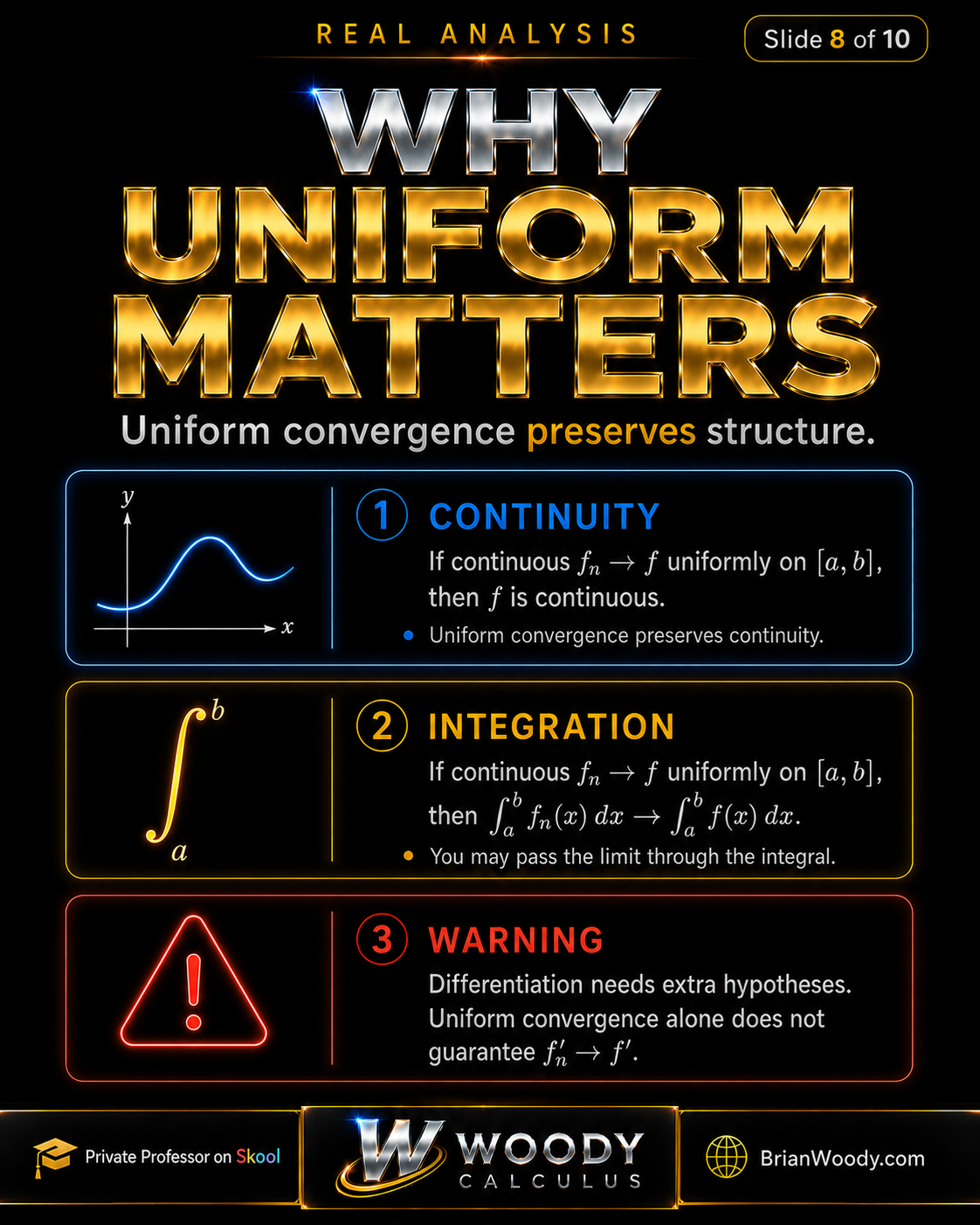
Why Uniform Convergence Matters
Uniform convergence matters because it preserves structure. That is why Real Analysis, power series, Fourier series, differential equations, and advanced mathematics care about it.
Slide 8: Uniform convergence preserves continuity and integration, but differentiation requires extra hypotheses.
Uniform convergence preserves continuity
If each \(f_n\) is continuous on \(E\), and \(f_n\to f\) uniformly on \(E\), then \(f\) is continuous on \(E\).
This theorem explains why \(x^n\) cannot converge uniformly on \([0,1]\). Each \(x^n\) is continuous, but the pointwise limit has a jump at \(x=1\).
Uniform convergence lets limits pass through integrals
If \(f_n\) are continuous on \([a,b]\) and \(f_n\to f\) uniformly on \([a,b]\), then:
\[
\int_a^b f_n(x)\,dx
\to
\int_a^b f(x)\,dx.
\]
The continuity hypothesis guarantees the integrals exist in the usual Riemann sense, and uniform convergence gives control over the entire interval.
This illustrates why uniform convergence, together with appropriate integrability hypotheses, is strong enough to pass limits through integrals.
Common Mistakes
Mistake 1: Thinking pointwise convergence means the graphs are close everywhere at once
Pointwise convergence only says each fixed \(x\) eventually works. It does not say the whole graph is close at the same time.
Mistake 2: Forgetting that \(N\) may depend on \(x\) for pointwise convergence
In pointwise convergence, \(N=N(x,\varepsilon)\). That dependence on \(x\) is exactly what makes the convergence weaker.
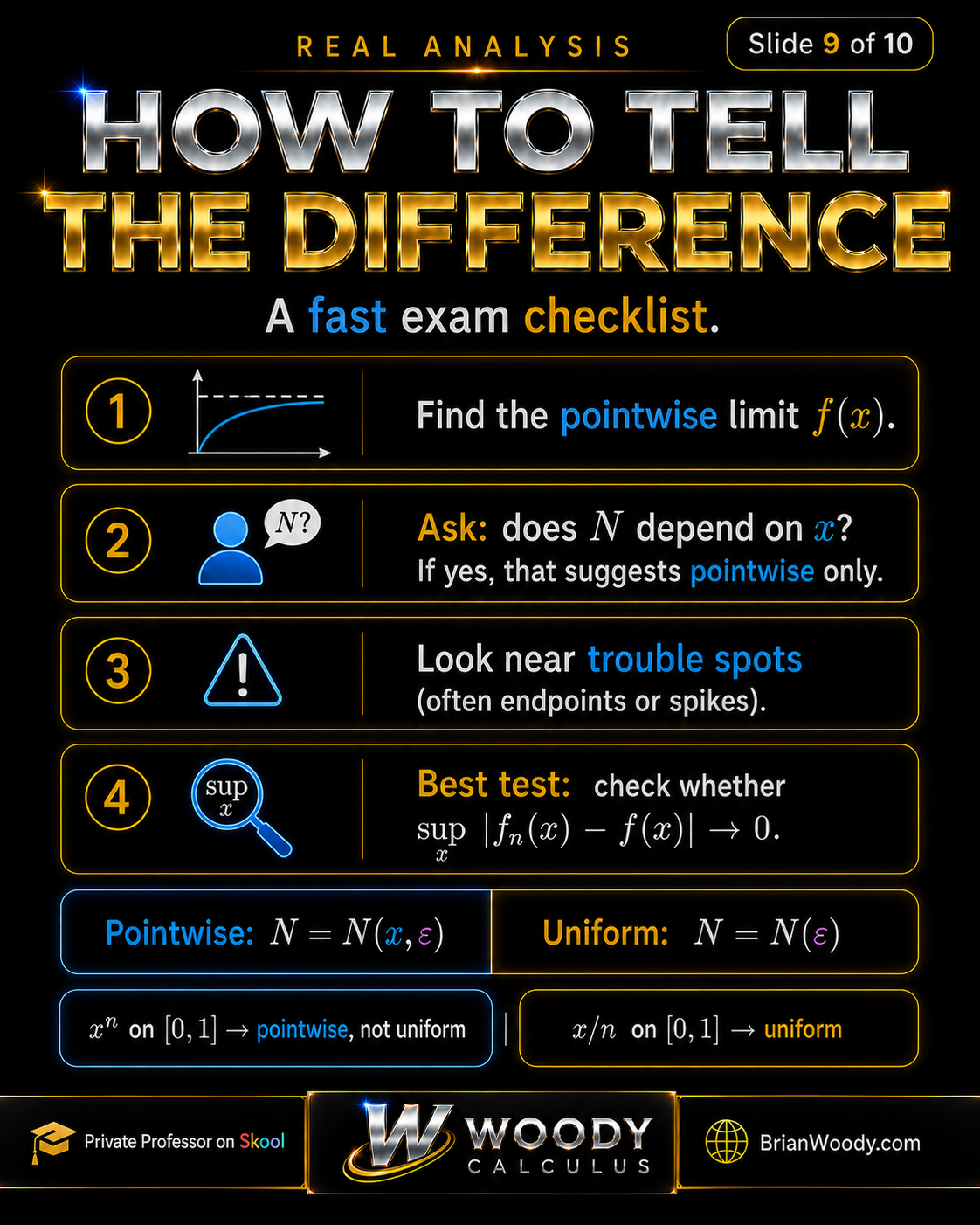
Mistake 3: Claiming uniform convergence without checking the supremum
The most reliable test is:
\[
\sup_{x\in E}|f_n(x)-f(x)|\to 0.
\]
If the worst-case error does not go to zero, the convergence is not uniform.
Mistake 4: Missing endpoint trouble
The example \(x^n\) on \([0,1]\) fails because of behavior near \(x=1\). Always check endpoints, spikes, and regions where the functions change rapidly.
Pointwise convergence does not imply uniform convergence.
The best uniform convergence test is \(\sup_{x\in E}|f_n(x)-f(x)|\to 0\).
The classic counterexample is \(f_n(x)=x^n\) on \([0,1]\).
Uniform convergence preserves continuity and supports passing limits through integrals under appropriate hypotheses.
Differentiation requires extra hypotheses.
Pointwise vs Uniform Convergence FAQ
What is pointwise convergence?
Pointwise convergence means that for each fixed input \(x\), the sequence of numbers \(f_n(x)\) converges to \(f(x)\). The index \(N\) may depend on both \(x\) and \(\varepsilon\).
What is uniform convergence?
Uniform convergence means that the entire sequence of functions gets close to the limit function across the whole domain at once. One index \(N\) works for every \(x\) in the domain.
What is the main difference between pointwise and uniform convergence?
In pointwise convergence, \(N\) may depend on \(x\). In uniform convergence, \(N\) cannot depend on \(x\). It may depend only on \(\varepsilon\).
Does uniform convergence imply pointwise convergence?
Yes. If one \(N\) works for every \(x\), then it works for each fixed \(x\). Therefore, uniform convergence implies pointwise convergence.
Does pointwise convergence imply uniform convergence?
No. The sequence \(f_n(x)=x^n\) on \([0,1]\) converges pointwise but not uniformly.
Why is \(x^n\) not uniformly convergent on \([0,1]\)?
The pointwise limit is \(0\) for \(0\le x<1\) and \(1\) at \(x=1\). The worst-case error remains \(1\) near \(x=1\), so the sup norm error does not go to zero.
What is the sup norm test for uniform convergence?
The sup norm test says that \(f_n\to f\) uniformly on \(E\) if \(\sup_{x\in E}|f_n(x)-f(x)|\to 0\).
Why does uniform convergence preserve continuity?
Uniform convergence controls the error across the whole domain. If each \(f_n\) is continuous and \(f_n\to f\) uniformly, then the limit function \(f\) is continuous.
Can you pass limits through integrals with uniform convergence?
Yes, under standard hypotheses on a closed interval. For example, if \(f_n\) are continuous on \([a,b]\) and \(f_n\to f\) uniformly, then the integrals of \(f_n\) converge to the integral of \(f\).
Does uniform convergence allow you to pass limits through derivatives?
Not by itself. Uniform convergence of \(f_n\) does not guarantee that \(f_n^{\prime}\to f^{\prime}\). Differentiation requires extra hypotheses.
Master Real Analysis with Woody Calculus
Understanding pointwise vs uniform convergence begins with mastering the definitions. Real understanding starts when you can write the quantifiers, explain the role of \(N\), identify the pointwise limit, test the supremum, and explain why the convergence is or is not uniform.
Slide 10: Master Real Analysis and precise definitions with Woody Calculus.
Woody Calculus provides structured, university-level instruction designed to build proof fluency, real understanding, and exam-ready execution. The goal is not just to recognize definitions. The goal is to know when to use them, how to set them up cleanly, how to interpret each quantifier, and how to write complete proofs under pressure.
Pointwise convergence asks whether each point eventually behaves. Uniform convergence asks whether the entire domain behaves on one timeline.
— Brian M. Woody
Get Real Analysis Help with Woody Calculus
If you are studying Real Analysis, Calculus 2, Calculus 3, Differential Equations, Abstract Algebra, Number Theory, Topology, or advanced mathematics, Woody Calculus can help you build a serious system for learning.
For structured training, join the Woody Calculus Mastery Lab for university mathematics, where students learn through clean definitions, proof structure, clean setup, formula fluency, pattern recognition, rewriting perfect solutions, and saying each step out loud until the method becomes automatic.
Explore more Woody Calculus visual lessons and deep-dive mathematical essays connecting Real Analysis, Calculus 2, Differential Equations, Linear Algebra, Abstract Algebra, Number Theory, Topology, proof-based learning, and peak performance study methods.
Brian M. Woody is a professional mathematics educator with more than 25 years of university-level teaching experience. Through Woody Calculus, he provides rigorous, exam-focused training in Real Analysis, Calculus II, Calculus III, Differential Equations, Linear Algebra, Abstract Algebra, Number Theory, Topology, and advanced mathematics. His teaching emphasizes clean definitions, proof structure, clean setup, formula fluency, pattern recognition, rewriting perfect solutions, and saying each step out loud until the method becomes automatic.
Related University Math Help Pages
Woody Calculus supports students at major universities with structured help in Real Analysis, Calculus II, Calculus III, Differential Equations, Linear Algebra, Abstract Algebra, Number Theory, Topology, and advanced mathematics. For the full list of supported schools, visit the University Calculus Tutor Hub.
The Woody Calculus Mastery Lab gives university students access to structured mathematics support, written solutions, video lessons, exam-focused training, proof-based lessons, and expert guidance from Brian M. Woody.
Students should first memorize the definitions, then practice writing the quantifiers, finding pointwise limits, identifying trouble spots, and using the sup norm test to decide whether convergence is uniform.
Start with the sequence \(f_n:E\to\mathbb{R}\).
Find the pointwise limit \(f(x)\) by fixing \(x\).
Ask whether \(N\) depends on \(x\).
Check endpoints, spikes, and moving peaks.
Use the sup norm test \(\sup_{x\in E}|f_n(x)-f(x)|\to 0\).
Use structure theorems to check continuity, integration, and differentiation carefully.
Say the quantifiers out loud until the difference becomes automatic.
Where This Topic Appears in University Mathematics
Pointwise and uniform convergence appear in Real Analysis, sequences and series of functions, power series, Fourier series, functional analysis, measure theory, topology, probability theory, differential equations, mathematical physics, and advanced proof-based mathematics.
![Slide showing f_n(x)=x^n on [0,1] converging pointwise to zero for x less than 1 and to one at x equals 1, creating a discontinuous limit.](https://k3p6r8v3.delivery.rocketcdn.me/wp-content/uploads/2026/07/Pointwise-vs-Uniform-Convergence-Slide-5.png "The Classic Example: x^n on [0,1]")
![Why uniform convergence fails for f_n(x)=x^n on [0,1], showing the supremum error remains 1 near x equals 1 for every n.](https://k3p6r8v3.delivery.rocketcdn.me/wp-content/uploads/2026/07/Pointwise-vs-Uniform-Convergence-Slide-6.png "Why Uniformity Fails")
![True uniform convergence example f_n(x)=x/n on [0,1] with sup norm error equal to 1/n tending to zero.](https://k3p6r8v3.delivery.rocketcdn.me/wp-content/uploads/2026/07/Pointwise-vs-Uniform-Convergence-Slide-7.png "A True Uniform Convergence Example")