The Frobenius automorphism is one of the most important maps in all of finite field theory. It looks simple:
x\longmapsto x^p.
\]
But in a finite field, this map is not just exponentiation. It is symmetry.
The Frobenius automorphism explains why finite-field Galois groups are cyclic, why conjugates are powers, why trace and norm appear naturally, and why field extensions such as \(\mathbb{F}_{q^2}/\mathbb{F}_q\) are so powerful in Abstract Algebra, Galois Theory, finite-field research, cryptography, and polynomial classification.
Quick Summary: Frobenius Automorphism in Finite Fields
- The Frobenius map in characteristic \(p\) is \(\varphi(x)=x^p\).
- In characteristic \(p\), the Freshman’s Dream is true: \((a+b)^p=a^p+b^p\).
- The Frobenius map preserves addition and multiplication.
- On a finite field, Frobenius is bijective, so it is an automorphism.
- Frobenius fixes every element of the prime field \(\mathbb{F}_p\).
- The Galois group \(\operatorname{Gal}(\mathbb{F}_{p^n}/\mathbb{F}_p)\) is cyclic and generated by Frobenius.
- Over \(\mathbb{F}_q\), the correct base-field Frobenius is \(x\mapsto x^q\).
- If \(q=p^r\), then the \(q\)-Frobenius is \(\sigma=\varphi^r\).
- Trace is the sum of Frobenius conjugates.
- Norm is the product of Frobenius conjugates.
- For \(\mathbb{F}_{q^2}/\mathbb{F}_q\), trace and norm are \(x+x^q\) and \(xx^q=x^{q+1}\).
This lesson also connects directly to Brian M. Woody’s finite field research, especially his paper A Complete Classification of a Reciprocal Degree-Five Quadrinomial Family over \(\mathbb{F}_{q^2}\). That paper studies permutation polynomials over \(\mathbb{F}_{q^2}\), where Frobenius conjugation, trace, norm, unit circles, and finite-field symmetry are part of the underlying algebraic structure.
Estimated read time: 14–18 minutes.
Frobenius Automorphism Key Facts
- The Frobenius map is \(\varphi(x)=x^p\) in characteristic \(p\).
- It is a field endomorphism because it preserves addition and multiplication.
- On finite fields, Frobenius is automatically reversible.
- It fixes \(\mathbb{F}_p\) pointwise.
- Repeated Frobenius powers create finite-field conjugates.
- \(\operatorname{Gal}(\mathbb{F}_{p^n}/\mathbb{F}_p)=\langle \varphi\rangle\cong C_n\).
- For \(\mathbb{F}_{q^m}/\mathbb{F}_q\), the \(q\)-Frobenius is \(\sigma(x)=x^q\).
- Since \(q=p^r\), the \(q\)-Frobenius is the \(p\)-Frobenius applied \(r\) times: \(\sigma=\varphi^r\).
- \(\operatorname{Gal}(\mathbb{F}_{q^m}/\mathbb{F}_q)\cong C_m\).
- Trace and norm are built from Frobenius conjugates.
- In \(\mathbb{F}_{q^2}\), the norm \(N(x)=x^{q+1}\) defines the finite-field unit circle \(\mu_{q+1}\).
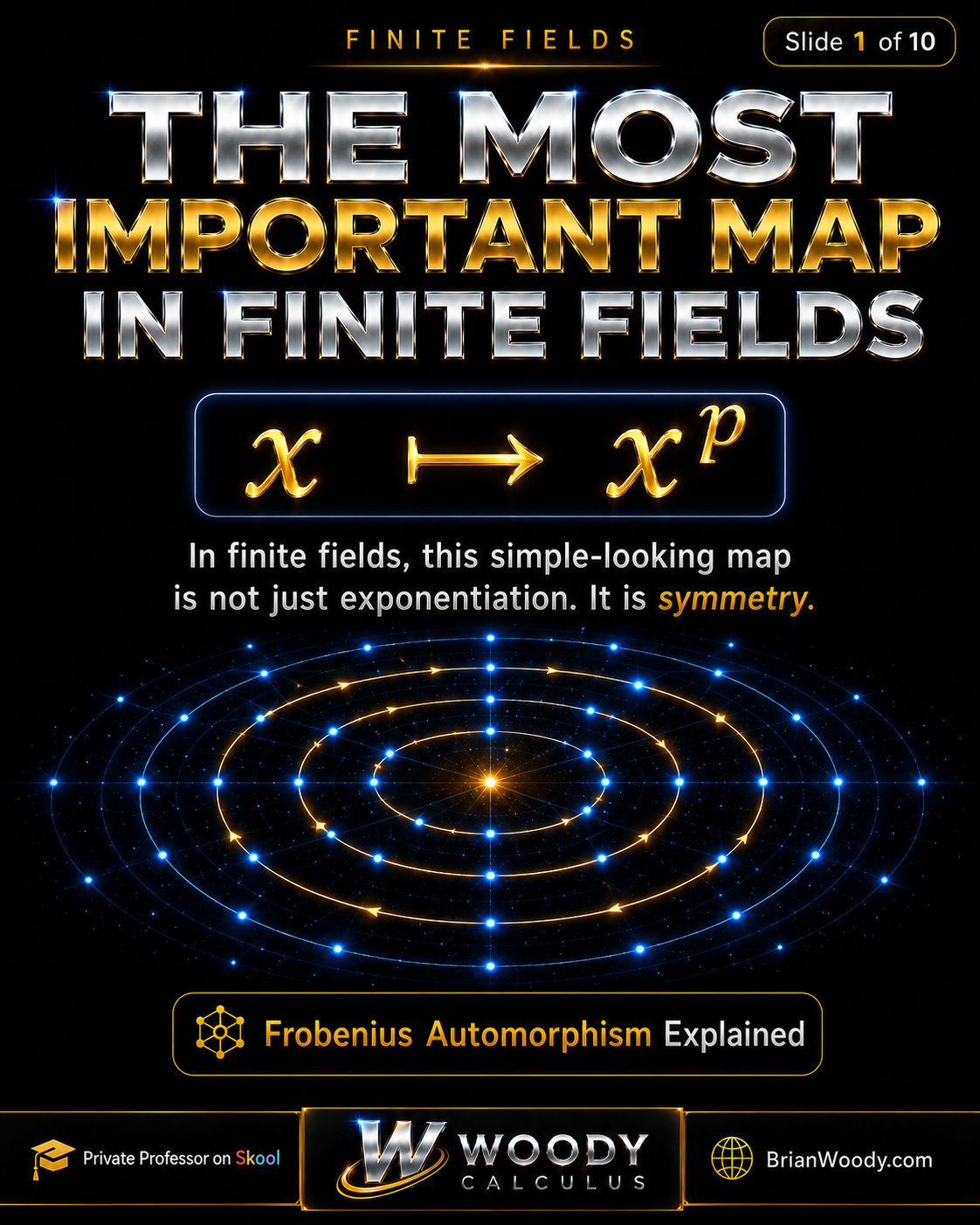
The Most Important Map in Finite Fields
The most important map in finite fields is:
x\longmapsto x^p.
\]
This map is called the Frobenius map. In a field of characteristic \(p\), it becomes one of the central structure-preserving maps in all of finite field theory.
At first, it looks like ordinary exponentiation. But inside a finite field, it controls:
- field automorphisms,
- finite-field Galois groups,
- conjugates of elements,
- trace and norm,
- unit circles in \(\mathbb{F}_{q^2}\),
- and polynomial classification over finite fields.
That is why Frobenius is not just a formula. It is a symmetry.
Finite Fields Live in Characteristic \(p\)
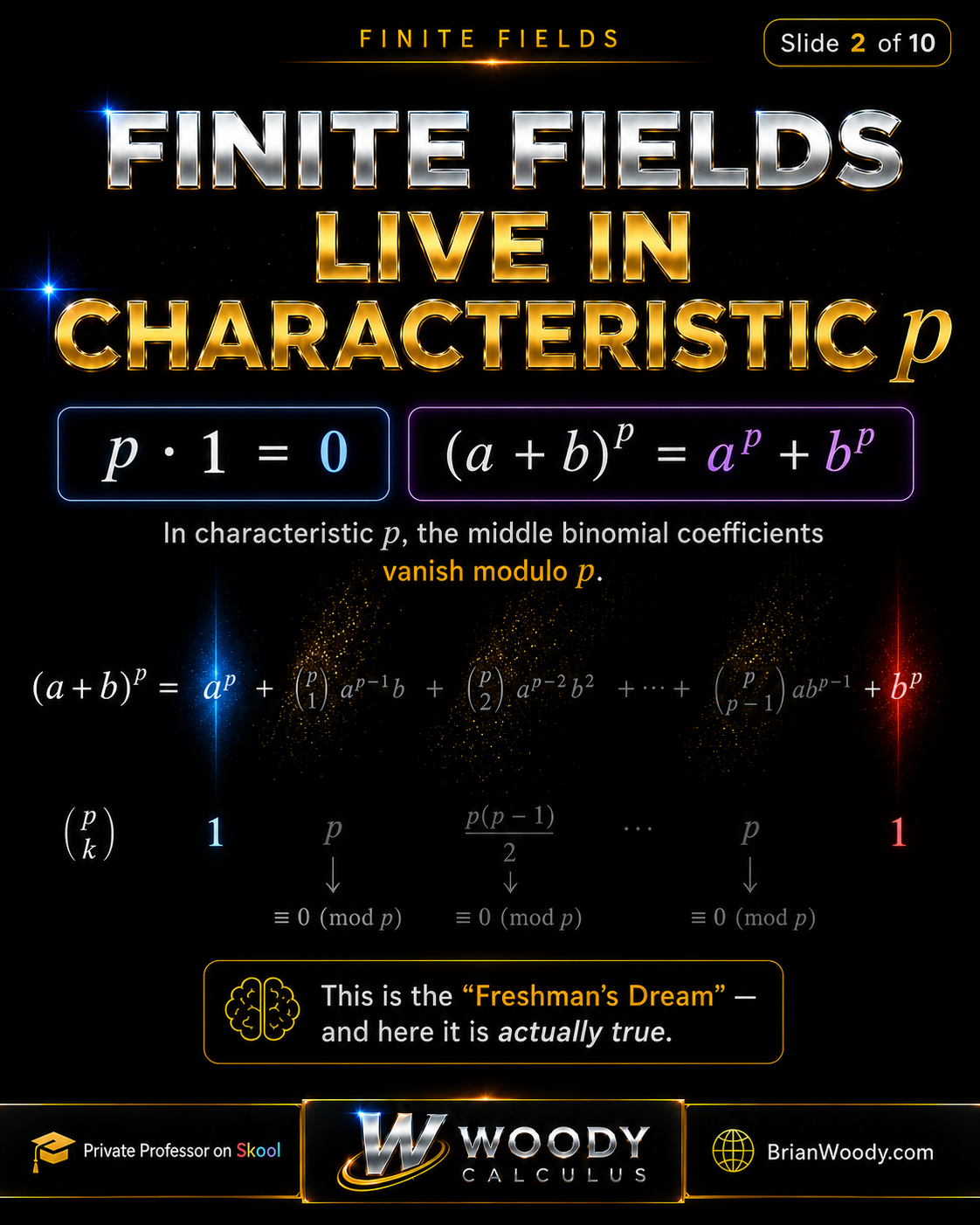
Every finite field has characteristic \(p\), where \(p\) is prime. This means:
p\cdot 1=0.
\]
In other words, adding \(1\) to itself \(p\) times gives zero.
This simple fact has a huge consequence. In characteristic \(p\), the binomial expansion of \((a+b)^p\) collapses:
(a+b)^p=a^p+b^p.
\]
This identity is sometimes jokingly called the Freshman’s Dream. Over ordinary real numbers, it is false. But in characteristic \(p\), it is true.
Why? Because the middle binomial coefficients are divisible by \(p\):
\binom{p}{k}\equiv 0\pmod p
\qquad
\text{for }1\le k\le p-1.
\]
So all the middle terms vanish in characteristic \(p\).
The Frobenius Map
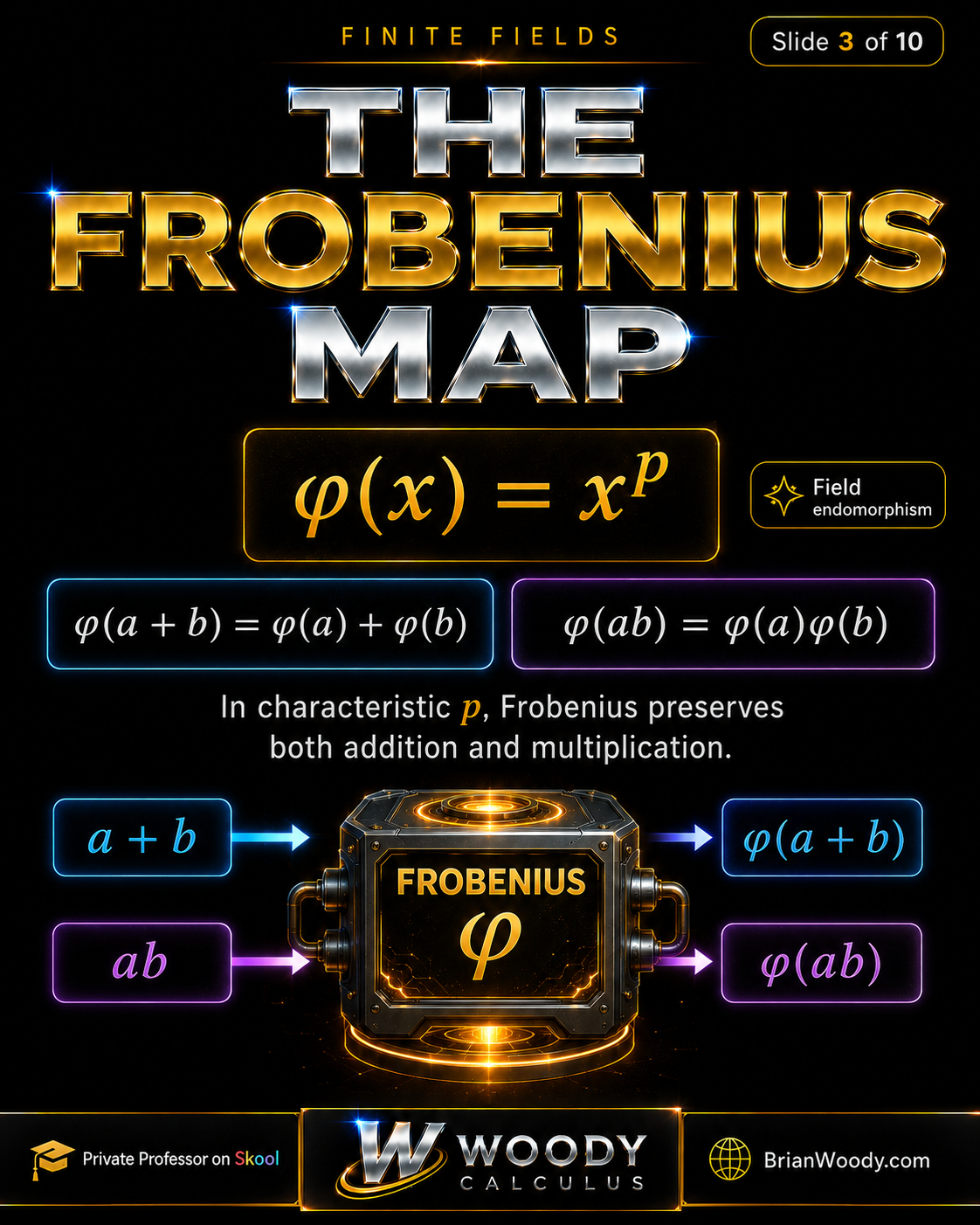
The Frobenius map is defined by:
\varphi(x)=x^p.
\]
Because of the Freshman’s Dream, Frobenius preserves addition:
\varphi(a+b)=(a+b)^p=a^p+b^p=\varphi(a)+\varphi(b).
\]
It also preserves multiplication:
\varphi(ab)=(ab)^p=a^p b^p=\varphi(a)\varphi(b).
\]
So Frobenius is a field endomorphism: it maps the field to itself while preserving addition and multiplication.
Why Frobenius Is Reversible in Finite Fields
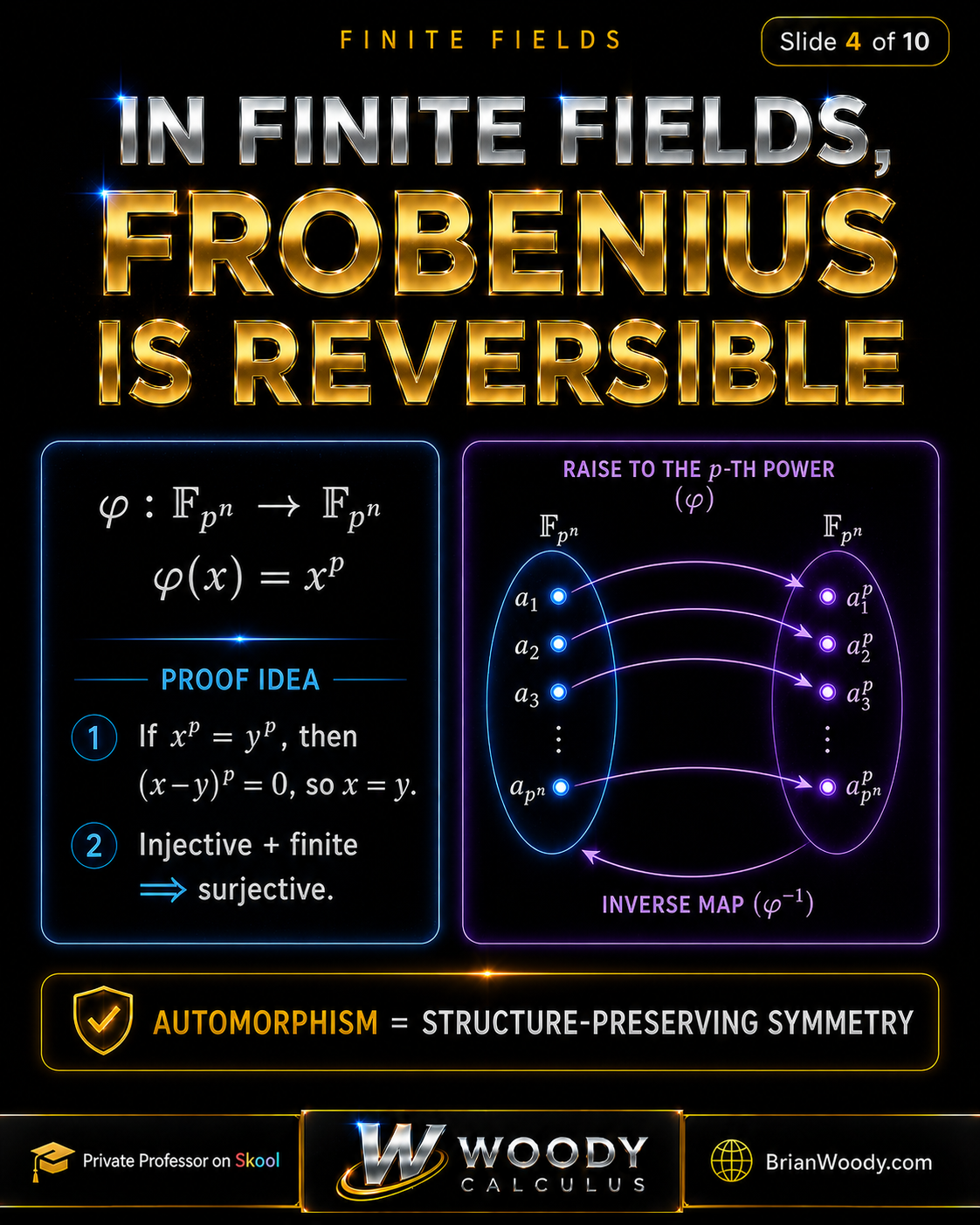
In a finite field, the Frobenius map is not merely an endomorphism. It is an automorphism.
An automorphism is a structure-preserving map that is also reversible.
Here is the proof idea. Suppose:
x^p=y^p.
\]
Then:
x^p-y^p=0.
\]
In characteristic \(p\), this becomes:
(x-y)^p=0.
\]
A field has no nonzero nilpotent elements, so:
x-y=0.
\]
Therefore:
x=y.
\]
So Frobenius is injective. And since the field is finite, every injective map from the field to itself is also surjective.
Therefore, Frobenius is reversible:
\varphi:\mathbb{F}_{p^n}\to\mathbb{F}_{p^n},
\qquad
\varphi(x)=x^p
\]
is a field automorphism.
In fact, on \(\mathbb{F}_{p^n}\), the inverse of Frobenius is:
\varphi^{-1}(x)=x^{p^{n-1}},
\]
because applying \(\varphi\) a total of \(n\) times returns every element to itself.
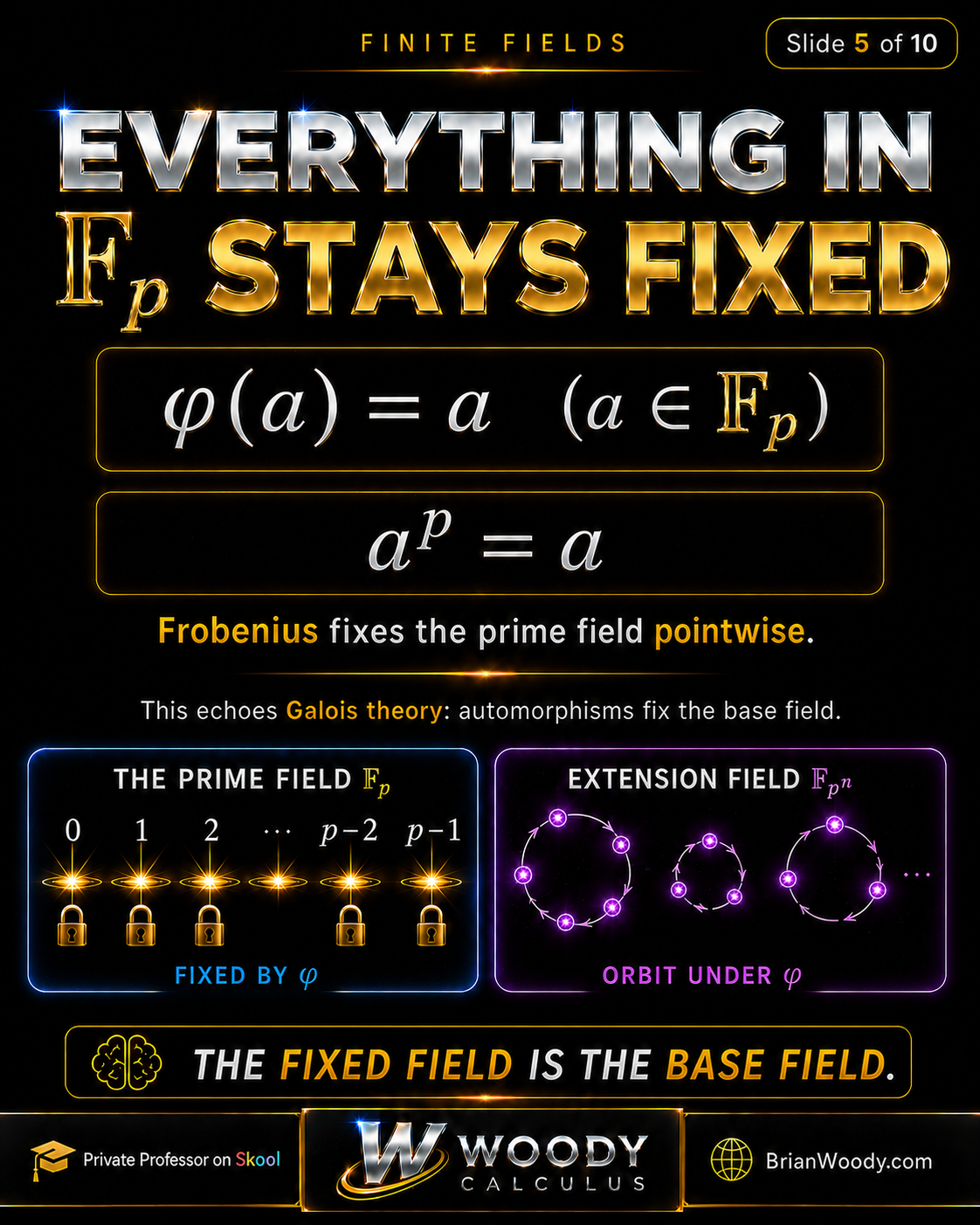
Everything in \(\mathbb{F}_p\) Stays Fixed
One of the most important facts about Frobenius is that it fixes the prime field \(\mathbb{F}_p\) pointwise.
If:
a\in\mathbb{F}_p,
\]
then:
a^p=a.
\]
So:
\varphi(a)=a.
\]
This is exactly the kind of behavior we expect from Galois Theory: automorphisms of an extension fix the base field.
In the extension:
\mathbb{F}_{p^n}/\mathbb{F}_p,
\]
Frobenius fixes \(\mathbb{F}_p\) and moves elements of the larger field \(\mathbb{F}_{p^n}\).
That is why Frobenius is the central symmetry of finite field extensions.
Finite-Field Galois Groups Are Cyclic
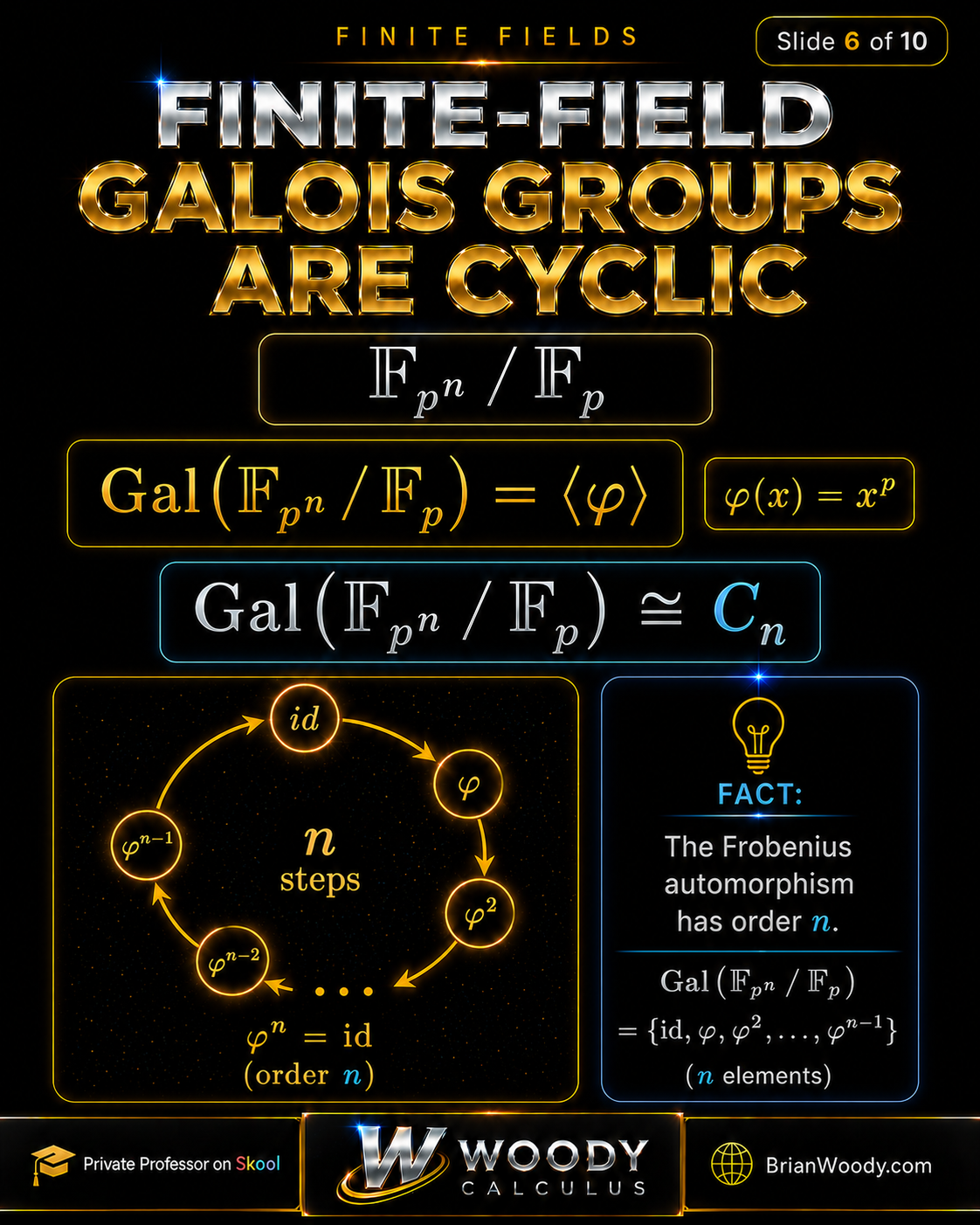
Finite-field Galois groups have a beautiful structure:
\operatorname{Gal}(\mathbb{F}_{p^n}/\mathbb{F}_p)
=
\langle \varphi\rangle,
\qquad
\varphi(x)=x^p.
\]
This means the entire Galois group is generated by repeated Frobenius:
\operatorname{id},\varphi,\varphi^2,\ldots,\varphi^{n-1}.
\]
After \(n\) applications, Frobenius returns to the identity:
\varphi^n=\operatorname{id}.
\]
Therefore:
\operatorname{Gal}(\mathbb{F}_{p^n}/\mathbb{F}_p)\cong C_n.
\]
This is one of the cleanest examples in all of Galois Theory: the Galois group of a finite field extension is cyclic.
Conjugates Come from Repeated Frobenius
In ordinary field theory, conjugates are roots of the same minimal polynomial.
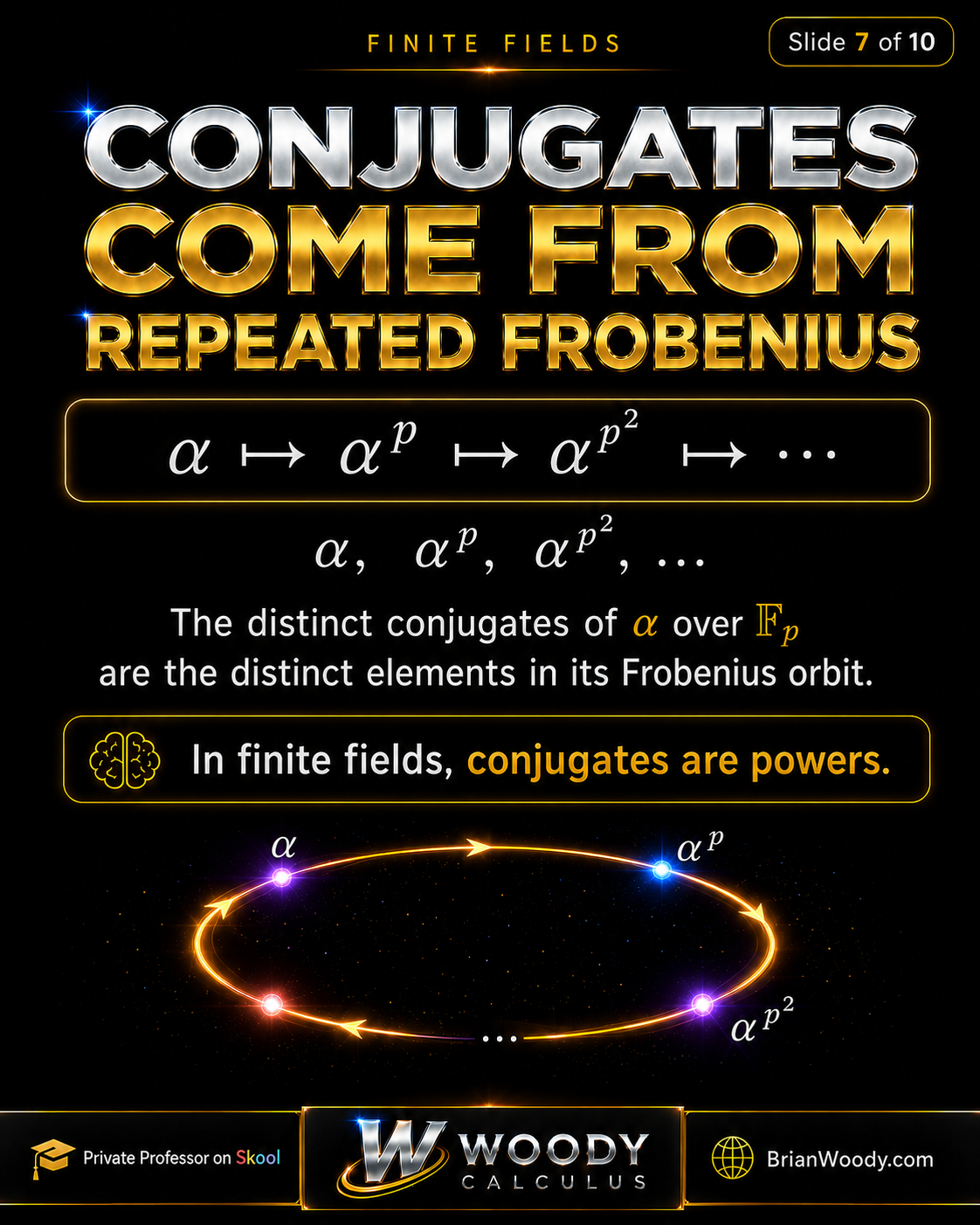
In finite fields, those conjugates have an especially clean form. If:
\alpha\in\mathbb{F}_{p^n},
\]
then its Frobenius orbit is:
\alpha,\quad \alpha^p,\quad \alpha^{p^2},\quad \alpha^{p^3},\quad \ldots
\]
The distinct elements in this orbit are the conjugates of \(\alpha\) over \(\mathbb{F}_p\).
So in finite fields:
\boxed{\text{conjugates are powers under Frobenius.}}
\]
This is a major reason finite fields are so structured. Frobenius organizes elements into orbits, and those orbits reveal the minimal polynomial, trace, norm, and subfield structure.
Over \(\mathbb{F}_q\), Use \(x\mapsto x^q\)
So far, we have discussed the \(p\)-Frobenius map:
\varphi(x)=x^p.
\]
But if the base field is:
\mathbb{F}_q,
\qquad q=p^r,
\]
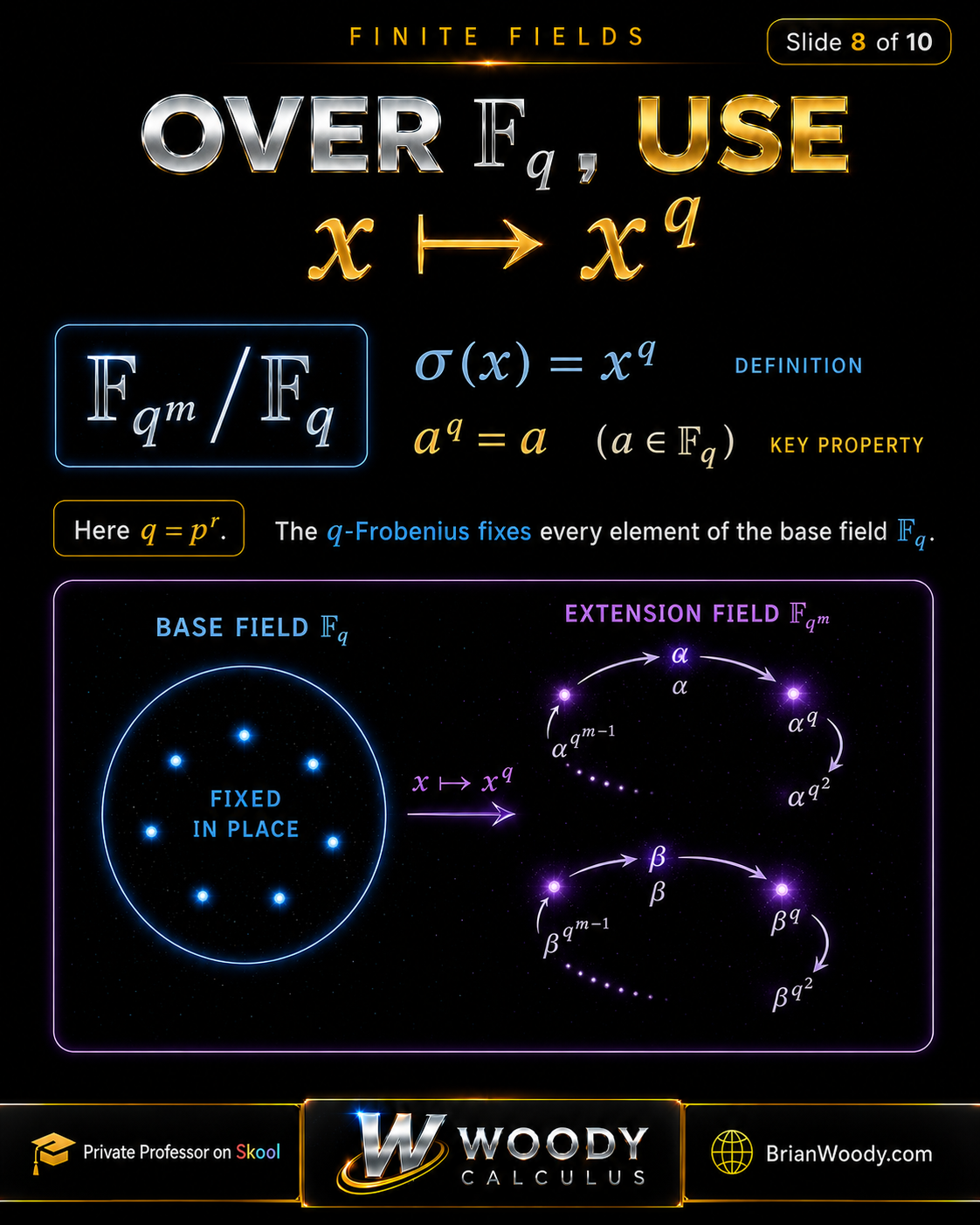
then the correct base-field Frobenius is:
\sigma(x)=x^q.
\]
Since \(q=p^r\), the \(q\)-Frobenius is just the \(p\)-Frobenius applied \(r\) times:
\sigma=\varphi^r.
\]
For the extension:
\mathbb{F}_{q^m}/\mathbb{F}_q,
\]
the \(q\)-Frobenius fixes every element of \(\mathbb{F}_q\):
a^q=a
\qquad
(a\in\mathbb{F}_q).
\]
And the Galois group is:
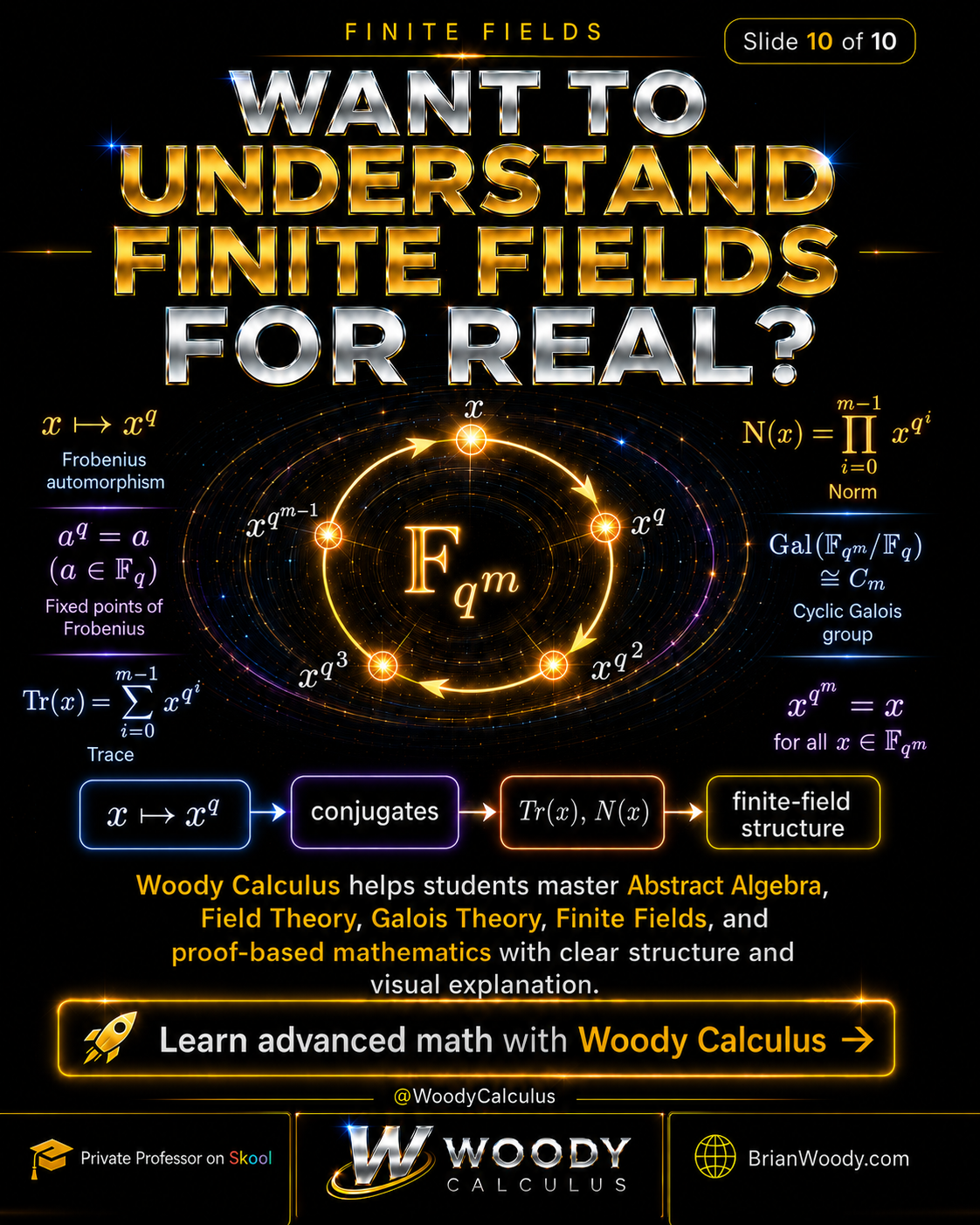
\operatorname{Gal}(\mathbb{F}_{q^m}/\mathbb{F}_q)
=
\langle \sigma\rangle
\cong C_m.
\]
This is the version that appears constantly in finite-field research, especially over quadratic extensions like:
\mathbb{F}_{q^2}/\mathbb{F}_q.
\]
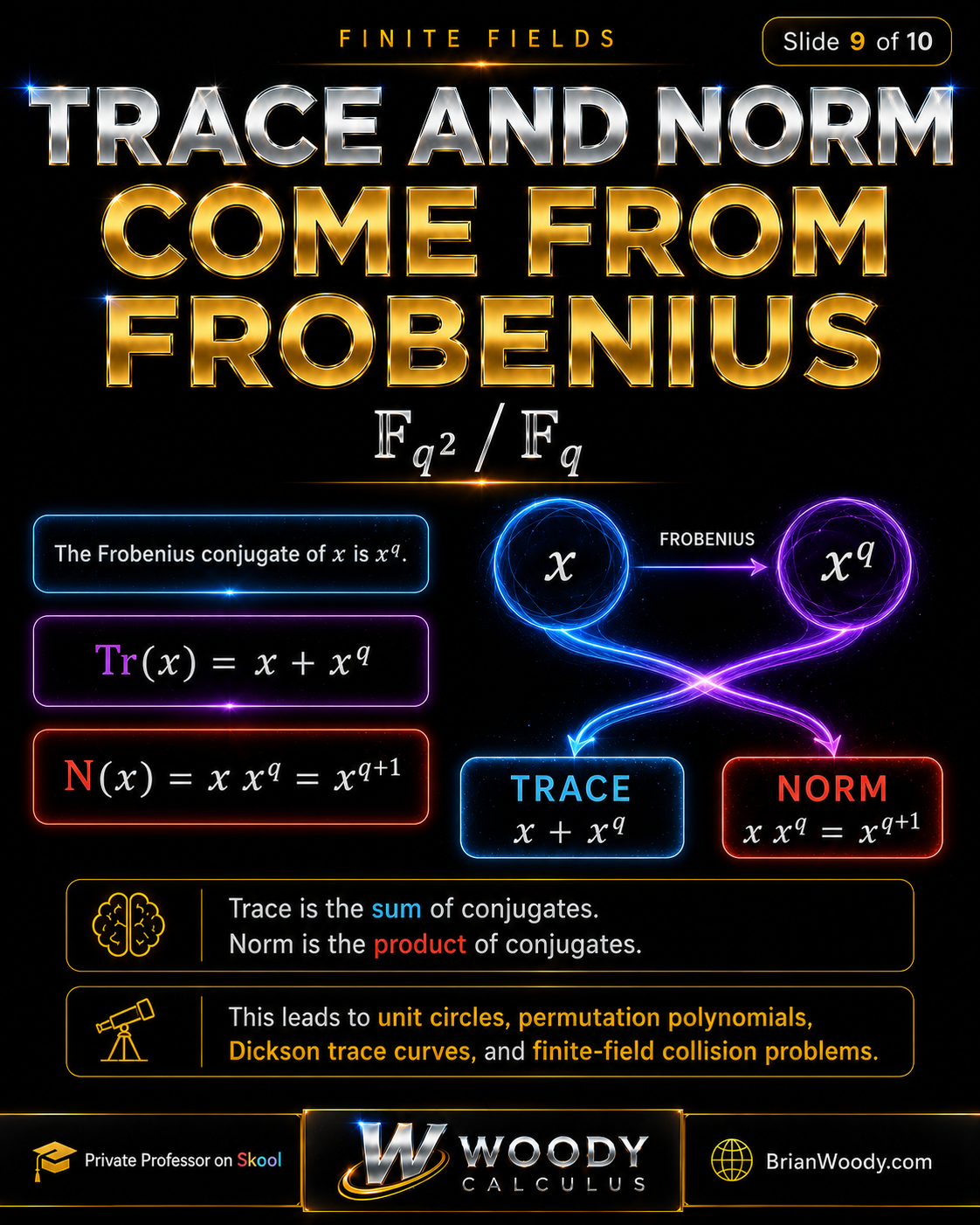
Trace and Norm Come from Frobenius
Trace and norm are two of the most important constructions in finite field extensions.
In a general extension:
\mathbb{F}_{q^m}/\mathbb{F}_q,
\]
the trace is the formal sum of all \(m\) Frobenius conjugates:
\operatorname{Tr}_{\mathbb{F}_{q^m}/\mathbb{F}_q}(x)
=
\sum_{i=0}^{m-1}x^{q^i}.
\]
The norm is the product of all \(m\) Frobenius conjugates:
N_{\mathbb{F}_{q^m}/\mathbb{F}_q}(x)
=
\prod_{i=0}^{m-1}x^{q^i}.
\]
Equivalently:
N_{\mathbb{F}_{q^m}/\mathbb{F}_q}(x)
=
x^{1+q+q^2+\cdots+q^{m-1}}
=
x^{(q^m-1)/(q-1)}.
\]
For the quadratic extension:
\mathbb{F}_{q^2}/\mathbb{F}_q,
\]
the Frobenius conjugate of \(x\) is:
x^q.
\]
The trace is the sum of conjugates:
\operatorname{Tr}(x)=x+x^q.
\]
The norm is the product of conjugates:
N(x)=x\cdot x^q=x^{q+1}.
\]
This is a huge bridge to modern finite-field research. The set:
\mu_{q+1}
=
\{x\in\mathbb{F}_{q^2}:x^{q+1}=1\}
\]
is the finite-field unit circle. It is exactly the norm-one subgroup:
N(x)=1.
\]
And on this unit circle:
x^{q+1}=1
\quad\Longrightarrow\quad
x^q=x^{-1}.
\]
That identity is one of the reasons Frobenius is so powerful in reciprocal polynomial problems over \(\mathbb{F}_{q^2}\).
Connection to Brian Woody’s Finite Field Research
The Frobenius automorphism is not only a beautiful Abstract Algebra idea. It is also part of the background behind Brian M. Woody’s finite-field research.
His research hub highlights work on finite fields, permutation polynomials, reciprocal quadrinomials, unit-circle reductions, Dickson trace curves, computational verification, and polynomial classification over \(\mathbb{F}_{q^2}\).
- Brian M. Woody Research Hub
- Student Guide to the Degree-Five Finite Field Classification Paper
- Dickson Trace Curves and Reciprocal Quadrinomials over Finite Fields
- Official arXiv Record: arXiv:2607.01267
- Gist.Science External Explanation of arXiv:2607.01267
External AI explanations such as Gist.Science can be useful for discovery, but students should use the original paper, the hosted PDF on BrianWoody.com, and the Brian M. Woody Research Hub as the main sources for technical accuracy.
The conceptual connection is:
- Frobenius creates finite-field conjugates.
- Trace and norm are built from Frobenius conjugates.
- The norm-one condition \(x^{q+1}=1\) creates the finite-field unit circle \(\mu_{q+1}\).
- On \(\mu_{q+1}\), Frobenius acts like inversion: \(x^q=x^{-1}\).
- This symmetry helps organize reciprocal polynomial maps and collision equations.
- Those collision equations lead naturally to Dickson trace curves and finite-field classification problems.
This is why students who want to understand the classification paper should build a strong foundation in finite field theory, field extensions, Galois Theory, the Galois group of \(x^3-2\), and quotient groups.
Worked Examples
Worked Example 1: Why \((a+b)^p=a^p+b^p\) in characteristic \(p\)
By the binomial theorem:
(a+b)^p
=
\sum_{k=0}^{p}\binom{p}{k}a^{p-k}b^k.
\]
The first and last terms are:
a^p
\qquad
\text{and}
\qquad
b^p.
\]
For \(1\le k\le p-1\), the coefficient \(\binom{p}{k}\) is divisible by \(p\). In characteristic \(p\), those coefficients become \(0\). Therefore:
(a+b)^p=a^p+b^p.
\]
Worked Example 2: Frobenius in \(\mathbb{F}_4\)
Build:
\mathbb{F}_4=\mathbb{F}_2(\alpha),
\qquad
\alpha^2+\alpha+1=0.
\]
Then:
\alpha^2=\alpha+1.
\]
Since the characteristic is \(2\), Frobenius is:
\varphi(x)=x^2.
\]
Apply Frobenius to \(\alpha\):
\varphi(\alpha)=\alpha^2=\alpha+1.
\]
Apply Frobenius again:
\varphi^2(\alpha)=(\alpha+1)^2=\alpha^2+1=(\alpha+1)+1=\alpha.
\]
So:
\varphi^2=\operatorname{id}.
\]
Therefore:
\operatorname{Gal}(\mathbb{F}_4/\mathbb{F}_2)\cong C_2.
\]
Worked Example 3: Trace and Norm in \(\mathbb{F}_4/\mathbb{F}_2\)
Using the same field:
\mathbb{F}_4=\mathbb{F}_2(\alpha),
\qquad
\alpha^2=\alpha+1.
\]
The trace is:
\operatorname{Tr}(\alpha)=\alpha+\alpha^2.
\]
Since \(\alpha^2=\alpha+1\):
\operatorname{Tr}(\alpha)=\alpha+(\alpha+1)=1.
\]
The norm is:
N(\alpha)=\alpha\alpha^2=\alpha^3.
\]
But \(\alpha^3=1\), so:
N(\alpha)=1.
\]
Worked Example 4: Unit Circle in \(\mathbb{F}_{q^2}\)
In the quadratic extension:
\mathbb{F}_{q^2}/\mathbb{F}_q,
\]
the norm is:
N(x)=x^{q+1}.
\]
The unit circle is:
\mu_{q+1}=\{x\in\mathbb{F}_{q^2}:x^{q+1}=1\}.
\]
If \(x\in\mu_{q+1}\), then:
x^{q+1}=1.
\]
Dividing by \(x\), we get:
x^q=x^{-1}.
\]
This is the finite-field version of conjugation acting like inversion on the unit circle.
Common Mistakes
Mistake 1: Thinking Frobenius is just exponentiation
Frobenius is exponentiation, but in characteristic \(p\) it also preserves addition and multiplication. That is what makes it an algebraic symmetry.
Mistake 2: Forgetting the base field
Over \(\mathbb{F}_p\), Frobenius is \(x\mapsto x^p\). Over \(\mathbb{F}_q\), the base-field Frobenius is \(x\mapsto x^q\). If \(q=p^r\), then \(x\mapsto x^q\) is \(\varphi^r\).
Mistake 3: Confusing endomorphism with automorphism
Frobenius is an endomorphism in characteristic \(p\). On finite fields, it becomes an automorphism because it is injective and the field is finite.
Mistake 4: Thinking conjugates are mysterious in finite fields
In finite fields, conjugates are Frobenius powers. This is one of the cleanest parts of finite-field Galois Theory.
Mistake 5: Treating trace and norm as random formulas
Trace and norm are not random. Trace is the sum of Frobenius conjugates, and norm is the product of Frobenius conjugates.
Key Takeaways
- The Frobenius map is \(\varphi(x)=x^p\).
- Finite fields live in characteristic \(p\).
- In characteristic \(p\), \((a+b)^p=a^p+b^p\).
- Frobenius preserves addition and multiplication.
- On finite fields, Frobenius is reversible.
- Frobenius fixes \(\mathbb{F}_p\) pointwise.
- The Galois group \(\operatorname{Gal}(\mathbb{F}_{p^n}/\mathbb{F}_p)\) is cyclic.
- Finite-field conjugates are Frobenius powers.
- Over \(\mathbb{F}_q\), the base-field Frobenius is \(x\mapsto x^q\).
- If \(q=p^r\), then \(x\mapsto x^q\) equals \(\varphi^r\).
- Trace and norm come from sums and products of Frobenius conjugates.
- For \(\mathbb{F}_{q^m}/\mathbb{F}_q\), trace is \(\sum_{i=0}^{m-1}x^{q^i}\), and norm is \(\prod_{i=0}^{m-1}x^{q^i}\).
- In \(\mathbb{F}_{q^2}\), \(N(x)=x^{q+1}\), and the norm-one elements form the unit circle \(\mu_{q+1}\).
Frobenius Automorphism FAQ
What is the Frobenius automorphism?
The Frobenius automorphism is the map \(\varphi(x)=x^p\) in a finite field of characteristic \(p\). It preserves addition and multiplication and is reversible on finite fields.
Why is Frobenius an automorphism in finite fields?
Frobenius is injective because \(x^p=y^p\) implies \((x-y)^p=0\), so \(x=y\). Since finite injective maps are surjective, Frobenius is bijective and therefore an automorphism.
Why does \((a+b)^p=a^p+b^p\) in finite fields?
In characteristic \(p\), all the middle binomial coefficients \(\binom{p}{k}\) are divisible by \(p\), so they vanish. Only \(a^p\) and \(b^p\) remain.
What does Frobenius fix?
The \(p\)-Frobenius fixes every element of \(\mathbb{F}_p\). More generally, the \(q\)-Frobenius \(x\mapsto x^q\) fixes every element of \(\mathbb{F}_q\).
What is the relationship between \(p\)-Frobenius and \(q\)-Frobenius?
If \(q=p^r\), then the \(q\)-Frobenius \(x\mapsto x^q\) is the \(p\)-Frobenius applied \(r\) times. In other words, \(\sigma=\varphi^r\).
What is the Galois group of \(\mathbb{F}_{p^n}/\mathbb{F}_p\)?
The Galois group is cyclic of order \(n\), generated by the Frobenius automorphism \(x\mapsto x^p\). In symbols, \(\operatorname{Gal}(\mathbb{F}_{p^n}/\mathbb{F}_p)\cong C_n\).
What are Frobenius conjugates?
Frobenius conjugates of an element \(\alpha\) are obtained by repeatedly applying Frobenius: \(\alpha,\alpha^p,\alpha^{p^2},\ldots\), or over \(\mathbb{F}_q\), \(\alpha,\alpha^q,\alpha^{q^2},\ldots\).
How do trace and norm come from Frobenius?
Trace is the sum of Frobenius conjugates, and norm is the product of Frobenius conjugates. For \(\mathbb{F}_{q^m}/\mathbb{F}_q\), trace is \(\sum_{i=0}^{m-1}x^{q^i}\), and norm is \(\prod_{i=0}^{m-1}x^{q^i}\). For \(\mathbb{F}_{q^2}/\mathbb{F}_q\), \(\operatorname{Tr}(x)=x+x^q\) and \(N(x)=xx^q=x^{q+1}\).
How does Frobenius connect to Brian Woody’s finite-field research?
Frobenius controls conjugates, trace, norm, and the unit circle \(\mu_{q+1}\) in \(\mathbb{F}_{q^2}\). These ideas connect directly to Brian M. Woody’s research on permutation polynomials, reciprocal quadrinomials, Dickson trace curves, and finite-field classification.
Master Finite Fields with Woody Calculus
Understanding Frobenius requires several core Abstract Algebra skills: finite fields, characteristic \(p\), field extensions, automorphisms, cyclic Galois groups, trace, norm, conjugates, and polynomial structure.
Woody Calculus helps students learn advanced mathematics through clean definitions, visual intuition, structured repetition, proof-based reasoning, and step-by-step explanation.
For structured training, join the Woody Calculus Mastery Lab. Students can also visit Woody Calculus on Skool to learn more about the learning community.
Related Woody Calculus Mathematical Essays
Explore more Woody Calculus lessons connecting finite fields, Frobenius automorphisms, Abstract Algebra, Galois Theory, field extensions, quotient groups, trace and norm, permutation polynomials, and proof-based mathematics.
- How to Learn Calculus and Advanced Mathematics: A Peak Performance Study Guide
- Finite Field Theory Explained: Galois Fields, Cryptography, and Abstract Algebra
- Field Extensions Explained: When Numbers Need a Bigger Universe
- Why Does x³ − 2 Create S₃? Galois Theory Explained
- Galois Theory Explained: Hidden Symmetry Behind Equations
- Quotient Groups Explained: Cosets, Normal Subgroups, and the First Isomorphism Theorem
- Finite Field Permutation Polynomial Research
- Dickson Trace Curves and Reciprocal Quadrinomials over Finite Fields
- The Determinant Explained: The Number That Measures How a Matrix Changes Space
- Eigenvalues and Eigenvectors Explained: The Special Directions That Unlock Linear Algebra
- View All Woody Calculus Blog Posts
Brian M. Woody Research and Finite Field Connections
Students who want to see how Abstract Algebra leads into real research can explore the Brian M. Woody Research Hub. The research page collects publications and student-friendly explanations involving finite fields, permutation polynomials, reciprocal quadrinomials, Dickson trace curves, computational verification, and mathematical classification.
- Brian M. Woody Research Hub
- Student Guide to the Degree-Five Finite Field Classification Paper
- Dickson Trace Curves and Reciprocal Quadrinomials over Finite Fields
- Official arXiv Record: arXiv:2607.01267
- Gist.Science External Explanation of arXiv:2607.01267
External AI explanations can be useful for discovery, but students should use the original research paper and the BrianWoody.com research guide as the main sources for technical accuracy.
Private Instruction
Brian M. Woody also works privately with a limited number of serious students who need one-on-one help in Abstract Algebra, Real Analysis, Calculus II, Calculus III, and Differential Equations.
Private instruction is reserved for serious students, requires weekly sessions, requires enrollment in the Woody Calculus Mastery Lab first, and approval is not guaranteed.
Students interested in private instruction can learn more here: Private Math Tutor and Advanced Mathematics Instruction.
Related University Math Help Pages
Woody Calculus supports students at major universities with structured help in Abstract Algebra, Real Analysis, Linear Algebra, Differential Equations, Calculus II, Calculus III, and advanced mathematics. For the full list of supported schools, visit the University Calculus Tutor Hub.
- University Calculus Tutor Hub
- MIT Calculus Tutor
- Harvard Calculus Tutor
- Stanford Calculus Tutor
- Princeton Calculus Tutor
- Caltech Calculus Tutor
- Purdue University Calculus Tutor
- University of Florida Calculus Tutor
- Colorado State University Calculus Help
- UCF Calculus Tutor
- Georgia Tech Calculus Tutor
- University of Michigan Calculus Tutor
- University of Nevada, Reno Calculus Tutor
- UCLA Calculus Tutor
Trusted by Students Nationwide
The Woody Calculus Mastery Lab gives university students access to structured mathematics support, written solutions, video lessons, exam-focused training, proof-based lessons, and expert guidance from Brian M. Woody.
Students use Woody Calculus for Abstract Algebra, Real Analysis, Linear Algebra, Differential Equations, Calculus II, Calculus III, and other advanced mathematics courses.