“`html
Infinite series tests are one of the most important parts of Calculus 2. They teach you how to decide whether an infinite sum converges or diverges, even when you cannot directly add every term.
The secret is not to memorize a random list of tests. The real skill is learning how to read the pattern first and then choose the test second.
In Calculus 2, the growth rate of the terms tells you where to look first. Constants grow slower than logarithms, logarithms grow slower than powers, powers grow slower than exponentials, exponentials grow slower than factorials, and factorials grow slower than super-exponential terms like \(n^n\).
100 \ll \ln n \ll n^2 \ll 2^n \ll n! \ll n^n.
\]
That growth hierarchy is the backbone of series testing. Once you can recognize the pattern, you can choose between the Test for Divergence, p-test, geometric series test, comparison tests, Ratio Test, Root Test, Integral Test, Alternating Series Test, and telescoping series.
This topic connects directly to radius of convergence and power series, Taylor series in Calculus 2, and the larger Woody Calculus method of building formula fluency through rewriting perfect solutions and saying each step out loud until the method becomes automatic.
Estimated read time: 15–18 minutes.
Quick summary: To choose an infinite series test in Calculus 2, identify the pattern first:
- Terms do not go to zero: use the Test for Divergence.
- Powers like \(1/n^p\): use the p-test.
- Fixed ratio: use the geometric series test.
- Rational-function terms: compare degrees, then use p-test or Limit Comparison Test.
- Dominant terms with add/subtract structure: use the Limit Comparison Test.
- Bounded noise: use the Direct Comparison Test.
- Factorials, exponentials, or products: use the Ratio Test.
- Whole term raised to \(n\): use the Root Test.
- Positive, continuous, decreasing terms: consider the Integral Test.
- Alternating signs: check absolute convergence first, then use the Alternating Series Test.
- Cancellation: look for telescoping.

Infinite Series Tests Key Facts
- The first question is always whether the terms \(a_n\) go to zero.
- If \(\lim_{n\to\infty}a_n\ne 0\), then \(\sum a_n\) diverges by the Test for Divergence.
- The p-test applies to \(\sum 1/n^p\): it converges if \(p>1\) and diverges if \(p\le 1\).
- A geometric series \(\sum ar^n\) converges if \(|r|<1\) and diverges if \(|r|\ge 1\).
- The Limit Comparison Test works well for rational expressions and dominant-term behavior.
- The Direct Comparison Test works well when you can bound a nonnegative series above or below by a known series.
- The Ratio Test is usually best for factorials, exponentials, and products.
- The Root Test is usually best when the entire term is raised to the \(n\)th power.
- The Integral Test works for positive, continuous, decreasing terms.
- The Alternating Series Test applies to alternating series with positive decreasing terms that go to zero.
- Telescoping series work when cancellation appears in the partial sums.
This Woody Calculus lesson explains infinite series tests in order: growth rates, the Test for Divergence, rational-function degree comparisons, p-series, geometric series, Limit Comparison Test, Direct Comparison Test, Ratio Test, Root Test, Integral Test, Alternating Series Test, telescoping series, and the full decision map for choosing the right test.
Read the Speed: Growth Rate Comes First
Before choosing a series test, read the speed of the terms. The growth hierarchy
100 \ll \ln n \ll n^2 \ll 2^n \ll n! \ll n^n
\]
tells you which part of the expression is likely to dominate as \(n\to\infty\).
For example:
- If you see powers like \(n^2\), \(n^5\), or \(1/n^p\), think p-test or comparison.
- If you see a fixed ratio, think geometric series.
- If you see factorials or exponentials mixed with powers, think Ratio Test.
- If you see an entire expression raised to \(n\), think Root Test.
- If you see alternating signs, check absolute convergence first, then consider AST.
- If terms are subtracting in a way that cancels in partial sums, think telescoping.
That is why the Woody Calculus rule is:
Pattern first. Test second.
— Brian M. Woody
The 11 Essential Series Tests
This table gives the fast student-friendly overview of the major Calculus 2 series tests.
| Test | When to Use | Convergence / Divergence Rule |
|---|---|---|
| Test for Divergence | Always check first. | If \(a_n\not\to 0\), then \(\sum a_n\) diverges. |
| p-test | Terms look like \(1/n^p\). | Converges if \(p>1\); diverges if \(p\le 1\). |
| Geometric Series | Terms have a fixed ratio \(r\). | Converges if \(|r|<1\); diverges if \(|r|\ge 1\). |
| Limit Comparison Test | Dominant terms match a known series. | If \(0 |
| Direct Comparison Test | A messy nonnegative term can be bounded. | Compare above by a convergent series or below by a divergent series. |
| Ratio Test | Factorials, exponentials, or products appear. | \(L<1\) converges absolutely; \(L>1\) diverges; \(L=1\) is inconclusive. |
| Root Test | The whole term is raised to \(n\). | \(L<1\) converges absolutely; \(L>1\) diverges; \(L=1\) is inconclusive. |
| Integral Test | Terms come from a positive, continuous, decreasing function. | The series and improper integral either both converge or both diverge. |
| Alternating Series Test | Signs alternate. | If \(b_n>0\), \(b_n\) decreases, and \(b_n\to 0\), the alternating series converges. |
| Telescoping Series | Partial sums show cancellation. | Compute the partial sum \(S_N\), then take \(\lim_{N\to\infty}S_N\). |
| Absolute / Conditional Check | Alternating or sign-changing series. | Test \(\sum |a_n|\) first when possible. |
Always Start with the Test for Divergence
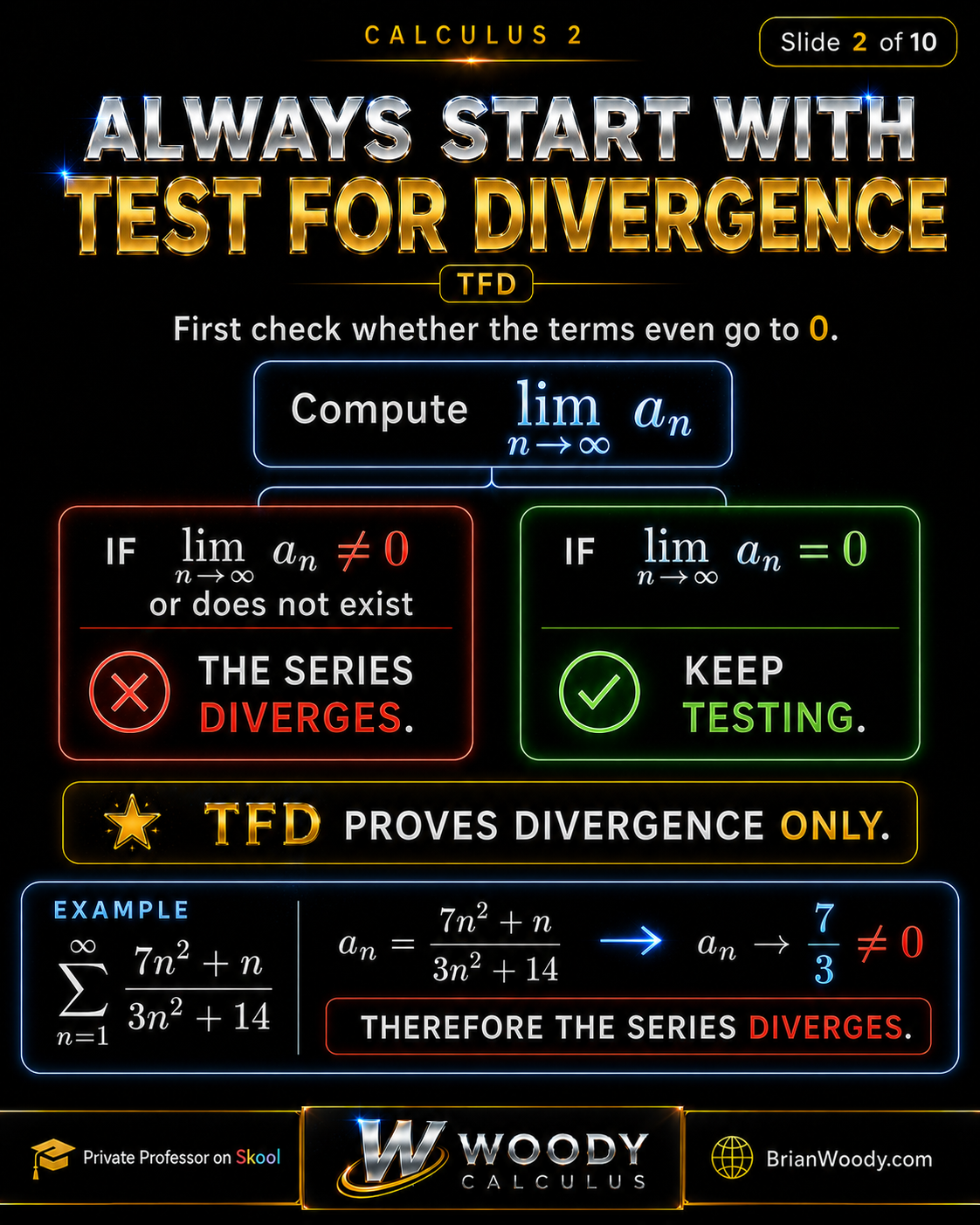
The Test for Divergence, also called the nth term test, is the first thing to check. For an infinite series
\sum_{n=1}^{\infty} a_n,
\]
compute:
\lim_{n\to\infty}a_n.
\]
If
\lim_{n\to\infty}a_n\ne 0
\]
or if the limit does not exist, then the series diverges.
If
\lim_{n\to\infty}a_n=0,
\]
then you keep testing. The Test for Divergence proves divergence only. It never proves convergence.
Example: Divergence from a nonzero term limit
Consider:
\sum_{n=1}^{\infty}\frac{7n^2+n}{3n^2+14}.
\]
The term is:
a_n=\frac{7n^2+n}{3n^2+14}.
\]
Divide top and bottom by \(n^2\):
a_n=
\frac{7+\frac{1}{n}}{3+\frac{14}{n^2}}
\to
\frac{7}{3}.
\]
Because the terms do not go to zero, the series diverges by the Test for Divergence.
Rational Terms: Compare Degrees
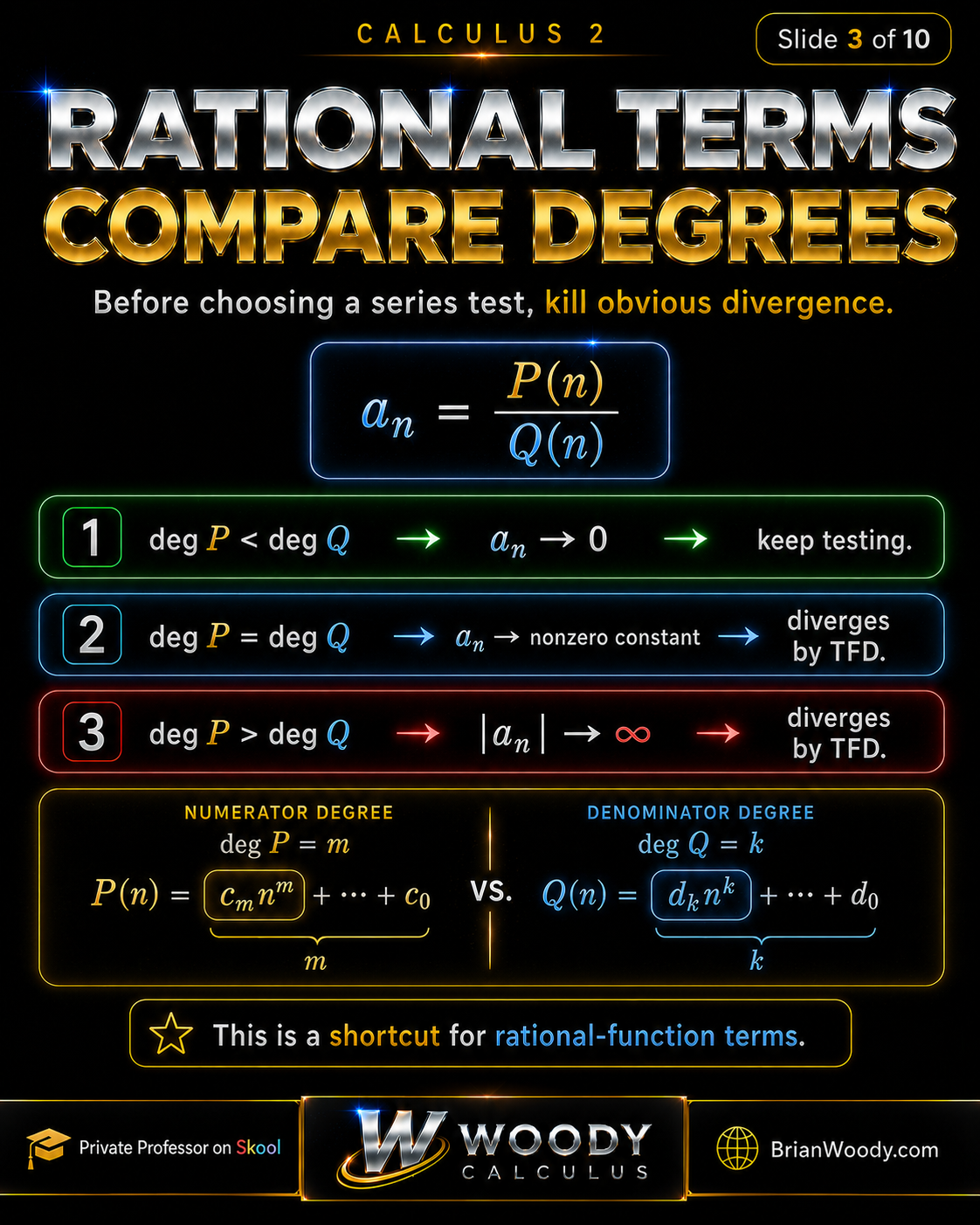
For rational-function terms of the form
a_n=\frac{P(n)}{Q(n)},
\]
look at the degrees of the numerator and denominator before choosing a deeper test.
The degree shortcut
Suppose:
P(n)=c_m n^m+\cdots+c_0,
\qquad
Q(n)=d_k n^k+\cdots+d_0.
\]
Then:
- If \(\deg P<\deg Q\), then \(a_n\to 0\). Keep testing.
- If \(\deg P=\deg Q\), then \(a_n\to\) a nonzero constant. The series diverges by TFD.
- If \(\deg P>\deg Q\), then \(|a_n|\to\infty\). The series diverges by TFD.
This shortcut is not the full convergence test. It is a way to quickly eliminate obvious divergence and identify the dominant behavior.
When the terms do go to zero, rational-function series often lead naturally to the p-test, Limit Comparison Test, or power-series style thinking.
Powers Only: Use the p-Test
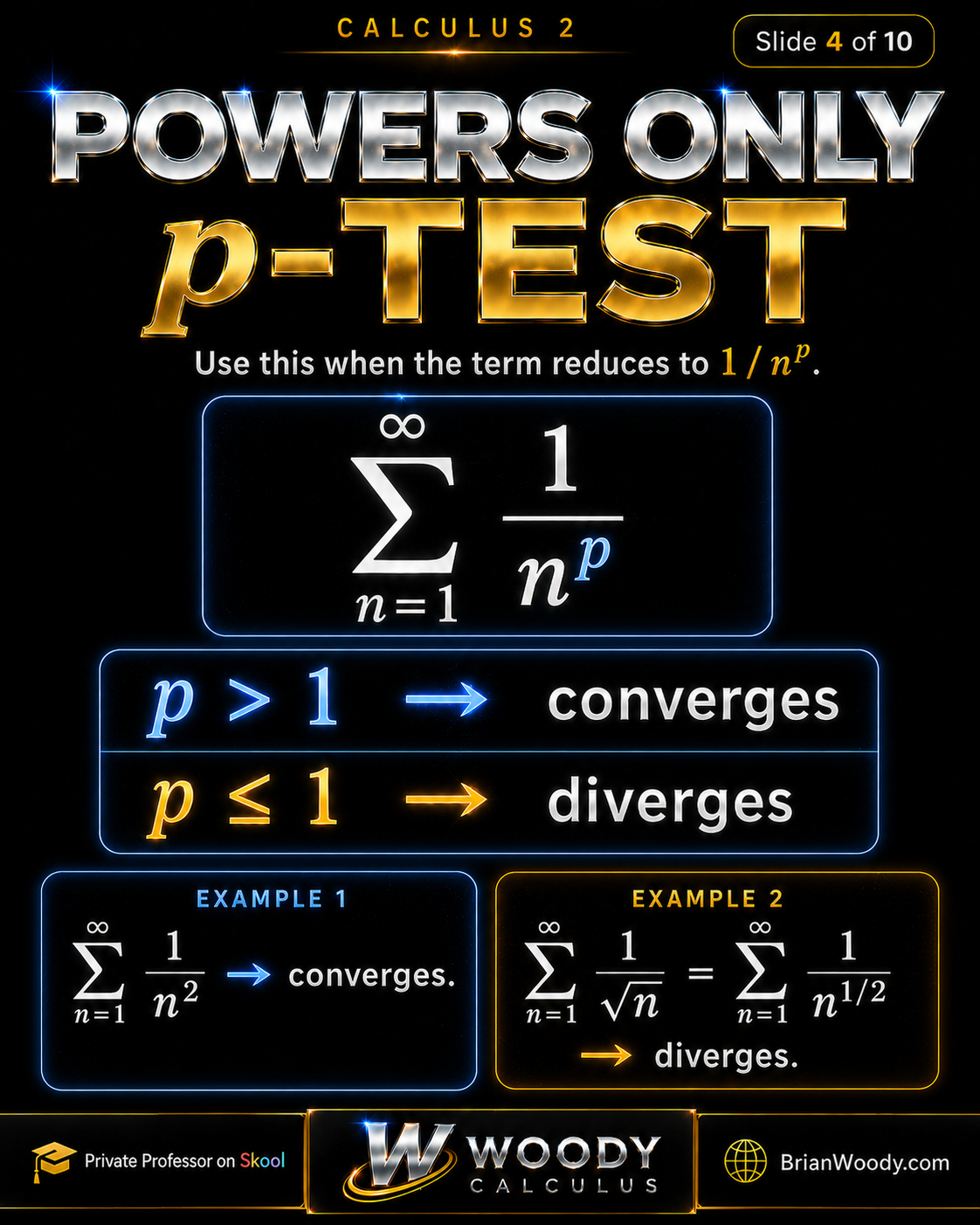
The p-test applies to series of the form:
\sum_{n=1}^{\infty}\frac{1}{n^p}.
\]
The rule is:
p>1
\quad\Longrightarrow\quad
\sum_{n=1}^{\infty}\frac{1}{n^p}
\text{ converges},
\]
p\le 1
\quad\Longrightarrow\quad
\sum_{n=1}^{\infty}\frac{1}{n^p}
\text{ diverges}.
\]
Examples
The series
\sum_{n=1}^{\infty}\frac{1}{n^2}
\]
converges because \(p=2>1\).
The series
\sum_{n=1}^{\infty}\frac{1}{\sqrt{n}}
=
\sum_{n=1}^{\infty}\frac{1}{n^{1/2}}
\]
diverges because \(p=\frac12\le 1\).
Fixed Multiplier: Use the Geometric Series Test
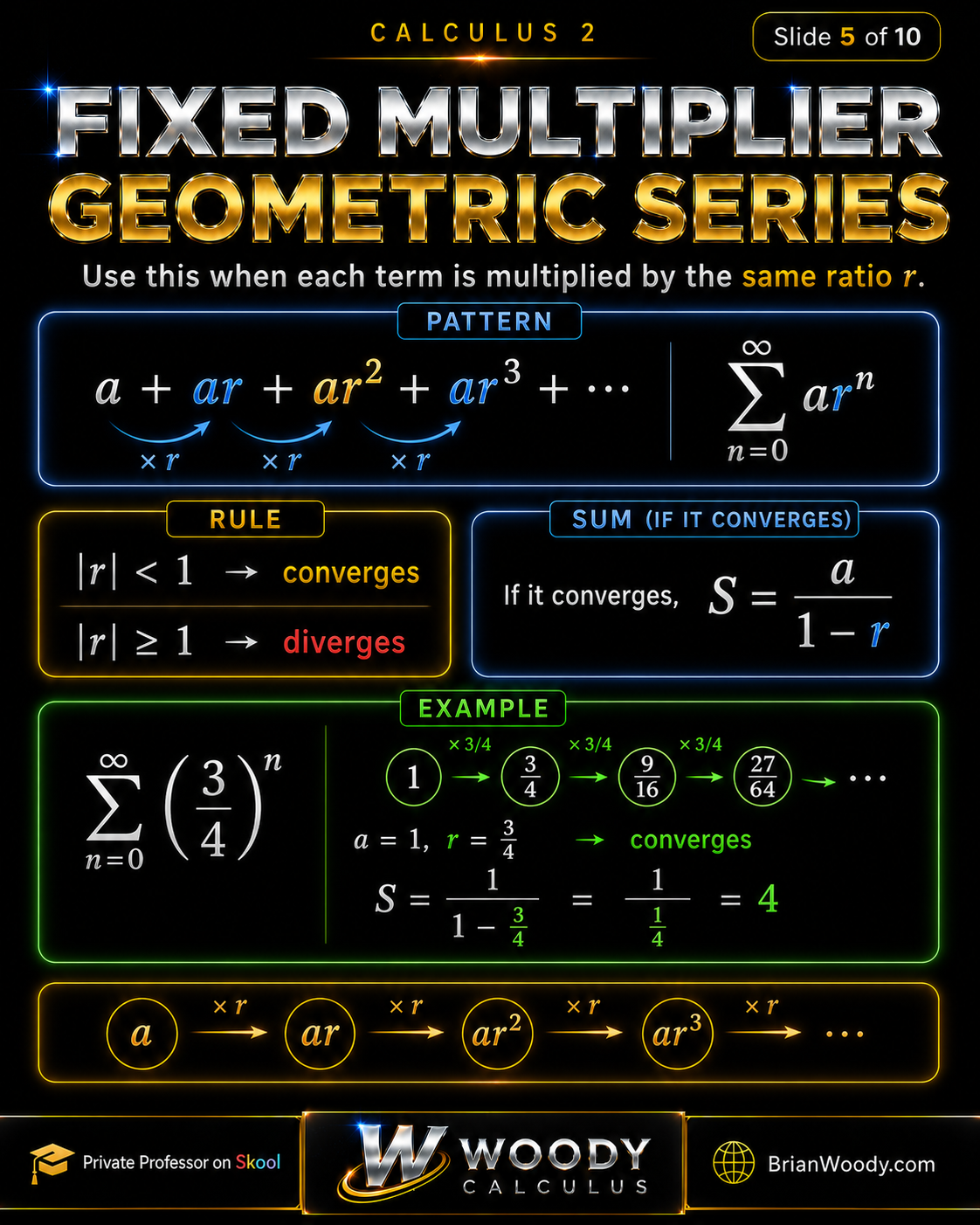
A geometric series has the form:
\sum_{n=0}^{\infty} ar^n.
\]
Each term is multiplied by the same ratio \(r\). The rule is:
|r|<1 \quad\Longrightarrow\quad \text{converges}, \]
|r|\ge 1
\quad\Longrightarrow\quad
\text{diverges}.
\]
If it converges, then:
\sum_{n=0}^{\infty} ar^n=\frac{a}{1-r}.
\]
Example
For:
\sum_{n=0}^{\infty}\left(\frac34\right)^n,
\]
we have:
a=1,
\qquad
r=\frac34.
\]
Since \(|r|=\frac34<1\), the series converges, and:
S=\frac{1}{1-\frac34}
=
\frac{1}{\frac14}
=
4.
\]
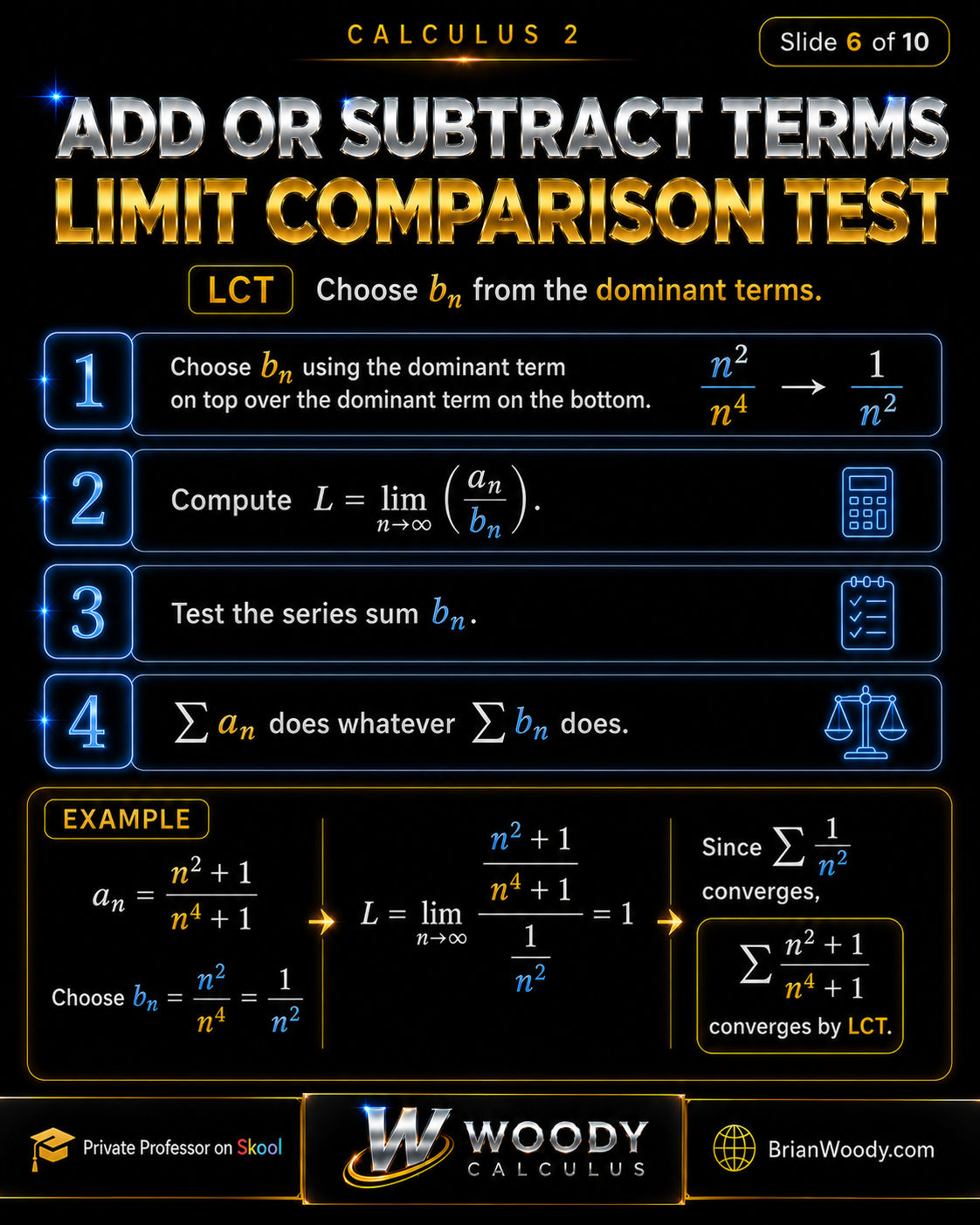
Add or Subtract Dominant Terms: Use the Limit Comparison Test
The Limit Comparison Test is one of the most useful Calculus 2 tools for rational expressions and dominant-term behavior.
Choose a known positive series \(\sum b_n\), usually from the dominant term on top divided by the dominant term on the bottom. Then compute:
L=\lim_{n\to\infty}\frac{a_n}{b_n}.
\]
If:
0
then \(\sum a_n\) and \(\sum b_n\) either both converge or both diverge.
Example
Consider:
\sum_{n=1}^{\infty}\frac{n^2+1}{n^4+1}.
\]
The dominant behavior is:
\frac{n^2}{n^4}=\frac{1}{n^2}.
\]
Choose:
b_n=\frac{1}{n^2}.
\]
Then:
L
=
\lim_{n\to\infty}
\frac{\frac{n^2+1}{n^4+1}}{\frac{1}{n^2}}
=
\lim_{n\to\infty}
\frac{n^2(n^2+1)}{n^4+1}
=
1.
\]
Since \(0
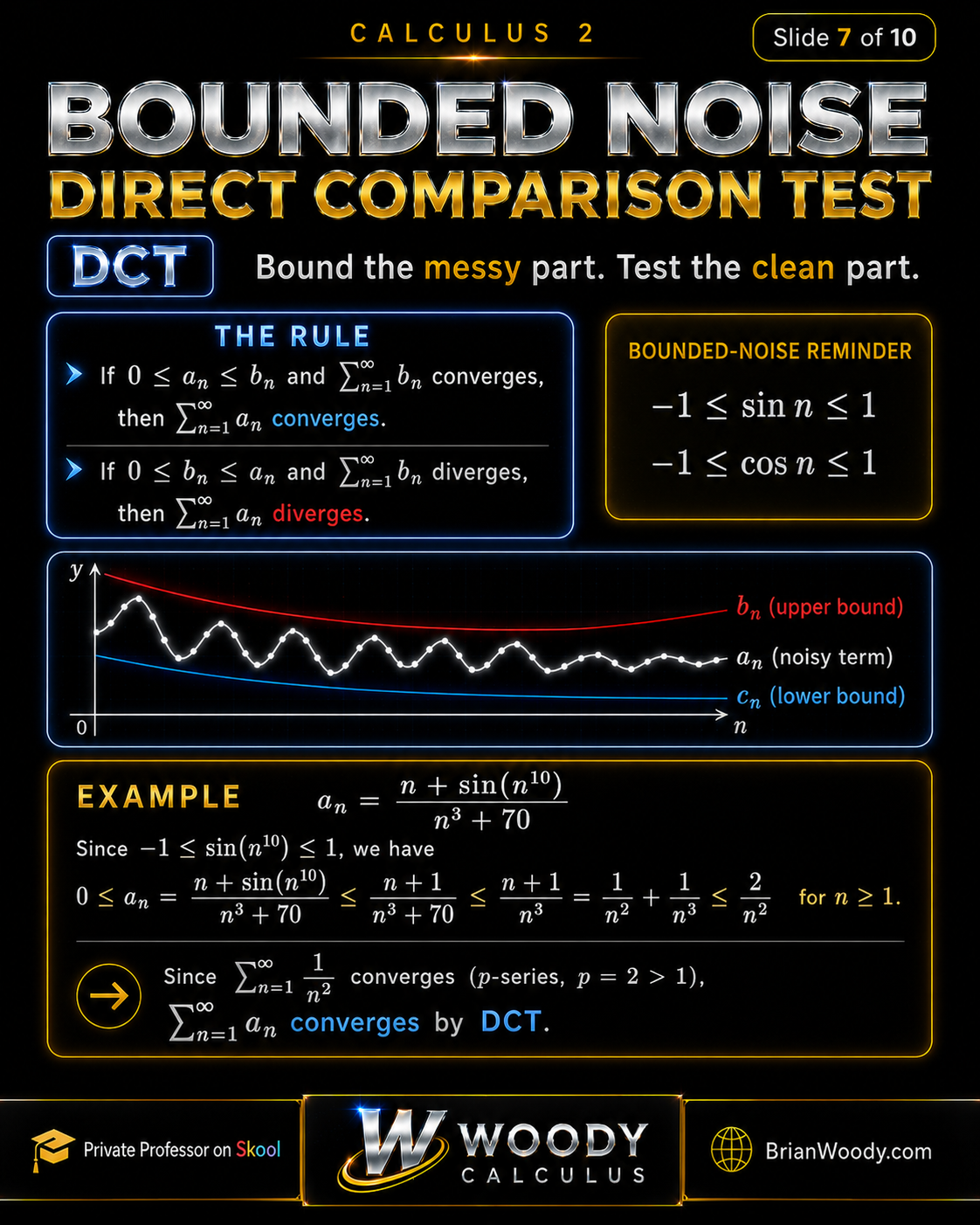
The Direct Comparison Test is useful when a messy part of the formula is bounded. For example, sine and cosine are always trapped between \(-1\) and \(1\):
The comparison test for nonnegative terms says:
Consider:
Since \(-1\le \sin(n^{10})\le 1\), we have:
Therefore:
Since \(\sum 2/n^2\) converges, the original series converges by the Direct Comparison Test.
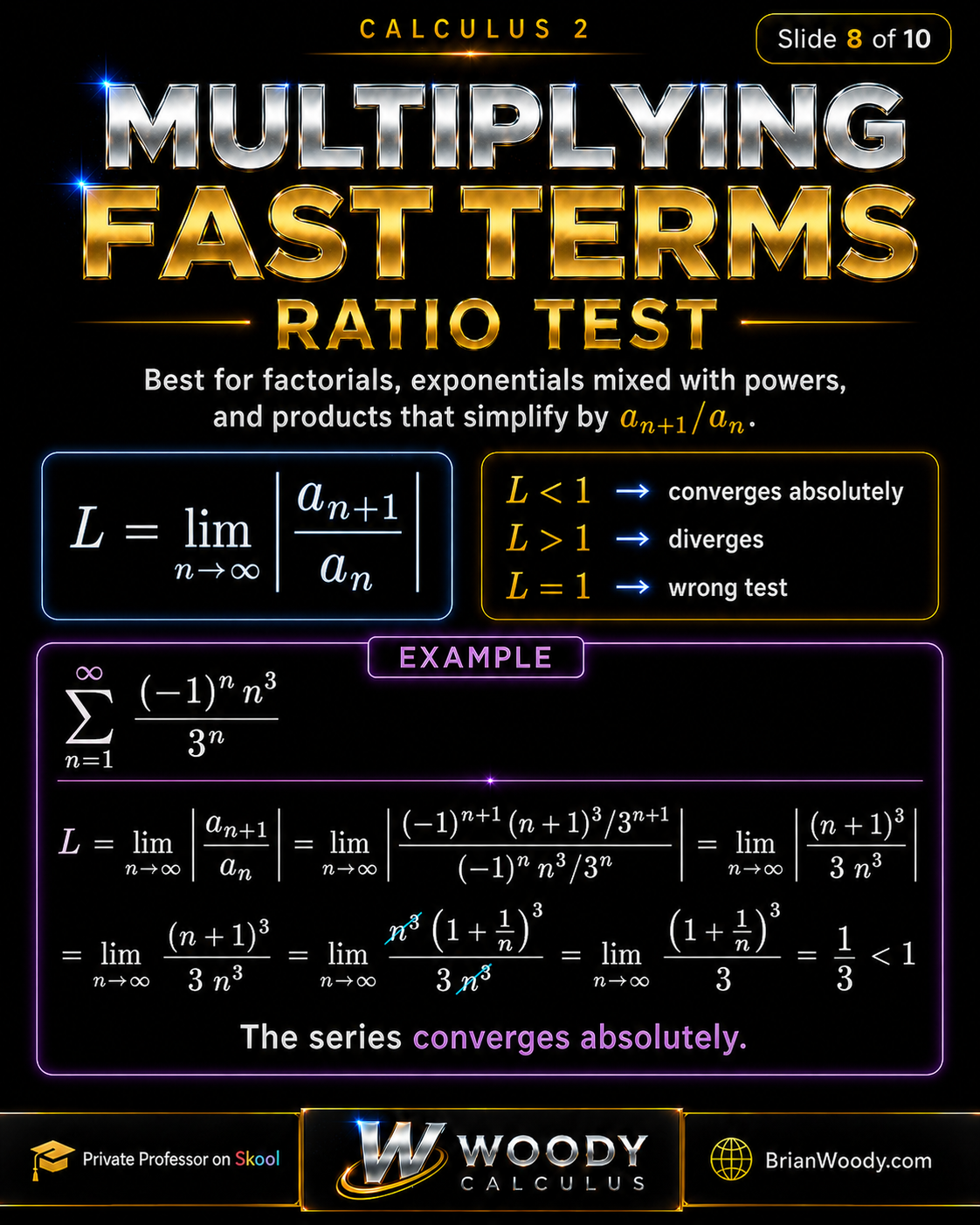
The Ratio Test is best for factorials, exponentials, and products that simplify when you divide \(a_{n+1}\) by \(a_n\).
Compute:
Then:
Consider:
Let:
Then:
So:
Since \(L=\frac13<1\), the series converges absolutely by the Ratio Test.
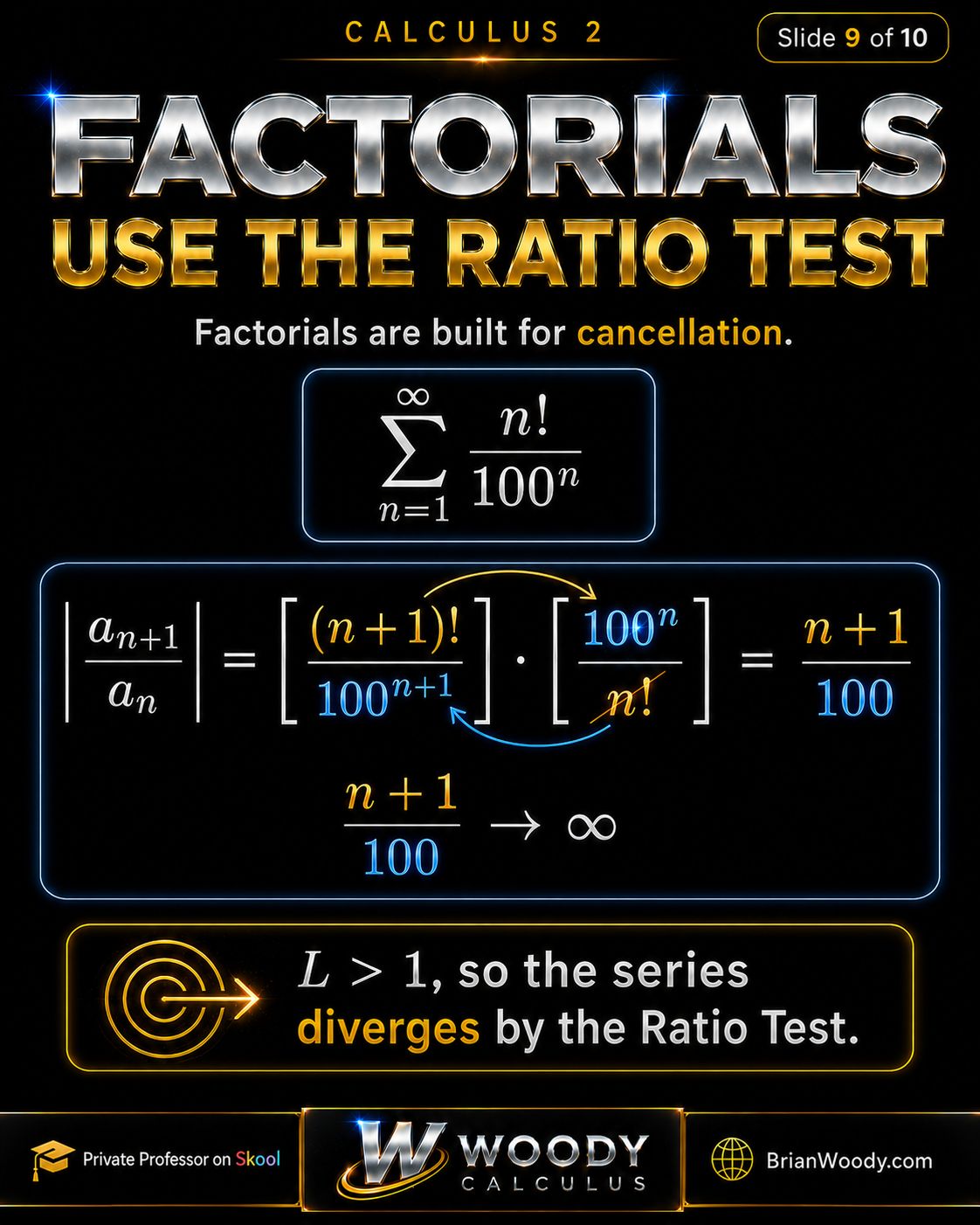
Factorials are built for cancellation. That is why the Ratio Test is usually the first serious test to try when a series contains \(n!\).
Consider:
Let:
Then:
Therefore:
Since \(L>1\), the series diverges by the Ratio Test.
The Root Test is best when the entire term is raised to the \(n\)th power.
Compute:
Then:
Consider:
Here:
Apply the Root Test:
Now divide by \(n\):
Since \(L=\frac23<1\), the series converges by the Root Test.
The Integral Test applies when \(a_n=f(n)\), where \(f(x)\) is positive, continuous, and decreasing for \(x\ge N\).
Then:
either both converge or both diverge.
Consider:
Use:
Then:
Let:
Then:
As \(b\to\infty\), this goes to \(\infty\). Therefore:
diverges by the Integral Test.
The Alternating Series Test applies to series of the form:
If:
then the alternating series converges.
Consider:
Here:
The sequence \(b_n\) is positive, decreasing, and:
So the series converges by the Alternating Series Test.
However:
diverges. Therefore, the alternating harmonic series converges conditionally, not absolutely.
A telescoping series occurs when most terms cancel in the partial sums. This often appears after partial fraction decomposition.
Consider:
Use partial fractions:
Then the partial sum is:
Expanding:
Everything cancels except the first and last surviving terms:
Therefore:
So:
When you are sitting in a Calculus 2 exam, the worst approach is to randomly try tests. Use the decision pattern.
Determine whether the series converges or diverges:
The term is:
Compare leading terms:
Since \(\frac57\ne 0\), the terms do not go to zero. Therefore, the series diverges by the Test for Divergence.
Determine whether:
converges or diverges.
This is a p-series with:
Since \(p>1\), the series converges.
Determine whether:
converges or diverges.
The dominant behavior is:
Choose:
Then:
Since \(0
Determine whether:
converges or diverges.
Let:
Then:
Therefore:
The series converges absolutely by the Ratio Test.
Determine whether:
converges.
Let:
Then \(b_n>0\), \(b_n\) is decreasing, and:
So the series converges by the Alternating Series Test.
But:
diverges by the p-test because \(p=\frac12\le 1\). Therefore, the series converges conditionally.
The Test for Divergence only proves divergence. If \(a_n\to 0\), you have not proved convergence. You must keep testing.
The p-test applies to series of the form \(\sum 1/n^p\). If the expression is not a clean power, simplify or compare first.
The Ratio Test and Root Test use absolute values. This is why they prove absolute convergence when \(L<1\).
For alternating series, first check whether the absolute value series converges. If it does, the series is absolutely convergent. If not, then try AST for conditional convergence.
For comparison tests, choose the clean series from the dominant terms. If the dominant behavior is \(1/n^2\), compare to \(1/n^2\), not something unrelated.
If partial fractions create cancellation, do not force a comparison test. Write out partial sums and check whether the series telescopes.
Always start with the Test for Divergence. If the terms \(a_n\) do not go to zero, then the series diverges immediately.
No. The Test for Divergence proves divergence only. If \(a_n\to 0\), the test is inconclusive and you must keep testing.
Compare degrees. If the numerator degree is greater than or equal to the denominator degree, the terms do not go to zero and the series diverges by the Test for Divergence. If the numerator degree is smaller, the terms go to zero and you keep testing.
Use the p-test when the series has the form \(\sum 1/n^p\). It converges if \(p>1\) and diverges if \(p\le 1\).
Use the geometric series test when each term is multiplied by the same fixed ratio \(r\). The series converges if \(|r|<1\) and diverges if \(|r|\ge 1\). When \(r=1\) or \(r=-1\), the nonzero terms do not approach zero, so the series diverges.
Use the Limit Comparison Test when the series behaves like a simpler known positive series, especially for rational expressions where dominant terms determine the long-term behavior. Compute the limit of \(a_n/b_n\); if the limit is a positive finite number, both series share the same convergence or divergence behavior.
Use the Direct Comparison Test when you can bound a nonnegative series above or below by a known convergent or divergent series.
Use the Ratio Test when the series contains factorials, exponentials, or products that simplify when you compute the absolute value of \(a_{n+1}/a_n\). If the limit is less than \(1\), the series converges absolutely. If the limit is greater than \(1\), the series diverges.
Use the Root Test when the entire term is raised to the \(n\)th power. If the limit of the \(n\)th root of \(|a_n|\) is less than \(1\), the series converges absolutely. If the limit is greater than \(1\), the series diverges.
Use the Integral Test when \(a_n=f(n)\) and \(f(x)\) is positive, continuous, and decreasing for large \(x\).
Use the Alternating Series Test when the signs alternate and the positive terms \(b_n\) decrease to zero. Check absolute convergence first.
A telescoping series is a series where most terms cancel in the partial sums. These often appear after partial fraction decomposition.
Understanding infinite series begins with mastering pattern recognition, formula fluency, and clean test selection. You do not want to randomly try tests. You want to read the structure, identify the dominant behavior, and choose the right tool.
Woody Calculus provides structured, university-level instruction designed to build genuine mathematical understanding and exam-ready execution. The goal is not just to recognize formulas. The goal is to know when to use them, how to set them up cleanly, and how to explain the conclusion in complete sentences.
Infinite series become manageable when you stop guessing tests and start reading patterns.
— Brian M. Woody
If you are studying Calculus 2, infinite series, power series, Taylor series, integration techniques, Calculus 3, Differential Equations, or advanced mathematics, Woody Calculus can help you build a serious system for learning.
Visit BrianWoody.com for Woody Calculus visual mathematics lessons covering free mathematical essays, visual lessons, exam-focused resources, and advanced university math support.
For structured training, join the Woody Calculus Mastery Lab for university mathematics, where students learn through clean definitions, clean setup, formula fluency, pattern recognition, rewriting perfect solutions, and saying each step out loud until the method becomes automatic.
Join Woody Calculus Mastery Lab on Skool
Explore more Woody Calculus visual lessons and deep-dive mathematical essays connecting Calculus 2, infinite series, power series, Taylor series, Calculus 3, Differential Equations, Real Analysis, and peak performance study methods.
Woody Calculus supports students at major universities with structured help in Calculus II, Calculus III, Differential Equations, Linear Algebra, Real Analysis, Abstract Algebra, Number Theory, Topology, and advanced mathematics. For the full list of supported schools, visit the University Calculus Tutor Hub.
The Woody Calculus Mastery Lab gives university students access to structured mathematics support, written solutions, video lessons, exam-focused training, proof-based lessons, and expert guidance from Brian M. Woody.
Students use Woody Calculus for Calculus II, Calculus III, Differential Equations, Linear Algebra, Abstract Algebra, Real Analysis, Number Theory, Topology, and other advanced mathematics courses.
“`Bounded Noise: Use the Direct Comparison Test
-1\le \sin n\le 1,
\qquad
-1\le \cos n\le 1.
\]
Example with bounded noise
a_n=\frac{n+\sin(n^{10})}{n^3+70}.
\]
0\le n+\sin(n^{10})\le n+1
\qquad
\text{for }n\ge 1.
\]
0\le
\frac{n+\sin(n^{10})}{n^3+70}
\le
\frac{n+1}{n^3}
=
\frac{1}{n^2}+\frac{1}{n^3}
\le
\frac{2}{n^2}.
\]
Multiplying Fast Terms: Use the Ratio Test
L=\lim_{n\to\infty}\left|\frac{a_{n+1}}{a_n}\right|.
\]
Example
\sum_{n=1}^{\infty}\frac{(-1)^n n^3}{3^n}.
\]
a_n=\frac{(-1)^n n^3}{3^n}.
\]
\left|\frac{a_{n+1}}{a_n}\right|
=
\left|
\frac{(-1)^{n+1}(n+1)^3/3^{n+1}}{(-1)^n n^3/3^n}
\right|
=
\frac{(n+1)^3}{3n^3}.
\]
L=
\lim_{n\to\infty}
\frac{(n+1)^3}{3n^3}
=
\frac13.
\]
Factorials: Ratio Test Is Usually the Move
Example
\sum_{n=1}^{\infty}\frac{n!}{100^n}.
\]
a_n=\frac{n!}{100^n}.
\]
\left|\frac{a_{n+1}}{a_n}\right|
=
\frac{(n+1)!}{100^{n+1}}\cdot \frac{100^n}{n!}
=
\frac{n+1}{100}.
\]
L=
\lim_{n\to\infty}\frac{n+1}{100}
=
\infty.
\]
Whole Term to \(n\): Use the Root Test
L=\lim_{n\to\infty}\sqrt[n]{|a_n|}.
\]
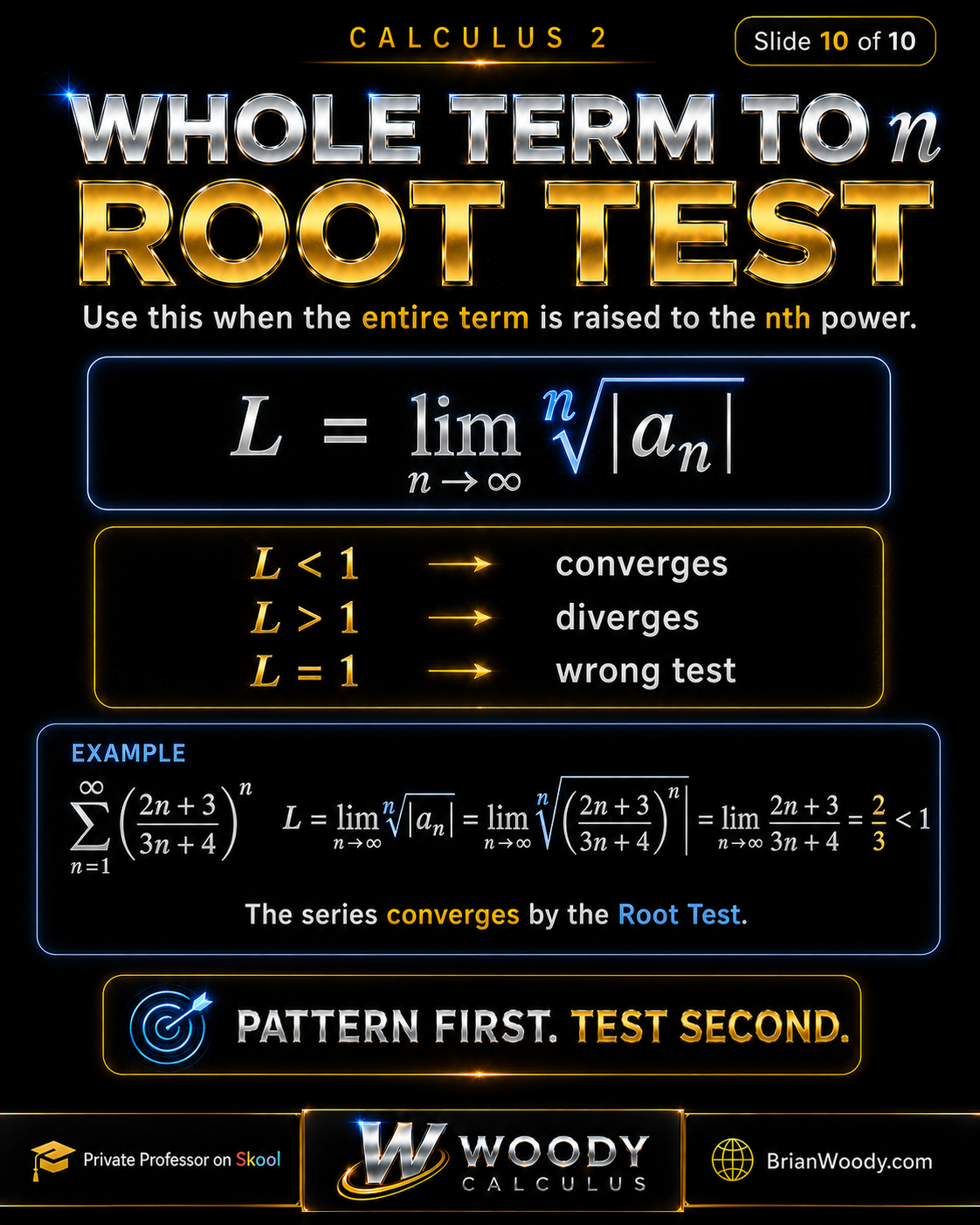
Example
\sum_{n=1}^{\infty}
\left(\frac{2n+3}{3n+4}\right)^n.
\]
a_n=
\left(\frac{2n+3}{3n+4}\right)^n.
\]
L=
\lim_{n\to\infty}
\sqrt[n]{\left|\left(\frac{2n+3}{3n+4}\right)^n\right|}
=
\lim_{n\to\infty}
\left|\frac{2n+3}{3n+4}\right|.
\]
L=
\lim_{n\to\infty}
\frac{2+\frac{3}{n}}{3+\frac{4}{n}}
=
\frac{2}{3}.
\]
Positive, Continuous, Decreasing: Use the Integral Test
\sum_{n=N}^{\infty}a_n
\quad\text{and}\quad
\int_N^{\infty}f(x)\,dx
\]
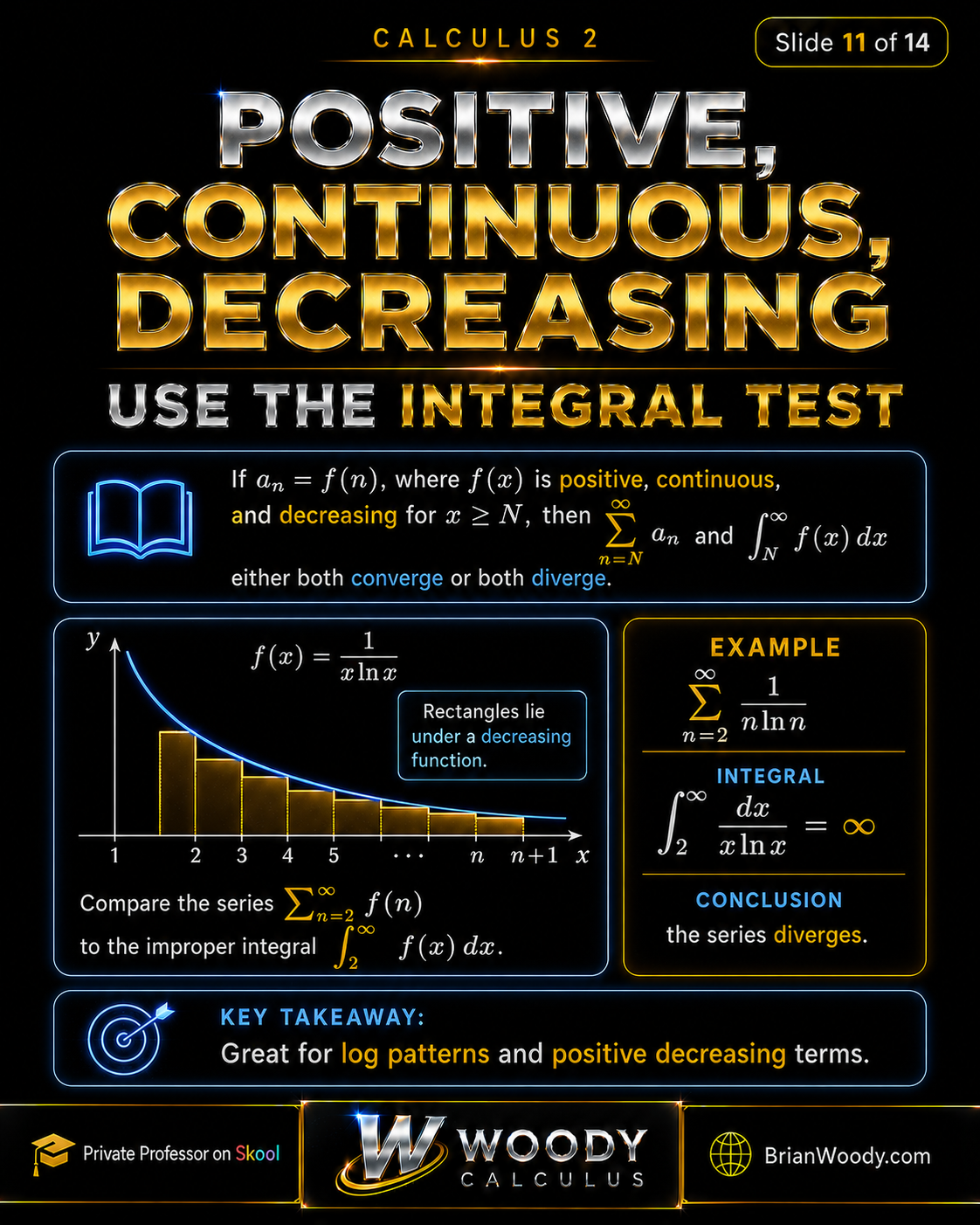
Example
\sum_{n=2}^{\infty}\frac{1}{n\ln n}.
\]
f(x)=\frac{1}{x\ln x}.
\]
\int_2^{\infty}\frac{dx}{x\ln x}
=
\lim_{b\to\infty}
\int_2^b \frac{dx}{x\ln x}.
\]
u=\ln x,
\qquad
du=\frac{1}{x}\,dx.
\]
\int_2^b \frac{dx}{x\ln x}
=
\int_{\ln 2}^{\ln b}\frac{du}{u}
=
\ln|\ln b|-\ln|\ln 2|.
\]
\sum_{n=2}^{\infty}\frac{1}{n\ln n}
\]
Alternating Signs: Use the Alternating Series Test
\sum_{n=1}^{\infty}(-1)^n b_n
\quad\text{or}\quad
\sum_{n=1}^{\infty}(-1)^{n+1} b_n.
\]
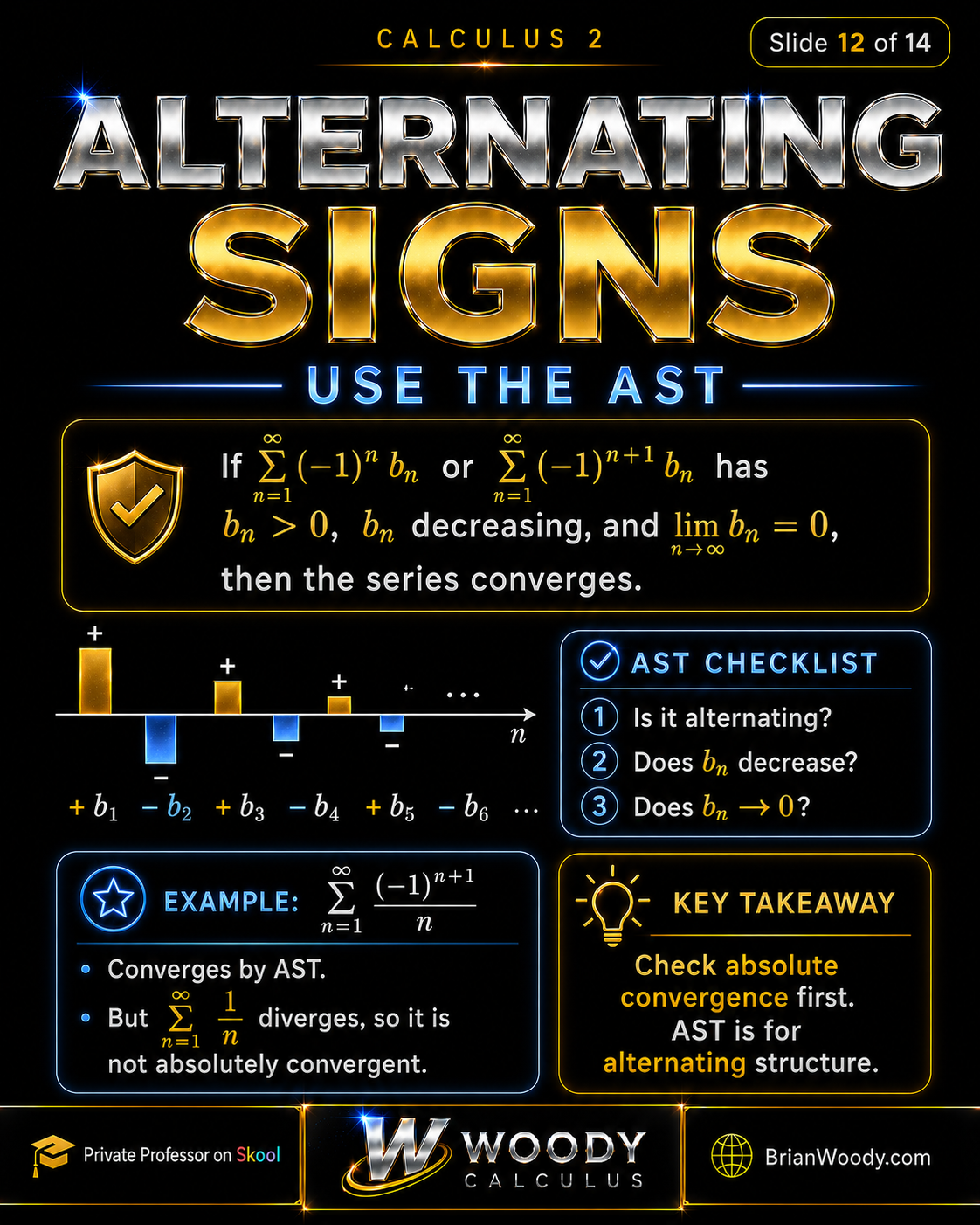
Example: Alternating harmonic series
\sum_{n=1}^{\infty}\frac{(-1)^{n+1}}{n}.
\]
b_n=\frac1n.
\]
\lim_{n\to\infty}\frac1n=0.
\]
\sum_{n=1}^{\infty}\left|\frac{(-1)^{n+1}}{n}\right|
=
\sum_{n=1}^{\infty}\frac1n
\]
Canceling Terms: Use Telescoping
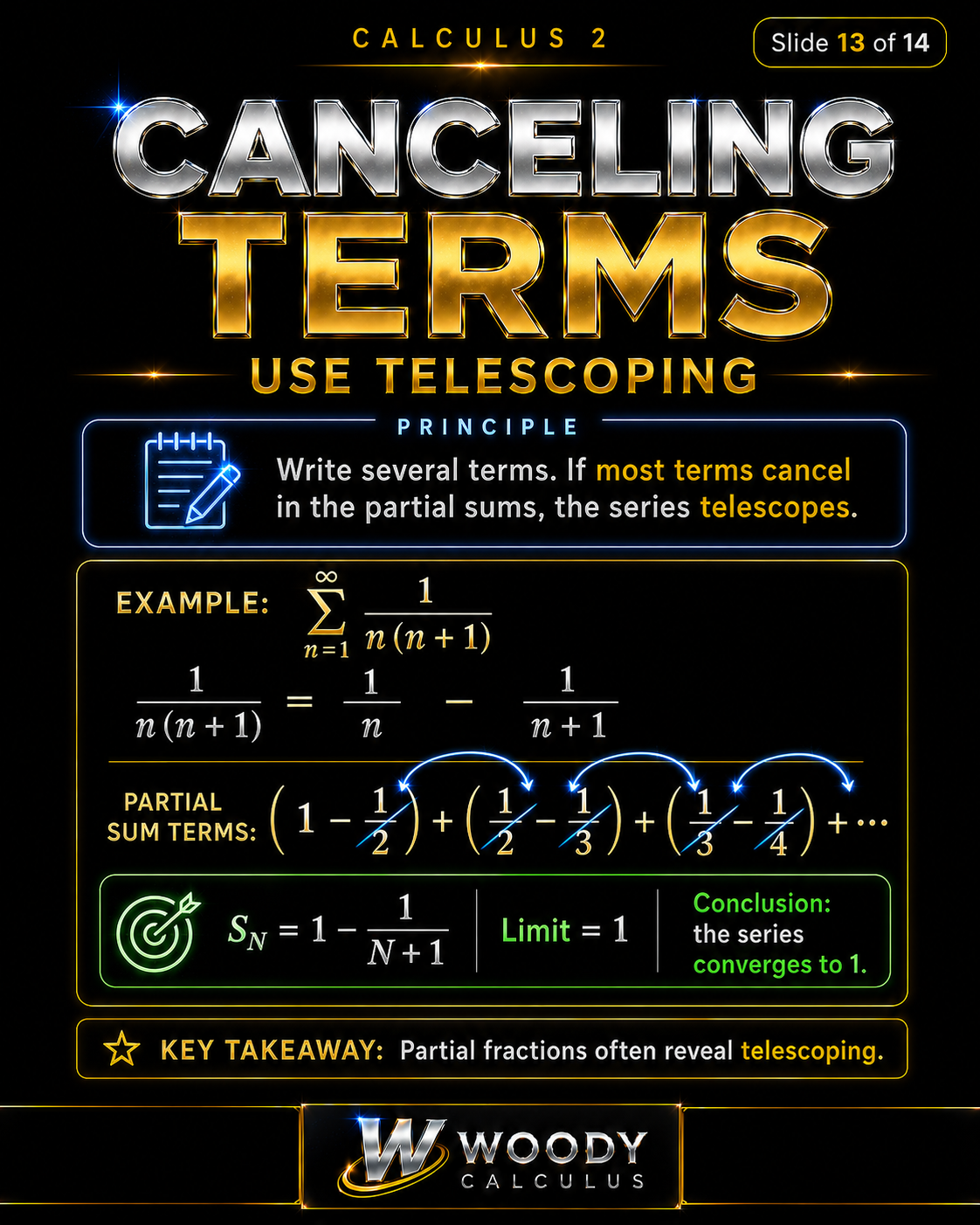
Example
\sum_{n=1}^{\infty}\frac{1}{n(n+1)}.
\]
\frac{1}{n(n+1)}
=
\frac1n-\frac{1}{n+1}.
\]
S_N
=
\sum_{n=1}^{N}
\left(\frac1n-\frac{1}{n+1}\right).
\]
S_N=
\left(1-\frac12\right)
+
\left(\frac12-\frac13\right)
+
\left(\frac13-\frac14\right)
+\cdots+
\left(\frac1N-\frac{1}{N+1}\right).
\]
S_N=1-\frac{1}{N+1}.
\]
\lim_{N\to\infty}S_N
=
\lim_{N\to\infty}
\left(1-\frac{1}{N+1}\right)
=
1.
\]
\sum_{n=1}^{\infty}\frac{1}{n(n+1)}=1.
\]
Master Infinite Series: The Full Test Checklist
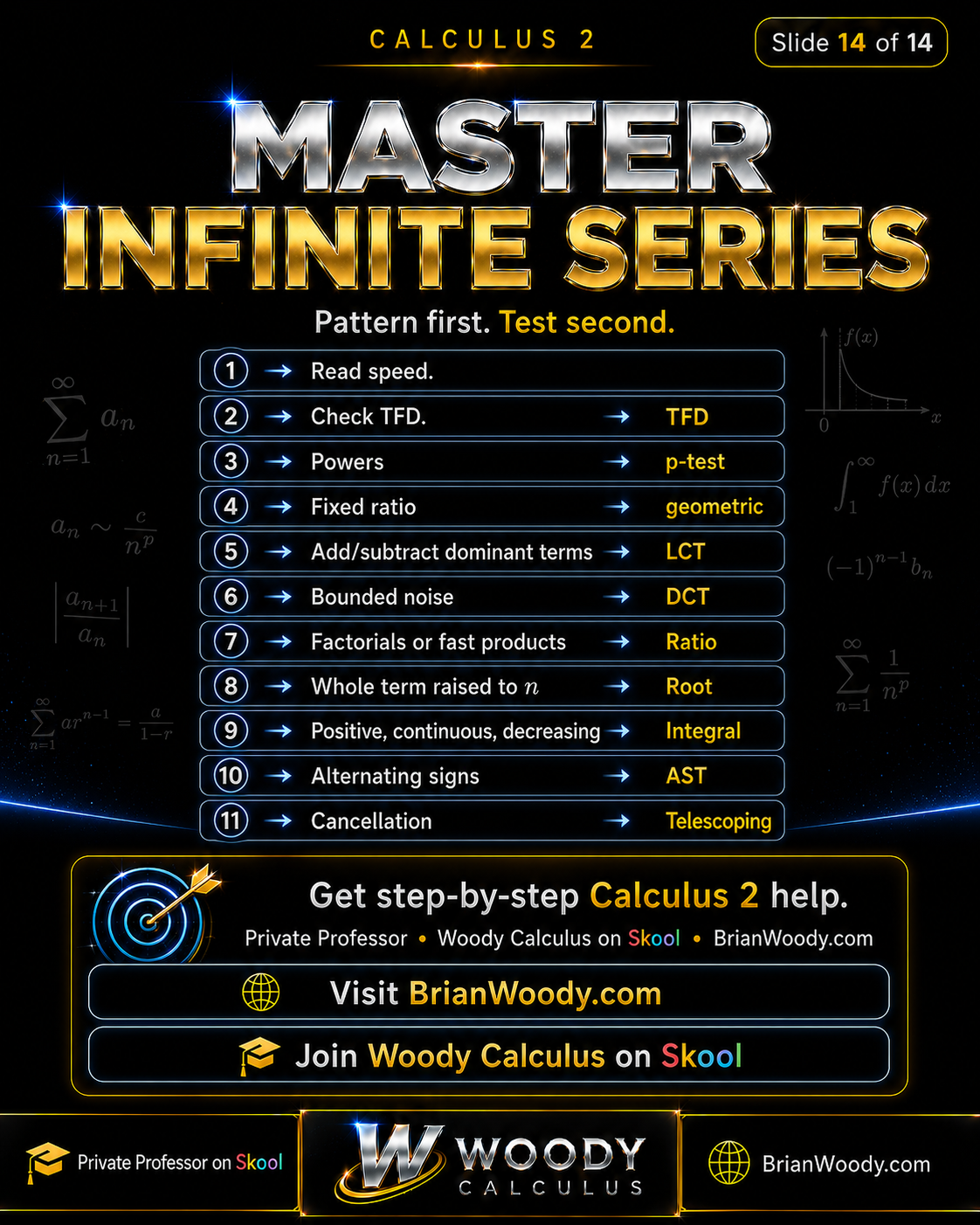
The Woody Calculus series test checklist
Worked Examples
Worked Example 1: Use the Test for Divergence
\sum_{n=1}^{\infty}\frac{5n^3+2}{7n^3-n}.
\]
a_n=\frac{5n^3+2}{7n^3-n}.
\]
a_n\to \frac57.
\]
Worked Example 2: Use the p-test
\sum_{n=1}^{\infty}\frac{1}{n^{5/3}}
\]
p=\frac53.
\]
Worked Example 3: Use the Limit Comparison Test
\sum_{n=1}^{\infty}\frac{4n^3+7n}{9n^5+1}
\]
\frac{4n^3}{9n^5}
=
\frac{4}{9n^2}.
\]
b_n=\frac{1}{n^2}.
\]
L=
\lim_{n\to\infty}
\frac{\frac{4n^3+7n}{9n^5+1}}{\frac1{n^2}}
=
\lim_{n\to\infty}
\frac{n^2(4n^3+7n)}{9n^5+1}
=
\frac49.
\]
Worked Example 4: Use the Ratio Test
\sum_{n=1}^{\infty}\frac{n^4}{5^n}
\]
a_n=\frac{n^4}{5^n}.
\]
\left|\frac{a_{n+1}}{a_n}\right|
=
\frac{(n+1)^4}{5^{n+1}}\cdot \frac{5^n}{n^4}
=
\frac{(n+1)^4}{5n^4}
=
\frac15\left(1+\frac1n\right)^4.
\]
L=\frac15<1.
\]
Worked Example 5: Use the Alternating Series Test
\sum_{n=1}^{\infty}\frac{(-1)^{n+1}}{\sqrt{n}}
\]
b_n=\frac1{\sqrt n}.
\]
\lim_{n\to\infty}\frac1{\sqrt n}=0.
\]
\sum_{n=1}^{\infty}\left|\frac{(-1)^{n+1}}{\sqrt n}\right|
=
\sum_{n=1}^{\infty}\frac1{\sqrt n}
\]
Common Mistakes with Infinite Series Tests
Mistake 1: Thinking the Test for Divergence proves convergence
Mistake 2: Using the p-test on the wrong form
Mistake 3: Forgetting absolute value in the Ratio Test and Root Test
Mistake 4: Using the Alternating Series Test before checking absolute convergence
Mistake 5: Choosing comparison terms that do not match the dominant behavior
Mistake 6: Ignoring telescoping structure
Key Takeaways
Infinite Series Tests FAQ
What is the first test I should try for an infinite series?
Does the Test for Divergence prove convergence?
How do I quickly check a series with rational terms?
When should I use the p-test?
When should I use the geometric series test?
When should I use the Limit Comparison Test?
When should I use the Direct Comparison Test?
When should I use the Ratio Test?
When should I use the Root Test?
When should I use the Integral Test?
When should I use the Alternating Series Test?
What is a telescoping series?
Master Infinite Series with Woody Calculus
Woody Calculus CTA
Related Woody Calculus Mathematical Essays
Related University Math Help Pages
Trusted by Students Nationwide