Eigenvalues and Eigenvectors Explained: The Special Directions That Unlock Linear Algebra
Eigenvalues and eigenvectors are some of the most important ideas in Linear Algebra, Differential Equations, dynamical systems, data science, engineering, and advanced mathematics.
At first, the equation
\[
Av=\lambda v
\]
looks small. But this one equation has huge consequences.
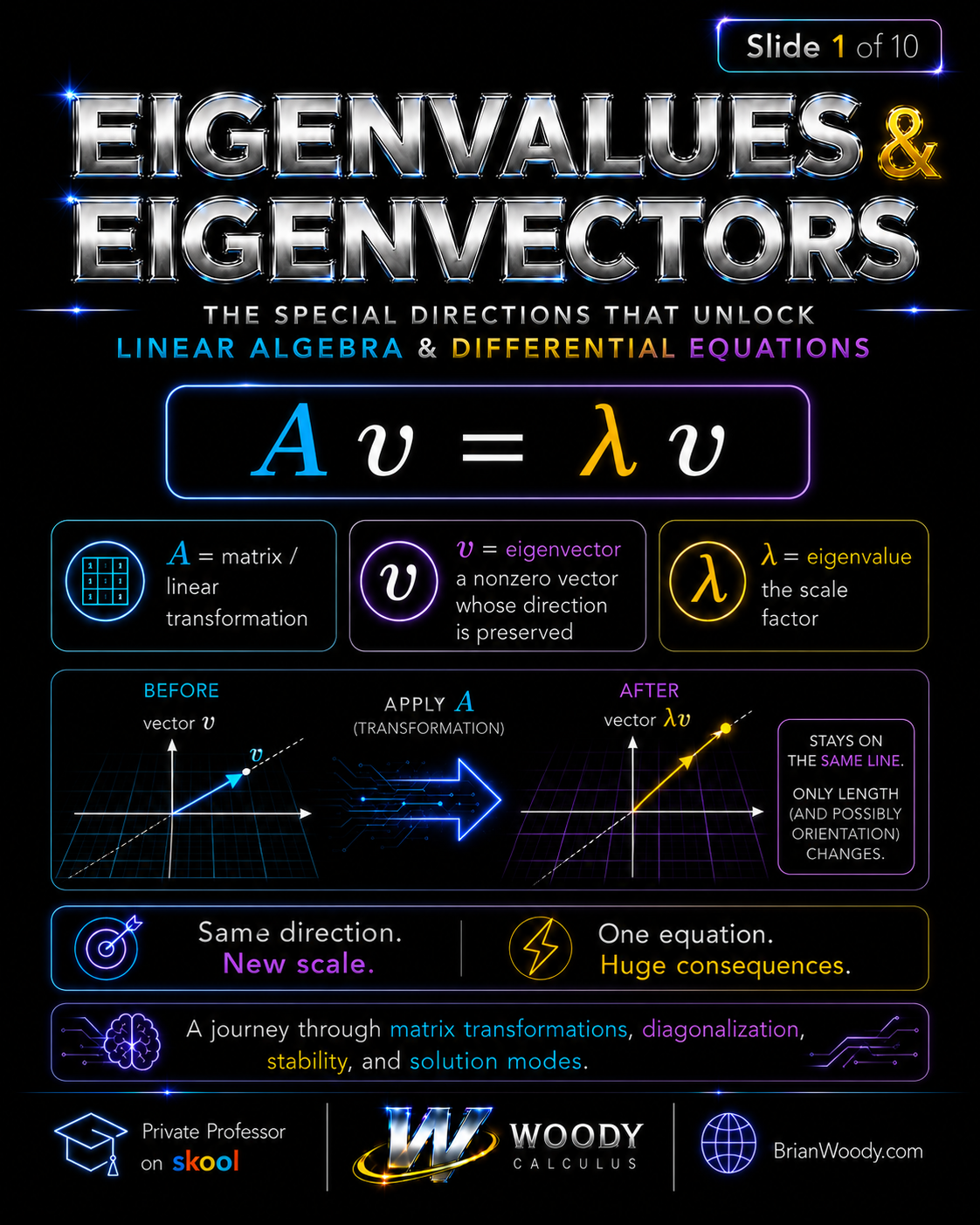
It says that when a matrix \(A\) acts on a special vector \(v\), the vector does not change direction. It only gets scaled by the number \(\lambda\). That special vector is called an eigenvector, and the scaling number is called an eigenvalue.
This visual Woody Calculus lesson walks through the full story in order: what eigenvalues and eigenvectors mean geometrically, how to find them, why they simplify matrix powers, how they become solution modes in Differential Equations, how they unlock diagonalization, and why they predict stability and phase portraits before you even solve the system.
What Are Eigenvalues and Eigenvectors?
The fundamental eigenvalue equation is
\[
Av=\lambda v.
\]
Here:
- \(A\) is a matrix or linear transformation.
- \(v\) is a nonzero vector called an eigenvector.
- \(\lambda\) is a scalar called an eigenvalue.
The condition \(v\neq 0\) matters because the zero vector always satisfies \(A0=\lambda 0\), but it tells us nothing about the transformation. Eigenvectors are special nonzero directions that reveal the hidden structure of a matrix.
Geometrically, the equation \(Av=\lambda v\) means that applying \(A\) to \(v\) keeps the vector on the same line. The vector may stretch, shrink, flip direction, or collapse to the origin, but it does not rotate into a new line.
That is the core idea:
\[
\text{Same direction. New scale.}
\]
The Big Idea: Some Vectors Keep Their Direction
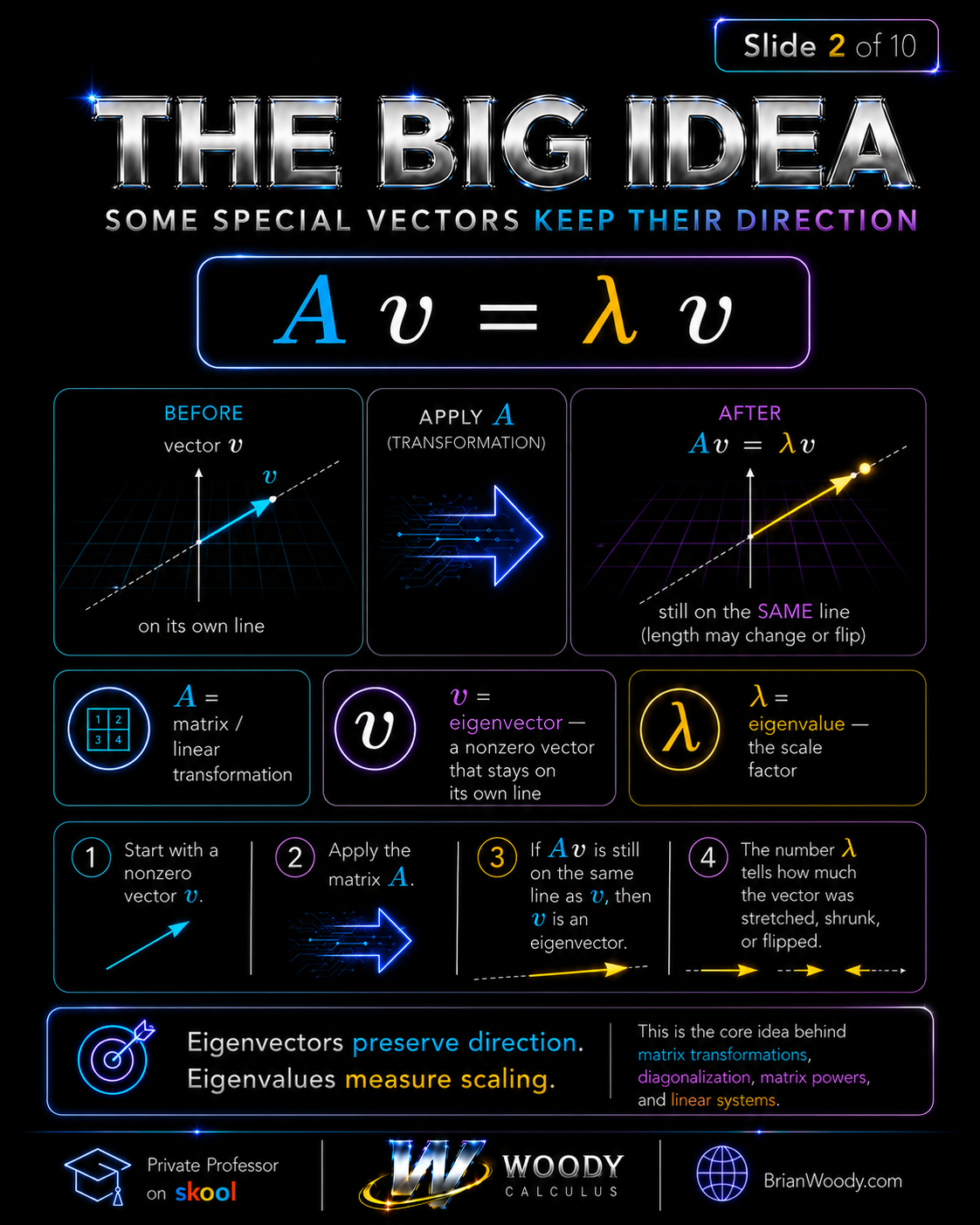
Most vectors change direction when a matrix transformation is applied. A matrix can rotate, shear, stretch, compress, reflect, or combine these effects. But some special vectors remain on their own line.
Those special vectors are eigenvectors.
If
\[
Av=\lambda v,
\]
then applying \(A\) to \(v\) gives a new vector that still lies on the same line as \(v\). The eigenvalue \(\lambda\) tells us exactly what happened to the vector’s length and orientation.
- If \(|\lambda| > 1\), the vector is stretched.
- If \(0 < |\lambda| < 1\), the vector is shrunk.
- If \(\lambda < 0\), the vector flips direction.
- If \(\lambda=0\), the vector collapses to the origin.
This is the core idea behind matrix transformations, diagonalization, matrix powers, and linear systems.
Geometric Meaning of Eigenvalues
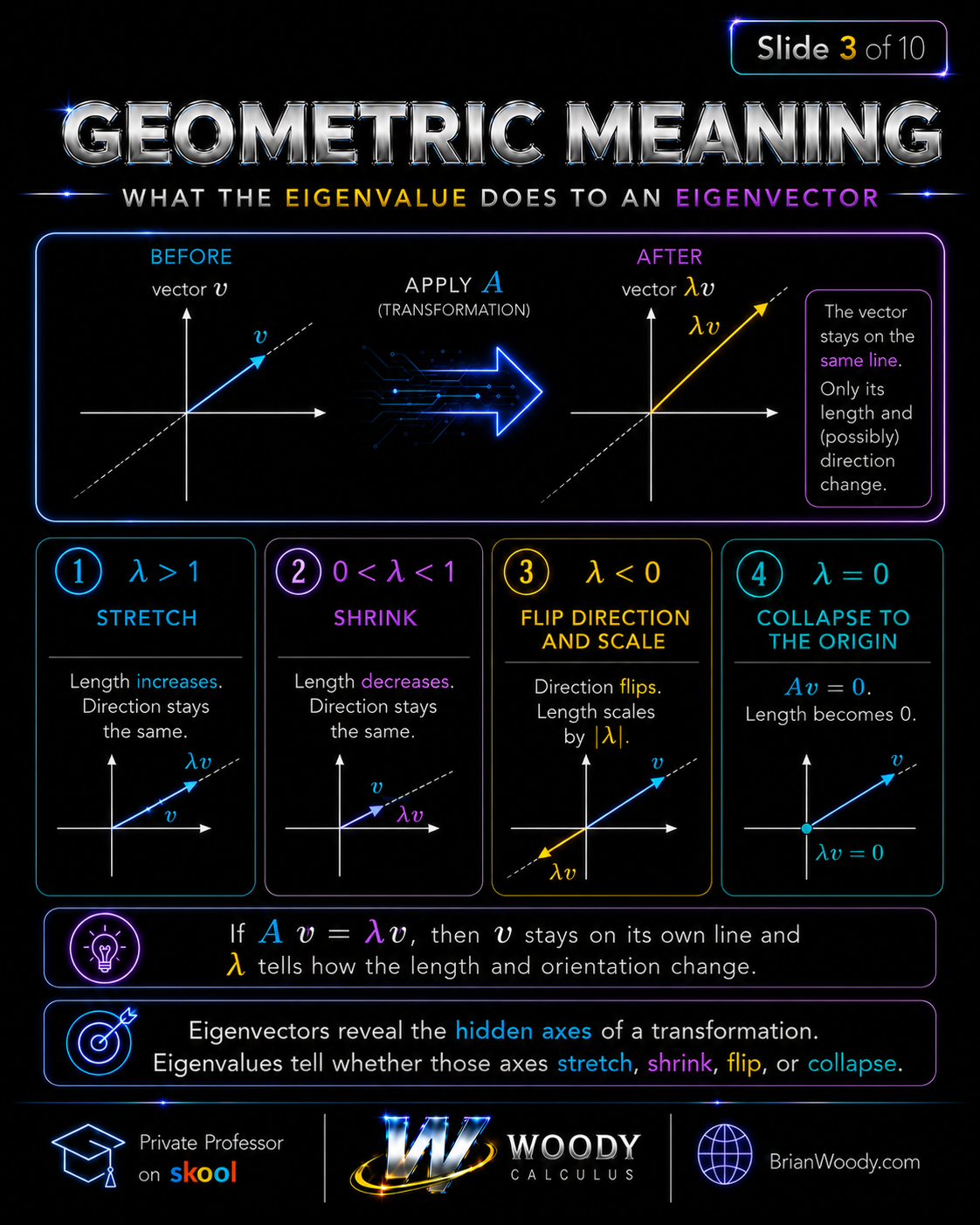
The eigenvalue \(\lambda\) tells us what the matrix does to the eigenvector geometrically.
If
\[
Av=\lambda v,
\]
then the eigenvector \(v\) stays on its own line, and \(\lambda\) tells us how the length and orientation change.
\(\lambda > 1\): Stretch
If \(\lambda > 1\), the vector keeps its direction and gets longer. The transformation stretches the eigenvector.
\(0 < \lambda < 1\): Shrink
If \(0 < \lambda < 1\), the vector keeps its direction but gets shorter. The transformation shrinks the eigenvector.
\(\lambda < 0\): Flip and Scale
If \(\lambda < 0\), the vector flips direction and scales by \(|\lambda|\). The negative sign reverses orientation.
\(\lambda=0\): Collapse
If \(\lambda=0\), then
\[
Av=0.
\]
The eigenvector collapses to the origin. This happens when \(v\) lies in the nullspace of \(A\).
This is why eigenvectors reveal the hidden axes of a transformation. Eigenvalues tell whether those axes stretch, shrink, flip, or collapse.
How to Find Eigenvalues and Eigenvectors
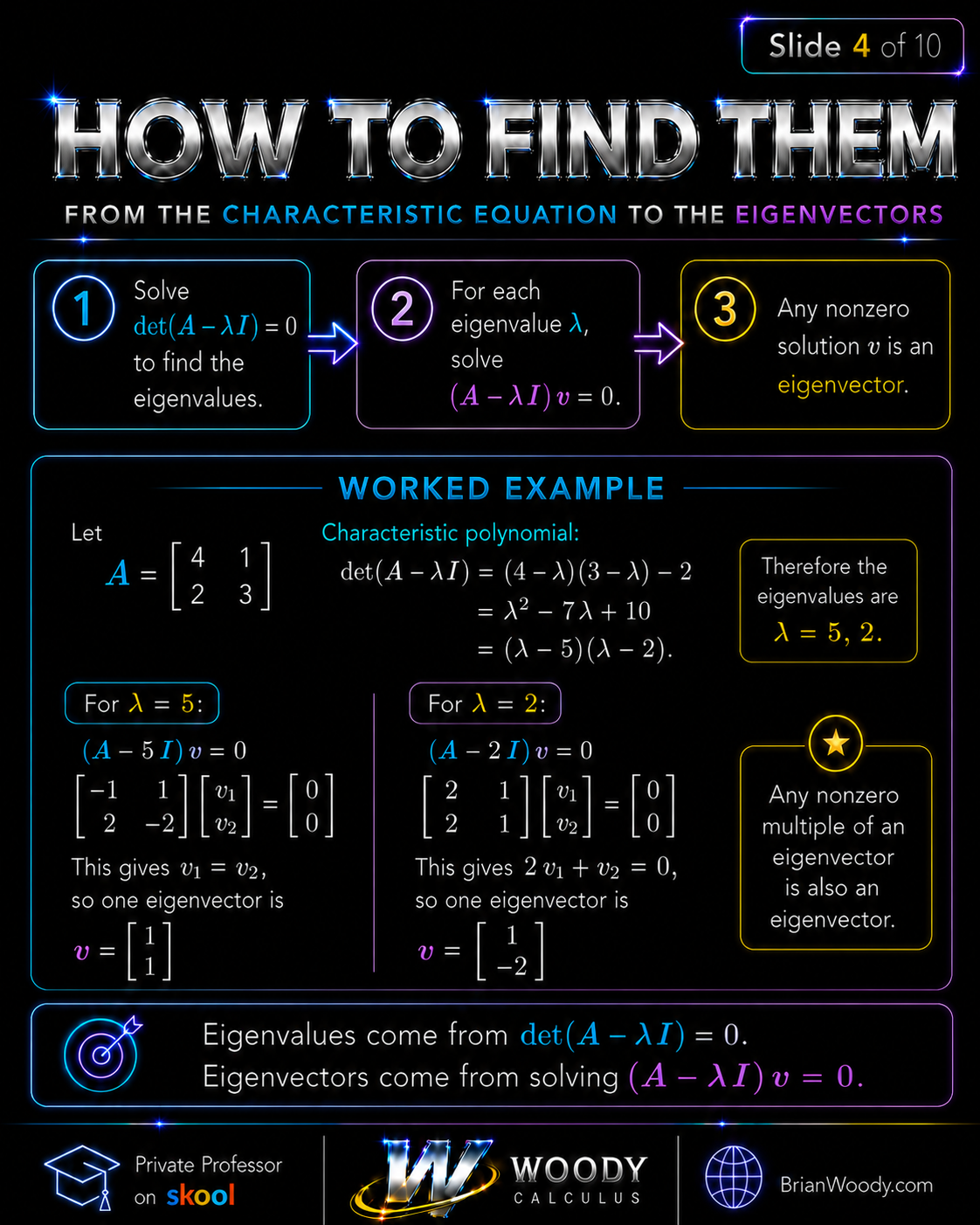
To find eigenvalues and eigenvectors, start with
\[
Av=\lambda v.
\]
Move everything to one side:
\[
Av-\lambda v=0.
\]
Since \(v=Iv\), we can write
\[
Av-\lambda Iv=0.
\]
Factor out \(v\):
\[
(A-\lambda I)v=0.
\]
For a nonzero eigenvector \(v\) to exist, the matrix \(A-\lambda I\) must be singular. Therefore,
\[
\det(A-\lambda I)=0.
\]
This equation is called the characteristic equation. Its solutions are the eigenvalues.
Once an eigenvalue \(\lambda\) is found, the eigenvectors come from solving
\[
(A-\lambda I)v=0.
\]
Worked Example
Let
\[
A=
\begin{bmatrix}
4 & 1\\
2 & 3
\end{bmatrix}.
\]
The characteristic equation is
\[
\det(A-\lambda I)=0.
\]
Compute:
\[
\det(A-\lambda I)
=
\begin{vmatrix}
4-\lambda & 1\\
2 & 3-\lambda
\end{vmatrix}.
\]
So
\[
\det(A-\lambda I)
=
(4-\lambda)(3-\lambda)-2.
\]
Expanding:
\[
(4-\lambda)(3-\lambda)-2
=
12-7\lambda+\lambda^2-2
=
\lambda^2-7\lambda+10.
\]
Factor:
\[
\lambda^2-7\lambda+10=(\lambda-5)(\lambda-2).
\]
Therefore, the eigenvalues are
\[
\lambda=5,\qquad \lambda=2.
\]
Eigenvector for \(\lambda=5\)
Solve
\[
(A-5I)v=0.
\]
This gives
\[
\begin{bmatrix}
-1 & 1\\
2 & -2
\end{bmatrix}
\begin{bmatrix}
v_1\\
v_2
\end{bmatrix}
=
\begin{bmatrix}
0\\
0
\end{bmatrix}.
\]
The equation gives
\[
v_1=v_2.
\]
So one eigenvector is
\[
v=
\begin{bmatrix}
1\\
1
\end{bmatrix}.
\]
Eigenvector for \(\lambda=2\)
Solve
\[
(A-2I)v=0.
\]
This gives
\[
\begin{bmatrix}
2 & 1\\
2 & 1
\end{bmatrix}
\begin{bmatrix}
v_1\\
v_2
\end{bmatrix}
=
\begin{bmatrix}
0\\
0
\end{bmatrix}.
\]
The equation gives
\[
2v_1+v_2=0.
\]
So one eigenvector is
\[
v=
\begin{bmatrix}
1\\
-2
\end{bmatrix}.
\]
Any nonzero multiple of an eigenvector is also an eigenvector. The direction matters, not the particular length.
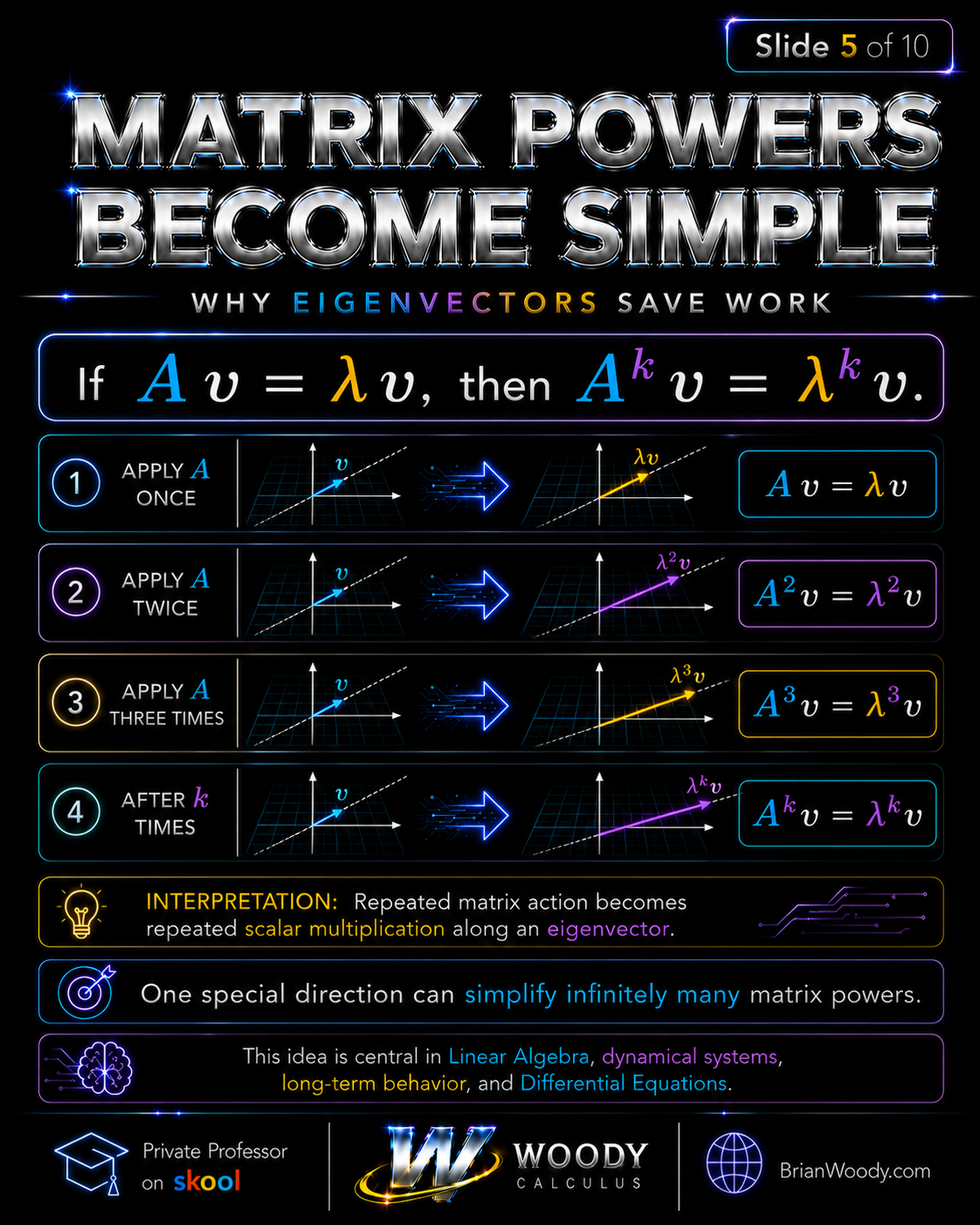
Why Eigenvectors Make Matrix Powers Simple
Eigenvectors are powerful because they simplify repeated matrix multiplication.
If
\[
Av=\lambda v,
\]
then applying \(A\) again gives
\[
A^2v=A(Av)=A(\lambda v)=\lambda Av=\lambda(\lambda v)=\lambda^2v.
\]
Apply \(A\) three times:
\[
A^3v=A(A^2v)=A(\lambda^2v)=\lambda^2Av=\lambda^3v.
\]
After \(k\) applications,
\[
A^kv=\lambda^k v.
\]
This is a massive simplification. Repeated matrix action becomes repeated scalar multiplication along an eigenvector.
That is why eigenvalues and eigenvectors are central in long-term behavior, dynamical systems, Markov chains, population models, matrix powers, and Differential Equations.
Eigenvalues and Eigenvectors in Differential Equations
Eigenvalues and eigenvectors become even more powerful in systems of Differential Equations.
A linear system has the form
\[
x^{\prime}(t)=Ax(t).
\]
If
\[
Av=\lambda v,
\]
then
\[
x(t)=ce^{\lambda t}v
\]
is a solution.
To check this, differentiate:
\[
x^{\prime}(t)=c\lambda e^{\lambda t}v.
\]
Now apply \(A\):
\[
Ax(t)=A(ce^{\lambda t}v)=ce^{\lambda t}Av=ce^{\lambda t}\lambda v.
\]
Thus
\[
x^{\prime}(t)=Ax(t).
\]
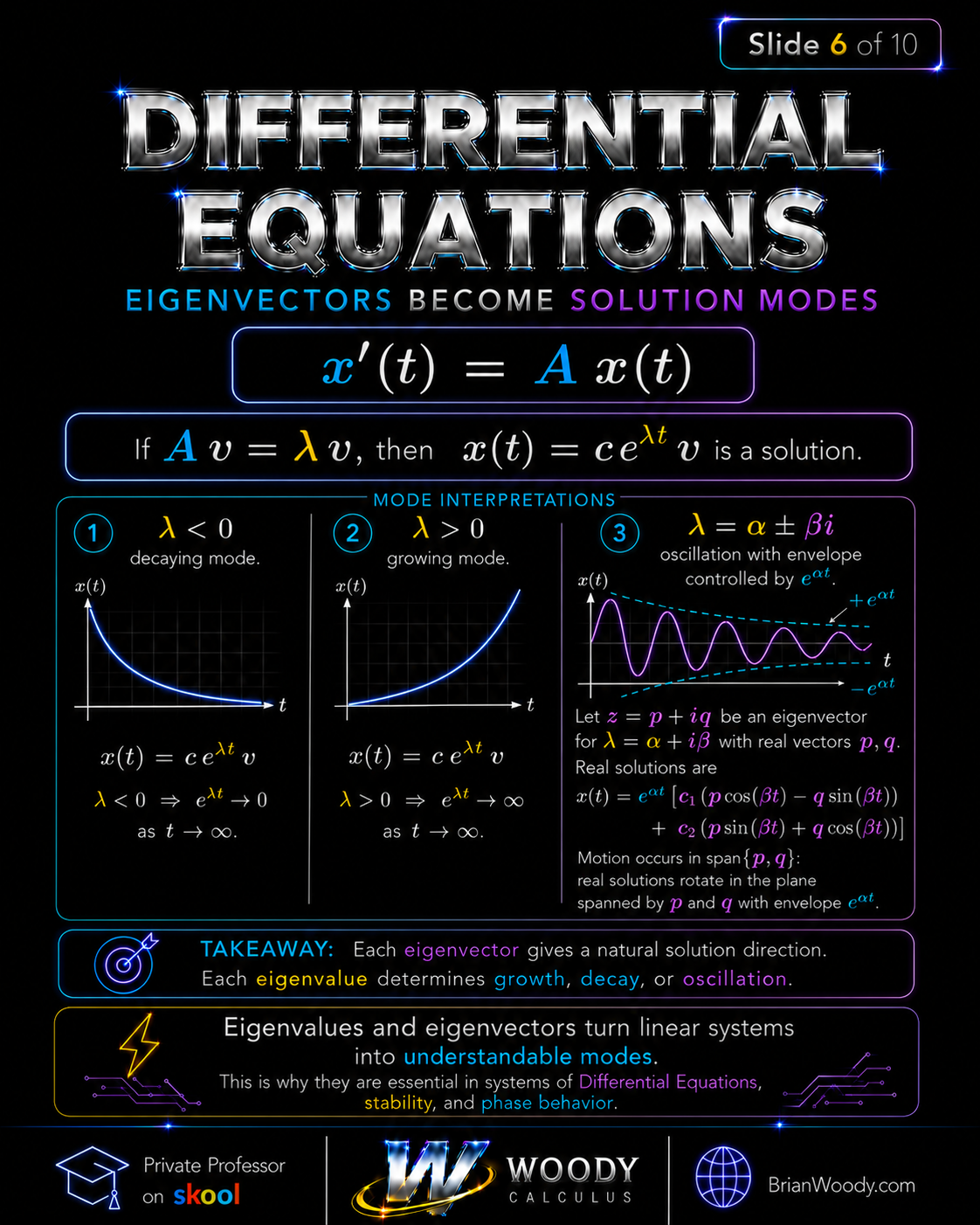
This is why eigenvectors become natural solution directions, and eigenvalues determine growth, decay, or oscillation.
Real Eigenvalue Modes
If \(\lambda < 0\), then
\[
e^{\lambda t}\to 0
\quad \text{as} \quad t\to\infty.
\]
This creates a decaying mode.
If \(\lambda > 0\), then
\[
e^{\lambda t}\to \infty
\quad \text{as} \quad t\to\infty.
\]
This creates a growing mode.
Complex Eigenvalue Modes
If the eigenvalues are complex,
\[
\lambda=\alpha\pm \beta i,
\]
then the solutions involve oscillation. The real part \(\alpha\) controls the exponential envelope, and the imaginary part \(\beta\) controls rotation.
If \(z=p+iq\) is a complex eigenvector for \(\lambda=\alpha+i\beta\), with real vectors \(p\) and \(q\), then real solutions can be written using
\[
e^{\alpha t}
\left(
p\cos(\beta t)-q\sin(\beta t)
\right)
\]
and
\[
e^{\alpha t}
\left(
p\sin(\beta t)+q\cos(\beta t)
\right).
\]
So complex eigenvalues produce rotating motion in the plane spanned by \(p\) and \(q\), with envelope controlled by \(e^{\alpha t}\).
Diagonalization: Unlocking a Matrix With Eigenvectors
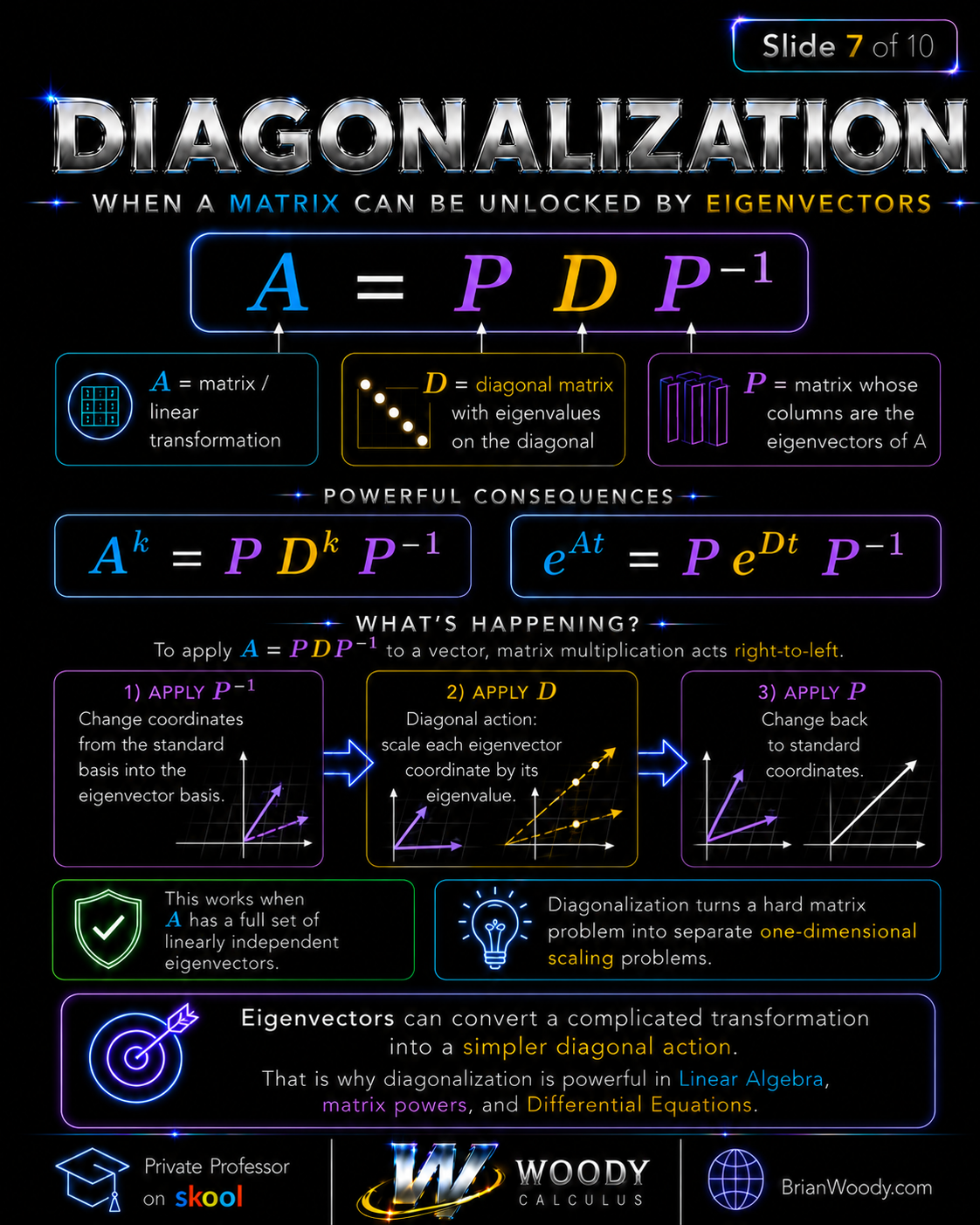
Diagonalization is one of the most important uses of eigenvalues and eigenvectors.
A matrix \(A\) is diagonalizable when it can be written as
\[
A=PDP^{-1}.
\]
Here:
- \(P\) is the matrix whose columns are eigenvectors of \(A\).
- \(D\) is the diagonal matrix whose diagonal entries are the eigenvalues.
- \(P^{-1}\) changes coordinates from the standard basis into the eigenvector basis.
- \(D\) performs simple scaling in the eigenvector directions.
- \(P\) changes coordinates back from the eigenvector basis to the standard basis.
Even though the formula is written as \(A=PDP^{-1}\), the operations act from right to left: first \(P^{-1}\), then \(D\), then \(P\).
This works when \(A\) has a full set of linearly independent eigenvectors.
The power of diagonalization is that it turns a hard matrix problem into separate one-dimensional scaling problems.
Matrix Powers
If
\[
A=PDP^{-1},
\]
then
\[
A^k=PD^kP^{-1}.
\]
This is much easier than multiplying \(A\) by itself \(k\) times.
Matrix Exponentials
In Differential Equations, diagonalization also simplifies matrix exponentials:
\[
e^{At}=Pe^{Dt}P^{-1}.
\]
Since \(D\) is diagonal, \(e^{Dt}\) is easy to compute: each diagonal eigenvalue simply becomes an exponential term.
That is why diagonalization is powerful in Linear Algebra, matrix powers, dynamical systems, and Differential Equations.
Stability and Phase Portraits
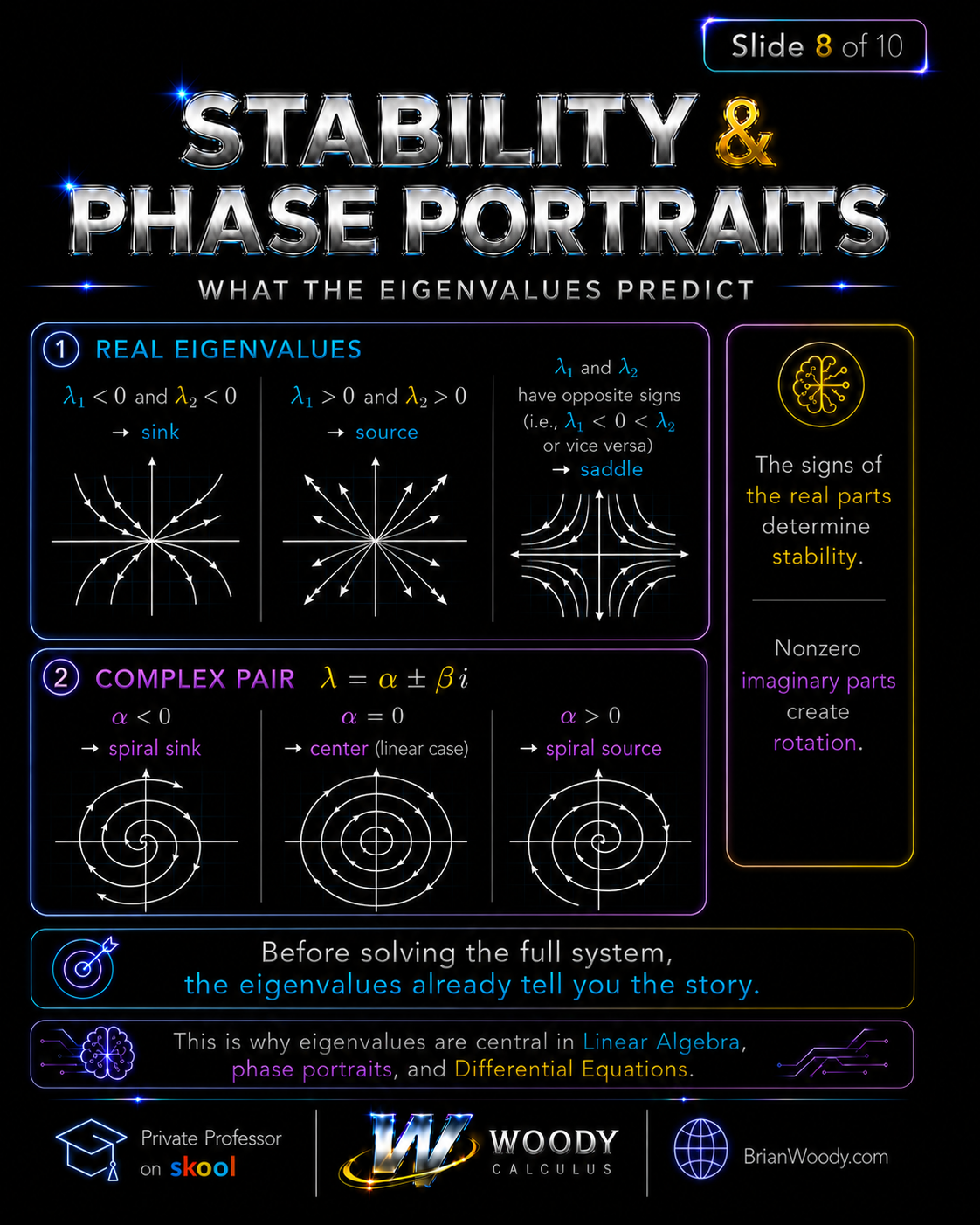
Eigenvalues are essential in phase portraits and stability analysis for systems of Differential Equations.
Before solving the full system
\[
x^{\prime}(t)=Ax(t),
\]
the eigenvalues already tell the story.
Real Eigenvalues
If both real eigenvalues are negative,
\[
\lambda_1 < 0,\qquad \lambda_2 < 0,
\]
the system is a sink. Solutions move toward the equilibrium.
If both real eigenvalues are positive,
\[
\lambda_1 > 0,\qquad \lambda_2 > 0,
\]
the system is a source. Solutions move away from the equilibrium.
If the real eigenvalues have opposite signs,
\[
\lambda_1 < 0 < \lambda_2
\]
or vice versa, the system is a saddle. One direction attracts while another direction repels.
Complex Eigenvalues
If the eigenvalues are complex,
\[
\lambda=\alpha\pm \beta i,
\]
then the real part \(\alpha\) determines stability, while the imaginary part \(\beta\) creates rotation.
- If \(\alpha < 0\), the system is a spiral sink.
- If \(\alpha=0\), the system is a center in the linear case.
- If \(\alpha > 0\), the system is a spiral source.
This is one of the most important ideas in Differential Equations: the signs of the real parts determine stability, and nonzero imaginary parts create rotation.
Where Eigenvalues and Eigenvectors Appear
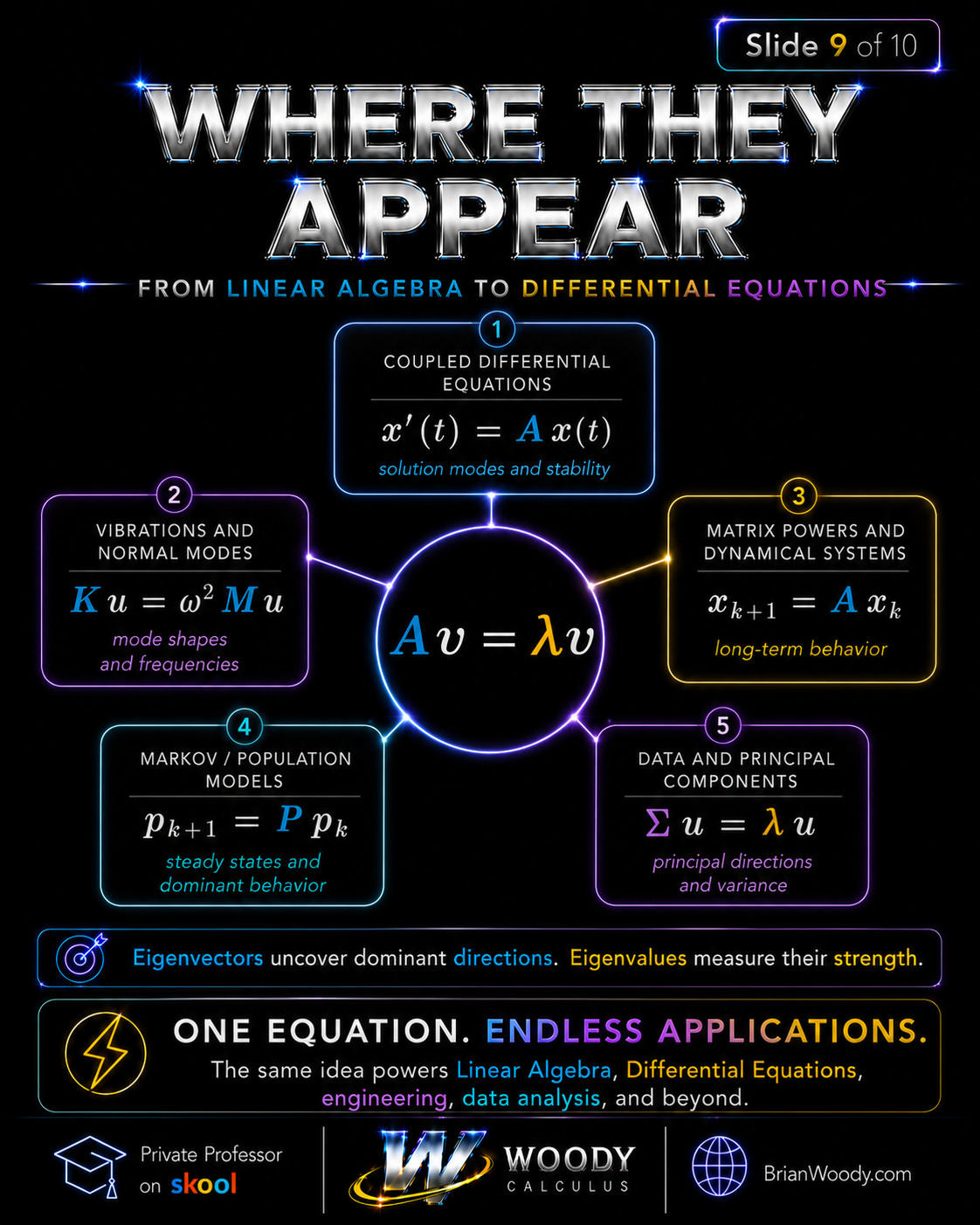
Eigenvalues and eigenvectors appear everywhere because they identify dominant directions and measure their strength.
The same equation
\[
Av=\lambda v
\]
powers many different areas of mathematics, science, engineering, and data analysis.
Coupled Differential Equations
In systems such as
\[
x^{\prime}(t)=Ax(t),
\]
eigenvalues and eigenvectors give solution modes and stability information.
Vibrations and Normal Modes
In mechanical systems and vibration problems, eigenvectors describe mode shapes, and eigenvalues determine frequencies. A common generalized eigenvalue form is
\[
Ku=\omega^2 Mu.
\]
Matrix Powers and Dynamical Systems
Discrete dynamical systems often have the form
\[
x_{k+1}=Ax_k.
\]
Eigenvalues help determine long-term behavior.
Markov and Population Models
Population and transition models often involve repeated matrix multiplication:
\[
p_{k+1}=Pp_k.
\]
Eigenvectors can reveal steady states, dominant behavior, and long-term proportions.
Data and Principal Components
In data analysis and principal component analysis, eigenvectors identify principal directions, and eigenvalues measure the variance along those directions:
\[
\Sigma u=\lambda u.
\]
This is why the same idea appears in Linear Algebra, Differential Equations, engineering, data science, machine learning, and beyond.
Master the Math Behind the Matrix
Eigenvalues and eigenvectors are not just formulas. They are a language for understanding how matrices act.
To master them, students need to connect three layers:
- Geometry: eigenvectors are special directions.
- Algebra: eigenvalues come from the characteristic equation.
- Differential Equations: eigenvectors become solution modes.
At Woody Calculus, students build fluency through clean setup, pattern recognition, formula memorization, repeated perfect solutions, and saying every step out loud until the method becomes automatic.
Eigenvalues and eigenvectors reveal the hidden structure of a matrix. They show the directions that matter most.
— Brian M. Woody
If you are studying Linear Algebra, Differential Equations, Calculus III, or advanced university mathematics, this is one of the ideas you want to master deeply.
Students who want to go deeper can explore the Woody Calculus Mastery Lab, where Brian M. Woody teaches advanced mathematics through clear structure, expert-guided repetition, and exam-focused problem solving.
Join Woody Calculus Private Professor on Skool
You can also explore more lessons, mathematical essays, and advanced mathematics support at BrianWoody.com.
Related Woody Calculus Mathematical Essays
Explore more Woody Calculus visual lessons and deep-dive mathematical essays connecting
Real Analysis,
Calculus 2,
Calculus 3,
Differential Equations,
Linear Algebra,
Abstract Algebra,
topology,
Fourier Series,
Chaos Theory,
Galois Theory,
blockchain mathematics,
mathematical psychology,
peak performance study methods,
math anxiety,
subconscious training,
and advanced problem-solving.
- Laplace Transforms Explained: Turning Differential Equations Into Algebra
- Euler’s Identity Explained: The Most Beautiful Equation in Mathematics
- How to Learn Calculus and Advanced Mathematics: A Peak Performance Study Guide
- Taylor Series Explained: Mathematical Time Travel in Calculus 2
- Cantor Set Explained: Infinite Points, Zero Length in Real Analysis
- Möbius Strip Explained: Orientation, Vector Calculus, and Stokes’ Theorem
- Fourier Series Explained: Harmonics, Sound, Heat, and Quantum Mechanics
- Gabriel’s Horn Explained: Finite Volume, Infinite Surface Area in Calculus 2
- Line Integrals and Vector Fields: What They Measure in Calculus 3
- Chaos Theory Explained: Butterfly Effect, Lorenz System, and Lyapunov Exponents
- Galois Theory Explained: Hidden Symmetry and the Quintic
- The Baader-Meinhof Phenomenon in Mathematics: Pattern Recognition and Subconscious Training
- Blockchain Mathematics Explained: Hash Functions, Cryptography, AI, and Consensus
- View All Woody Calculus Blog Posts
Related University Math Help Pages
Woody Calculus supports students at major universities with structured help in Calculus, Differential Equations, Linear Algebra, Abstract Algebra, Real Analysis, and advanced mathematics.
- University Calculus Tutor Hub
- MIT Calculus Tutor
- Purdue University Calculus Tutor
- University of Florida Calculus Tutor
- Colorado State University Calculus Help
- UCF Calculus Tutor
- Georgia Tech Calculus Tutor
- University of Michigan Calculus Tutor
- Michigan State Calculus Tutor
- Virginia Tech Calculus Tutor
- University of Nevada, Reno Calculus Tutor
Trusted by Students Nationwide
The Woody Calculus Mastery Lab gives university students access to structured mathematics support, written solutions, video lessons, exam-focused training, and expert guidance from Brian M. Woody.
Students use Woody Calculus for Linear Algebra, Differential Equations, Calculus II, Calculus III, Abstract Algebra, Real Analysis, AP Calculus BC, and other advanced mathematics courses.
- Read Woody Calculus Google Reviews
- Private Math Tutor and Advanced Mathematics Instruction
- Join the Woody Calculus Mastery Lab
Universities Supported by Woody Calculus
Students from universities across the United States use Woody Calculus for help with Calculus, Differential Equations, Linear Algebra, Abstract Algebra, Real Analysis, and advanced mathematics.
- View the full university calculus tutor hub
- Colorado State University Calculus Help
- UCF Calculus Tutor
- Purdue University Calculus Tutor
- University of Florida Calculus Tutor
- Georgia Tech Calculus Tutor
- Texas A&M Calculus Tutor
- Penn State Calculus Tutor
- Arizona State Calculus Tutor
- UCLA Calculus Tutor
- UC San Diego Calculus Tutor
- Michigan State Calculus Tutor
- Virginia Tech Calculus Tutor
- University of Washington Calculus Tutor
- University of Illinois Urbana-Champaign Calculus Tutor
- Rutgers Calculus Tutor
- University of Maryland Calculus Tutor
- Indiana University Calculus Tutor
- UNC Calculus Tutor
- Auburn University Calculus Tutor
- SDSU Calculus Tutor
- University of Nevada, Reno Calculus Tutor