![Woody Calculus introduction to differential-equation mixing problems, showing a perfectly stirred saltwater tank with inflow and outflow. The governing model is Q′(t) = c_in r_in − [Q(t)/V(t)]r_out. Equal flow rates produce constant volume, while unequal flow rates produce changing volume.](https://k3p6r8v3.delivery.rocketcdn.me/wp-content/uploads/2026/08/Mixing_Problems_Slide_01.png)

Learn how to model and solve differential-equation mixing problems with rate in minus rate out. Work through constant-volume, draining-tank, and overflow examples, then practice the complete seven-step method.
Learn how to model and solve differential-equation mixing problems with rate in minus rate out. Work through constant-volume, draining-tank, and overflow examples, then practice the complete seven-step method.
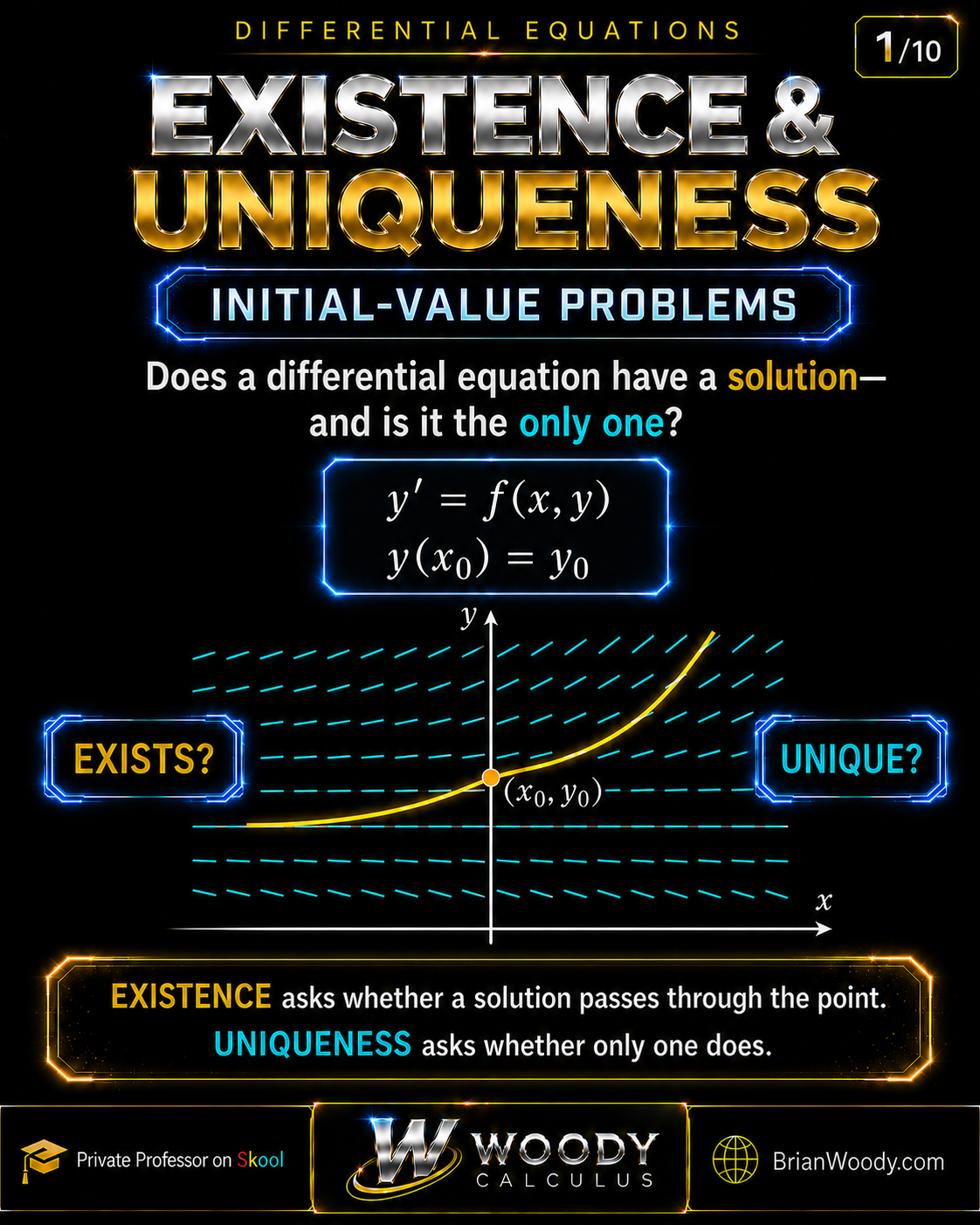
Does an initial-value problem have a solution, and is that solution the only one? This complete Woody Calculus lesson explains the existence and uniqueness theorem, the rectangle test, worked examples, nonunique solutions, finite-time blow-up, maximal intervals, the nonintersection principle, and higher-order linear ODEs.
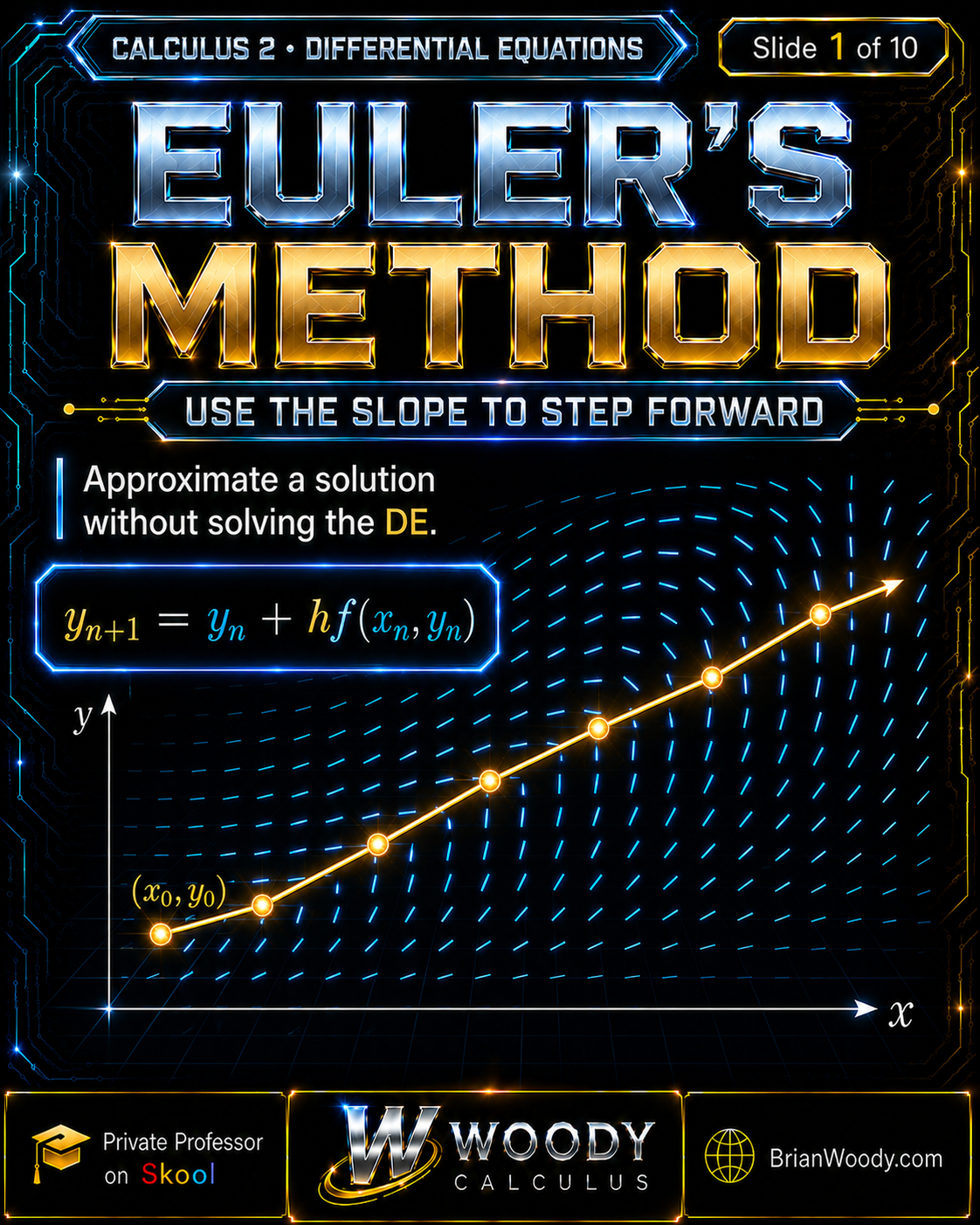
Euler’s method approximates the solution of an initial-value problem by repeatedly using the differential equation’s slope. Learn the update formula, complete a worked example, compare step sizes, and verify the approximation against an exact solution.