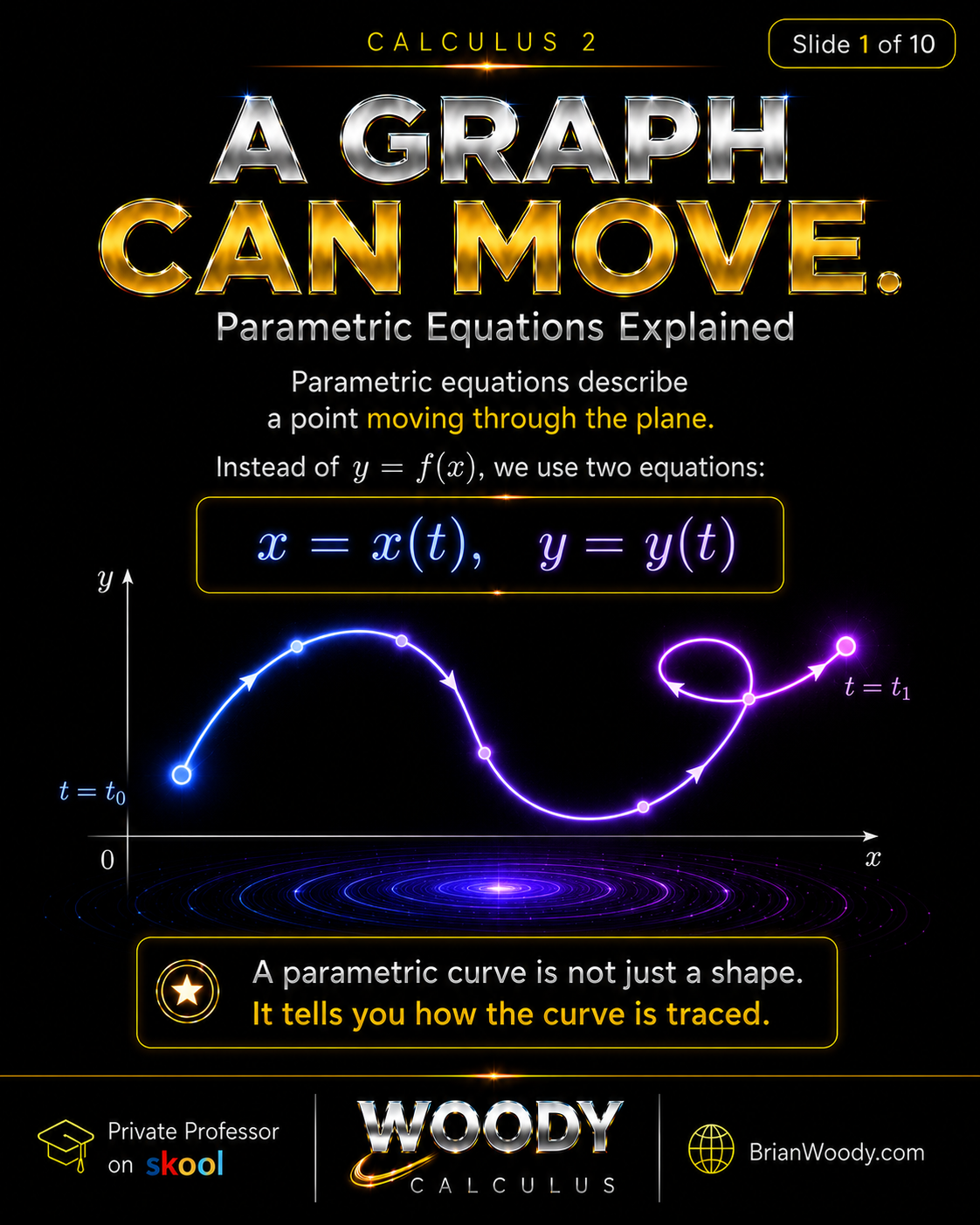

Parametric equations describe a point moving through the plane. This Woody Calculus lesson explains how \(x=x(t)\) and \(y=y(t)\) create a directed curve, how to compute \(\frac{dy}{dx}\), and how to find horizontal and vertical tangent lines.
Parametric equations describe a point moving through the plane. This Woody Calculus lesson explains how \(x=x(t)\) and \(y=y(t)\) create a directed curve, how to compute \(\frac{dy}{dx}\), and how to find horizontal and vertical tangent lines.
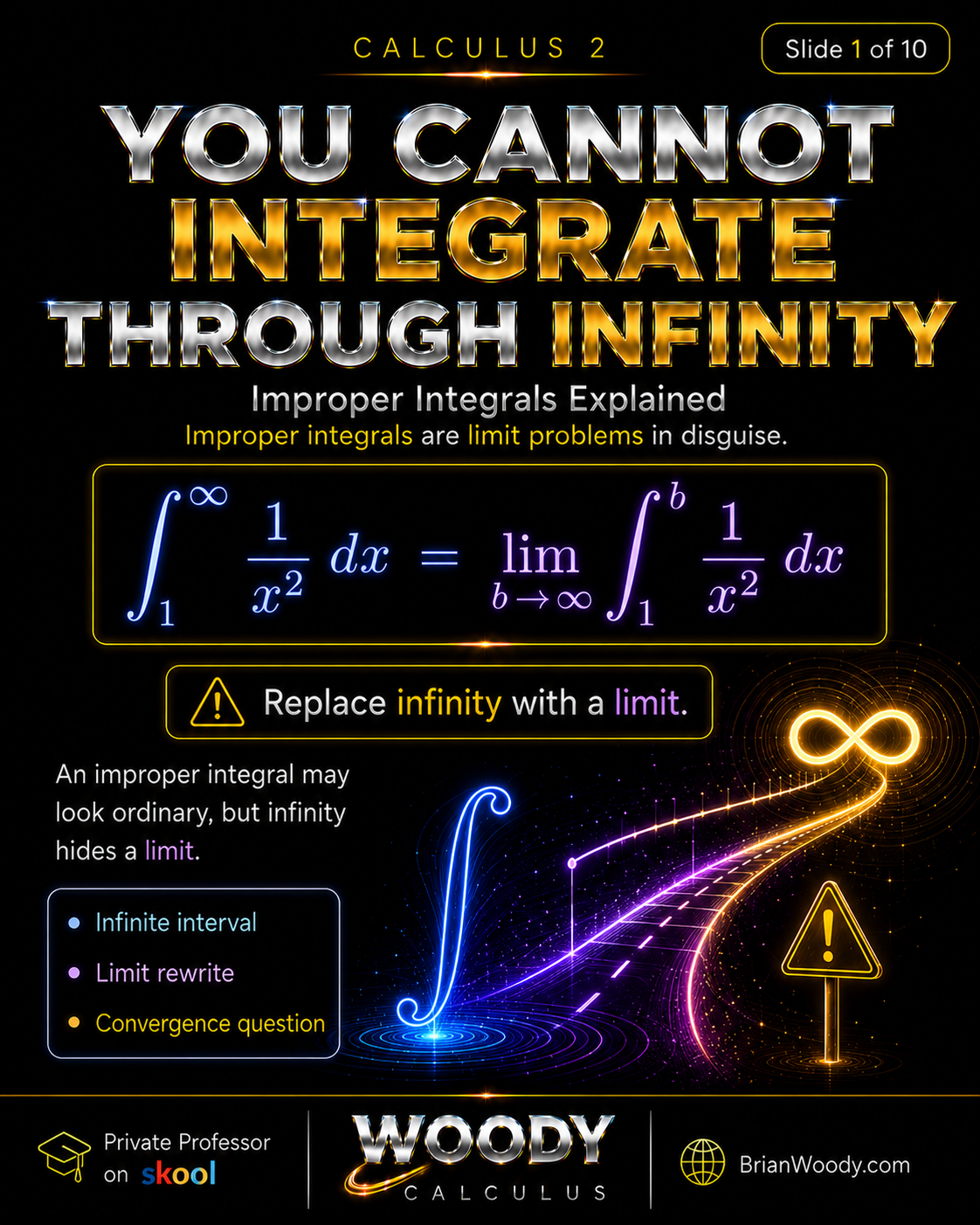
Improper integrals are Calculus 2 limit problems in disguise. This Woody Calculus lesson teaches how to handle infinite intervals, vertical asymptotes, bad points inside an interval, p-integrals, comparison tests, convergence, and divergence with a clear step-by-step system.
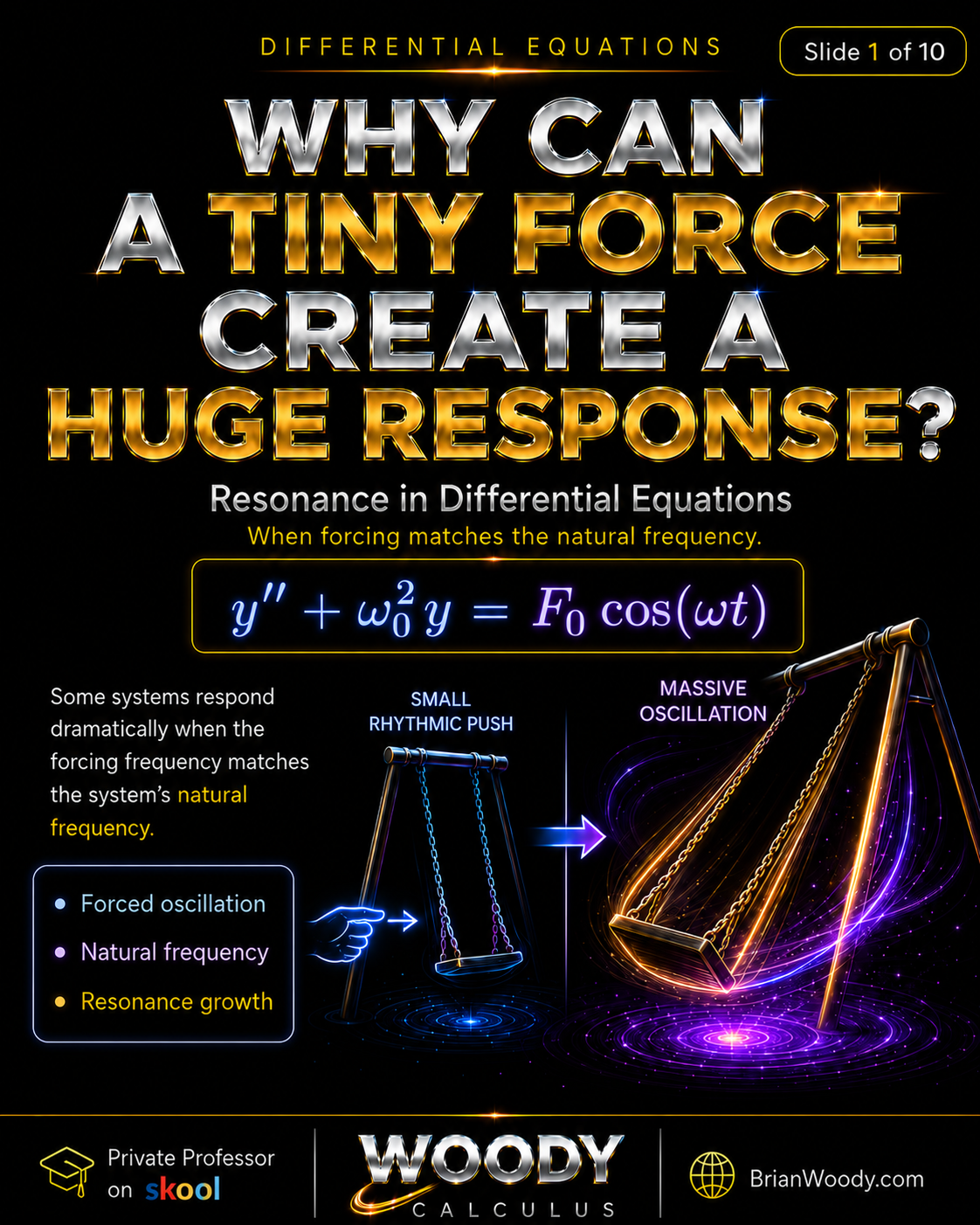
Resonance happens when a forcing frequency matches a system’s natural frequency. This Woody Calculus Differential Equations lesson explains forced oscillations, natural frequency, undamped resonance growth, damping, peak response, and real-world applications.
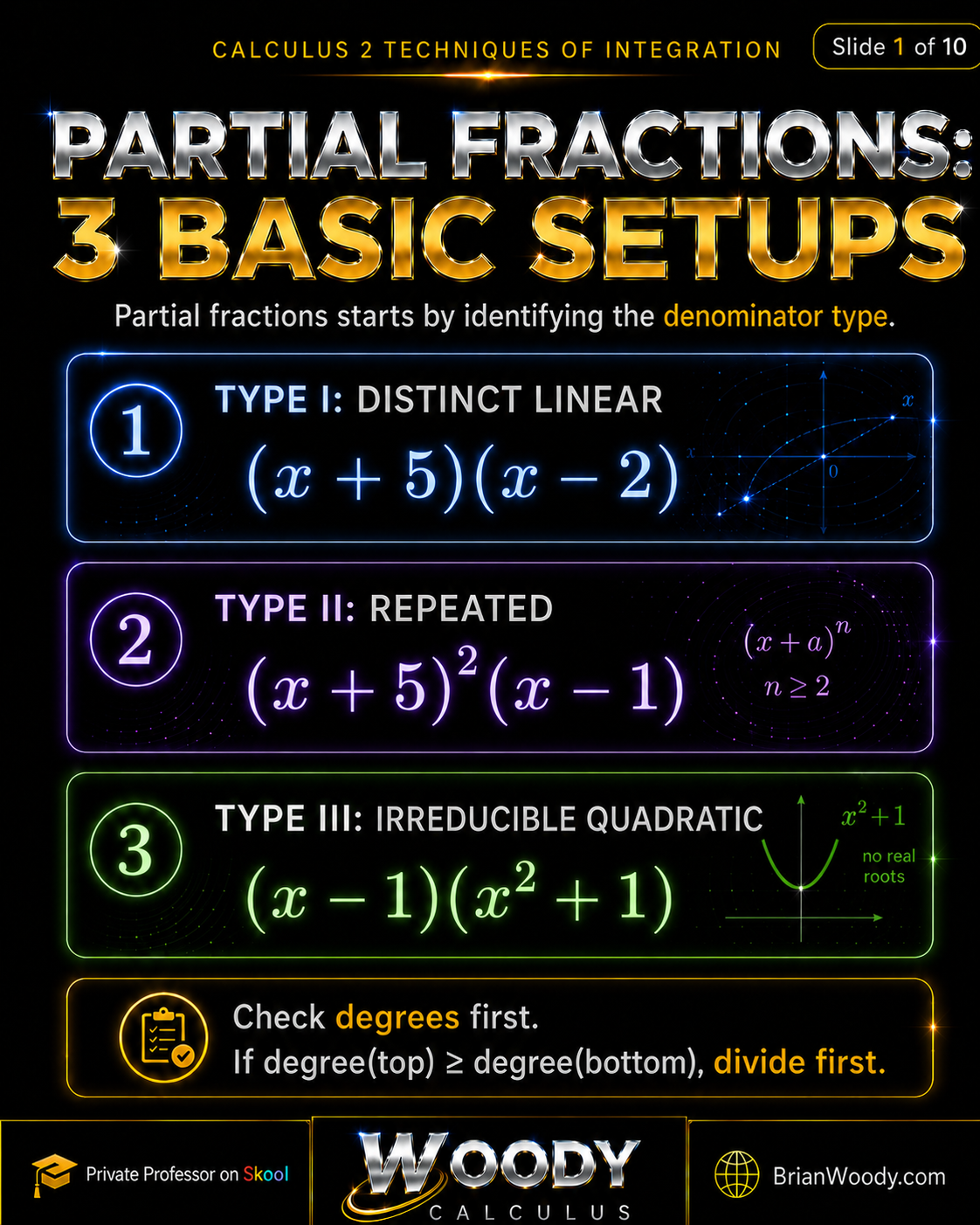
Partial fraction decomposition becomes easier when students stop guessing and identify the denominator type first. This Woody Calculus lesson teaches the complete Calculus 2 system: distinct linear factors, repeated factors, irreducible quadratics, solving for constants, and integrating each piece.
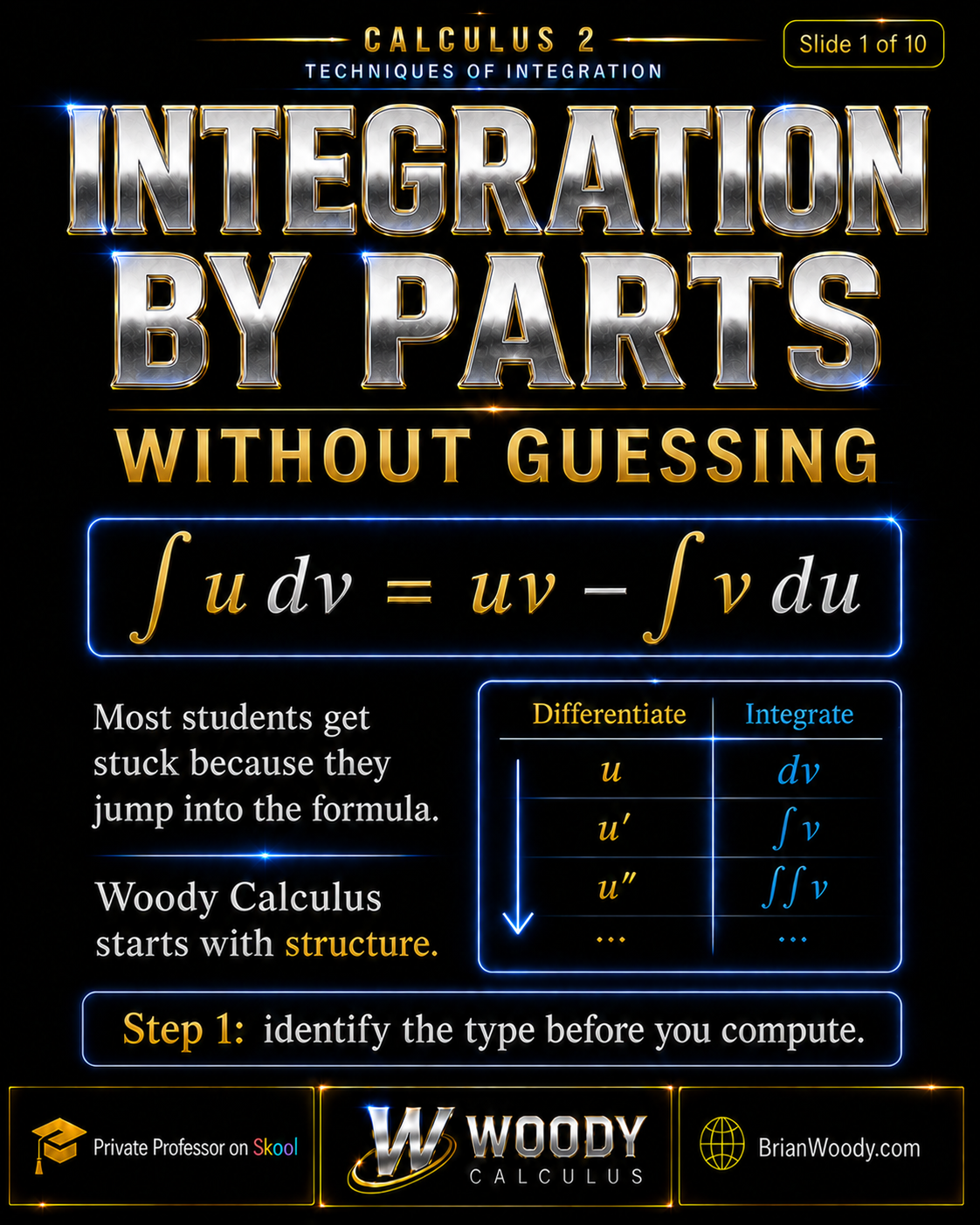
Integration by parts becomes easier when students stop guessing and identify the structure first. This Woody Calculus lesson teaches the complete 3-type IBP system for Calculus 2, including tabular integration by parts, exponential-trig loops, logarithms, inverse trig, and worked examples.
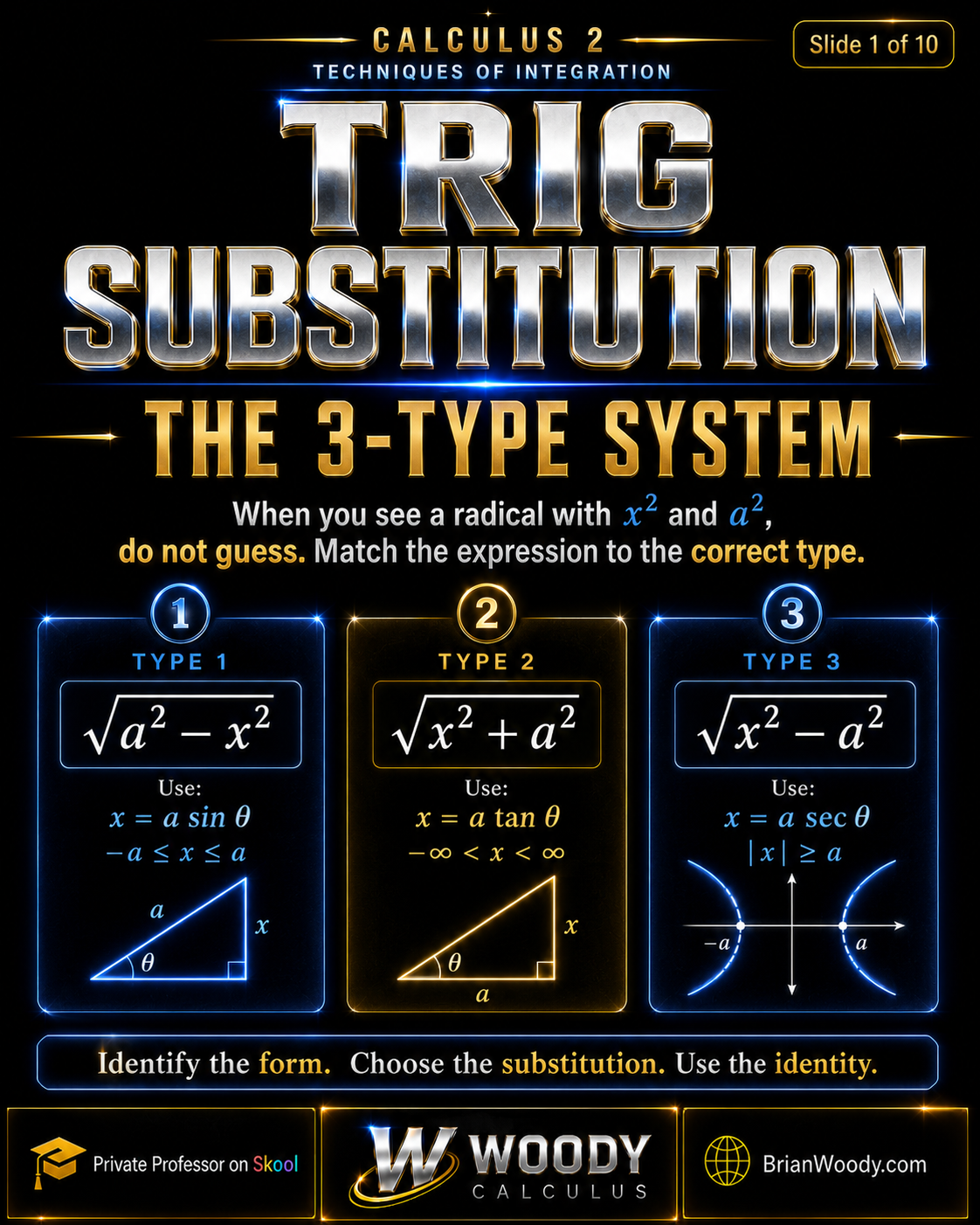
Trig substitution becomes much easier when students stop guessing and match the radical to one of three forms. This Woody Calculus lesson teaches the complete 3-type system for Calculus 2: sine for sqrt(a²−x²), tangent for sqrt(x²+a²), and secant for sqrt(x²−a²).
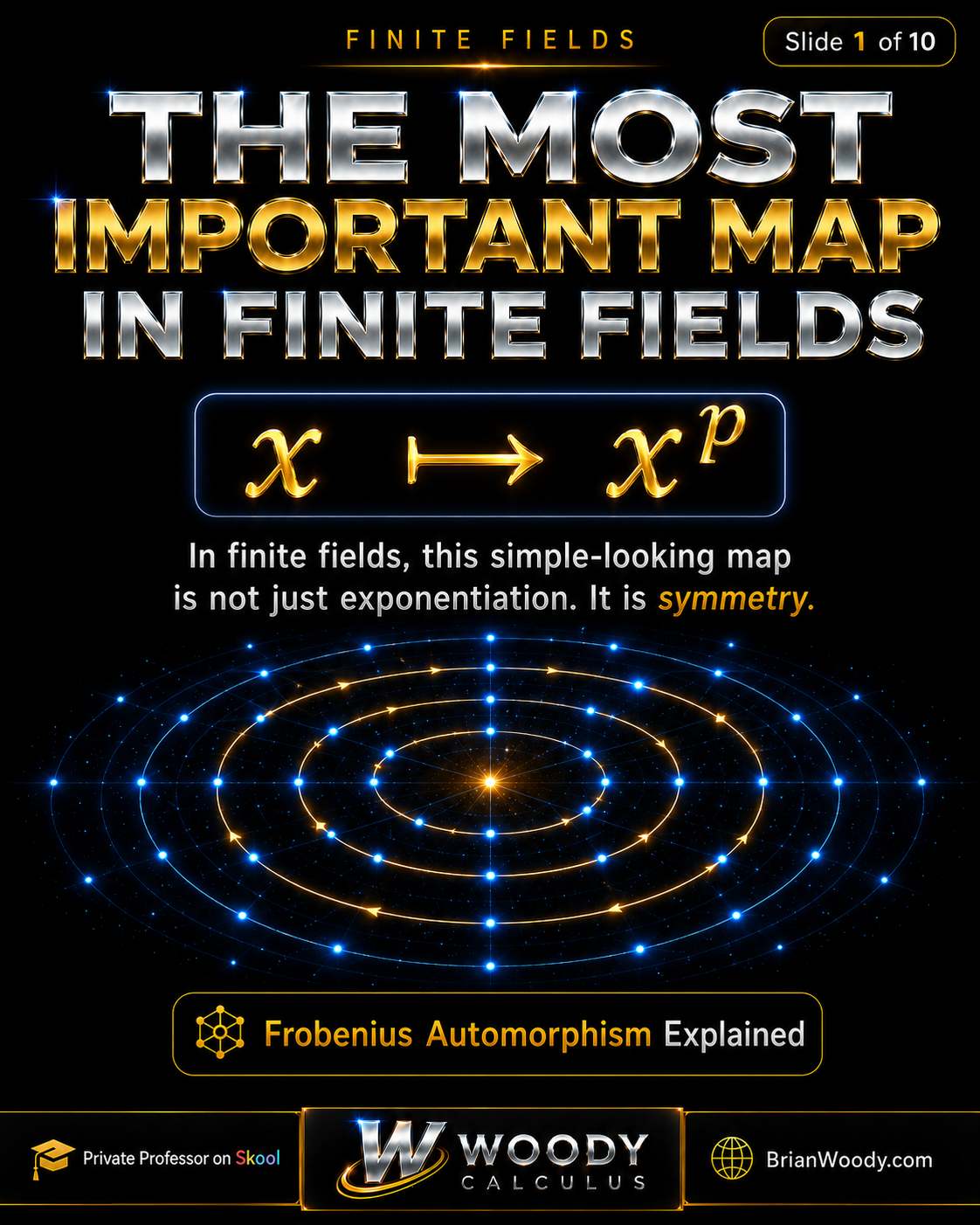
The Frobenius automorphism \(x\mapsto x^p\) is the central symmetry of finite fields. This Woody Calculus Abstract Algebra lesson explains characteristic \(p\), the Freshman’s Dream, cyclic finite-field Galois groups, Frobenius conjugates, trace, norm, unit circles, and how these ideas connect to modern finite-field research.
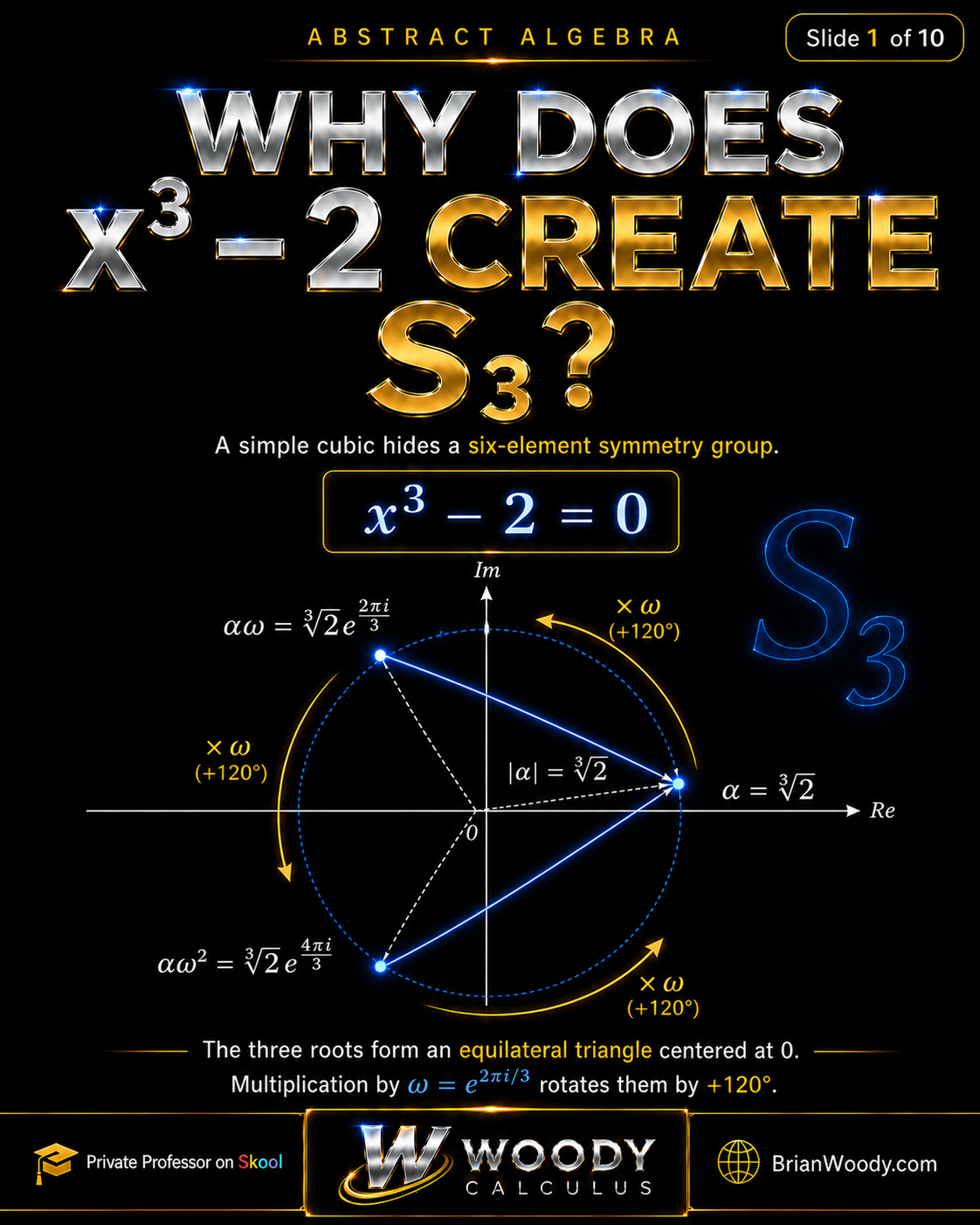
Why does the simple cubic x³ − 2 create the six-element symmetry group S₃? This Woody Calculus Abstract Algebra lesson explains the roots, splitting field, extension degree, automorphisms, triangle symmetries, and quotient group connection behind one of the cleanest examples in Galois theory.
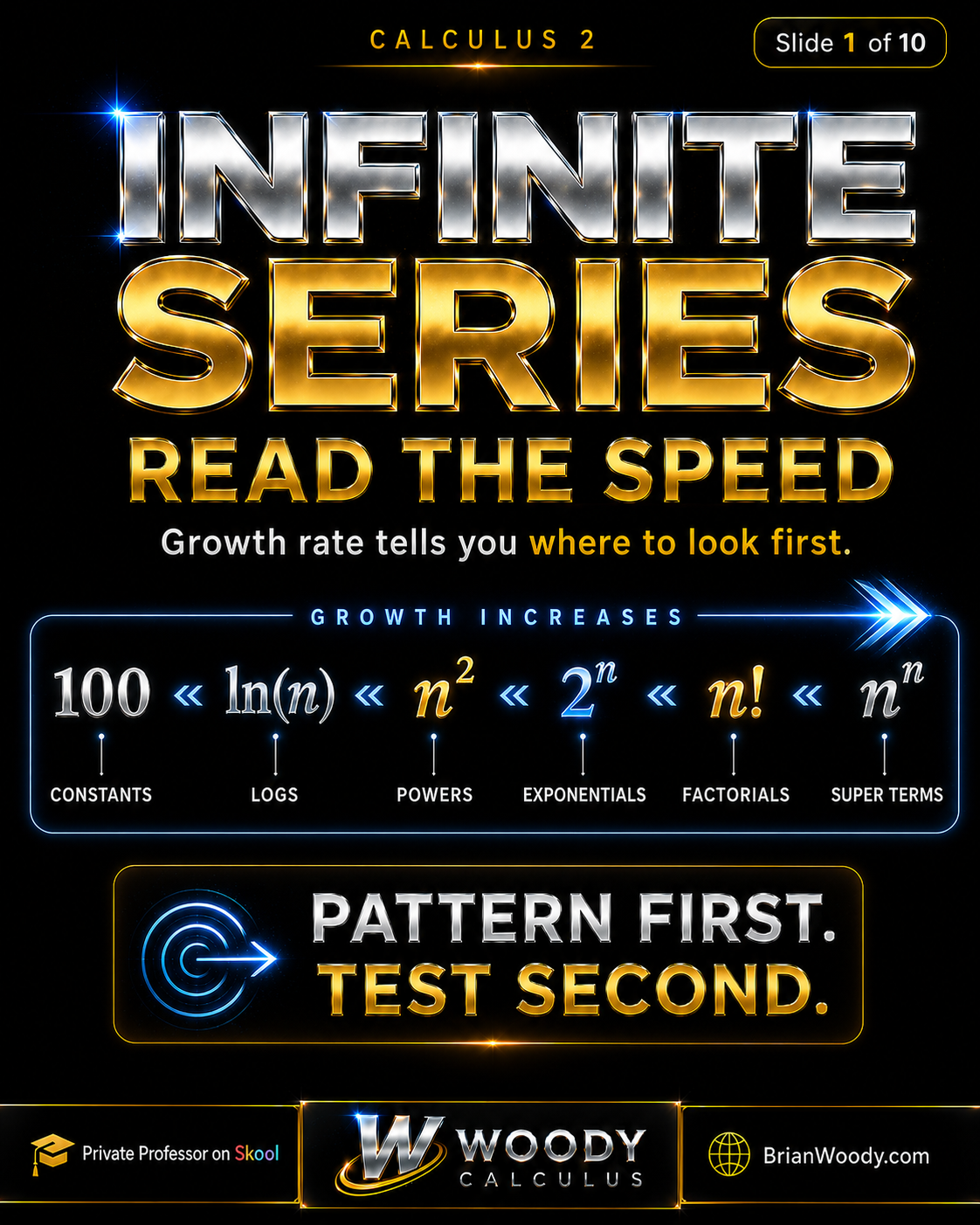
Learn how to choose the right infinite series test in Calculus 2. This Woody Calculus guide explains the Test for Divergence, p-test, geometric series, Limit Comparison Test, Direct Comparison Test, Ratio Test, Root Test, Integral Test, Alternating Series Test, and telescoping series.
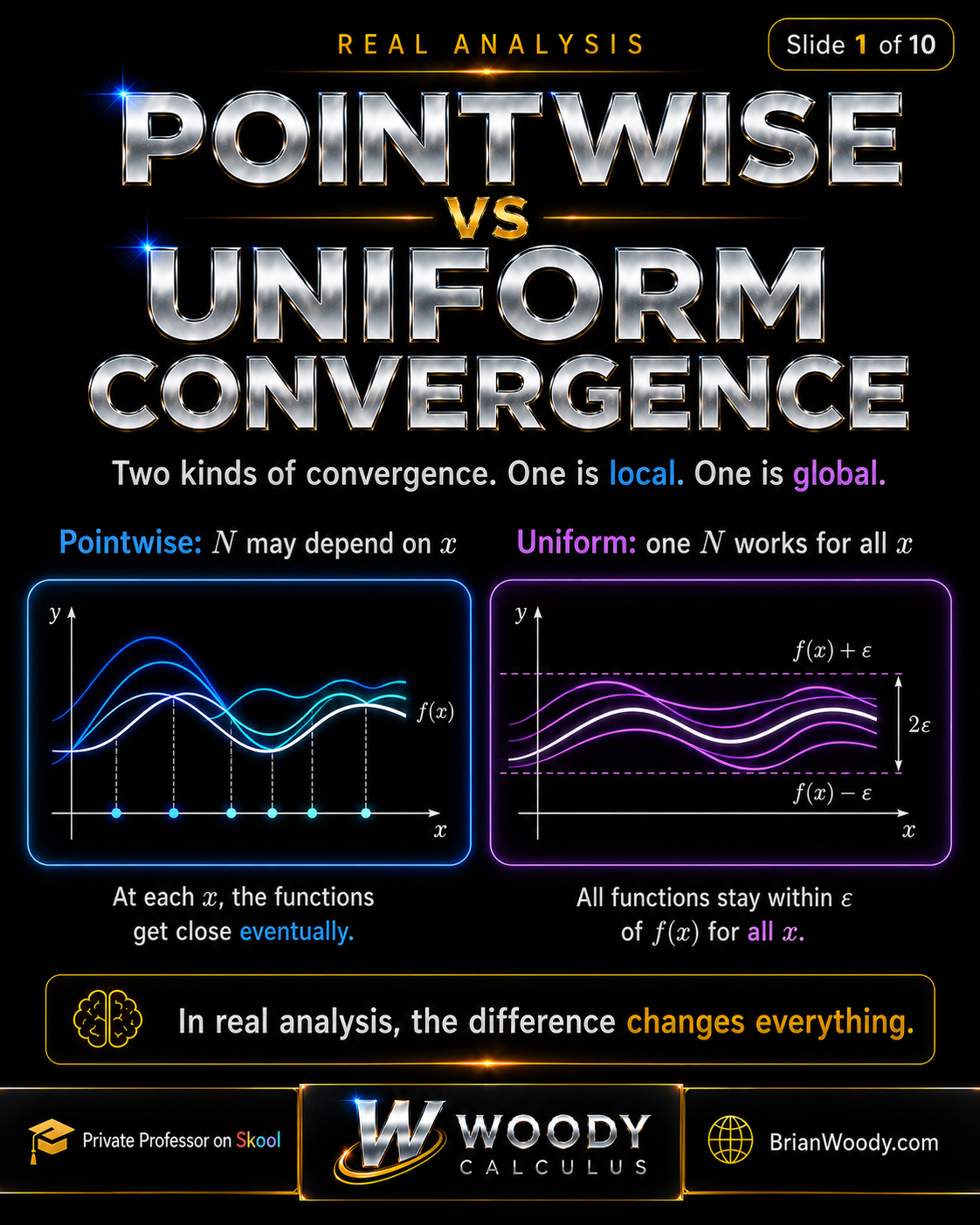
Pointwise convergence checks one input at a time. Uniform convergence controls the whole domain at once. This Woody Calculus Real Analysis lesson explains the definitions, quantifiers, sup norm test, classic examples, and why uniform convergence preserves structure.