An improper integral is a definite integral with an infinite interval or an unbounded integrand, and it must be rewritten as a limit before evaluation.
Improper integrals are one of the biggest turning points in Calculus 2. They look like ordinary definite integrals, but they are really limit problems in disguise.
The most important rule is simple:
The Woody Calculus Rule
You cannot integrate through infinity. You cannot integrate through a vertical asymptote. You must rewrite the problem as a limit first.
\int_a^\infty f(x)\,dx
=
\lim_{b\to\infty}\int_a^b f(x)\,dx
\]
Students often lose points on improper integrals because they try to plug in \(\infty\), plug into an undefined endpoint, or integrate straight through a bad point inside the interval. The Woody Calculus method stops that mistake before it starts.
This lesson teaches the full Calculus 2 system for improper integrals: infinite intervals, vertical asymptotes, bad points inside an interval, \(p\)-integral benchmarks, comparison tests, convergence, divergence, and the step-by-step checklist that makes these problems predictable.
Students studying improper integrals should also connect this topic to partial fractions, integration by parts, trig substitution, Taylor series, and resonance in Differential Equations. The same pattern appears everywhere in advanced mathematics: find the danger, rewrite correctly, then solve.
Estimated read time: 12–15 minutes.
Last updated: July 9, 2026.

Key Takeaways
- Improper integrals are definite integrals that involve infinity or an unbounded integrand.
- They must be rewritten as limits before evaluation.
- Type 1 improper integrals have infinite intervals.
- Type 2 improper integrals have vertical asymptotes or undefined points.
- If the bad point is inside the interval, split the integral first.
- A finite limit means the improper integral converges.
- An infinite or nonexistent limit means the improper integral diverges.
- The \(p\)-integral rules are the main benchmark for comparison tests.
Improper Integrals Key Facts
- Improper integral means the interval is infinite or the function becomes unbounded.
- Never plug in \(\infty\). Replace infinity with a limit.
- Never plug into a vertical asymptote. Replace the bad endpoint with a one-sided limit.
- If the bad point is inside the interval, split the integral into two improper integrals.
- Every required piece must converge for the full improper integral to converge.
- For \(\int_1^\infty \frac{1}{x^p}\,dx\), convergence happens when \(p > 1\).
- For \(\int_0^1 \frac{1}{x^p}\,dx\), convergence happens when \(p < 1\).
- Comparison tests are often used when an improper integral cannot be evaluated directly.
What Is an Improper Integral?
An improper integral is a definite integral that cannot be evaluated directly because either the interval is infinite or the integrand becomes infinite or undefined somewhere on the interval.
The central idea is:
\text{improper integral} \quad \Longrightarrow \quad \text{limit problem}.
\]
For example, the integral:
\int_1^\infty \frac{1}{x^2}\,dx
\]
cannot be evaluated by plugging in \(\infty\). Instead, we replace infinity with a finite variable \(b\), integrate from \(1\) to \(b\), and then take the limit:
\int_1^\infty \frac{1}{x^2}\,dx
=
\lim_{b\to\infty}\int_1^b \frac{1}{x^2}\,dx.
\]
That limit decides convergence or divergence.
Two Things Can Go Wrong
An integral is improper when one of two things goes wrong:
- The interval is infinite.
- The function becomes unbounded or undefined.
These create the two main types of improper integrals.
The Two Improper Integral Types
| Type | Problem | Example | Required Move |
|---|---|---|---|
| Type 1 | Infinite interval | \(\int_a^\infty f(x)\,dx\) | Replace infinity with a limit |
| Type 2 | Vertical asymptote or undefined point | \(\int_0^1 \frac{1}{\sqrt{x}}\,dx\) | Use a one-sided limit |
The danger point determines the setup. Once you identify the danger point, the rest of the problem becomes mechanical.
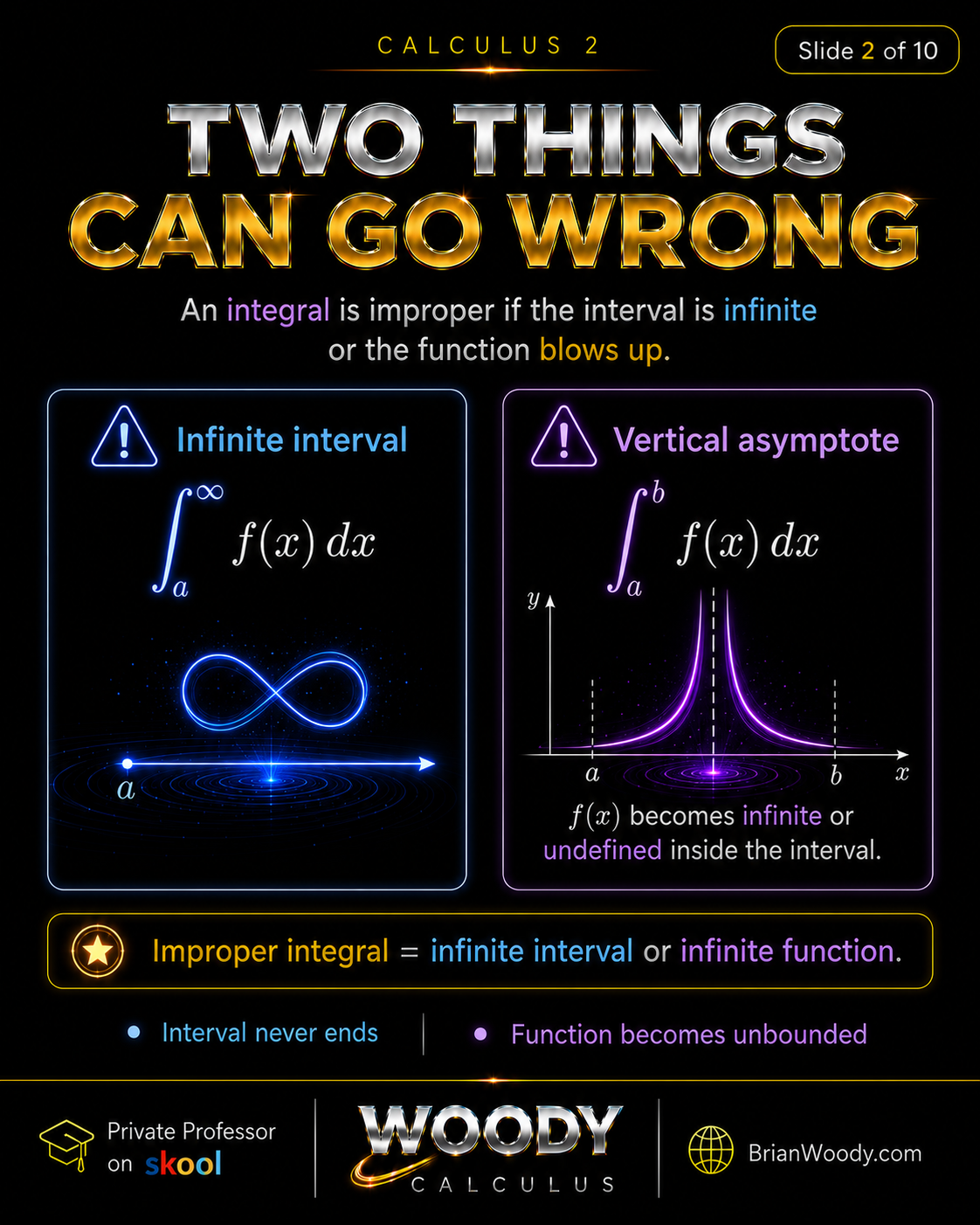
Bad Endpoint? Use a Limit
Every improper integral must be rewritten as a limit before evaluation.
Limit Setups You Must Memorize
For an infinite upper endpoint:
\int_a^\infty f(x)\,dx
=
\lim_{b\to\infty}\int_a^b f(x)\,dx.
\]
For an infinite lower endpoint:
\int_{-\infty}^b f(x)\,dx
=
\lim_{a\to-\infty}\int_a^b f(x)\,dx.
\]
For a vertical asymptote at the left endpoint:
\int_a^b f(x)\,dx
=
\lim_{t\to a^+}\int_t^b f(x)\,dx.
\]
For a vertical asymptote at the right endpoint:
\int_a^b f(x)\,dx
=
\lim_{t\to b^-}\int_a^t f(x)\,dx.
\]
Warning
Do not plug in infinity. Do not plug into a vertical asymptote. Use a limit.
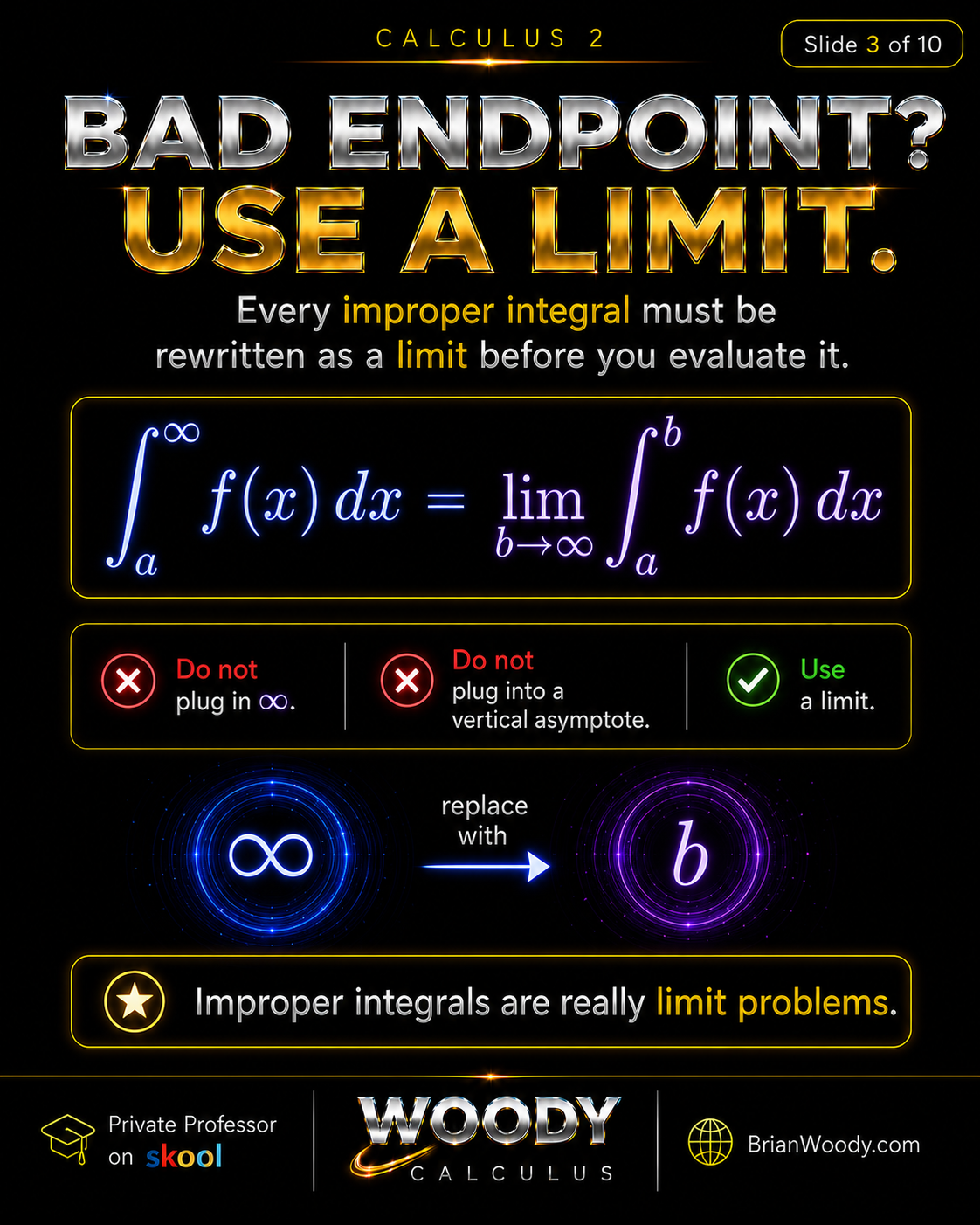
Type 1: Infinite Interval
Type 1 improper integrals happen when the interval never ends.
Example: Infinite Interval
Consider:
\int_1^\infty \frac{1}{x^2}\,dx.
\]
Rewrite infinity as a limit:
\int_1^\infty \frac{1}{x^2}\,dx
=
\lim_{b\to\infty}\int_1^b x^{-2}\,dx.
\]
Now integrate:
\int x^{-2}\,dx=-\frac{1}{x}.
\]
So:
\lim_{b\to\infty}\int_1^b x^{-2}\,dx
=
\lim_{b\to\infty}\left[-\frac{1}{x}\right]_1^b.
\]
=
\lim_{b\to\infty}\left(1-\frac{1}{b}\right).
\]
=1.
\]
Because the limit is finite, the improper integral converges.
\boxed{
\int_1^\infty \frac{1}{x^2}\,dx=1.
}
\]
In plain English: The area extends forever, but the total area is finite.
Connection: Gabriel’s Horn
This same finite-area-from-infinite-region phenomenon is part of the magic behind Gabriel’s Horn, one of the most famous examples in Calculus 2.
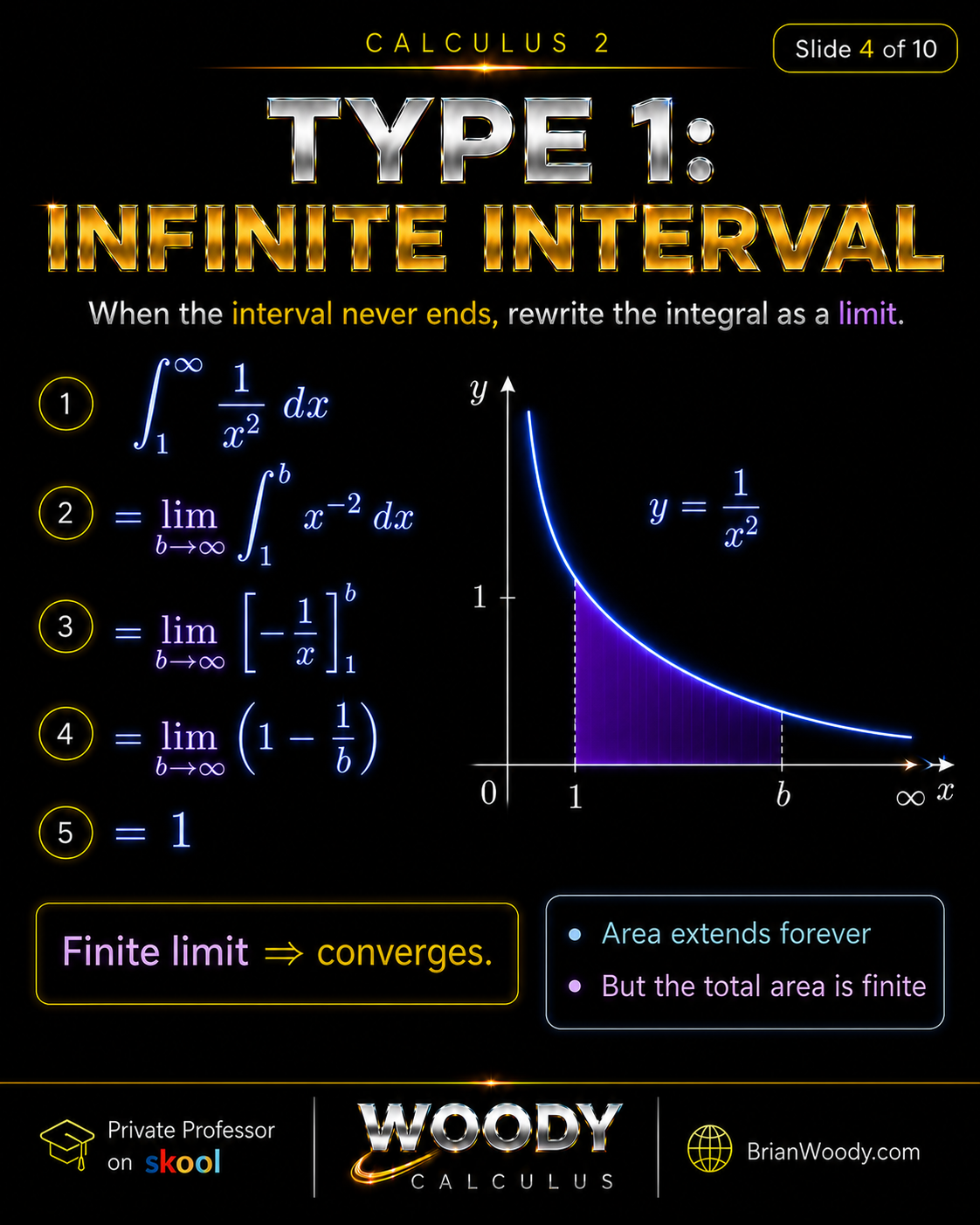
Type 2: Vertical Asymptote
Type 2 improper integrals happen when the function blows up or becomes undefined on the interval.
Example: Vertical Asymptote at an Endpoint
Consider:
\int_0^1 \frac{1}{\sqrt{x}}\,dx.
\]
The function \(\frac{1}{\sqrt{x}}\) blows up as \(x\to 0^+\). Therefore \(x=0\) is the bad endpoint.
Rewrite the bad endpoint as a one-sided limit:
\int_0^1 \frac{1}{\sqrt{x}}\,dx
=
\lim_{a\to 0^+}\int_a^1 x^{-1/2}\,dx.
\]
Now integrate:
\int x^{-1/2}\,dx=2\sqrt{x}.
\]
So:
\lim_{a\to 0^+}\int_a^1 x^{-1/2}\,dx
=
\lim_{a\to 0^+}\left[2\sqrt{x}\right]_a^1.
\]
=
\lim_{a\to 0^+}\left(2-2\sqrt{a}\right).
\]
=2.
\]
Because the limit is finite, the improper integral converges.
\boxed{
\int_0^1 \frac{1}{\sqrt{x}}\,dx=2.
}
\]
In plain English: The function becomes infinite near \(x=0\), but the total area is finite.
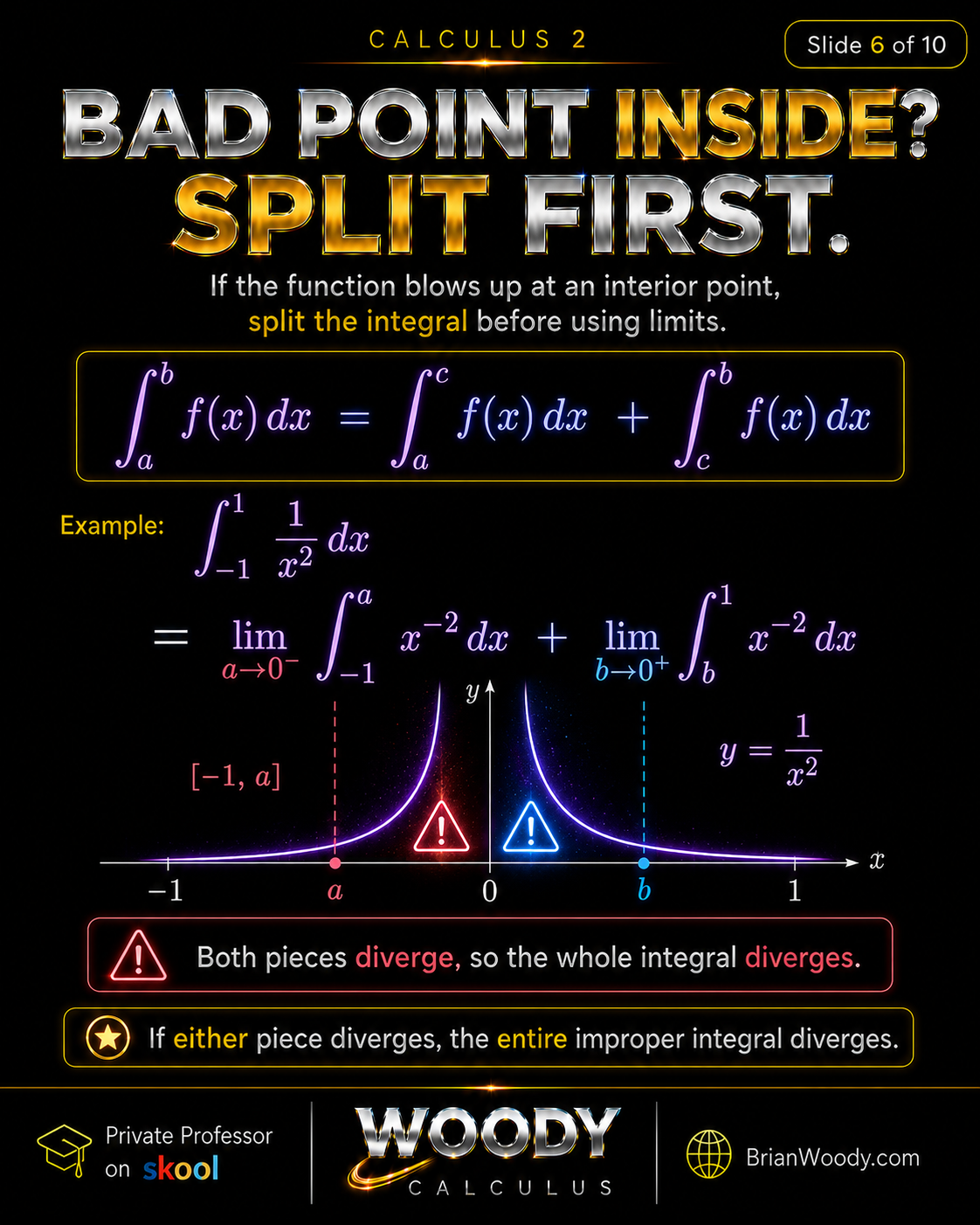
Bad Point Inside? Split First
If the function blows up at an interior point, you must split the integral before taking limits.
Interior Bad Point Rule
If \(c\) is a bad point inside \([a,b]\), then:
\int_a^b f(x)\,dx
=
\int_a^c f(x)\,dx
+
\int_c^b f(x)\,dx,
\]
and each piece must be interpreted as an improper integral.
Example: Bad Point Inside the Interval
Consider:
\int_{-1}^1 \frac{1}{x^2}\,dx.
\]
The function has a vertical asymptote at \(x=0\), which is inside the interval. Therefore:
\int_{-1}^1 \frac{1}{x^2}\,dx
=
\lim_{a\to 0^-}\int_{-1}^a x^{-2}\,dx
+
\lim_{b\to 0^+}\int_b^1 x^{-2}\,dx.
\]
The left piece is:
\lim_{a\to 0^-}\int_{-1}^a x^{-2}\,dx
=
\lim_{a\to 0^-}\left[-\frac{1}{x}\right]_{-1}^a
=
\lim_{a\to 0^-}\left(-\frac{1}{a}-1\right)
=
+\infty.
\]
The right piece is:
\lim_{b\to 0^+}\int_b^1 x^{-2}\,dx
=
\lim_{b\to 0^+}\left[-\frac{1}{x}\right]_b^1
=
\lim_{b\to 0^+}\left(-1+\frac{1}{b}\right)
=
+\infty.
\]
Both pieces diverge, so the entire improper integral diverges.
\boxed{
\int_{-1}^1 \frac{1}{x^2}\,dx \text{ diverges.}
}
\]
Do Not Let Infinities Cancel
Improper integrals are not evaluated using cancellation across a vertical asymptote. Each required one-sided limit must converge on its own.
The p-Integral Decision Rule
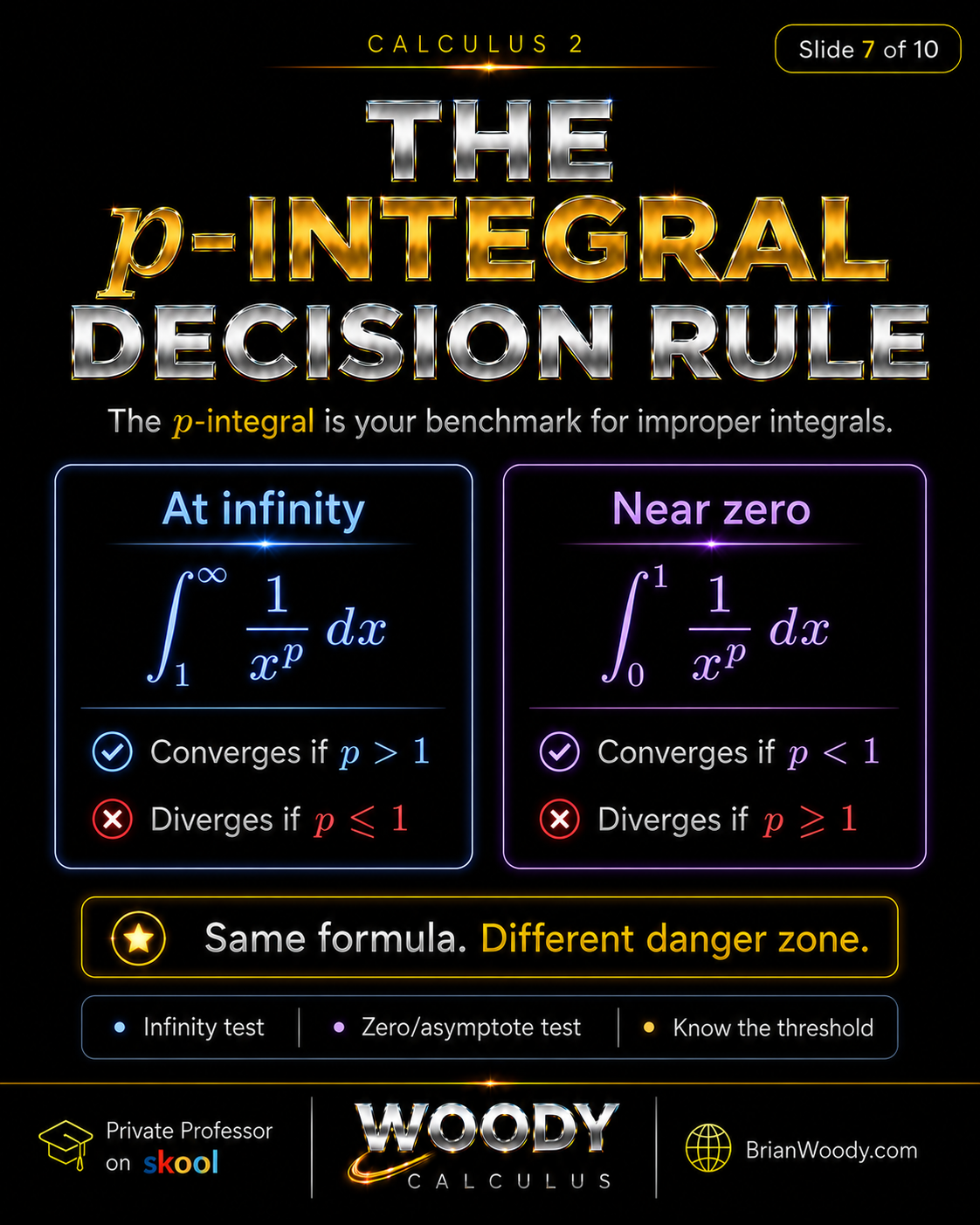
The \(p\)-integral is the most important benchmark for improper integrals.
The Two \(p\)-Integral Danger Zones
At infinity:
\int_1^\infty \frac{1}{x^p}\,dx
\]
converges if \(p > 1\) and diverges if \(p\le 1\).
Near zero:
\int_0^1 \frac{1}{x^p}\,dx
\]
converges if \(p < 1\) and diverges if \(p\ge 1\).
This is the same formula \(\frac{1}{x^p}\), but a different danger zone. At infinity, large powers help the function shrink fast enough. Near zero, large powers make the vertical asymptote too strong.
When You Cannot Integrate It, Compare It
Not every improper integral can be evaluated easily. When direct integration is difficult, use comparison.
Direct Comparison Test for Improper Integrals
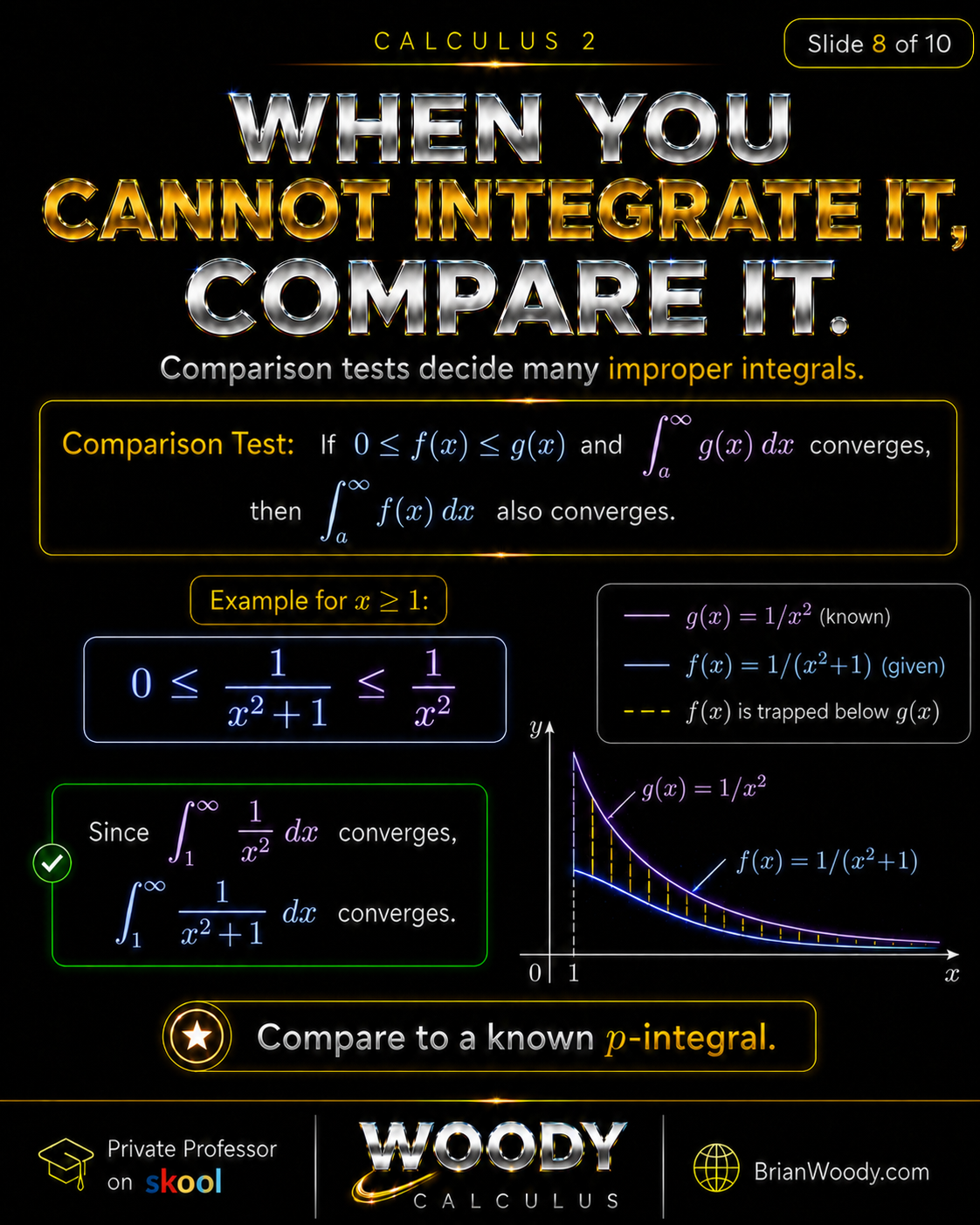
If \(0\le f(x)\le g(x)\) and \(\int_a^\infty g(x)\,dx\) converges, then \(\int_a^\infty f(x)\,dx\) also converges.
If \(0\le g(x)\le f(x)\) and \(\int_a^\infty g(x)\,dx\) diverges, then \(\int_a^\infty f(x)\,dx\) also diverges.
Example: Compare to a Known \(p\)-Integral
For \(x\ge 1\):
0\le \frac{1}{x^2+1}\le \frac{1}{x^2}.
\]
Since:
\int_1^\infty \frac{1}{x^2}\,dx
\]
converges, the comparison test gives:
\int_1^\infty \frac{1}{x^2+1}\,dx
\]
also converges.
This is the main idea behind many difficult-looking improper integral problems: compare the integrand to a known \(p\)-integral.
How to Solve Every Improper Integral
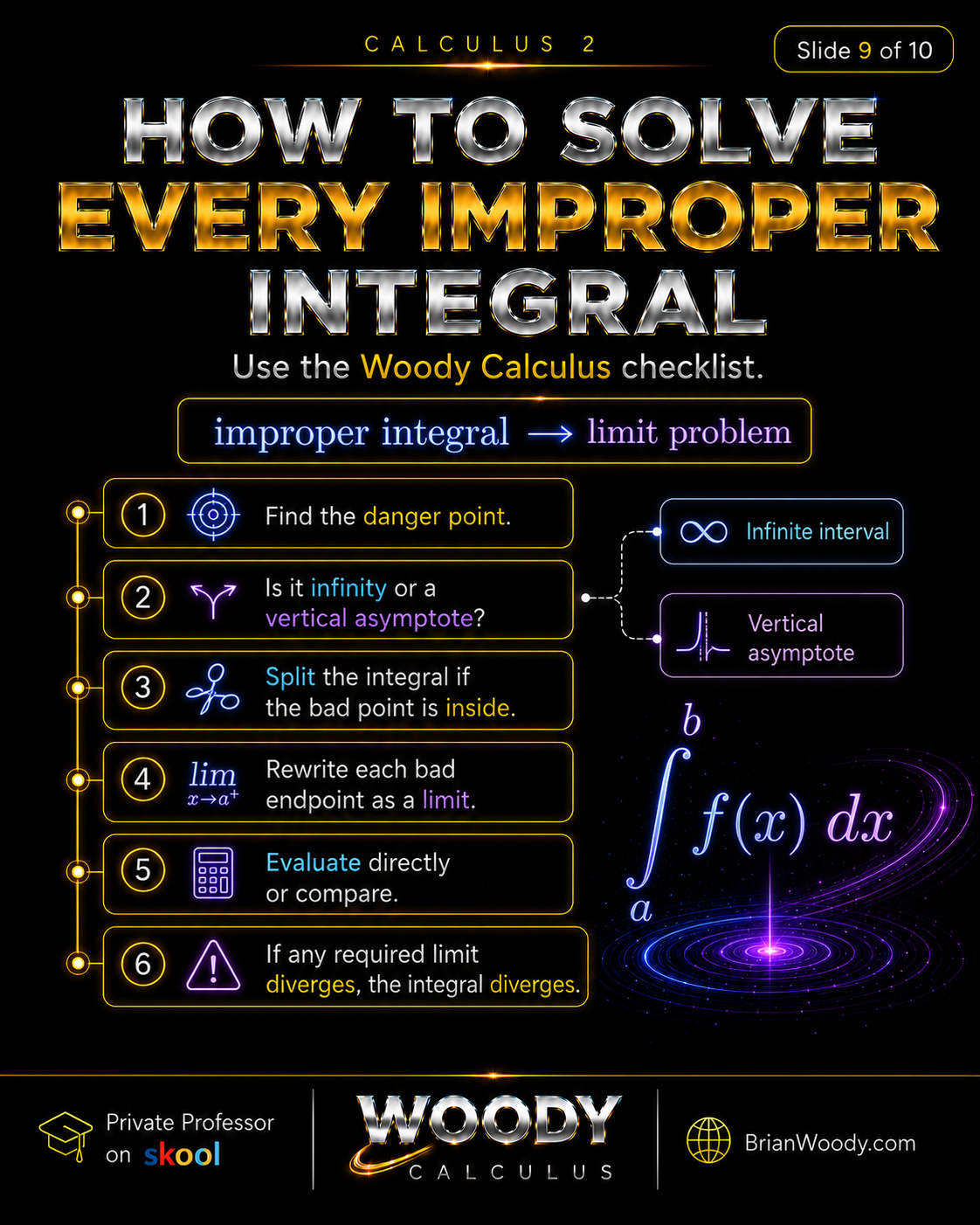
The Woody Calculus Improper Integral Checklist
- Find the danger point.
- Decide whether the danger is infinity or a vertical asymptote.
- Split the integral if the bad point is inside the interval.
- Rewrite each bad endpoint as a limit.
- Evaluate directly or compare to a known benchmark.
- If any required limit diverges, the improper integral diverges.
This turns improper integrals from a guessing game into a repeatable system.
Worked Examples
Improper Integral Example 1: Infinite Interval
Evaluate:
\int_2^\infty \frac{3}{x^2}\,dx.
\]
Rewrite as a limit:
\int_2^\infty \frac{3}{x^2}\,dx
=
\lim_{b\to\infty}\int_2^b 3x^{-2}\,dx.
\]
Integrate:
\int 3x^{-2}\,dx=-\frac{3}{x}.
\]
Now evaluate:
\lim_{b\to\infty}\left[-\frac{3}{x}\right]_2^b
=
\lim_{b\to\infty}\left(-\frac{3}{b}+\frac{3}{2}\right)
=
\frac{3}{2}.
\]
\boxed{
\int_2^\infty \frac{3}{x^2}\,dx=\frac{3}{2}.
}
\]
Improper Integral Example 2: Vertical Asymptote
Evaluate:
\int_0^4 \frac{1}{\sqrt{x}}\,dx.
\]
The bad point is \(x=0\), so:
\int_0^4 \frac{1}{\sqrt{x}}\,dx
=
\lim_{a\to 0^+}\int_a^4 x^{-1/2}\,dx.
\]
Integrate:
\int x^{-1/2}\,dx=2\sqrt{x}.
\]
Evaluate:
\lim_{a\to 0^+}\left[2\sqrt{x}\right]_a^4
=
\lim_{a\to 0^+}\left(4-2\sqrt{a}\right)
=
4.
\]
\boxed{
\int_0^4 \frac{1}{\sqrt{x}}\,dx=4.
}
\]
Improper Integral Example 3: Bad Point Inside
Determine whether the integral converges:
\int_{-2}^2 \frac{1}{x^2}\,dx.
\]
The bad point is \(x=0\), which lies inside the interval. Split the integral:
\int_{-2}^2 \frac{1}{x^2}\,dx
=
\lim_{a\to 0^-}\int_{-2}^a x^{-2}\,dx
+
\lim_{b\to 0^+}\int_b^2 x^{-2}\,dx.
\]
Both pieces diverge to \(+\infty\), so:
\boxed{
\int_{-2}^2 \frac{1}{x^2}\,dx \text{ diverges.}
}
\]
Improper Integral Example 4: Comparison Test
Determine whether the integral converges:
\int_1^\infty \frac{1}{x^3+4}\,dx.
\]
For \(x\ge 1\), we have:
0\le \frac{1}{x^3+4}\le \frac{1}{x^3}.
\]
Since:
\int_1^\infty \frac{1}{x^3}\,dx
\]
converges because \(p=3 > 1\), the original integral converges by comparison.
\boxed{
\int_1^\infty \frac{1}{x^3+4}\,dx \text{ converges.}
}
\]
Common Mistakes
Mistake 1: Plugging in infinity
Infinity is not a number. Do not plug it into an antiderivative. Replace it with a limit.
Mistake 2: Plugging into a vertical asymptote
If the function blows up at an endpoint, use a one-sided limit. Do not directly substitute the bad endpoint.
Mistake 3: Forgetting to split at an interior bad point
If the bad point is inside the interval, the integral must be split first. The entire improper integral converges only if both pieces converge.
Mistake 4: Mixing up the \(p\)-integral rules
At infinity, \(\int_1^\infty \frac{1}{x^p}\,dx\) converges when \(p > 1\). Near zero, \(\int_0^1 \frac{1}{x^p}\,dx\) converges when \(p < 1\). Same formula, different danger zone.
Mistake 5: Thinking cancellation saves a divergent improper integral
Improper integrals are not evaluated by letting infinities cancel. Each required limit must converge on its own.
Improper Integrals Cheat Sheet
| Situation | Rewrite | Rule / Move |
|---|---|---|
| Infinite upper endpoint | \(\int_a^\infty f(x)\,dx=\lim_{b\to\infty}\int_a^b f(x)\,dx\) | Converges if the limit is finite |
| Infinite lower endpoint | \(\int_{-\infty}^b f(x)\,dx=\lim_{a\to-\infty}\int_a^b f(x)\,dx\) | Converges if the limit is finite |
| Bad left endpoint | \(\int_a^b f(x)\,dx=\lim_{t\to a^+}\int_t^b f(x)\,dx\) | Converges if the right-hand limit is finite |
| Bad right endpoint | \(\int_a^b f(x)\,dx=\lim_{t\to b^-}\int_a^t f(x)\,dx\) | Converges if the left-hand limit is finite |
| Bad point inside | Split the integral first | Every piece must converge |
| \(p\)-integral at infinity | \(\int_1^\infty \frac{1}{x^p}\,dx\) | Converges if \(p > 1\) |
| \(p\)-integral near zero | \(\int_0^1 \frac{1}{x^p}\,dx\) | Converges if \(p < 1\) |
Improper Integrals FAQ
What is an improper integral?
An improper integral is a definite integral where the interval is infinite or the function becomes infinite or undefined on the interval.
Why are improper integrals limit problems?
Improper integrals involve infinity or a vertical asymptote, so direct substitution is not allowed. The integral must be rewritten as a limit first.
When does an improper integral converge?
An improper integral converges when the required limit exists and is finite.
When does an improper integral diverge?
An improper integral diverges when the required limit is infinite or does not exist.
What should I do if the bad point is inside the interval?
Split the integral at the bad point. Each piece must converge separately for the original improper integral to converge.
What is the p-integral rule at infinity?
The integral \(\int_1^\infty \frac{1}{x^p}\,dx\) converges if \(p > 1\) and diverges if \(p\le 1\).
What is the p-integral rule near zero?
The integral \(\int_0^1 \frac{1}{x^p}\,dx\) converges if \(p < 1\) and diverges if \(p\ge 1\).
How do comparison tests help with improper integrals?
Comparison tests determine convergence or divergence when an integral is hard to evaluate directly by comparing the integrand to a known benchmark such as a \(p\)-integral.
Master Calculus 2 with Woody Calculus
Train Improper Integrals Until the Limit Setup Becomes Automatic
Improper integrals are not random. They follow a system.
- Find the danger point.
- Decide whether the danger is infinity or a vertical asymptote.
- Split the integral if the bad point is inside.
- Rewrite each bad endpoint as a limit.
- Evaluate directly or compare to a known integral.
- Declare convergence only if every required limit is finite.
The Woody Calculus method requires strict discipline. To master improper integrals, you must memorize the limit formulas, rewrite perfect solutions from scratch, and verbalize every step out loud until the danger point tells you exactly what to do next. Memorization is not the enemy of understanding. In Calculus 2, correct memorization builds the mental pathways that make recognition automatic.
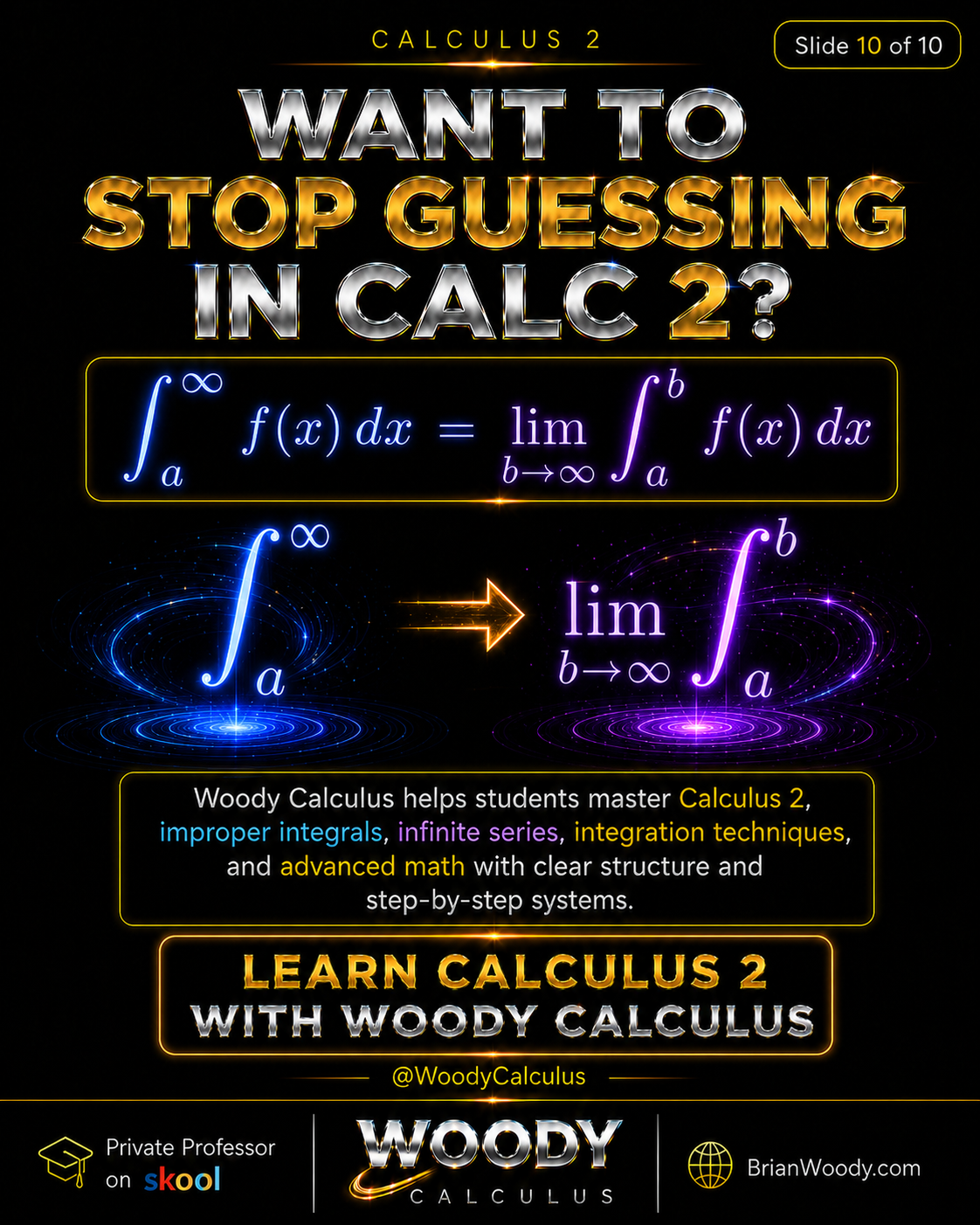
Learn Calculus 2 with Woody Calculus on Skool
Woody Calculus Private Professor on Skool is built for serious students who want structure, clarity, and mastery in Calculus 2, Calculus 3, Differential Equations, Linear Algebra, and advanced mathematics.
Inside the Woody Calculus Mastery Lab, students train through complete step-by-step explanations, exam preparation, homework support, formula memorization, pattern recognition, and mathematical fluency.
This is not casual tutoring. This is structured mathematical training.
Private Instruction
Brian M. Woody works privately with a limited number of serious students who need one-on-one help in Calculus II, Calculus III, Differential Equations, Linear Algebra, and advanced mathematics.
Private instruction is reserved for serious students, requires weekly sessions, requires enrollment in the Woody Calculus Mastery Lab first, and approval is not guaranteed.
Students interested in private instruction can learn more here: Private Math Tutor and Advanced Mathematics Instruction.
About the Author: Brian M. Woody
Brian M. Woody is a professional mathematics educator with more than 25 years of university-level teaching experience. Through Woody Calculus, he provides rigorous, exam-focused training in Calculus II, Calculus III, Differential Equations, Linear Algebra, Abstract Algebra, Real Analysis, and advanced mathematics. His teaching emphasizes clean definitions, formula memorization, proof structure, visual intuition, pattern recognition, rewriting perfect solutions, and saying each step out loud until the method becomes automatic.
Top University Calculus 2 Help Pages
Woody Calculus supports students at major universities with structured help in Calculus 2, Calculus 3, Differential Equations, Linear Algebra, and advanced mathematics. For the full list of supported schools, visit the University Calculus Tutor Hub.
- Purdue University Calculus Tutor
- University of Florida Calculus Tutor
- University of Central Florida Calculus Tutor
- Auburn University Calculus Tutor
- University of Arizona Calculus Tutor
- Arizona State University Calculus Tutor
- Colorado State University Calculus Help
- University of Nevada, Reno Calculus Tutor
- University of Wisconsin Calculus Tutor
- Penn State Calculus Tutor
- Texas A&M Calculus Tutor
- University of Michigan Calculus Tutor
- UCLA Calculus Tutor
- UC Berkeley Calculus Tutor
- MIT Calculus Tutor
- University of Tennessee Knoxville Calculus Tutor
- Caltech Calculus Tutor
- Lehigh University Calculus Tutor
- University of Miami Calculus Tutor
- Colorado School of Mines Calculus Tutor