Trig substitution is one of the most feared topics in Calculus 2, but it becomes much easier when students stop guessing and start matching patterns.
The entire technique comes down to one idea:
Match the radical to the correct trigonometric identity.
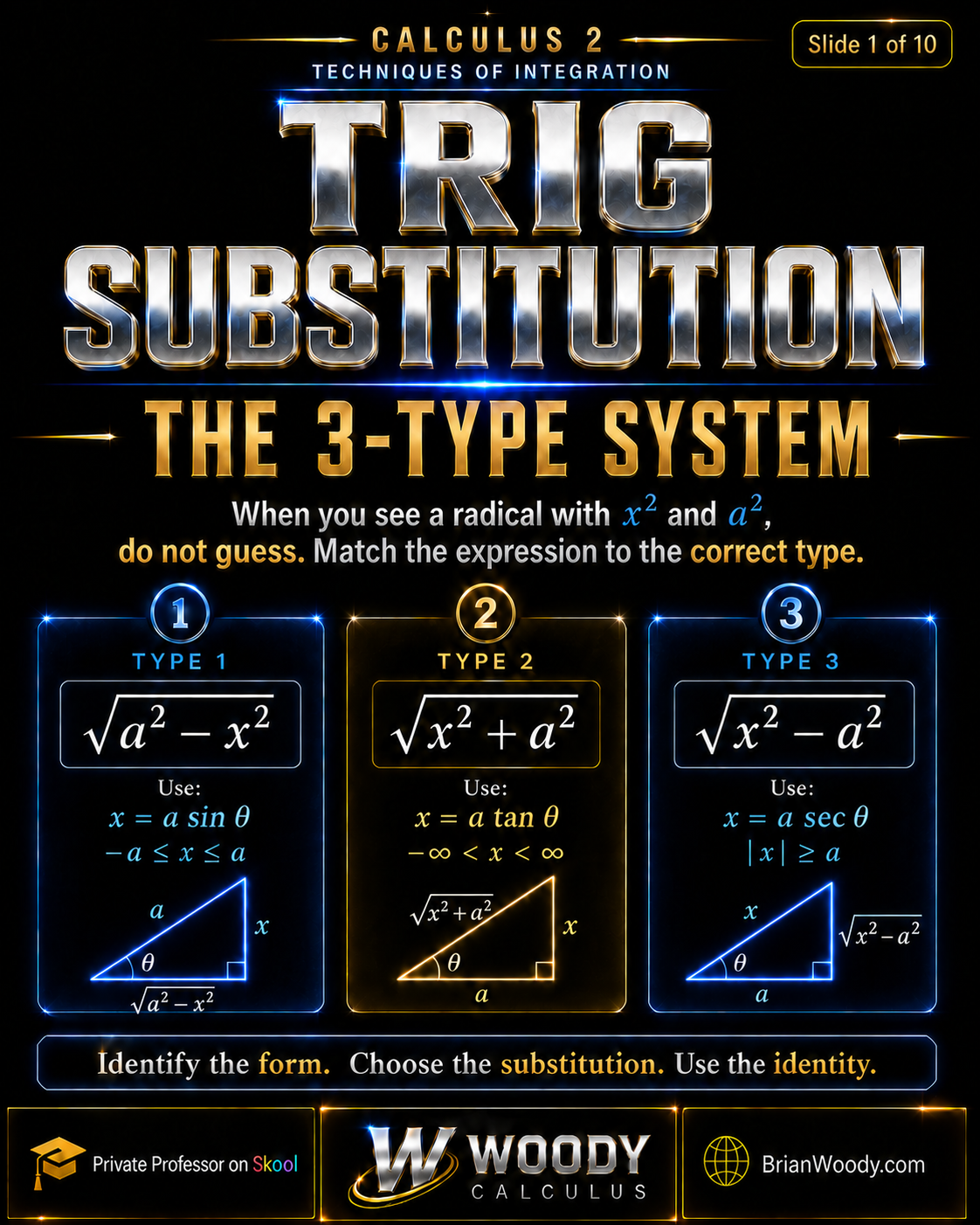
When you see a radical involving \(x^2\) and \(a^2\), there are only three standard types:
\sqrt{a^2-x^2},\qquad
\sqrt{x^2+a^2},\qquad
\sqrt{x^2-a^2}.
\]
Each type has its own substitution:
\sqrt{a^2-x^2}\Rightarrow x=a\sin\theta,
\qquad
\sqrt{x^2+a^2}\Rightarrow x=a\tan\theta,
\qquad
\sqrt{x^2-a^2}\Rightarrow x=a\sec\theta.
\]
This Woody Calculus lesson teaches the 3-type system for trigonometric substitution. It is designed for Calculus 2 students who are learning techniques of integration, especially students who need a reliable system for choosing the right substitution, simplifying the radical, integrating in \(\theta\), and converting the answer back to \(x\).
Estimated read time: 14–18 minutes.
Last updated: July 7, 2026.
Quick Summary: Trig Substitution in Calculus 2
- Trig substitution is used when an integral contains a radical involving \(x^2\) and \(a^2\).
- Type I: \(\sqrt{a^2-x^2}\), use \(x=a\sin\theta\).
- Type II: \(\sqrt{x^2+a^2}\), use \(x=a\tan\theta\).
- Type III: \(\sqrt{x^2-a^2}\), use \(x=a\sec\theta\).
- The substitution turns the radical into a trig identity.
- After substituting, integrate with respect to \(\theta\).
- Never leave the final answer in \(\theta\). Use a triangle to convert back to \(x\).
Trig Substitution Key Facts
- Trig substitution is a Calculus 2 integration technique for radical expressions.
- The expression under the square root tells you which substitution to use.
- \(\sqrt{a^2-x^2}\) matches \(\sin^2\theta+\cos^2\theta=1\).
- \(\sqrt{x^2+a^2}\) matches \(1+\tan^2\theta=\sec^2\theta\).
- \(\sqrt{x^2-a^2}\) matches \(\sec^2\theta-1=\tan^2\theta\).
- Each substitution creates a triangle that converts the final answer back to \(x\).
- Trig substitution is part of the broader Calculus 2 toolbox alongside integration techniques, improper integrals, sequences, series, and Taylor series.
What Is Trig Substitution?
Trig substitution is a Calculus 2 integration technique used to simplify integrals containing radicals such as:
\sqrt{a^2-x^2},\qquad
\sqrt{x^2+a^2},\qquad
\sqrt{x^2-a^2}.
\]
These radicals are difficult because the variable appears inside a square root. The purpose of trig substitution is to replace \(x\) with a trigonometric expression so the radical simplifies using a Pythagorean identity.
The method sounds complicated until you realize that each radical has a matching identity:
- \(1-\sin^2\theta=\cos^2\theta\)
- \(1+\tan^2\theta=\sec^2\theta\)
- \(\sec^2\theta-1=\tan^2\theta\)
That is the entire game. Identify the radical, choose the substitution, use the identity, integrate, and convert back.
The Woody Calculus 3-Type System
The Woody Calculus 3-type system gives students a fast way to choose the substitution without guessing.
| Type | Radical Form | Use This Substitution | Identity | Main Triangle |
|---|---|---|---|---|
| Type I | \(\sqrt{a^2-x^2}\) | \(x=a\sin\theta\) | \(1-\sin^2\theta=\cos^2\theta\) | Hypotenuse \(a\), opposite \(x\) |
| Type II | \(\sqrt{x^2+a^2}\) | \(x=a\tan\theta\) | \(1+\tan^2\theta=\sec^2\theta\) | Adjacent \(a\), opposite \(x\) |
| Type III | \(\sqrt{x^2-a^2}\) | \(x=a\sec\theta\) | \(\sec^2\theta-1=\tan^2\theta\) | Adjacent \(a\), hypotenuse \(x\) |
The expression under the radical tells you the type. The type tells you the substitution. The substitution tells you the triangle.
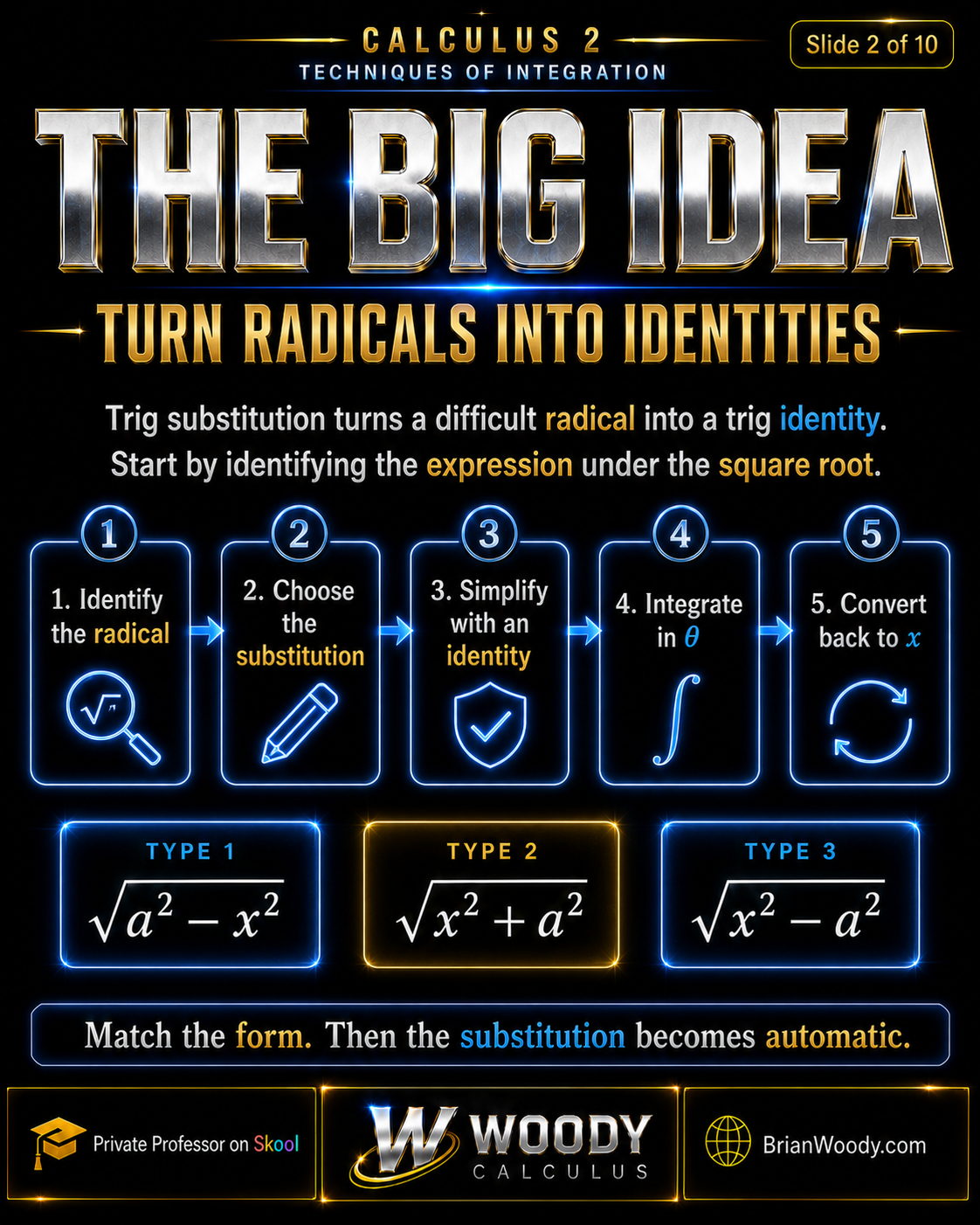
The Big Idea: Turn Radicals into Identities
Trig substitution turns a difficult radical into a trigonometric identity.
Follow these five steps to solve any trigonometric substitution integral:
- Identify the radical.
- Choose the substitution.
- Simplify with a trig identity.
- Integrate in \(\theta\).
- Convert back to \(x\).
Most student mistakes happen at step 1 or step 5. Students either choose the wrong substitution, or they integrate correctly but leave the answer in \(\theta\).
The Woody Calculus rule is:
Identify the form. Choose the substitution. Use the identity. Integrate in \(\theta\). Convert back to \(x\).
Type I: \(\sqrt{a^2-x^2}\)
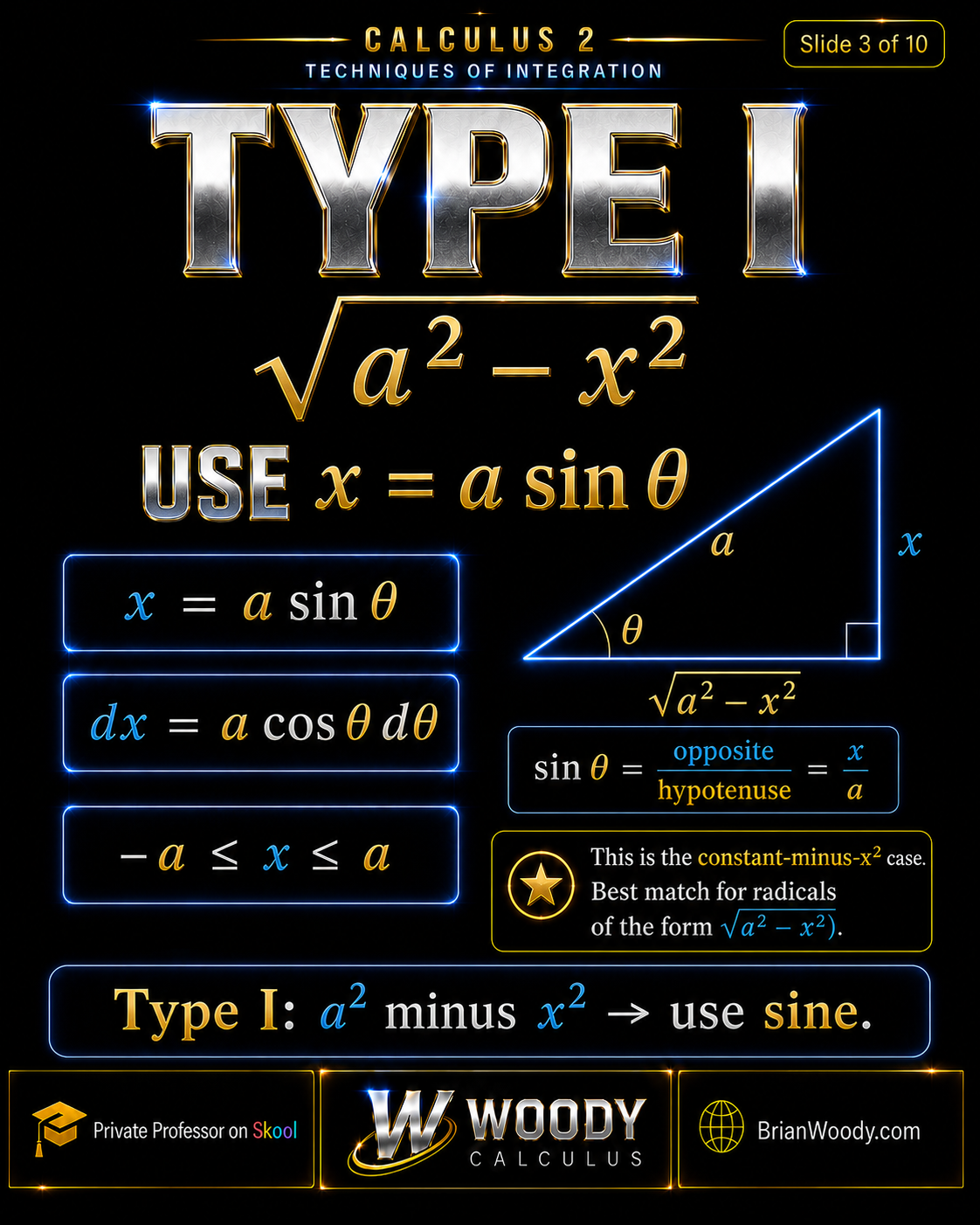
Type I is the constant-minus-\(x^2\) case:
\sqrt{a^2-x^2}.
\]
For this form, use:
x=a\sin\theta.
\]
Then:
dx=a\cos\theta\,d\theta.
\]
This substitution is natural because \(\sin\theta\) ranges between \(-1\) and \(1\), so:
-a\le x\le a.
\]
The reference triangle comes from:
\sin\theta=\frac{x}{a}.
\]
So the opposite side is \(x\), the hypotenuse is \(a\), and the adjacent side is:
\sqrt{a^2-x^2}.
\]
Why Type I Works
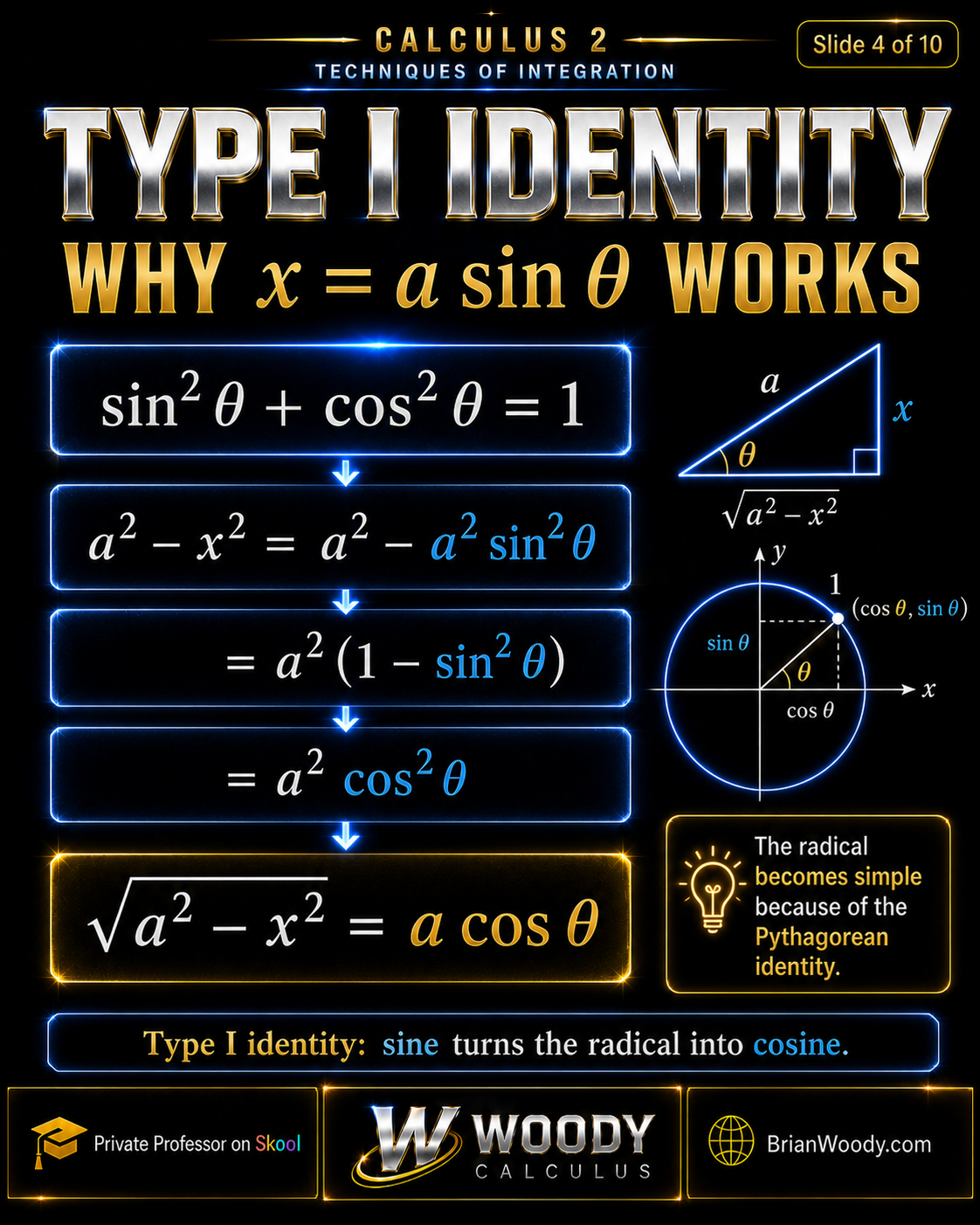
The reason \(x=a\sin\theta\) works is the identity:
\sin^2\theta+\cos^2\theta=1.
\]
Substitute \(x=a\sin\theta\) into the radical:
a^2-x^2
=
a^2-a^2\sin^2\theta.
\]
Factor out \(a^2\):
a^2-x^2
=
a^2(1-\sin^2\theta).
\]
Use \(1-\sin^2\theta=\cos^2\theta\):
a^2-x^2
=
a^2\cos^2\theta.
\]
Therefore:
\sqrt{a^2-x^2}
=
a\cos\theta.
\]
This simplification assumes the standard trig-substitution interval where \(\cos\theta\ge 0\), usually \(-\frac{\pi}{2}\le \theta\le \frac{\pi}{2}\).
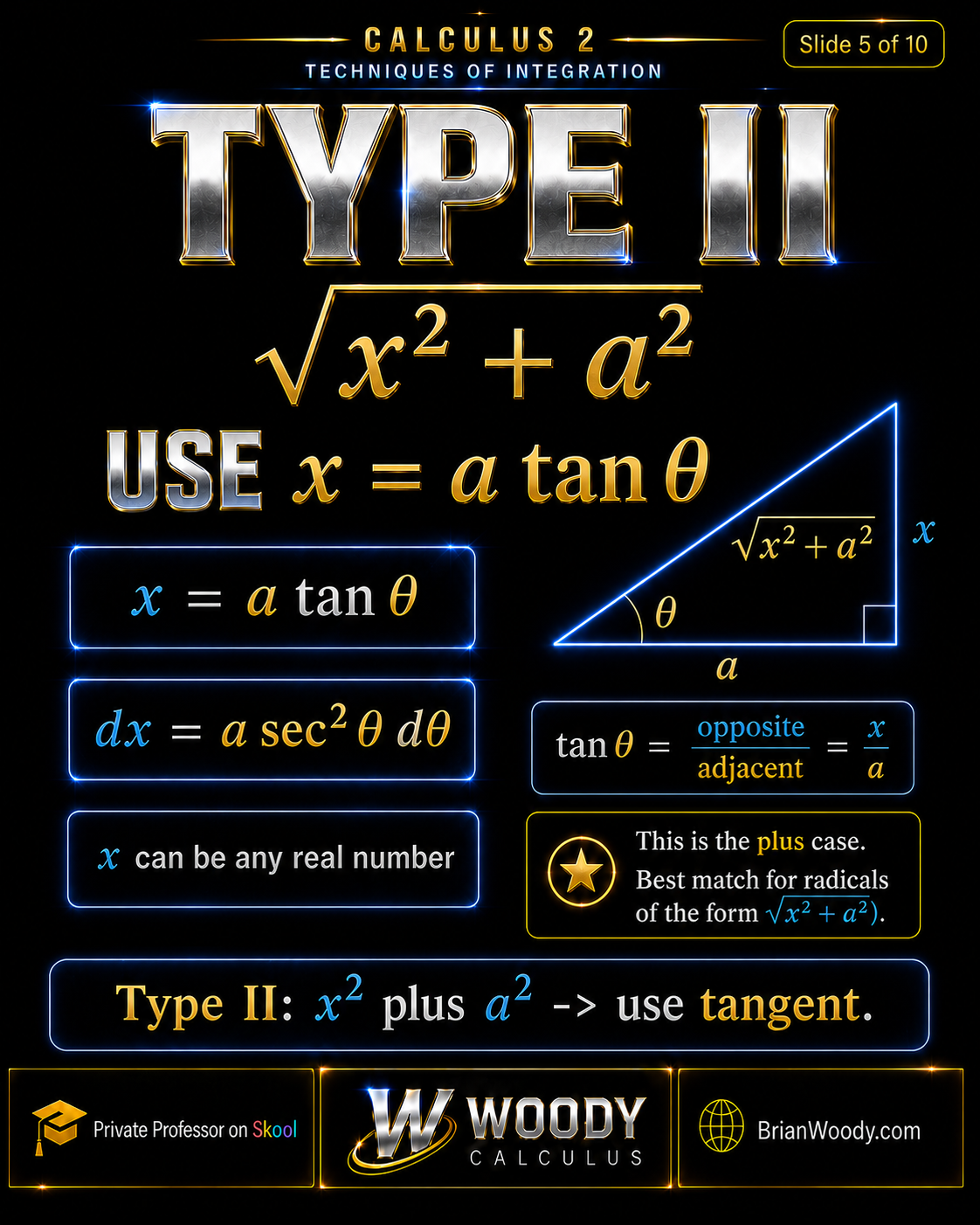
Type II: \(\sqrt{x^2+a^2}\)
Type II is the plus case:
\sqrt{x^2+a^2}.
\]
For this form, use:
x=a\tan\theta.
\]
Then:
dx=a\sec^2\theta\,d\theta.
\]
This substitution is natural because tangent can represent any real value:
-\infty
The reference triangle comes from:
\tan\theta=\frac{x}{a}.
\]
So the opposite side is \(x\), the adjacent side is \(a\), and the hypotenuse is:
\sqrt{x^2+a^2}.
\]
Why Type II Works
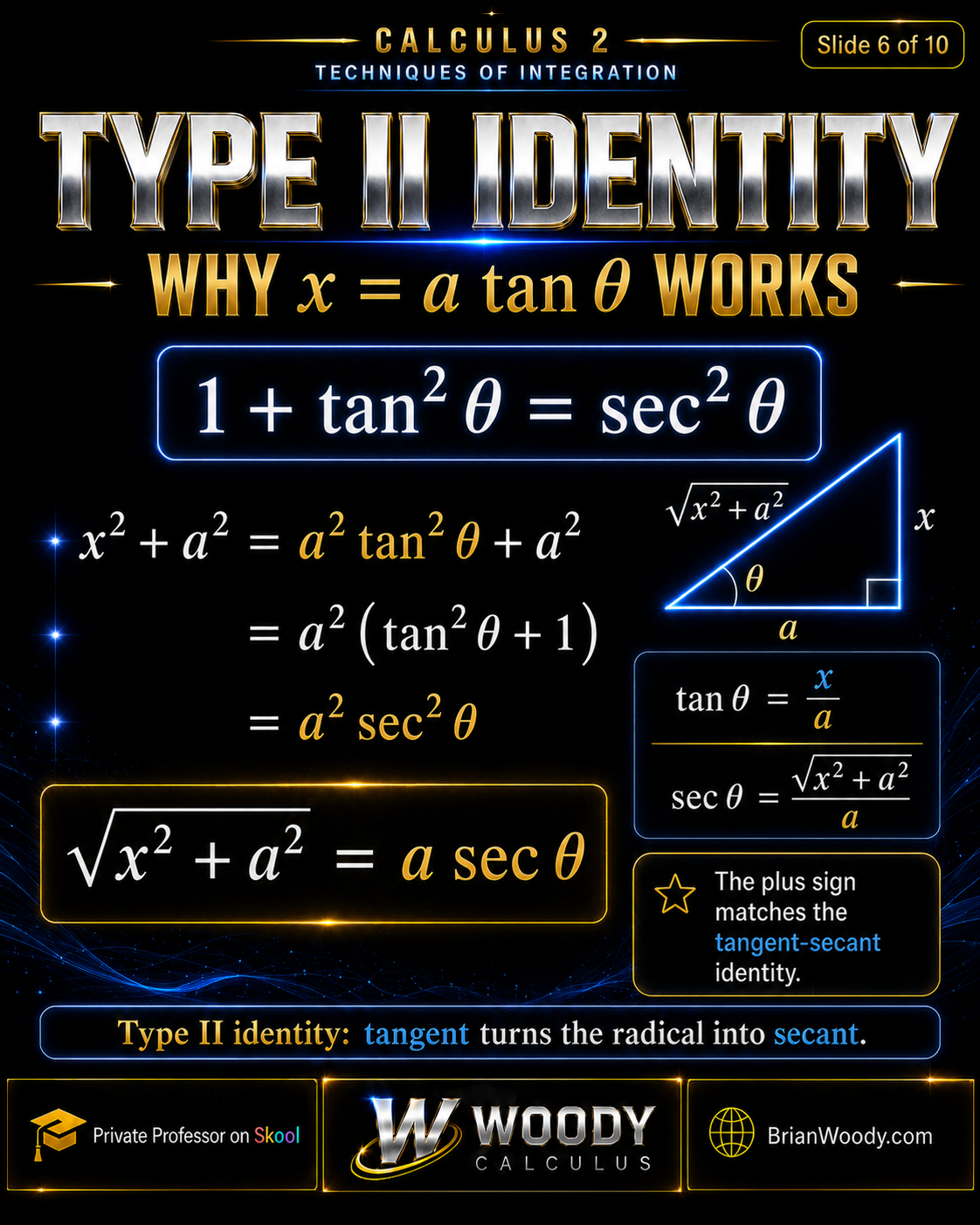
The reason \(x=a\tan\theta\) works is the identity:
1+\tan^2\theta=\sec^2\theta.
\]
Substitute \(x=a\tan\theta\) into the radical:
x^2+a^2
=
a^2\tan^2\theta+a^2.
\]
Factor out \(a^2\):
x^2+a^2
=
a^2(\tan^2\theta+1).
\]
Use \(1+\tan^2\theta=\sec^2\theta\):
x^2+a^2
=
a^2\sec^2\theta.
\]
Therefore:
\sqrt{x^2+a^2}
=
a\sec\theta.
\]
This simplification uses the standard interval \(-\frac{\pi}{2}<\theta<\frac{\pi}{2}\), where \(\sec\theta>0\).
Type III: \(\sqrt{x^2-a^2}\)
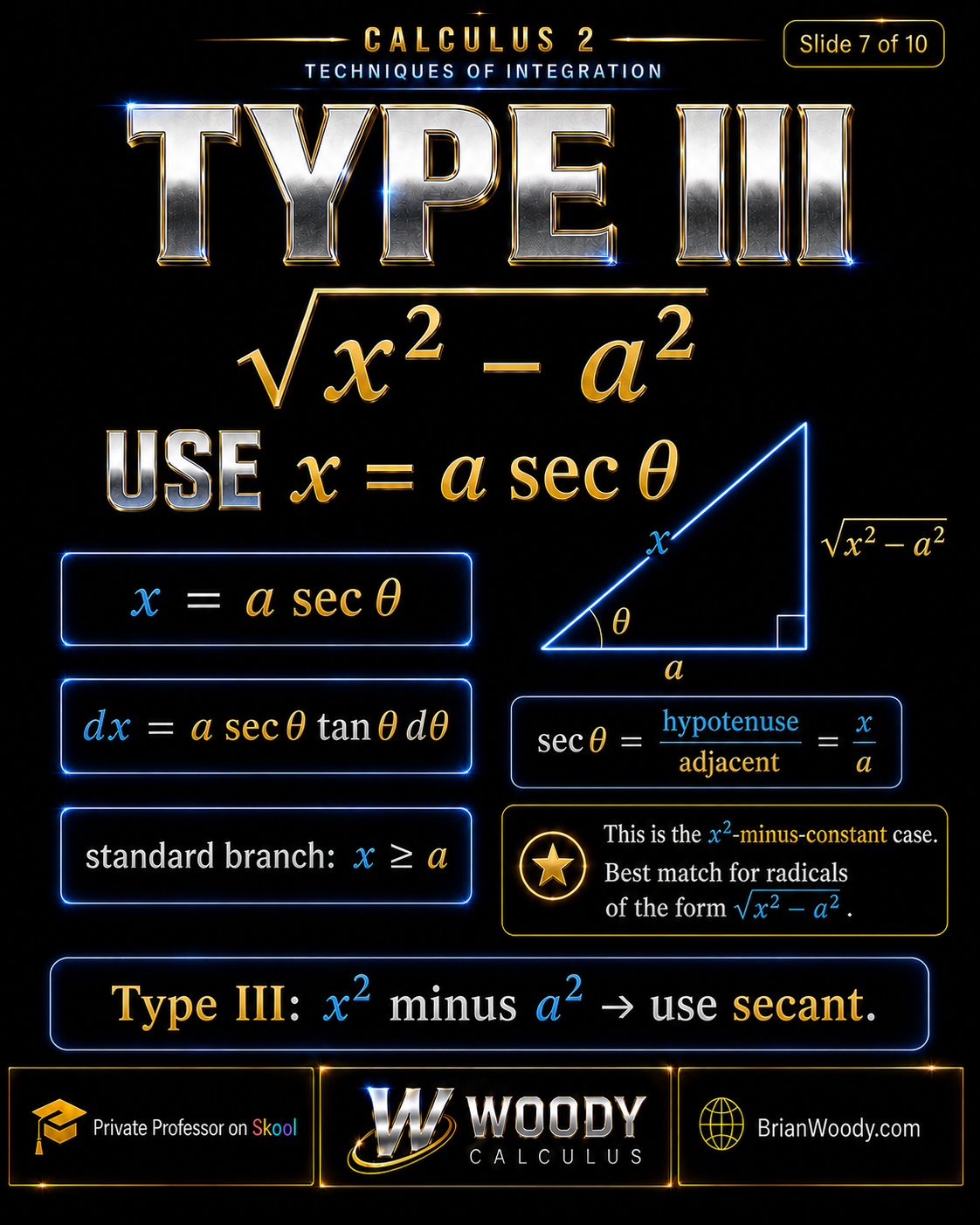
Type III is the \(x^2\)-minus-constant case:
\sqrt{x^2-a^2}.
\]
For this form, use:
x=a\sec\theta.
\]
Then:
dx=a\sec\theta\tan\theta\,d\theta.
\]
The standard branch is:
x\ge a.
\]
The reference triangle comes from:
\sec\theta=\frac{x}{a}.
\]
So the hypotenuse is \(x\), the adjacent side is \(a\), and the opposite side is:
\sqrt{x^2-a^2}.
\]
For the negative branch \(x\le -a\), instructors may choose a different convention or handle signs carefully. In most Calculus 2 examples, the standard branch \(x\ge a\) is used while teaching the method.
Why Type III Works
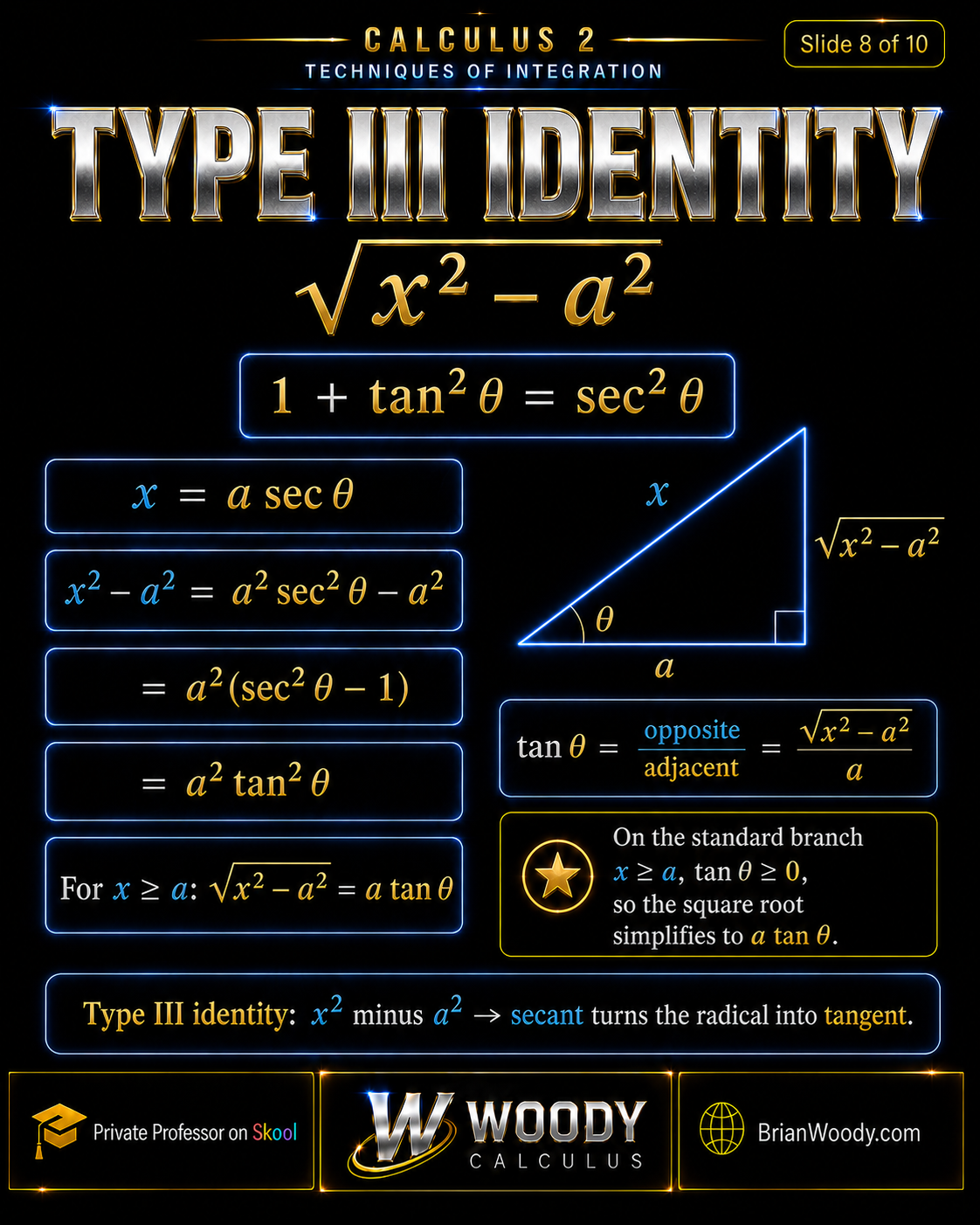
The reason \(x=a\sec\theta\) works is the identity:
\sec^2\theta-1=\tan^2\theta.
\]
Substitute \(x=a\sec\theta\) into the radical:
x^2-a^2
=
a^2\sec^2\theta-a^2.
\]
Factor out \(a^2\):
x^2-a^2
=
a^2(\sec^2\theta-1).
\]
Use \(\sec^2\theta-1=\tan^2\theta\):
x^2-a^2
=
a^2\tan^2\theta.
\]
On the standard branch \(x\ge a\), take \(\tan\theta\ge 0\), so:
\sqrt{x^2-a^2}
=
a\tan\theta.
\]
This branch detail matters. Without it, the square root would technically involve an absolute value:
\sqrt{a^2\tan^2\theta}=a|\tan\theta|.
\]
The standard branch lets us write \(a\tan\theta\) cleanly.
Convert Back to \(x\)
This is the step students forget most often:
Integrate in \(\theta\). Answer in \(x\).
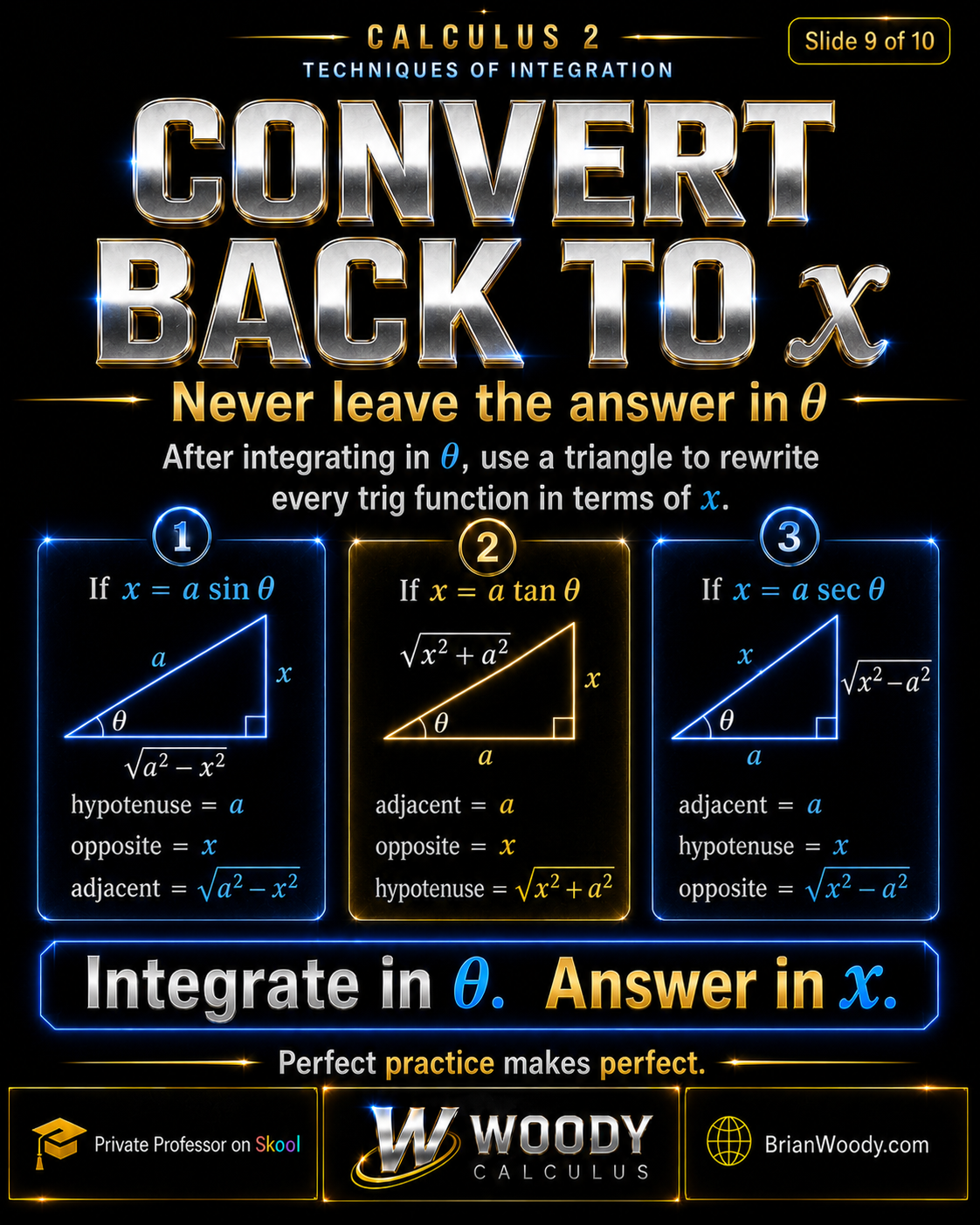
After integrating, use the reference triangle to rewrite every trig function in terms of \(x\).
Type I Triangle
If:
x=a\sin\theta,
\]
then:
\sin\theta=\frac{x}{a}.
\]
The triangle has:
- hypotenuse \(a\),
- opposite side \(x\),
- adjacent side \(\sqrt{a^2-x^2}\).
Type II Triangle
If:
x=a\tan\theta,
\]
then:
\tan\theta=\frac{x}{a}.
\]
The triangle has:
- adjacent side \(a\),
- opposite side \(x\),
- hypotenuse \(\sqrt{x^2+a^2}\).
Type III Triangle
If:
x=a\sec\theta,
\]
then:
\sec\theta=\frac{x}{a}.
\]
The triangle has:
- adjacent side \(a\),
- hypotenuse \(x\),
- opposite side \(\sqrt{x^2-a^2}\).
Worked Examples
Worked Example 1: Type I Integral
Evaluate:
\int \frac{dx}{\sqrt{a^2-x^2}}.
\]
This is Type I because the radical is:
\sqrt{a^2-x^2}.
\]
Use:
x=a\sin\theta,
\qquad
dx=a\cos\theta\,d\theta.
\]
Then:
\sqrt{a^2-x^2}=a\cos\theta.
\]
Substitute into the integral:
\int \frac{dx}{\sqrt{a^2-x^2}}
=
\int \frac{a\cos\theta\,d\theta}{a\cos\theta}.
\]
Simplify:
\int d\theta=\theta+C.
\]
Since \(x=a\sin\theta\), we have:
\theta=\arcsin\left(\frac{x}{a}\right).
\]
Therefore:
\boxed{
\int \frac{dx}{\sqrt{a^2-x^2}}
=
\arcsin\left(\frac{x}{a}\right)+C.
}
\]
Plain-language formula: The integral of 1/sqrt(a^2 – x^2) is arcsin(x/a) + C.
Worked Example 2: Type II Integral
Evaluate:
\int \frac{dx}{\sqrt{x^2+a^2}}.
\]
This is Type II because the radical is:
\sqrt{x^2+a^2}.
\]
Use:
x=a\tan\theta,
\qquad
dx=a\sec^2\theta\,d\theta.
\]
Then:
\sqrt{x^2+a^2}=a\sec\theta.
\]
Substitute into the integral:
\int \frac{dx}{\sqrt{x^2+a^2}}
=
\int \frac{a\sec^2\theta\,d\theta}{a\sec\theta}.
\]
Simplify:
\int \sec\theta\,d\theta.
\]
Use:
\int \sec\theta\,d\theta
=
\ln|\sec\theta+\tan\theta|+C.
\]
From the Type II triangle:
\tan\theta=\frac{x}{a},
\qquad
\sec\theta=\frac{\sqrt{x^2+a^2}}{a}.
\]
So:
\ln|\sec\theta+\tan\theta|
=
\ln\left|\frac{\sqrt{x^2+a^2}+x}{a}\right|.
\]
The constant \(\ln(a)\) can be absorbed into \(C\), so:
\boxed{
\int \frac{dx}{\sqrt{x^2+a^2}}
=
\ln|x+\sqrt{x^2+a^2}|+C.
}
\]
Plain-language formula: The integral of 1/sqrt(x^2 + a^2) is ln|x + sqrt(x^2 + a^2)| + C.
Worked Example 3: Type III Integral
Evaluate:
\int \frac{dx}{\sqrt{x^2-a^2}}.
\]
This is Type III because the radical is:
\sqrt{x^2-a^2}.
\]
Use:
x=a\sec\theta,
\qquad
dx=a\sec\theta\tan\theta\,d\theta.
\]
On the standard branch:
\sqrt{x^2-a^2}=a\tan\theta.
\]
Substitute into the integral:
\int \frac{dx}{\sqrt{x^2-a^2}}
=
\int
\frac{a\sec\theta\tan\theta\,d\theta}{a\tan\theta}.
\]
Simplify:
\int \sec\theta\,d\theta.
\]
Therefore:
\int \sec\theta\,d\theta
=
\ln|\sec\theta+\tan\theta|+C.
\]
From the Type III triangle:
\sec\theta=\frac{x}{a},
\qquad
\tan\theta=\frac{\sqrt{x^2-a^2}}{a}.
\]
So:
\ln|\sec\theta+\tan\theta|
=
\ln\left|\frac{x+\sqrt{x^2-a^2}}{a}\right|.
\]
Again, the constant \(\ln(a)\) is absorbed into \(C\), giving:
\boxed{
\int \frac{dx}{\sqrt{x^2-a^2}}
=
\ln|x+\sqrt{x^2-a^2}|+C.
}
\]
Plain-language formula: The integral of 1/sqrt(x^2 – a^2) is ln|x + sqrt(x^2 – a^2)| + C.
Common Mistakes
Mistake 1: Guessing the substitution
Do not guess. The radical tells you the substitution. Match the form:
- \(a^2-x^2\) means sine.
- \(x^2+a^2\) means tangent.
- \(x^2-a^2\) means secant.
Mistake 2: Forgetting \(dx\)
The substitution is not complete until you compute \(dx\):
x=a\sin\theta \Rightarrow dx=a\cos\theta\,d\theta,
\]
x=a\tan\theta \Rightarrow dx=a\sec^2\theta\,d\theta,
\]
x=a\sec\theta \Rightarrow dx=a\sec\theta\tan\theta\,d\theta.
\]
Mistake 3: Leaving the answer in \(\theta\)
Trig substitution introduces \(\theta\), but the original problem is written in \(x\). The final answer must be converted back to \(x\).
Mistake 4: Ignoring branch restrictions
The square root is nonnegative. That is why we choose standard intervals for \(\theta\) so expressions like \(a\cos\theta\), \(a\sec\theta\), or \(a\tan\theta\) match the positive square root.
Mistake 5: Mixing up Type II and Type III
Students often confuse:
\sqrt{x^2+a^2}
\quad\text{and}\quad
\sqrt{x^2-a^2}.
\]
Remember:
- Plus means tangent.
- \(x^2\) minus \(a^2\) means secant.
Trig Substitution Cheat Sheet
| Radical | Substitution | \(dx\) | Radical Simplifies To | Triangle Ratio |
|---|---|---|---|---|
| \(\sqrt{a^2-x^2}\) | \(x=a\sin\theta\) | \(dx=a\cos\theta\,d\theta\) | \(a\cos\theta\) | \(\sin\theta=x/a\) |
| \(\sqrt{x^2+a^2}\) | \(x=a\tan\theta\) | \(dx=a\sec^2\theta\,d\theta\) | \(a\sec\theta\) | \(\tan\theta=x/a\) |
| \(\sqrt{x^2-a^2}\) | \(x=a\sec\theta\) | \(dx=a\sec\theta\tan\theta\,d\theta\) | \(a\tan\theta\) | \(\sec\theta=x/a\) |
Trig Substitution FAQ
What is trig substitution?
Trig substitution is a Calculus 2 integration technique where \(x\) is replaced by a trigonometric expression to simplify radicals involving \(x^2\) and \(a^2\).
When should I use trig substitution?
Use trig substitution when an integral contains radicals such as \(\sqrt{a^2-x^2}\), \(\sqrt{x^2+a^2}\), or \(\sqrt{x^2-a^2}\), especially when simpler methods like \(u\)-substitution do not work.
How do I know which trig substitution to use?
Match the radical form. For \(\sqrt{a^2-x^2}\), use \(x=a\sin\theta\). For \(\sqrt{x^2+a^2}\), use \(x=a\tan\theta\). For \(\sqrt{x^2-a^2}\), use \(x=a\sec\theta\).
Why does \(\sqrt{a^2-x^2}\) use sine?
Because substituting \(x=a\sin\theta\) turns the expression under the radical into \(a^2\cos^2\theta\). Taking the square root then simplifies the entire difficult radical down to \(a\cos\theta\).
Why does \(\sqrt{x^2+a^2}\) use tangent?
Because substituting \(x=a\tan\theta\) turns the expression under the radical into \(a^2\sec^2\theta\). Taking the square root then simplifies the entire difficult radical down to \(a\sec\theta\).
Why does \(\sqrt{x^2-a^2}\) use secant?
Because substituting \(x=a\sec\theta\) turns the expression under the radical into \(a^2\tan^2\theta\). On the standard branch, taking the square root then simplifies the entire difficult radical down to \(a\tan\theta\).
Do I leave my final answer in \(\theta\)?
No. Trig substitution introduces \(\theta\) temporarily, but the original integral is in \(x\). The final answer should be converted back to \(x\) using the reference triangle.
Why do branches matter in trig substitution?
Branches matter because square roots are nonnegative. Standard intervals for \(\theta\) are chosen so expressions like \(a\cos\theta\), \(a\sec\theta\), or \(a\tan\theta\) match the positive square root.
Master Trig Substitution with Woody Calculus
Trig substitution is not about memorizing random tricks. It is about recognizing structure. Once students learn the 3-type system, the technique becomes much more predictable.
The Woody Calculus method is:
- Identify the radical.
- Match the radical to the correct type.
- Choose the substitution.
- Use the identity.
- Integrate in \(\theta\).
- Convert back to \(x\).
- Rely on strict formula memorization, rewrite perfect solutions, and say each step out loud until the pattern becomes automatic.
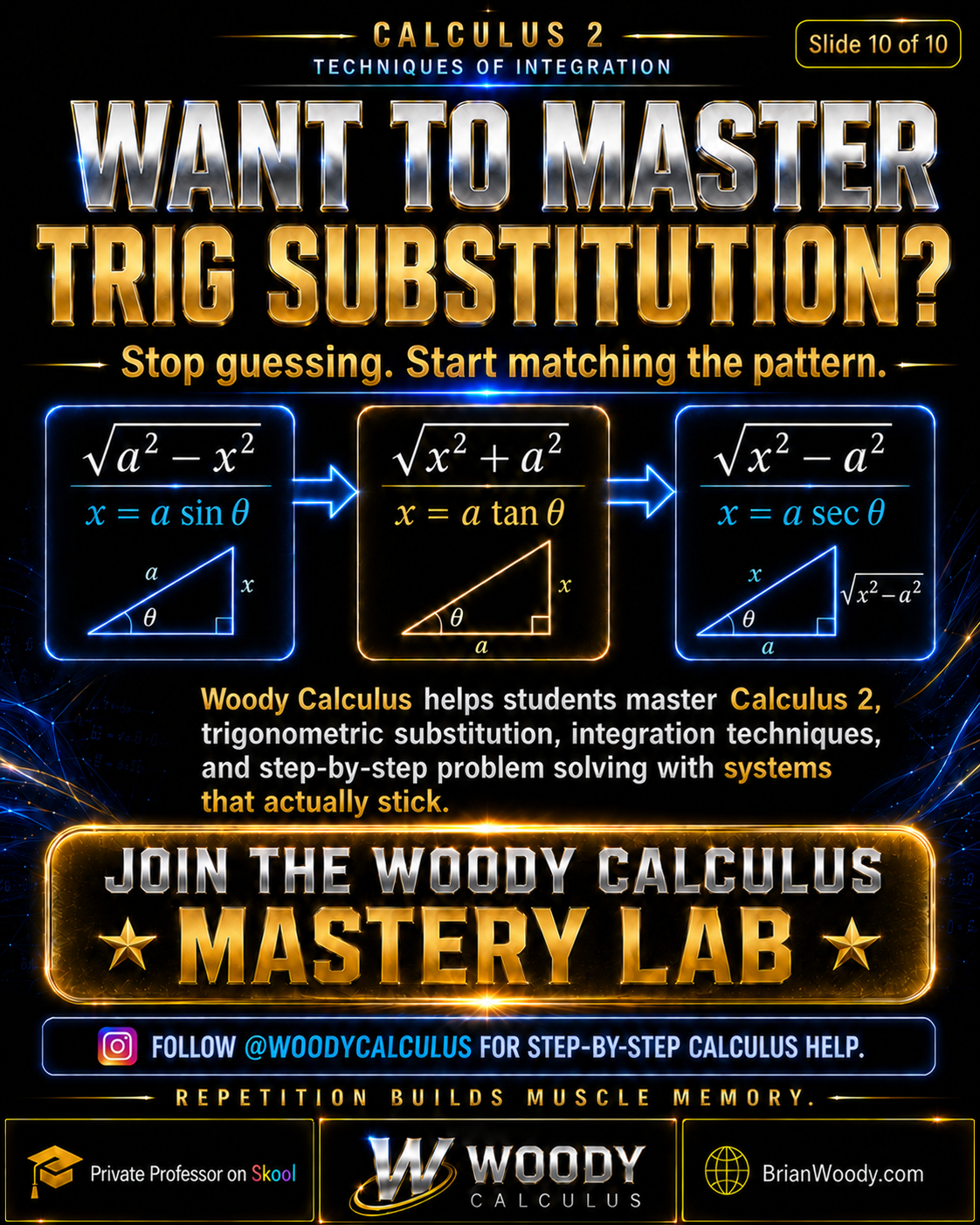
For students who want structured Calculus 2 help, join the Woody Calculus Mastery Lab. The Mastery Lab helps students build skill through repetition, step-by-step lessons, written solutions, exam-focused systems, and direct support.
You can also visit Woody Calculus on Skool for the learning community.
Related Woody Calculus Mathematical Essays
Explore more Woody Calculus lessons connecting Calculus 2, integration techniques, infinite series, Taylor series, convergence, Differential Equations, Linear Algebra, and advanced mathematics.
- How to Learn Calculus and Advanced Mathematics: A Peak Performance Study Guide
- Taylor Series Explained: Mathematical Time Travel in Calculus 2
- Radius of Convergence and Interval of Convergence Explained
- Gabriel’s Horn Explained: Finite Volume and Infinite Surface Area
- Laplace Transforms Explained: Differential Equations Become Algebra
- Eigenvalues and Eigenvectors Explained
- The Determinant Explained
- Line Integrals Explained: Vector Fields and Calculus 3
- View All Woody Calculus Blog Posts
Private Instruction
Brian M. Woody works privately with a limited number of serious students who need one-on-one help in Calculus II, Calculus III, Differential Equations, Linear Algebra, and advanced mathematics.
Private instruction is reserved for serious students, requires weekly sessions, requires enrollment in the Woody Calculus Mastery Lab first, and approval is not guaranteed.
Students interested in private instruction can learn more here: Private Math Tutor and Advanced Mathematics Instruction.
Related University Math Help Pages
Woody Calculus supports students at major universities with structured help in Calculus 2, Calculus 3, Differential Equations, Linear Algebra, and advanced mathematics. For the full list of supported schools, visit the University Calculus Tutor Hub.
- University Calculus Tutor Hub
- Purdue University Calculus Tutor
- University of Florida Calculus Tutor
- Colorado State University Calculus Help
- UCF Calculus Tutor
- University of Nevada, Reno Calculus Tutor
- Auburn Calculus Tutor
- University of Alabama Calculus Tutor
- University of Wisconsin Calculus Tutor
- University of Michigan Calculus Tutor
- UCLA Calculus Tutor
- MIT Calculus Tutor
Trusted by Students Nationwide
The Woody Calculus Mastery Lab gives university students access to structured mathematics support, written solutions, video lessons, exam-focused training, and expert guidance from Brian M. Woody.
Students use Woody Calculus for Calculus II, Calculus III, Differential Equations, Linear Algebra, Abstract Algebra, and other advanced mathematics courses.