Learn epsilon-delta proofs through visual intuition, exact definitions, and complete worked examples. This Woody Calculus real analysis lesson explains how to choose delta from epsilon, build local bounds, avoid common proof mistakes, and prove limits rigorously.
The Divergence Theorem converts outward flux through a closed surface into a triple integral of divergence over the enclosed solid. Learn the theorem’s conditions, flux and divergence meanings, method-selection rules, singularity warnings, and a complete sphere example with exact verification.
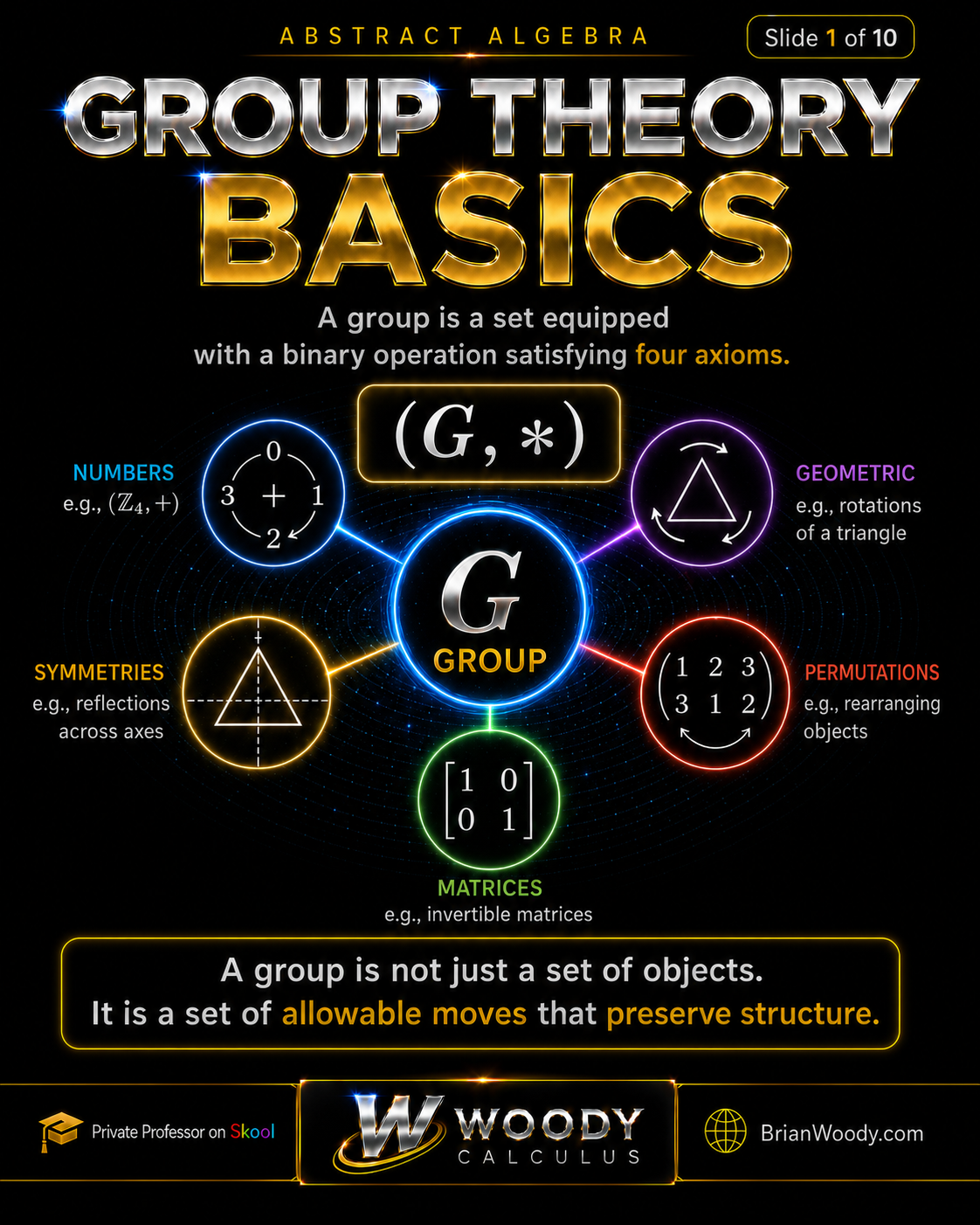
A group is a set with a binary operation satisfying closure, associativity, identity, and inverse axioms. Learn these four axioms through Z4, Cayley tables, element orders, generators, cyclic groups, and the symmetries of an equilateral triangle.
Euler’s method approximates the solution of an initial-value problem by repeatedly using the differential equation’s slope. Learn the update formula, complete a worked example, compare step sizes, and verify the approximation against an exact solution.
Why do gradients become parallel in constrained optimization? This Woody Calculus lesson explains the geometry and algebra of Lagrange multipliers, derives the system ∇f = λ∇g, and solves complete rectangle and box optimization examples.
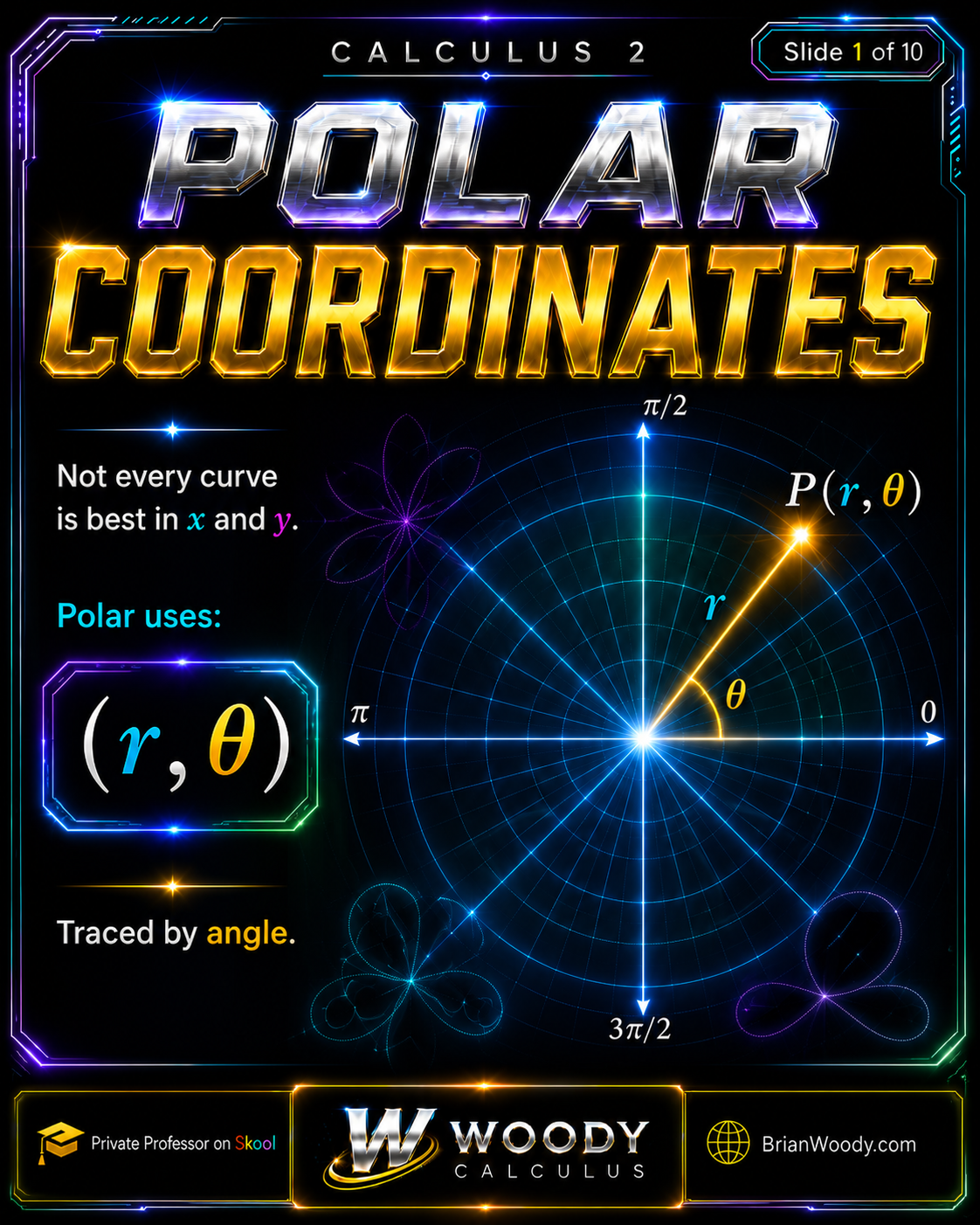
Polar coordinates describe a point using distance and angle instead of x and y. This Woody Calculus lesson explains r and θ, negative radius, graphing, symmetry tests, rose curves, cardioids, limaçons, and the polar area formula.
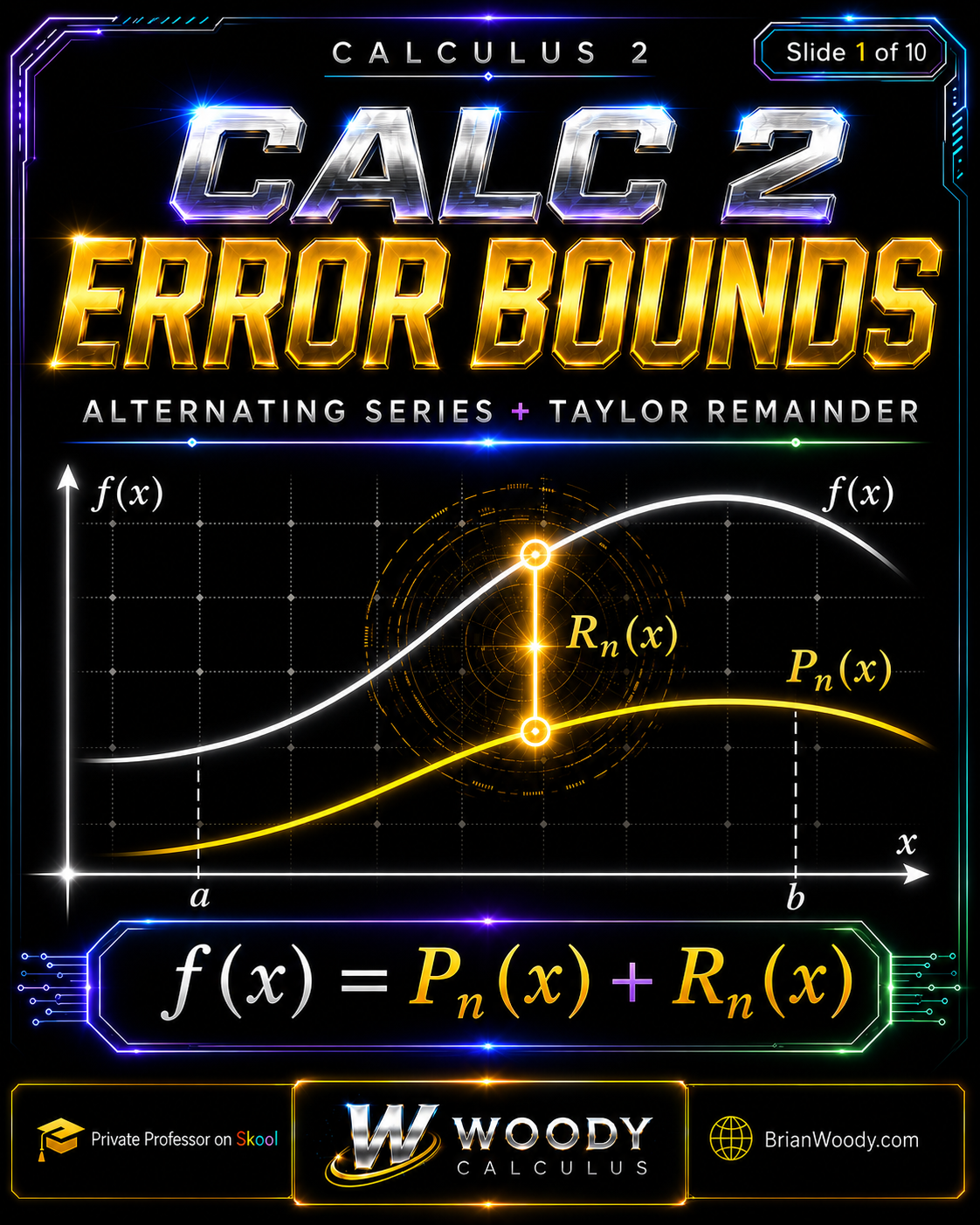
Error bounds tell students how accurate an approximation is. This Woody Calculus lesson compares alternating series error with Taylor remainder, explains the first omitted term rule, and shows how Taylor’s theorem controls polynomial approximation error.
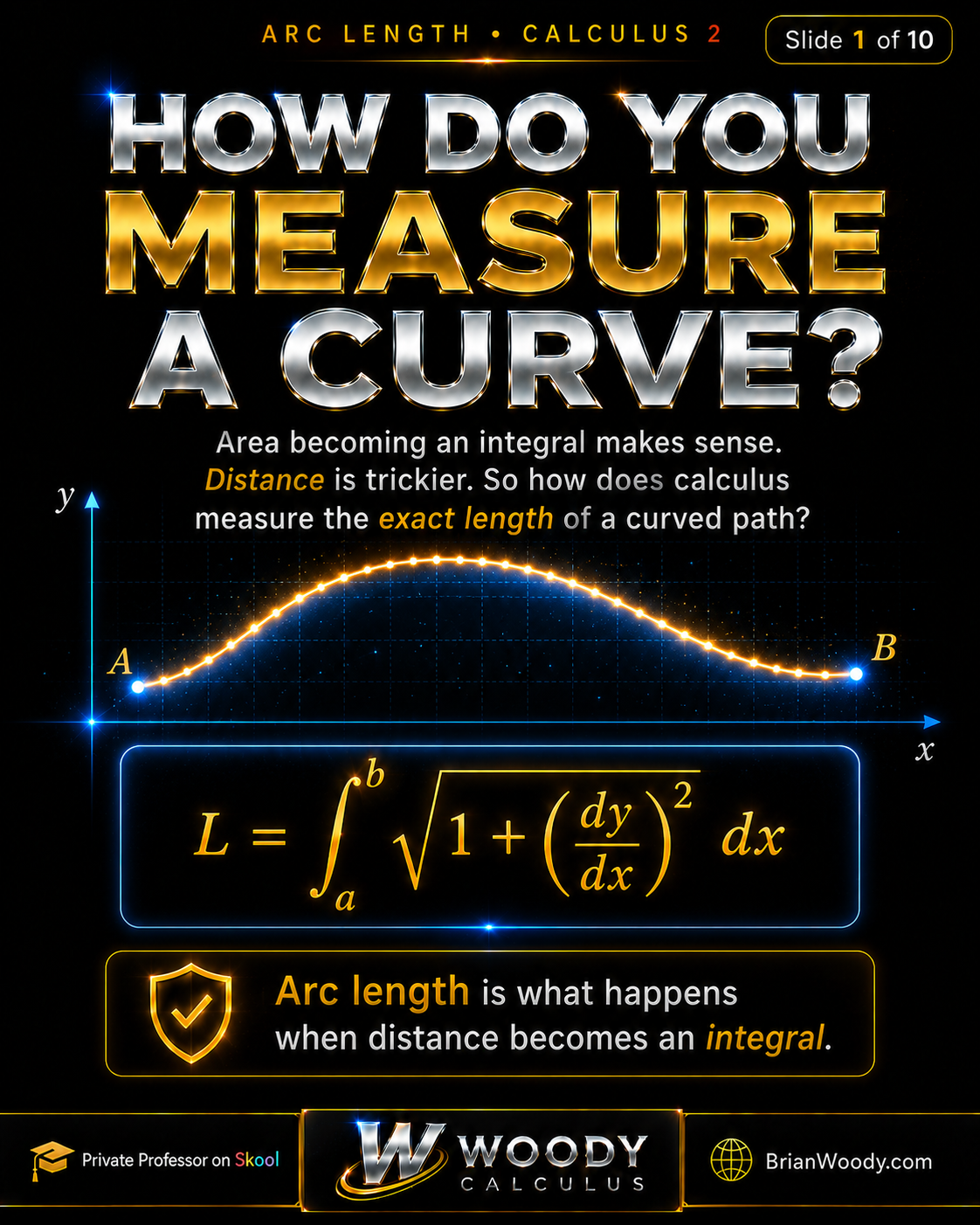
Arc length measures the exact distance along a curve by adding infinitely many tiny straight-line distances. This Woody Calculus lesson derives the formula, explains the ds triangle, and solves the classic hard arc length example step by step.
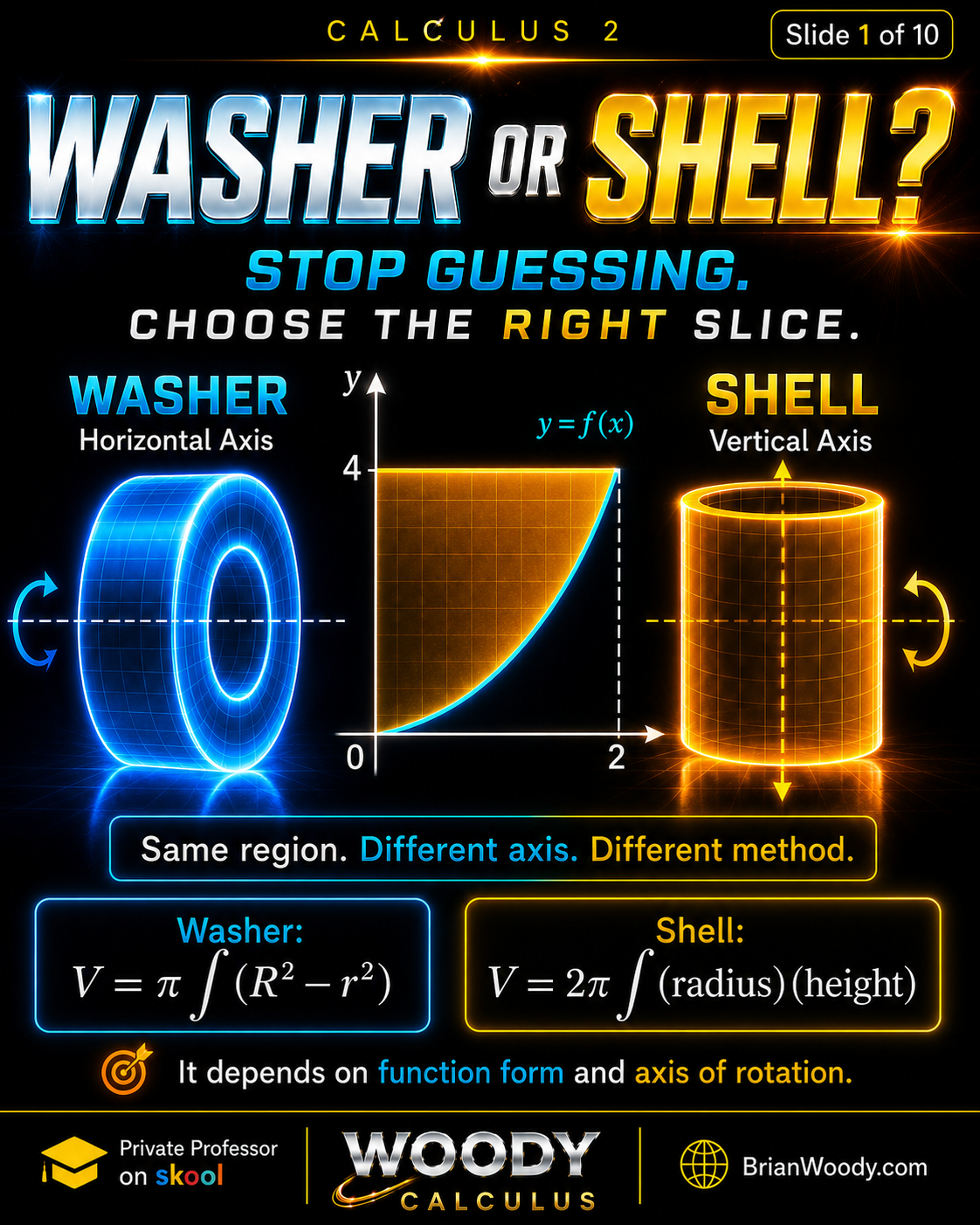
Washer method or shell method? This Woody Calculus lesson teaches the Calculus 2 decision rule for volumes of revolution: identify the function form, check the axis of rotation, choose the right slice, and build the correct volume integral.
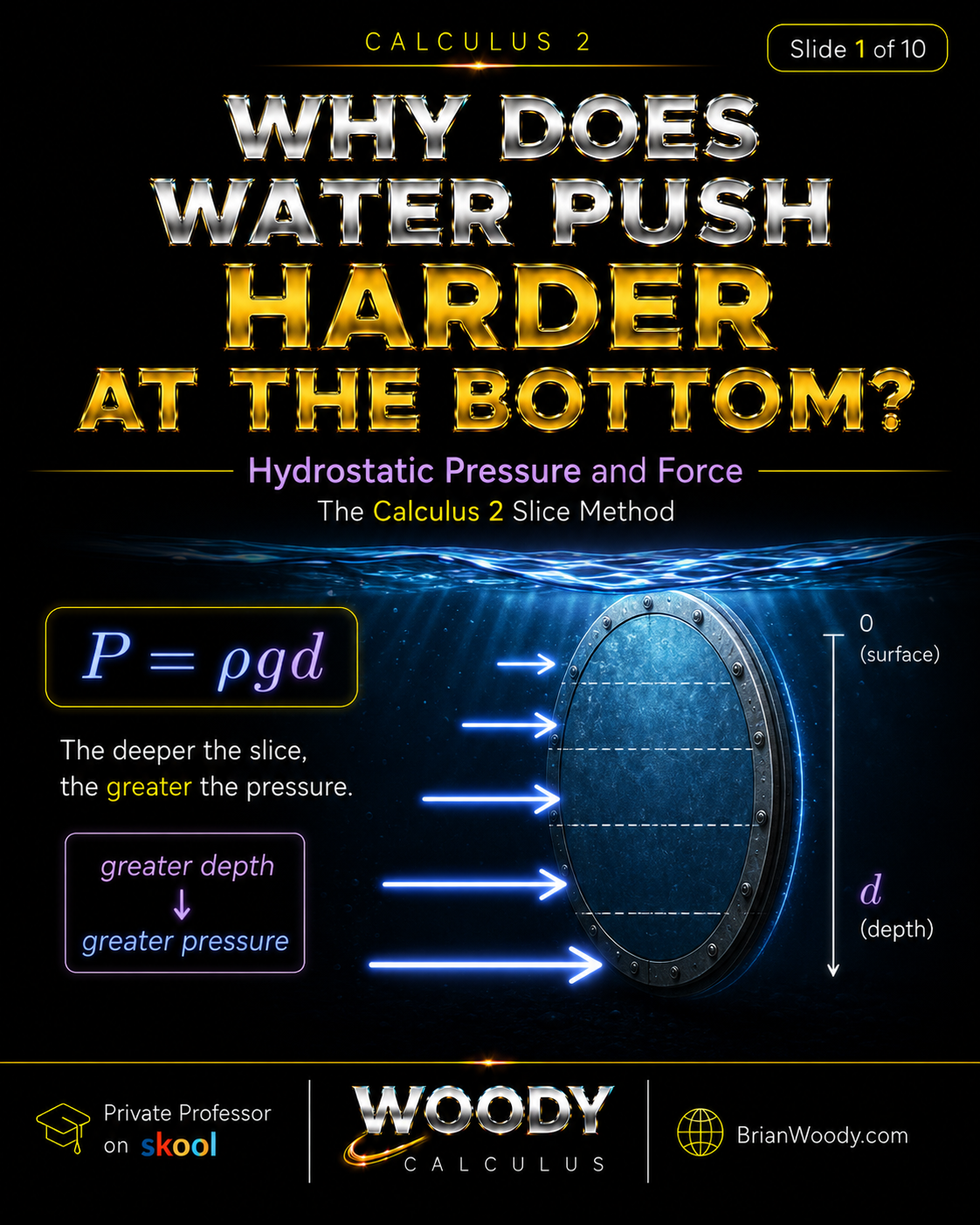
Hydrostatic force problems are Calculus 2 slice-method problems in disguise. This Woody Calculus lesson explains why force equals density times gravity times area times depth, why pressure changes with depth, and how to set up the hydrostatic force integral for a circular plate.