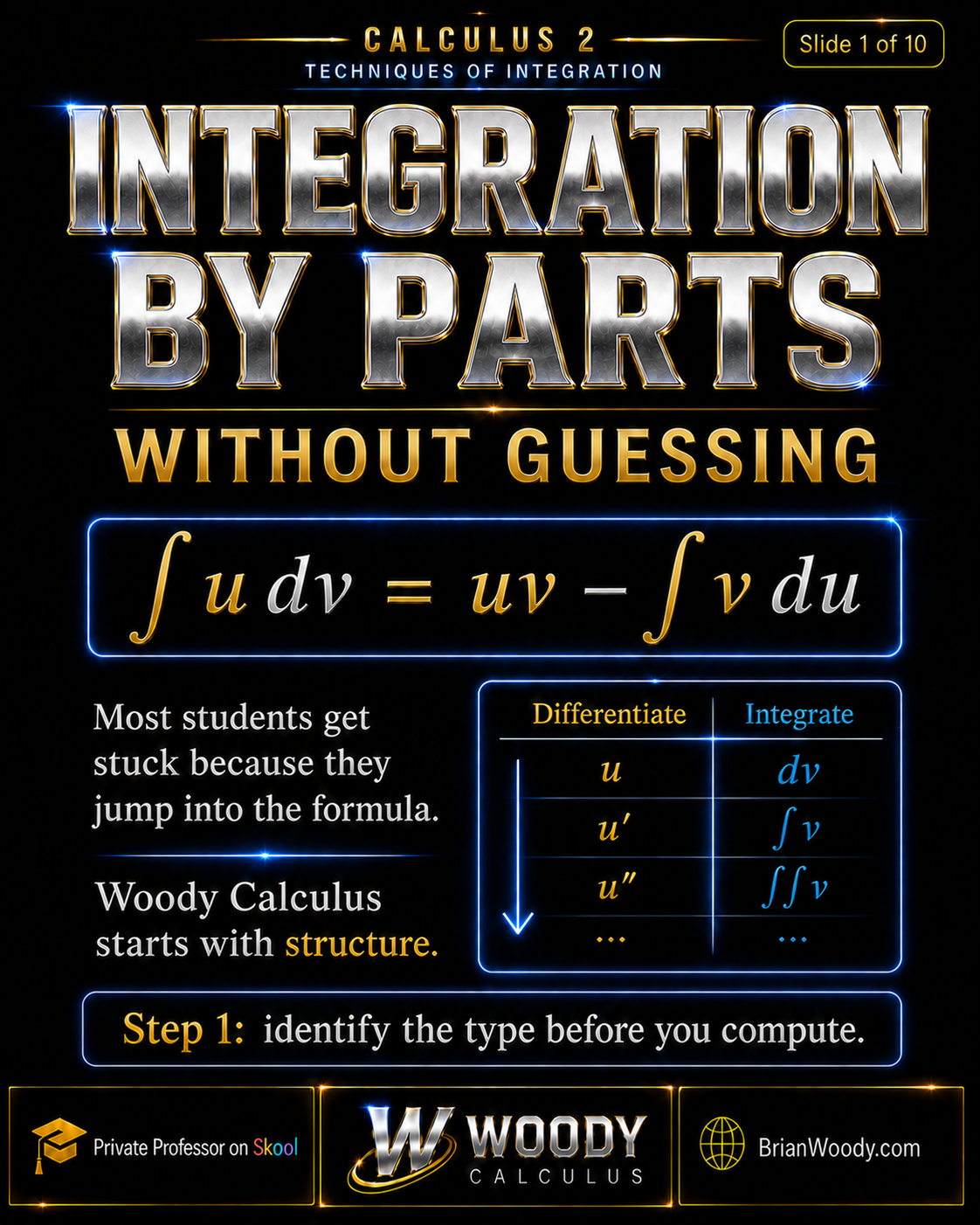
Integration by parts is one of the most important techniques in Calculus 2. It is also one of the easiest techniques to make harder than it needs to be.
Most students get stuck because they jump straight into the formula:
\int u\,dv=uv-\int v\,du.
\]
But the Woody Calculus method starts one step earlier:
Identify the type before you compute.
Once you know the type, the setup becomes much more predictable. You stop guessing \(u\) and \(dv\), and you start building the correct structure.
This lesson teaches the Woody Calculus 3-type system for integration by parts. It is designed for Calculus 2 students learning techniques of integration, especially students who need a reliable way to handle polynomial products, exponential-trig products, logarithms, inverse trig functions, and tabular integration by parts.
Estimated read time: 10–12 minutes.
Last updated: July 7, 2026.
Quick Summary: Integration by Parts in Calculus 2
- Integration by parts comes from the product rule.
- The core formula is \(\int u\,dv=uv-\int v\,du\).
- Type I: polynomial times exponential or trig. Differentiate the polynomial until it reaches zero.
- Type II: exponential times trig. Repeat until the original integral comes back, then solve algebraically.
- Type III: logarithm or inverse trig. Choose the log or inverse trig function as \(u\).
- Tabular integration by parts organizes repeated integration by parts into a table.
- The Woody Calculus rule is structure first, mechanics second.
Integration by Parts Key Facts
- Use integration by parts when an integral looks like a product of two different kinds of functions.
- The formula is based on reversing the product rule.
- Choosing \(u\) correctly is the main decision.
- For polynomial products, choose the polynomial as \(u\).
- For exponential times trig, repeated integration by parts creates a loop.
- For logarithms and inverse trig functions, choose the logarithm or inverse trig function as \(u\).
- Integration by parts is part of the broader Calculus 2 toolbox with trig substitution, partial fractions, improper integrals, sequences, series, and Taylor series.
What Is Integration by Parts?
Integration by parts is a calculus technique used to evaluate integrals containing a product of functions by applying the formula \(\int u\,dv=uv-\int v\,du\), which is directly derived from the product rule.
The idea is to split the integrand into two pieces:
- \(u\), the part you differentiate,
- \(dv\), the part you integrate.
Then you compute:
du
\qquad\text{and}\qquad
v.
\]
The goal is for the new integral,
\int v\,du,
\]
to be easier than the original integral.
The problem is that students often jump into the formula without first identifying the structure of the problem. That is why the Woody Calculus method begins with the type.
Why Integration by Parts Comes from the Product Rule
Integration by parts is not a random formula. It comes directly from the product rule.
The product rule says:
(uv)^{\prime}=u^{\prime}v+uv^{\prime}.
\]
In differential notation:
d(uv)=u\,dv+v\,du.
\]
Rearrange:
u\,dv=d(uv)-v\,du.
\]
Now integrate both sides:
\int u\,dv=\int d(uv)-\int v\,du.
\]
Since:
\int d(uv)=uv,
\]
we get:
\boxed{\int u\,dv=uv-\int v\,du.}
\]
That is the integration by parts formula.
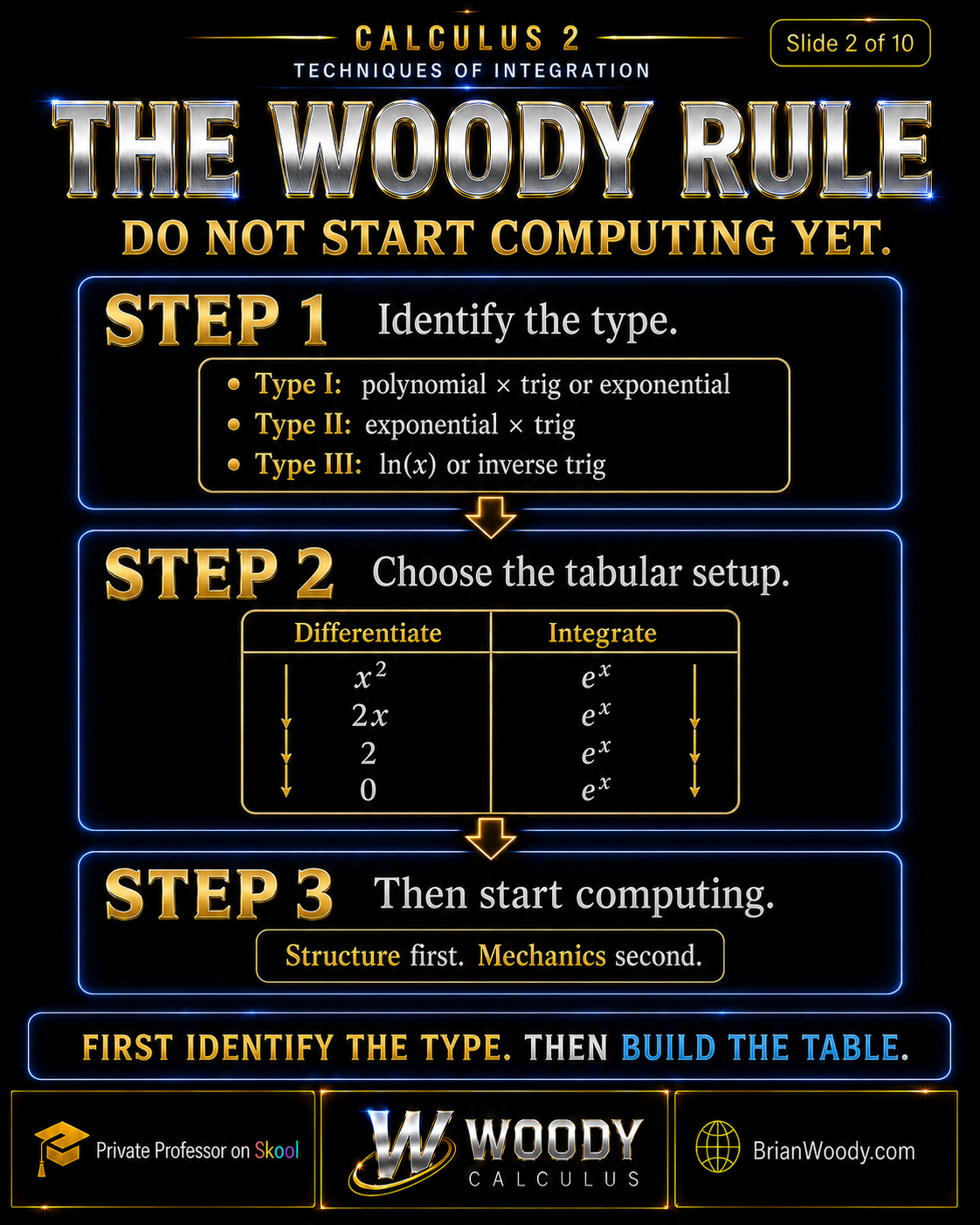
The Woody Rule: Do Not Start Computing Yet
The main Woody Calculus rule for integration by parts is:
Do not start computing yet. First identify the type.
There are three steps:
- Identify the type.
- Choose the tabular setup.
- Then start computing.
This is important because different kinds of integration by parts problems behave differently.
A polynomial times an exponential eventually stops. An exponential times trig function loops back. A logarithm or inverse trig function needs to be chosen as \(u\).
Structure first. Mechanics second.
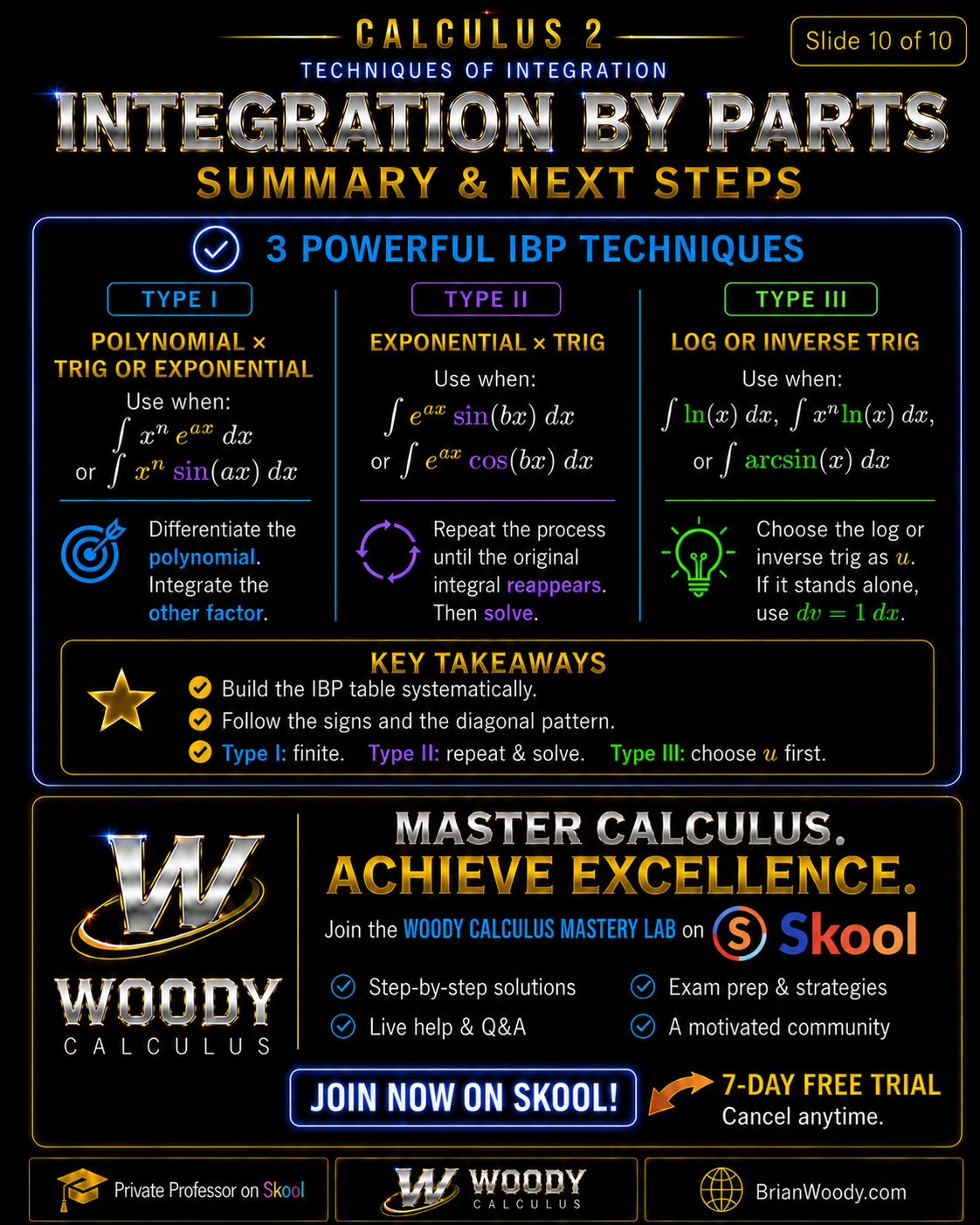
The 3 IBP Types
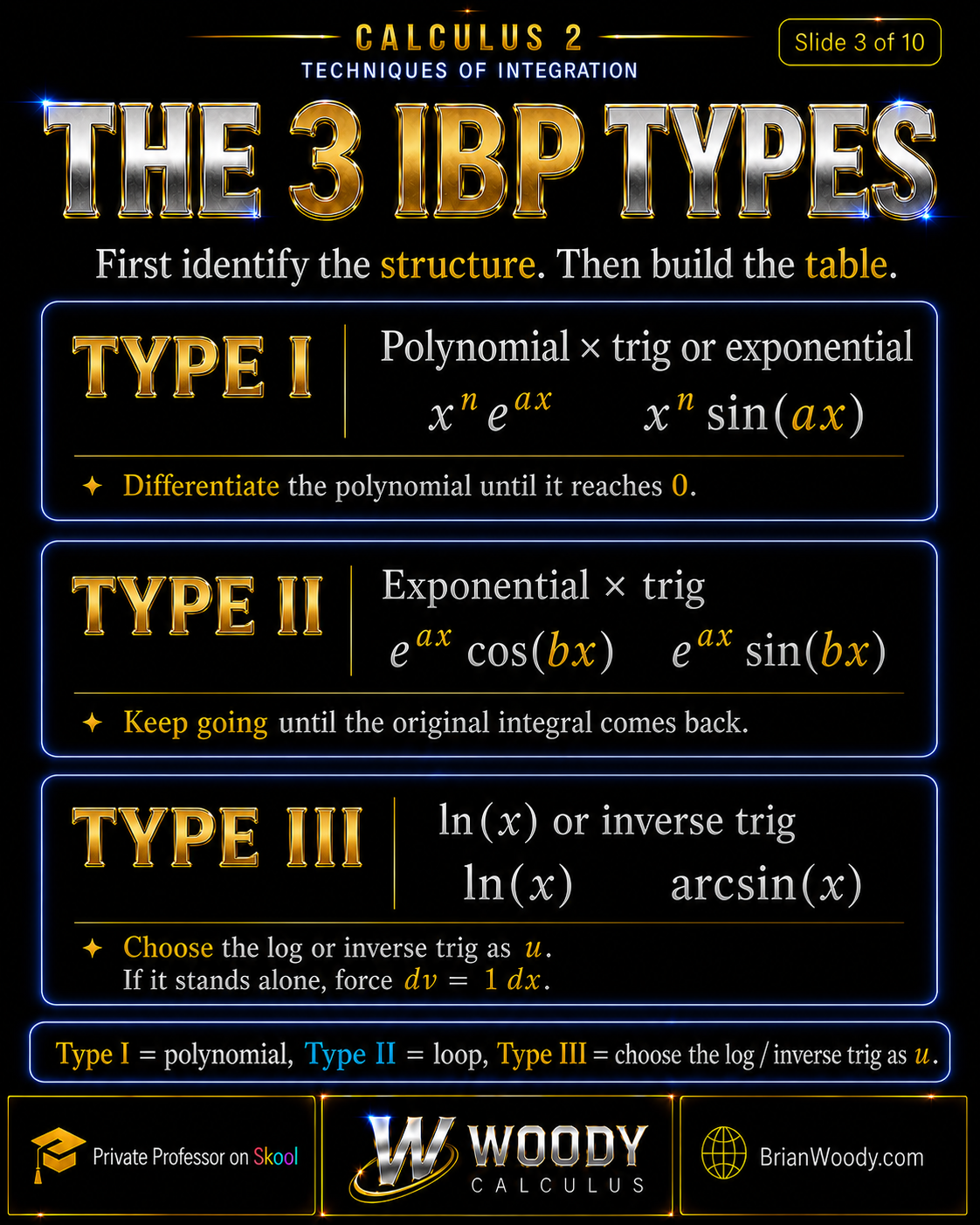
The Woody Calculus system separates integration by parts into three major types.
| Type | Pattern | Examples | Main Rule |
|---|---|---|---|
| Type I | Polynomial times exponential or trig | \(x^n e^{ax}\), \(x^n\sin(ax)\), \(x^n\cos(ax)\) | Differentiate the polynomial until it reaches \(0\). |
| Type II | Exponential times trig | \(e^{ax}\sin(bx)\), \(e^{ax}\cos(bx)\) | Repeat until the original integral comes back, then solve. |
| Type III | Logarithm or inverse trig | \(\ln x\), \(\arcsin x\), \(x^n\ln x\) | Choose the log or inverse trig function as \(u\). |
This type system makes integration by parts less mysterious. Instead of asking, “What do I do?” ask:
What type is this?
Type I: Polynomial Gets Simpler
Type I appears when the integral contains a polynomial times an exponential or trigonometric function:
\int x^n e^{ax}\,dx,
\qquad
\int x^n\sin(ax)\,dx,
\qquad
\int x^n\cos(ax)\,dx.
\]
The reason this type is nice is that the polynomial eventually differentiates to zero.
For example:
x^2\to 2x\to 2\to 0.
\]
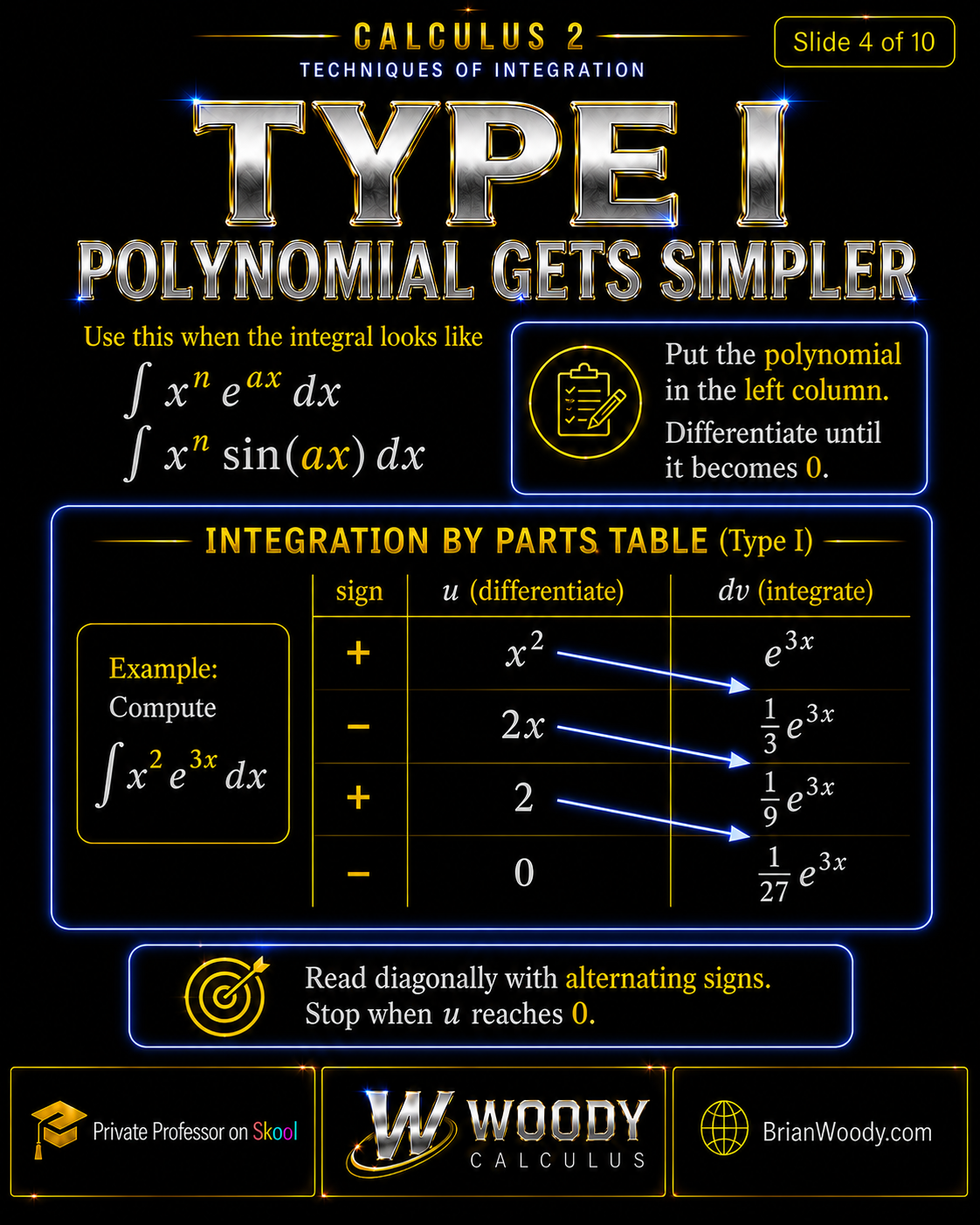
This makes tabular integration by parts very efficient. Put the polynomial in the left column. Differentiate downward until it reaches \(0\). Put the other factor in the right column. Integrate downward.
Then read the diagonal products with alternating signs.
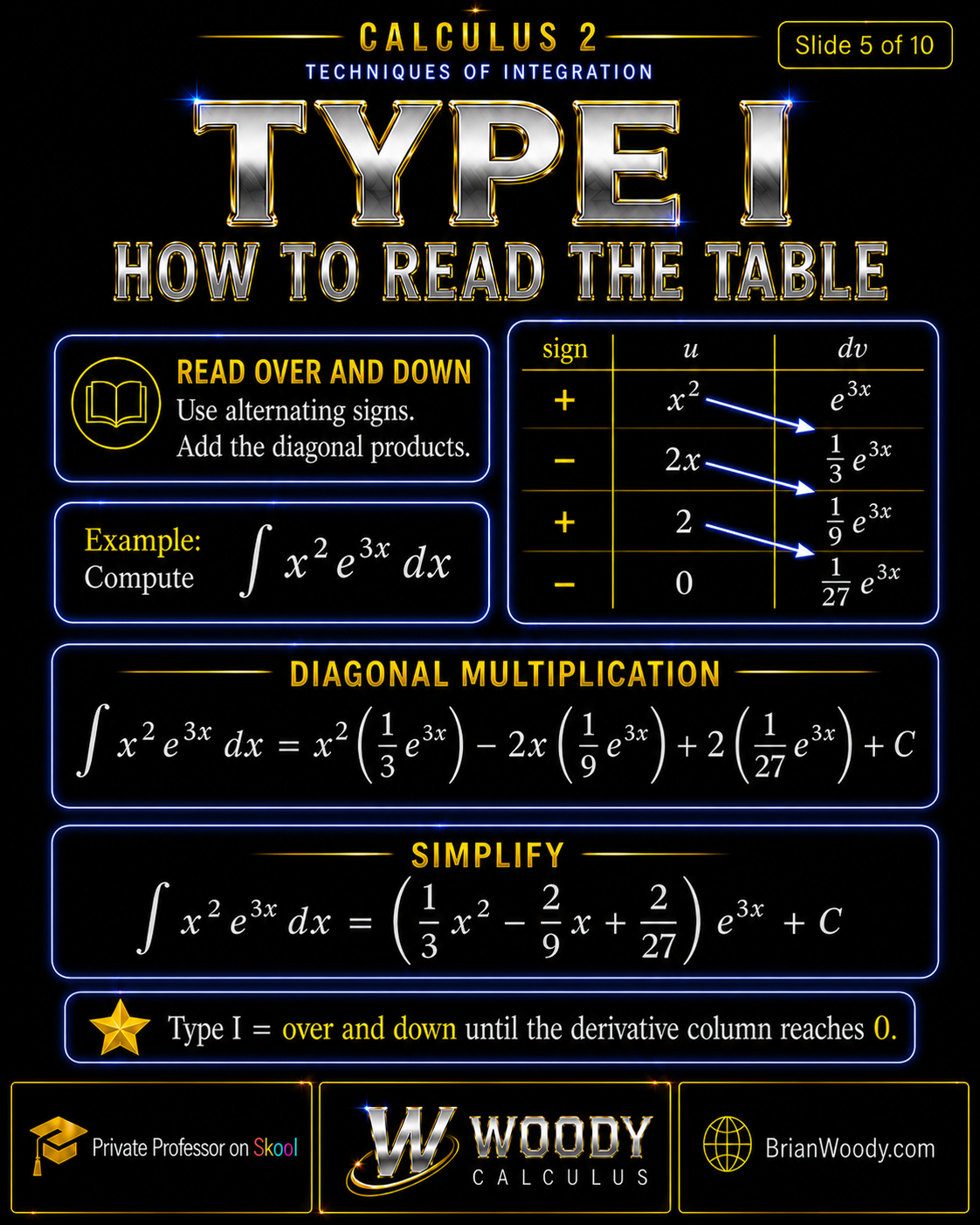
Type I: How to Read the Table
For a Type I problem such as:
\int x^2e^{3x}\,dx,
\]
the table is:
| Sign | Differentiate \(u\) | Integrate \(dv\) |
|---|---|---|
| \(+\) | \(x^2\) | \(e^{3x}\) |
| \(-\) | \(2x\) | \(\frac13 e^{3x}\) |
| \(+\) | \(2\) | \(\frac19 e^{3x}\) |
| \(-\) | \(0\) | \(\frac1{27}e^{3x}\) |
Now multiply diagonally and use alternating signs:
\int x^2e^{3x}\,dx
=
x^2\left(\frac13 e^{3x}\right)
–
2x\left(\frac19 e^{3x}\right)
+
2\left(\frac1{27}e^{3x}\right)
+C.
\]
Simplify:
\boxed{
\int x^2e^{3x}\,dx
=
\left(
\frac13x^2-\frac29x+\frac2{27}
\right)e^{3x}+C.
}
\]
Plain-language formula: The integral of \(x^2e^{3x}\) is \(\left(\frac13x^2-\frac29x+\frac2{27}\right)e^{3x}+C\).
Type II: Original Integral Comes Back
Type II appears when the integral contains an exponential times a trig function:
\int e^{ax}\sin(bx)\,dx,
\qquad
\int e^{ax}\cos(bx)\,dx.
\]
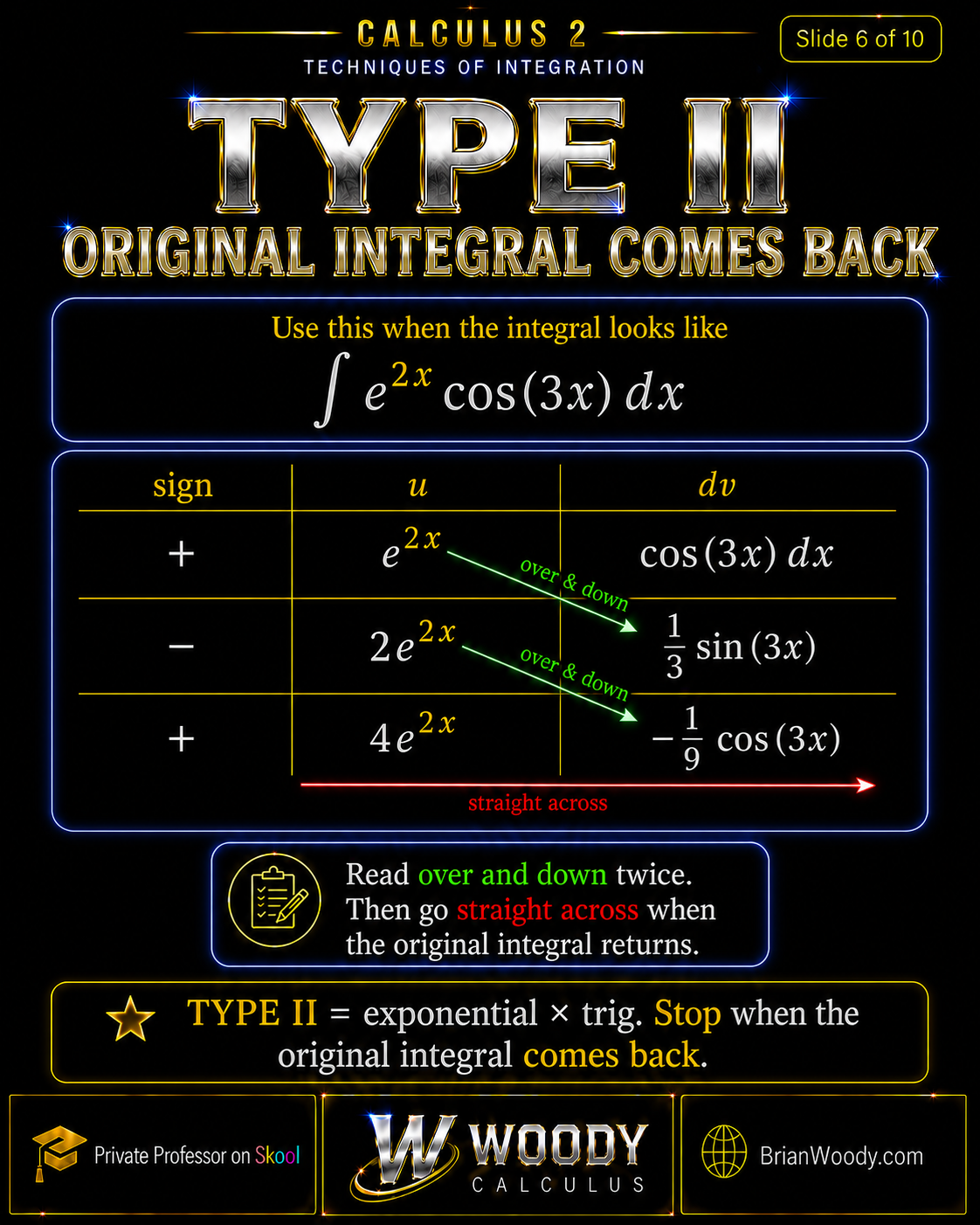
This type does not terminate like Type I. Instead, repeated integration by parts eventually brings back the original integral.
When that happens, do not panic. Move the repeated integral to the left side and solve algebraically.
For example:
I=\int e^{2x}\cos(3x)\,dx.
\]
This is Type II because it is exponential times trig.
Type II: The Key Move
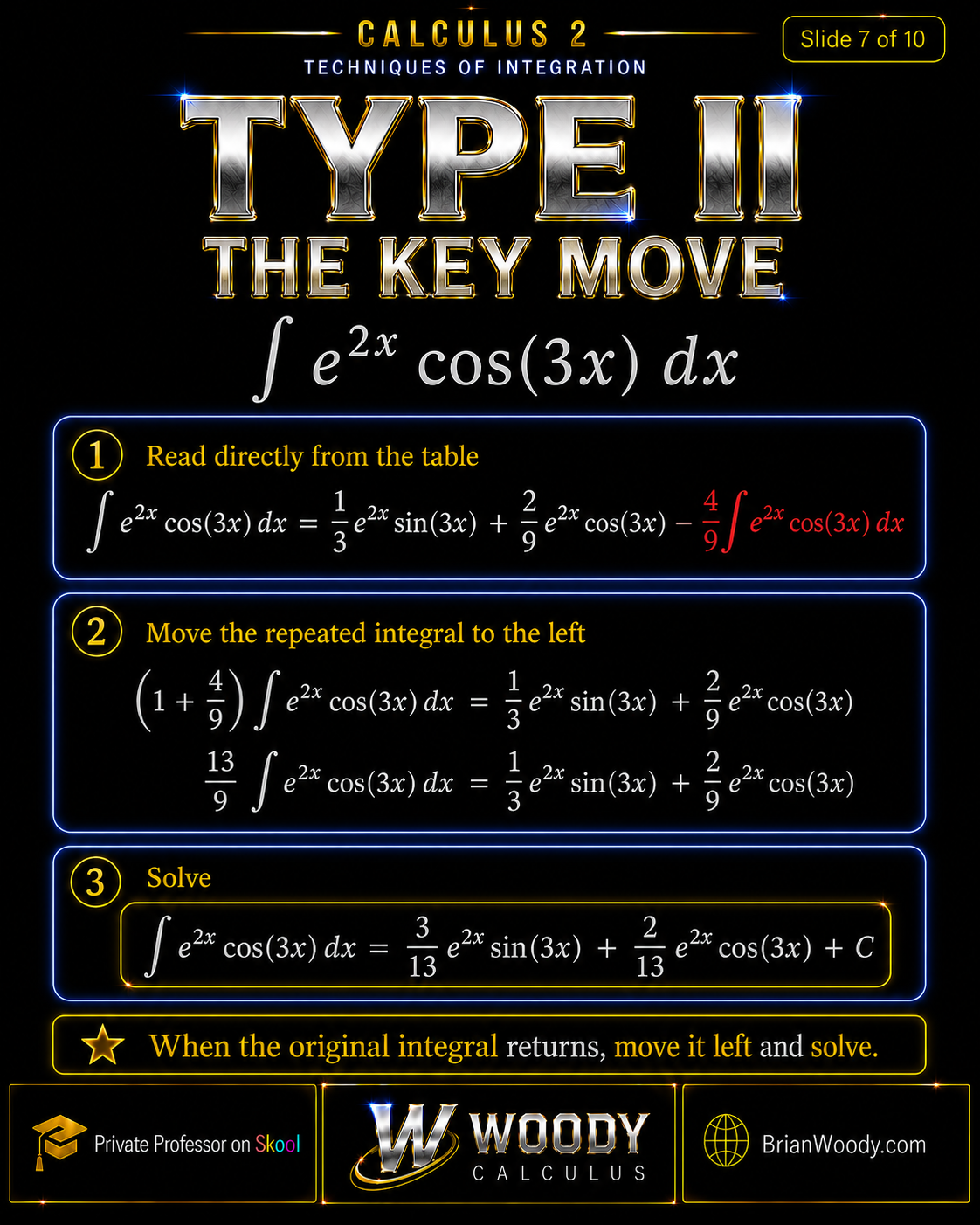
Let:
I=\int e^{2x}\cos(3x)\,dx.
\]
After applying integration by parts twice, the original integral comes back:
I
=
\frac13e^{2x}\sin(3x)
+
\frac29e^{2x}\cos(3x)
–
\frac49 I.
\]
Move the repeated integral to the left:
I+\frac49I
=
\frac13e^{2x}\sin(3x)
+
\frac29e^{2x}\cos(3x).
\]
Combine:
\frac{13}{9}I
=
\frac13e^{2x}\sin(3x)
+
\frac29e^{2x}\cos(3x).
\]
Multiply by \(\frac9{13}\):
\boxed{
\int e^{2x}\cos(3x)\,dx
=
\frac3{13}e^{2x}\sin(3x)
+
\frac2{13}e^{2x}\cos(3x)
+C.
}
\]
Plain-language formula: The integral of \(e^{2x}\cos(3x)\) is \(\frac3{13}e^{2x}\sin(3x)+\frac2{13}e^{2x}\cos(3x)+C\).
The key idea is simple:
When the original integral returns, move it left and solve.
Type III: Choose u First
Type III appears when the integral contains a logarithm or inverse trig function:
\int \ln(x)\,dx,
\qquad
\int \arcsin(x)\,dx,
\qquad
\int x^n\ln(x)\,dx.
\]
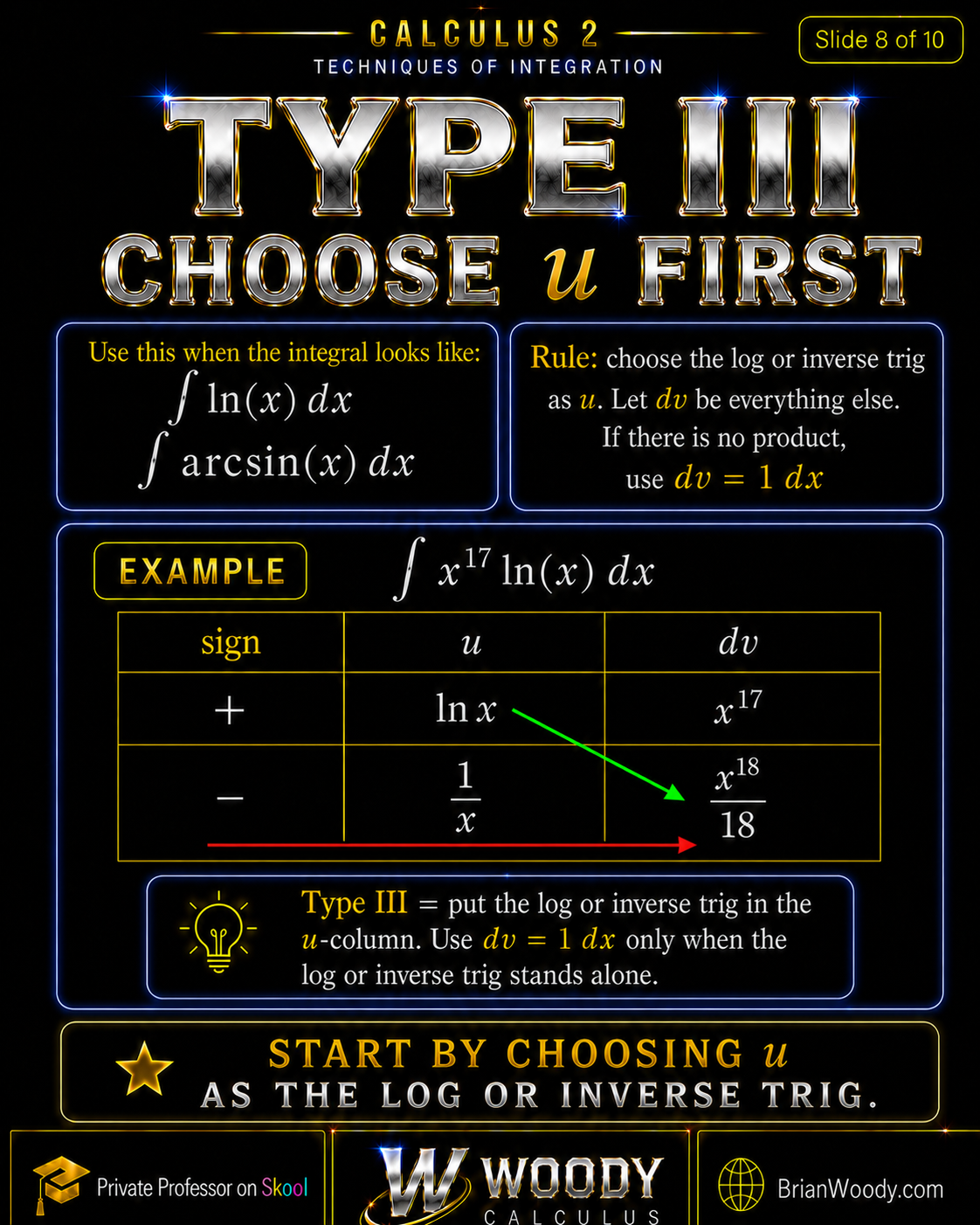
The rule is:
Choose the logarithm or inverse trig function as \(u\).
If the log or inverse trig function stands alone, force:
dv=1\,dx.
\]
For example, in:
\int \ln(x)\,dx,
\]
choose:
u=\ln(x),
\qquad
dv=1\,dx.
\]
In a product like:
\int x^{17}\ln(x)\,dx,
\]
choose:
u=\ln(x),
\qquad
dv=x^{17}\,dx.
\]
This type is common in Calculus 2 because logarithms and inverse trig functions usually get simpler when differentiated.
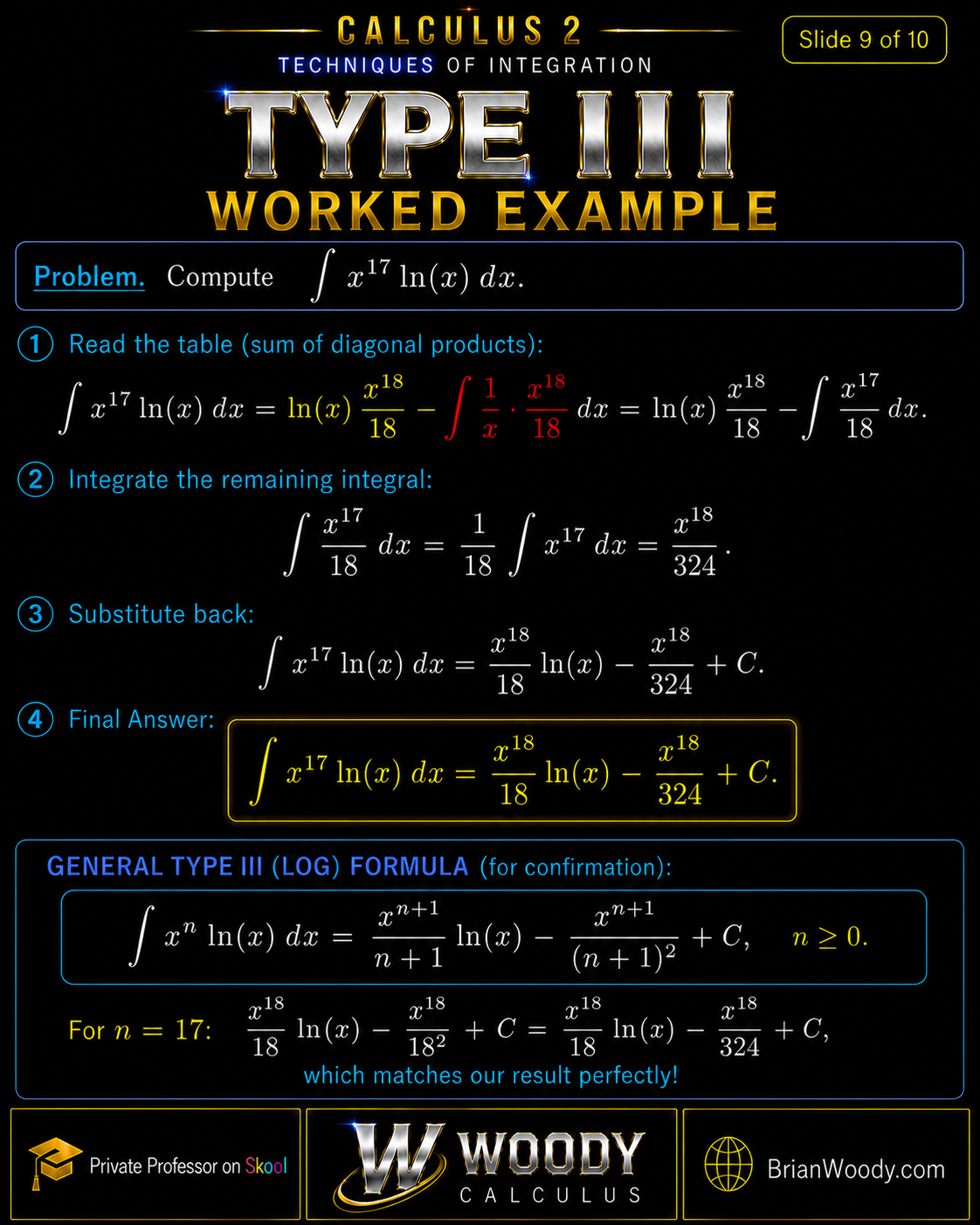
Type III Worked Example
Compute:
\int x^{17}\ln(x)\,dx.
\]
Since this contains a logarithm, choose:
u=\ln(x),
\qquad
dv=x^{17}\,dx.
\]
Then:
du=\frac1x\,dx,
\qquad
v=\frac{x^{18}}{18}.
\]
Use integration by parts:
\int x^{17}\ln(x)\,dx
=
\ln(x)\frac{x^{18}}{18}
–
\int \frac1x\cdot \frac{x^{18}}{18}\,dx.
\]
Simplify the remaining integral:
\int \frac1x\cdot \frac{x^{18}}{18}\,dx
=
\frac1{18}\int x^{17}\,dx
=
\frac{x^{18}}{324}.
\]
Therefore:
\boxed{
\int x^{17}\ln(x)\,dx
=
\frac{x^{18}}{18}\ln(x)
–
\frac{x^{18}}{324}
+C.
}
\]
This formula assumes \(x>0\), since \(\ln(x)\) is defined for positive \(x\). In contexts using \(\ln|x|\), the corresponding absolute-value version should be used.
Plain-language formula: The integral of \(x^{17}\ln(x)\) is \(\frac{x^{18}}{18}\ln(x)-\frac{x^{18}}{324}+C\).
General Type III Log Formula
For \(n\ne -1\), the general logarithmic integration by parts formula is:
\boxed{
\int x^n\ln(x)\,dx
=
\frac{x^{n+1}}{n+1}\ln(x)
–
\frac{x^{n+1}}{(n+1)^2}
+C.
}
\]
For \(n=17\), this gives:
\frac{x^{18}}{18}\ln(x)-\frac{x^{18}}{18^2}+C
=
\frac{x^{18}}{18}\ln(x)-\frac{x^{18}}{324}+C,
\]
which matches the worked example.
Worked Examples
Integration by Parts Example: Polynomial Times Exponential
Evaluate:
\int x^2e^{3x}\,dx.
\]
This is Type I because it is a polynomial times an exponential. Put \(x^2\) in the differentiate column and \(e^{3x}\) in the integrate column.
x^2\to 2x\to 2\to 0,
\]
e^{3x}\to \frac13e^{3x}\to \frac19e^{3x}\to \frac1{27}e^{3x}.
\]
Read diagonally with alternating signs:
\boxed{
\int x^2e^{3x}\,dx
=
\left(
\frac13x^2-\frac29x+\frac2{27}
\right)e^{3x}+C.
}
\]
Integration by Parts Example: Exponential Times Trig
Evaluate:
\int e^{2x}\cos(3x)\,dx.
\]
This is Type II because it is exponential times trig. Repeated integration by parts returns the original integral:
I
=
\frac13e^{2x}\sin(3x)
+
\frac29e^{2x}\cos(3x)
–
\frac49 I.
\]
Move the repeated integral left:
\frac{13}{9}I
=
\frac13e^{2x}\sin(3x)
+
\frac29e^{2x}\cos(3x).
\]
Solve:
\boxed{
\int e^{2x}\cos(3x)\,dx
=
\frac3{13}e^{2x}\sin(3x)
+
\frac2{13}e^{2x}\cos(3x)
+C.
}
\]
Integration by Parts Example: Polynomial Times Logarithm
Evaluate:
\int x^{17}\ln(x)\,dx.
\]
This is Type III because it contains \(\ln(x)\). Choose:
u=\ln(x),
\qquad
dv=x^{17}\,dx.
\]
Then:
du=\frac1x\,dx,
\qquad
v=\frac{x^{18}}{18}.
\]
Therefore:
\boxed{
\int x^{17}\ln(x)\,dx
=
\frac{x^{18}}{18}\ln(x)
–
\frac{x^{18}}{324}
+C.
}
\]
Common Mistakes
Mistake 1: Starting with the formula before identifying the type
The formula matters, but the type tells you how to use it. Before writing a table or choosing \(u\), identify whether the problem is Type I, Type II, or Type III.
Mistake 2: Choosing \(u\) randomly
Do not guess. Use the structure:
- Polynomial product: choose the polynomial as \(u\).
- Exponential times trig: expect the original integral to return.
- Log or inverse trig: choose the log or inverse trig function as \(u\).
Mistake 3: Forgetting alternating signs in the table
The tabular method uses alternating signs:
+,\quad -,\quad +,\quad -,\quad \ldots
\]
A sign error can ruin the final answer even when the table setup is correct.
Mistake 4: Stopping too early in Type II
In Type II, the original integral must come back. Once it returns, move it to the left and solve. Do not keep integrating forever.
Mistake 5: Forgetting \(dv=1\,dx\) for standalone logarithms or inverse trig functions
For integrals like:
\int \ln(x)\,dx,
\qquad
\int \arcsin(x)\,dx,
\]
there is no obvious second factor. Use:
dv=1\,dx.
\]
Integration by Parts Cheat Sheet
| Type | Integral Pattern | Setup Rule | Stop Rule |
|---|---|---|---|
| Type I | \(x^n e^{ax}\), \(x^n\sin(ax)\), \(x^n\cos(ax)\) | Differentiate the polynomial, integrate the other factor. | Stop when the polynomial reaches \(0\). |
| Type II | \(e^{ax}\sin(bx)\), \(e^{ax}\cos(bx)\) | Use repeated integration by parts. | Stop when the original integral comes back. |
| Type III | \(\ln(x)\), inverse trig, \(x^n\ln(x)\) | Choose the log or inverse trig function as \(u\). | Use \(dv=1\,dx\) if it stands alone. |
Integration by Parts FAQ
What is integration by parts?
Integration by parts is a Calculus 2 integration technique based on the product rule. It rewrites \(\int u\,dv\) as \(uv-\int v\,du\).
When should I use integration by parts?
Use integration by parts when an integral contains a product of functions, especially products involving polynomials, exponentials, trig functions, logarithms, or inverse trig functions.
How do I choose \(u\) and \(dv\)?
First identify the type. For polynomial products, choose the polynomial as \(u\). For logarithms or inverse trig functions, choose the logarithm or inverse trig function as \(u\). For exponential times trig, expect the original integral to return.
What is tabular integration by parts?
Tabular integration by parts is a table method for repeated integration by parts. One column differentiates \(u\), the other integrates \(dv\), and diagonal products are combined with alternating signs.
What is Type I integration by parts?
Type I is used for polynomial times exponential or trig functions, such as \(x^ne^{ax}\) or \(x^n\sin(ax)\). Differentiate the polynomial until it reaches zero.
What is Type II integration by parts?
Type II is used for exponential times trig functions, such as \(e^{ax}\sin(bx)\) or \(e^{ax}\cos(bx)\). Repeated integration by parts brings back the original integral, which is then moved left and solved.
What is Type III integration by parts?
Type III is used for logarithms and inverse trig functions. Choose the log or inverse trig function as \(u\). If it stands alone, use \(dv=1\,dx\).
Why does the original integral come back in exponential-trig problems?
Exponentials reproduce themselves under differentiation, while sine and cosine cycle. That creates a loop, so repeated integration by parts eventually brings back the original integral.
What is the biggest mistake students make with integration by parts?
The biggest mistake is starting to compute before identifying the type. The Woody Calculus rule is to identify the structure first, then build the table.
Master Integration by Parts with Woody Calculus
Integration by parts is not just one formula. It is a system. Once students learn to identify the type, the setup becomes much more automatic.
The Woody Calculus method is:
- Identify the structure first.
- Choose the correct IBP type.
- Build the table systematically.
- Follow the signs and diagonal products.
- For Type I, stop when the polynomial reaches \(0\).
- For Type II, stop when the original integral comes back.
- For Type III, choose the log or inverse trig function as \(u\).
To make the system automatic, rely on strict formula memorization, rewrite perfect solutions, and say each step out loud until the method becomes part of your muscle memory.
For students who want structured Calculus 2 help, join the Woody Calculus Mastery Lab. The Mastery Lab helps students build skill through repetition, step-by-step lessons, written solutions, exam-focused systems, and direct support.
You can also visit Woody Calculus on Skool for the learning community.
Related Woody Calculus Mathematical Essays
Explore more Woody Calculus lessons connecting Calculus 2, integration techniques, trig substitution, infinite series, Taylor series, convergence, Differential Equations, Linear Algebra, and advanced mathematics.
- How to Learn Calculus and Advanced Mathematics: A Peak Performance Study Guide
- Trig Substitution Explained: The Woody Calculus 3-Type System
- Taylor Series Explained: Mathematical Time Travel in Calculus 2
- Radius of Convergence and Interval of Convergence Explained
- Gabriel’s Horn Explained: Finite Volume and Infinite Surface Area
- Laplace Transforms Explained: Differential Equations Become Algebra
- Eigenvalues and Eigenvectors Explained
- The Determinant Explained
- View All Woody Calculus Blog Posts
Private Instruction
Brian M. Woody works privately with a limited number of serious students who need one-on-one help in Calculus II, Calculus III, Differential Equations, Linear Algebra, and advanced mathematics.
Private instruction is reserved for serious students, requires weekly sessions, requires enrollment in the Woody Calculus Mastery Lab first, and approval is not guaranteed.
Students interested in private instruction can learn more here: Private Math Tutor and Advanced Mathematics Instruction.
Related University Math Help Pages
Woody Calculus supports students at major universities with structured help in Calculus 2, Calculus 3, Differential Equations, Linear Algebra, and advanced mathematics. For the full list of supported schools, visit the University Calculus Tutor Hub.
- University Calculus Tutor Hub
- Purdue University Calculus Tutor
- University of Florida Calculus Tutor
- Colorado State University Calculus Help
- UCF Calculus Tutor
- University of Nevada, Reno Calculus Tutor
- Auburn Calculus Tutor
- University of Alabama Calculus Tutor
- University of Wisconsin Calculus Tutor
- University of Michigan Calculus Tutor
- UCLA Calculus Tutor
- MIT Calculus Tutor
Trusted by Students Nationwide
The Woody Calculus Mastery Lab gives university students access to structured mathematics support, written solutions, video lessons, exam-focused training, and expert guidance from Brian M. Woody.
Students use Woody Calculus for Calculus II, Calculus III, Differential Equations, Linear Algebra, Abstract Algebra, and other advanced mathematics courses.