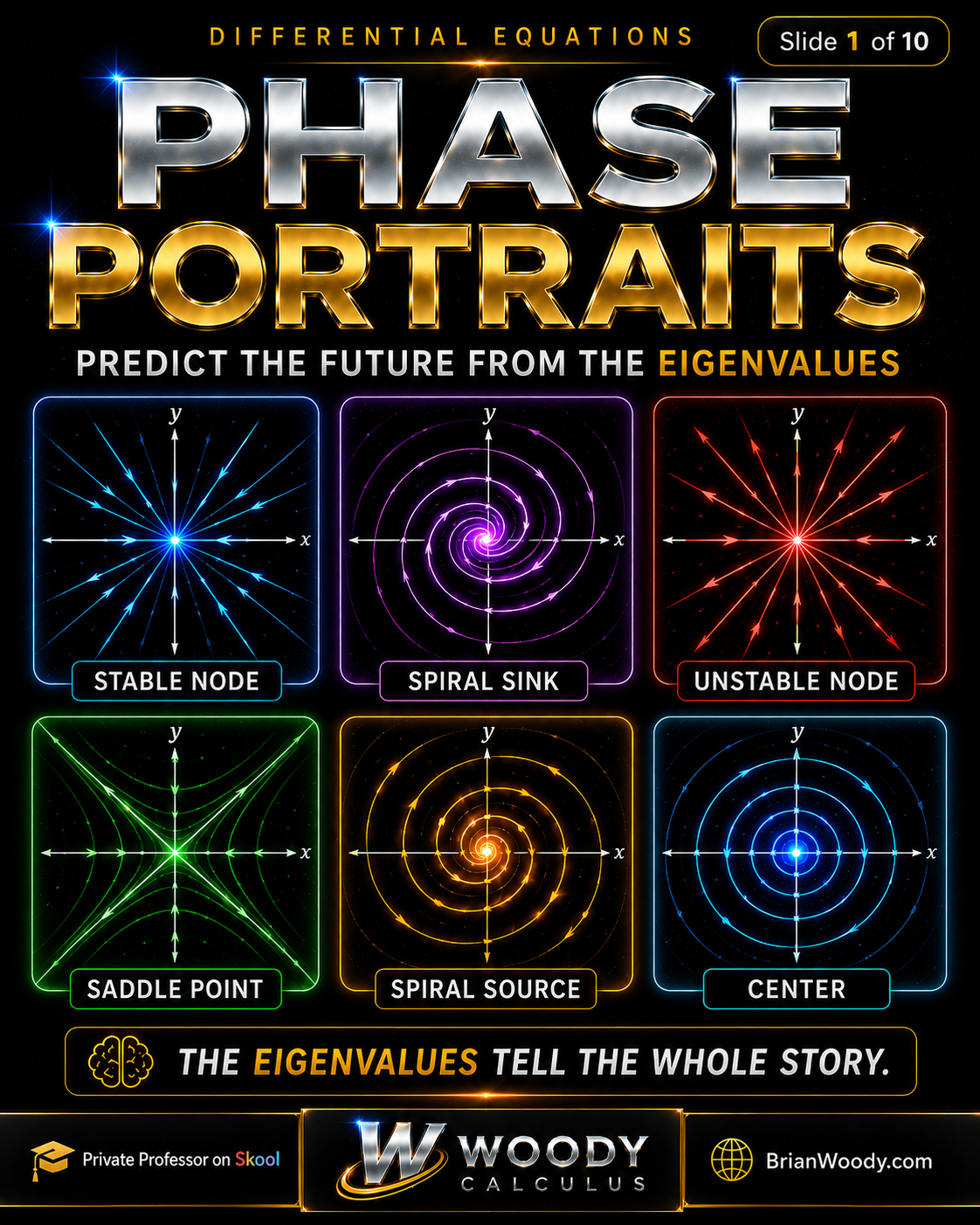

Learn how eigenvalues determine phase portraits in Differential Equations. This Woody Calculus lesson explains stable nodes, unstable nodes, saddle points, spiral sinks, spiral sources, centers, repeated eigenvalues, eigenvectors, and stability.
Learn how eigenvalues determine phase portraits in Differential Equations. This Woody Calculus lesson explains stable nodes, unstable nodes, saddle points, spiral sinks, spiral sources, centers, repeated eigenvalues, eigenvectors, and stability.
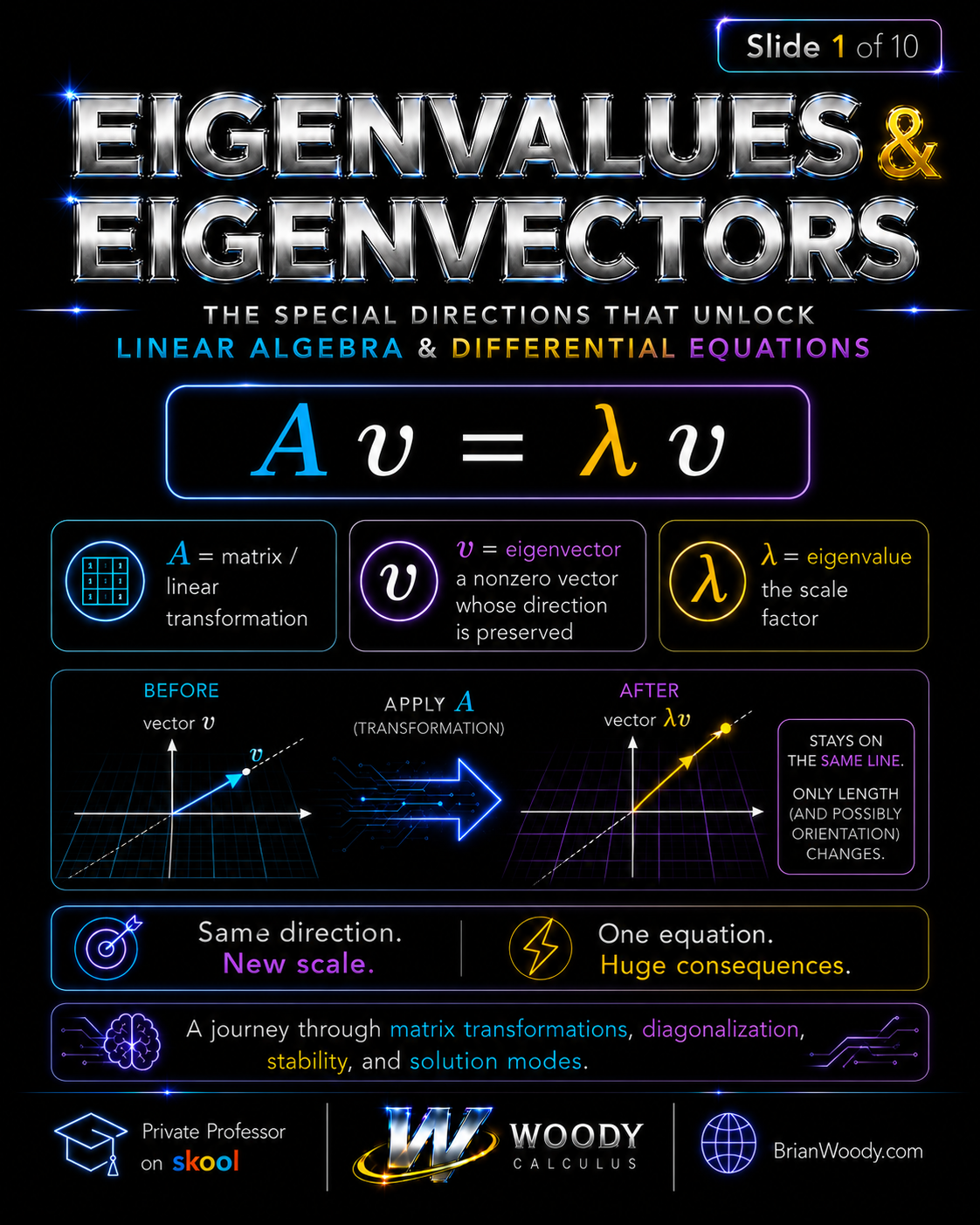
Eigenvalues and eigenvectors reveal the special directions that unlock Linear Algebra and Differential Equations. In this Woody Calculus visual lesson, learn how Av = λv explains matrix transformations, scaling, diagonalization, matrix powers, solution modes, stability, phase portraits, and why eigenvalues predict long-term behavior in systems before you even solve them.

The Riemann Hypothesis is one of the deepest unsolved problems in mathematics. It connects prime numbers, the zeta function, complex analysis, randomness, and hidden order — with a $1,000,000 Clay Mathematics Institute prize for a proof.
After nearly thirty years of teaching advanced mathematics, Brian M. Woody explains how to learn calculus through perfect practice, subconscious training, active recall, sleep science, and identity transformation.
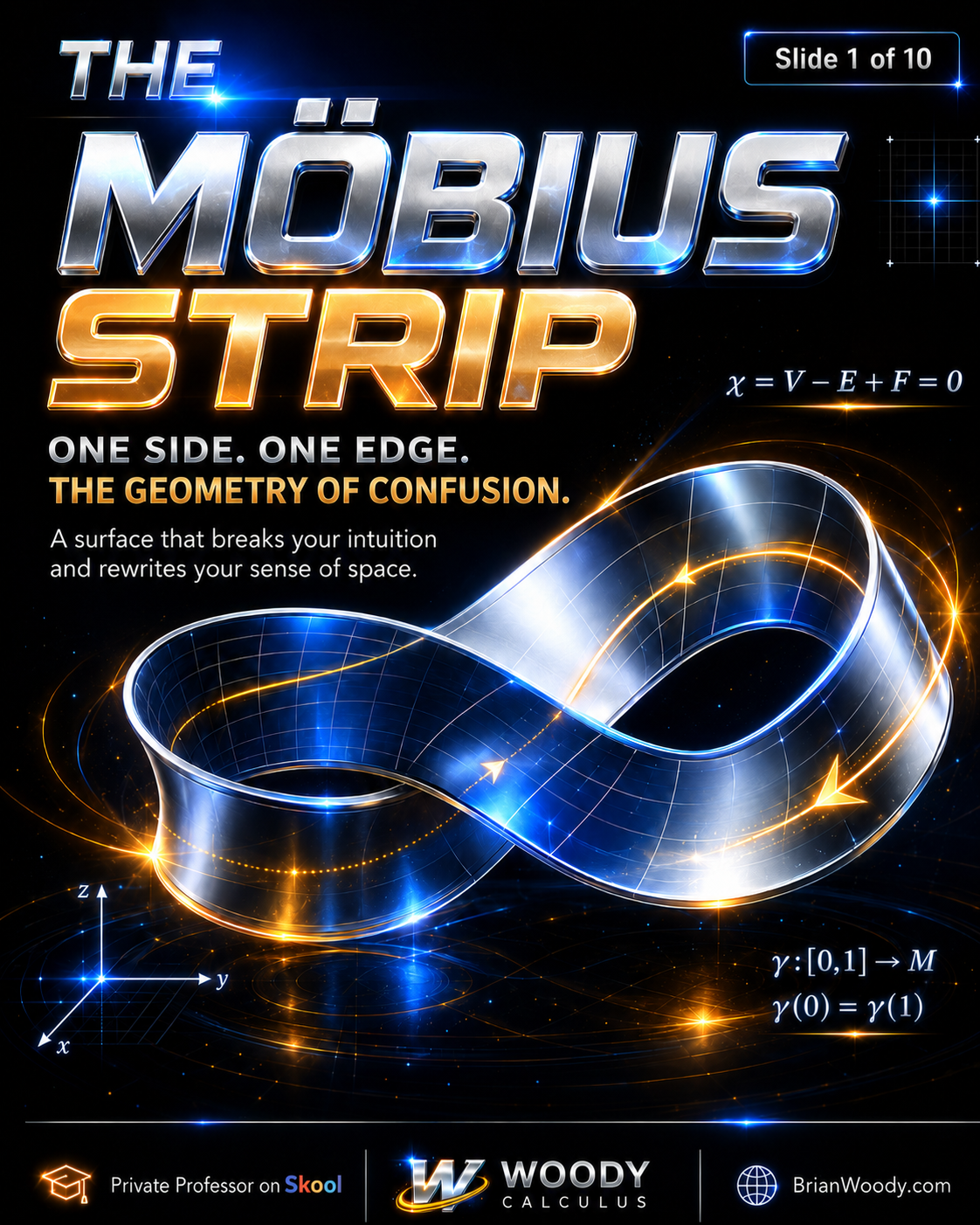
The Möbius strip is one of the clearest examples of why orientation matters in Calculus 3, vector calculus, topology, and surface integrals. Learn how one half-twist creates a one-sided surface with one boundary edge, no global normal vector, and a powerful obstruction to the standard global form of Stokes’ Theorem.
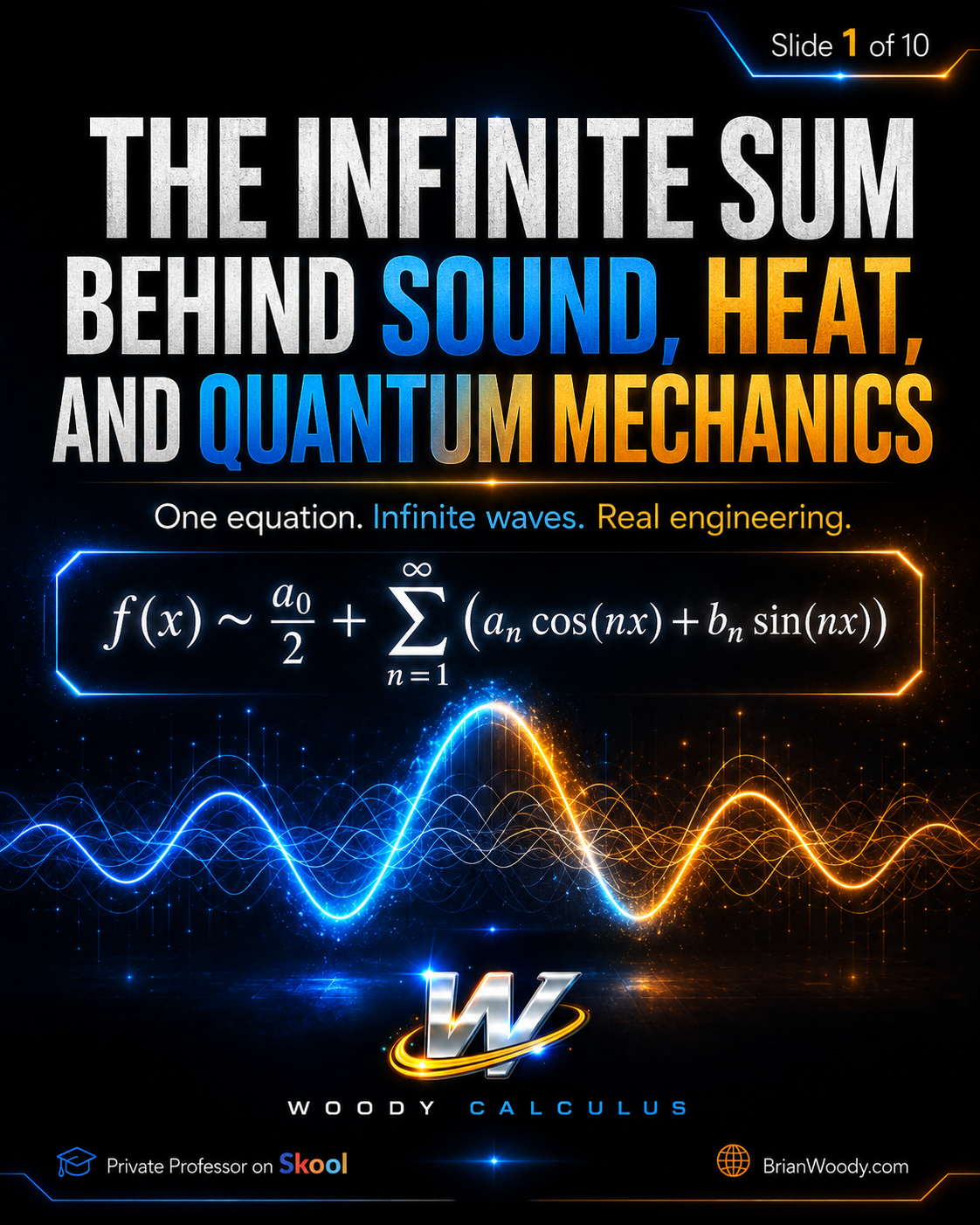
Fourier series reveal how complex periodic signals can be rebuilt from simple sine and cosine waves. Learn how harmonics, Fourier coefficients, orthogonality, partial sums, and frequency-domain thinking connect to sound, heat flow, PDEs, engineering, and quantum mechanics.
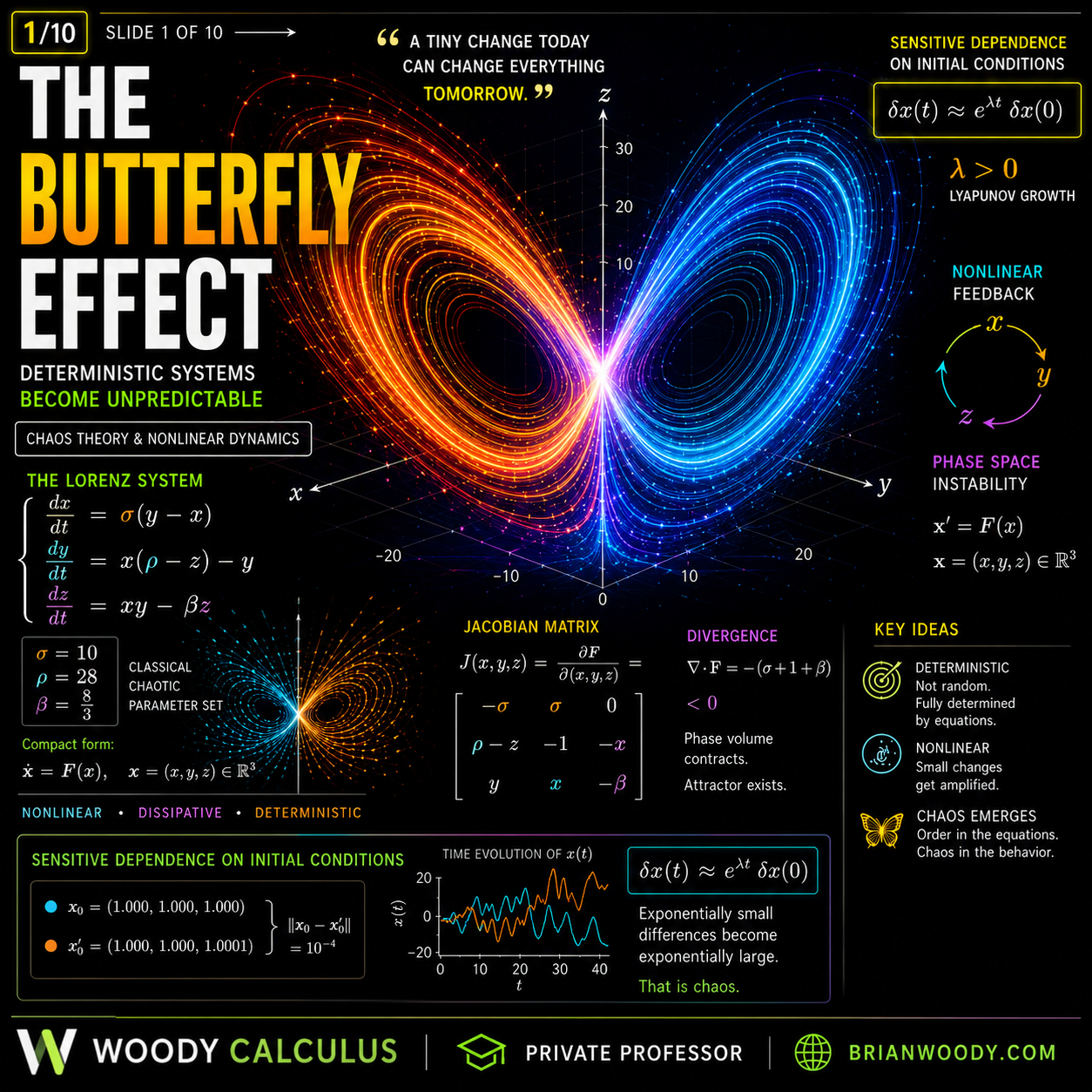
Chaos Theory explained through the Butterfly Effect, Lorenz System, Lyapunov Exponents, Strange Attractors, and nonlinear dynamics. Learn why deterministic equations can still produce unpredictable behavior.
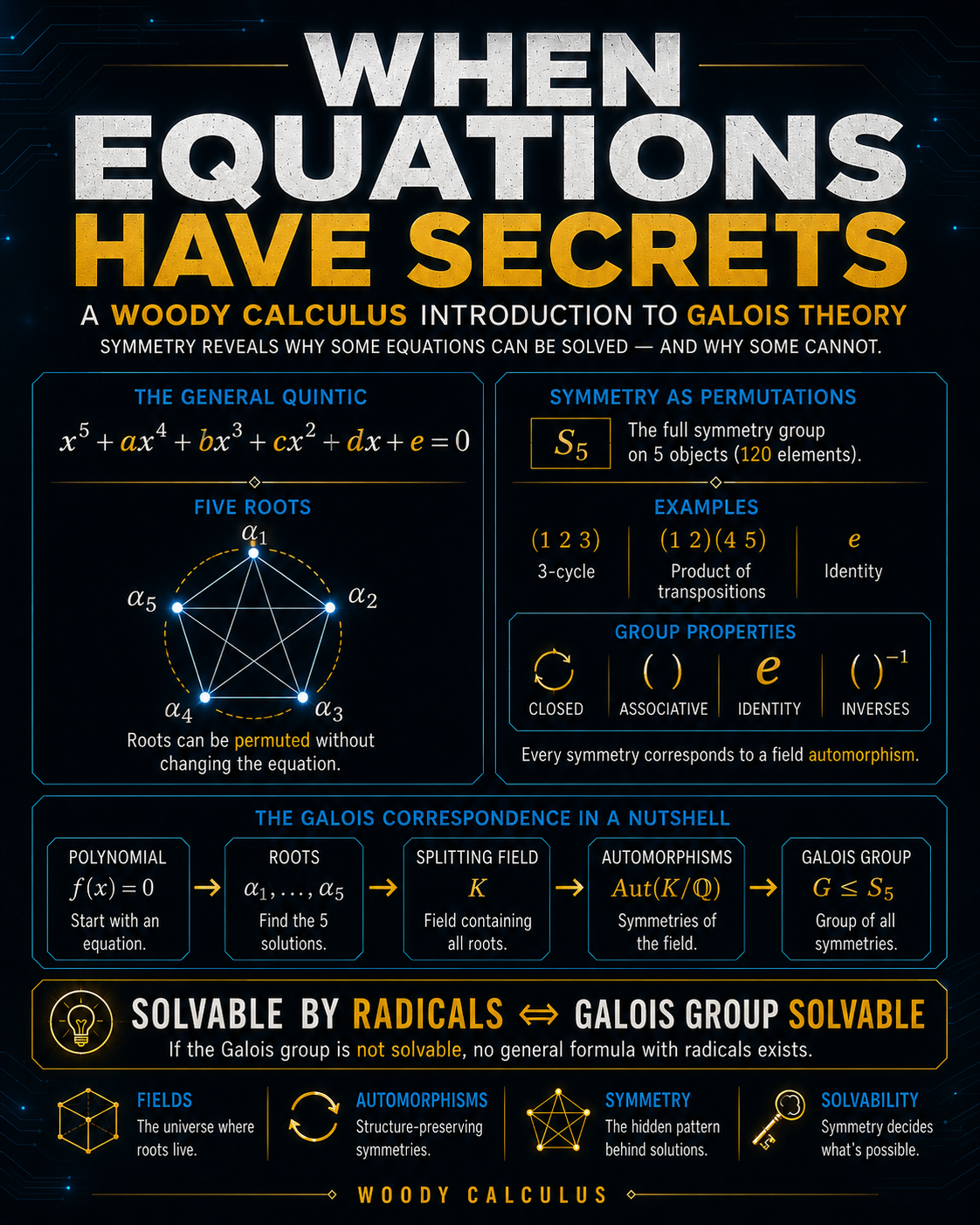
Galois theory explains why some equations can be solved by radicals and others cannot. This undergraduate-friendly introduction explores Galois groups, splitting fields, fixed fields, subgroup lattices, normal subgroups, and the deep symmetry behind the quintic equation.
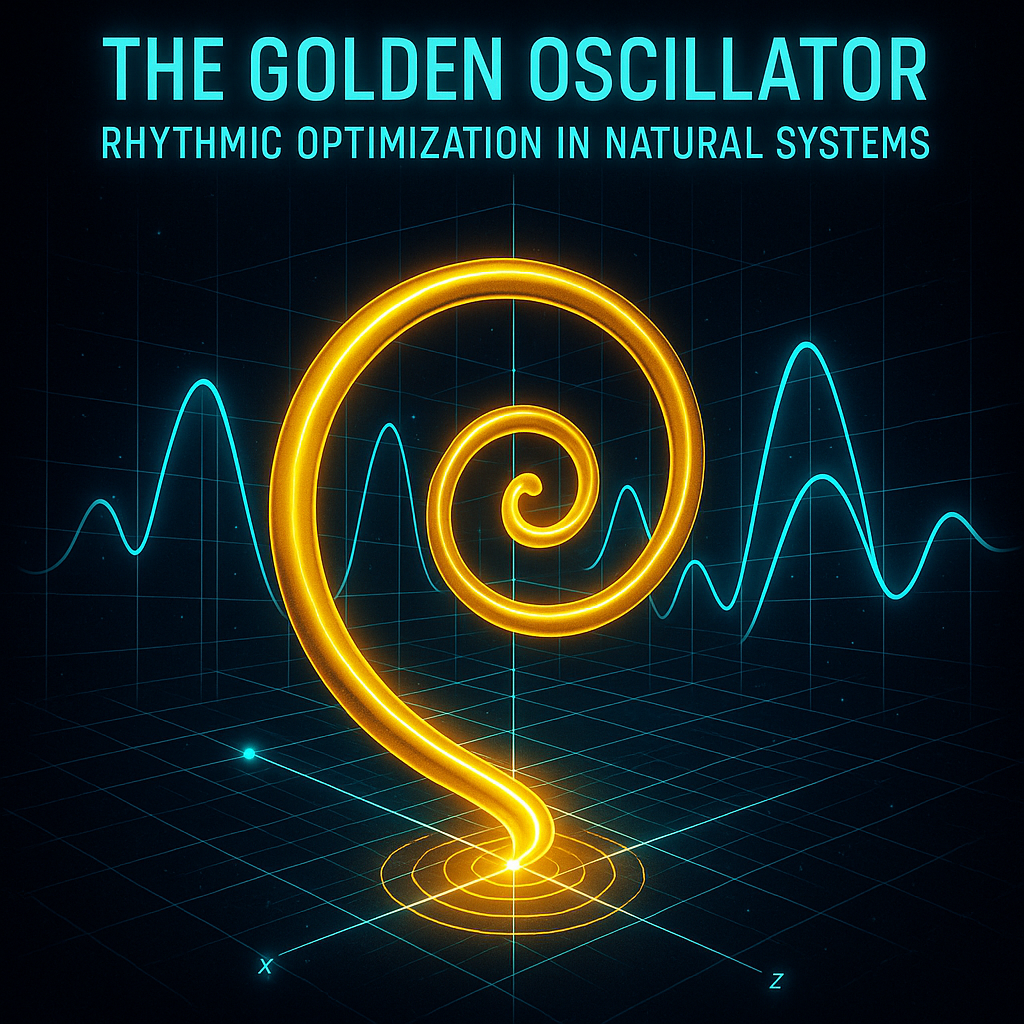
This full-length Woody Calculus web edition presents Brian M. Woody’s paper, The Golden Oscillator: Rhythmic Optimization in Natural Systems, preserving the original December 12, 2025 record date while adapting the work for clear mathematical web presentation.

Explore the mathematics of quantum computing through qubits, superposition, interference, entanglement, quantum algorithms, error correction, and cryptography.