A group is a set equipped with a binary operation that satisfies closure, associativity, the existence of an identity element, and the existence of an inverse for every element.
Group theory studies these structures and explains how numbers, permutations, matrices, and geometric symmetries can obey the same abstract rules.
The subject matters because groups turn complicated systems into organized collections of allowable operations. Once the group structure is identified, the same ideas can be used in abstract algebra, number theory, finite fields, geometry, cryptography, physics, and Galois theory.
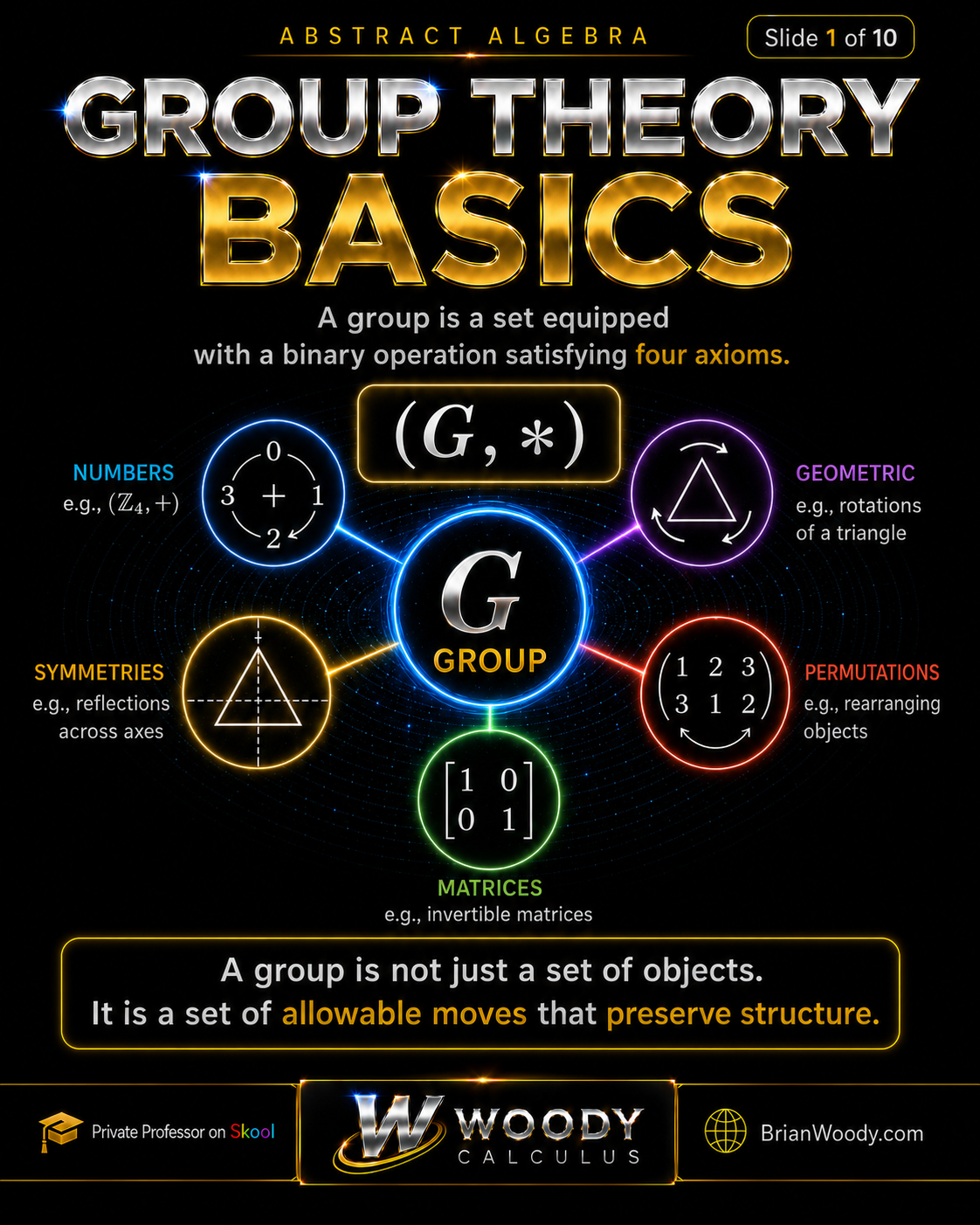
What Is a Group in Abstract Algebra?
A group is a set of elements together with a rule for combining two elements so that the result remains in the set and the four group axioms hold.
The notation
(G,\ast)
\]
names both pieces of the structure. The symbol \(G\) denotes the set, while \(\ast\) denotes the operation. The operation may be addition, multiplication, function composition, matrix multiplication, permutation composition, or another carefully defined rule.
A useful intuition is that a group describes reversible, structure-preserving moves. Rotating a triangle, permuting a list, adding an element modulo \(4\), or multiplying by an invertible matrix can all be treated as allowable moves. This intuition is powerful, but the formal definition is still the set, the operation, and the four axioms.
Plain-language answer:
Group theory asks which operations can be combined, undone, and repeated without leaving the mathematical system.
What Are the Set and Binary Operation?
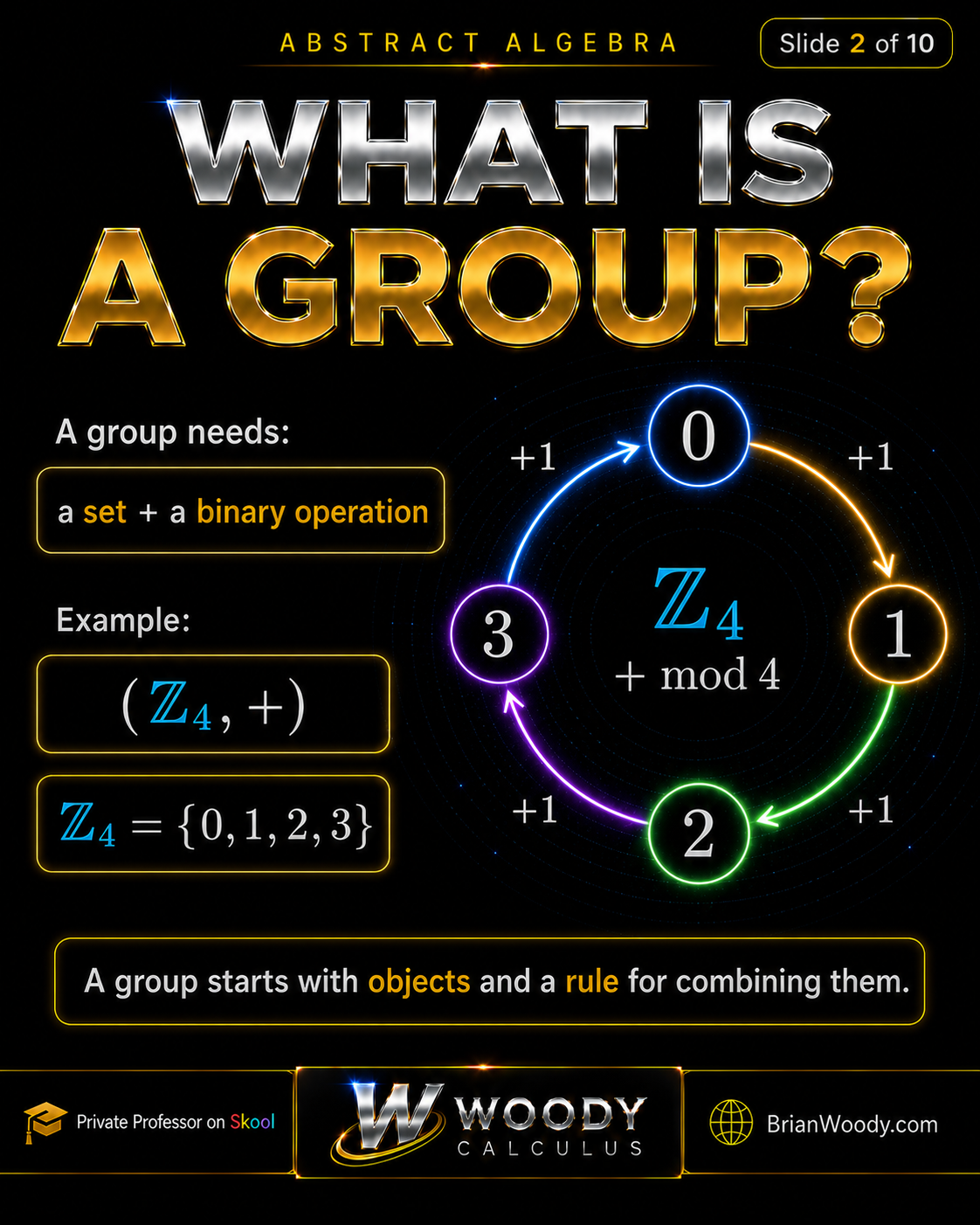
A group begins with a set \(G\) and a binary operation that combines any ordered pair of elements of \(G\) to produce another element of \(G\).
\ast:G\times G\longrightarrow G.
\]
For the running example,
\mathbb{Z}_4=\{0,1,2,3\},
\]
and the operation is addition modulo \(4\). The expression \(3+2\) is first calculated as an ordinary integer sum and then reduced to its remainder modulo \(4\):
3+2=5\equiv1\pmod 4.
\]
What Does the Group-Theory Notation Mean?
Group-theory notation compresses the set, operation, identity, inverses, orders, generators, and structural relationships into a small number of standard symbols.
| Notation | Read aloud | Meaning |
|---|---|---|
| \(G\) | “G” | The underlying set of group elements |
| \(\ast\) | “star” | A generic binary operation; it does not automatically mean multiplication |
| \((G,\ast)\) | “G under star” | The set together with its specified operation |
| \(e\) | “the identity” | The element satisfying \(e\ast a=a\ast e=a\) |
| \(a^{-1}\) | “a inverse” | The element that combines with \(a\) to produce the identity |
| \(|G|\) | “the order of G” | The number of elements in a finite group |
| \(\operatorname{ord}(a)\) | “the order of a” | The least positive number of repetitions of \(a\) needed to reach the identity |
| \(\langle a\rangle\) | “the subgroup generated by a” | All powers of \(a\), or all integer multiples of \(a\) in additive notation |
| \(\mathbb Z_n\) | “Z mod n” | The residue classes modulo \(n\), usually studied under addition modulo \(n\) |
| \(G\cong H\) | “G is isomorphic to H” | The groups have the same operation structure after their elements are relabeled |
Plain-language answer:
Read every symbol as a complete sentence. This prevents notation from hiding the definition you must use in a proof.
What Are the Four Group Axioms?
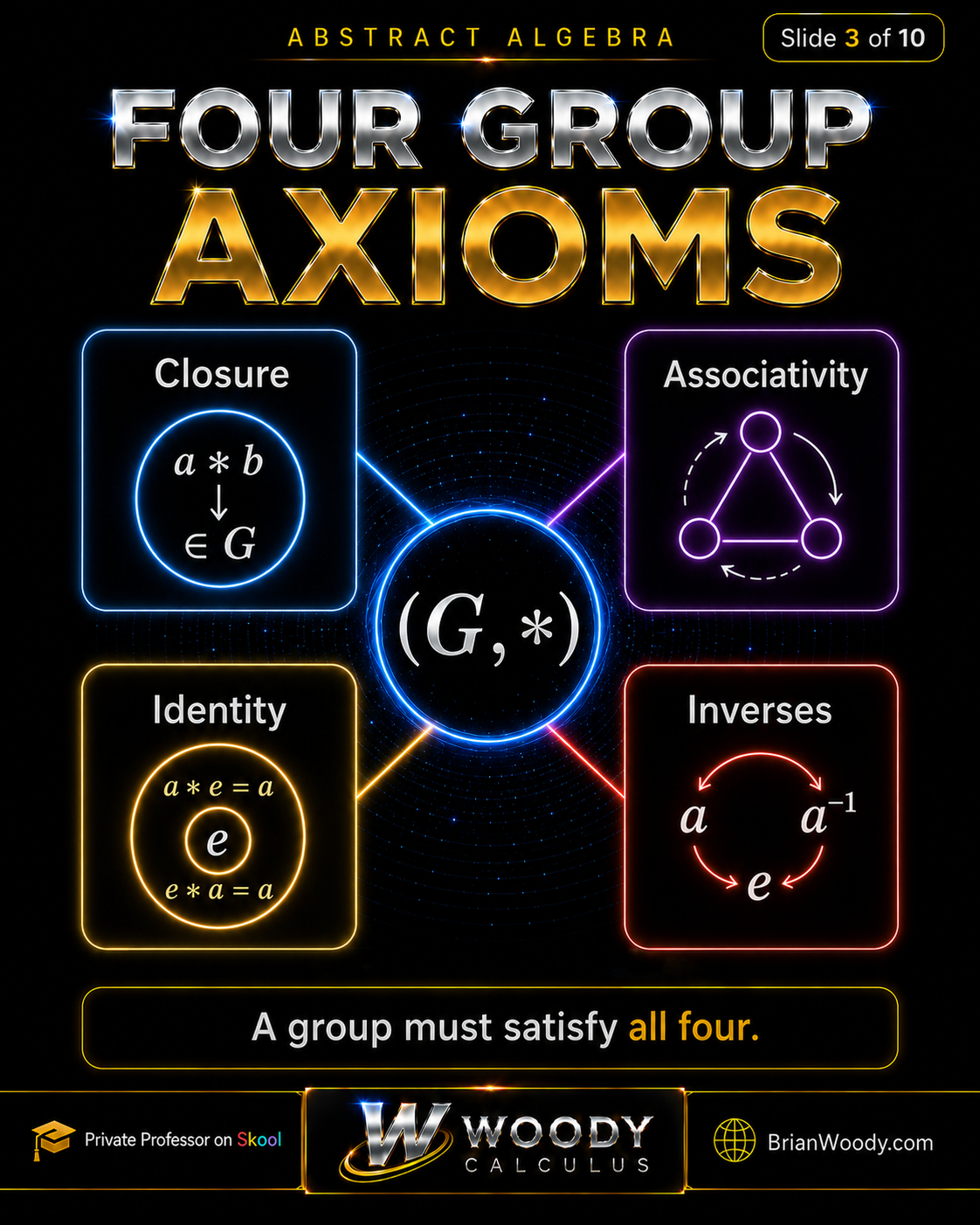
The four group axioms are closure, associativity, the existence of a two-sided identity, and the existence of a two-sided inverse for every element.
1. Closure
a,b\in G\implies a\ast b\in G.
\]
2. Associativity
(a\ast b)\ast c=a\ast(b\ast c).
\]
3. Identity
e\ast a=a\ast e=a.
\]
4. Inverses
a\ast a^{-1}=a^{-1}\ast a=e.
\]
Every statement must hold for the required elements—not merely for one convenient example. One successful calculation can illustrate an axiom, but it does not prove a universal statement.
Examples reveal the pattern. Proof verifies the axiom for every required choice.
What Does Closure Mean?
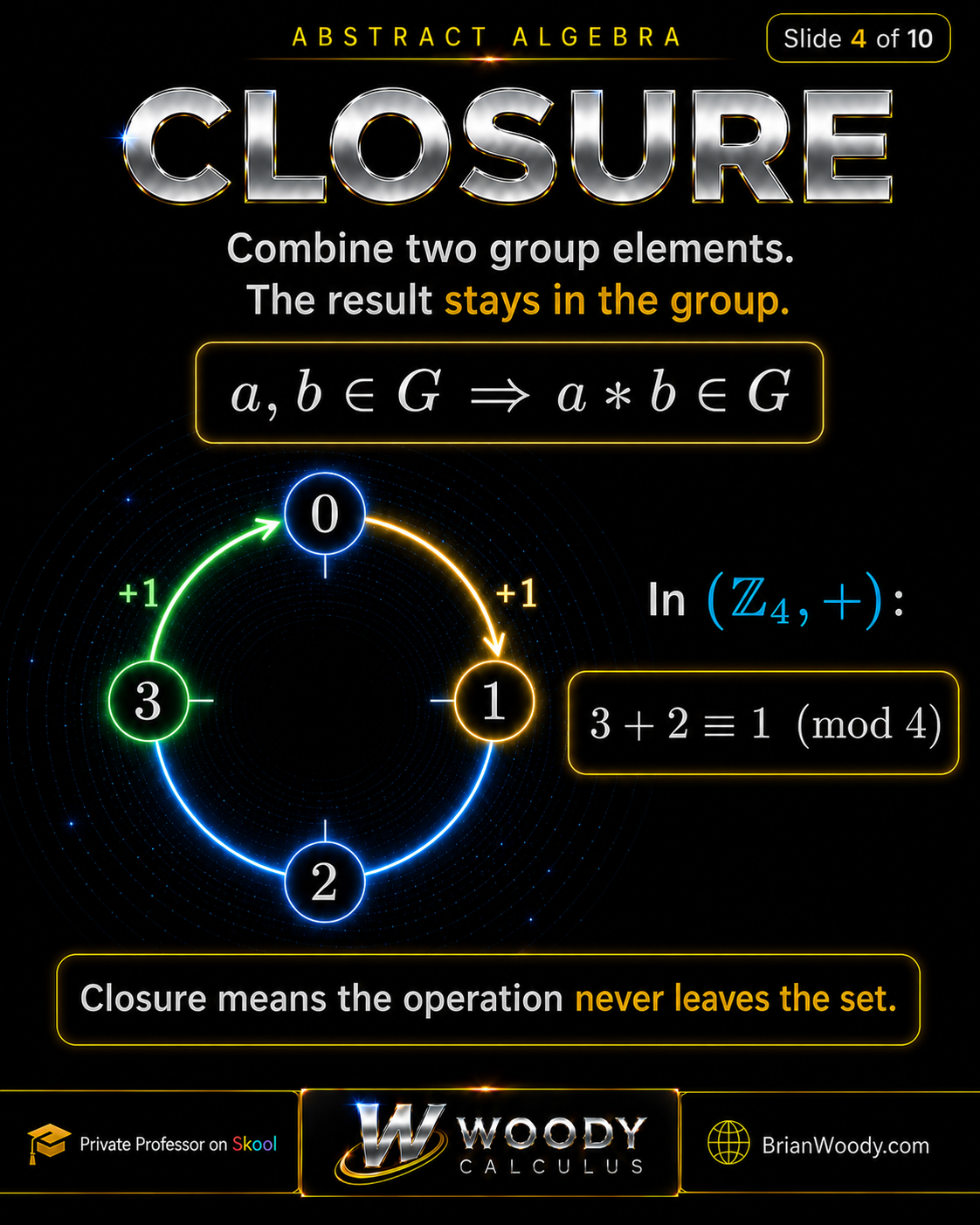
Closure means that combining any two elements of the group never produces an output outside the group.
a,b\in G\implies a\ast b\in G.
\]
In \((\mathbb{Z}_4,+)\), every integer sum has exactly one remainder among \(0,1,2,3\) when divided by \(4\). Therefore, addition modulo \(4\) always returns an element of \(\mathbb{Z}_4\).
What Does Associativity Mean?
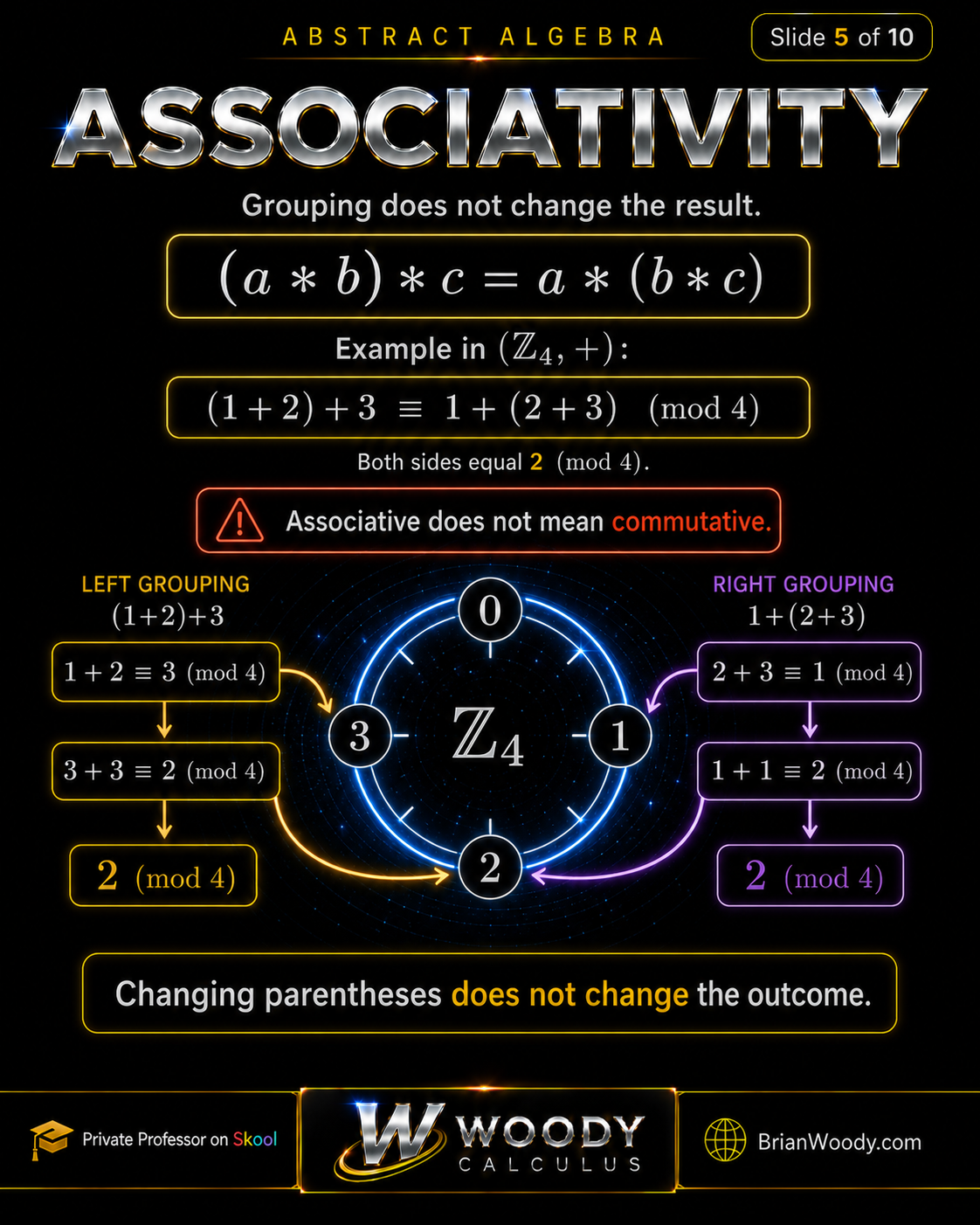
Associativity means that changing the placement of parentheses does not change the result, provided the order of the elements remains fixed.
(a\ast b)\ast c=a\ast(b\ast c).
\]
In \((\mathbb{Z}_4,+)\),
(1+2)+3\equiv1+(2+3)\pmod4.
\]
The left side is
(1+2)+3\equiv3+3\equiv2\pmod4,
\]
and the right side is
1+(2+3)\equiv1+1\equiv2\pmod4.
\]
Why Does Associativity Hold for All Elements of \(\mathbb{Z}_4\)?
Integer addition is associative:
(a+b)+c=a+(b+c).
\]
Passing to residue classes preserves this equality:
([a]+[b])+[c]=[a]+([b]+[c]).
\]
This inheritance from integer addition proves associativity for every triple of residue classes.
What Are the Identity and Inverses?
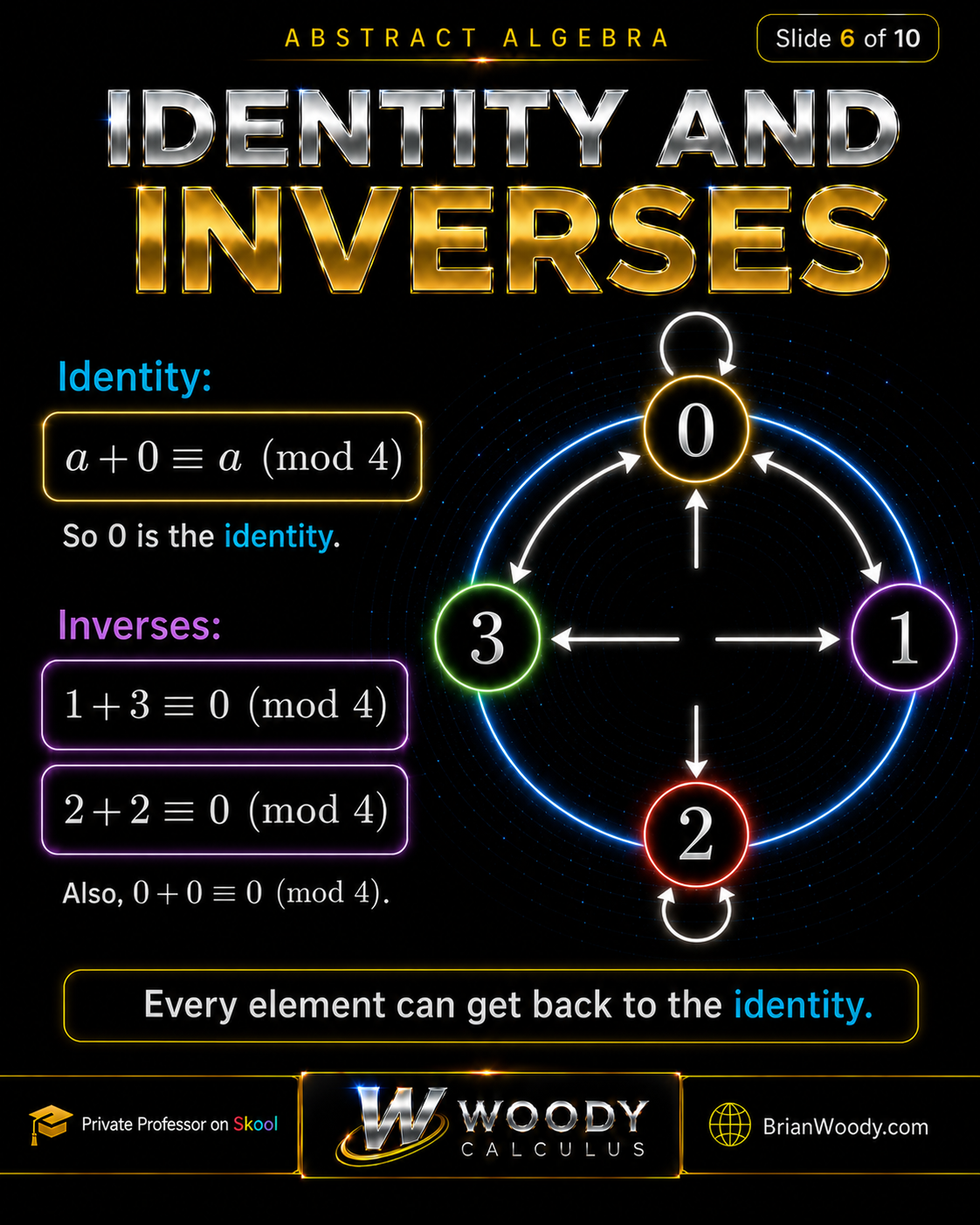
The identity leaves every element unchanged, while an inverse combines with an element to return the identity.
The Identity Element
An identity element \(e\in G\) satisfies
e\ast a=a\ast e=a
\]
for every \(a\in G\). In \((\mathbb{Z}_4,+)\), the identity is \(0\):
a+0\equiv0+a\equiv a\pmod4.
\]
Inverse Elements
For each \(a\in G\), an inverse \(a^{-1}\) must satisfy
a\ast a^{-1}=a^{-1}\ast a=e.
\]
In additive notation, the inverse is often written \(-a\). The inverse relationships in \(\mathbb{Z}_4\) are
-0=0,\qquad -1=3,\qquad -2=2,\qquad -3=1.
\]
Plain-language answer:
The identity means “do nothing,” and the inverse means “undo the move.”
How Do You Read a Cayley Table?
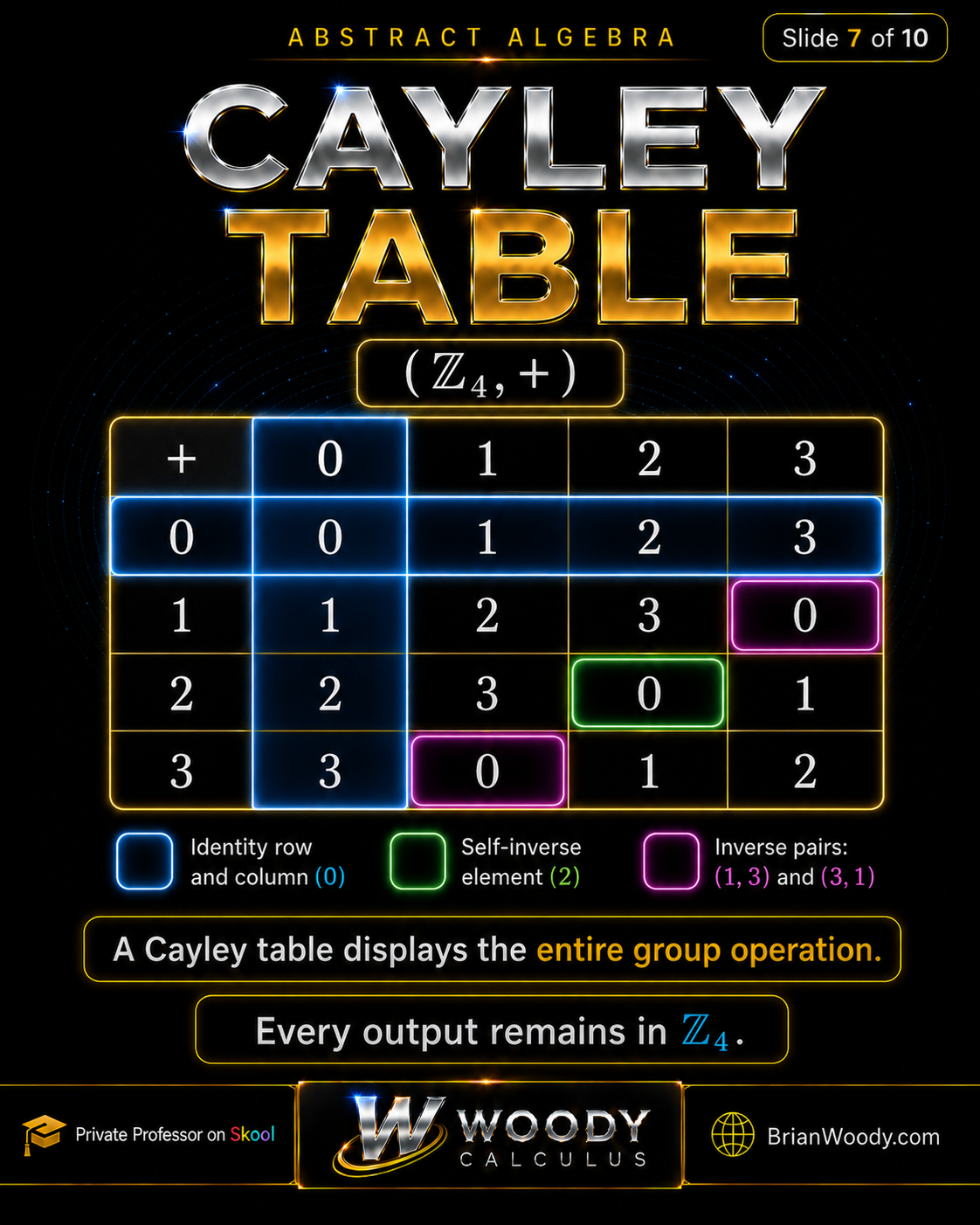
A Cayley table records the output \(a\ast b\) at the intersection of the row labeled \(a\) and the column labeled \(b\).
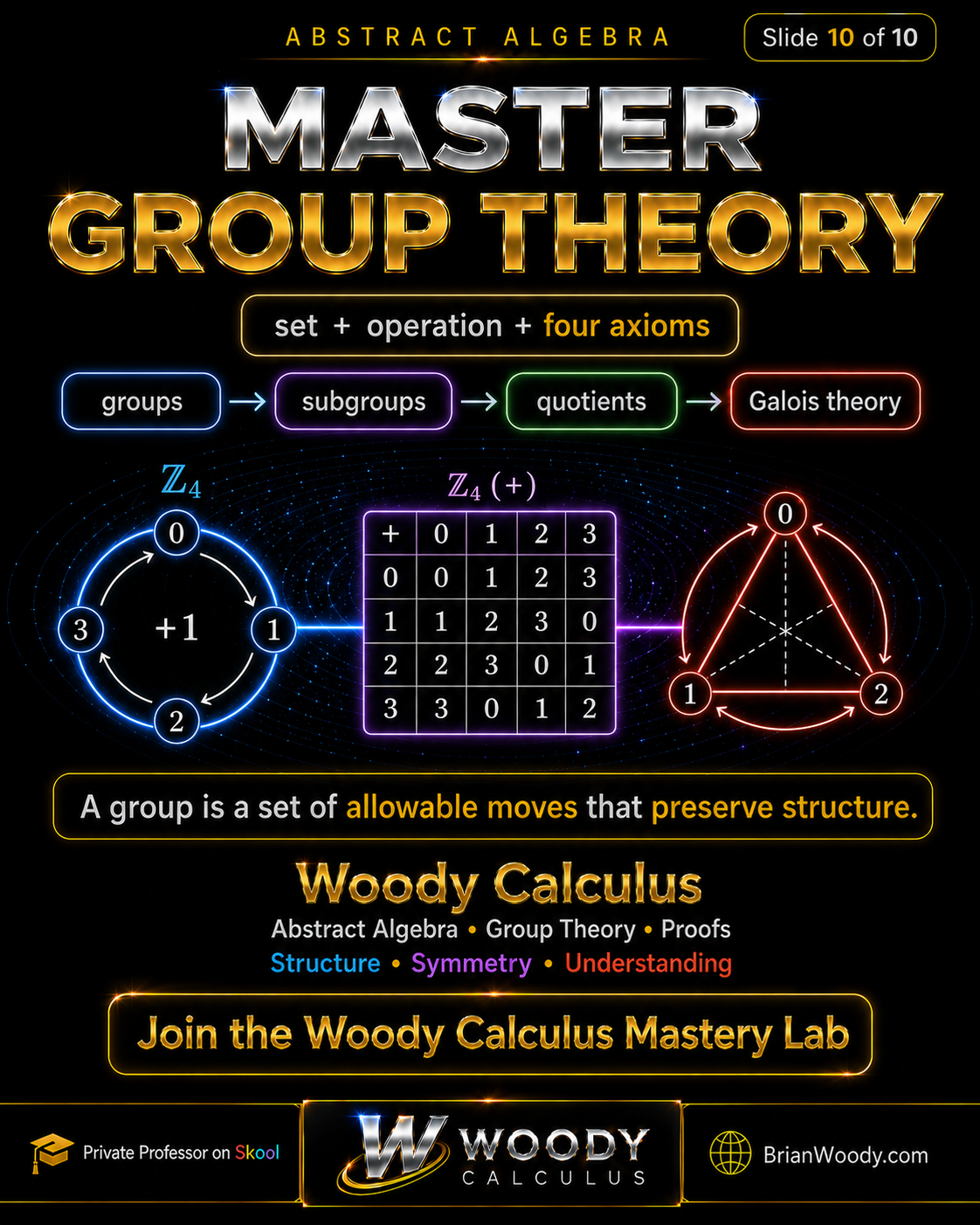
The Cayley table for \((\mathbb{Z}_4,+)\) is:
| \(+\) | 0 | 1 | 2 | 3 |
|---|---|---|---|---|
| 0 | 0 | 1 | 2 | 3 |
| 1 | 1 | 2 | 3 | 0 |
| 2 | 2 | 3 | 0 | 1 |
| 3 | 3 | 0 | 1 | 2 |
What Can You Detect from the Table?
- Closure: every entry belongs to \(\mathbb{Z}_4\).
- Identity: the row and column labeled \(0\) reproduce the headers.
- Inverses: entries equal to \(0\) identify pairs whose sum is the identity.
- Commutativity: the table is symmetric across its main diagonal.
- Latin-square pattern: every element appears exactly once in each row and column.
What Are Group Order, Element Order, and Generators?
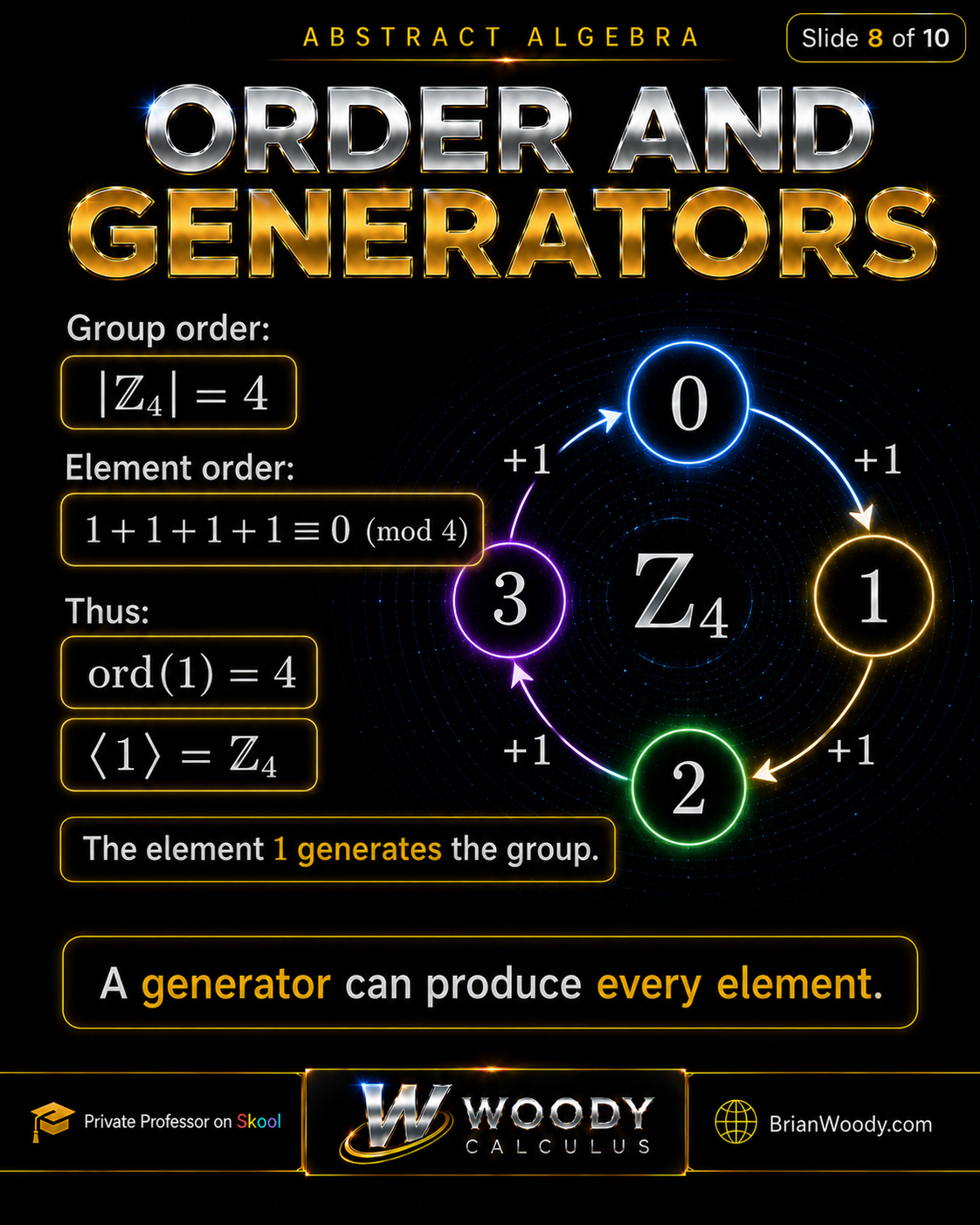
The order of a finite group is its number of elements, while the order of an element is the smallest positive number of repetitions needed to reach the identity.
Order of a Group
|\mathbb{Z}_4|=4.
\]
Order of an Element
In multiplicative notation, the order of \(a\) is the least positive integer \(n\) such that
a^n=e.
\]
In additive notation, this becomes
na=0.
\]
For the element \(1\in\mathbb{Z}_4\),
1+1+1+1\equiv0\pmod4,
\]
and no smaller positive number of copies of \(1\) produces \(0\). Therefore,
\boxed{\operatorname{ord}(1)=4}.
\]
| Element | Repeated sums | Element order | Generated subgroup |
|---|---|---|---|
| 0 | \(0\) | 1 | \(\{0\}\) |
| 1 | \(1,2,3,0\) | 4 | \(\mathbb{Z}_4\) |
| 2 | \(2,0\) | 2 | \(\{0,2\}\) |
| 3 | \(3,2,1,0\) | 4 | \(\mathbb{Z}_4\) |
Thus both \(1\) and \(3\) generate \(\mathbb{Z}_4\). A group generated by one element is called a cyclic group.
Plain-language answer:
Group order counts elements. Element order counts repetitions. A generator reaches every element.
How Do Groups Describe Symmetry?
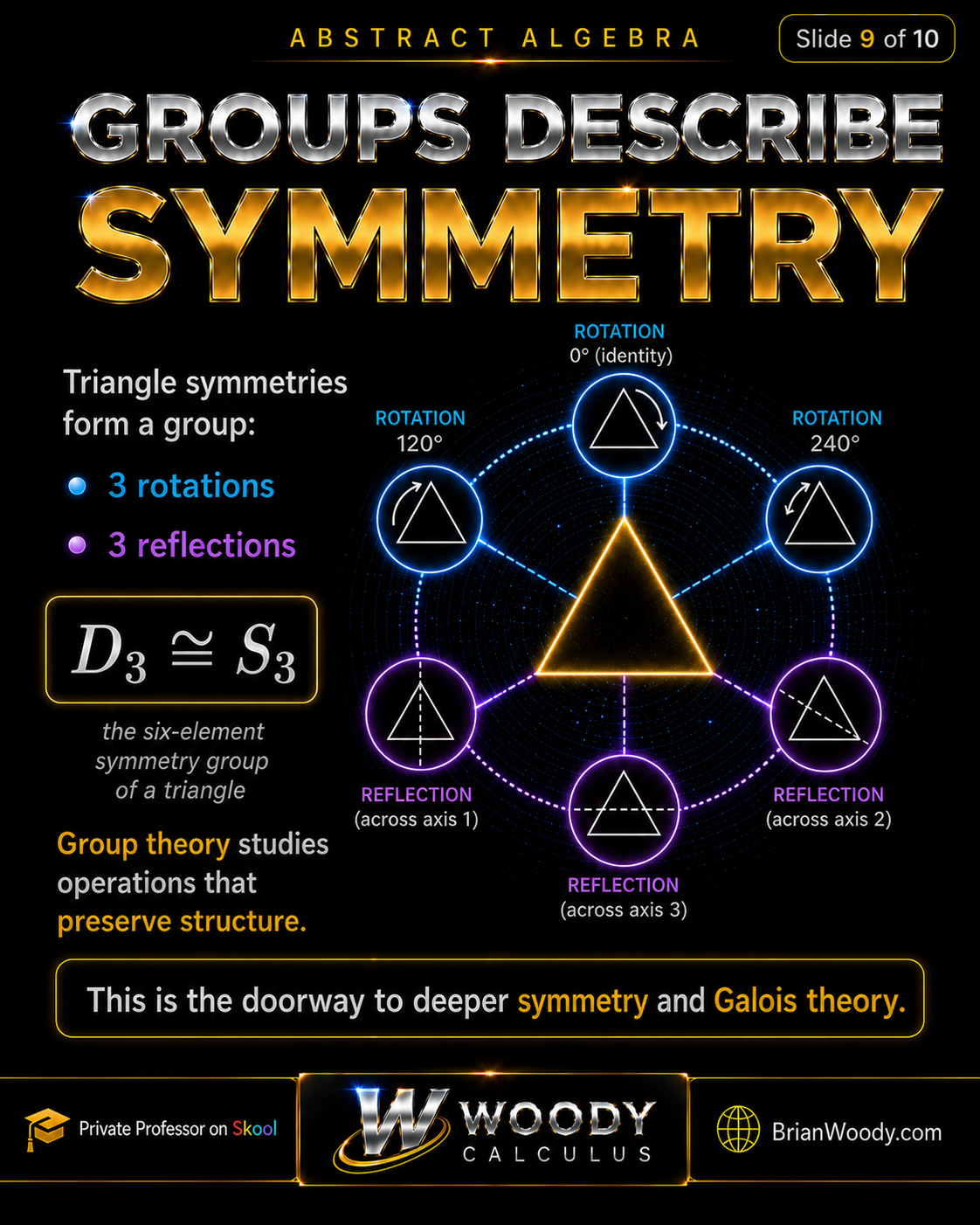
The symmetries of a geometric object form a group when composition is used as the operation.
An equilateral triangle has six rigid symmetries:
- the identity rotation through \(0^\circ\),
- rotations through \(120^\circ\) and \(240^\circ\),
- and three reflections across symmetry axes.
These transformations are closed under composition, composition is associative, the \(0^\circ\) rotation is the identity, and every symmetry can be undone by another symmetry.
Why Is \(D_3\cong S_3\)?
Label the triangle’s three vertices \(1,2,3\). Every geometric symmetry permutes these labels, so each symmetry determines an element of the symmetric group \(S_3\).
The correspondence preserves composition, is one-to-one, and reaches all six permutations. Therefore,
\boxed{D_3\cong S_3}.
\]
Why Is the Triangle Symmetry Group Nonabelian?
A rotation followed by a reflection generally produces a different symmetry from the same reflection followed by the rotation. Therefore, composition is not commutative:
r\circ s\neq s\circ r.
\]
This gives a concrete example of a group that satisfies all four axioms without being abelian.
What Is the Difference Between Abelian and Nonabelian Groups?
An abelian group satisfies \(a\ast b=b\ast a\) for every pair of elements, while a nonabelian group has at least one pair whose order of composition changes the result.
| Feature | \((\mathbb Z_4,+)\) | \(D_3\cong S_3\) |
|---|---|---|
| Operation | Addition modulo \(4\) | Composition of triangle symmetries |
| Group order | 4 | 6 |
| Commutative? | Yes | No |
| Cyclic? | Yes; generated by \(1\) or \(3\) | No |
| Identity | \(0\) | The \(0^\circ\) rotation |
Plain-language answer:
In an abelian group, the order of two moves does not matter. In a nonabelian group, performing the same two moves in the opposite order can produce a different outcome.
How Do You Prove \((\mathbb{Z}_4,+)\) Is a Group?
Verify the operation and all four axioms using statements that hold for every element, not isolated numerical examples.
The word abelian is justified because addition modulo \(4\) is also commutative:
[a]+[b]=[a+b]=[b+a]=[b]+[a].
\]
What Prevents a Set and Operation from Being a Group?
A single failed axiom is enough to prove that a proposed structure is not a group.
| Set and operation | What works | What fails | Conclusion |
|---|---|---|---|
| \((\mathbb{N},+)\), with \(0\in\mathbb{N}\) | Closure, associativity, identity | Positive elements have no additive inverses in \(\mathbb{N}\) | Not a group |
| \((\mathbb{Z},-)\) | Closure | Subtraction is not associative and has no two-sided identity | Not a group |
| Nonzero integers under multiplication | Closure, associativity, identity | Most multiplicative inverses are not integers | Not a group |
| All \(2\times2\) real matrices under multiplication | Closure, associativity, identity | Singular matrices have no multiplicative inverses | Not a group |
| Invertible \(2\times2\) real matrices under multiplication | All four axioms | Nothing fails | A group: \(GL_2(\mathbb{R})\) |
Plain-language answer:
Do not try to force a structure to be a group. Test the axioms and let the first failure decide the question.
What Are the Most Common Group Theory Mistakes?
Mistake 1: Naming a Set Without Naming the Operation
The same set can behave differently under different operations. Write \((G,\ast)\), not merely \(G\), when the operation matters.
Mistake 2: Checking One Example Instead of Proving an Axiom
The calculation \(3+2\equiv1\pmod4\) illustrates closure, but closure requires every pair. If your proof contains only one numerical example, the universal claim is still unproved.
Mistake 3: Confusing Associativity with Commutativity
Associativity changes parentheses; commutativity changes order. If your argument swaps \(a\) and \(b\), you are using commutativity, not associativity.
Mistake 4: Proving Only a One-Sided Identity
In a general operation, \(e\ast a=a\) does not automatically justify \(a\ast e=a\). Verify both sides unless a theorem lets you deduce the other side.
Mistake 5: Forgetting That Every Element Needs an Inverse
Finding inverses for several elements is not enough. One element without an inverse destroys the group structure.
Mistake 6: Using the Wrong Identity
The identity depends on the operation. It is \(0\) for addition and \(1\) for multiplication. For function composition, it is the identity function.
Mistake 7: Treating the Generic Symbol \(\ast\) as Multiplication
The symbol \(\ast\) is a placeholder. Always read the problem’s definition before calculating.
Mistake 8: Assuming Every Group Is Commutative
Many important groups are nonabelian. If your proof changes the order of factors without justification, the argument may fail.
Mistake 9: Confusing Group Order with Element Order
The notation \(|G|\) counts elements in the group. The notation \(\operatorname{ord}(a)\) counts repetitions of one element needed to reach the identity.
Mistake 10: Reading a Cayley Table Backward
Use the declared convention. In this lesson, the row element comes first and the column element comes second. This distinction matters in nonabelian groups.
How Do You Prove a Set and Operation Form a Group?
Use a fixed verification sequence so that the set, operation, quantifiers, identity, and inverses are never left implicit.
- Name the set: Write \(G\) explicitly.
- Name the operation: State exactly how \(a\ast b\) is calculated.
- Check well-definedness: Confirm that the rule does not depend on an arbitrary representation.
- Verify closure: Use arbitrary \(a,b\in G\).
- Verify associativity: Use a known associative operation or prove the equality for arbitrary \(a,b,c\in G\).
- Find the identity: Solve \(e\ast a=a\ast e=a\).
- Find inverses: For arbitrary \(a\), solve \(a\ast x=x\ast a=e\).
- Check commutativity separately: Determine whether \(a\ast b=b\ast a\).
- Calculate structural data: Find group order, element orders, and generators.
- Use a Cayley table when finite: Verify outputs, identity patterns, and inverse positions.
- Search for a counterexample: One failed axiom ends the group test.
- Rewrite the complete proof: Rebuild the argument from a blank page.
- Say the definitions aloud: Set, operation, closure, associativity, identity, inverses.
Formula and definition memorization are required, but the structure tells you which definition to deploy.
Group Theory FAQ
What is a group in abstract algebra?
A group is a set with a binary operation satisfying closure, associativity, the existence of a two-sided identity, and the existence of a two-sided inverse for every element.
What are the four group axioms?
The four standard axioms are closure, associativity, identity, and inverses. Each axiom must hold for every required element of the set.
Is commutativity a group axiom?
No. A group does not need to be commutative. A group whose operation is commutative is called an abelian group.
What is the identity element of Z4 under addition?
The identity is \(0\) because \(a+0\equiv0+a\equiv a\pmod4\) for every element \(a\in\mathbb{Z}_4\).
What are the inverses in Z4 under addition?
The element \(0\) is its own inverse, \(1\) and \(3\) are inverses of each other, and \(2\) is its own inverse.
What is a Cayley table?
A Cayley table is a table that displays the output of a finite binary operation for every ordered pair of elements.
What is the difference between group order and element order?
Group order is the number of elements in a finite group. Element order is the smallest positive number of repetitions of one element needed to reach the identity.
What is a generator of a group?
A generator is an element whose repeated powers, or repeated sums in additive notation, produce every element of the group.
Why is Z4 a cyclic group?
The elements \(1\) and \(3\) each generate all of \(\mathbb{Z}_4\) under repeated addition, so \(\mathbb{Z}_4\) is cyclic.
Why are the symmetries of a triangle a group?
Triangle symmetries are closed under composition, composition is associative, the identity transformation exists, and every symmetry has an inverse.
Why is D3 isomorphic to S3?
Every symmetry of an equilateral triangle permutes its three vertices, and this correspondence is a bijective homomorphism from the six triangle symmetries to the six permutations in \(S_3\).
How do you prove a set and operation are not a group?
Find one axiom that fails and provide a valid counterexample or general argument. A single failed axiom is enough.
What does \(\langle a\rangle\) mean in group theory?
The notation \(\langle a\rangle\) means the subgroup generated by \(a\): all integer powers of \(a\), or all integer multiples of \(a\) when the operation is written additively.
Can a Cayley table prove associativity?
A finite Cayley table can be used to check associativity by comparing \((a\ast b)\ast c\) with \(a\ast(b\ast c)\) for every ordered triple, but symmetry or a Latin-square pattern alone does not prove associativity.
Is \(D_3\) the same group as \(D_6\)?
Depending on the textbook’s convention, the six-element symmetry group of an equilateral triangle may be called \(D_3\) or \(D_6\). Some authors use the subscript for the number of polygon sides, while others use it for the number of group elements.
How Do You Master Group Theory Basics?
Master the definitions first, then practice proving and disproving group structure with the same repeatable checklist.
Private Abstract Algebra Instruction
The
Woody Calculus Mastery Lab
is the required first step for students seeking structured help with group axioms, homomorphisms, subgroups, quotient groups, rings, fields, field extensions, and proof-based exam preparation.
Limited
private instruction
is selective, normally requires weekly sessions, requires active Mastery Lab enrollment first, and is not guaranteed. Students and parents may use the
Woody Calculus contact page
to ask about the appropriate starting point.
University Abstract Algebra and Advanced Mathematics Help
Woody Calculus provides professor-led online support for students taking abstract algebra, proof-based mathematics, linear algebra, number theory, and related university courses.
Visit the
university mathematics help hub
to explore additional university pages.
Woody Calculus Reviews
★★★★★
Read
Woody Calculus 5-star Google reviews
and view
Brian M. Woody’s 5.0 RateMyProfessors rating.
Students ready to build a stronger proof system can begin with the
Woody Calculus Mastery Lab on Skool.